11 Rapes a Day, 6 Gang-Rapes a Week—And Shivraj Still Sleeps Soundly

[dropcap]M[/dropcap]adhya Pradesh Chief Minister Shivraj Singh Chouhan suffers from chronic verborrhea. He shoots off jumlas with greater rapidity than in even Narendra Modi. If the rape of a child is highlighted in the media, he takes no time in announcing that child rapists will be given death sentence and his government will bring in the next session of the Assembly the bill to amend the relevant section of the Indian Penal Code (IPC). If a rape is highlighted in the media, he promises death sentence for the rapist by amending the law. If a gang-rape is highlighted in the media, he shouts with full force the death sentence for all the rapists by amending the law in the next session of the Assembly. At present the IPC stipulates from seven years’ rigorous imprisonment to life term for rape, depending on the circumstances.

One thing, he has never moved to introduce a bill to amend the IPC. Secondly, his jumlas come out only when the crime is highlighted in the media. Scores of incidents of molestation and rape take place regularly in Madhya Pradesh outside the big cities and away from the media glare but Chouhan was never heard saying that he could not sleep because of that incident or that he will ensure that the rapist will be awarded the death sentence. Madhya Pradesh, incidentally records the highest molestation/rape incidents in the country.

The State Assembly was told earlier this year that on an average, 11 women were raped every day and six women were gang-raped every week in the State during 2016, over half of the victims being minor. Between February 2016 and mid-February 2017, as many as 4279 women were raped and 248 were gang-raped in the State. Of the 4279 rape victims, 2260 were minors. According to the National Crime Records Bureau (NCRB), the State had 5076 such cases in 2014 and 4391 cases in 2015.

The short-lived BJP government of Uma Bharti had addressed itself to the problem of humiliation of women in public and moved a bill in the Assembly to provide harsher punishment to the offenders. She, though, could not see it through. Babulal Gaur had replaced her as the chief minister by the time the bill was passed. It became part of the statute book in December 2004.

The bill added Subsection-A to Section 354 of the Indian Penal Code (use of criminal force to outrage the modesty of woman) and provided that the offender ‘shall be punished with imprisonment of either description for a term which shall not be less than one year but which may extend to ten years and shall also be liable to fine.’ The main Section provides for a maximum punishment of up to two years. Besides, the Madhya Pradesh amendment also provides for the same punishment to whoever abets or conspires in the act, which is not there in the main Section.

Difficult to say how the amended Section would have been enforced had Uma Bharti remained at the helm of affairs. Her successors (Babulal Gaur and then Shivraj Singh Chouhan), however, did not show any interest in this. The amended law was consigned to the archives once the gazette notification was made. Today most of those concerned – the politicians, the police officers and, of course, those for whose benefit the Act was amended — are not even aware that such a law exists.

Crime, particularly the crimes against women, has been steadily going up in Madhya Pradesh for quite some time. It was during the BJP government of Sunderlal Patwa that Madhya Pradesh recorded the highest number of heinous crimes including murder, rape and dacoity. The trend continued almost unabated during the ten-year Congress regime of Digvijaya Singh. Bad law and order, with emphasis on crimes against women, formed part of Uma Bharti’s vigorous campaign for the November 2003 Assembly elections, along with what was then described as BSP (bijli, sadak, pani). Being a woman, she had shown particular sensitivity towards the plight of women. Under her leadership, the BJP captured power with an overwhelming majority.

It would be interesting to note that Chouhan, when he replaced Babulal Gaur as Chief Minister in November 2005, believed there was no rule of law in the State. This he put as his top priority. The Governor’s customary address to the Assembly at the beginning of Chouhan’s first budget session had specifically stated: ‘Meri Sarkar ki prathamikata kanoon ka raaj sthapit karana hai’ (the priority of my government is to establish the rule of law). The Governor’s address is always approved by the cabinet. Unfortunately, the law and order in the State has since been steadily deteriorating.

A major reason for this state of affairs is the total personalisation, not politicisation but personalisation, of the police force (once described by Madhya Pradesh High Court judge as ‘criminals in uniform’). Secondly, there are too many IPS officers and an acute shortage of the lower staff who do the field work. To top it all, there is the pathetic insensitivity of the police almost at every level.

Will Dineshwar Sharma have a free hand in Kashmir?

0

An observation of former Intelligence Bureau (IB) chief Dineshwar Sharma spotlights the contrary pulls in the Modi government on Kashmir problem. In an interview to The Hindu, he said that the ‘fear of guns has to go. There can be no solution under the shadow of the gun’.

Sharma was appointed on October 23 as a Special Representative by the Modi government to start a dialogue with the people of Jammu and Kashmir in a bid to find a solution to the persisting problem. The announcement was made by Home Minister Rajnath Singh in pursuant to Prime Minister Narendra Modi’s Independence Day speech in which he had specifically pointed out that the Kashmir problem could not be resolved either by bullets or by abuses and that a solution could be found only by embracing them (Kashmiris). Modi’s observation was welcomed by all parties in the Valley including the moderate Hurriyat Conference.

However, two days after Rajnath Singh announced Sharma’s appointment as a Special Representative, Chief of Army Staff Bipin Rawat announced that the Army’s operations in Kashmir would continue ‘unabated’ in spite of the government’s attempt to have a dialogue with the stakeholders of the strife-torn State. Gen Rawat also said that the appointment of former IB chief would have no impact on the Army’s activities in the Valley.

This was contrary to the Prime Minister’s promise of no bullets or abuses but embracing. Now the Modi government’s Special Representatives has specifically pointed out that the fear of guns has to go as there can be no solution under the shadow of the gun. Sharma may be the government’s emissary for exploring the ways to restore peace in the Valley but Gen Rawat’s threat cannot be just brushed aside as he is supposed to enjoy full confidence of Modi. It was not the first time that he had issued a statement with political overtones; even earlier he had been issuing similar hawkish statements supposedly with the approval of Modi, or at least unchecked by him. No other Army Chief had in the past addressed press conferences and issued statements on issues which should be addressed by the political leadership. Once even a neighbouring country was constrained to ask if the Army Chief was expressing the views of the government.

A significant hint Sharma dropped in his The Hindu interview is that the present Kashmir problem started after Narendra Modi became Prime Minister. He said,  “When I became the IB chief in December 2014, Kashmir was not the problem…. Kashmir became a problem during the latter part of my tenure. Though there were problems initially, we did not expect the kind of unrest that happened in 2016.”

BJP, and Narendra Modi as its leader, always viewed the Kashmiris with a suspicion and always believed that only the bullets can bring them to their senses. Ruthless suppression of trouble-makers was what was reportedly recommended by National Security Advisor Ajit Doval. This apparently boomeranged and the situation in Kashmir at one point appeared to have gone beyond control. Sharma’s candidly expressed views on the Kashmir problem give a hope that he may try to win the trust of the people of the valley in order to find a lasting solution to the problem. But will the BJP’s 65-year-old prejudices and Modi’s apparent support to army’s not so discreet operations allow him to complete his mission?

Farmer’s ‘half-buried’ protest: A month on, but Vasundhara Raje yet to listen

0

Jaipur/Kolkata : Situated at the outskirt of Jaipur, Nindar village has become the hub of an ongoing movement. Around 1350 farmers and their family members including children and women have been staging a half-buried protest (Zameen Satyagrah) against JDA for forcibly acquiring their land, since October 2, 2017.

The farmers celebrated all their festivals from the site, have buried in pits. But, Rajasthan Chief Minister Vasundhara Raje is yet to lend them her ears to hear out their grievances.

In last few days, their agitation has intensified too. Village youths took out a motorcycle rally and while women blocked the National Highway for half and hour with burning torches in hand and anti JDA slogans on their lips. For a housing project, JDA has acquired 320 hectares of land in Nindar village, which farmers claim that it has been acquired forcibly and without their consent and compensating well.

Ironically, even after heart wrenching protest and for such a long period of time, no MLA raised the issue inside in the just concluded assembly session. Only Congress leaders Sachin Pilot and CP Joshi paid visit to the protesters.

Nagendra Singh Shekhawat, the farmer, who is leading the agitation told eNewsroom over phone, “Our demand from government is to do survey again. But, administrative officials who met us so far, while saying that they will do the survey, they want to start the work at the site, simaltinously.”

“How it is possible?”, the farmer leader questioned.

Please watch the video below.

[embedyt] https://www.youtube.com/watch?v=iSLZdUP8LII[/embedyt]

Prescribed: Taekwondo, for Bengal doctors

0

Kolkata: The first batch of Bengal Government’s pilot project—to train medicos the martial arts now has 100 participants including medical students, young doctors and nurses enrolled at Kolkata’s Neel Ratan Sircar (NRS) Hospital. These young aspiring doctors have been sweating it out in between their medical training, to master Taekwondo. The batch is almost ready and now some other medical institutes have been approaching NRS Hospital, to help them train their faculties and students.

Because of the scuffles between patient party and doctors in some of Kolkata’s premium medical institutes, which made it to the headlines, earlier this year had forced the government to take a call on having doctors trained in martial arts. The grievances between doctors and patient had escalated to such an extent that Chief Minister Mamata Banerjee had to intervene.

From medicine to martial arts

Following, which the Bengal Government decided to train medical students in this 2,000-year-old martial art. This martial arts training was introduced as an extra-curricular activity, which was open not just only for medical students but also for young doctors of the state run hospitals.

Speaking to eNewsroom, Dr Dwaipayan Biswas, deputy superintendent of NRS,who himself is a Taekwondo black belt holder, said, “Being a Taekwondo black belt holder, I know the benefits of this martial art form. Concentration power, self-confidence, communication skill are highly intensified. It is a sport that increases mental agility and is an excellent method of de-stressing. It would help to improve the doctor patient relationship in a big way.” He claims that Taekwondo has helped him evolve, personally.

The NRS pilot project is Dr Biswas’s brain child. And has been shaping up well and its training model is all set to be replicated in other 13 state-run-medical colleges of Bengal.

More than self defence

So, is this training being imparted to help doctor deal situations when they are attacked by relatives of patients? Well, most undergoing this training claim that its not just to teach them self defence but help them ease their stress and improve communication skills.

Being agile, fit, de-stressed and a well grounded person are the essentials that a doctor needs to have. West Bengal Director of Medical Education (DME) Dr Debashis Bhattacharya said,

“Discussions are on to have such training workshops in other medical colleges like RG Kar Hospital and Calcutta National Medical College, as they have expressed an interest. However, we are yet to draft a formal notification, announcing the execution of such training in other medical colleges.”

According to state health department sources, NRS hospital deputy superintendent Dr (Major) Biswas, who himself is also a taekwondo black belt, would be appointed as a nodal officer.

Master Pradipta Kumar Roy, a regular member of Kukkiwon World Taekwondo Leaders Forum who has been giving training to the junior doctors at NRS hospital, said that it was a very positive development.

“I appreciate this initiative. West Bengal is the first state in the country to lead this educational movement on motivation and stress management through taekwondo. Many reputable universities and educational institutions have taekwondo as part of their curriculum. As a taekwondo player and instructor, it is my duty to build up moral character and mental strength among people,” said Roy.

Martial Arts Trained Doctors Bengal
Medical students attending martial arts training session

Doctor’s take

Well, isn’t training doctors in martial arts, a short cut? Wouldn’t bettering infrastructure, tightening loopholes that lead to medical lapses at times be a better way? On condition of anonymity, a senior nephrologist, said, “That would be the ideal solution. But then in life, nothing is ideal. Look as this training as workshop that will prove to stress busters for doctors, who have to spend so many hours in the chamber and operation theatres. Its not the perfect solution, but still, it will help in the long run.”

Reacting to the same, Dr Shivshankar Chatterjee of NRS, said, “I can only say that introduction of Taekwondo into the curriculum, will help in the overall development of the medical students.”
While many hinted at AIIMS move of also introducing a similar curriculum in martial art in their New Delhi campus.

And what more? The students are loving it. “It is an excellent way to raise our physical fitness along with our concentration level. We look forward to those two days in a week when we attend the class,” said Mohammad Rizwan Uzzamam, a final year medical student of NRS.

What Xi wants, for himself and for China?

0

Kolkata: During his three-and-half-hour long speech at the just concluded 19th party Congress meeting in Beijing, the President of People’s Republic of China (PRC) Xi Jinping has dropped hints that after his second term, he can stay there for third consecutive times! It seems a reality, as there was no heir apparent of President Xi when the week long session concluded.

But, it is not just Presidentship that the President of the most populous nation on earth wants. In his speech, Xi Jinping made it clear to fellow partymen that he wants his country to be the world’s leader by 2050. The key highlight of his speech was, “It’s time for our nation to transform itself into a mighty force that could lead the entire world on political, economic, military and environmental issues”.

Xi, during the meet urged his party men not only to safeguard China’s sovereignty but also to revitalise Chinese culture, oppose “erroneous” ideology and promote religion that is “Chinese in orientation”.

The second sentence is important to China and Chinese citizen and has no global significance. However, it’s the first sentence that we need to understand, as it will have a global impact.

Xi has put a roadmap before the Chinese Communist Party, according to which, China will be replacing United States by 2050 and emerge as a ‘Super Power’. He also termed his second term as the beginning of ‘New Era’ for China and Chinese people.  As the session started, the first term of Xi as President of China completed and it began his second and important term, which he termed as ‘New Era.’

Addressing a huge gathering, and said, “The Chinese nation … has stood up, grown rich, and become strong — and it now embraces the brilliant prospects of rejuvenation … It will be an era that sees China moving closer to centre stage and making greater contributions to mankind.”

Let’s begin with environment

Xi wants China to become a beautiful country and less polluted. However, some of its megacities like Beijing and Shanghai are highly polluted.

According to a 2007 World Health Organization (WHO) it was estimated that diseases triggered by indoor and outdoor air pollutants kill 656,000 Chinese citizens each year, while consuming unsafe drinking water kills another 95,600. In 2007, the air quality of China had been termed as the deadliest in the world, and India stood second to China.

However, according to 2017 Lancet report, India is on first position and China come down to second.

Hi-speed trains help combat pollution

The expansion of high-speed train and metro rail network as public transportation system has helped significantly in reducing pollution. In China, now, there is no bike which runs on fossil fuels like petrol. Most are electric bikes.

Despite, being the world’s most populous country, China is astonishing clean. The government has shown strong will to deal with pollution by shutting down factories that don’t meet the environmental norms.

For almost two decades, China had the level of being world’s manufacturing hub, but in the year 2015, Xi’s government understanding that it had reached a saturation point made them shift focus to service industry.

Major Shift

While shifting gears from manufacturing to service industry, China ended its much talked about single child policy. In doing so, it not only took care of providing an alternative to its aging population but also hopes of augmenting its military force with addition of young blood.

Xi’s roadmap includes building a world class military, and thus it made complete sense for China moving on to two-child policy. But, building military or preparing a standing army cost hugely to country’s exchequer and for that, Xi’s government will need a flourishing economy.

By allowing two children, government had also made a major change in their belief, of creating a market inside China itself, where a Chinese will be a consumer of its goods.

Message to Trump

Xi knows that all these dreams can be shaped into reality only when there is a stable government. During three and half hour speech, he sent a strong message to US President Donald Trump that unlike his unstable situation, if he (Xi) wishes, he can get a third term as well.

In fact, in last two years, Xi took several steps including abolishing single child policy, holding major strength show off on the 70th anniversary of China-Japan war, and shifting the economy towards service industry from manufacturing, acting tough against the corrupt officials from top to bottom, all helped China bringing closer to being a superpower.

Recently, Bloomberg, a media outlet which cover financial news, carried an opinion that, as far as economy is concerned, China is already at the same place as US and is only behind in terms of military power, which they can achieve in near future.

Xi, however, is aware about the challenges, so he told the party men, “The great rejuvenation of the Chinese nation is no walk in the park or mere drum-beating and gong-clanging. The whole party must be prepared to make ever more difficult and harder efforts.”

“To achieve great dreams there must be a great struggle,” the president of China had concluded.

Challenges before China

China has its own share of challenges that it needs to overcome in order to become a superpower.  Some of the most pressing issues that Xi needs to tackle is the slowing growth and its economy. China has been able keep its GDP above 6.5 so far, but it may slow down, sometime soon. How Beijing deals with Hong Kong and Taiwan issues, to keep them together. And how China’s Belt and Road initiative turns out in the future, is definitely going to redefine China’s relation with many neighbouring countries.


Niti Aayog: a monument to Modi’s ignorance

0

[dropcap]O[/dropcap]ne of the major decisions taken by Narendra Modi soon after becoming the Head of Government in May 2014 was to replace Yojana Aayog with Niti Aayog. It reflected not only Modi’s lack of understanding of governance but his ignorance of Hindi language also. Niti in Hindi means policy. Taking policy decisions is the responsibility of the constitutionally formed government which works through its Council of Ministers. This responsibility cannot be entrusted to a non-statutory body which is more like a club of a few hand-picked economists.

Yojana Aayog, on the other hand, was meant to work like a limb of the government. Yojana means planning. Yojana Aayog or Planning Commission had the responsibility to plan out for proper implementation the policy decisions taken by the government. When the government, for instance, took the policy decision to create irrigation facilities in the country, the Planning Commission would work like a task force assessing the needs and resources of each State and how best to implement the policy decision of the government.

Set up in 1950, the Planning Commission was entrusted with the following tasks: make an assessment of the material, capital and human resources of the country, including technical personnel, and investigate the possibilities of augmenting such of these resources as are found to be deficient in relation to the nation’s requirement; formulate a plan for the most effective and balanced utilisation of country’s resources; on a determination of priorities, define the stages on which the Plan should be carried out and propose the allocation of resources for the due completion of each stage; and indicate the factors which are tending to retard economic development and determine the conditions which, in view of the current social and political situation, should be established for the successful execution of the Plan.

The guidelines further said: determine the nature of the machinery which will be necessary for securing the successful implementation of each stage of the Plan in all its aspects; appraise from time to time the progress achieved in the execution of each stage of the Plan and recommend the adjustments of policy and measures that such appraisal may show to be necessary; and make such interim or ancillary recommendations as appear to it to be appropriate either for facilitation the discharge of the duties assigned to it, or on a consideration of prevailing economic conditions, current policies, measures and development programmes or on an examination of such specific problems as may be referred to it for advice by the Central or State Governments.

The first Five-Year Plan was launched in 1951 and two subsequent Five-Year-Plan were formulated till 1965 when there was a break because of the India-Pakistan war. After three Annual Plans between 1966 and 1969, the fourth Five-Year Plan was started in 1969. The emphasis, initially, was on a growing public sector with massive investments in basic and heavy industries which provided the country a sound economic foundation.

Started on January 1, 2015, Niti Aayog has no concrete goals before it. Its pronounced objectives are mired in a jumble of high-sounding words and phrases. For instance, it ‘aims to build strong States that will come together to build a strong India’. It does not say how? Nor is there visible on the ground what steps it had taken towards that goal in the two and a half years. In fact, Niti Aayog describes itself ‘Think Tank’ of Government of India to provide ‘both directional and policy inputs’. It further defines its role as ‘designing strategic and long term policies and programmes for the Government of India’. Designing policies, whether short-term or long-term is clearly the prerogative of the Government, and not of non-statutory body.

Journalists, lawyers hit street against Rajasthan ordinance

0

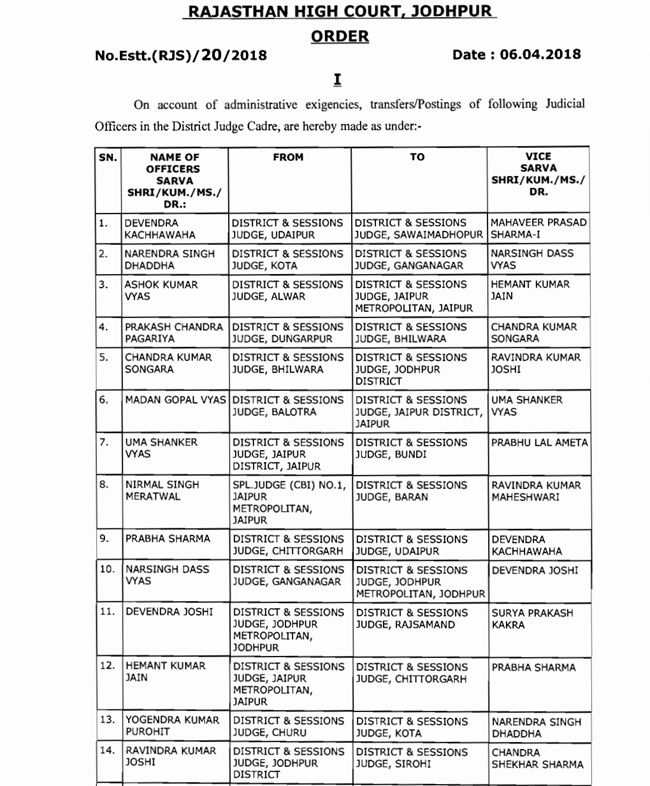
Jaipur: The proposed bill, which seeks to amend the Criminal Penal Code (CrPC) in a bid to shield judges and bureaucrats, has invited sharp criticism from all quarters, ever since it was tabled in Rajasthan assembly by Vasundhara Raje’s  government on Monday.

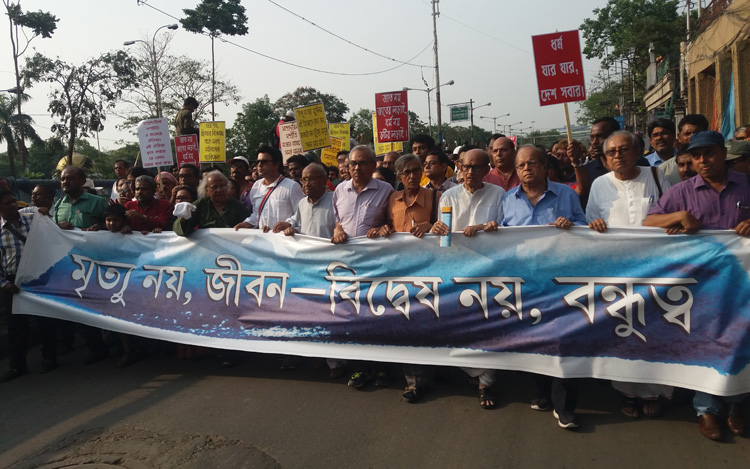
Huge protests against the controversial ordinance was witnessed with people, oppositions, media and lawyers hitting on the streets of the state capital, to voice their discontent.  On Monday, leaders of Congress party, led by its state president Sachin Pilot had protested against the ordinance with black batches on face and shoulders. They described the proposed amendment as Black Law. Congress leaders who had marched towards assembly, had been detained by the police.

Rajasthan ordinance

The protest further, on Tuesday, a large number of journalists and lawyers were seen hitting on the streets of Jaipur. This time, too, journalists were detained by the police. However, Rajasthan journalists got supports from across India as The Indian Women Press Corps, Press Club of India, Press Association, And Federation of Press Clubs in India expressed their solidarity and demanded from Raje to withdraw the ordinance. If the amendments get passed by the assembly, it will become impossible to lodge an FIR against government officials and judges without a getting a go from the government.

The amendment also bars the media of reporting against a corrupt official, without having an FIRs lodged against the official. Flouting rules will lead to a two-year imprisonment of the offender. Seeing the rising anger of several sections of people, Raje government has sent the ordinance to Select Committee to review it. But, journalists and activists have demanded that the ordinance should be withdraw immediately as it is against the Article 4 of the constitution.

“We want the ordinance to be repeal now,” said Kavita Srivastava, of PUCL.

Watch all the three major protests’ main pictures clicked by our photojournalist Chandra Mohan Aloria’.

Even BJP’s Swamy is against Vasundhara giving immunity to babus

0

Jaipur/Kolkata: Vasundhara Raje led Bhartiya Janata Party (BJP) government has been at the receiving end ever since she has issued an ordinance which makes it impossible for people to lodge FIRs against judges and bureaucrats, without seeking permission from the government. The ordinance, also bars media from covering such complaints till then it get cleared by the government. The ordinance is being sharply criticized by journalists, media organizations, activists and opposition parties.

However, amid all crying foul, criticism came from unexpected quarter– from lawyer cum politician Subramanian Swamy, the BJP leader, tweeted on Sunday, stating that the ordinance tabled by Raje is against Article 4 of the Indian Constitution, and that P Chidambaram had tried to bring such ordinance in favour of bankers, but Supreme Court had struck down the step on his plea.

The Article 4 of the Indian Constitution stresses on Right to Equality. Equality, before law.

The senior BJP leader tweeted: The draft Rajasthan law to dilute PCA etc for bureaucrats violates the SC’s 2015 Constitutional Bench judgment in Subramanian Swamy vs CBI.

The leader got more than 2600 likes and over 1100 retweets for this particular tweet.

Earlier, The Editors Guild of India, had issued a communiqué opposing Raje’s attempt to gag media and said that it will stop journalist in doing public interest stories.

Partika Group Chairman, Gulab Kothari has also vehementaly criticized the step and wrote a front page editorial on it.

The President of Press Club, Jaipur LL Sharma has called upon journalists to stand up against the draconian law. “Think again before having such a draconian law implemented. This law aims at suppressing freedom of press. It will not be tolerated,” he warned Raje.

Organizations working for Human Rights, Public Union for Civil Liberties, PUCL has also condemned the government’s decision to shield judges and babus by putting a gag on media.

Congress’ state president Sachin Pilot made it a point to mention before the journalists that this was an attempt by Vasundhara Raje to protect her corrupt officials.

However, some senior journalist based at Jaipur, questioned the opposition parties for their lack of knowledge on this law being in the anvil. Narayan Bareth said, “It is not surprising that the opposition came to know about the ordinance only after some media organization reported about it. This ordinance was tabled on September 7 itself. This happens when opposition parties follow calendars to assess when they are coming into power.”

Second hunger death in a month, and cover ups by Jharkhand officials

Dhanbad/Ranchi: It’s not even a month, since Santoshi Kumari, an 11-year-old girl died of hunger in Simdega, and news of a rickshaw puller dying due to hunger in Dhandbad’s Sindri area is now making to the headlines.

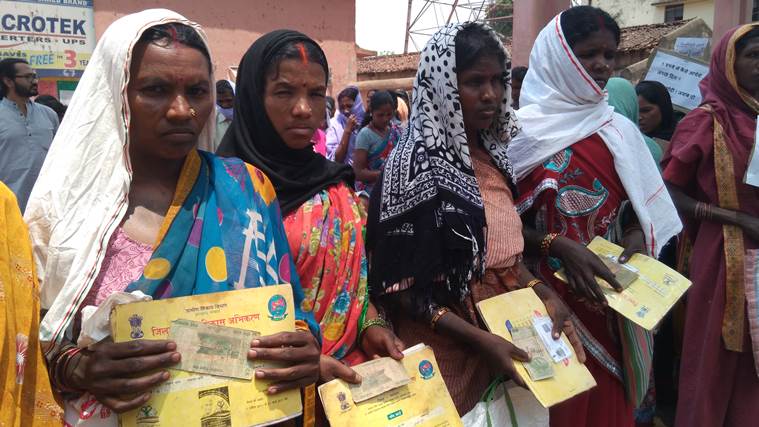
Baijnath Ravidas, a quinquagenarian, had no ration in his house, when he died, claimed locals as well as ward councillor Sailendra Singh. Many claimed that he was unable to get ration as he had yet to have his ration card issued. Earlier his name was included in his elder brother Jago Ravidas’ card.

“In Dhanbad district, one can’t have these cards issued without a middleman. They rule here. He had applied for a ration card, which is yet to be issued. He was a poor man, but he neither had his Below Poverty Line (BPL) or ration card,” said the ward councillor.

Hunger Death

Baijnath had two sons, of whom, one lives separately, while the other get jobs on casually, not regular.

Like the Simdega case, where Santoshi died while asking for boiled rice (bhaat), as claimed by her mother the administration conveniently claimed it to be a malaria death, here too, Dhanbad district administration, is claiming that the Hunger death is due to prolonged illness and not hunger. As soon as the local channels began relaying the news of Baijnath’s death, the administration issued a communiqué claiming that he had applied for a ration card, only four days back and was about to have it issued soon.

Deputy Commissioner A Dodde, while ruled out the news of Baijnath’s household not having any ration, by stating that his wife worked as a domestic help. However, he accepted the fact that one lakh ration cards have been deleted since NFSA (National Food Security Act) has been implemented.

Significantly, it is not only in Baijnath but also in Santoshi’s case, that many observed the government opting for a cover-up. JMM MLA, Polus Surin has alleged that a team sent by Union Food Supply and Consumer Minister Ram Vilash Paswan to inquire into the death of Santoshi had been sent back from Ranchi itself. They were not allowed to reach Simdega.

He has also claimed that the report sent by Simdega deputy commissioner claiming that the minor girl had died due malaria is completely false. He had further added that the girl’s mother is being harassed for bringing forth the truth. He has even set off an alarm, stating that that if anything happens to the mother, then. The district administration should b held responsible. Surin also claimed that JMM would be raising the issue inside state assembly and upper and lower houses of the Parliament.

Congress helps Shivraj appoint new Lokayukta, secretly!

0

During his first term as Leader of Opposition in the Madhya Pradesh Assembly (2010-2013), Ajay Singh (Rahul Bhaiya) had made a name for himself for his aggressive stance against the wrong-doings of the BJP government of Shivraj Singh Chouhan. But in his second tenure, which began in February this year, not only his performance has been lack-lustre but this month he did something which will haunt his political career for the rest of his life. He collaborated in Chouhan’s clandestine move to get his own man appointed as Lokayukta of the State.

It was kept a closely guarded secret, known only to Chouhan, a few others involved, and Ajay Singh till an official announcement was made late in the night that former MP High Court judge Naresh Kumar Gupta had been appointed as the Lokayukta. Gujarat Governor O P Kohli, who has been holding additional charge of Madhya Pradesh for over a year, was flown in from Gandhinagar next day (October 18). He administered oath of office and secrecy to the new Lokayukta and flew back to Gandhinagar, barely spending a couple of hours in the Madhya Pradesh capital.

The law, rules and procedures were breached in appointment of Justice (Retd) Gupta as the Lokayukta. No panel of names was prepared and no meeting of selectors was held. Chouhan got a single name approved by the High Court Chief Justice and sent an officer to Ajay Singh to get his signature which the 62-year-old Congress leader obliged — all in secrecy. Appointment of Gupta as Lokayukta created another anomaly. Deputy Lokayukta Justice (Retd) U C Maheshwari had been acting as Lokayukta for over a year. Maheshwari was senior to Gupta by six years in the High Court and now Gupta has come to boss over him. A sullen Maheshwari did not attend Gupta’s swearing-in. A day before, he pushed off to Mhow to celebrate Diwali with his family.

Justice (Retd) Gupta was legal advisor to the Chouhan government before he was appointed a High Court judge in 2010. During that period he was said to have helped Chouhan manage some serious scams and had won the trust of Chouhan. According to PCC spokesman K K Mishra, Deputy Lokayukta Maheshwari was probing corruption charges against an influential IAS officer and now the investigation would naturally be taken over by Gupta as Maheshwari’s boss.

Ajay Singh has been receiving a lot of criticism, mainly from his own party men, for his complicity in Chouhan’s nefarious game. Congress Rajya Sabha member and senior lawyer Vivek Tankha wondered how the Chief Justice of the High Court and Leader of Opposition could become party to serious transgression of judicial procedures. Former Speaker of the Madhya Pradesh Assembly Srinivas Tiwari and several other party leaders felt that Ajay Singh had forfeited the right to lead the Congress party in the Assembly. There are reports that a large number of missives have been sent to the party high command in Delhi about the unseemly conduct of Ajay Singh.

In a facile statement, Ajay Singh said that he did not know anything about gradation of High Court judges; the Chief Justice suggested the name, the Chief Minister sent it to him and he signed. How innocent! Even ninnies would not take his defence seriously.

Deputy Leader of Opposition Bala Bachan, who was acting Leader of Opposition before Ajay Singh was nominated to the post, came out with an observation that Chouhan had been trying to get Justice (Retd) Gupta appointed as Lokayukta for nearly a year; he had sent the officers from the CMO with Gupta’s name to Bala Bachan as many as six times and every time Bala Bachan returned them saying that he would not sign for a single name. Bachan had always insisted on a panel of three names to select from, as per the rules. When Bachan asked for the file so that he could note down his objections, the officers refused to give him the file, Bachan added.