


Jodhpur: Five years after being arrested for having raped a minor on pretext of exorcism, Jodhpur Scheduled Caste and Scheduled Tribe Court, gave a landmark judgment by sentencing Asaram, a self-styled Godman, for lifetime. His associates, Shilpi and Sharad, will now have to spend 20 years in jail, as they have been awarded 20 years of imprisonment.
Operator’s phone number in several Aadhar cards, gets control of all data

Ranchi: Last year in March, Sakshi Dhoni, wife of former Team India, captain, Mahendra Singh Dhoni had raised an alarm concerning the M S Dhoni’s confidential data listed in Aadhar being leaked. She had also complained regarding the same to Union Law and Information Technology Minister Ravi Shankar Prasad. With the government giving an assurance that there would not be a repeat, it was believed that no Aadhar information would ever be leaked in Jharkhand.
But, within a year, this incident where a Common Service Center (CSC) operator, at Ganwah More, Ganwah block, Giridih has put his phone number in most of the Aadhar cards made through him, has exposed once again, as to how vulnerable the data listed in one’s Aadhar identity proof is.
The center used to operate from Ganwah Panchayat Building, has now been shutdown, with Aadhar now being made at banks. But till January 31, 2018 one Raju Kumar, had put one single phone number in every Aadhar card that was applied for through his centre. A little bit of investigation revealed that the number belongs to him. Several Aadhar cards and the enrollment slips have the same phone number—8969877638 listed in it.
Phone number listed in the Aadhar card has great significance as now one can only get rations, pensions and several other welfare scheme’s benefits authentification get done only after submitting OTP (One Time Password).
When eNewsroom contacted Raju on the number listed on the card, he received the call and explained that he had had his number listed as he wanted to help certain people who didn’t have any phone or mobile numbers to list. “If I would not have added my number, they would have not been able to get an Aadhar,” he told eNewsroom.
On being asked, if he was aware of the fact that his action of listing his own number was a punishable offence and that the Unique Identification Authority of India (UIDAI) can book him, or that the card owner would be dependent on him for life, Raju had no answer. However, his modus operandi exposes the fact that Aadhar credentials can easily be manipulated or accessed by anyone.
When contacted Shambhu Singh, General Manager, Technology SCS eGovernance Services, he told eNewsroom, “The person (Raju Kumar) has been removed from CSC center in March itself for some other reason.”
“However, we had no idea about this issue, and now when UIDAI will instruct us, then only we can take action against him,” he added.
This year in January, The Tribune newspaper had done a story, which had shown how by paying just Rs 500 anybody can get access to millions of personal Aadhar data.
PM Modi, when 19 cr becomes 100 cr, its either magic or fantasy!

[dropcap]P[/dropcap]rime Minister Narendra Modi, it appears, lives in his own fantasy world. He fantasises something about his achievements and then starts believing it to be true. The latest example is the claim, he made during his recent interaction with the Indian diaspora in London. He said that he, as the Chief Minister of Gujarat, had been receiving gifts which he had auctioned over Rs 100 crore. He said that he spent this amount on girl education. Following which people started giving him cheques for girls’ education. In his own words: —
फिर मैं उसका valuation करवाने लगा, फिर मैंने उसका ऑक्शन करवाना शुरू किया। हम लोग जानते हैं हिंदुस्तान में राजनेताओं के साथ ऐसी बातें, सब सच होती हैं ऐसा भी मैं नहीं कहता हूं, झूठ होती हैं ये भी मैं नहीं कह सकता। लेकिन ये तो होता कि यार वो फलाना था, कितना ले गया। लेकिन मैं गर्व से कहता हूं कि जब मैंने गुजरात छोड़ा था तो ये जो मुझे मिलती थीं चीजें, मैं उसका लगातार ऑक्शन करता था पब्लिक में। और ऑक्शन करके उससे जो पैसा आता था वो मैं girl child education के लिए सरकार में donate कर देता था। और करीब-करीब 100 करोड़ से ज्यादा रुपए ऑक्शन से और फिर लोग मुझे चैक भी देने लगे। किसी फंक्शन में जाता था तो चीज देने के बजाय girl child education के लिए चैक देने लगे। ये amount करीब-करीब 100 करोड़ से ज्यादा था, जो मैं बच्चियों की शिक्षा के लिए दे देता था।
But in reality, all that Narendra Modi had received from the auction of the gifts during his 12-year tenure was only Rs 19 crore. Indian Express, Ahmedabad edition, had reported it on January 2, 2014: ‘In the 12 years of being at the helm in Gujarat, Chief Minister Narendra Modi has been able to contribute about Rs 19 crore to the Kanya Kelavani, a programme floated by his government for girls’ education in the state. Modi contributed the money to the state treasury after auctioning 18,000-plus gifts, that he had received by him, in a public auctions, stated an official release here on Wednesday”.
With so much zeal displayed by Modi towards improving the life of girls, it will not be out of place to have a look at the state of girls’ education in Gujarat when he left the State to become the Prime Minister. In June 2014, the then Human Resource Development (HRD) Minister Smriti Irani was invited to Gujarat to participate in a school function. There she promptly announced that she would replicate the Gujarat school education model to other States. She was, however, stopped by the officials of her own Ministry from making any move. She was then said to have been given a report prepared by the HRD Ministry around the same time.
The report titled ‘Elementary Education in India: Progress towards Universal Elementary Education’ had found that the average dropout rate of girls in the upper primary level in Gujarat was 8.19 per cent, which was higher than all States except Madhya Pradesh (10.27 per cent). The all-India average dropout rate for girls at the higher primary level was 4.01 percent only. Obviously the Gujarat government’s ‘Kanya Kelavani’ drive for ensuring girl child participation in education had failed. The dropout rate for the boys, too, at the upper primary level was quite high – 2.75 per cent, whereas the all-India average was 2.30 per cent.
The enrollment rate for children was also far below the objective set in the Right to Education Act of 2009. The all-India average was 88.05 per cent at the lower primary level and 70.20 per cent at the upper primary level. Gujarat lagged behind all-India average here also, with 82.92 per cent at the lower primary level and 68.39 per cent at the upper primary level. Figures of enrolment at the lower primary level for some other States were: Bihar 91.66 per cent, Chhattisgarh 93.79 per cent, Jharkhand 96.49 per cent, Madhya Pradesh 93.66 per cent, Odisha 89.05 per cent, and Uttar Pradesh 87.03 per cent.
Unethical human clinical trials for jobs, total violation of medical ethics says Civil Society

Jaipur: About 21 healthy men from Churu came to Jaipur in the hope of earning some money. However, they had been kept in dark about the nature of the work that the Jaipur-based multispecialty Hospital would be giving them to do. On arrival these men were admitted and asked to have a medicine, which the doctor claimed would help in digestion, 17 of those admitted while four denied.
For the uninitiated, Malpani Hospital in 2017, along with several other hospitals across India had been authorized to conduct the phase II clinical drug trial of a medicine formulated by Glenmark Pharmaceuticals. The 17 who were administered a medicine prior to their meals now allege that they had been unethically used by the hospital for the scheduled clinical human drug trial.
“The recent incident in which 20 healthy poor persons brought from villages of Churu and Bharatpur districts under the pretext of getting them employment and then were administered medicines which led to serious medical complications is a total violation of all medical ethics for clinical trial,” reacted the civil society of Rajasthan, as a united unit.
In a press communiqué, they collectively said, “We condemn the sinister manner in which the clinical trials are being carried out in Malpani Hospital, VKIA Area, Jaipur by flouting all protocols and standard procedures laid down by the Drug Controller General of India.”
Collectively criticizing the horrific act, were — Jan Swasthya Abhiyan (JSA) Rajasthan, PUCL, Actionaid, BGVS, BARC, Prayas and several other human rights, women and child rights organizations, networks and individuals.
They also expressed their concern over how India was becoming a hub of clinical trials for pharmaceutical companies, a majority of whom are transnational companies. “Poor and uneducated people of the country are being coerced to become guinea pigs for a paltry sums of money and in the process are subjecting themselves to adverse medical consequences without being compensated properly,” stated the press release.
According to NGOs that have been protesting against the recent flouting of rules, Malpani Hospital, Jaipur administered medicine (code name GRC27864-201 expiry April 30, 2019), manufactured by Glenmark Pharmaceuticals, headquartered in Mumbai and that caused adverse consequences among those who were administered the medicine. They claim that the medical well being of these individuals need to be further investigated to rule out adverse effects and also to determine if the reactions are just symptomatic or have caused more serious damage to the body organs.
They have also demanded for the setting up of regulatory bodies to monitor clinical trials in India and the immediate cancellation of the clinical trial registration of Malpani Hospital, Jaipur. “Enquiry should be conducted to find the violations of norms in clinical trials conducted by Malpani Hospital and prosecuted accordingly after filing criminal cases,” said Kavita Srivastava.
They have also demanded that the government needs to ascertain through proper investigation with regards to any violations made by Glenmark when it launched the clinical drug trial of its new medicine.
Among other demands that the civil society have put forward before the government are, compensation for the 17 people, evaluation of the extent of damages caused to the body because of the drug trial and rigorous monitoring of the centres where the trials are conducted.
They added that JSA Rajasthan and other organizations have planned a campaign against unethical clinical trials and would soon be organizing a protest against Malpani Hospital.
The seventeen labours have lodged an FIR against the hospital, and Rajasthan government has ordered probe on it too.
From a General Store Owner to being the Messiah of Indian migrant workers

Ranchi: On April 14, 2018, 10 migrant workers from India got stuck in Malaysia, sent an SOS to WhatsApp group meant for the migrant workers community, informing that they are being treated as bonded labours by the Malaysian Company that has hired them. The company had not just seized their passports but was also paying them 500 Ringit instead of the promised 1500 Ringit. To make matter worse was the fact that the migrants who wanted to return back to India, had no money on them and were supposed to pay a fine as they were sent to Malaysia on Visit Visa and it has been three months now staying there.
However, within a week of posting an SOS in the WhatsApp group, the company was not just returned their passports but also had them sent to the Indian embassy in Kuala Lumpur, where the fine imposed on them was waived off, by the Malaysian government. All were done by the initiation of the group. And there was no bureaucrat of politicians directly involved in the process.
And this is not the only case in which, this group played a key role in getting back migrant workers. Only a fortnight back, about 44 migrant workers (Nine from Jharkhand and 35 from West Bengal) were rescued back to India through the same WhatsApp group.
Meet Sikandar Ali, the Good Samaritan, he has been silently helping hundreds of migrant workers return back to India from abroad. It doesn’t matter if the worker has been cheated or is dead. He is there to help them. Adding on to his list is the funds that he collects for the orphans of the migrant workers who die abroad.
Sikandar is neither an official of the Ministry of External Affairs nor a politician nor a well placed bureaucrat who has been authorized to save the migrant worker. On the contrary, he is a simple political science graduate, running a general store in Giridih’s Bagoder district. And he has been on a mission since 2015 to help migrant workers. Sikandar, often uses social media to share these information with both regional and national media operating in Jharkhand.
With the number of people Sikandar has helped in bringing back home, has made him a name to reckon with. Today, whenever any migrant from Jharkhand and Bengal area face problem outside India they send an SOS to him instead of approaching any official or political leader.
“I come from an area a lot of people choose to work abroad with the dream of carving out a better life. Most of them are uneducated and belong to labour category. Sometimes, they get cheated even before going abroad and sometime after reaching, while some die after working on international. And in all these situations, they have to face a lot of difficulties,” informed Sikandar to eNewsroom.
The 36-year-old social activist further maintained that he had created a WhatsApp group for migrant workers, where all they need to do is send a message when in distress. Following which he visits the family to get all the details and shares with the journalists to report the news, so that the issue gets highlighted.
The group members include journalists, politicians, social activists, teacher, locals, and NRIs.
“However, in our first attempt to help bring 38 workers from Malaysia, we had failed. It was in 2015. But soon, in 2016, we managed to save 34 workers. They had been jailed, but we managed to get them released and return back to India,” he recalled.
Last year, Sikandar kept following up with the Saudi Arabian official to get back Nunuchand Mahto’s dead body, and only after seven months after his death, his body returned. Later he collected almost Rs 2 lakhs through the group for the welfare of Mahto’s children. To make things easier, he maintains complete transparency when it comes to donations, he makes it a point to share the details with the group members on a daily basis.
Recently, he had even been felicitated for his work at an award function in Mumbai, which has Maharashtra’s Chief Minister Devendra Fadnavis as the Chief Guest.
Former Bagoder MLA Vinod Singh, who too has helped in bringing back migrant workers, had a word of praise for Sikandar and his friend Ajay Kumar Mahto, a government school teacher, who also works for the education of children of migrant workers. “They have been doing great work together and have saved several migrant workers. Their commitment for the cause is commendable,” said the former MLA.
“In cases which happen in Malaysia, one Bikas Mahto, who is from Hazaribagh, works in Malaysia, also helps workers there,” Sikadar pointed out.
The social activist’s works also make a point that how WhatsApp, a messenger can connect people for a greater cause, and not spreading hate among communities, as it is prevalent nowadays.
Over 10 rapes a day in Vasundhara Raje’s Rajasthan

Jaipur: Daily over ten women are getting raped in Rajasthan, a state that has a woman at the helm of its affairs. In Police Headquarters report, it has been stated that in the first 90 days of 2018— at least 966 women have been violated in Rajasthan, while in the state capital, Jaipur– between January 1 to March 31, 183 cases of rape have taken place.
Former Chief Minister of Rajasthan and Congress National General Secretary Ashok Gehlot, issued a press communiqué and stated on the police report, “It’s a serious issue, given that such a large number of cases of rapes being registered in the state.” Adding that he questioned, “During earlier government, chief minister Vasundhara Raje used to ask to step down such government where a woman had been raped, now will she do the same?”
He also attacked home minister Gulabchand Kataria, by saying, “Kataria only makes tall claims, but in reality nobody listens to him.”
But, it was Raje who remained to be the focus of the former chief minister’s direct attack. He further said, “The woman chief minister has become insensitive. She only talks about women empowerment but in reality women are feeling unsafe. They are fearing to venture out of their homes.”
Gehlot then added on the report, “Girls child are not seen safe in the BJP regime.”
He also mentioned that despite Raje government having passed a bill, which awards a death sentence to rapists of children below the age of 12. There is no law and order in the state. And criminals no longer fear the police. It seems like the chief minister has lost control on the administration.”
Significantly, last few years have not been much better than the ongoing year, according to National Crime Record Bureau (NCRB). In the last released data of 2016, Rajasthan had registered almost same number of rape cases. Around 3656 cases of rapes had been registered in Rajasthan in the year 2016.
Rajasthan has assembly elections scheduled in December this year, and it seems that not only lynching of Muslims, atrocities against Dalits but also the occurance of a large number of rape cases are going to become a major issue for the opposition parties.
Because of the gang-rape and rape cases in Kathua and Unnao, across India people are hitting the streets, saying enough is enough against rape cases. However, 2018 records so far says situation for women are not better either in the desert state.
SC judgement in Mishra case, a blow to MP Chief Minister Shivraj Singh Chouhan

The recent judgement of the Supreme Court in the K K Mishra case is a blow to Madhya Pradesh Chief Minister Shivraj Singh Chouhan. It may haunt the ruling BJP, particularly the Chief Minister, through the Assembly elections due in November this year. The apex court judgement is also a sad reflection on the session judge of Bhopal who had tried the case initially.
The case in nutshell is like this. K K Mishra, who is the chief spokesperson of the State Congress, had made the following observations at a press conference he had convened at the PCC office in June 2014: as many as 19 among the transport inspectors appointed by the State government were from Gondia (in Maharashtra) which is Chouhan’s sasural; Chouhan’s cousin Sanjay Singh had been talking on mobile to the accused in the mega-scam now known as Vyapam; and Chouhan’s wife, Sadhna Singh, had made 139 calls from the CM’s residence to the top Vyapam operators, Nitin Mahendra, Pankaj Trivedi and Laxmikant Sharma.
Chouhan took offence and filed, as Chief Minister, a defamation case against Mishra in the court of the Special Judge, Prevention of Corruption Act, Bhopal. After the sessions trial, the Judge, by its order of November 17, 2017, sentenced K K Mishra to undergo a simple imprisonment for two years with fine of Rs 25,000. Having failed to get a relief from the High Court, Mishra went in an appeal before the Supreme Court where the case was heard by a division bench comprising Justices Ranjan Gogoi, R Banumathi and Mohan M Shantanagoudar.
The bench, in its judgement delivered on April 13, observed that ‘none of the said statements, even if admitted to have been made by the appellant (Mishra), can be said to have any reasonable connection with the discharge of public duties by or the office of the Hon’ble Chief Minister. The appointment of persons from the area/place to which the wife of the Hon’ble Chief Minister belongs and the making of phone calls by the relatives of the Hon’ble Chief Minister have no reasonable nexus with the discharge of public duties by or the office of the Hon’ble Chief Minister’.
The bench pointed out that such statements may be defamatory but in the absence of nexus between the same and the discharge of public duties of the office, the remedy provided for public servants under provisions of the Cr.P.C. would not be available. Chouhan, as individual, and not as Chief Minister, should have gone before the ordinary court (the court of the magistrate).
The bench said: The press meet was convened by the appellant (Mishra) on June 21, 2014. The government accorded sanction to the public prosecutor to file complaint under Section 500 IPC against the appellant on June 24, 2014. The complaint was filed by the public prosecutor against the appellant on the very same day, i.e. June 24, 2014. The haste with which the complaint was filed prima facie indicates that the public prosecutor may not have applied his mind to the materials placed before him. ‘We, therefore, take the view that the complaint is not maintainable on the very face of it and would deserve our interference.’
The apex court allowed Mishra’s appeal and quashed all proceedings in the trial court. Desperate State BJP has been trying to argue that the trial court order has been quashed by the Supreme Court only on technical grounds and that nothing has changed substantially. This is an utterly erroneous assertion. After the Supreme Court judgement, the situation now is the same as it was before Chouhan had filed the complaint against Mishra in the special court. If he still feels defamed by Mishra’s allegations, he will have to file a fresh complaint like an ordinary person in the court of judicial magistrate.
Do people of Giridih deserve a ‘First Citizen’ with doubtful caste credentials?

Ranchi: Local policy of Jharkhand makes it very clear for the residents of the state– for those who wants reservation under Scheduled Caste (SC) and Scheduled Tribe (ST) category, they should be staying in Jharkhand before the year of 1950 and for Backward Caste (BC) beneficiaries it should be 1978. However, going by the present trend it seems like, these rules are only for the poor unemployed youths who are seeking government jobs and not for political leaders fighting elections.
Giridih, around 220 kilometers away from state capital Ranchi, is all awaiting the results for the Municipal Corporation election to be declared on April 20. This is the first ever municipal poll for Giridih to elect its Mayor and Deputy Mayor.
The Mayor’s seat has been kept reserved for a Schedule Caste candidate, while deputy mayor’s seat has been left for the general candidate. Also, this is for the first time, that election getting held on party basis.
Ruling Bhartiya Janata Party (BJP) gave ticket to Sunil Paswan for the Mayor position, while Congress fielded Samir Choudhary. Jharkhand Mukhti Morcha (JMM) gave its symbol to Paromila Mehra. Apart from these three candidates, there were 19 others who had filled their nominations to become the first citizen of Giridih.
“We had given application to RO about BJP candidate Sunil Paswan only that he is not a resident of Jharkhand before 1950, as per the guidelines of the Jharkhand government for the candidates who wants to avail reservation facility in state. On our complaint, administration inquired all the mayor candidate’s caste documents. And found not only found our complaint about Paswan, true, but seven other candidates, including Congress candidate Samir Choudhary get issued wrong caste certificates,” Sanjay Singh, district president of JMM told eNewsroom.
After the inquiry, district administration has also lodged an FIR against Congress’ Samir Choudhary and an independent candidate Laxmi Kumari under section 420 (forgery) of Indian Penal Code (IPC). eNewsroom has got the inquiry report, submitted by the Circle Officer (CO) on the thirteen mayor candidates’ caste certificates to the district administration.
Administration had held back the scrutiny process for a day, but later cleared all the candidates and gave them chance to fight election. However, sent the seven candidate’s matter to the Screening Committee, under Department of Personal, Jharkhand. Screening committee, looks after genuine nature of the caste certificate.
According to the sources, BJP candidate Sunil Paswan, belongs to the schedule caste community only, but as per the rule of Jharkhand government he should have been residing in Giridih (Jharkhand) since or before 1950, which is not in his case. His father, a government employee, got posted in Giridih in 1985.
The source added, “The family tree, on the basis of which a person can make claims of belonging to a certain caste was incorrect for Samir Choudhary, the Congress candidate.”
Significantly, a complaint about the caste background of JMM candidate was also challenged by BJP office bearer, but her credentials were found true in administration’s inquiry.
Ultimately, it is the people of Giridih, who will be the real looser. “Political parties should not field candidates whose documents are in question,” feels Krishan Murari Sharma, the district coordinator of Aam Aadmi Party (AAP), Giridih.
He further questioned, “If JMM candidate wins and becomes the Mayor then this issue will not arise. However, if BJP or Congress candidate wins, then JMM for sure follow with screening committee and can go to court as well. Assume a scenario, where the BJP or Congress candidate wins the election only to lose in the court. Thereby, he will have to vacate the mayor’s seat and re-election will be scheduled. For this situation people have voted for?”
A tale of ‘love-jihad’, murder of Afrazul and Tina Dabi’s wedding in Rajasthan
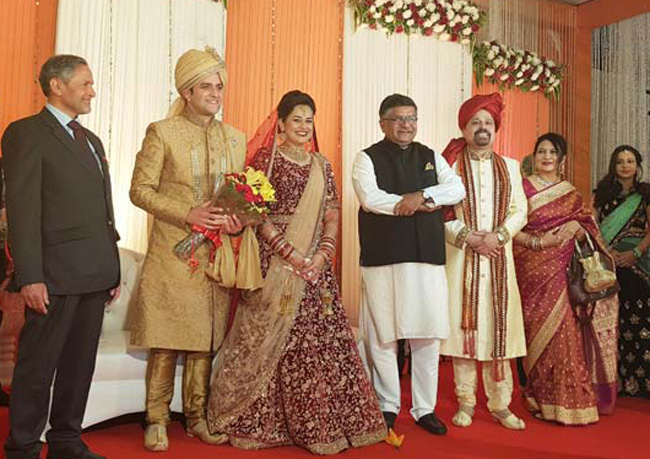
Jaipur: At a time when Hadiya had to fight a legal battle to debunk the love-jihad theory, to stay with her husband, the news of Tina Dhabi, the 2016 batch, Union Public Service Commission (UPSC) topper, now serving as Indian Administrative Service (IAS) officer, marrying Athar Aamir Khan, the second UPSC topper for the same year comes as a welcome change. The news however, did not surprise many. Those who knew the couple were well aware of them being in love since many years.
But, what was most amusing with Tina-Athar wedding was that politicians belonging to Bhartiya Janata Party (BJP), which has coined the term Love-Jihad, for Hindu-Muslim marriages in India, were seen gracing the occasion and blessing the newly wed ‘power’ couple.
On March 20, Tina and Athar had a court marriage in Jaipur. However, Tina tweeted about it on April 9 and also shared details of the two wedding receptions, going to be hosted in Delhi and Kashmir.
And it was not just one or certain low profile leader belonging to the BJP, who attended the ceremony. But right from Vice-President of India, Venkaiah Naidu to Lok Sabha Speaker Sumitra Mahajan and Minister for Law and Justice, Ravi Shankar Prasad, attended their reception hosted in Delhi on April 14.
Both, Tina and Athar are Rajasthan cadre IAS and are posted in Ajmer and Jaipur respectively. Tina’s ancestral place is in Pali district, but her parents had shifted to Delhi.
Significantly, Rajasthan is the place, where on December 6, 2017, 50-year-old Afrazul Khan, a resident of Malda, Bengal had been brutally murdered by Sambhulal Regar in Rajsamand district on the suspicion of Afrazul causing love-jihad. Shambhulal had shown no remorse after the incident, while BJP leaders from both Rajasthan and Delhi had remained silent on the heinous crime.
While, interfaith or mixed marriages have been done from time immortal in India. It is more common among high profile people and celebrities. Rajasthan, has also history of such marriages, especially among the Kayamkhani community. But in recent times, it has been coined as love-jihad and get politicised too.
“I remember two cases of the Kayamkhani Muslim community, where, a girl and a boy had married their partners who belonged to different religion and we had welcomed them like Rajasthan has welcomed Tina and Athar. Aslam Khan, an IPS officer, was a girl belonging to Kayamkhani Muslim community. She chose to marry a Dalit IPS officer, Pankaj Kumar in 2007. Presently, Aslam is posted in Delhi. Similarly, an advocate from the same community chose to marry a girl belonging to the Soni family. Both these marriages were well accepted and not branded as love-jihad,” told Ashfaque Kayamkhani, a social activist from Sikar, Rajasthan, to eNewsroom.
“Marrying outside caste and religion is a very common among the Kamayamkhani community,” claimed Ashfaque.
Indian Constitution under Article 21, gives liberty to every adult citizen of India to right to marry a partner of their choice. However, when interfaith marries take place between couples hailing from economically weaker section of society, it gets labelled as love-jihad, especially if the girl is Hindu.
After the UPSC 2016 results, when for the first time, Tina had expressed her love for Athar and said that she will marry the second topper, some right wing organizations had written to the parents of Tina expressing their unhappiness on her decision.
Right wing outfits not just make a hue and cry over it, but also have several websites and social media pages filled with fake articles to strengthen the narrative of love-jihad.
It was because of this, that Shambhulal had hacked and set ablaze Afrazul. Following Regar’s arrest, a rally had also been organised to show solidarity. In fact a huge amount of money had also been crowdfunded in his wife’s account.
Under such circumstances, Tina and Athar’s wedding and the presence of BJP leaders has brought smile on professors of inter-religious and inter-caste marriages.
How a Kolkata’s missing girl issue is being compared with Kathua case to create communal unrest in Bengal
Kolkata: As civil societies took on to the streets across India demanding Justice for the 8-year-old child, who had been gang-raped and murdered in Kathua, Jammu social media in Bengal went berserk drawing parallels between Kathua gang rape victim and the minor girl, who has been missing from her home for the past 10 months in Kolkata. Most of the posts being circulated in various Facebook groups have been scathingly criticizing the Kolkata Police and Chief Minister Mamata Banerjee for not doing enough to save the missing girl as the accused belong to her alleged vote bank community.
Several concocted stories being circulated that the police were dreading to enter the minority dominated area, which is almost like a fortress. Adding fuel to these theories were claims being made by certain publications. “I saw this news about two months ago on social media. I was disturbed. But soon I saw it being circulated and replicated by websites and portal that at aim spreading fake or half-baked news and creating communal disharmony,” says Anwesha Dutta, a content writer.
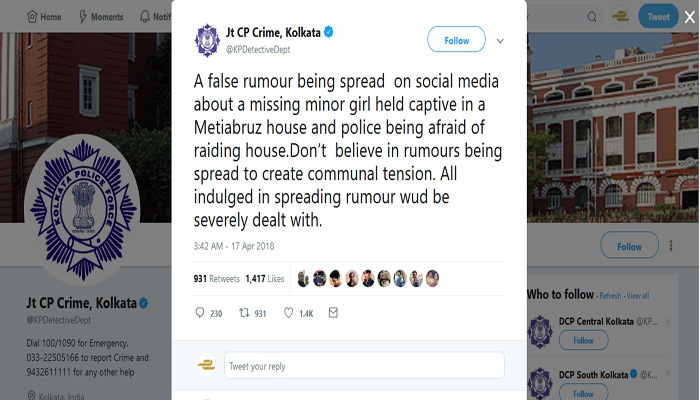
A section of vernacular media covering the news made the police sit up and take notice. On April 17, Joint CP Crime, Kolkata in an attempt to trash the news doing the rounds, tweeted, “A false rumour is being spread on social media about a missing minor girl held captive in a Metiabruz house and police being afraid of raiding house. Don’t believe in rumours being spread to create communal tension. All indulged in spreading rumours wud be severely dealt with (sic).”
Following which several Facebook groups like Calcutta Liberals declared that posts related to Metiabruz issue would be deleted as the police had debunked the theory. Reacting to it, Dutta, who is also a moderator of the group said, “I presume when a publication like ABP did a story on the same, made the police jump into action as they realized that the public will be taken for a ride.”
Interestingly, the ABP story, which is being shared by several to prove the police inefficiency nowhere in the copy mentions that the police didn’t raid or they were afraid of raiding the house. A senior police official said, “It’s true that the girl is missing for 10 months and that the High Court has directed us to trace her. But there is more to this case. Some sections of people are simply communalizing the case.”
Replying to a message of eNewsroom, regarding the action, Joint CP Crime, Pravin Tripathy stated, “Police has started a specific case and have conducted several raids at all probable hideouts. My DD team has conducted raid under proper video coverage in that house also. There are some mischief mongers who are spreading wrong information and rumour. We will take strict action against them as per law.”
eNewsroom, also tried contacting local Metiabruz residents to gauge the ground reality. Kashif Zafar, an educationist and social worker from the Garden Reach area said, “I am amazed at the way, people are terming not just Garden Reach and Metiabruz area as Mini Pakistan but also Khidderpore area. Let’s state a simple fact – anti-socials will be found in many localities, but that doesn’t mean that the entire locality is inhabited by criminals. Coming to this particular case, whatever bit of information that I have been able to gather, it’s evident that this case is being communalised for political gain. The house in question has been raided not once but many a time and the police have not been able to locate the girl there. We understand the parent concern, but we should allow the police to do its job and trace the girl, instead of getting agitated and giving a communal twist to it.”
Communal violence has sharply increased over the past three years in West Bengal, according to the data compiled by the Union Home Ministry.
Communal violence has been on the rise in West Bengal since 2015. The number of communal violence have doubled from 27 (2015) to 58 (2017). Last year, Bashirhat was under siege after an objectionable picture had been circulated on Facebook. Last month Bengal’s Raniganj and Asansol witness fresh communal clashes following the Ram Navami celebration.