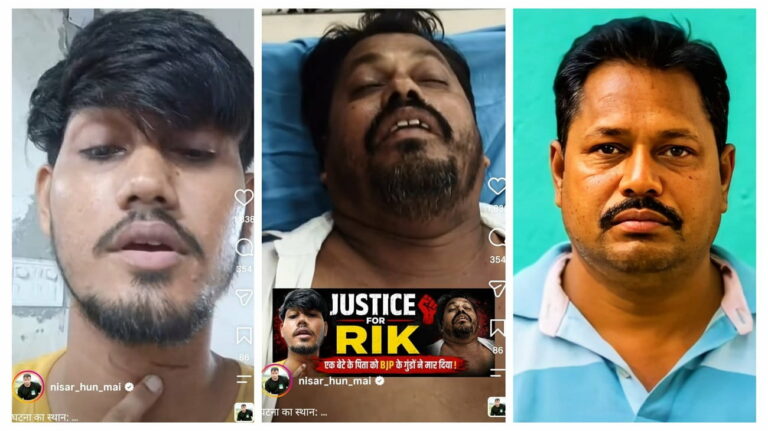
Kolkata: Sheikh Mohammad Mafik was killed on August 15, two days after he was allegedly assaulted at his home in Bankura’s Indus area, allegedly by BJP-linked attackers. His son, Sheikh Abdul Hafiz, a member of the Cockroach Janata Party (CJP), has alleged that the attack was connected to videos he had recorded about the poor condition of a local government school.
Mafik was a resident of Karishunda village under Indus police station. His son Hafiz had recently returned from Delhi, where he had participated in a CJP protest demanding the resignation of Union Education Minister Dharmendra Pradhan, who subsequently resigned on July 25 amid student protests.
Significantly, Mafik was killed on India’s Independence Day, in Bengal, the land of Rabindranath Tagore, who imagined a free India “where the mind is without fear and the head is held high.”
Hafiz travelled to Delhi on July 19 to participate in the programme. On July 20, he was allegedly detained at Rajiv Chowk and was caught in a police lathi-charge and tear-gas shelling during the protest. He returned to his village on July 27.
Back in Karishunda, Hafiz joined CJP’s ‘School Thik Karo’ campaign, which seeks to highlight the condition of government schools. He visited Karishunda Primary School, recorded videos showing what he described as its poor condition and spoke to the headmaster about the problems he had observed.
According to Hafiz and his family, he began receiving threats after posting the videos. On the night of August 13, a group of people allegedly entered his house and assaulted him. The family has also alleged that the attackers took away his mobile phone and deleted the video.
Hafiz’s father intervened when he saw his son being attacked. The family alleges that Mafik was then beaten with iron rods and sticks.
Mafik’s condition deteriorated the following day. He was initially taken to Indus Hospital and was later shifted to Bardhaman Medical College Hospital for further treatment. He died there on August 15 while undergoing treatment.
Hafiz Alleges BJP Link; Suvendu Adhikari Says Accused Are ‘Miscreants’
Hafiz has alleged that local BJP leaders and workers were behind the attack. In a video message, he said, “A group of local BJP leaders and workers entered our home and launched an attack. They beat me first. When my father tried to save me, they assaulted him as well. They attacked me with the intention of killing me.”
Hafiz further alleged that his father suffered serious injuries while trying to protect him.
The BJP has rejected the allegation. Chief Minister Suvendu Adhikari said on Sunday that five people had been named in the FIR and that three had already been arrested. He also denied that the accused were BJP workers.
“We are aware of the incident. The families have named five people in the FIR, and all of them are alleged to be miscreants. Who said they are BJP workers? Three of them have already been arrested, and the remaining accused will also be arrested. All of them are miscreants. The rule of law prevails in the state, and legal action will be taken in every such incident,” Adhikari said at a press conference.
State minister Agnimitra Pal also said that any BJP worker found to have been involved would face action.
“What does it mean to say that BJP workers are involved? If any BJP worker has done something like this, the police will not overlook the matter simply because they are associated with the BJP. Appropriate action will certainly be taken against them,” Pal said.
The police investigation will now have to establish what led to the assault, who was involved and whether the attack was connected to Hafiz’s campaign highlighting the condition of the school.
CJP Rallies Behind Hafiz After Father Murdered Following Alleged Assault
The incident drew a response from CJP leaders, who rallied around Hafiz and his family. On Sunday afternoon, party in-charge leader Dedipya Gangopadhyay met Hafiz at Burdwan Medical College Hospital.
CJP founder Abhijit Deepke condemned the incident in an Instagram post, alleging that Hafiz’s father died after an attack linked to the campaign over government schools.
“It makes my blood boil that people are being killed simply for demanding better schools,” Deepke wrote. He demanded the immediate arrest of those responsible and said a CJP team would visit West Bengal to pursue the matter and seek justice for Hafiz and his family.
CJP leader Ashutosh Ranka also said that he, along with Vijay Mallangi, Ankit Bharadwaj, Sudhir Sangowan and other party members, would visit Karishunda village in Bankura.
The party has said it will continue its “School Thik Karo” campaign despite the alleged attack.
There is a village in present-day Uttar Pradesh that was once home to thousands of people, including families who had travelled hundreds of kilometres from Bengal in search of a new life.
In June 1857, as the uprising against the British spread across North India, violence reached that settlement. British forces came in pursuit of those they held responsible for the killing of their soldiers. Within days, homes were destroyed, people were killed or driven away, and the settlement was razed.
Then came an order that was almost as devastating as the destruction itself: the village was not to be rebuilt.
Its name was Mahua Dabar.
For decades, the settlement barely existed in India’s mainstream historical memory. Yet its story connects the upheaval of 1857 with the displacement of Bengal’s weavers, the lives of ordinary villagers and the extraordinary fourteen-year search by a Mumbai tailor to recover the history of a place his family had lost.
As India approaches another Independence Day, Mahua Dabar raises an uncomfortable question: how many people who lived, resisted and died in the freedom struggle disappeared from our histories simply because their stories were never preserved?
The Families Who Carried Bengal’s Weaving Tradition West
By the eighteenth century, Murshidabad, Kasimbazar and Dhaka were internationally known centres of textile production and trade. As British control over Bengal deepened, however, the region’s traditional handloom economy suffered a prolonged decline.
Accounts of the period describe high tariffs, economic pressure on artisans and the displacement of weavers. Stories of the physical mutilation of master weavers — including claims that their thumbs or hands were cut off — have also survived in popular histories. Historians have debated how widespread these specific incidents were, and such claims require careful documentation.
The broader destruction of Bengal’s traditional textile economy, however, is far less disputed.
Among those who left in search of livelihood and safety were Bengali Muslim weaving families. According to accounts of Mahua Dabar, around 20 such families from Murshidabad travelled several hundred kilometres west and settled there around the 1830s, when the area was associated with the territory of Awadh.
They had already lost one home.Mahua Dabar was supposed to be a new beginning.
What had been a modest settlement grew into a bustling textile centre. Francis Buchanan’s 1813 survey of Gorakhpur recorded around 200 houses. By the 1850s, Mahua Dabar had grown into a settlement of roughly 5,000 people, with weaving and dyeing among its important economic activities and an unusually large educated and salaried population for a rural settlement of its size.
Families that had carried their skills out of Bengal had begun rebuilding their lives.
Then came 1857.
What Happened at Mahua Dabar?
On June 8, 1857, Indian sepoys of the 22nd Native Infantry at Faizabad rebelled. British soldiers were taken captive but were later allowed to leave by boat towards Dinapur cantonment, near present-day Patna.
The journey turned violent.
On June 9, a group of British soldiers left in four boats. During the journey, some encountered Indian rebels and two British officers were killed.
The following day, June 10, a party of seven British soldiers, accompanied by an Indian escort, stopped near Mahua Dabar in search of refreshments.
According to Sergeant Busher, the British survivor whose account later became an important source for reconstructing the incident, villagers armed with swords and matchlocks attacked them.
Six of the seven British soldiers were killed.
Busher survived. He reached a neighbouring village, where he was assisted by Baboo Bully Singh, a local zamindar, and was eventually handed over to William Peppe after several days.
British accounts of the incident understandably centred on the deaths of their soldiers. But later researchers have attempted to place the episode within the wider violence of 1857 and the social composition of Mahua Dabar, whose residents included Bengali-origin weavers, Pathans and other Indian Muslims.
The British response was devastating.
When the British Came for the Whole Town
Gorakhpur Collector W. Peterson appointed William Peppe, an indigo planter, to lead a punitive operation against Mahua Dabar.
British forces reached the settlement on June 20, 1857.
For the people living there, this was no longer a confrontation involving a handful of soldiers. Houses were destroyed and civilians were killed. Hundreds fled. Others were unable to escape.
Men and women, elderly people and children were among those caught in the violence.
The precise death toll remains contested. Local researcher Dr Shah Alam Rana has put the figure as high as 5,000, while other reconstructions associated with the archaeological work at the site suggest a lower number.
But the disagreement over the number should not obscure what happened to the town itself.
By July 3, Mahua Dabar had been completely razed.
A settlement that had taken generations to build was gone.
The colonial administration then went further. The land was designated ghair-chiragi — literally, without a lamp. The order effectively meant that no homes or habitation were to be allowed to return.
A family could flee a village. A town could be destroyed.
But Mahua Dabar was also being erased administratively.
The site was subsequently converted into farmland. Another settlement some distance away was also known by the name Mahua Dabar, further complicating the memory of the original town.
The people were gone. The houses were gone. The map itself became part of the erasure.
One Man Could Not Forget the Village His Family Lost
For most people, Mahua Dabar might have remained a name buried in an old record.
For Mohammad Abdul Latif Ansari, it was family history.
A Mumbai-based tailor, Ansari had grown up hearing fragments of the Mahua Dabar story from his father. His family was connected to the Bengali-origin weavers who had once lived there before migrating to Rangoon, present-day Yangon, and eventually settling in Mumbai.
Whenever Ansari visited his ancestral village of Bahadurpur, near the ruins of Mahua Dabar, he felt drawn towards the site.
By then, the former town had largely become farmland. Among the few visible reminders was the remains of a mosque.
In February 1994, Ansari returned to the area while arranging his son’s marriage. He visited the site once again.
This time, he wanted answers.
What had happened to the people who lived there?
What had happened to his own family?
And how could an entire town disappear from history?
What followed was fourteen years of painstaking investigation.
Ansari was not a professional historian. He was a tailor running a business in Mumbai. Yet in his spare time he searched the Basti Gazetteer, spoke to elderly residents and approached historians in Basti, Lucknow and Allahabad.
Much of what he encountered was uncertain.
Rumours survived. Memories survived. But the documentary trail was difficult to find.
Then, in January 2003, a book changed the direction of his search.
At a book fair in Mumbai, Ansari found Pooran Chand Joshi’s Inquilab 1857. It pointed him towards British-era accounts of the uprising.
At the Bombay Central Library, he began reading Charles Ball’s 1860 History of the Indian Mutiny.
There he found what he had been looking for: the account of Sergeant Busher, the British survivor of the Mahua Dabar attack.
A family story was beginning to become documented history.
From a Family Memory to Archaeological Evidence
Ansari’s search eventually drew the attention of the Basti district administration.
A committee involving historians from Lucknow University examined the evidence and located an old survey map dating to 1831.
In 2010, an excavation associated with the Archaeological Survey of India uncovered burnt debris and foundations consistent with a substantial settlement.
For Ansari, this was more than an archaeological discovery.
It was evidence that the place he had heard about as a child had really existed.
The town his family had carried in its memory had left physical traces beneath the soil.
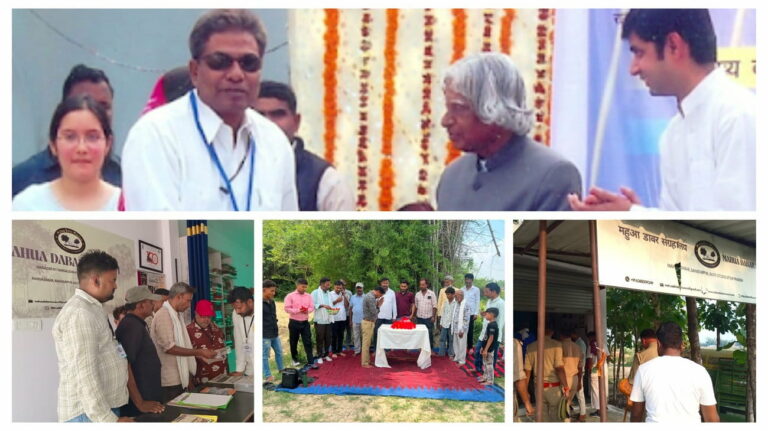
Ansari was later presented with a certificate of appreciation by then-President APJ Abdul Kalam. In July 2011, MP Jagdambika Pal unveiled a memorial plaque at the site.
Yet formal recognition of Mahua Dabar remains limited.
The Other Man Who Refused to Let Mahua Dabar Disappear
Ansari was not alone in trying to preserve the memory of the vanished town.
Dr Shah Alam Rana, whose family is connected to neighbouring Pura Pirai, began visiting the site regularly in the late 1990s. Farmers continued to find burnt relics in their fields, and Rana collected them.
In 1999, he established the Mahua Dabar Museum.
The museum remains housed in a rented building.
Rana has summed up the neglect of Mahua Dabar in a striking sentence: “We reached the moon in Amrit Kaal; Mahua Dabar is still buried in 1857.”
His work, alongside Ansari’s, shows that the memory of the town never entirely disappeared. It survived in family histories, village conversations, fragments found in fields and the persistence of people who refused to accept that an erased town should remain forgotten.
The ghair-chiragi notice and Shaleen Kumar Singh’s interpretation
The ghair-chiragi decree itself has also attracted the attention of researchers, including Dr Shaleen Kumar Singh, who examined the judicial proceedings that formally recorded the village’s erasure in 1860.
Singh argues that the order was not merely administrative housekeeping but “a speech act which turned inhabited space into an administratively blank terrain” — language being used to complete an act of physical violence.
The significance of the decree lies precisely in that combination of physical destruction and official erasure. Mahua Dabar was not simply a settlement that had been destroyed in the violence of 1857; its inhabitants were denied the possibility of returning and rebuilding their homes.
The violence, in other words, did not end when the houses stopped burning. It continued through the administrative act of ensuring that the town could not return.
The Forgotten Resistance of Mahua Dabar
The standard histories of 1857 rightly remember Mangal Pandey, Tantia Tope, Rani Lakshmibai, Kunwar Singh and other prominent figures.
But the uprising was also lived and fought by ordinary people whose names rarely entered national histories.
Jaffer Ali, identified in Sergeant Busher’s account as one of the leaders of the attack on the British soldiers, became part of Mahua Dabar’s story. So did the villagers who confronted British forces with the weapons available to them.
The historical record, however, is inevitably shaped by whose accounts survived.
The British recorded the deaths of their soldiers in considerable detail. The lives of the villagers who were subsequently killed, displaced or forced to disappear from the settlement were far less carefully preserved.
That imbalance matters.
Mahua Dabar reminds us that the freedom struggle was not made up only of famous leaders whose portraits hang in textbooks and public buildings. It was also made up of weavers, farmers, labourers, villagers and families whose names often vanished with the places where they lived.
From Murshidabad to Mahua Dabar — and Beyond
The Mahua Dabar story is therefore more than the story of a forgotten massacre.
It is a story of migration, economic dispossession, memory and belonging.
The Bengali Muslim weavers who settled at Mahua Dabar had already experienced displacement. They had left Murshidabad carrying their skills and family traditions with them. At Mahua Dabar, they built another life.
That life lasted only a few decades before the violence of 1857 destroyed the settlement.
Their story also shows how memory can survive outside textbooks.
A son hears fragments from his father.
A man returns to a patch of farmland.
He asks questions.
He searches old books.
He finds a survivor’s account in a library.
Historians examine maps.
Archaeologists uncover burnt remains.
And slowly, a vanished town returns to the historical record.
Why Mahua Dabar Matters in 2026
There is another reason Mahua Dabar deserves to be remembered today.
Since 2025, reports have emerged from several parts of India about Bengali-speaking migrant workers being detained as alleged “illegal Bangladeshi immigrants”, with rights groups documenting cases in which people were allegedly pushed across international borders.
The circumstances of 1857 and 2026 are obviously not identical. But the question of belonging has a striking resonance.
The Bengali-origin weavers of Mahua Dabar were migrants. They had moved from Bengal in search of livelihood and rebuilt their lives elsewhere in India. Their descendants became part of a community that participated in one of the most violent episodes of colonial resistance.
And yet, nearly 170 years later, Bengali-speaking Indians can still find themselves asked to prove that they belong.
That is why Mahua Dabar deserves a place in India’s history of 1857.
Not simply because a town was destroyed there.
Not simply because British soldiers were killed there.
But because the people who lived there — migrants, weavers, villagers and families — were part of the history of resistance, even though their names and stories were nearly erased.
As India marks another Independence Day, remembering Mahua Dabar means remembering a part of the freedom struggle that was almost erased twice: first from the land, and later from memory.
Kolkata: On the morning of 3 August 2026, Rumpa Mondal, an ASHA worker from Gangajalghati in Bankura district, died of cardiac arrest. She had spent the previous night working on E-KYC formalities for the Ayushman Bharat scheme. By the time her husband and nephew helped her down the stairs the next morning, her legs had become numb, and she could no longer stand. Doctors at the hospital detected a faint pulse, then declared her dead ten minutes later.
Her death immediately became linked to a viral video that had circulated the day before. On 2 August, Saltora constituency BJP MLA Chandana Bauri arrived at a makeshift camp in Gangajalghati, where ASHA workers were processing forms. In the footage, she repeatedly accused them of having obtained their jobs through theft. The language was public, sustained and humiliating.
Rumpa Mondal’s Last Night: E-KYC Work Until 10.30 PM
Subhas Mondal, Rumpa’s husband, recounted the final hours.
“She had been working as an ASHA worker since 2014. Currently, our household consists of three members—myself, my daughter, and my mother. My wife had no prior medical conditions. The other night on August 2, she was working on E-KYC tasks alongside my nephew. They worked until around 10:30 PM, after which we wrapped up, returned home, and had dinner. We went to bed around 12 at night.”
The next morning, she woke earlier than he did, around 6 am, complaining of a mild stomachache. He suggested it might be gas or acidity caused by late nights and irregular meals.
The pain did not subside. While sitting in an auto-rickshaw on the way to seek help, she soiled her clothes with faeces, felt nauseous, and grew so weak that she needed support to reach the bathroom.
“After cleaning up and coming out, she told me she couldn’t make sense of what was happening and couldn’t stand; her limbs, specifically from the waist down to her legs, felt numb,” he said.
As he and his nephew supported her down the stairs, she suffered a stroke. A Maruti van took her to hospital. Ten minutes after doctors noted a faint pulse, she was gone.
Subhas has no formal job; he is a farmer and works on a small plot of land. Rumpa was the sole breadwinner, earning between ₹6,000 and ₹7,000 a month, including incentives.
“There was a lot of pressure—meaning, there was anxiety regarding the work—but she was capable of handling it and would complete everything personally; still, the pressure was immense. Every day, it would be nearly 11 at night by the time the work such as filing reports and maintaining records was finished.”
Visits from MLA Chandana Bauri and the local police inspector brought verbal promises of possible employment and support for their daughter, but no written assurance has followed yet.
Papia Adhikary at work, attending General meeting at her block in Pashchim Medinipur | Arranged
‘Are We Thieves?’: ASHA Workers React to MLA’s Remark
Sumitra, an ASHA worker from Bankura district who was present at the scene, responded to the MLA’s words with fury.
“Are we thieves? Have we got our jobs by theft? We all who are present here joined this work in 2011; from then we have been trained to take care of pregnant women, children’s and babies’ health. We worked giving our sweat and blood during COVID time; back then no one thought us thieves!” she said.
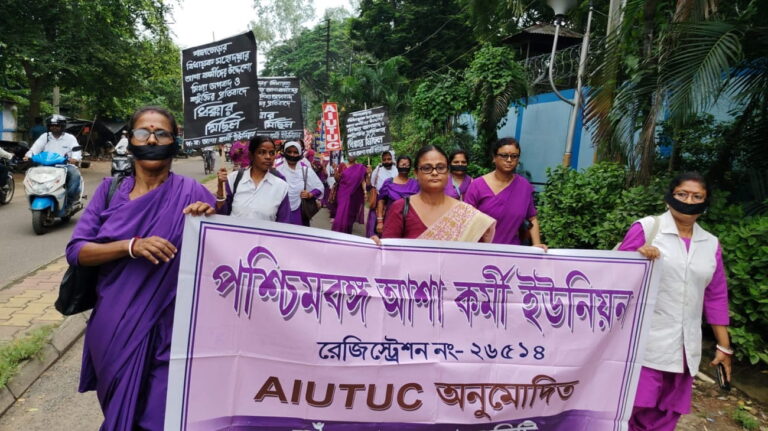
Ismat Ara Khatun, state secretary of the West Bengal ASHA Workers’ Union, placed the confrontation in the context of a larger pattern of administrative pressure and political display.
“In Gangajalghati, the work was being conducted at a makeshift camp set up in a spot with good network connectivity where residents had been asked to gather. A BJP individual acting with a specific agenda pointed out to the MLA that the ASHA workers were supposed to visit homes to perform their duties, yet here they were simply sitting at the camp. Subsequently, MLA Chandana Bauri arrived and questioned them using highly inappropriate language. Her actions were entirely unethical and exceeded the scope of her authority.”
Khatun recalled that Health Minister Dr Sharadwad Mukherjee had once told the union that if anyone ranked above God, it was the ASHA workers.
“Yet, look at what MLA Chandana Bauri said. She called us thieves, claiming we secured our jobs through theft. This represents a stark contrast in character.”
Why ASHA Workers Are Struggling With Ayushman Bharat E-KYC
The E-KYC work is part of the central Ayushman Bharat–PMJAY programme. ASHA workers were assigned the task by the National Health Authority (NHA) because many eligible rural residents lack smartphones.
The process itself is stringent. Workers must receive OTPs twice, capture facial images, navigate roughly 15 sequential questions, and often restart entirely if a blink invalidates an eye scan or the server times out.
“The very nature of the work and process of executing the Ayushman Bharat scheme for making this card involves receiving the OTP on mobile twice, capturing the face and so on. So it’s basically a very time-consuming procedure,” Khatun explained.
Each ASHA covers a population of roughly 1,000 to 1,200 people.
“Sometimes there is no internet, or there are glitches and issues. Even when the Internet is working, the site server remains down. Then even after everything seems fine, it still doesn’t go through. The site keeps circling, gets stuck, and eventually gets rejected with an error message.”
Madhuja Sen Roy, state president of the West Bengal ASHA Workers’ Union, described the same technical barrier.
“The E-KYC task requires a significant level of proficiency in data entry. It is a job that requires the skills of a data entry operator, yet ASHA workers are being forced to do it without proper training; in some places, they received only an hour of training, while in others, they received none at all.”
Completing one KYC under stable conditions takes 30 to 40 minutes.
“With unreliable networks, the process becomes hopeless. Workers sit in people’s homes waiting for OTPs that never arrive, sometimes enduring the irritation of household members,” she added.
Papia Adhikary, an ASHA worker in Paschim Medinipur since April 2010, received around 1,300 Ayushman Bharat forms after a training session that lasted barely 15 or 20 minutes.
“Sorting through the forms we received was like looking for a needle in a haystack. Matching names against Aadhaar cards was an arduous task in itself, but on top of that, we had to take the forms home to fill them out and organise them household by household.”
She has not yet completed a single E-KYC herself.
“I am trying to use my phone, but it keeps getting stuck on a particular page; even after trying 5 or 6 times, it shows an error. The internet connectivity here is so poor.”
Ismat Ara Khatun, State Secretary of West Bengal ASHA Workers Union talks to media persons | Arranged
How E-KYC Work Is Pushing ASHA Workers Beyond Their Duties
Faced with daily targets of 50 to 60 forms, the administration directed workers to set up camps in places with better connectivity and to enlist tech-savvy family members.
“Since the health department mandated that these tasks had to be performed and had also suggested seeking assistance from family members, specifically those technologically advanced, these tasks were successfully carried out. It was precisely because the entire family pitched in to help,” Khatun said.
In many districts, the core maternal and child health work—check-ups for pregnant women, polio drops, iron supplementation and hospital admissions—has been pushed aside.
“We, across a large part of Murshidabad district, have not done this work. We have stopped the KYC work through deputation,” Madhuja Sen Roy noted.
“If we do this, then the regular work which is supposed to be maternal and child health care falls behind because the entire day is being spent on doing E-KYC.”
Long Hours, Household Duties and No Medical Leave
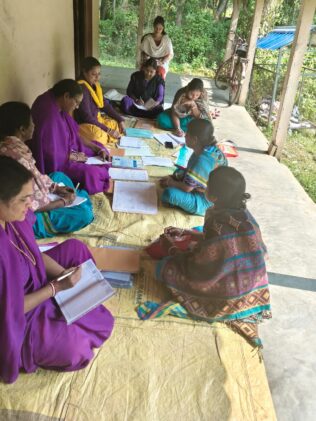
Archana Khan, 48, works in Kashipur block of Purulia. Her husband has been paralysed since suffering a brain stroke 18 months ago; their son studies in Kolkata. She is the sole earner.
“I have to wake up between 4:30 and 5:00 AM to bathe him. I manage to cook a simple meal—just rice, lentils, and a vegetable dish—before heading out for work by 10:30 AM.”
Fieldwork, cooking, more fieldwork, and then 16 different registers keep her awake until midnight or later.
“I even dream about this work; in fact, I have forgotten what a pleasant dream feels like.”
During menstruation, she walks instead of cycling because of cramps. There is no medical leave.
“We keep medicines with us for things like fever, colds, coughs, or stomach aches; we just take the medicine and head to work.”
Papia Adhikary described similar exhaustion.
“It has cost us our sleep; sometimes we work until 2:00 or 2:30 AM, and there have even been days when we were still at it at 3:45 AM.”
Monsoon rains leave no dry place to sit and fill forms.
“How am I supposed to fill out the form without documents? It’s monsoon season now, and it rains every day.”
Archana Khan at work, during her Routine work in her block in Purulia| Arranged
ASHA Workers Say Wages Are Low and Payments Often Delayed
ASHA workers receive an honorarium of ₹6,250. After a prolonged struggle, the total was raised to ₹11,250, with a further ₹5,000 increase announced in the 2026–27 state budget by Finance Minister Swapan Dasgupta and scheduled from September. Central incentives remain irregular.
For each completed E-KYC, the stated payment is ₹5 or ₹8, yet three to five attempts are often required.
“If I even work for ₹10, then I expect to receive that exact amount on time,” Khatun said.
“Instead, I am forced to run back and forth from the block office to the municipality and the health department as many as five times a month just to get paid for the work I have already done. The remuneration received relative to the work performed is meagre and is even rarely paid on time.”
Madhuja Sen Roy was blunt about the classification that keeps workers vulnerable.
“They extract labour from us, yet when it comes to claiming our rights, we are dismissed as mere ‘volunteers’—this simply cannot happen and is unacceptable.”
The demand for a minimum wage of ₹24,000 has been consistent for years. Maternity leave of 180 days was won only after a major protest in January 2026.
A proposed ₹5 lakh payment in case of death on duty or retirement still awaits Finance Ministry clearance.
“In general, ASHA workers do not even have the right to be sick; there is no provision for leave in the event of illness. Taking time off is not considered a right; it is something ASHA workers receive only as an act of charity.”
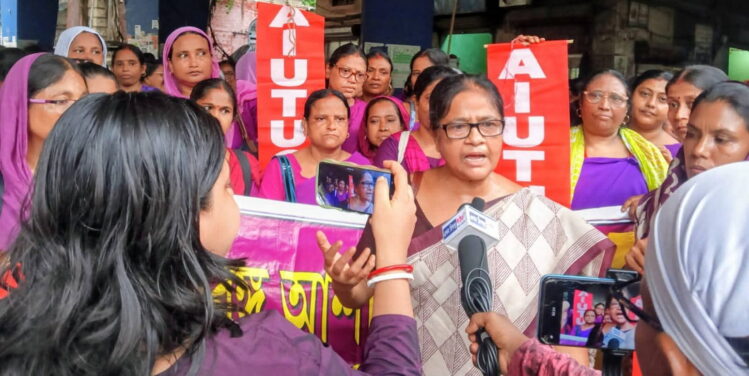
Lina Sarkar of the West Bengal AIUTUC Workers’ Union pointed to the structural contradiction.
“According to government guidelines, the scope of work for ASHA workers is strictly limited to matters concerning mothers, infants, and children. However, it is increasingly observed that these workers who receive only an honorarium are being assigned various other tasks. Why are ASHA workers being tasked with it? When registrations fail or are delayed by higher authorities, it is the ASHA worker who faces public anger,” she said.
Madhuja Sen Roy, State President of West Bengal ASHA Workers Union | Courtesy: Facebook
45-Day Strike Shows the Cost of Resistance
Early in 2026, ASHA workers staged a 45-day work stoppage. They endured salary deductions running into thousands of rupees, administrative threats, and social-media trolling from supporters of both previous and present ruling parties.
“There is a prevailing narrative that this government has increased the amount by ₹5,000; however, if one looks at the reality, the question arises: did the government do this voluntarily, or was it compelled to do so?” Lina Sarkar asked.
Deputations submitted to BMOHs, CMOHs, DMs and BDOs requesting exemption from E-KYC work have largely gone unanswered.
In places where alternative assistance centres were set up, the pressure eased; in most others, it did not. Reporting problems brings not help but threats of being sidelined or removed.
After Rumpa’s Funeral, ASHA Workers Return to the Same Work
Rumpa Mondal’s registers are closed. The forms she was processing remain unfinished.
Across West Bengal, thousands of women continue the same cycle: rising before dawn to care for household members or small children, cycling through villages in all seasons, waiting for servers that refuse to respond, filling the same data twice—once on paper, once online—then returning home to update 16 registers until midnight.
They are the bridge envisaged by the National Rural Health Mission in 2005: local women who would carry maternal and child health to the doorstep.
Two decades later, that bridge is expected to carry digital welfare schemes, survey after survey, and political deadlines, all while remaining legally classified as volunteers whose sickness is not a right and whose death still requires another file to move through the Finance Ministry.
“Had this incident not occurred, the government’s eyes would not have been opened,” Ismat Ara Khatun added.
eNewsroom: The issue has become centred on the CBI inquiry. Do you think a CBI probe was necessary, and is that why the protest has continued for so long? The government says 98% of the demands have already been met. So, what is keeping the protest going?
Neha Bora: There are two things here. First, there has been no demand to cancel the JPSC-CGL examination. There is a technical aspect to it because the appointments have already been made. But that does not mean that the demand for justice for students who suffered because of the mismanagement of the paper is wrong.
The second issue is the CBI inquiry. Even that is not a demand shared by everyone. I went to the Jaipal Singh Munda Stadium. Students are sitting there in different groups, and not all of them are demanding a CBI probe.
There is another question around the CBI. If we look at JPSC, the major corruption that came to light in JPSC-1 and JPSC-2 was also investigated by the CBI. There has been no outcome so far. Even after all these years, that investigation is, in a way, still going on. If there has been no outcome from the earlier probe, what is the point of handing another JPSC investigation to the same agency?
There is another thing we need to look at—the way the CBI has changed over the past few years. In 2024, the investigation into the NEET paper leak was also handed over to the CBI. The people who should have faced action were not chargesheeted within 90 days, and the court released them on technical grounds.
You see, we expect institutions like these to complete investigations at the earliest and submit their reports or chargesheets. If they function like this, how can we continue to have faith in them?
And there is another very important aspect to what you asked. The way students were repeatedly lathi-charged yesterday, water cannons were used, and dozens of our comrades had to be admitted to Sadar Hospital—the injuries they suffered were so severe. This kind of state repression is absolutely unacceptable.
If you are part of the INDIA alliance and want to present yourself as a better alternative to the BJP, then you have to act accordingly in politics as well. You cannot keep saying, “Don’t vote for the BJP, we are different from the BJP, we stand with the students,” and at the same time treat students in exactly the same way the BJP does. You cannot have both things together.
That is why this kind of brutal repression of students by the JMM government in Jharkhand is absolutely unacceptable. It is shameful. The Jharkhand government should move towards resolving these issues at the earliest and accepting the students’ demands, rather than lathi-charging them.
Hemant Soren Under Fire: Why JMM’s Crackdown Mirrors BJP-Style Governance
eNewsroom: Hemant Soren has still not met the students. Rahul Gandhi has also spoken out on the issue. Do you think Hemant Soren should have met the students and spoken to them by now?
Neha Bora: It has taken too long. He should have met them by now. And the way Rahul Gandhi condemned what happened yesterday is also important.
I have been following the work of the CPI(ML) in Jharkhand. CPI(ML) is also standing with the students. Arup ji also raised the issue in the Assembly yesterday, and the minister had to respond.
So both these positions—the stand you have taken and Rahul Gandhi’s stand—appear to be in support of the students. The Congress, too, has taken a position in support of the students. So why is Hemant Soren being left out of this?
Now, for those who are in government and are being questioned, it has become a difficult position. That’s the point.
Otherwise, if you are genuinely part of the struggle to save India’s democracy and Constitution, then your role in this struggle cannot simply be to oppose the BJP during elections.
‘Non-BJP Governments Can Be Removed Too’: AISA Leader’s Warning to Jharkhand Alliance
eNewsroom: So, non-BJP governments also have to set a better example than the BJP?
Neha Bora: Absolutely. Non-BJP governments in different states have to show what the BJP government is not doing and why the BJP needs to be removed from power.
At present, the JMM government is failing on this front. The simplest example is that instead of leading, it is repeating the very things it should be challenging.
In Jharkhand, there have been irregularities around the JPSC—from its very formation right up to the fourteenth commission. The BJP is equally responsible for unemployment among young people and the collapsing education system in Jharkhand because it was in power for such a long time.
But even then, if the Jharkhand government repeats the same things, if the same things continue under its rule, it too can be removed from power—just as the BJP was.
‘He Will Become Irrelevant’: Why Rahul Gandhi Isn’t Immune to Student Scrutiny
eNewsroom: You have met Rahul Gandhi. How do you see Rahul Gandhi as a leader? Do you see the same change in him that was visible during the farmers’ movement? Do you see a political future for him?
Neha Bora: Look, as long as he is with our issues and speaks alongside us, we will see.
And the moment he feels that we don’t need to do all this, that we are detached from people and people’s movements, then he will become irrelevant—not just to all of us, but to this country as well.
Watch | The full interview
‘Our Loyalty Is to People, Not Power’: Why Student Activists Question Every Regime
eNewsroom: So, if Rahul Gandhi changes in that way, will you question him too?
Neha Bora: Why wouldn’t we? When the Congress was in power, did we not question it? We raised many questions then too, and faced a lot of repression as well.
If that happens now, we will certainly question it. We are not spokespersons for any political party.
Our job is to remain committed and honest towards the voices coming from the ground, the issues being raised and those that are being ignored.
Parties can change, and those in power can change. I am myself a member of a political party, but we have questioned those in power in every phase and faced repression from every government in power.
Because our loyalty is not to power. It is to the people.
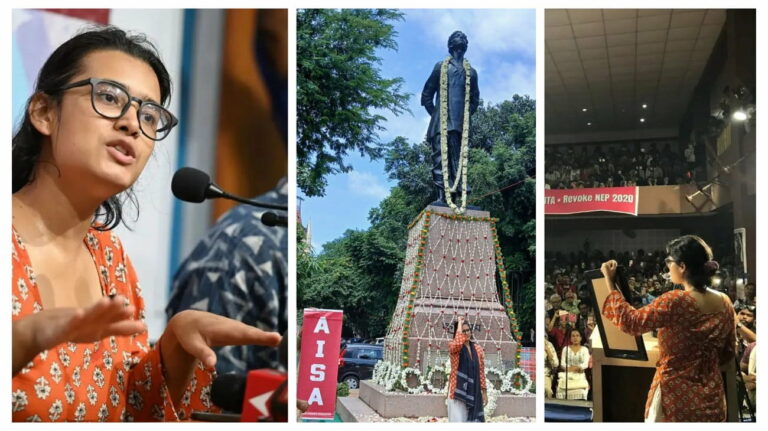
30 Years of AISA: Building Women and Marginalized Voices in Political Leadership
eNewsroom: AISA has completed 30 years. How do you see AISA’s role in promoting women’s leadership?
Neha Bora: As a student organisation, one of the core principles of our political understanding is to prepare people from the marginalised sections of society for leadership. They should receive political training so that they can take on leadership roles.
The people who came before me did this work sincerely. That is why AISA has consistently produced women leaders and leaders from marginalised gender identities. People from marginalised religious communities have also held leadership positions.
And that is why I am part of this organisation and not another one.
From Siliguri to Left Activism: Neha Bora on Unlearning Right-Wing Ideology
eNewsroom: You have said at several places that you grew up in a right-wing family environment. How important was AISA and left politics in helping you move away from that thinking and reach where you are today?
Neha Bora: I think the struggle I had with my family’s political understanding is the same struggle that millions of students and young people in this country have had with their own families.
Every generation goes through a coming-of-age process. When you are trying to understand what the world means to you as an individual, and how you see yourself, you begin questioning the ideas you have grown up with.
It is not a rebellion against your family. It is a process of questioning your own old understanding.
When you look at the things you have always believed to be true through a critical lens, when you question them, sometimes you realise that you no longer see things the way you once did.
That is why this struggle continues. And it happens in every generation.
And since I am from Bengal, I will speak from that experience. My struggle did not begin at university. It began at school.
I studied in Siliguri. That’s where I completed my schooling—Classes 10, 11 and 12. I had teachers there. My English teacher, Srimanti Ma’am, Srimanti Gupta, my Economics teacher Khurram Sir—all these teachers pushed me in that direction.
Not towards the Left, but away from the Right.
And perhaps because I was in Bengal, I heard the name Charu Majumdar, I heard about Naxalbari, I heard the names of martyrs, Tagore, Khudiram Bose. If I had been somewhere else, perhaps I would not have heard all of this.
I heard these things, and I also heard them from my friends. Even though I did not take a step towards the Left while I was in school, I certainly took a step away from the Right.
I think that is something I learnt here.
When your struggle intensifies during Classes 10, 11 and 12, the people you are surrounded by, in some way, shape what you go on to do and what you begin to see.
So I think Siliguri and Bengal played a role in helping me take a step towards the Left and away from the Right.
Gen Z’s Political Awakening: How Student Agitations Build Confidence to Fight Systemic Power
eNewsroom: You just spoke about coming of age. We have all closely watched this protest. Fighting the system is a long and difficult battle. Do you think this movement has given young people the patience and fighting spirit to carry it forward?
Neha Bora: I don’t think I want to rush into saying that, yes, everything has fallen into place.
But I do think a dream is necessary if you want to fight. And it is equally important to have the confidence that you can fight for that dream, that you can struggle for it.
We all carry the dream of a better world. That dream may be broader for some, its language may be richer, but the desire to live in a better world—that is everyone’s dream, isn’t it?
But this movement has given young people the confidence that they can contribute to the struggle needed to build that better world.
Now, keeping that confidence alive is our responsibility. It is the responsibility of student organisations. It is the responsibility of politically conscious people, of those who know, read and write, and of those studying and living in universities, to keep alive the confidence that young people have gained today.
Today, they feel that if they remain engaged in the struggle, they can perhaps touch that dream. Keeping alive their commitment and political dedication to that dream, and keeping alive the confidence that we can participate in the struggle, that we can change the world that has made our lives difficult—that is our responsibility.
Young people also have a responsibility to keep nurturing this. Figuring out how much nourishment is needed with changing circumstances—that is a political process.
We have to remain part of this political process for the long term. We have to keep nurturing this movement.
And why shouldn’t it happen? Throughout history, young people across the world have changed the power structures, governments and politics of their countries. It will happen in India too, undoubtedly.
Ink Attack & Umar Khalid: How Right-Wing Ecosystems Weaponize Dissent
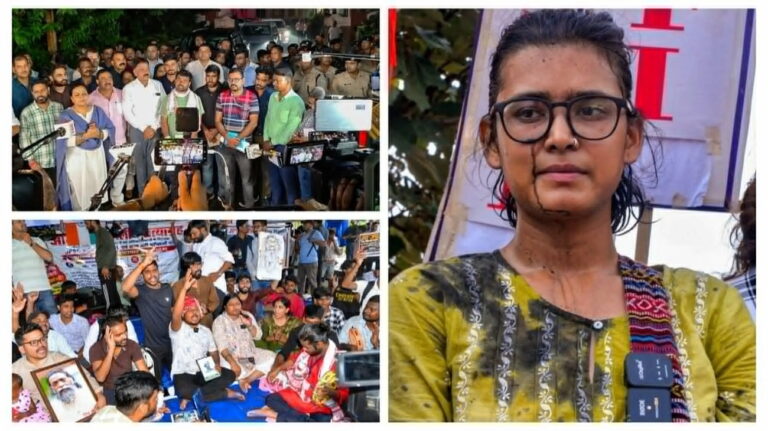
eNewsroom:You faced an ink attack, because you support Umar Khalid. Will you continue to stand by him in the future? Today is also Umar Khalid’s birthday. Is there anything you would like to say about him?
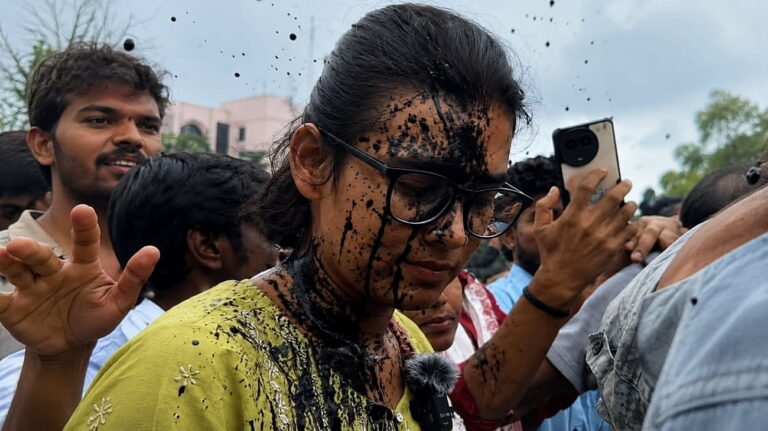
Neha Bora: Look, first of all, the ink was not thrown at me because I support Umar Khalid. It was thrown at me because those people were deeply upset that their Education Minister had to resign and was forced out of power in disgrace. There is still anger among those who support the BJP and RSS over that.
The second point is about Umar. This is both important and deeply unfortunate. When you invoke Umar’s name, those who use his name as an abuse do so specifically so that people stop listening to whatever comes next.
Umar’s name is used as a trigger, so that whatever is said after that is automatically viewed negatively.
And that is deeply unfortunate because the politics Umar came from was a politics that respected disagreement.
He was able to connect with people he loved and struggled alongside. And he was also able to criticise those he fundamentally disagreed with—the BJP and RSS—without turning that disagreement into violence.
Umar represented all of these things. And it is deeply unfortunate that the Right Wing is now using his name to erase all of these ideas from the country’s consciousness.
The other thing is, if we are talking about Umar’s struggle, I would say to young people today: if you are going to talk about Umar, read about him. Why is Umar in jail? What is the status of his trial?
Read about it. Umar’s struggle is not a battle between nationalism and anti-nationalism.
His struggle is about what is happening to the judicial process in a country where a strong system of justice and rule of law was established, but where laws such as UAPA are now being used to undermine that very judicial process.
The Constitution gave every ordinary citizen the right to a fair trial, a right established at the foundation of our Republic—that every person deserves a fair hearing and that the judiciary should decide, through due process, who is guilty and who is not. That constitutional ideal is being dismantled.
And mainstream media bypasses this judicial process, using doctored videos and lies to put Umar on trial and pronounce his sentence. It declares him guilty before the entire world.
Those who shut their ears the moment Umar’s name is mentioned—do they even know what the charges against him are?
There are no charges of anti-nationalism against him. He has certainly not been charged with shouting, “Bharat tere tukde honge.” None of these are the charges against him.
Find out what the charges actually are. Do you know that his trial has not even begun?
Do you know that when he writes his PhD thesis, he researches communities that have been deprived of their rights for generations, including tribal communities?
Do you know all this?
If you don’t, then find out. You are the young people of this country. You will decide which direction this country takes.
You have to switch off the alarms that go off in your head when you hear certain names, simply because of all the noise surrounding them. The Right-wing ecosystem wants you to lose your ability to think and understand.
If you want to fight it, you have to reclaim that ability to think and understand.
You have to read about all those things that have been labelled anti-national and declared as such.
Umar was a brilliant scholar. He was from my university. The fact that his trial has not begun even after six years is not just about him.
It is about the changing definition of our country, the changing meaning of justice, and the question of how the state will treat its citizens.
And I would urge all young people in this country to find out what is happening to ordinary people today. What is happening to Umar today can happen to any one of us.
‘Copy-Pasting Propaganda vs True Art’: Why Artists Must Stand Against State Power
eNewsroom: You have met people like Shabana Azmi, Arundhati Roy and Prakash Raj. What have you learnt from meeting them? Have these interactions influenced the way you think in any way?
Neha Bora: Actually, I haven’t just met these people recently. People think they are only getting to know me now, and perhaps that I have only recently started student activism. That isn’t the case.
Arundhati Roy and her writing have been part of my political life for a long time—more than a decade.
I have also followed Prakash Raj’s political understanding and his ability to stand with different people’s movements for a long time.
Exactly, since the time of Gauri Lankesh. I have also been watching Shabana Azmi’s ability to stand with people’s movements for a long time.
Since I have been associated with theatre, I have always been very aware of the world of art.
To a large extent, the role of art is to shape the consciousness of society. Rather than lecture society, it should give it memories and stories through which people understand themselves, define who they are and communicate with one another.
So if you abandon the historical responsibility of art and instead start doing this—someone sends out a tweet from the headquarters in Nagpur and everyone simply copy-pastes it on X—I don’t understand that.
If all those who call themselves artists are merely doing copy-paste work, how many times will you recycle the same script with different heroes and actresses?
So when artists refuse to bow to power and instead stand with the people, the courage of such artists inspires everyone in theatre and literature. These people have always been part of this struggle.
ईन्यूज़रूम: बात CBI inquiry पर अटकी है। क्या आपको लगता है कि सीबीआई जांच ज़रूरी थी और इसी वजह से protest लंबा खिंचा? सरकार कह रही है कि 98% demands पूरी हो चुकी हैं। फिर विरोध जारी रहने की वजह क्या है?
नेहा बोरा: इसमें दो चीज़ें हैं। पहली बात, JPSC-CGL को रद्द करने की मांग नहीं की गई है। उसमें एक तकनीकी पहलू है, क्योंकि भर्तियां हो चुकी हैं। लेकिन इसका ये मतलब बिल्कुल नहीं है कि paper के mismanagement के बाद जिन छात्रों के साथ अन्याय हुआ, उनके न्याय की मांग गलत है।
दूसरी बात CBI inquiry की है। अब ये भी सबकी मांग नहीं है। मैं जयपाल सिंह मुंडा स्टेडियम गई थी। वहां अलग-अलग समूहों में छात्र बैठे हैं और उनमें से सब लोग ये नहीं कह रहे हैं कि सीबीआई से जांच कराई जाए।
सीबीआई को लेकर एक और सवाल है। अगर हम जेपीएससी की बात करें, तो जेपीएससी-1 और जेपीएससी-2 में जो बड़ा भ्रष्टाचार सामने आया था, उसकी जांच भी सीबीआई कर रही थी। आज तक उसका कोई नतीजा नहीं निकला। इतने सालों बाद भी वह जांच, एक तरह से, चल ही रही है। अगर पहले की जांच का ही कोई नतीजा नहीं निकला, तो उसी एजेंसी से एक और जेपीएससी जांच कराने का क्या तुक बनता है?
और दूसरी बात, सीबीआई पिछले कुछ सालों में जिस तरह बदली है, उसे भी देखना होगा। 2024 में NEET paper leak की जांच भी सीबीआई को सौंपी गई थी। जिन लोगों के खिलाफ कार्रवाई होनी चाहिए थी, उनके खिलाफ 90 दिनों के अंदर chargesheet दाखिल नहीं हुई और अदालत ने उन्हें तकनीकी आधार पर छोड़ दिया।
आप समझिए, इस तरह की संस्थाओं से उम्मीद होती है कि वे जल्द से जल्द जांच पूरी करके अपनी रिपोर्ट या चार्जशीट पेश करें। अगर वो इस तरह काम करेंगी तो हम उन पर भरोसा कैसे जता पाएंगे?
और आपने जो पूछा, उसका एक बहुत महत्वपूर्ण पहलू और है। कल जिस तरह छात्रों पर बार-बार लाठीचार्ज हुआ, water cannon चलाए गए, हमारे दर्जनों साथी सदर अस्पताल में भर्ती हुए—रात में उन्हें इतनी चोटें लगी थीं। इस तरह का राज्य दमन बिल्कुल बर्दाश्त नहीं है।
अगर आप INDIA alliance का हिस्सा होते हुए खुद को BJP के मुकाबले एक बेहतर विकल्प के रूप में खड़ा करना चाहते हैं, तो आपको राजनीति में भी वही करना होगा। आप लगातार ये नहीं कह सकते कि बीजेपी को मत जिताइए, हम भाजपा से अलग हैं, हम छात्रों के पक्ष में हैं और उसी समय छात्रों के साथ वही सलूक करें जो बीजेपी कर रही है। दोनों चीज़ें साथ में नहीं हो सकतीं।
इसलिए झामुमो की झारखंड सरकार की तरफ से छात्रों पर इस तरह का बर्बर दमन कतई बर्दाश्त नहीं है। ये बिल्कुल शर्मनाक है। झारखंड सरकार को जल्द से जल्द इन मुद्दों को सुलझाकर छात्रों की जितनी भी मांगें हैं, उन्हें मानने की तरफ बढ़ना चाहिए—उनके ऊपर लाठी चलाने के बजाय।
हेमंत सोरेन की चुप्पी पर क्यों उठ रहे सवाल
ईन्यूज़रूम: हेमंत सोरेन की अभी तक छात्रों से मुलाकात नहीं हुई है। राहुल गांधी ने भी इस मुद्दे पर बयान दिया है। क्या आपको लगता है कि हेमंत सोरेन को अब तक छात्रों से मिलकर बात कर लेनी चाहिए थी?
नेहा बोरा: बहुत देर हुई है। उनको अब तक मिलकर बात कर लेनी चाहिए थी। और राहुल गांधी ने कल जिस तरह इसकी निंदा की है, वह भी महत्वपूर्ण है।
मैं झारखंड में CPI(ML) का काम देखती रही हूं। सीपीआई (एमएल) भी छात्रों के साथ खड़ी है। कल अरूप जी ने भी विधानसभा में ये मुद्दा उठाया और मंत्री को जवाब देना पड़ा।
तो ये दोनों चीज़ें—जो आप लोगों का रुख है और राहुल गांधी का रुख—छात्रों के समर्थन में दिख रहा है। कांग्रेस का भी रुख छात्रों के समर्थन में दिख रहा है। तो इस बीच हेमंत सोरेन क्यों छूट जा रहे हैं?
अब जिनकी सरकार है और जिनसे सवाल पूछे जा रहे हैं, उनके लिए मुश्किल स्थिति हो गई है। यही बात है।
वरना अगर आप सच में इस जद्दोजहद में शामिल हैं कि हिंदुस्तान की जम्हूरियत, हिंदुस्तान का लोकतंत्र और हिंदुस्तान का संविधान बचाएंगे, तो इस जद्दोजहद में आपको सिर्फ चुनाव में बीजेपी का विरोध नहीं करना है।
सिर्फ बीजेपी का विरोध नहीं, बेहतर मिसाल भी देनी होगी
ईन्यूज़रूम: यानी गैर-बीजेपी सरकारों को भी बीजेपी से बेहतर उदाहरण पेश करना होगा?
नेहा बोरा: बिल्कुल। अलग-अलग राज्यों में जो गैर-बीजेपी सरकारें हैं, उनको उदाहरण दिखाना होगा कि भाजपा सरकार क्या नहीं कर रही है और क्यों भाजपा को सत्ता से बेदखल करने की जरूरत है।
फिलहाल JMM की सरकार इस चीज़ में नाकाम हो रही है। सीधा उदाहरण है—नेतृत्व करने के बजाय वह वही चीज़ें दोहरा रही है।
झारखंड में JPSC को लेकर, उसके गठन से लेकर अभी चौदहवीं तक, लगातार इस तरह की गड़बड़ियां रही हैं। झारखंड में युवाओं की बेरोजगारी और शिक्षा व्यवस्था के ढहते हुए ढांचे के लिए भाजपा भी बराबर जिम्मेदार है, क्योंकि वही लंबे समय तक सत्ता में रही है।
लेकिन इसके बावजूद अगर झारखंड की सरकार वही चीज़ें दोहराती है, वही चीज़ें उसकी सत्ता में भी होती हैं, तो उसे भी बेदखल किया जा सकता है—जैसे भाजपा को बेदखल किया गया।
राहुल गांधी में बदलाव दिखता है, लेकिन उम्मीद सवालों से परे नहीं
ईन्यूज़रूम: आपकी राहुल गांधी से मुलाकात हुई है। एक नेता के तौर पर आपको राहुल गांधी कैसे दिखते हैं? क्या आपको उनमें वही बदलाव दिखता है, जो किसान आंदोलन के समय दिखा था? क्या आप उनमें राजनीतिक भविष्य देखती हैं?
नेहा बोरा: देखिए, जब तक वो हमारे मुद्दों के साथ हैं, हमारे साथ बोलते हैं, तब तक देखेंगे।
और जब उनको ये महसूस होगा कि हमें ये सब करने की जरूरत नहीं है, हम लोगों से और जन आंदोलनों से परे हैं, तो वो खुद अप्रासंगिक हो जाएंगे—हम सबके लिए और इस देश के लिए।
सत्ता चाहे जिसकी हो, सवाल तो पूछे जाएंगे
ईन्यूज़रूम: यानी अगर राहुल गांधी में ये बदलाव आया, तो आप उनसे भी सवाल करेंगी?
नेहा बोरा: क्यों नहीं करेंगे? जब कांग्रेस सत्ता में थी, तब क्या हमने सवाल नहीं किए थे? तब भी बहुत सवाल किए थे और तब भी बहुत दमन झेला था।
अभी भी अगर ऐसा होगा तो बिल्कुल सवाल करेंगे। हम किसी पार्टी के प्रवक्ता तो हैं नहीं।
हमारा काम है कि जमीन से जो आवाज़ आ रही है, जो मुद्दे उठ रहे हैं और जिन्हें नज़रअंदाज़ किया जा रहा है, उन मुद्दों के प्रति हमारी निष्ठा और ईमानदारी रहे।
पार्टियां बदल सकती हैं, जो सत्ता में है वो बदल सकता है। मैं खुद एक पार्टी की सदस्य हूं, लेकिन हमने हर दौर में सत्ता पक्ष के सामने सवाल उठाए हैं और हर सत्ता पक्ष का दमन झेला है।
क्योंकि हमारी निष्ठा सत्ता के प्रति नहीं, जनता के प्रति है।
पूरा वीडियो इंटरव्यू देखें
हाशिए के लोगों को नेतृत्व तक लाने की आइसा की कोशिश
ईन्यूज़रूम: आइसा को 30 साल हो गए हैं। महिला नेतृत्व को आगे बढ़ाने में आइसा की भूमिका को आप कैसे देखती हैं?
नेहा बोरा: एक छात्र संगठन होने के नाते, हमारी मूल राजनीतिक समझ में से एक बात ये है कि समाज के जो हिस्से हाशिए पर हैं, उनको नेतृत्व के लिए तैयार किया जाए। उनको राजनीतिक प्रशिक्षण दिया जाए, ताकि वे नेतृत्व संभाल सकें।
क्योंकि मुझसे पहले जो लोग थे, उन्होंने ये काम ईमानदारी से किया। इसलिए आइसा से हमेशा महिला नेतृत्व और हाशिए पर मौजूद लैंगिक पहचानों से आने वाली लीडरशिप आती रही है। हाशिए पर मौजूद धार्मिक समुदायों से आने वाले लोग भी नेतृत्व में रहे हैं।
और इसलिए मैं इस संगठन का हिस्सा हूं और किसी और संगठन का नहीं।
दक्षिणपंथी माहौल से बाहर आने की अपनी जद्दोजहद
ईन्यूज़रूम: आपने कई जगह कहा है कि आपका पारिवारिक माहौल right-wing mentality वाला था। उस सोच से बाहर आने और आज की आपकी जिंदगी तक पहुंचने में आइसा और left politics का कितना बड़ा योगदान रहा?
नेहा बोरा: मुझे लगता है कि मेरी family की राजनीतिक समझ के साथ मेरी जो जद्दोजहद रही है, वो इस देश के न जाने कितने लाखों-करोड़ों छात्रों और युवाओं की अपने परिवार के साथ जद्दोजहद है।
हर पीढ़ी का एक coming of age होता है। जब आप ये समझने की कोशिश कर रहे होते हैं कि एक व्यक्ति के तौर पर आपकी दुनिया और खुद के बारे में क्या समझ है, तब आप अपने पुराने विचारों पर सवाल करते हैं।
ये अपने family के खिलाफ कोई rebellion नहीं है। ये अपनी ही पुरानी समझ को सवालों के घेरे में लाने की प्रक्रिया है।
जो चीज़ें हम अभी तक सच समझते आए हैं, जब आप उनको एक critical lens से देखते हैं, सवाल करते हैं, तो कभी-कभार आपको लगता है कि पहले हम चीज़ों को जिस तरह सोचते और समझते थे, अब वैसे नहीं देखते।
इसलिए ये जद्दोजहद चलती है। और हर generation में चलती है।
और क्योंकि मैं बंगाल में हूं, तो इसके बारे में बोलूंगी। मेरी ये जद्दोजहद university में शुरू नहीं हुई थी। मेरी जद्दोजहद school में शुरू हुई थी।
मैं सिलीगुड़ी में पढ़ती थी। वहीं मेरी पढ़ाई हुई—दसवीं, ग्यारहवीं, बारहवीं। वहां मेरे शिक्षक थे। मेरी अंग्रेजी की शिक्षिका श्रीमंती मैम, श्रीमंती गुप्ता, अर्थशास्त्र के शिक्षक खुर्रम सर—इन सब शिक्षकों ने मुझे उस तरफ धकेला।
Left की तरफ नहीं, बल्कि right से दूर धकेला।
और शायद क्योंकि मैं बंगाल में थी, मैंने चारू मजूमदार का नाम सुना, नक्सलबाड़ी सुना, शहीदों के नाम सुने, टैगोर सुना, खुदीराम बोस सुना। अगर मैं कहीं और होती तो शायद ये सब नहीं सुनती।
मैंने ये बातें सुनीं, अपने दोस्तों से भी सुनीं। भले ही left की तरफ मैंने school में एक कदम नहीं बढ़ाया हो, लेकिन right से दूर एक कदम मैंने जरूर बढ़ाया।
मुझे लगता है, ये चीज़ मैंने यहीं से सीखी।
दसवीं, ग्यारहवीं, बारहवीं में जब आपकी जद्दोजहद तेज होती है और जिन लोगों से आप घिरे होते हैं, वो कहीं न कहीं ये तय करते हैं कि आप आगे क्या करेंगे और क्या देखेंगे।
तो मुझे लगता है, सिलीगुड़ी और बंगाल का योगदान रहा है मुझे left की तरफ कदम बढ़ाने और right से दूर जाने में।
Gen Z के बेहतर दुनिया के सपने को संघर्ष का भरोसा मिला है
ईन्यूज़रूम: आपने अभी coming of age की बात की। हम सबने इस protest को closely watch किया है। System से fight बहुत बड़ी और लंबी होती है। क्या आपको लगता है कि इस movement ने young लोगों में वो patience और fight का जज़्बा पैदा किया है, जो इसे आगे ले जा सके?
नेहा बोरा: मुझे नहीं लगता कि मैं इतनी जल्दबाजी में बोलूंगी कि हां, सब सही हो गया है।
लेकिन मुझे लगता है, लड़ने के लिए एक सपना जरूरी होता है। और उस सपने के लिए आप लड़ सकते हैं, उसके लिए संघर्ष कर सकते हैं—इस चीज़ का भरोसा भी जरूरी होता है।
एक बेहतर दुनिया का सपना तो हम सब लेकर चलते हैं। कहीं न कहीं वो सपना broad हो सकता है, उसकी भाषा और rich हो सकती है, लेकिन एक बेहतर दुनिया में हम जिएं—ये तो सबका सपना है, है ना?
लेकिन इस बेहतर दुनिया को बनाने में जो संघर्ष लगता है, उसमें आपका योगदान रह सकता है—इस चीज़ का भरोसा इस आंदोलन ने युवाओं को दिया है।
अब इस भरोसे को बनाए रखना हम सबका काम है। छात्र संगठनों का काम है। जो लोग राजनीतिक हैं, जो जानते हैं, लिखते-पढ़ते हैं, विश्वविद्यालय में रहने-पढ़ने वाले लोगों का काम है कि ये भरोसा, जो युवाओं को आज मिला है, उसे जिंदा रखें।
आज उन्हें लगभग लगता है कि अगर वे जद्दोजहद में लगे रहें तो उस सपने को छू सकते हैं। उस सपने के प्रति समर्पण और राजनीतिक प्रतिबद्धता को जिंदा रखना और ये भरोसा जिंदा रखना कि हम संघर्ष में शामिल हो सकते हैं, हम उस दुनिया को बदल सकते हैं जिसने हमारा जीना मुश्किल कर दिया है—ये दोनों चीज़ें बनाए रखना हमारा काम है।
युवाओं का भी काम है कि इस पर बराबर खाद-पानी डालते रहें। मौसम के साथ कितना खाद-पानी देना है, इसका हिसाब लगाते रहना—ये एक राजनीतिक प्रक्रिया है।
इस राजनीतिक प्रक्रिया में हमें लंबे समय तक रहना है। इस आंदोलन को खाद-पानी देते रहना है।
और क्यों नहीं होगा ऐसा? लंबे समय के इतिहास में, पूरी दुनिया में युवाओं ने अपने देशों की ताकतों, सत्ता और राजनीति को बदला है। हिंदुस्तान में भी यकीनन होगा।
उमर खालिद के नाम को गाली नहीं, सवाल की तरह देखना होगा
ईन्यूज़रूम: आपने जिस तरह की ink attack का सामना किया और क्योंकि आप उमर खालिद को सपोर्ट करती हैं, क्या फ्यूचर में भी आपका स्टैंड उनके साथ वैसा ही रहेगा? आज उमर खालिद का जन्म दिन भी है। आप उनके बारे में कुछ कहना चाहेंगी?
नेहा बोरा: देखिए, पहली बात तो मेरे ऊपर स्याही इसलिए नहीं फेंकी गई क्योंकि मैं उमर खालिद की समर्थक हूं। मेरे ऊपर स्याही इसलिए फेंकी गई क्योंकि उन लोगों को बहुत बुरा लगा कि उनके Education Minister को इस्तीफा देना पड़ा और बेइज्जत करके सत्ता से बाहर किया गया। अभी भी बीजेपी और आरएसएस को सपोर्ट करने वाले लोगों में उस चीज़ की नाराज़गी है।
दूसरी बात उमर की है। ये बहुत महत्वपूर्ण और बहुत दुख की बात है। जब आप उमर का नाम लेते हैं, तो जो लोग उमर को एक गाली की तरह इस्तेमाल करते हैं, वे खास तौर पर इसलिए उनका नाम लेते हैं ताकि लोग उसके बाद क्या बोला जाएगा, वो सुनना ही बंद कर दें।
उमर के नाम को एक trigger की तरह इस्तेमाल किया जाता है कि इसके बाद जो भी बोला जाएगा, आपको उसको बुरी नज़र से देखना है।
जबकि ये कितनी दुख की बात है, क्योंकि उमर जिस राजनीति से आते थे, वो असहमति का सम्मान करने वाली राजनीति थी।
वो जिन लोगों से प्रेम करते हैं, जिन लोगों के साथ संघर्ष करते हैं, उनसे जुड़ पाते थे। और जिन लोगों से बुनियादी स्तर पर असहमत थे—बीजेपी-आरएसएस के साथ—उनको भी आलोचना कर पाते थे, बिना अपनी असहमति को हिंसा में बदले।
उमर इन सब चीज़ों को सामने रखते थे। और इतनी दुख की बात है कि राइट विंग आज उनको इस्तेमाल कर रहा है इन तमाम चीज़ों को देश की चेतना से गायब करने के लिए।
दूसरी बात, उमर के संघर्ष के बारे में अगर हम बात करें, तो मैं आज के युवाओं से कहना चाहूंगी—अगर आप उमर के बारे में बात कर रहे हैं, तो पढ़िए। उमर क्यों जेल में हैं? उनके मुकदमे की क्या स्थिति है?
आप पढ़िए। उमर की लड़ाई राष्ट्रवाद बनाम राष्ट्र-विरोध की लड़ाई नहीं है।
उमर की लड़ाई इस चीज़ की लड़ाई है कि एक देश में, जिसमें एक मजबूत न्याय व्यवस्था स्थापित की गई, जिसमें कानून-व्यवस्था की व्यवस्था स्थापित की गई, आज UAPA जैसी चीज़ों का इस्तेमाल करके उस न्यायिक प्रक्रिया को ध्वस्त किया जा रहा है।
एक आम नागरिक को जो अधिकार संविधान ने हमें, हमारे गणराज्य की बुनियाद में, दिया—कि हर इंसान को निष्पक्ष सुनवाई का अधिकार है और न्यायपालिका उचित प्रक्रिया के बाद तय करे कि कौन दोषी होगा और कौन नहीं—उस संवैधानिक आदर्श को ध्वस्त किया जा रहा है।
और मुख्यधारा का मीडिया इस न्यायिक प्रक्रिया को दरकिनार करते हुए doctored videos और झूठ के माध्यम से उमर का मुकदमा भी कर देता है और सज़ा भी सुना देता है। पूरी दुनिया के सामने उन्हें दोषी साबित कर देता है।
जो लोग उमर के नाम पर अपना कान बंद कर देते हैं, क्या उन्हें पता है कि उनके खिलाफ क्या आरोप हैं?
उनके खिलाफ राष्ट्र-विरोध के आरोप नहीं हैं। उनके खिलाफ ये आरोप बिल्कुल नहीं हैं कि उन्होंने ‘भारत तेरे टुकड़े होंगे’ का नारा लगाया। ये तमाम आरोप उनके खिलाफ नहीं हैं।
आप पता करो कि उनके खिलाफ क्या आरोप है। क्या आपको पता है कि उनका मुकदमा शुरू नहीं हुआ है?
क्या आपको पता है कि जब वो अपना PhD thesis लिखते हैं, तो उसमें उस समुदाय के बारे में शोध करते हैं, आदिवासी समुदाय के बारे में लिखते हैं, आदिवासियों के बारे में लिखते हैं—जो लंबे समय से इस देश में हर परिभाषा से अपने अधिकारों से वंचित रहे हैं?
क्या आप ये सब जानते हैं?
अगर नहीं जानते हैं, तो जानिए। आप देश के युवा लोग हैं। ये देश किस दिशा में जाएगा, ये आप तय करेंगे।
आपको इतने शोर की वजह से, कुछ नाम सुनकर आपके दिमाग में जो alarms बजने लगते हैं, उनको बंद करना होगा। राइट-विन्ग इकोसिस्टम यही चाहता है कि आप सोचने-समझने की क्षमता खो दें।
अगर आपको इसे लड़ना है, तो आपको अपनी सोचने-समझने की क्षमता वापस हासिल करनी होगी।
जो तमाम चीज़ें एंटी नेशनल बोल दी गई हैं, घोषित कर दी गई हैं, आपको उनके बारे में पढ़ना होगा।
उमर एक brilliant scholar थे। मेरी यूनिवर्सिटी से थे। उनका मुकदमा छह साल से न होना सिर्फ उनके बारे में नहीं है।
ये हमारे देश की बदलती हुई परिभाषा, न्याय व्यवस्था की परिभाषा और इस बात के बारे में है कि राज्य अपने नागरिकों के साथ कैसा व्यवहार करेगा।
और मैं देश के सभी युवाओं से कहना चाहूंगी कि आज इस देश में आम लोगों के साथ क्या हो रहा है, ये जानिए। आज उमर के साथ जो हो रहा है, वो हममें से किसी के साथ भी हो सकता है।
कला को सत्ता की आवाज नहीं, समाज की स्मृति बनना चाहिए
ईन्यूज़रूम: आपसे शबाना आज़मी, अरुंधति रॉय, प्रकाश राज जैसे लोग मिले हैं। उनसे मिलकर आपने क्या सीखा? क्या इन मुलाकातों ने आपके सोचने के तरीके को किसी तरह प्रभावित किया?
नेहा बोरा: असल में, मुझे ये लोग अभी जाकर नहीं मिले हैं। लोगों को लग रहा है कि वे मुझे अभी जानने लगे हैं, इसलिए शायद मैंने अभी छात्र सक्रियता शुरू की है। ऐसा नहीं है।
अरुंधति रॉय और वो जो लिखती हैं, वो मेरी राजनीतिक जिंदगी का लंबे समय से—एक दशक से ज्यादा समय से—हिस्सा रही हैं।
प्रकाश राज की राजनीतिक समझ और अलग-अलग जन आंदोलनों के साथ खड़े होने की उनकी क्षमता को मैं आज से नहीं, लंबे समय से देख रही हूं।
Exactly, गौरी लंकेश के समय से। शबाना आज़मी के जन आंदोलनों के साथ खड़े होने की क्षमता को भी मैं लंबे समय से देख रही हूं।
क्योंकि मैं रंगमंच से जुड़ी रही हूं, इसलिए मैं कला की दुनिया के बारे में बहुत जागरूक हूं।
कला का काम बहुत हद तक ये होता है कि वह समाज की चेतना को आकार दे। समाज को भाषण देने के बजाय यादें दे, कहानियां दे, जिनके पीछे समाज खुद को समझता है, अपनी पहचान तय करता है और जिनका इस्तेमाल समाज एक-दूसरे से संवाद करने के लिए करता है।
तो कला की जो ऐतिहासिक जिम्मेदारी रही है, उसको छोड़कर अगर आप ये करने लगें कि नागपुर के मुख्यालय से एक tweet आता है और आप सब उसे X पर copy-paste कर देते हैं, तो मुझे समझ नहीं आता।
जितने लोग खुद को कलाकार कह रहे हैं, अगर वे सिर्फ copy-paste का काम कर रहे हैं, तो एक ही script को अलग-अलग heroes और actresses लेकर कितनी बार recycle करेंगे?
तो एक तरफ जब आर्टिस्ट इस तरह का काम कर रहे हैं और सत्ता के सामने जनता को serve करना छोड़ चुके हैं, तो ऐसे आर्टिस्ट का होना उन तमाम लोगों को बहुत हिम्मत देता है जो रंगमंच से आते हैं या साहित्य से आते हैं। ये लोग हमेशा से इसका हिस्सा रहे हैं।
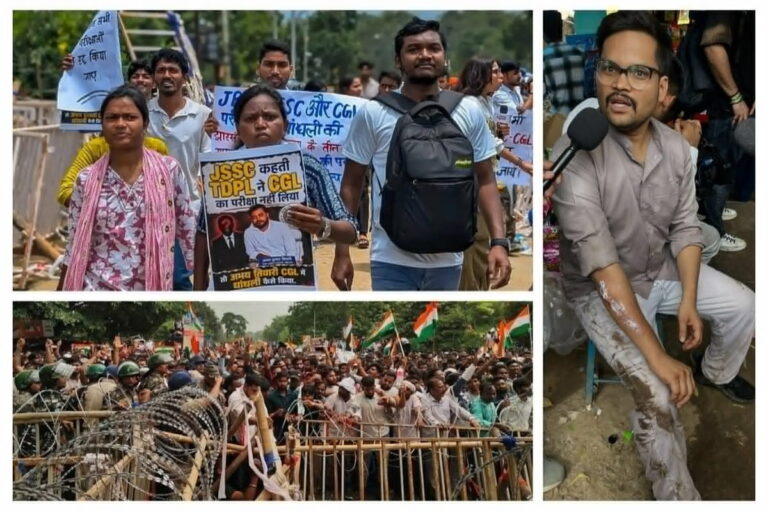
Ranchi: Barely weeks after a Gen Z movement at Delhi’s Jantar Mantar marched towards Parliament, thousands of job aspirants in Jharkhand marched towards the state Assembly on Monday, demanding Central Bureau of Investigation (CBI) inquiry over alleged irregularities in recruitment examinations of Jharkhand Public Service Commission (JPSC) and Jharkhand Staff Selection Commission (JSSC). Police used tear gas, water cannons and a mild lathi-charge after protesters breached several barricades.
Yet the Jharkhand protest is markedly different from the Delhi agitation.
The protesters here are overwhelmingly job seekers, many of whom have spent years preparing for JPSC and JSSC examinations. Their immediate demands include a clean and credible recruitment process, cancellation of examinations they believe were compromised and a CBI investigation into alleged corruption and irregularities.
That distinction has also shaped the political and media response.
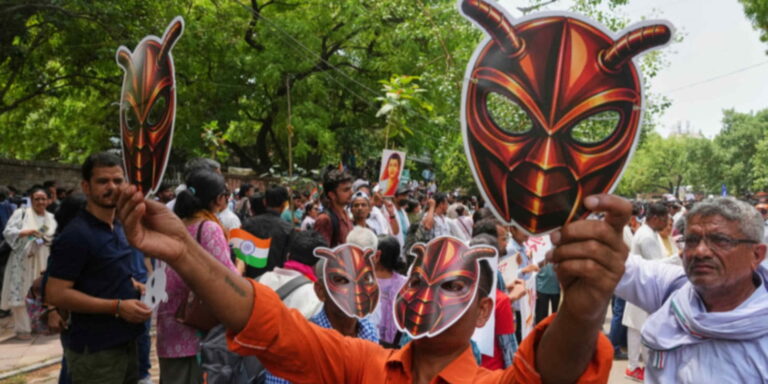
At Delhi’s Jantar Mantar, sections of the BJP ecosystem and mainstream media sought to frame the young protesters through allegations of foreign funding, including claims of links with China and Pakistan, and attempts to destabilise the government. In some narratives, the protesters were pushed into the vocabulary of “anti-national” politics.
No comparable allegations have been levelled against the Jharkhand job aspirants. The argument surrounding their movement has remained largely about examinations, recruitment, corruption and jobs.
That makes Monday’s confrontation particularly significant.
Three hours of restraint, then the barricades broke
The police did not immediately use force when the protesters began marching towards the Assembly. According to the police, the administration remained patient for more than three hours, repeatedly asking protesters to maintain peace.
The situation changed when sections of the crowd allegedly broke through barricades and pelted stones at police personnel.
Ranchi City SP Paras Rana said around 90% of the protesters remained peaceful while about 10% became violent. Police subsequently used water cannons and tear gas and resorted to a mild lathi-charge to disperse the crowd. Reports from the spot also said protesters breached multiple barricades as they tried to move towards the Assembly.
The police version of events cannot be ignored. At the same time, the use of force against protesters cannot be justified merely by the existence of a protest.
The conduct of a section of protesters and the proportionality of the police response are separate questions.
What remains at the centre of the agitation is a recruitment system whose credibility has been under sustained questioning.
Government says 98% demands accepted. Students say the remaining 2% matters most
The confrontation came even after the government and student representatives held a third round of talks on Sunday.
Ministers said around 98% of the students’ demands had been accepted. The government has agreed to investigate the allegations through the state CID, proposed an inquiry headed by a retired judge and brought the Enforcement Directorate into the investigation of alleged financial irregularities.
But the students have refused to withdraw their agitation.
The reason is the remaining two per cent.
They want a CBI investigation and cancellation of the CGL examination.
For the government, these demands represent a relatively small unresolved part of a largely accepted charter.
For the students, they are the demands that determine whether they can trust the entire process.
And that is why negotiations have failed to end the protest.
The government can point to arrests — including the former JPSC chairman
The government has not merely promised an investigation.
Higher and Technical Education Minister Sudivya Kumar Sonu told the Assembly on Monday that Chief Minister Hemant Soren was the first to order a CID inquiry into alleged irregularities in JPSC examinations.
The investigation has already resulted in arrests. Former JPSC chairman L. Khiangte was arrested by the CID on Monday, taking the number of arrests in the case to 20. Three other JPSC members — Ajita Bhattacharya, Anima Hansda and Jamal Ahmed — resigned on Sunday.
For the government, these are evidence that the state machinery is already acting against those suspected of wrongdoing.
For the students, however, the question is not merely whether there will be an investigation. It is whether the investigation will be independent enough for them to trust its outcome.
Arup Chatterjee brings the CGL demand into the Assembly
The issue also found an important voice inside the Assembly.
CPI(ML) MLA Arup Chatterjee raised the students’ demands in the House, including the controversy surrounding the JSSC-CGL examination. Minister Sudivya Kumar Sonu responded to the issues raised by Chatterjee and explained the government’s position on the latest developments.
Chatterjee later reiterated outside the Assembly that the students’ demand for cancellation of the CGL examination should be accepted.
His intervention is significant because the demand for action on the CGL controversy is no longer confined to the protesters outside the Assembly. It has entered the political debate inside the House as well.
Rahul Gandhi’s intervention adds pressure on the alliance government
The police action has also produced an unusual political complication for the Jharkhand government.
Leader of Opposition in the Lok Sabha Rahul Gandhi condemned violence against the protesting students, saying: “My message is clear to the protesting students in Jharkhand, we condemn it, we are against any violence against peacefully protesting students, does not matter where it happens.”
The statement carries additional political weight because the Congress is an ally of the JMM-led government in Jharkhand.
Gandhi did not endorse the protesters’ alleged stone-pelting or the breaching of barricades. His emphasis was on the right of peaceful protesters not to face violence.
From Delhi’s Gen Z to Jharkhand’s job seekers
The contrast with Delhi is revealing.
The Jantar Mantar mobilisation involved a largely Gen Z constituency — students and young people preparing for NEET, school and college entrance examinations and demanding accountability in the education system.
Jharkhand’s movement is driven primarily by a different anxiety: **employment**.
For a job aspirant, a compromised examination is not merely an administrative failure. It can mean losing years of preparation, missing an age limit, exhausting an attempt and having to start again.
For many, government employment is not simply another career option. It represents economic security for themselves and their families.
That is why the movement has continued even after repeated negotiations.
And unlike the Delhi agitation, the Jharkhand protesters have so far not been defined by a battle over their patriotism, political affiliations or alleged foreign links.
By forcing the formidable Union government to seek the resignation of Education Minister Dharmendra Pradhan with their relentless protests at Jantar Mantar recently, Gen Z has learned to seek accountability from those in power. Current protests with a similar objective in Jharkhand mean youngsters are no longer shying away from politics and activism.
Coinciding with the growing interest among the younger generation in political activities, the Madhya Pradesh government has assured the Jabalpur-based principal bench of the high court that it will conduct student union elections in colleges and universities across the state in September.
The Long Shadow of Sabharwal on MP’s Campus Politics
Ever since Prof H S Sabharwal’s death in Ujjain in 2006, elections to students’ bodies have been held intermittently. The last elections were held way back in 2017. Prof Sabharwal, who taught in Madhav College, Ujjain, was allegedly beaten up by activists of Akhil Bharatiya Vidyarthi Parishad (ABVP) who were unhappy over the postponement of elections. In his late 50s, the professor died of a heart attack. Courts had acquitted ABVP activists of the murder charge.
The case had hit national headlines, causing a major embarrassment to the BJP government due to the alleged involvement of a students’ body affiliated with the RSS, its ideological fountainhead. Thereafter, the elections to these bodies were held only sporadically, with the state government citing law and order and other technical difficulties. Even when the Kamal Nath-led Congress government was in power for 15 months between 2018 and 2020, the elections were not held.
The government also maintained that rallies and campaigns took their toll on academic activities, disrupting the academic calendar. No elections were conducted from 2017 onwards, and then the Covid pandemic struck. A Jabalpur resident, Adnan Ansari, who’s associated with the National Students’ Union of India (NSUI), a body affiliated with the Congress, moved the high court in 2024 seeking a direction to the state government to conduct the elections.
When the matter came up for hearing before a division bench led by acting Chief Justice Vivek Rusia and Justice Pradeep Mittal on July 15, the advocate general submitted that the academic calendar for 2026-27 was being prepared. In the last hearing, the bench was told in a written reply that the higher education department had made a provision for the elections. The court said local authorities will take a call on deployment of police force as and when sought by college and university functionaries.
The Mohan Yadav government has not made it clear whether the elections will be direct or indirect. In the direct mode, all students cast votes for posts like president and vice-president. The indirect system involves merit, with only those students who have cleared all subjects eligible to contest. Students vote for their class representative (CR). The CRs then choose the president, vice-president and others.
Why MP Governments Have Kept Campus Politics at Bay
Incidentally, the 2017 elections were held only because the ABVP had alleged that the education mafia was running a parallel network in the state. The right-wing students’ body had taken to the streets in large numbers in 2016, forcing the Shivraj Singh Chouhan government to announce that the elections would be held in 2017. Then Higher Education Minister Jaibhan Singh Pawaiya, who was once the national president of Bajrang Dal, came to the ABVP protest site in the state capital to placate the protesters. Once the demand for elections was accepted, the ABVP called the announcement ‘historic’, saying it would bring positive change in education.
Former CM Chouhan, now Union Agriculture Minister, and many others, including CM Mohan Yadav, are products of student politics. The government’s reluctance to hold elections stemmed from the fear of organised protests, which have now become commonplace.
Ranchi: Anyone who has followed Jharkhand’s recruitment examinations knows that the anger visible on the streets today did not begin with this protest.
For years, students preparing for JPSC and JSSC examinations have complained about delayed examinations, irregularities, cancellations and an uncertain recruitment process. For many of them, government-job preparation has become a cycle of waiting, preparing again and waiting some more.
That is why the current student agitation in Jharkhand needs to be seen beyond the immediate political arguments around it.
The students’ grievance is difficult to dismiss.
But what makes this protest particularly interesting is everything that has happened around that grievance: the distinct responses from the government and police, the media narrative, the entry of political parties, and the arrival of activists associated with the Jantar Mantar protest.
In fact, what remained only partly visible after the Jantar Mantar protest has become much clearer in Jharkhand.
The problems with JPSC and JSSC, however, did not begin with the Hemant Soren government. They have existed under successive governments, and the present government is also responsible for fixing them.
This Anger Has Been Building for Years
For a generation of Jharkhand students, JPSC and JSSC are not simply names of recruitment bodies. They are institutions around which many have spent years planning their lives.
The problem is not only that examinations are sometimes delayed. It is the uncertainty created by the entire process.
A student prepares for an examination, waits for a notification, prepares again, appears for the examination and then faces a controversy, delay or another round of uncertainty.
For a young person who has spent two, three or even more years preparing for a government job, another delayed examination does not simply mean waiting for a few more months.
It means another year of life.
That is the context in which the present protest has to be understood.
It would therefore be unfair to dismiss the agitation simply because political organisations are visible around it. The political affiliations of those participating can certainly be questioned, but that does not erase the original grievance or the central question: why has Jharkhand failed to create a transparent recruitment system where students can prepare with some certainty that the process will be completed on time and fairly?
Why Jharkhand’s Students Are So Angry
There is another interesting difference between the Jharkhand agitation and the recent Jantar Mantar protest.
The Delhi movement was strongly identified with Gen Z and younger students. The Jharkhand movement has a significant presence of an older generation of aspirants—millennials and others who have already spent years preparing for competitive examinations.
For them, this is not simply a protest about their future.
Their present has already been consumed by the recruitment system.
They have spent years preparing, waiting for examinations and dealing with uncertainty. Many have seen their peers move on to jobs, careers and other lives while they continue preparing for an examination that may or may not take place as scheduled.
That gives the Jharkhand movement a different kind of anger.
It is not only youthful impatience. It is accumulated frustration.
The Government Response Is What Makes Jharkhand Different
For nearly two weeks of protest, there has been no major confrontation between the protesting students and the Jharkhand Police.
That itself is worth noticing.
Even when the BJP’s student wing ABVP organised a march during the agitation, the police managed the situation without the kind of serious confrontation that has been seen during several student protests elsewhere.
This does not mean that the police should be described as being on the students’ side. But it does show a restrained approach.
A government does not have to accept every demand made on the street. But the first response to students raising genuine grievances should not automatically be force, detention or confrontation.
It should be engagement.
Jharkhand, so far, has largely followed that route.
The government was not immediately responsive. Chief Minister Hemant Soren initially said that a CID inquiry was underway and that he was waiting for its findings. But subsequently, the government formed a committee, ministers met student representatives and talks began.
More importantly, government representatives publicly acknowledged that the students’ demands were genuine and that resolving the issues could also help future generations of aspirants.
Former Jharkhand Pradesh Congress Committee president Rajesh Thakur, who met the protesting students, also spoke about the government’s response.
According to Thakur, Hemant Soren acted promptly by ordering the CID inquiry. He said the chief minister had even made it clear that if the investigation needed to reach his house, it could do so.
“Soon, there will be justice for the students,” Thakur said.
The statement puts the question of accountability at the centre of the government’s response.
The students, however, are asking for more than assurances.
After the latest round of talks, they said the protest would continue until August 10 and that they wanted the government’s response in writing.
That is important. A sympathetic statement is welcome, but eventually the students need a recruitment system that works.
Jantar Mantar vs Jharkhand: Why the Response Is Different
This is where the Jharkhand protest becomes particularly interesting.
At Jantar Mantar, students were protesting against a BJP-led government at the Centre. The movement became increasingly confrontational and the police response became an important part of the story.
In Jharkhand, the political equation is different.
Here, a non-BJP government is facing the students.
And the government’s response has been substantially different.
This does not mean that the Hemant Soren government should be given a clean chit. The problems with JPSC and JSSC have existed for years, under different governments, and the present government is also responsible for fixing them.
But the contrast in the response cannot simply be ignored.
It tells us something important about protest politics in India.
Does the way a government responds to a student movement depend on the nature of the grievance—or on which government is being challenged?
That question becomes even more relevant when political parties change sides between being in power and being in opposition.
What the Media Is Missing About the Protest
The role of the media in the Jharkhand protest is another important part of this story.
When students come out on the streets, the first responsibility of journalism should be to understand what brought them there.
In Jharkhand, however, sections of the media have spent considerable time focusing on political affiliations, activists and issues that have little to do with the core JPSC-JSSC grievance. At times, the focus has shifted towards communal and political angles rather than the examination and recruitment issues at the heart of the agitation.
The people associated with the Jantar Mantar protest became part of this narrative as well.
There was a strange irony to it.
Some people questioned why activists associated with the Delhi protest had not come to Jharkhand. When some of them eventually arrived, their presence itself became the focus.
Instead of asking why Jharkhand’s students had to spend years waiting for recruitment examinations, the conversation increasingly became about who had come to support them.
A political organisation can be questioned. An activist can be questioned. The motives of anyone entering a protest can be examined.
But those questions should not become a substitute for reporting the original grievance.
The central question should remain: why are Jharkhand’s students having to protest for a recruitment system that should have been functioning in the first place?
Why Neha Bora’s Ink Attack Changed the Story
The arrival of AISA president Neha Bora added another dimension.
Sections of the political and media ecosystem had questioned the absence of activists associated with the Jantar Mantar protest and challenged them to come to Jharkhand.
Bora eventually came.
On August 7, while marching towards the Jharkhand Assembly, ink was thrown at her. Police detained a man in connection with the incident.
Bora and her organisation alleged that the incident was linked to BJP-RSS supporters. The allegation needs to be investigated and should not be treated as an established fact.
But the incident itself cannot be ignored.
What is striking is how quickly the focus moved away from the students’ original demands.
The discussion became about Neha Bora, her political affiliations and the identity of the person who attacked her.
Yet neither the attack nor the political noise around it should divert attention from why thousands of students were driven onto the streets in the first place.
Sandeep Jaiswal, Jharkhand president of the Revolutionary Youth Association (RYA), was with Bora when the incident took place. Jaiswal had also spent a month with her during her campaign for CPI(ML) candidate Vinod Singh in the 2024 Lok Sabha election in Koderma.
He described Bora as someone who would not allow the incident to weaken her resolve.
“Neha is not the kind of girl who will lose her spirit or her resolve to fight against the system because of an incident like this. This is not going to stop her,” Jaiswal said.
He also said the incident should be seen as a warning and expressed hope that the state government would ensure her security.
For Jaiswal, therefore, the attack is not simply about ink being thrown at an activist. It is part of a larger political contest over a student movement that has increasingly attracted people and organisations from outside Jharkhand.
Who gets to own a student protest?
If AISA supports the students, does that make the entire protest an AISA movement?
If BJP or ABVP supports the students, does that make the students BJP supporters?
The answer should be no.
A student can accept support from a political organisation without becoming a member of that organisation.
Similarly, the presence of Left activists does not mean every student on the street is a Left activist.
The students need to be heard in their own voices.
That is particularly important in Jharkhand because the recruitment crisis predates the present political contest.
The BJP, which is in opposition in Jharkhand, has supported the students and attacked the Hemant Soren government over the JPSC controversy.
That is the job of an opposition party.
But another question naturally follows.
The BJP was on the other side of the political equation during the Jantar Mantar protest. It was then the party in power at the Centre.
The question, therefore, is not whether the BJP should support Jharkhand’s students. Of course it can.
The real question is whether political parties believe in the right to protest only when they are in opposition—or also when they are in power.
And this question should be asked of every party, not just the BJP.
What Jharkhand Has Made Clear
Perhaps this is the most important part of the entire story.
The Jharkhand government has not solved the JPSC-JSSC problem yet. It cannot claim success simply because ministers have met the students.
But it has shown that a government can respond to a student movement through dialogue.
The police have shown that a protest can be managed without turning it into a confrontation.
Ministers have publicly acknowledged that the students’ demands are genuine.
Now the government has to take the next step.
The students are asking for written assurances because they know that statements made during a protest can disappear once the protest ends.
They want examinations to be held on time.
They want accountability for irregularities.
They want a transparent recruitment system.
And they want the government to ensure that the next generation of students does not have to spend years fighting the same battle.
The Jantar Mantar protest raised many questions about how a government, police and media respond to student dissent.
Jharkhand has provided another part of the answer.
Here, the same kind of student anger has met a different political environment.
The government has chosen dialogue. The police have largely remained restrained. Civil society groups have entered the debate. Political parties have tried to position themselves around the movement. Sections of the media have tried to frame it through political and communal lenses.
And the arrival—and subsequent attack—of an activist associated with the Delhi movement has made those contradictions even more visible.
This is why the Jharkhand protest is important.
It is not merely about JPSC or JSSC.
It is also about what happens when students protest, and what everyone else does when they do.
Perhaps the biggest lesson is simple: a democratic government should not first ask who is supporting the students. It should first ask whether the students have a legitimate grievance.
In Jharkhand, even the government has acknowledged that they do.
Now it has to prove that acknowledgement through action.
The students have asked for the answer in writing.
Ranchi/Kolkata: Long before Neha Bora, Dalit educationist Savitribai Phule endured daily humiliation for educating girls and oppressed communities. Mud, stones, cow dung and other refuse were hurled at her as she walked to school. In independent India, one of the most widely reported ink attacks on a woman public figure was on IAS-turned social activist Aruna Roy in 2011 during public consultations on the Lokpal Bill.
More than a century after Savitribai, another young woman has become the target of public humiliation.
The Journey from NEET Protests to the Ranchi Attack
Twenty-nine-year-old Neha Bora, national president of the All India Students’ Association (AISA), was attacked with ink in Ranchi. The alleged attacker later claimed he targeted her because she is “anti-national” and supports Umar Khalid.
That one statement has turned what could have remained an isolated assault into a larger debate about dissent, student politics and the shrinking space for speaking in defence of Umar Khalid.
Thirty-eight-year-old Umar Khalid, who holds a PhD from Jawaharlal Nehru University (JNU), has spent nearly six years in prison over allegations of conspiring against the nation, without trial. Coincidentally, his doctoral research focused on Adivasi communities, including those in Jharkhand.
Neha had emerged as one of the most recognisable faces of the nationwide student movement after leading a 23-day hunger strike at Delhi’s Jantar Mantar against the NEET paper leak and corruption in the country’s education system. By the time Union Education Minister Dharmendra Pradhan resigned on July 26, her fiery speeches and persistence had made her a familiar face far beyond student politics.
The JNU research scholar had already faced lathi charges, tear gas and pellet firing during the Delhi protests. Soon afterwards, when students protesting in Bihar were allegedly fired upon with AK-47 rifles and several were arrested, Neha travelled across the state to campaign for their release.
“We did not get scared of pellets and tear gas. Do they think students will now be frightened by ink?” Neha said after the attack. “We will write our future with this ink. And we now pledge to defeat their politics of hatred.”
Ranchi Police did not disclose the identity of the attacker. However, at a press conference, Neha identified him as 26-year-old Amarnath Pandey, a Hindi honours student, and alleged that he is associated with the RSS.
A senior Ranchi journalist wrote on social media that the attack reflected a lack of genuine concern for education reforms. “Until now, they had been asking CJP and AISA to come to Ranchi. Now that they have, they are responding by throwing ink at them,” he wrote.
eNewsroom also contacted Saurav Das of the Cockroach Janata Party (CJP), but received no response till the time of publication. However, CJP shared several videos of Neha speaking after the attack and described the incident as “shameful”.
Ink Attack Rekindles Questions Over Speaking for Umar Khalid
CPIML General Secretary Dipankar Bhattacharya described the incident as another attempt to intimidate the student movement.
“Having failed to silence the youth movement by unleashing police brutalities, the Sangh brigade has now resorted to street violence and online abuse,” he told eNewsroom. “The ink attack on AISA President Neha Bora reveals its growing fear of Gen Z, and of young women activists in particular. But every such attack will only strengthen the movement.”
The alleged attacker’s statement also prompted eNewsroom to ask former Rajya Sabha MP and public intellectual Jawhar Sircar whether India had reached a point where even expressing solidarity with Umar Khalid could invite intimidation.
At a time when Umar Khalid has spent nearly six years in prison without a trial, has the space to demand due process, constitutional rights and a fair hearing become so narrow that even speaking in his support carries a cost? Is it time for civil liberties groups to speak more forcefully in his defence?
Sircar replied:
“Umar Khalid’s continued incarceration despite no tenable charges and the judiciary’s obvious indulgence is a new low-water mark in Indian democracy. It was tragic to see a once-liberal Chief Justice find newer and newer reasons to either avoid granting bail or holding the government to account—proving not only the hollowness of his much-flaunted openness but also the system’s hypocrisy.”
Dubai/Kolkata: Dubai-based real estate developer PANTHEON has announced a major brand transformation, unveiling PANTHEON – Art, Culture, Real Estate (PANTHEON ACR), a platform that combines property development, cultural programming and artistic initiatives under a single identity.
The announcement, made on August 5, marks the company’s strategic shift after a decade in Dubai’s residential real estate market. While retaining its core focus on property development, the company says it now aims to create communities by integrating cultural experiences with the built environment.
PANTHEON said the new platform is based on three interconnected verticals—art, culture and real estate—reflecting its belief that meaningful ideas, communities and creative expressions require platforms that enable them to reach wider audiences and foster deeper connections.
Under the new structure, PANTHEON Development will continue to lead the group’s real estate business, while HOP Events will serve as its cultural arm, organising live entertainment, events and shared community experiences.
Founder Kalpesh Kinariwala said the evolution reflects a broader understanding of how cities and communities are shaped.
“Real estate builds the framework of a city, but people, culture and creativity give it meaning. PANTHEON ACR is our way of creating the stage where music can be heard, culture can travel, communities can form and developments can become more than buildings,” Kinariwala said in a statement.
The company said the initiative is centred on a “people-first” approach to urban living, arguing that neighbourhoods are defined not merely by architecture or infrastructure but by the interactions, relationships and shared experiences of the people who inhabit them.
According to PANTHEON, Dubai’s multicultural character and growing global profile have influenced the company’s new direction. It believes the emirate’s position as an international hub provides an opportunity to build platforms that connect diverse communities through cultural engagement alongside residential development.
Kinariwala said real estate would remain central to the company’s identity, but added that buildings alone cannot create thriving communities.
“Communities are not built by buildings alone. They are built through the experiences, relationships, creativity and culture that bring people together. This evolution reflects the future we want to help create,” he said.
The company described PANTHEON ACR as a long-term ecosystem rather than a project centred on individual concerts, developments or markets. Instead, it intends to bring together talent, audiences, artists and communities through a combination of residential projects and cultural initiatives.
PANTHEON said its vision is to create platforms where developments become more than physical spaces, enabling cultural exchange, creative expression and stronger community engagement.
The rebranding comes as developers in the Gulf region increasingly seek to differentiate residential projects by incorporating lifestyle, entertainment and community-driven experiences alongside traditional real estate offerings.
Founded in Dubai, PANTHEON has spent the past decade developing residential communities and investment-focused real estate projects. With the launch of PANTHEON ACR, the company says it plans to expand its role beyond construction by positioning itself at the intersection of urban development, culture and the creative economy.