For millions of people in Delhi, voting has never been merely about pressing a button on an EVM. It is a small ritual of citizenship — checking the voter slip, walking to the polling booth, standing in a queue with neighbours and returning home with a marked finger.
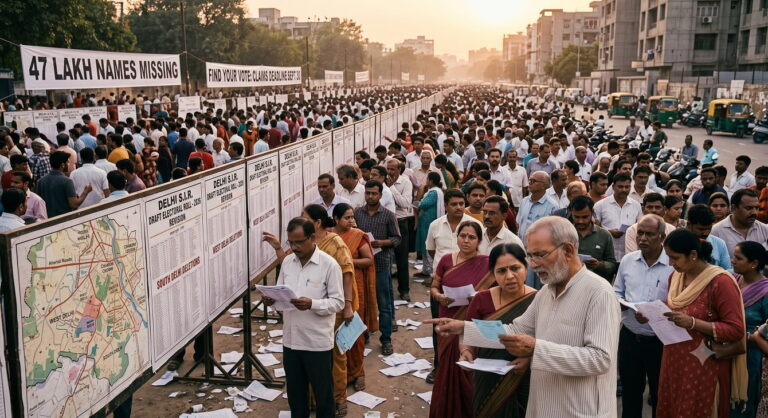
But for nearly 47.6 lakh people in the national capital, that familiar right has suddenly become a question mark.
Delhi SIR: When One in Three Voters Is Missing From the Draft Roll
The draft electoral roll published after the Special Intensive Revision (SIR) has excluded 32.78% of Delhi’s voters — almost one in every three names from the earlier list of around 1.45 crore electors. Delhi has recorded the highest percentage of deletions among the states and Union Territories covered in this phase.
Behind that percentage are people, not numbers.
There could be an elderly pensioner who has lived in the same neighbourhood for decades but was not at home when the Booth Level Officer arrived. There could be a tenant who works twelve hours a day and missed the verification exercise. A migrant worker may have travelled back to his village. A young couple may have shifted houses within Delhi but never imagined that moving a few kilometres could put their vote in doubt.
The Election Commission’s exercise categorised 43.32 lakh voters as permanently shifted or absent. Another 2.82 lakh were marked deceased, while around 1.41 lakh were identified as duplicates or enrolled at multiple places.
For the genuinely deceased or duplicate entries, cleaning the electoral roll is necessary. No democracy benefits from a bloated or inaccurate voter list.
But the real question begins with those who are alive, eligible and still living where they say they live — yet find their names missing.
When a Missing Name Becomes a Fight for the Right to Vote
For a daily-wage worker, a domestic worker, an elderly person or someone unfamiliar with online forms, proving that a name belongs on the electoral roll may not be a simple administrative exercise. It can mean finding documents, understanding forms, making repeated visits and spending a day’s wage.
The Election Commission has opened the claims and objections process until September 30, allowing excluded voters to seek inclusion.
But democracy should ideally not make citizens prove their existence after the state loses track of them.
In India’s national capital, where Parliament makes laws in the name of the people, nearly one in three voters now has to first make sure that the system still recognises them as a voter.
That is not merely a number worth debating.
It is 47 lakh individual stories waiting to be heard.
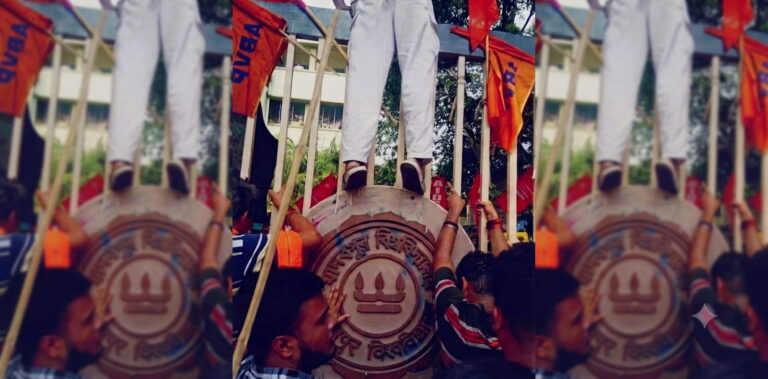
Kolkata: On 19 August, a proposed general body (GB) meeting called by the Faculty of Engineering and Technology Students’ Union (FETSU) of Jadavpur University in Kolkata sparked an altercation between members of the Akhil Bharatiya Vidyarthi Parishad (ABVP) and Left-backed student organisations. What unfolded during the intervening night of August 19 and 20, however, was unprecedented even for a campus with a long history of intense student politics, Left-wing activism, and exposure to State-led violence.
The campus was reportedly taken hostage when a mob, armed with sticks and iron rods, engaged in stone-pelting, vandalism, and the burning of flags and festoons.
According to Tanay Dutta, a third-year Chemical Engineering student, it all started when attendees were labelled ‘Naxals’ and verbally abused, even as organisers tried to prevent confrontation. As the situation escalated, “groups of outsiders appeared; some individuals were carrying bamboo poles, and the overall atmosphere became increasingly aggressive,” Dutta said.
Saptak Mistri, a fourth-year Bengali student and All India Students’ Association (AISA) member, described the mob as “100-150 men, some well into their 40s and 50s, and visibly drunk”.
Mistri described the mob’s mood and momentum as signifying a stance of “jobordokhol”, or forcible occupation, as if to invade and mark a territory yet to be conquered as their own.
“Don’t Return; You Might Die”
After the meeting broke up, students saw groups loitering near Gate No. 1. When assaults began, they repeatedly asked security personnel for help. “The guards said the assaults were happening outside the immediate campus boundary. But we felt they were indifferent,” Dutta recalled.
Several injured students, many with head injuries, were taken to MR Bangur Hospital in the university ambulance; more were sent when the ambulance returned. Treatment continued until around midnight. While at the hospital, students received messages that fires had been set inside campus, a large crowd had entered, and buildings were being targeted. “Those of us who were outside, between hospital trips, were told not to return—we could die,” Dutta said.
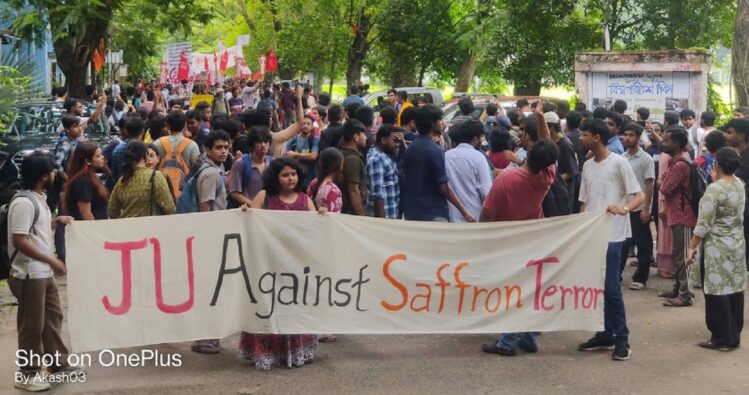
United Left rally at Jadavpur University on August 20 | Courtesy/ Akash Gupta
Violence, Inquiry and the Questions Now Facing Jadavpur University
On 24 August, Vice-Chancellor Chiranjib Bhattacharjee announced a five-member inquiry committee headed by former Calcutta High Court judge Pranab Chatterjee to investigate the 19-20 August vandalism.
The university also dissolved its students’ grievance cell, previously headed by former Vice-Chancellor Buddhadeb Sau. A Times of India report cited CCTV footage showing Sau entering campus as the mob rampaged early on 20 August, and speaking with Subhabrata Adhikary, a member of ABVP’s central working committee, while outsiders vandalised the campus. Sau is an office-bearer of the Akhil Bharatiya Rashtriya Shaikshik Mahasangh (ABRSM); both ABVP and ABRSM are affiliated with Rashtriya Swayamsevak Sangh (RSS), a Hindu far-right network.
Mistri said demands at the all-stakeholder meeting included an inquiry into the alleged role of Jadavpur BJP MLA Sarbari Mukherjee in leading the midnight “tandav”, deployment of more female security guards, and restoration of an on-campus medical facility now occupied by BJP-RSS as its office—a move he described as contrary to students’ interests and welfare.
Was the FETSU GB Meeting Illegal? The Legal and Political Dispute Behind the Clash
Talking to the media, Somsurya Banerjee, who describes himself on Facebook as a Founding Member of the Nationalist Students’ Front (NSF), questioned the validity of the FETSU-called GB meeting. In a Facebook post on August 20, he alleged FETSU tried to seize the General Secretary’s post through an ‘illegal’ GB meeting, and that ‘Naxalite/Naxal-oriented’ Democratic Students’ Front (DSF) cadres launched a ‘barbaric attack’ on ABVP members who protested this ‘undemocratic’ bid.
NSF, Banerjee wrote, “extends unconditional solidarity to ABVP in this fight for campus democracy and student rights”. ABVP is a student organisation affiliated with the RSS; NSF has no official RSS affiliation. ABVP alleged the “general body was called even though there are no official union representatives in the university”.
In his post, Banerjee cited RTI documents and the Calcutta High Court’s order in WPA (P) 241 of 2025, claiming they show unauthorised student unions or GB meetings lack legal recognition.
When eNewsroom contacted Banerjee for a response, he elaborated on his allegations: “While NSF condemns any violence inside campus, the available CCTV footage doesn’t show any public property being destroyed or any student being beaten up; we can only see flags being burnt and posters being torn. And while that is wrong, what is worse is the khap-panchayat style politics in the name of a GB meeting, which can’t be held without an election in the first place. For the past two years, we have been raising our voice against the dirty politics practised in the name of unions; imposing union politics on students, making them scared about losing scholarships and jobs if they don’t participate.”
He further elaborated that “what is more shocking and condemnable is that the Left unions, despite calling themselves Communists, used casteist slurs against ABVP members. Two ABVP members had to be hospitalised as a result of the violence inflicted on them, just because their political ideology is different.”
“If people are found guilty of engaging in violence and vandalism, they should be prosecuted. We would also recommend the deployment of police outposts outside the campus for greater security,” Banerjee added.
Dutta told eNewsroom that this is a ‘false narrative’, saying the 19 August, 5.30 PM GB meeting was called to address administrative issues around student-run bodies and campus resources.
According to Dutta, the GB meeting agenda covered bank account signatories, access to the mail, and FETSU Facebook page adminship. “The idea is that all students should know who has administrative access. Nobody should be able to secretly control the Facebook page. Students should know who is managing it, so that issues can be raised if necessary,” he explained. These included access to FETSU accounts for Srijan, the annual techno-management fest and Sanskriti, a cultural initiative associated with FETSU.
“Apart from that, throughout the year—not just during festivals—there are sponsorship activities and other campus-related events. For those purposes, someone needs authority over banners and related matters. Security and accountability require that there be a designated signatory. We demanded that this be formalised through the GB process,” Dutta said. The meeting also discussed access to organisational email accounts and procedures for transferring control between office-bearers.
“Every year, through the GB meeting, there is supposed to be a signatory. The signatory holds access to these accounts as a beneficiary during that period. Later, whenever a new signatory is chosen, the access is transferred to that person. This is part of the system,” he explained.
The accessible copy of WPA (P) 241 of 2025 is an order dated July 3, 2025 in Sayan Banerjee v State of West Bengal & Ors. It notes a government affidavit listing universities where student-union elections had not been held recently, and no student council was functioning, and directs that where there is no recognised body or council, student-union rooms should be locked and access controlled by written permission from the Registrar or another competent authority.
On the material available, the order concerns the absence of a recognised student body or council; control and access to student-union rooms; and preventing unauthorised use of those rooms. It does not automatically prove that every student-organised GB meeting is illegal; that FETSU has no authority to hold any internal meeting; that a meeting discussing accounts or digital resources is legally void; or that a person selected at such a meeting cannot perform any organisational function.
The distinction between unauthorised use of a union room, an unrecognised student body, an invalid university election, and an illegal meeting is legally important. Banerjee’s post, however, treats these separate questions as one claim, although the order does not expressly resolve all of them.
Dutta maintained the meeting was not an ‘election’ but a selection process via the GB mechanism to ensure continuity in managing these resources. “What we did was not an election; it was a selection. Through the GB, we wanted to select who would hold access to the GS account,” he explained.
The published JU election rules state a General Secretary is elected by students of the concerned faculty. JU’s last documented students’ union election was on 19 February 2020—six years and six months before the disputed meeting. In the 2020 election, Students Federation of India (SFI) retained the Arts Faculty, We The Independent (WTI) the Science Faculty, and Democratic Students Front (DSF) the Engineering Faculty; ABVP contested nine of 13 central-panel seats and failed to secure a single office-bearer position.
eNewsroom didn’t verify either Banerjee’s or Dutta’s claims independently.
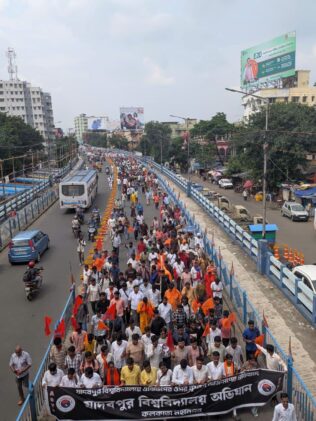
ABVP rally on August 20 | Courtesy: ABVP/Facebook
From ‘Dimagi Naxal’ to The Bengal Files: How Jadavpur Became an Ideological Battleground
A significant moment in the ABVP’s ideological terrain-marking drive arrived with a screening of The Bengal Files inside the Jadavpur campus on August 16, 2026, a day after Prime Minister Narendra Modi coined the term ‘Dimagi Naxal’. The third instalment in Vivek Agnihotri’s Files franchise, banned from screening by the former Trinamool Congress government, has been criticised as furthering Hindutva propaganda.
In Modi’s speech, ‘dimagi Naxal’ referred to people with a Naxal or Maoist mindset rather than armed cadres. Sanjib Acharya, Professor of Mechanical Engineering at Jadavpur, called it “yet another addition to the long-existing tradition of a stigma-inducing vocabulary, including phrases such as ‘urban Naxals’, used to paint students, academics, rationalists, free-thinkers as the other, cut off from the rest, and therefore dangerous. Such labels serve the agenda of the ruling regime to portray them as suspect and a threat to peaceful existence.”
Acharya reminded that Jadavpur has largely had a ‘Bam gharana’ of ‘Left-leaning culture’, and in the current climate, the August vandalism must be understood as an attempt to occupy the progressive space and redraw it through communalisation.
Manas Ghosh, Assistant Professor of Film Studies, said, “The irony is that the phrase is no longer a taboo, as it is intended to be.” Soon after Modi’s call, a digital page called Dimagi Naxal Party appeared on Instagram, following a genesis similar to that of Cockroach Janata Party (CJP), which emerged after derogatory remarks by CJI Justice Surya Kant and quickly evolved into an online and on-ground youth movement.
“Why should there be an issue if an engineering student, who has come to the university for four years, also learns to care about Nandigram, Singur, or hawker evictions or Palestine? Why should there be a problem if they cultivate and nurture a social consciousness? The problem is that the ruling regime would like it if students were mere careerists, and not thinkers, and never raised a slogan or walked in solidarity with oppressed people.”
Ahead of the 2026 West Bengal Assembly election, Modi singled out Jadavpur, decrying ‘anti-national’ messaging on campus walls. The professor argued for a ‘panorama’ of nationalism: “Indian nationalism first took its roots in the anti-colonial struggle, but it can never be reduced to any one school. The nationalism of Rabindranath Tagore is different from that of Mahatma Gandhi, and Gandhi’s from Ambedkar, and so on. Moreover, the Congress, the socialists, the communists—all contributed to the nationalist struggle in their own ways. But no history book has found any positive contribution of the RSS and Hindu Mahasabha in anti-colonial discourses.” “A distinction must be made between a nationalist and a State-ist.”
Ghosh pointed out, “The former is a shared sentiment of belonging, the latter demands absolute obedience to a legal-political mechanism.”
Beyond Campus Politics: Why the Jadavpur Clash Is Also a Battle Over Public Education
Ujan, a third-year Comparative Literature student, broke down the cost of a Humanities degree at Jadavpur: Rs 1,235 for the first year, Rs 950 for the second and third. Describing the ‘freeship’ for disadvantaged sections, she described the August violence a battle between ‘free thinking’ and the agenda of privatisation of the education sector. “The ruling regime is insisting on private schools so that only one section of society, those who can afford it, will get education,” Barsha Baral, joint secretary of AISA West Bengal, added. Baral has pursued her graduation and post-graduation degrees in Sociology from Jadavpur University, and is currently pursuing a PhD from Presidency University.
“One must look at the scams at the heart of the National Testing Agency (NTA) and the controversies surrounding the National Education Policy (NEP) and see how the ruling regime is in favour of a monolithic educational model and treats education as a commodity, rather than a right,” Ujan said. The NEP has also been criticised for eroding federal autonomy and embodying the “three Cs” of centralisation, commercialisation, and communalisation, with a “one-syllabus model” promoting sanitised, government-approved books.
Ujan described the attack on Jadavpur as an attack on this inclusive ‘Jadavpur model’, following a pattern of police brutality, digital surveillance, and State-led violence unleashed on scores of youth protestors in New Delhi and elsewhere. A NITI Aayog report notes an average of 25 schools closing daily in India over the past decade. As the second wave of the Cockroach Janata Party (CJP) movement addresses school reforms, Baral said the attack on Jadavpur is part of a long-term project to strip its autonomy and delegitimise its egalitarian voice.
BJP, ABVP and the ‘Final Battle’: Why Jadavpur Matters to Bengal’s Campus Politics
After the vandalism, West Bengal BJP president Samik Bhattacharya said ABVP is not the student wing of BJP and functions independently, though it is RSS-affiliated.
Yet Minister of Urban Development and Municipal Affairs Agnimitra Paul called it an “ideological battle against dimagi Naxals”.
Minister Dilip Ghosh described Jawaharlal Nehru University (JNU), Delhi University (DU), and Osmania as already transformed, and called Jadavpur the ‘final battle’ of this BJP-led campus transformation, asserting “change has happened” and “everything will happen” within six months. Baral countered that this ‘final frontier’ has traditionally been a bastion of “free, secular, and democratic thinking”, a citadel of inclusive public education.
“Under the current ‘double-engine’ government in West Bengal, the ABVP enjoys impunity, and with this impunity they want to impose their vision of a monolithic India; an India without diversity. They want to impose the idea of ‘One Nation, One Election’, and also ‘One Nation, One Party’, which is not only an attack on the multifaceted, multicultural, pluralistic identities of India but on democracy itself,” Mistri said.
From Jadavpur to Presidency and Midnapore: How Campus Clashes Are Spreading Across Bengal
The violence reverberated across West Bengal, with clashes between ABVP and AISA-SFI supporters at Presidency University and Midnapore College. Mistri described a disturbing pattern: under Bengal’s ‘dada culture’, senior ABVP ideologues threaten students to join rallies, warning of registration card cancellation. “And it’s not just a Kolkata phenomenon; it’s a Bengal-wide phenomenon,” he said, noting fear from Barasat to Midnapore.
Reacting to BJP leader Ghosh’s comment that “Jadavpur is an exceptional place, like an island”, Ujan said, “Jadavpur is not an isolated or disconnected island; here, students take up causes that affect them collectively, as they grapple with concerns of placement, job insecurity, and increasing dependence on gig work. Here, students also speak up for greater social good.”
For Ujan, the August vandalism also carried a Brahminical, Manuwadi undertone, viewing the “woman’s body as a battleground”.
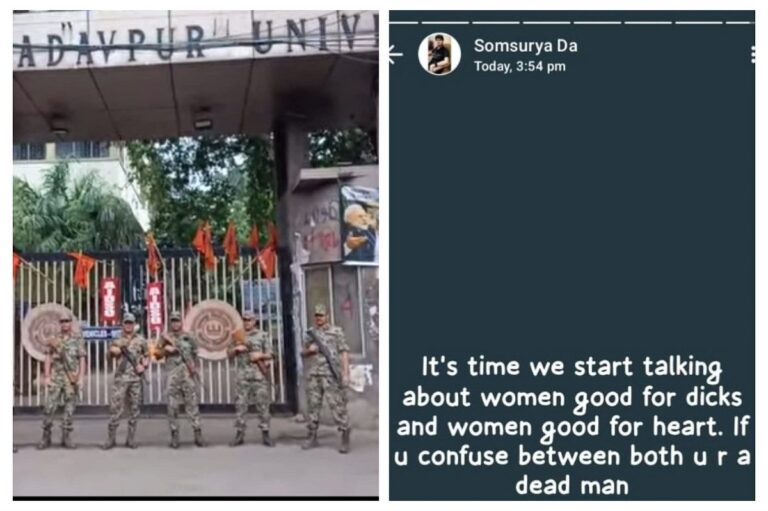
Adding to the concerns over the gendered undertones of the confrontation, a source who requested anonymity shared with eNewsroom a WhatsApp status posted by an NSF member that read: “It’s time we start talking about women good for d**cks and women good for heart. If you confuse between both u r a dead man.”
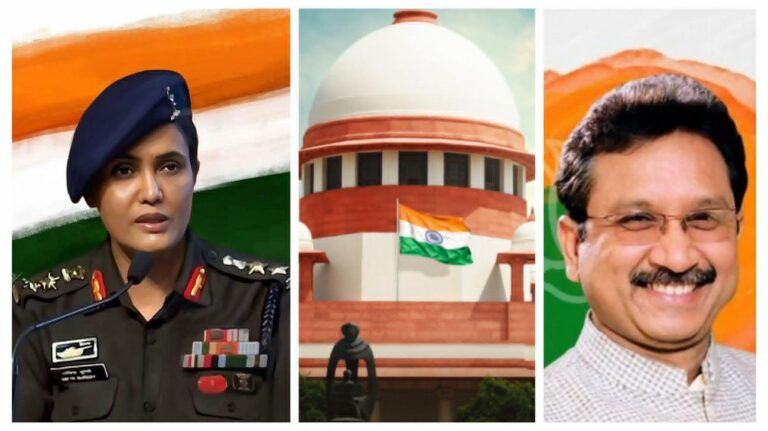
By throwing its full weight behind habitual offender Vijay Shah, a senior minister, the Mohan Yadav government in Madhya Pradesh has demonstrated an appetite for impropriety, even at the cost of inviting potential judicial ire.
In May 2025, the minister had called Colonel Sofiya Qureshi a ‘sister’ of terrorists involved in the Pahalgam terror attack. The Colonel was among the spokespersons of the NDA government who briefed the media on India’s strikes against Pakistan.
Nearly 15 months after his abominable remarks sparked nationwide outrage, the minister has escaped any criminal or political action, even though an SIT set up by the apex court has long submitted its report. The BJP government has not sanctioned the prosecution of the motormouth minister.
Vijay Shah Case: How the Yadav Government Chose to Protect Him
Days before the matter is scheduled to come up for hearing in the Supreme Court, the Yadav cabinet decided to protect the minister. Usually, when the Council of Ministers meet, many administrative officials are present either to provide information or an explanation or to record the minutes.
As widely reported in the local media, once the official agenda was over, only a handful of senior bureaucrats were allowed to remain in the room, and the rest were told to leave. Shah was allowed to explain himself, and then asked to leave the room too.
Apparently satisfied with his defence, the other ministers, including Chief Minister Mohan Yadav, discussed steps to meet the legal challenge as the higher judiciary has repeatedly expressed displeasure over the government’s dilly-dallying in the case.
On one pretext or another, the Yadav government had not made its stand on the prosecution sanction clear. During the unofficial meeting, the Cabinet ministers felt that Shah had publicly apologised on four occasions for his remarks, and the punishment was sufficient. They insisted the matter should rest here.
During a hearing in January this year, the Supreme Court learnt that the SIT had submitted its report last year itself, but the Yadav government was sitting on the request for prosecution sanction. The apex court refused to accept the argument that the minister had already apologised, and gave the government two months to decide.
In May, the apex court asked the MP government to abide by the previous orders and gave it four months to file a report on the action taken in the case so far. On July 23, the court was told the government had filed no report so far.
Vijay Shah Case Raises Questions Over Constitutional Impropriety
Unless there’s a last-minute course correction, the government is unlikely to give the go-ahead to prosecute the minister, who has made several controversial remarks in the past too. The only time he was penalised was more than a decade ago, when he was stripped of his ministerial portfolio after an alleged pass at then-incumbent Chief Minister Shivraj Singh Chouhan’s wife.
It’s unclear whether the MP government has yet sent a report to Governor Mangubhai Patel. According to legal experts, the governor’s decision will be crucial in the matter. For the record, after the informal Cabinet meeting ended, PWD Minister Rakesh Singh had claimed that the matter was not discussed at all.
The Opposition Congress, meanwhile, wrote to the President and the Governor seeking their intervention in the matter. Accusing the BJP government of committing a constitutional impropriety (by refusing to grant prosecution sanction), the Congress asserted that a minister who insulted a serving army official was being protected.
Legal experts said the government’s reported refusal to sanction prosecution amounted to contempt of court. According to Supreme Court lawyer Vivek Tankha, the MP Cabinet had no authority to decide whether to prosecute the minister or not because it was contrary to the higher judiciary’s intent.
It may be recalled that the state government was not even keen on initiating proceedings against the minister, but the FIR was filed only because the MP High Court had given a direction to that effect. While the legal proceedings are on, the Yadav government hasn’t even stripped him of the portfolio.
India’s discourse on women’s workforce participation is increasingly informed by evidence on the structural barriers that shape women’s economic choices and opportunities. Research has consistently highlighted the importance of childcare, mobility, safety, social norms, access to skills and the availability of decent work in determining whether women can enter and remain in the labour market. Yet one dimension of women’s economic participation has received considerably less attention: the burden of extreme heat on women’s work.
A growing body of research examines the gendered impacts of climate change, documenting differences in women’s exposure to climate risks, health outcomes, livelihoods, unpaid care responsibilities and economic security. However, considerably less attention has been given to a related question: to what extent can increasing climate stress affect women’s ability to enter, remain in or sustain participation in the labour force?
The Hidden Cost of Heat on Women’s Work
The latest Periodic Labour Force Survey (PLFS) provides an important starting point. In 2025, 10.5% of women who were outside the labour force reported health or age-related reasons for not participating. This does not establish a causal relationship between heat and labour force participation. However, it highlights health as an existing dimension of labour market exclusion- one that warrants greater attention as exposure to extreme heat increases.
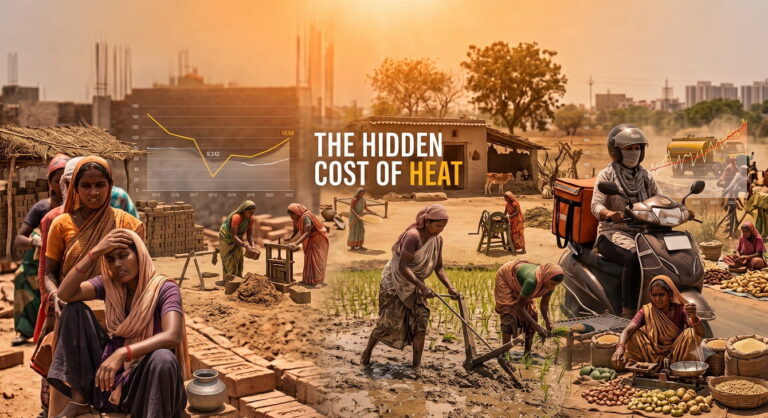
The scale of the climate work nexus is already significant. The 2025 Lancet Countdown estimates that heat exposure resulted in 247 billion potential labour hours lost in India in 2024 with agriculture accounting for 66% and construction for a further 20%. The associated potential income loss from reduced labour capacity was estimated at USD 194 billion. Yet even this major assessment does not provide a gender disaggregated estimate of these labour losses. We know the overall economic cost of extreme heat and yet again there is less known about who bears that cost and women are probably among those most affected. This matters because women are significantly represented in agriculture and a range of informal and precarious forms of work where access to cooling, paid leave, occupational health protection and flexible working arrangements is often limited or absent.
A 2025 study by the M S Swaminathan Research Foundation on “The Impact of heat on the health of women in India – A Cross-sectional Study” provides important gender specific evidence. Covering more than 3,300 women across 15 districts in seven states including Andhra Pradesh, Karnataka, Kerala, Maharashtra, Rajasthan, Tamil Nadu and Uttar Pradesh, the study examined the health and socioeconomic impacts of extreme heat on women as well as differences associated with occupation, poverty, caste and unpaid care responsibilities. 97% of respondents reported wage losses exceeding ₹1,500 during peak summer months.
This shifts the discussion beyond productivity alone. For women working without income protection, a heat-related reduction in productivity can translate directly into reduced earnings and greater household financial insecurity.
More recent evidence from southern India strengthens the case. A 2026 Scientific Reports study of 1,560 informal outdoor workers across 11 districts of Tamil Nadu found that elevated heat exposure was associated with a 1.4 fold higher risk of perceived productivity loss. The research documents heat related wage losses and called for workplace adaptation measures addressing working conditions, health protection and income security.
Furthermore, a recent 2026 report by HERA, “Counting the Cost of Heat: The Case for Urgent Solutions for Cities” reinforces this point by bringing together climate projections, health and labour productivity modelling, gender disaggregated economic analysis and qualitative evidence from informal women workers. Its analysis of Ahmedabad found that women in the informal economy lose an average 7% of their annual wages to extreme heat. The report also highlights how heat increases women’s unpaid workload- in Ahmedabad, women reported spending an additional 120 minutes on unpaid domestic work on heatwave days as routine household tasks take longer and caregiving demands increase.
Heat Does Not Affect All Women Equally
This is where an intersectional lens becomes critical, particularly when considering how socio-cultural norms shape women’s exposure and ability to adapt.
While writing about social expectations around modesty, medical journalists, Indu Subramanian and Christianez Ratna Kiruba argue that dressing appropriately for heat is a privilege. I have experienced a small part of this myself. I wear a scarf on my head, by choice, as part of my faith. In extreme heat, I am more conscious of how clothing, ventilation and access to cooling can shape physical comfort. Yet I also recognise the privilege embedded in my experience as an urban professional, I can access air-conditioning, breathable clothing, reliable electricity, indoor workspaces and limited exposure to cooking fires.
However, the experience is very different for a woman agricultural worker working outdoors, a domestic worker travelling between households, a woman working in a poorly ventilated home or a platform worker waiting for her next assignment on a Delhi street.
The 2026 HeatWatch study of women platform workers in Delhi-NCR illustrates this intersection of climate exposure, employment conditions and gender. 86% of respondents reported at least one heat-related health challenge, 69% reported reducing or stopping work because of heat-related illness, and 71% reported a decline in summer income.
These findings point to an important distinction- women do not experience climate risk uniformly. Caste, class, occupation, geography, housing conditions, access to technology, disability, pregnancy and access to social protection can all shape a woman’s ability to adapt to extreme heat. The academic evidence on the direct relationship between extreme heat and women’s labour-force participation in India, however, remains limited.
This evidence gap is itself a policy concern.
India Needs to Count the Women Behind the Heat Loss
A 2023 PLOS Climate analysis by Vijay S. Limaye highlights how the health and financial costs of extreme heat for women remain inadequately captured in climate economic assessments, particularly in the global south. The paper argues for greater recognition of these costs in adaptation and public-health planning. The implication is not that climate change should replace the established explanations for low female labour force participation. Rather, climate stress should be recognised as an additional structural condition that can interact with existing barriers to women’s economic participation.
This calls for greater convergence between climate adaptation, labour, social protection, public health and gender policy. It also calls for stronger public investment, updated policy frameworks, better gender disaggregated evidence and gender responsive heat action. The data and administrative mechanisms to respond already exist. The opportunity now is to build on them by recognising extreme heat not only as a public health concern but also as a workforce and economic resilience issue.
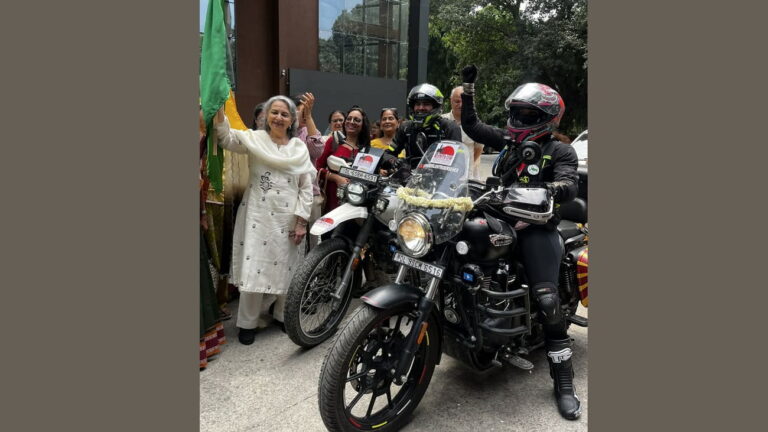
Delhi: “We need to be more tolerant, to be more understanding, more welcoming, and give more time to all of us who are going through this struggle to understand,” actor Sharmila Tagore said, addressing not just those living with mental-health difficulties, but also the people around them who may not always know how to respond.
Her words came at the flag-off of a journey that is taking the conversation about mental health onto the road — a more than 7,000-kilometre motorcycle expedition from Delhi to Kanyakumari and back, led by Seher Hashmi.
Beyond the Horizon: A Ride for Resilience, flagged off in New Delhi on August 20, brings together riders, mental-health professionals and public figures in an effort to raise awareness, challenge misconceptions and encourage people to seek support.
But for Hashmi, the journey is more than a campaign. It is deeply personal. She has lived with mental illness for more than a decade, and her own experience of finding support has now become the foundation for reaching out to those who continue to suffer in silence.
Tagore, speaking at the event, acknowledged that the expedition ahead would not be easy. But, she said, Hashmi’s own journey had been “much bigger”.
Doctors, therapists, family members and friends had stood by Hashmi, Tagore said. Yet ultimately, it was Hashmi herself who had to make the decision to change her life and take care of herself.
That personal journey now forms the heart of a much longer one — a ride of more than 7,000 kilometres across India, bringing together motorcycle riders, mental-health professionals and public figures to raise awareness, challenge misconceptions and encourage people to seek support.
The expedition will take Hashmi and the participating riders from Delhi to Kanyakumari and back, passing through several states and cities along the way.
The journey to Kanyakumari will take them through Alwar, Jaipur, Ajmer, Udaipur, Ahmedabad, Vadodara, Surat, Mumbai, Pune, Kolhapur, Goa, coastal Karnataka and Kerala before reaching the country’s southern tip.
The return route will pass through Tamil Nadu, Karnataka, Telangana, Maharashtra, Madhya Pradesh and Rajasthan before the riders head back to Delhi.
For Hashmi, however, this is not simply a long-distance motorcycle expedition. It is an extension of a conversation she has been carrying with her for years.
Mental Health Awareness on the Road: From Kashmir to Kanyakumari
Hashmi has previously undertaken motorcycle journeys to create awareness around mental health.
Last year, she travelled from Delhi to Kashmir, where she and her team conducted mental-health awareness sessions across several cities. Earlier this year, she also conducted awareness sessions at 22 locations in Karnataka.
Hashmi has spoken about why she continues to take the conversation onto the road.
“I was one of the lucky ones who got support, but so many continue to suffer in silence. This journey is for them,” she said in an interview with a news portal.
Her earlier journey to Kashmir also gave her an experience that she continues to remember.
During that motorcycle expedition, Hashmi conducted a mental-health session with more than 50 women from the J&K Armed Police.
“It changed everything,” she recalled in an interview with a news portal. “The women opened up, they asked questions; they shared.”
For Hashmi, moments such as these appear to underline why conversations about mental health cannot remain confined to formal settings. Sometimes, the first step towards seeking help is simply finding a space where someone feels safe enough to speak.
The participation of women riders adds another dimension to the current expedition. Their presence brings questions of mobility, confidence and independence into a campaign that is fundamentally about mental health and the ability to ask for help.
Mental Health Misconceptions Can Stop People From Seeking Help
Psychologist Khilly Marwaha, who is associated with the campaign, said one of the biggest challenges remains the misconceptions surrounding mental health and professional support.
“Often we overshadow it, saying that everyone has stress,” Marwaha said, pointing to the tendency to reduce mental-health concerns to ordinary stress.
In India, she said, there are still “a lot of myths and misconceptions” surrounding mental health and seeking support.
Marwaha urged people to pay attention to changes that may suggest that someone is struggling. These may include cognitive, behavioural and emotional changes, as well as changes in physical wellbeing.
Mental health, she stressed, is as important as physical health.
She also cautioned against dismissing people experiencing emotional or cognitive difficulties as simply lacking resilience.
Instead, Marwaha said, people should encourage those facing difficulties to seek professional help.
“Every issue can be addressed at the right time. People don’t have to suffer,” she said.
For her, recovery can sometimes begin with something as simple as a conversation.
“We all can heal by talking to someone. We all can heal by connecting with the right people,” Marwaha said.
Marwaha said the campaign was significant because relatively few people are able to dedicate their time to travelling and spreading awareness about mental health, helping others recognise the signs of mental-health difficulties and understand when and where to seek support.
The speakers at the flag-off event approached the issue from different directions.
Tagore spoke about Hashmi’s deeply personal journey and the decision she ultimately made to change her life. Marwaha focused on recognising signs of distress, challenging misconceptions and encouraging people to connect with professional support.
Hashmi’s own story sits at the centre of both perspectives.
She has lived with mental illness for more than a decade. She has also experienced what support can mean at a difficult point in life — and has chosen to turn that experience into a journey aimed at reaching people who may still be suffering silently.
As the riders begin their two-month expedition, Beyond the Horizon: A Ride for Resilience therefore becomes more than a ride across India’s highways.
It is an attempt to carry a conversation from one person to another, from one city to another — and perhaps, along the way, make it a little easier for someone to say what they have been unable to say for years.
For Hashmi, the road ahead stretches thousands of kilometres.
But the destination is not merely Kanyakumari, or Delhi on the return journey.
It is a society in which asking for help is understood not as weakness, but as one of the first steps towards healing.
Kolkata: Tension gripped Jadavpur University on Wednesday night after a dispute between members of the Akhil Bharatiya Vidyarthi Parishad (ABVP) and Left-backed student organisations over a proposed general body (GB) meeting of the Faculty of Engineering and Technology Students’ Union (FETSU) escalated into violence, with allegations of stone-pelting, vandalism and the burning of flags and festoons on the campus.
Several students were reportedly injured in the unrest and taken to KPC Medical College and Hospital for treatment. Police personnel reached the university premises late at night and intervened to bring the situation under control.
According to students and members of the Left student organisations, the immediate dispute centred on the GB meeting called by several Left-backed organisations, including the Students’ Federation of India (SFI). ABVP members questioned the legitimacy of the meeting and objected to what they described as an attempt by student organisations to convene a meeting without an elected student union being in place. The disagreement reportedly led to a heated exchange before turning physical.
ABVP Objects to GB Meeting, Left Groups Allege Campus Entry and Vandalism
Left student organisations alleged that a group of ABVP supporters entered the university campus late at night after gathering near Jadavpur police station. According to them, at around 12.30 am, the group moved towards Gate No. 4, allegedly forced open the closed gate and entered the campus. They further alleged that posters, flags and festoons belonging to SFI and other student organisations were torn down and set on fire. The group then reportedly moved towards Arvind Bhavan, which houses the Vice-Chancellor’s office.
Left-backed students also alleged that some students sitting in the field behind Arvind Bhavan were chased. They claimed that people from outside the university had also been brought onto the premises during the unrest. There were also allegations of brick and stone-pelting from both sides. Students inside Arvind Bhavan reportedly closed the gate amid the tension, while stones and bricks were allegedly thrown towards the building. These claims could not be independently verified.
ABVP Denies Allegations, Claims Its Members Were Attacked
ABVP, however, presented a different account of the night’s events. The organisation alleged that SFI and other Left student groups had unilaterally called the GB meeting despite the absence of an elected student union at the university. An ABVP member claimed that when its members went to protest against the meeting, they were attacked by a large group of students. According to the ABVP, around 70–80 people were involved in the alleged assault, following which its members resisted.
ABVP also alleged that Dalit students were among those targeted during the melee. The organisation subsequently held a protest outside Jadavpur police station, demanding the arrest of those allegedly responsible for the violence.
SFI’s All India General Secretary Srijan Bhattacharya rejected the allegations against his organisation and accused ABVP and BJP supporters of attempting to create unrest on the campus. In a video message, Bhattacharya claimed that students of the engineering faculty had gathered for a meeting when ABVP supporters allegedly entered the area and attempted to disrupt it. He said the initial dispute was between engineering students and alleged that SFI was not involved in the first confrontation.
Bhattacharya later alleged that BJP supporters entered the campus and vandalised university property. He questioned why there should be opposition to a democratic process involving students and accused the BJP and ABVP of attempting to create unrest at Jadavpur University.
BJP, Left Trade Charges as Rival Protests Planned at Jadavpur
The episode has also triggered a political face-off, with leaders on both sides blaming their opponents. Jadavpur BJP MLA Sarbori Mukherjee alleged that there is currently no elected student union at the university and questioned the legitimacy of the GB meeting. “There is no union in Jadavpur. Still, GB meeting money is illegal. ABVP protested against this. That is why the Left boys beat them up,” she said.
Mukherjee also alleged that anti-national slogans and activities would not be allowed on the campus and warned those involved in attacking ABVP members of legal and political consequences.
Her remarks drew criticism from Left student organisations, which accused the BJP of attempting to politicise the university and justify alleged violence on campus.
Following the night’s violence, both ABVP and Left student organisations announced separate protest programmes for Thursday. DSO State Committee Secretary Biswajit Roy alleged that a section of ABVP and RSS supporters had torn flags, set them on fire and vandalised parts of the university. He said his organisation would protest against the alleged attack.
ABVP, meanwhile, announced a protest procession from Golpark to Jadavpur at noon, demanding action against those it accused of attacking its members. With both sides planning demonstrations, the possibility of further tension on and around the campus remains a concern.
The violence has also prompted reactions from civil society members, former students and activists, many of whom expressed concern over the growing political polarisation of educational institutions.
Student leader Chhandak Chatterjee alleged that the episode was part of a wider pattern of attacks on educational institutions. He wrote on social media that the BJP was opposed to education, science and critical thought, and linked the Jadavpur developments to violence and controversies at other educational institutions.
He also warned that the situation could escalate if the administration failed to act promptly. Referring to reports of fires and alleged attempts to enter administrative buildings, he said the authorities would be responsible if a major incident occurred.
Social activist Saikat Bandyopadhyay also condemned the alleged attack, describing it as an assault on Jadavpur University’s democratic and academic culture. He wrote on Facebook, “Late at night, so-called Hindutva activists attacked Jadavpur University. There is no need for a cover-up; it was like a full-scale Taliban-style attack. When an incident happens, everyone’s version generally needs to be verified. But there was no need to do that here because, unbelievably, the attack was broadcast live on social media.”
“As a result, this kind of thing will continue at Jadavpur. It will happen at Presidency. It will happen at Asutosh. It will happen across Bengal. Earlier, Jadavpur alumni and students protested, but there were no such attacks then, nor was there any proud broadcast of an attack. Now this is happening across the state. What will you do about this attack? Not just this particular attack, but the attacks taking place across the state and the destruction of the pride of our democracy? It would be good if something were done. Otherwise, what else can I do? I will watch all of this unfold live from afar,” Bandyopadhyay added.
Kazi Mohammed Sherif Saheb spent his life among people, communities and movements, working for those whose voices were often unheard and standing firmly for equality, human dignity, secularism and social justice.
A social worker, public servant, social activist, writer, organiser and mentor, he was not merely associated with people’s movements—he helped nurture them, guide younger activists and build institutions that sought to empower marginalised communities.
His sudden demise on 11 August 2026 has left his family, friends, colleagues, fellow activists and countless people whose lives he touched deeply shocked and bereaved. For those who worked with him, however, his passing is not only the loss of an individual. It is the loss of a repository of experience, knowledge, wisdom and institutional memory built over decades of public service and social action.
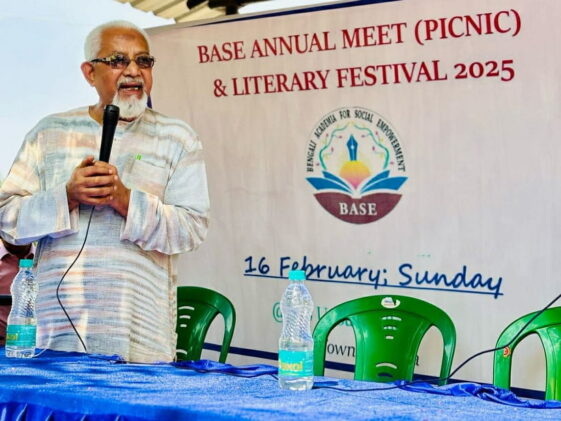
Until the end of his life, Kazi Saheb remained the State Convener of the National Alliance of People’s Movements (NAPM), West Bengal. He was also a Founder Member and Vice-President of the Bengali Academia for Social Empowerment (BASE), an organisation whose development and work he helped shape.
His life was guided by a simple but deeply held belief: human beings deserve dignity, justice, equality and compassion.
Kazi Mohammad Sherif | Arranged
A Life Dedicated to People’s Movements and Social Justice
Kazi Saheb’s commitment to society extended far beyond his official responsibilities. Throughout his life, he remained actively associated with people’s organisations, social movements and initiatives for social justice.
He stood firmly against communalism, discrimination, exploitation and injustice in all their forms. He believed passionately in equality, human dignity, secularism and the rights of ordinary and marginalised people.
He understood that meaningful social transformation required both research and action. He encouraged younger activists and colleagues to study social realities carefully, understand the problems faced by marginalised communities, and translate that knowledge into meaningful collective action.
That combination of knowledge and action became one of the defining features of his public life.
Whether through meetings, campaigns, discussions, research or direct engagement with communities, he brought to social movements a rare combination of experience, knowledge, patience and determination.
Since joining NAPM, he remained alert, active and always ready to participate in people’s struggles and social actions. As its State Convener in West Bengal, he carried out his responsibilities with remarkable sincerity, commitment and a strong sense of public accountability.
His commitment to equity and social justice was recognised and remembered by many of his fellow activists.
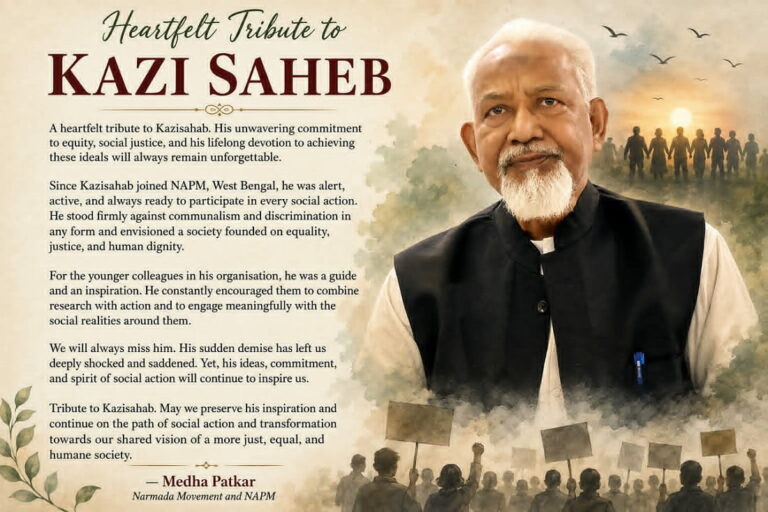
Medha Patkar of the Narmada Movement and NAPM paid a heartfelt tribute to him, recalling his unforgettable commitment to equity and social justice and his readiness to participate in every social action. She remembered his strong vision against communalism and discrimination and described him as a guide to younger colleagues, motivating them towards both research and action.
Her tribute reflects what many who worked with him knew well: Kazi Saheb was not simply a participant in social movements. He was a mentor, guide, organiser and source of inspiration to those around him.
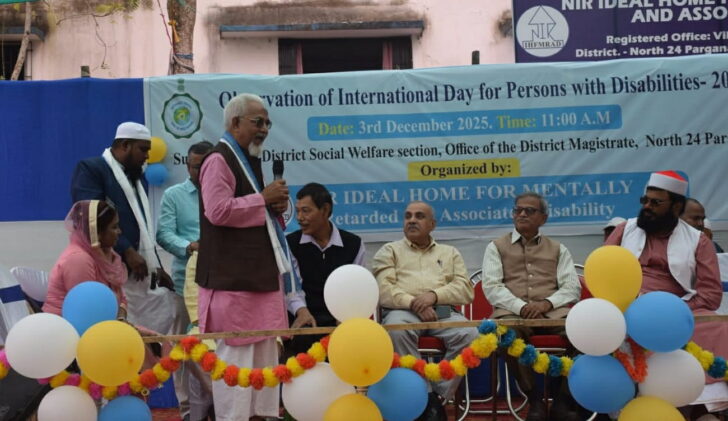
Kazi Mohammed Sherif in a meet with specially abled people | Arranged
Building BASE and Empowering the Marginalised
Kazi Mohammed Sherif Saheb was closely associated with the Bengali Academia for Social Empowerment (BASE), where he was a Founder Member and Vice-President.
For BASE, his contribution went beyond organisational responsibilities. He was remembered as a beacon of light who guided the organisation through difficult times. For its members, he was a guardian and mentor whose wisdom, experience and understanding of society provided invaluable guidance.
His deep knowledge of the lives and struggles of marginalised sections of society, coupled with his determination to work for their empowerment, made his contribution particularly significant.
For an organisation built around social empowerment, his approach was deeply important: understand society, listen to people, study their problems and then work collectively towards change.
His legacy will continue to inspire BASE in its future endeavours.
From Government Service to People’s Struggles
Kazi Mohammed Sherif Saheb dedicated his professional life to public service. He served in the Department of Social Welfare, Government of West Bengal, and retired as Assistant Director.
His professional journey took him to different parts of West Bengal, including Medinipur, Murshidabad, South 24 Parganas and North 24 Parganas. Through his work, he came into close contact with people from diverse social backgrounds and developed a deep understanding of the difficulties faced by disadvantaged and marginalised communities.
His years in public service gave him an understanding of administration and the realities of people who depended upon public institutions. But his engagement with society did not end with his professional responsibilities.
He carried that experience into people’s organisations, social movements and campaigns, where it became a source of knowledge and guidance for others.
He was remembered by his colleagues in the West Bengal Joint Social Welfare Services (WBJSWS) as a skilled and dedicated officer. Alongside his professional responsibilities, he was also an active member of FORSWO, contributing to its activities with sincerity and commitment.
Those who worked with him remember not only his professional competence and dedication but also his ever-smiling face, warmth, generosity and approachable nature.
Behind that gentle and cheerful personality was a deeply committed social worker who remained concerned about the welfare and dignity of others throughout his life.
Kazi Mohammed Sherif | Arranged
A Mentor Who Connected Generations
One of Kazi Saheb’s most lasting contributions was the inspiration he provided to younger colleagues and activists.
He encouraged them to ask questions, conduct research, understand the experiences of marginalised communities and participate actively in social action.
For many, he represented a bridge between generations of social workers and activists. His long experience of public service and people’s movements enabled him to offer perspective and guidance while remaining open to new ideas.
He believed that activism could not be separated from knowledge. Research was not an academic exercise for him; it was a means of understanding society and strengthening people’s struggles.
Those who came into contact with him often found in him not only an experienced activist but someone willing to listen, explain, guide and encourage.
His passing therefore represents not only the loss of an individual but also the loss of a repository of experience, knowledge, wisdom and institutional memory.
A Writer Who Brought Social Realities to Public Discourse
Kazi Saheb was a man of considerable wisdom and experience. His understanding of society was not confined to organisational work or public meetings.
He regularly expressed his views and reflections through articles published in various newspapers, bringing his knowledge and observations to a wider audience.
His writings reflected his concern for social justice and his deep engagement with the realities of ordinary people’s lives. He believed in informed public discourse and encouraged people to look beyond immediate events and understand the larger social forces shaping society.
Writing, for him, was another way of engaging with society—of documenting concerns, questioning injustice and encouraging people to think more deeply about the world around them.
His kindness, generosity, humility and wisdom touched innumerable lives. His colleagues and associates remember a person who could combine intellectual depth with warmth and humanity.
His smiling presence and gentle manner made him approachable to people across generations and backgrounds.
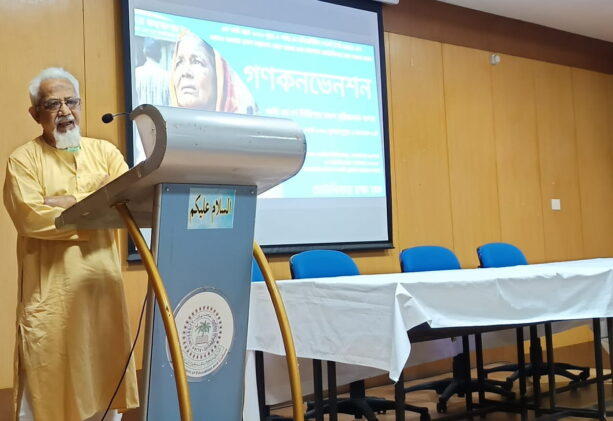
Kazi Mohammed Sherif addressing a gathering | Arranged
From Hooghly and Narkeldanga to a Life Across Bengal
Born on 1 March 1954 in Hooghly to Kazi Wasimuddin, Kazi Mohammed Sherif Saheb spent his formative years in Kolkata after his family moved there.
He received his early education in Kolkata and was brought up in Narkeldanga, old Kolkata, which remained an important part of his identity and memories.
He pursued higher education at the University of Calcutta and the Indian Institute of Social Welfare & Business Management (IISWBM).
Kazi Saheb was married in Birbhum and remained deeply connected to his family and roots. After spending many years in Narkeldanga, he eventually made Raigachi his permanent home.
Yet wherever life took him, his deepest commitment remained with people and society.
His professional journey, family life, writings, organisational work and activism were all connected by a common thread: a belief that human beings deserve dignity, justice, equality and compassion.
The Work He Leaves Behind
His sudden passing has created an irreplaceable void in the fields of social work and people’s movements.
We will miss his presence at meetings and campaigns, his thoughtful interventions, his guidance to younger colleagues, his willingness to stand beside people in difficult circumstances, and his quiet but steadfast commitment to justice.
But the best way to remember Kazi Mohammed Sherif Saheb is not merely to mourn his absence. It is to carry forward the values for which he lived.
His life reminds us that social justice requires perseverance; equality demands continuous effort; discrimination must be challenged wherever it appears; and knowledge becomes meaningful when it is placed at the service of people.
The tributes from NAPM, BASE, WBJSWS, FORSWO, and his many colleagues and fellow activists bear testimony to the breadth of his contribution.
Across professional service, social organisations, people’s movements, writing, research and community work, he remained guided by the same fundamental values—justice, equality, dignity, compassion and service to humanity.
As NAPM, West Bengal, has expressed, his ideals and commitment to people’s rights will remain a source of inspiration. The path he showed us—of solidarity, research, social action and collective struggle—must continue.
For BASE, NAPM, his professional colleagues, fellow activists, friends and all those who were inspired by him, his memory will remain a guiding force.
Kazi Mohammed Sherif Saheb leaves behind not only memories, but also ideas, values, relationships, institutions, writings and generations of people inspired by his example.
These will ensure that his contribution to society continues to live on.
His Final Journey
After a life spent among people, communities, movements, colleagues, friends and loved ones, Kazi Saheb has now begun his final journey.
The man who spent so many years walking through the lanes and streets of Bengal, travelling to meet people, listening to their concerns, participating in their struggles, writing about their lives and standing beside those who needed a voice, now rests in the quiet of his new home.
His final resting place is modest, but the life he lived was immense in its meaning. Beneath the earth lies a person whose work reached far beyond the boundaries of his profession and whose compassion touched countless lives.
There, beside the date palm tree and beneath the changing skies, the morning breeze and evening fragrance will pass over his resting place. The flowers that fall upon the earth may seem like nature’s own quiet tribute to a life devoted to humanity.
Those who stand beside his grave will not remember only the sadness of his departure. They will remember his smiling face, his wisdom, his gentle guidance, his willingness to stand with the vulnerable, his commitment to justice and his faith in the possibility of a better society.
His physical journey has ended, but the journey of his ideas continues.
Every young activist he encouraged, every person whose voice he helped strengthen, every organisation he nurtured, every article he wrote, every struggle in which he participated and every act of kindness he extended carries something of his presence forward.
His New Home
His new home is exquisite,
Just beside a date palm tree,
Surrounded by green grass
And variegated little plants.
A few Madhabilatas adorn the entrance,
While the grass-covered earth
Leads the quiet path towards his home,
At the far corner of the graveyard.
At Fajr, a gentle breeze will blow across his home;
At Maghrib, the evening air will carry the fragrance of flowers.
Petals will fall upon the earth above him,
As if nature itself were offering homage
To a great and gentle soul.
Through thunder, lightning and storm,
He will sleep in that humble bed alone.
Through sunshine, cloud and rain,
He will rest quietly,
Awaiting the summons of the Almighty.
That six-by-three-foot shelter—
His final destination and home—
Will hold him in peaceful rest
Until the day when he is summoned
Before the Almighty.
Standing beside his new home,
We prayed to Allah for the peace of his soul.
We prayed that his journey may lead
To Jannatul Firdaus,
For he spent his life in the service of others,
In compassion, justice and good deeds.
May his final home be peaceful.
May his grave be filled with light and mercy.
May Allah accept his good deeds, forgive his shortcomings and grant him eternal peace.
His journey on earth has ended.
His legacy has not.
We shall remember Kazi Mohammed Sherif Saheb not only with tears, but with gratitude—for a life lived with purpose, compassion, courage and an unwavering commitment to humanity.
Inna Lillahi wa inna ilayhi raji’un.
May Allah forgive his shortcomings, grant him Maghfirah and bless him with Jannatul Firdaus. May Allah grant his family, loved ones, colleagues and fellow activists the strength and sabr to bear this irreparable loss.
Ameen.
— This obituary is a collective tribute by the members of the Bengali Academia for Social Empowerment (BASE) to their beloved Founder, Kazi Mohammed Sherif Saheb.
Kolkata: The father of Cockroach Janta Party (CJP) member Sheikh Abdul Hafiz was murdered on August 15, two days after he and his son were allegedly attacked at their home in Bankura’s Karishunda village following Hafiz’s participation in the party’s “School Thik Karo” campaign.
In an exclusive conversation with eNewsroom, Hafiz alleged that he and his father, Sheikh Mohammad Mafik, were brutally attacked by a group of men whom he identified as BJP workers on the night of August 13, after he had filmed the condition of the primary school he attended as a child. Hafiz said he had taken permission from the school’s headmaster, Kashinath De, on August 12 to record the school the following day.
Mafik was rushed to Burdwan Medical College Hospital under police escort after the assault. He succumbed to his injuries on August 15.
‘We Couldn’t Kill You, So We’ll Kill Your Father’: Hafiz Recounts Attack
According to Hafiz, a group of men arrived on motorcycles at around 8 pm on August 13, armed with crowbars and bamboo sticks, barged into his home and attacked him and his father.
“On the 13th, I went to my school to record a video there after taking permission from the headmaster the previous day. That night around 8 PM, they arrived on bikes fully prepared and armed with crowbars and bamboo sticks. They barged into our home and first attacked me, striking my neck and chest, and assaulted my father by hitting him on the head and chest with crowbars and bamboo sticks. My father was right beside me; he had stepped in to protect me. They were telling, ‘toke marte parini tor baba kei mere felbo’ (we couldn’t kill you so we will kill your father),” Hafiz told eNewsroom.
His mother, Hasina Begum, said she pleaded with the attackers to spare her husband and son.
“When they were beating them with crowbars and sticks, I told my son to give whatever phone they were asking for. I fell at their feet so that they would spare my son and husband, otherwise they would have killed both of them,” she told eNewsroom.
Hafiz, 27, is from Karishunda village in Bankura district and is a member and campaigner of the “School Thik Karo” movement launched by CJP founder Abhijeet Dipke on August 10.
Hafiz said he had filmed his former school, Karisunda Pashchimpara Prathamik Vidyalaya, as part of the campaign after obtaining permission from headmaster Kashinath De a day earlier. eNewsroom is seeking the headmaster’s response regarding the permission and the filming.
After Hospital Visit, Hafiz Alleges Second Attack and Phone Seizure
At around 10 pm on August 13, Mafik was taken to hospital under police escort. Hafiz said that while returning home after the hospital visit, he was allegedly surrounded by the same group of men and attacked again.
“They initially tried to stop us and created a commotion. At the hospital, BJP party members gathered and blocked me from exiting from the hospital, fearing I might go to Indas police station to file an FIR. I had told the officer I wanted to file under Section 119 of the BNS, which they didn’t file in the first instance,” Hafiz alleged.
He said his father, whom he described as a simple and straightforward man, suggested that they apologise, settle the matter and leave peacefully.
“Returning home from the hospital, they surrounded me on their bikes and beat me again with bamboo and forced me to delete all the videos I had recorded and posted from my phone,” Hafiz said.
He alleged that the videos and audio recordings included footage of the school, the CJP protest and the earlier assault at his home. eNewsroom has not independently verified the contents of the deleted recordings.
Hafiz’s mother went to Indas Police Station on the afternoon of August 16 and filed a written complaint against 10 to 15 people, naming five of them as accused.
‘I Was Branded Pakistani, Terrorist’: Hafiz Links Threats to Jantar Mantar Protest
Hafiz had also participated in the CJP protest at Delhi’s Jantar Mantar over the NEET paper leak. He said he joined the protest for what he believed was the future of the country’s younger generation and that his parents supported his decision.
Hafiz travelled to Delhi on July 19 and stayed at the protest site until July 25. He said he was subjected to tear gas and a lathi charge by Delhi Police and was subsequently admitted to a hospital in Delhi.
“Ever since I was participating in the Jantar Mantar protests in Delhi, threats were being directed at me from my own neighbourhood. I was branded a Pakistani and a terrorist, and accused of having links to Pakistan, receiving threatening phone calls to that effect,” Hafiz alleged.
“I posted videos on social media and shared videos about the Jantar Mantar protests. When I returned home, I received threats that I would be killed. My family was also being threatened. That is why, on that day, they barged into our home and attacked both my father and me, and my father passed away,” he said.
Hafiz alleged that the threats intensified after he returned from Delhi and began participating in the “School Thik Karo” campaign.
Eight Arrested in Bankura Attack, Police Confirm
Indas Police Station Officer-in-Charge Chayan Kumar Ghosh told eNewsroom over the phone that eight people have been arrested from Karishunda village in connection with the case and that further investigation is underway.
The arrested persons are Sheikh Azad, Srikanta Majhi, Prashanta Ruidas, Rohit Majhi, Bablu Majhi, Santu Majhi, Tinku Keora and Ashtam Majhi.
According to the police, the case has been registered under Sections 329(4), 331(4), 126(2), 117(2), 118(2), 304(2), 351(3), 109, 103(1), 61(2), 324(4) and 3(5) of the Bharatiya Nyaya Sanhita (BNS).
Hafiz and his family have identified the arrested men as being involved in the alleged assault. Ashtam Majhi has been identified as a BJP leader and booth president; his political affiliation and position should be independently confirmed with the BJP before publication if not already established through official records.
The allegations against the arrested persons are part of an ongoing investigation and they have not been convicted by a court.
CJP Team Reaches Bankura as Hafiz Rejects Compensation
CJP co-convenor Asutosh Ranka and his team reached Bankura on August 17 to meet Hafiz and his family.
“It is not just the responsibility of CJP but of the entire country. Everyone in this country who is fighting for educational reform, we stand with them and support them. We are not afraid of BJP goons; this hooliganism will not be tolerated anymore. If BJP workers anywhere in the country think that they can intimidate us through violence, we are not going to be scared,” Ranka told the press.
CJP president Abhijeet Dipke also spoke to Hafiz over the phone.
“I will never forget these words from Abdul. I don’t think I have ever met someone who loves India as much as Abdul. Abdul lost his father, now the country needs to stand with him,” Dipke posted on X.
Earlier on August 17, former West Bengal Chief Minister Mamata Banerjee spoke to Hafiz over the phone, expressed solidarity with the family and condemned the attack. She assured the family of full support and asked Hafiz to visit her residence in Kalighat, Kolkata, with copies of the FIR and post-mortem report.
West Bengal Chief Minister Suvendu Adhikari, speaking at a press briefing, denied any link between the accused and the BJP, describing them as ordinary criminals and saying that strict legal action would be taken.
The investigation into the attack and the circumstances surrounding Mafik’s death is continuing.
Kolkata: Sheikh Abdul Hafiz does not want compensation for the death of his father. He wants a school.
“My father is no more. What will I do with government compensation? I want the government to build a world-class school in my late father’s name,” Hafiz told the media on Monday, days after his father, Sheikh Mohammad Mafik, died following an alleged assault at their home in Karishunda village in Bankura district.
For Hafiz, the demand is linked directly to what he says his father stood for in the final days of his life: better education for children in their village.
Hafiz had recently returned to Karishunda after participating in a protest in Delhi organised by the Cockroach Janata Party (CJP). Back home, he became involved in the organisation’s ‘School Thik Karo’ (Fix the School) campaign, which seeks to highlight the condition of government schools.
He visited Karishunda Primary School and raised questions about its condition and functioning. The family says Hafiz subsequently recorded a video showing the state of the school and posted it on social media.
What happened later that night is now at the centre of a police investigation.
“They came to our house and attacked us”
According to Hafiz’s family, a group of people entered their house after the school video was circulated and assaulted Hafiz. They allege that his mobile phone was taken and photographs and videos were deleted.
Mafik, 55, intervened when his son was being assaulted, the family alleges. He was also beaten and suffered injuries.
His condition later deteriorated. He was initially taken to Indus Hospital on August 14 and subsequently shifted to Bardhaman Medical College and Hospital. He died while undergoing treatment on August 15, according to his family.
The death has since turned a local dispute over a government school into a wider political controversy.
The family has alleged that people associated with the BJP were involved in the attack. The BJP has denied that the accused should be identified as party workers.
Eight arrested, police say investigation continues
Police have registered a case based on a complaint lodged by Mafik’s family and arrested eight people in connection with the incident.
A police official said the arrested accused were being interrogated in custody and that a search was continuing for others allegedly involved in the attack.
The arrests are the latest development in a case that has drawn the attention of political parties and student organisations.
The family’s allegations about a political connection, however, remain allegations and are part of the investigation.
‘What will I do with the money?’
For Hafiz, the question of compensation has become inseparable from the reason his father died.
“My father had to lose his life while raising his voice against the poor condition of the education system. My father is no more. What will I do with government compensation?” he said.
Instead, he wants a school.
“I want the government to build a world-class school in my father’s name,” Hafiz said.
His family has said it does not want financial assistance from the state government and would prefer the government to improve the local education infrastructure.
The son also made clear that he does not intend to abandon the campaign that brought him into the controversy.
“The students and young people of the country have taken to the streets. This fight will not stop. We will continue our efforts to improve the education system,” he said.
CJP says Hafiz will lead school campaign across Bengal
CJP leader Ashutosh Ranka, who visited the bereaved family on Monday, accused the state police of failing to provide adequate security to the family while allegedly protecting some of those accused in the case.
Ranka claimed that several people allegedly involved in the attack had already been identified by Hafiz’s family and demanded further arrests.
He said the CJP would give the state police 10 days to act. If the organisation believes the police have failed to take adequate action, Ranka said, it would stage a protest outside the office of the district Superintendent of Police.
“The BJP may think that it can silence us through violence and intimidation. We are not afraid of such threats,” Ranka said.
He said the CJP would continue raising issues of education, unemployment and employment.
Ranka also said the organisation would raise funds to support Hafiz’s family and hand over the money collected to them.
He announced that Hafiz would lead the CJP’s ‘School Thik Karo’ campaign across West Bengal.
Opposition leaders visit bereaved family
The family has received support from several opposition political parties and student organisations.
On Monday, CJP leaders, CPI(M) leaders Shatarup Ghosh and Mayukh Biswas and others visited Hafiz’s residence.
Former West Bengal chief minister and Trinamool Congress supremo Mamata Banerjee also spoke to the family over the phone and assured them of her support.
CPI(ML) Liberation has called for a statewide ‘Protest Day’ on August 17 and 18, demanding punishment for those responsible, a transparent and impartial investigation and adequate security for the bereaved family.
Party general secretary Dipankar Bhattacharya alleged that the attack was linked to Hafiz’s campaign over the condition of the local school.
AISA-RYA leaders also visited the family and demanded justice and exemplary punishment for those responsible.
From a school video to a father’s death
Hafiz’s ‘School Thik Karo’ campaign began with a familiar complaint: a government school in his village was in poor condition.
His father is now dead.
The family says Mafik was attacked when he intervened to protect his son. Police have arrested eight people, while allegations of political involvement are being investigated.
But Hafiz says he does not want his father’s death to end with a cheque.
He wants the school that his father, according to the family, died defending to become a better school.
“My father is no more. What will I do with government compensation? I want the government to build a world-class school in my father’s name.”
There was a time when even senior journalists and national newspapers avoided critical commentary on Supreme Court judgments, especially those of the Chief Justice of India, fearing that “contempt of court” proceedings would be initiated against them. Their occasional criticism was often laced with prevarication.
Against this backdrop, the public discourse over the last few days — actually, weeks — is remarkable in the country’s judicial history. It involves the incumbent CJI, whose comments and silence have been interpreted in many different ways. Rarely has a CJI been in the spotlight so much for reasons other than his judicial orders.
A New Era of Scrutiny for the Supreme Court
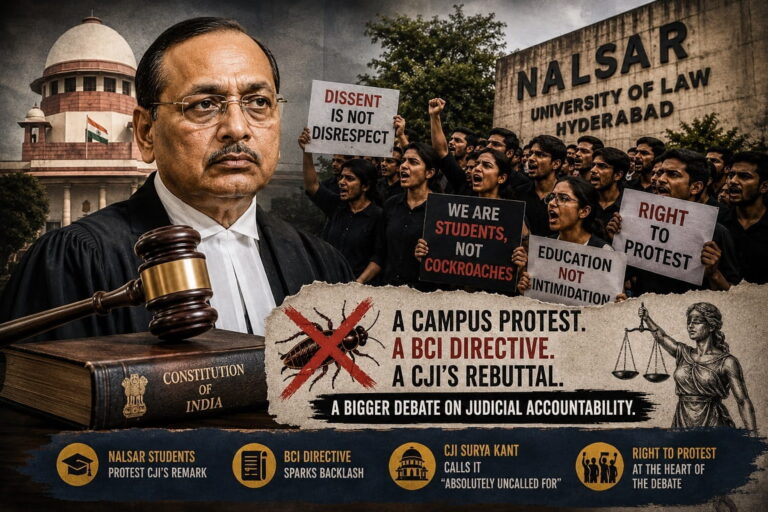
The latest sequence began on the campus of the National Academy of Legal Studies and Research (NALSAR), Hyderabad, when a large section of students announced their opposition to CJI Surya Kant serving as the chief guest at the proposed convocation. The development was unprecedented, as law students had taken on the country’s highest judicial officer.
The CJI did not react to it but was forced to intervene when the Bar Council of India (BCI) chairman, Mohan Kumar Mishra, issued a now-withdrawn directive asking state bar councils not to enrol any student of the university’s 2026 batch. He had also sought an inquiry to identify the students involved in the campaign against inviting the CJI to the convocation.
NALSAR alumni threw their weight behind the agitated students, saying they were well within their rights to ask the varsity not to invite the CJI. The alumni wrote an open letter to the BCI chairman condemning the language in his now-withdrawn directive, which vilified students and faculty by alleging groupism, dirty politics and nasty politics.
The BJP Rajya Sabha member not only withdrew the directive following the backlash but also apologised for his comments, saying he sincerely regretted and apologised if his words had hurt the feelings of law students. “An expression of regret is not a matter of ego or prestige. It’s simply an acknowledgement that the feelings and concerns of our students matter,” he was quoted as saying in a letter.
Mishra’s apology came only after the CJI described the directive as “absolutely uncalled for”. He said the matter was between him and the students, asking, “Who are they (BCI) to unnecessarily create an issue?” The CJI averred that students had the right to protest peacefully, and no one could stop them.
In a welcome gesture, he said the students should get licences to practise at the earliest and begin their careers in the apex court. He said he was also involved in many student activities. Indulging in activities or protests does not mean the students are wrong.
Students have a fundamental right to freedom of speech and expression. So long as they are lawfully and peacefully raising their voices over an issue, it must be heard, not opposed, the CJI said, adding, “We will empanel them and give them legal aid cases. This will be our response to those who intend to create impediments in their careers.”
When Students Challenge the Chief Justice
The students’ opposition to the CJI stemmed from his comment during proceedings concerning alleged police excesses against protesters at Jantar Mantar. The SC bench headed by the CJI had reportedly declined to watch the video footage of alleged police brutality, citing lack of time.
Ironically, the Jantar Mantar protests that led to the resignation of Union Education Minister Dharmendra Pradhan over the NEET paper leak issue were organised by the Cockroach Janata Party (CJP), itself a product of a comment made by the CJI weeks earlier.
CJI Surya Kant later said his oral remarks had been misquoted and misused with malicious intent to mislead the youth. While hearing a case on May 15, the CJI had compared some individuals with fraudulent degrees to “cockroaches” who become RTI activists to attack the system.
The comments sparked a backlash among youngsters, leading to an online satirical movement led by Abhijeet Dipke. The CJP also backed the movement by NALSAR students.
The recent events mean that even the apex court and institutions like the BCI are under scrutiny from the media, students, alumni and activists. This has coincided with greater transparency in court proceedings, not just for litigants but also for the public. Earlier, only a handful had access to court premises. Live telecasts of proceedings have helped bridge that gap.