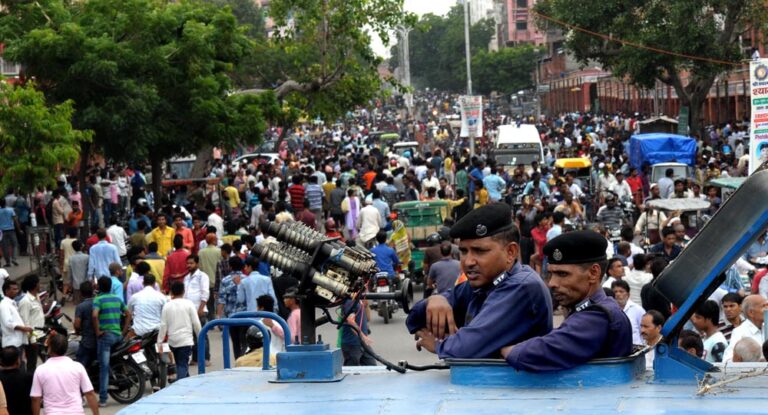
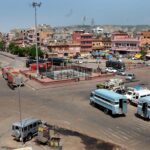
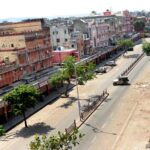
Jaipur: What does a curfew do to a normal life? It paralyses every activity. And who can feel it better than the residents of Ramganj, Jaipur, where there is curfew since Friday night.
After three days of curfew, there was a two hour break. During this break, which was from 3.30 pm to 5.30 pm not only people came out of their homes to buy essentials goods and food items, but also a bride and grooms took the opportunity to get married. Funerals were also taken to bury the dead. Some residents who were outside city and could not return during the curfew hours were also seen returning to their abode.
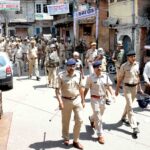
There was also a moment when huge gathering of locals had to be dispersed due to fear of some police action. On Friday night, because of police throwing a stick on a couple, which fractured the woman pillion rider’s hand but police refused to registering, locals attack on police and burnt some vehicles, causing injuries to some policemen. Later in police firing, one person died and police imposed curfew in four police station area in and around Ramganj.
The Walled City area or Pink City, because of its heritage background, in a normal day remain abuzz with activities, as its a must visit for local and foreign tourists.
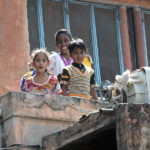
Our photojournalist Chandra Mohan Aloria stayed there during the curfew break and captured most of the activities.
A groom on the way for his marriage
Another follows suit
A bride on way to home after marriage
A family returning to the old city as gets relaxation in curfew
It was a funeral process which first allowed to move
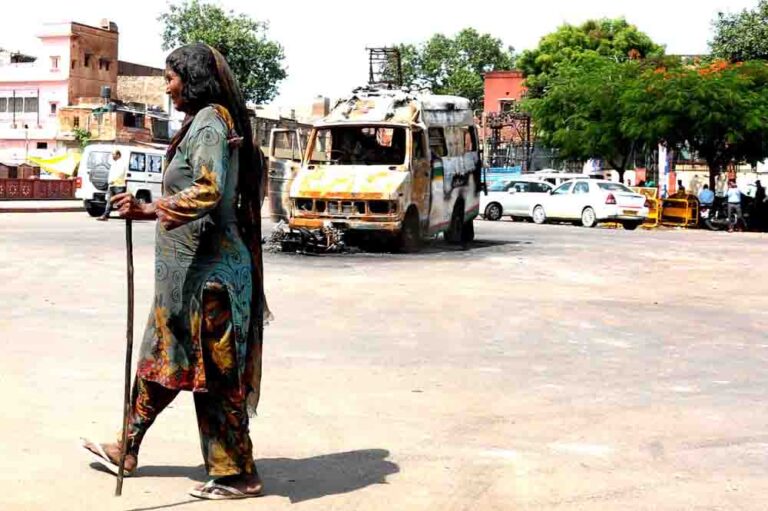
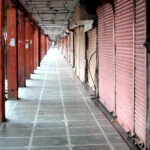
Jaipur: The clash between police and the residents of Ramganj, Jaipur which caused death of a civilian also paralysed the public life. The fiasco between police and common man occurred, on Friday night, when an injured woman, during police lathi charge, approached officers to register a complain, the police refused. It aggravated the matter and soon one of the most famous centers of Jaipur turned into a battle ground between police and locals. The incident caused severe injuries to several including police, and death of a civilian. Later, at four police station areas in and around Ramganj, curfew has been imposed. The old city market area was almost shut, the jam-packed roads were mostly deserted.
Our photojournalist Chandra Mohan Aloria visited the affected area and captured some intriguing pictures, depicting how life has been affected in Ramganj. Have a look.
Local shopkeepers watch an old lady in the deserted zone
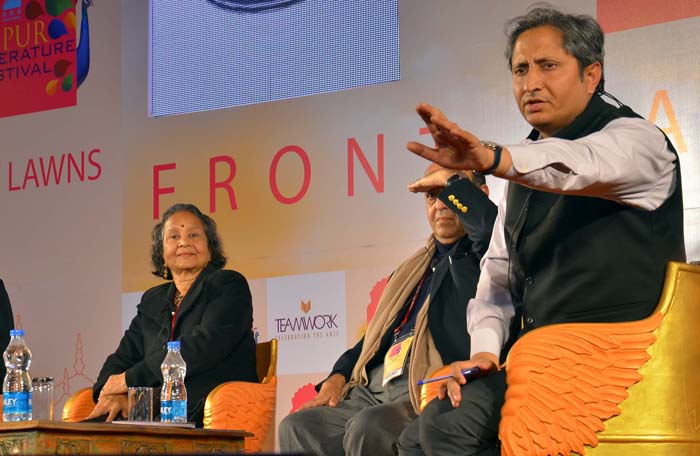
Kolkata: Barely a few days after the assassination of Gauri Lankesh, the Banglore based editor of Lankesh Patrike, senior journalist and anchor of NDTV’s Prime Time show Ravish Kumar is getting death threats on his phone.
On Friday morning, Ravish Kumar wrote about receiving phone calls, where the callers threatened him with dire consequence, on his Facebook Page. For a journalist like him, who has made a mark as pro-people journalism, and rational writer, has been constantly abused by the trolls on social media. The rise of the army of trolls has increase moreover, in these four years. However, calls, cannot be ignored, especially after the assassination of Lankesh. She too had been getting such calls, till she was killed.
“I am consulting my well-wishers, and as they will suggest, I will be finally taking a call on whether, I should report the threat,”Ravish said, while speaking to eNewsroom.
Ravish Kumar is among the few journalists in India, who has been continuously reinventing his show, often highlighting the issues that still plagues India and if required is even critical of the government and its policies.
These days, he is also active on social media and even after getting abusive comments, he replies to several’s comments on his Facebook page.
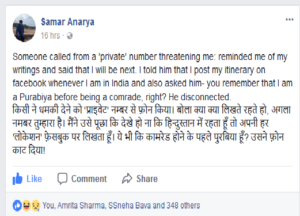
After Gauri’s murder, death threats are being issued not just to journalists, but also to rationalists and activists, who are critics of right-wing ideology, on the social media. Samar Anarya, who is a coordinator in Asian Human Rights Commission, and a Jawarhar Lal Nehru University (JNU) pass out, is very active on social media and writes in both English and Hindi languages. He too has received a threat call.
Screenshot of Samar Anarya’s post about the threat call he received
Significantly, Samar, a native of Uttar Pradesh is based in Hong Kong. And he was threatened on his international number.
“My number is available in public domain, so anyone can get it. But getting a threat call on my Hong Kong number, highlights the extent to which these people can go. I know, these cowards, have a list ready. Earlier, too, I had got such threat calls,” Samar told eNewsroom.
Senior journalist P Sainath has also mentioned the same, in his recent article published in The Wire.
Sainath in his write up, has explained the modus operandi of Lankesh’s murder is the message to all those not following the diktat. Guari, an open critic of the saffron brigade, has been warned to not voice her thoughts, following which she was shot point blank, right in front of her house. Investigations, have now revealed, that the pistol used for killing her, was of the same kind used to silence rationalists MM Kulbargi, Narendra Dabholkar and Govind Pansare. In fact, a Mumbai High Court observation, had even mentioned that format in which these killings are carried out are very well planned.
“The forces behind the assassination of Guari have a list, and they want us to know that they will pursue it,” Sainath wrote in the article.
eNewsroom in its earlier story has mentioned that a report published by the New York –based Committee for Protection of Journalists (CPJ), Indian exposing corruption often pay with their lives. As per CPJ data, 28 Indian journalists (including Lankesh) have been murdered since 1992. And so far conviction has happened in only one case.
International newspaper Washington Post had its September 6 edition’s headline screaming – Who is next? Whatever be the answer to this question posed, but one thing is evident it is – where the world’s largest democracy is heading to by trying to gag its fourth pillar.
Kolkata: Gauri Lankesh, a firebrand editor, who began her journalistic career with Kolkata’s Ananda Bazar Patrika, used to run her own publication Lankesh Patrike. She was a fierce critic of right-wing Hindu fanatism and communalism. Gauri, was only 55, when assassinated.
India, dangerous for journalists
Her killing, has been vehemently condemned by activists and journalist across India. But, it highlights one thing – India is increasingly becoming a dangerous country for journalists critical of the government or nationalist sentiment. According to the World Press Freedom Index, brought out in 2016, by Reporters without Borders, India ranks as low as 133 out of 180 countries sampled. The report states, “The situation is worsening in India, which is now ranked 133rd of the 180 countries, although its media are dynamic and much more capable of playing the role of a democracy’s watchdog than the media of most other countries in the last third of the index.”
According to this report, almost every month a journalist is attacked in India. And the journalists of Uttar Pradesh and Jammu and Kashmir are the most vulnerable.
Another report published by the New York –based Committee for Protection of Journalists (CPJ), Indian exposing corruption often pay with their lives. As per CPJ data, 28 Indian journalists have been murdered since 1992. Interestingly, they are yet to get justice. It states, “India’s culture of impunity is leaving the country’s press vulnerable to threats and attacks”.
But, why?
Explaining the rise in the number of journalists being murdered, S.N. Sinha, president of Indian Journalists Union, said, “Journalists were killed earlier too. However, we are disturbed by the present trend. Now, journalists who are critical of the present government being bumped off. It’s an open secret, that Gauri Lankesh was an open critic of the right-wing ideology. She had even been threatened with dire consequences.”
Gauri, had even been convicted for a defamation case filed by BJP MP Pralad Joshi, for having published articles against the saffron brigade in her tabloid.
Investigative journalists at higher risk
Many feel that the stakes are higher for Indian investigative journalists. Elaborating on the same was, Raja Chowdhury, a Gujarat-based investigative journalist. He said, “That’s (risk) part and parcel of being an investigative journalist. There were threats earlier too. But now, they are result oriented threats.” Chowdhury, who runs an investigative online portal Khooobsurat, further added, “These days we are given a diktat, which if not followed, we have to be prepared to face consequence, which can be in any form.”
Explaining this sudden rise, Sinha, said, “People are not open to criticism. They can’t accept the fact that media, being the watchdog of Indian democracy and has the right to criticize the present government. Media, has always criticised other government, for their failure. It’s nothing new. However, today, we can’t deny the fact, that we as journalists in India are at a risk. Till date, we don’t a law to protect us. We have been trying to get one into place, but it’s just not happening.”
While, Chowdhury claimed, “If you give absolute power to a single party in a democracy, with a weak opposition, then this is bound to happen.”
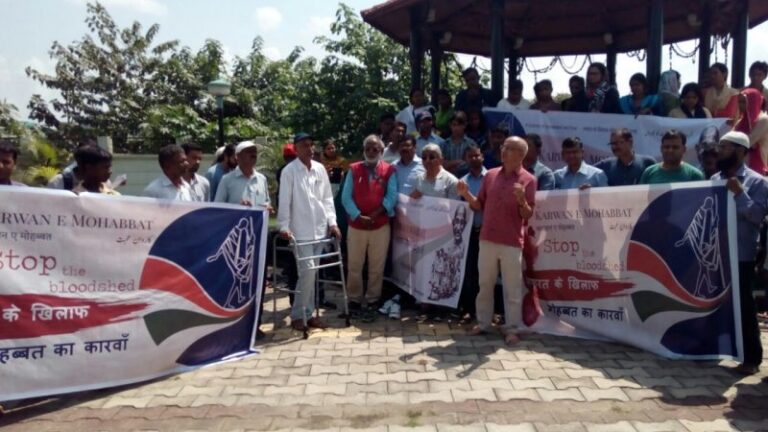
Ranchi: Social activists have strongly condemned the assassination of senior journalist Gauri Lankesh. Adding on to the voices was renowned activist and former IAS officer Harsh Mander, who has just reached Ranchi, with his Karwan-e-Mohabbat, a unique peace yatra, which aims at fighting communalism and spreading peace.
Saddened by the Gauri Lankesh’s murder, Mander, while addressing the Press meet said, “It was Gauri Lankesh who taught me how to fight against the politics of hate.” He then asserted, “Only by spreading the message of love, we can fight today’ crisis.”
Gauri, the Editor of Lankesh Patrike, a weekly Magazine, was very active on social media, and was a vehement critic of politics of hate. She had recently translated Rana Ayyub’s book Gujarat Files, in Kannada. She was well-known for being a critic of Right-wing extremism.
The 55-year-old writer learnt the journalistic ethics from her father, a firebrand writer, while her sister is a renowned film maker. Gauri used to consider Umar Khalid and Kanhaiya Kumar, the former Jawahar Lal Nehru University Student Union (JNUSU) president as her sons.
On Tuesday around 8pm, three assailants, open fired at Gauri, just outside her residence in Karnataka. Of the seven bullets pumped into her, two pierced into her chest and one on her forehead, thereby, killing her on the spot.
Those present in the press meet of Mander’s Karwan-e-Mohabbat, spoke about Gauri and her contribution to Indian journalism. They even observed two-minute of silence as tribute to her.
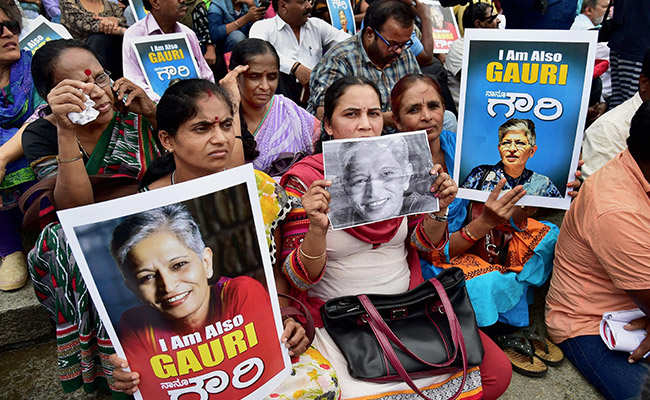
Across India, protests are being organized against the murder and the act to suppress freedom of expression in India.
The Karwan-e-Mohabbat, which started from Assam from September 4, will be touring eight Indian states. Mander, will soon be visiting Giridih to meet dairy farmer Usman Ansari, who has recently been lynched on suspicion of cow slaughter.
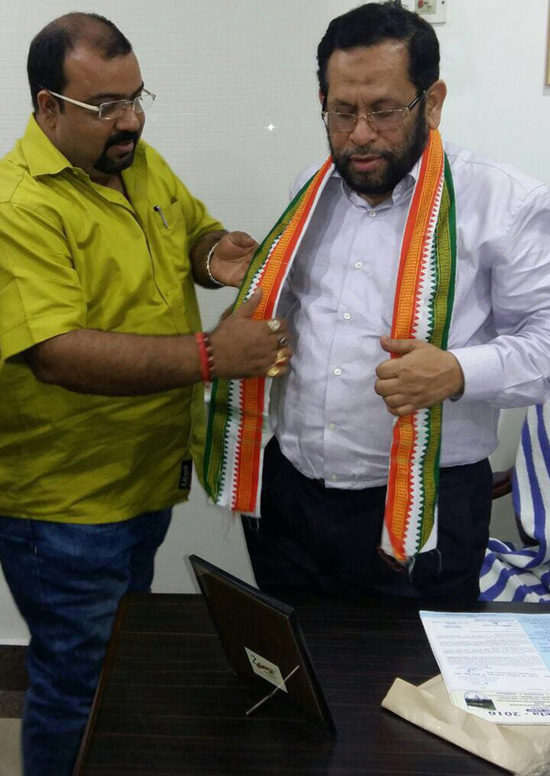
Kolkata: Trinamool Congress (TMC) leader Sultan Ahmed, was only 64, when he suffered from a massive cardiac arrest on Monday morning. The MP from Ulberia, was getting ready to meet one of his ailing professor, when his family discovered that he had suffered from an attack. Rushed to the Belle Vue Nursing Home, he was declared “brought dead”.
Sultan Ahmed, twice MLA and MP, had donned many role in his active political career and social life. He was Minister of State (MoS) Tourism in center, and Member of Personal Law Board and president of Mohammadan Sporting Club.
Perhaps the only low that hit the Ahmed’s career projectile was the Narada Sting case, where he was accused of taking a bribe of Rs 1.5 lakh, which he claimed was a donation, which was spent on party work.
Bengal Chief Minister Mamata Banerjee, who first tweeted about the demise of senior leader, later alleged that Ahmed was in “extreme stress” because BJP led government’s central agencies was trying to defame him. “I got information that when his body was being taken, a CBI notice was served. It was not an age to die,” The Telegraph newspaper quoted Bengal Chief Minister.
The rise of Sultan, a prominent face, in Chief Minister Mamata Banerjee’s government, indeed is a tale of the proverbial “rags to riches”.
Born to a middle class family, on 19 Ripon Street, Ahmed, carved a political career for himself, that many would have only dreamt of. Initially a student of Hasan Balki Night School, Sultan, got enrolled at the Madarsah Aliah, from where he did his schooling.
Contrary, to many, who believe that he began his political career as a college student union leader of Congress Chatra Parishad of Maulana Azad College, it was CPI leader, Abdul Ghani who introduced him to politics. It was only, much later that he was taken in to the folds of Congress, by his political mentor Abdul Rauf Ansari.
Under his tutelage, Sultan, a soft spoken, sauve, young blood, kept growing. Soon, his speeches got noticed. Even his rivals, remember him as a gentleman, who never failed to help those who came to seek his help. “I was a good friend of his. He was a man of principles and good nature. It’s difficult to believe that he is no more,” said West Bengal Congress leader Adhir Ranjan Bose.
In 1985, he won his first election from ward 61, to become its councillor, and since then, there was no looking back for him. Being the first political leader from the area, residents of area in and around Ripon Street, voted for him with an open heart, and in return, he till the day he died never turned down a needy reaching out to to him for help. At the peak of his political career, Sultan served as the Union Minister of State for Tourism, in the Manmohan Singh led UPA government.
His business chamber at Park Circus, was often jam packed with the needy. Even, when the parliament in session, for those who knew him well, were well aware, of him travelling back to Kolkata on Fridays and staying over for the weekends meeting people and resolving their issues.
The 30, 000 odd crowd, waiting outside his residence, was an evidence of the love he used to get from people of Bengal.
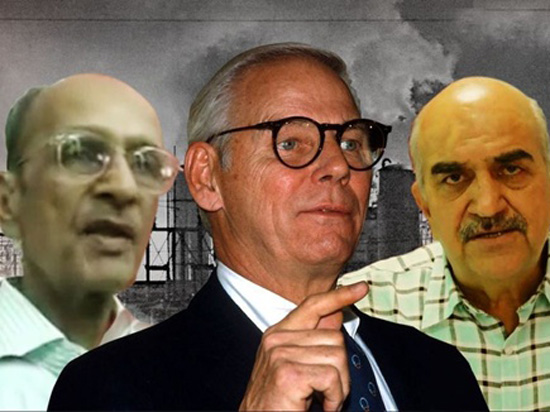
Bhopal Gas Tragedy: The English idiom ‘asking for trouble’ does not convey the real extent of nuttiness of the person as Hindi saying ‘aa bail, mujhe maar’. That was exactly what former Bhopal Collector Moti Singh did when he penned a book describing in detail how he had, along with then Bhopal Superintendent of Police Swaraj Puri, played a crucial role in providing safe passage to then Union Carbide chairman Warren Anderson soon after the Bhopal gas leak disaster. Anderson was the main accused in the disaster case.
Almost 33 years later now, the two have been directed to appear before the Chief Judicial Magistrate (CJM) in a criminal case initiated by a voluntary organisation working for the Bhopal Gas Tragedy affected people. Bhopal Gas Peedit Mahila Udyog Sangthan (BGPMUS) convener Abdul Jabbar quoted Moti Singh’s ‘confession’ (made in his book) in the court of the CJM as evidence to seek prosecution of Moti Singh and Swaraj Puri for helping an accused of a serious crime to abscond. Taking note of the complaint, the CJM ordered registration of a case against both under Sections 212 (harbouring a person believed to be an offender), 217 (public servant disobeying an order to save an offender from punishment) and 221 (intentional omission to apprehend) of Indian Penal Code (IPC).
Moti Singh wrote the book in 2008. Abdul Jabbar filed the complaint in the court in 2010. The case lingered on till the close of last year when the court of CJM sent summons to the two retired officers to present themselves in the court. As the summons were ignored by them, the court issued the summons for the second time early this year. They ignored the second summons also. The court then issued a bailable warrant against them, with the observation that the summons could not be served on them as they were influential people.
Bhopal Gas Tragedy
On a revision petition moved by Singh and Puri, the special sessions court (in its capacity as the appellate court) stayed the proceedings in the CJM court till the revision petition was disposed of. This was challenged by Jabbar in the Madhya Pradesh High Court. Justice J P Gupta, while upholding the jurisdiction of the appellate court to issue the stay, expressed its disapproval at the petitioner (Jabbar) rushing to the High Court instead of contesting the case before the special court. Justice Gupta, however, observed that “it appears that learned lower court (that of CJM) has applied its mind and has passed the reasoned order. In view of the facts and circumstances of the case, prima facie, it does not appear that the impugned order (of CJM) is arbitrary or causing prejudice to anyone.”
Special sessions judge R K Soni eventually dismissed on august 24 the revision petitions of Moti Singh and Swaraj Puri with the observation that in the order of the CJM, “there does not appear to be any illegality, error or impropriety which would require intervention of this court.” Later, CJM Bhubhaskar Yadav re-issued on august 28 the bailable warrants, for Rs 5000 each, for their appearance in the court on September 23.
Kolkata: Not to let miscreants take advantage of communal flare up, a week-long door to door campaign has been initiated by an imam and NGO to spread awareness for a clean, peaceful and harmonious Eid-Ul-Adha celebration
Maintaining peace during festivity
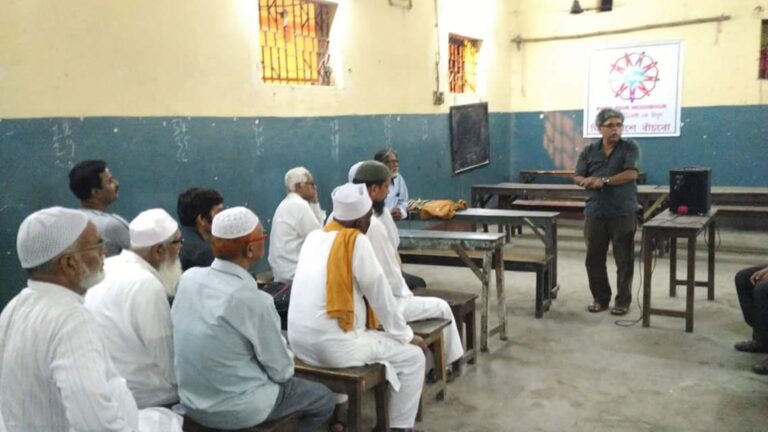
Maulana Mohammad Ashraf Qazmi, the imam of a local mosque in Mominpore, a Muslim dominated pocket in Kolkata, flagged off the initiative formally on August 30 by addressing a meeting with like- minded people from different communities. The interaction hosted at Hussain Shah School, requested Muslim, to sacrifice the animals, in such a way that the sentiments of their neighbours, belonging to other religious committee is not hurt.
Speaking about the initiative, Maulana Qasmi informed, “This Muslim festival in particular is seen with a lot of prejudice, as we sacrifice a huge number of animals. However, keeping the present situation in mind, we thought of meeting our Muslim brothers and counselling them to offer the sacrifice in ways that the sentiment of other communities is not hurt.”
NO selfies for Eid-Ul-Adha
Elaborating on the guidelines laid, he added, “We have in particular, asked not to sacrifice animals in the open. Many are vegetarians, while many many hold a particular animal sacred. Since, this sacrificial offering is a must for the financially stable Muslims, it can’t be done away with, but at the same time, we as fellow citizens and neighbours need to ensure that we don’t hurt the sentiment of others. So, people should also abstain from posting objectionable pictures on social media, clicking selfies or circulating images that can hurt religious sentiments of other community.”
An author, Milan Dutta, who was present during the meeting said, “We very well aware are of the fact that often festivals are used as an excuse by certain group of people to create bad blood. This initiative is a step that we are taking to avert such mishaps.”
Not just Eid-Ul-Adha
However, this is not all that is being done by a group of Muslims to maintain peace and order in this Muslim ghetto, during the Eid. With Durga Puja and Muharaam coinciding, the organisers, plan to use the same platform to facilitate tension free celebration.
“I have seen communal flare ups during festivals. Thus, we are doing this programme in association with SNAP, Forum for Promotion of Communal Harmony and Peace, Right Track, Memory of Martyrdom of Mehta and Mukhtar and Aims, Khidderpore. We have urged people to maintain cleanliness, not to discard the refuse in open but to have them covered and dispersed. Also, when distributing the meat, we have asked them to do so covertly. We at no point can take things for granted and hurt sentiments of others,” elaborated Md Anwar, founder member of SNAP.
Spreading peace
This is not the first time that Qasmi has flagged off such a programme. He organises a yearly event – Aao Mil Baithe, a day long event, where religious leaders from various communities take on the stage to spread the gospel of peace and love.
SNAP Association, also, has been doing its bit to spread communal peace. For the past two years, they have have relentlessly running a programme called – Know Your Neighbour, where informal meetings are set up between people of different religious belief, with the intention of tackling religious prejudice.
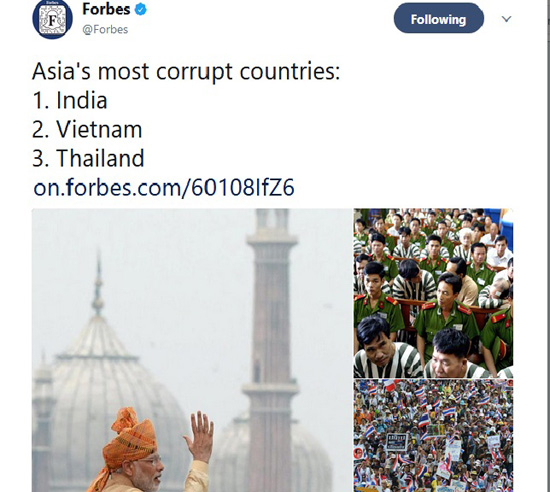
Kolkata: The Narendra Modi led Bhartiya Janata Party (BJP) government which has two consecutive bad or negative news, as far as India’s economy is concerned —return of 99 per cent demonetized notes to banking system, and Gross Domestic Product (GDP) going down to its lowest in June. Now the third bad news is that now the world’s most reputed business magazine Forbes has tweeted that India is Asia’s most corrupt country.
However, the magazine had first done this story in March itself. But it was seen sharing it once again, today. The ranking is based on a survey conducted by Transparency International. But, this time, the story is getting huge attention and within seven hours, it has been retweeted over four thousand times.
The Transperancy International had conducted the 18 month long survey by sampling more than 20000 people across 16 countries.
Forbes list of 5 most corrupt Asian countries include Mayanmar, Pakistan, Thailand, and Vietnam, while India tops the list. Pakistan stands as the fourth most corrupt countries.
The magazine, also shared Prime Minister Narendra Modi’s picture, addressing from Red Fort.
The report also carries bribe rate in all the top five nations mentioned in the story. India’s bribe rate is 69 per cent, which is the highest.
Speaking on, India getting the most corrupt nation (in Asia) tag, well-known economist Mohan Guruswamy told eNewsroom, “It could very well be. A good part of the Modi government was that it will fight corruption. It now seems to be only perpetuating the crony system.”
The timing of Forbes’ tweet is also interesting, as few days back anti-corruption crusader Anna Hazare has announced that he will be sitting on dharna again, in January 2018, as the present government is yet to appoint the Lokpal and many other ombudsman, a must haves in Jan Lokpal of Citizen Ombudsman Bill.
On Wednesday, central bank of India—RBI also revealed that 99 percent of demonetized money has been returned to the bank.
While on Thursday, the quarter one GDP stood as low as 5.7 per cent, which is the lowest in Modi as Prime Minister of India. The three coupled together has sent a shock wave across India.
This translates to China continuing to top the GDP tab. In March, India’s GDP has slipped to 6.1 per cent unlike China, which had still witnessed a 6.9 per cent growth rate.
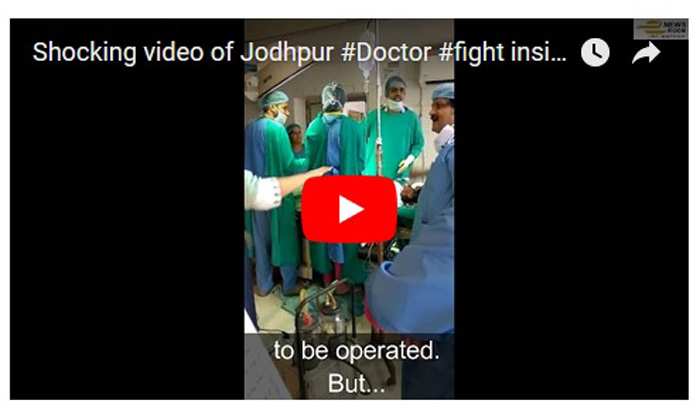
Jodhpur: With the video of two doctors fighting as a patient lied on the operation table at Jodhpur’s Umaid Hospital went viral, Health Minister of Rajasthan, Kalicharan Sharaf was forced to issue a communiqué. The letter released by the minister stated that it was not the child delivered during the ill-fated surgery that died, but was another.
The shocking video, showed a surgeon and an anesthetist indulging in an ugly fight inside an operation theatre while operating a pregnant lady. It was reported that the child delivered had died during the delivery due to the delay caused by the fight.
Watch the video
But, the health minister Sharaf, through a press release stated that it was not the baby of Naseem Bano, who was operated by the doctors that died. The release mentioned that the baby of 21-year-old Anita Sharma, a resident of Uttar Pradesh, who had also undergone C-Sect from some other doctor, had died. Sharaf also claimed that, in this case, the performing surgeon had pre-informed the parents that the baby may not survive.
However, the minister mentioned that, because of the fight inside the operation theater, both doctors—surgeon Ashok Naniwal and anesthesist ML Tak have been suspended. Doctor Naniwal, who was working on urgent temporary basis, has been dismissed from the job.
A three member team, lead by additional collection of Jodhpur has also been constituted and instructed to file a detailed report on the incident.
The spat between the two doctors inside the operation theater was recorded by their colleague and as soon as it put on public domain, the issue grabbed national attention.
India, which has already witnessed two major child death incidents in Gorakhpur and Jamshedpur where altogether 185 children have died in August month only, because of lack of oxygen and being malnourished, now doctor’s fighting inside operation theater, causing death to new born, is latest low in Indian healthcare system.