हिमालय से बंगाल की खाड़ी तक: विद्या भूषण रावत की गंगा यात्रा ने सामने लाए नए दृष्टिकोण

कोलकाता: सामाजिक कार्यकर्ता, लेखक और फिल्म निर्माता विद्या भूषण रावत ने पिछले 30 साल हाशिए पर रहने वाले समुदायों के साथ काम करते हुए बिताए हैं। उन्होंने सामाजिक न्याय के लिए पदयात्राएं की हैं, व्याख्यान दिए हैं, साक्षात्कार लिए हैं और कई वृत्तचित्र बनाए हैं। हाल ही में, उन्होंने एक महत्वपूर्ण काम पूरा किया—गंगा नदी की यात्रा की, जो हिमालय से शुरू होकर बंगाल की खाड़ी तक जाती है। उन्होंने इस यात्रा के दौरान गंगा के पर्यावरण, संस्कृति और इतिहास से जुड़े कई पहलुओं को डॉक्यूमेंट किया।

विद्या भूषण रावत ने इस यात्रा को अपने कई डॉक्यूमेंट्री फिल्मों में दिखाया है, और अब तक 25 से ज्यादा किताबें लिख चुके हैं। गंगा पर उनकी आने वाली किताब का भी बेसब्री से इंतजार हो रहा है। इस अद्भुत यात्रा को पूरा करने के एक दिन बाद, उन्होंने ईन्यूजरूम से बात की। बातचीत के दौरान वे शांत थे, लेकिन जैसे-जैसे गंगा के बारे में बात की, उनका उत्साह बढ़ता गया। बातचीत का अंश यहाँ प्रस्तुत है।

ईन्यूज़रूम: आपने गंगा नदी के किनारे यात्रा करने का फैसला क्यों किया?

विद्या भूषण रावत: उत्तराखंड का रहने वाला होने के कारण, मुझे हमेशा से नदियों और पहाड़ों से गहरा लगाव रहा है। पहली बार मैंने गंगा को 1978 में देखा था, जब मैं 10 साल का था। मैं मुनि की रेती, ऋषिकेश गया था और गंगा की सुंदरता से बहुत प्रभावित हुआ था। उस समय गंगा का पानी हरा, शुद्ध और बहुत शांत था। किनारे पर बैठकर उसे देखने से मुझे बहुत शांति मिली।

बड़े होने पर, जब मैं पढ़ाई के लिए देहरादून गया, तो हरिद्वार के हर की पौरी पर जाना एक नियमित काम बन गया। हमारे परिवार में भी, बाकी लोगों की तरह, अंतिम संस्कार के लिए गंगा के तट पर जाने की परंपरा थी। 1991 में जब मैं दिल्ली शिफ्ट हुआ, तब भी उत्तराखंड और गंगा से मेरा गहरा संबंध बना रहा।

करीब 20 साल बाद, मैंने ललित कला अकादमी में सावी सावरकर की एक प्रदर्शनी देखी, जिसमें एक पेंटिंग ‘डीब्राह्मिंसिंग द गंगा’ ने मुझ पर गहरी छाप छोड़ी। लेकिन मेरी गंगा यात्रा की असली प्रेरणा तब मिली जब 2021 में लॉकडाउन के बाद मैंने उत्तराखंड के हिमालयी इलाके की यात्रा की। मैंने देखा कि पहाड़ों का दोहन हो रहा है और गंदगी गंगा में बहाई जा रही है। इस अनुभव ने मुझे ‘गंगा तुम बहती रहो’ नामक एक छोटा वीडियो बनाने के लिए प्रेरित किया, जिसे मेरे दोस्तों ने काफी सराहा।
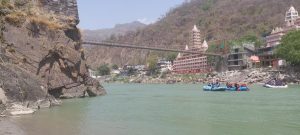
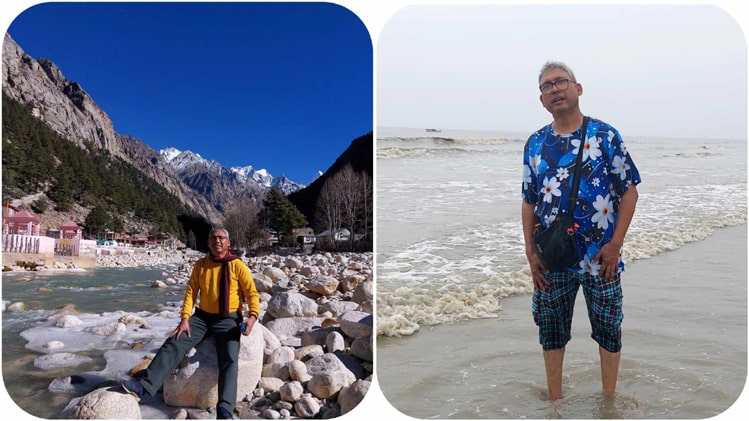
विद्या भूषण रावत गंगा की यात्रा गंगोत्री गंगासागर उत्तराखंड
उत्तराखंड में गंगा | साभार: विद्या भूषण रावत

उत्तर प्रदेश और उत्तराखंड में कई पदयात्राएं करने के बाद, मैंने गंगा पर नाव यात्रा का विचार सोचा। हालांकि, शुरू में वित्तीय और अन्य समस्याओं के कारण यह संभव नहीं हो पाया। फिर कुछ दोस्तों ने मेरा समर्थन किया और गंगा पर मंडरा रहे पर्यावरणीय संकट को डॉक्यूमेंट करने में मदद की। इससे मुझे इस प्रोजेक्ट को शुरू करने का हौसला मिला।

जब मैंने गंगा की कहानी में गहराई से जाना, तो मुझे महसूस हुआ कि केवल हिमालयी क्षेत्र को कवर करना पर्याप्त नहीं होगा। मुझे बंगाल की खाड़ी तक जाना पड़ा। मैंने सोचा था कि सबसे कठिन हिस्सा हिमालय में होगा, लेकिन निचले गंगा के क्षेत्रों में काम करना और भी चुनौतीपूर्ण साबित हुआ।

सितंबर 2021 में मैंने गंगोत्री से अपनी यात्रा शुरू की, जिसमें उत्तराखंड के अलावा यमुना घाटी, टोंस, महाकाली और अन्य क्षेत्र भी शामिल थे। मैंने उत्तर प्रदेश, झारखंड और पश्चिम बंगाल होते हुए गंगा सागर तक यात्रा पूरी की। यह यात्रा न सिर्फ एक अनोखा अनुभव था, बल्कि इसने मेरी समझ को भी गहरा किया कि लोग, प्रकृति और गंगा के किनारे रहने वाले समुदाय कितनी मुश्किलों का सामना कर रहे हैं।

ईन्यूज़रूम: भारतीय संस्कृति के संदर्भ में आपकी यह यात्रा कितनी महत्वपूर्ण थी, क्योंकि भारत में सभ्यताएँ गंगा के आसपास ही विकसित हुईं?

विद्या भूषण रावत: हिंदुओं के लिए गंगा का बहुत धार्मिक और आध्यात्मिक महत्व है। अधिकतर लोग उन्हें ‘मां गंगा’ के रूप में देखते हैं, जबकि उत्तराखंड में उन्हें शैलपुत्री के रूप में जाना जाता है। दुर्भाग्यवश, पिछले कुछ दशकों में गंगा को सिर्फ धार्मिक अनुष्ठानों तक सीमित कर दिया गया है, और उसकी पवित्रता की अनदेखी की जा रही है। मेरे लिए, गंगा के धार्मिक महत्व से परे यह जानना भी जरूरी था कि हम गंगा की ओर क्यों आकर्षित होते हैं? वह हमारे लिए मां क्यों है? इस यात्रा ने मुझे इन सवालों के जवाब ढूंढने में मदद की।

हिमालय क्षेत्र से यात्रा शुरू करते हुए, मैंने देखा कि यह क्षेत्र शिव और बुद्ध का निवास है। यहां शैव और बौद्ध धर्म फले-फूले, और समाज में स्त्री-पुरुष संबंधों को अधिक आजादी और सम्मान मिला। जैसे-जैसे गंगा मैदानी इलाकों में पहुंची, हमने धार्मिक अनुष्ठानों का बढ़ता प्रभाव और ब्राह्मणवाद का प्रभुत्व देखा, जिससे गंगा के प्रदूषण की समस्या भी बढ़ी।

विद्या भूषण रावत गंगा की यात्रा गंगोत्री गंगासागर बंदेल का इमामबाड़ा
बंदेल का ऐतिहासिक इमामबाड़ा और पीछे कोलकाता की ओर गुजरती हुगली

गंगा केवल धार्मिक महत्व की नहीं है, बल्कि यह भारत की विभिन्न सभ्यताओं और संस्कृतियों की साक्षी रही है। इसके किनारे कई साम्राज्य और राज्य बने। कन्नौज के राजा जय चंद, जिन्हें गलत तरीके से बदनाम किया गया था, और राजा हर्ष जैसे महान शासकों के साम्राज्य गंगा के किनारे ही फले-फूले थे।

चुनार का किला गंगा के किनारे स्थित है और काशी पहुंचने से पहले गंगा यहां बहुत आकर्षक लगती है। गंगा ने संत रैदास और कबीर जैसे ब्राह्मणवाद विरोधी संतों की शिक्षाओं को देखा है। सारनाथ, जो बौद्ध धर्म के लिए महत्वपूर्ण स्थान है, भी गंगा के पास है।

महान सम्राट अशोक की राजधानी पाटलिपुत्र भी गंगा के किनारे थी। आज का पटना शहर उसी ऐतिहासिक स्थल पर स्थित है। पटना गुरु गोबिंद सिंह, सिखों के 10वें गुरु, का जन्मस्थान भी है।

गंगा के किनारे एक और महत्वपूर्ण बौद्ध शिक्षा केंद्र विक्रमशिला था, जो नालंदा के बाद सबसे प्रसिद्ध विश्वविद्यालय था। झारखंड में गंगा के किनारे कई बौद्ध स्थल हैं। राजमहल, जो कभी बंगाल की राजधानी था, अब ऐतिहासिक स्थलों और स्मारकों का घर है, जैसे बारादरी और जुमा मस्जिद।

बंगाल में गंगा की यात्रा बहुत सुंदर है और इसके कई ऐतिहासिक स्थानों से पता चलता है कि यह क्षेत्र बौद्ध, मुगल, पुर्तगाली, डच, फ्रेंच और ब्रिटिश प्रभावों से समृद्ध रहा है। हुगली नदी के किनारे स्थित बंगाल के कई पुराने राजमहल और संरचनाएँ आज भी हमें उस समय की कहानी सुनाते हैं।

हिमालय से लेकर सुंदरवन तक, गंगा सिर्फ एक नदी नहीं है, यह भारत की जीवन रेखा है। इसने हमारी सभ्यता को आकार दिया है, सबसे उपजाऊ भूमि को पोषित किया है, मछुआरों और लोक समुदायों को जीवन दिया है, और महान कलाकारों को प्रेरणा दी है। गंगा हमारी धरोहर है, और हमें इसका सम्मान करना चाहिए और इसे बचाने के लिए कदम उठाने चाहिए।
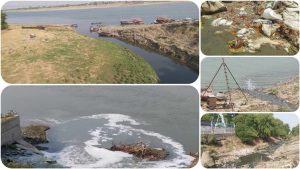
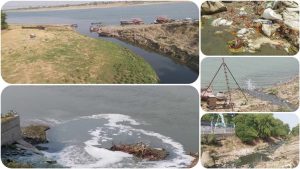
विद्या भूषण रावत गंगा नदी की यात्रा गंगोत्री गंगासागर फैक्ट्री के नाले, गंदगी, कूड़ा-कचरा नदी
वाराणसी से लेकर कानपुर और बक्सर तक विद्या भूषण रावत को फैक्ट्री के नाले, गंदगी, कूड़ा-कचरा नदी में फेंका हुआ मिला

ईन्यूज़रूम: जलवायु परिवर्तन और पर्यावरणीय मुद्दों को समझने के लिए आपकी यह यात्रा कितनी महत्वपूर्ण थी, खासकर यह देखते हुए कि गंगा जैसी नदियाँ, जो अरबों लोगों के जीवन को प्रभावित करती हैं, अब न तो उतनी स्वच्छ हैं और न ही उतनी विशाल?

विद्या भूषण रावत: यह यात्रा जलवायु परिवर्तन और पर्यावरणीय संकट को समझने के लिए बेहद महत्वपूर्ण थी। ग्लेशियरों का तेजी से पिघलना चिंताजनक है। इस साल मई की शुरुआत में ही हमने कई पहाड़ों को बिना बर्फ के देखा, जो बहुत ही दुखद था। चरम मौसम की घटनाएं, बाढ़ और जंगल की आग बढ़ रही हैं। गंगा के मैदानों में, नदी के संरक्षण के प्रति जागरूकता की कमी निराशाजनक थी। हरिद्वार के बाद गंगा में बड़े रेतीले पैच दिखने लगते हैं, और नदी धीरे-धीरे सिकुड़ती जा रही है।

कन्नौज में एक किसान ने मुझे बताया कि अब खेती से ज्यादा रेत खनन में फायदा है। उत्तर प्रदेश और बिहार में बड़े पैमाने पर रेत खनन हो रहा है, जिससे पर्यावरण को गंभीर नुकसान हो रहा है। इन राज्यों में मरुस्थलीकरण बढ़ रहा है। हर साल बाढ़ से व्यापक विनाश होता है, और कई जगहों पर गंगा का जल स्तर बहुत कम है। कानपुर, वाराणसी और पटना में पानी की गुणवत्ता इतनी खराब है कि वह नहाने लायक भी नहीं है।

बंगाल में गंगा बड़ी हो जाती है, लेकिन बाढ़ से वहां भी जीवन प्रभावित होता है। पानी की गुणवत्ता एक गंभीर मुद्दा है, और यह सुनिश्चित करना बहुत जरूरी है कि नदी में कोई सीवेज या कचरा न डाला जाए। नगर पालिकाओं और ग्राम पंचायतों को यह जिम्मेदारी दी जानी चाहिए कि वे उद्योगों को नदी में रासायनिक कचरा छोड़ने से रोकें। धार्मिक नेताओं को लोगों को जागरूक करना चाहिए कि वे गंगा में कचरा न डालें।

गंगा में स्नान को भी नियंत्रित किया जाना चाहिए। मेरे विचार से, लोग डुबकी लगाने की बजाय पानी का एक घूंट लेकर या उसे छिड़ककर गंगा की पूजा करें। इससे गंगा को बचाने में मदद मिलेगी। यह देखकर दुख होता है कि लोग गंगा को मां कहते हैं और फिर भी उसे प्रदूषित करते हैं। यदि हम गंगा के प्रदूषण पर ध्यान नहीं देंगे, तो यह भारत के लिए एक बड़ा सभ्यतागत और पर्यावरणीय संकट बन सकता है।

विद्या भूषण रावत की झारखंड में गंगा यात्रा

ईन्यूज़रूम: इस यात्रा से आपने क्या सीखा? क्या इसने गंगा या अन्य नदियों को लेकर आपकी किसी पूर्व धारणा को चुनौती दी?

विद्या भूषण रावत: इस यात्रा ने मुझे यह समझने में मदद की कि कोई भी यात्रा वास्तव में कभी पूरी नहीं होती। इसने मुझे गंगा की गहराई और विविधता के बारे में नई जानकारी दी, और यह कि कैसे इस नदी ने कई सभ्यताओं, राज्यों, और साम्राज्यों के विकास में योगदान दिया है। सच कहूँ तो, मुझे यह अंदाज़ा नहीं था कि गंगा की यात्रा कितनी विशाल और जटिल है। हम आम तौर पर हरिद्वार, कानपुर, इलाहाबाद, वाराणसी, और पटना जैसे नामों को जानते हैं, लेकिन गंगा के साथ इससे कहीं अधिक जुड़ा हुआ है।

बहुत से उत्तर भारतीयों को यह भी नहीं पता कि हुगली नदी गंगा का हिस्सा है, और बंगाल में भागीरथी का गहरा सांस्कृतिक महत्व है। पहले मुझे भी यही लगता था कि कानपुर के बाद गंगा बेजान हो जाएगी, लेकिन ऐसा बिल्कुल नहीं था। मुझे नहीं पता था कि बिहार में गंगा के किनारे इतनी खूबसूरत जगहें हैं, जैसे मुंगेर, भागलपुर, और कहलगांव, जिन्हें और अधिक बढ़ावा मिलना चाहिए।

एक और आश्चर्य था कि भारत के सबसे महान प्राचीन विश्वविद्यालयों में से एक, विक्रमशिला, गंगा के तट पर स्थित था। झारखंड का ऐतिहासिक शहर साहिबगंज भी मेरे लिए एक नई खोज थी। वहाँ से मनिहारी तक की जहाज यात्रा अविस्मरणीय थी। मैंने गंगा पर बड़े मालवाहक जहाजों को चलते देखा, और 45 मिनट तक अपनी कार के साथ नदी पर यात्रा करना एक अद्भुत अनुभव था। इससे मुझे गंगा की विशालता का अहसास हुआ।

बंगाल में गंगा की जटिलता, उसकी ज्वारीय और गैर-ज्वारीय शाखाओं के रूप में, मुझे बहुत कुछ सिखा गई। हुगली की उत्पत्ति को लेकर मैं पहले भ्रमित था, लेकिन मुर्शिदाबाद का दौरा करने से यह भ्रम दूर हो गया। रास्ते में कई महल, मंदिर, मस्जिद, और गुरुद्वारे देखने को मिले। यह यात्रा जीवन भर की सीख थी, लेकिन यह अभी खत्म नहीं हुई है। इस अभियान ने मुझे इन नदियों को बचाने और उनकी रक्षा करने का कर्तव्य महसूस कराया है, क्योंकि ये सिर्फ भौगोलिक रेखाएं नहीं, बल्कि हमारी पहचान और विरासत हैं।

ईन्यूज़रूम: क्या आप मानते हैं कि अगले 20-30 वर्षों में गंगा अपना महत्व खो देगी, या यह भारतीय जीवन का केंद्र बनी रहेगी, या संभवतः और अधिक प्रमुखता हासिल करेगी?

विद्या भूषण रावत: गंगा या भारत की कोई भी नदी कभी अपना महत्व नहीं खो सकती। यदि ऐसा हुआ, तो हमारी सभ्यता का अस्तित्व संकट में पड़ जाएगा। गंगा के बिना, हम जीवन की कल्पना भी नहीं कर सकते। पश्चिमी उत्तर प्रदेश, बिहार, झारखंड और बंगाल की उपजाऊ भूमि इसका प्रमाण है। मछुआरों से पूछिए, वे गंगा के महत्व को कैसे समझते हैं।

हालांकि, एक खतरा बना हुआ है: यदि प्रदूषण अनियंत्रित रहा, तो हमें केवल गंदे पानी का सामना करना पड़ेगा, जो विनाशकारी होगा। धार्मिक पुनरुत्थानवाद ने केवल गंगा को अनुष्ठानों की वस्तु बना दिया है, बिना उसकी स्वच्छता सुनिश्चित किए।

हमें यह समझने की जरूरत है कि स्वच्छ गंगा से सभी को अधिक संतोष मिलेगा। लोग हिमालय, देवप्रयाग और ऋषिकेश की ओर क्यों आते हैं? क्योंकि वहां गंगा जीवंत और पवित्र है, इसका जल इतना साफ है कि कोई भी इसे पीने में संकोच नहीं करता। लेकिन जैसे ही नदी मैदानों में पहुंचती है, हम उसकी पवित्रता खो देते हैं। कानपुर और वाराणसी में तो लोग नदी में सुरक्षित रूप से स्नान नहीं कर सकते (हालांकि कई लोग पानी की खराब गुणवत्ता से अनजान होकर ऐसा करते हैं)।

हमें जलवायु संकट को गंभीरता से लेना होगा। हिमालय के मुद्दे केवल उत्तराखंड, लद्दाख, या हिमाचल प्रदेश के लोगों के लिए नहीं, बल्कि पूरे देश के लिए महत्वपूर्ण हैं। सरकार को सतर्क रहना चाहिए और राज्य सरकारों को इन चिंताओं का समाधान करने के लिए स्थानीय समुदायों की भागीदारी सुनिश्चित करनी चाहिए। बिना उनकी भागीदारी के, कोई भी समाधान सफल नहीं होगा, और ऐसा करने से और अधिक आपदाएं आएंगी।

ईन्यूज़रूम: गंगा नदी की यात्रा के बाद गंगा की बेहतरी के लिए नीति निर्माताओं को आपके क्या सुझाव हैं?

विद्या भूषण रावत: अपनी पुस्तक में, मैं हर राज्य में क्षेत्र-विशिष्ट मुद्दों के आधार पर विशिष्ट सुझाव दूंगा। हालांकि, यहां कुछ सामान्य बिंदु हैं:

  1. स्थानीय निकायों को जिम्मेदार बनाना: स्थानीय निकायों को नदी को प्रदूषित करने वाली औद्योगिक इकाइयों के खिलाफ कार्रवाई करने के लिए सशक्त किया जाना चाहिए।
  2. नालों का पानी रोकना: गंगा में नालों का पानी प्रवाहित होने से रोकें।
  3. दंडित करना: ग्रीन ट्रिब्यूनल या नगर निगमों को उन कंपनियों या कारखानों के खिलाफ कार्रवाई करनी चाहिए जो नदी को प्रदूषित कर रही हैं और जो जल निकासी प्रणालियों पर कार्रवाई करने में विफल रहते हैं।
  4. निगरानी एजेंसियों को फंड देना: गंगा की सुरक्षा और संरक्षण के लिए निगरानी एजेंसियों को अधिक धन आवंटित करें।
  5. स्थानीय समुदायों को शामिल करना: गंगा के संरक्षण के प्रयासों में स्थानीय समुदायों और ग्रामीणों को शामिल करना आवश्यक है।
  6. धार्मिक पर्यटन का नियमन: हिमालयी क्षेत्र में पर्यटकों की भारी आमद आपदा का कारण बन सकती है, इसलिए वहां के बुनियादी ढांचे को बेहतर बनाने की जरूरत है। केदारनाथ और सुंदरबन जैसे पवित्र स्थलों की पवित्रता को हर कीमत पर संरक्षित किया जाना चाहिए।
  7. सावधानीपूर्वक पर्यटन की योजना: हिमालय से लेकर बंगाल की खाड़ी तक, हमें सावधानीपूर्वक पर्यटन की योजना बनानी चाहिए ताकि स्थानीय संस्कृतियों और पारिस्थितिकी तंत्र को नुकसान न पहुंचे।


इस इंटरव्यू को आप इंग्लिश में भी पढ़ सकते हैं

Prophet Muhammad’s Legacy: World’s 1st Constitution and Human Rights Charter Highlighted at Interfaith Meet

Kolkata: Prophet Muhammad gave the world’s first constitution and a human rights charter. Additionally, the Ghazwa-e-Hind had already occurred in India when Muhammad Bin Qasim came from Damascus to rescue Muslim women and children from Raja Dahir in Sindh. This was stated during an interfaith meeting held in Kolkata on October 2.

In an effort to counter rising Islamophobia and propaganda against Prophet Muhammad, this interfaith meeting was organized on Gandhi Jayanti in Kolkata. The seminar, held during the birth month of Prophet Muhammad, Rabiul Awwal, was conducted by two organizations, SR Foundation and Hayaat Foundation, to educate the public on the life and works of the Prophet. Around 30 non-Muslim intellectuals participated in the three-hour-long event.

Prophet Muhammad is the Most Recorded Prophet in World History, No Room for Propaganda in Islam

Dr Sarfaraz Adil, the convener of the event, pointed out that every second of Prophet Muhammad’s life has been recorded. As there was no formal education system at the time, narrators helped preserve these records, maintaining a chain of narration.

“To record the Prophet’s sayings, the narrators’ lives were also documented. Six lakh narrators’ lives have been preserved to record the Prophet’s works and life. Every detail, from his sitting posture to his hair and every moment, has been preserved,” Dr Adil explained.

“There is no place for propaganda in Islam. Yet, people and organizations attempt to spread it through fake memes, doctored videos, and misinformation. Although these falsehoods are later debunked, by that time, riots often erupt, and many innocent lives suffer as a result.”

Dr Adil also mentioned how people’s lives have changed while reading or writing about the Prophet. One such person is Swami Laxmi Shankaracharya, who first wrote the book Islamic Atankwad Ka Itihas but later authored Islam Atank Ya Adarsh. Not only did he realize his mistake and write a second book, but he also formed the Hindu-Muslim Ekta Manch to bring the two communities closer.

“When Gandhi Ji met Maulana Mungeri, he mentioned that he had read the Quran and liked it very much. He also read the biography of Prophet Muhammad and found many good things about him. He said, ‘If his life is followed by Indians, India will become heaven.’

Maulana Mungeri then asked Gandhi Ji if he found anything wrong in the Quran or the life of Prophet Muhammad.

“I wasn’t expecting this question, but no, I didn’t find anything wrong in either the Quran or the teachings of Prophet Muhammad,” Gandhi Ji had answered,” Dr. Adil shared.

Never Spoke Lies and Always Paid Others Their Due Rights

The next speaker, Mufti Abdul Mueed, highlighted two important aspects of the Prophet’s life: “Prophet Muhammad’s two most significant teachings were—never speak lies and always fulfill the rights of others. Most conflicts, whether personal, social, or political, arise from not giving others their due rights.”

The Prophet Told the World That Women Are Equal and He Trusted Them

Professor Abdul Rasheed emphasized that Prophet Muhammad established a constitution when he went to Medina, which contained 52 points. This constitution united all social groups, including Christians and Jews, to protect Medina and promote social responsibility and financial stability. The Prophet also formed 300 agreements with different tribes.

The professor discussed seven important messages the Prophet gave to the world. “He proclaimed that the Almighty is One, and never accept anyone else as God. He asserted this concept clearly and simply for common people. He also taught that the father of every human being is one, meaning all are brothers and equal, which brought his third message about equality. No one is superior based on caste, color, or creed. His last sermon in Mecca introduced the world’s first human rights charter.”

Although historians recognize The Cyrus Cylinder as the world’s first human rights charter, written by Persian King Cyrus in 539 BC after the conquest of Babylon, and in modern times, the UN Charter is known as the human rights document, Rasheed explained that Prophet Muhammad’s last sermon was also a human rights charter for the world.

Rasheed further stated that the fourth important message was that human beings are the best creation of the Almighty, and everything in this world was created for them.

“He also taught that men and women are equal. While in Arabia, a girl child was often killed, this was a common practice worldwide at that time. The Prophet empowered women, giving them rights in marriage, property, and education. He trusted women so much that he first told his Prophethood to his wife and even performed household chores,” said the professor.

Rasheed also stressed that Prophet Muhammad warned against superstition, advising people not to let it hinder their progress. “Religion is not just spirituality; it should be connected to daily life to make life better.”

He added that the Prophet reformed the system of slavery, urging people to feed their slaves the same food they ate, dress them in similar clothes, and assist them with major tasks. “He even encouraged people to free their slaves.”

Prophet Muhammad Teaches Us to Respect All Religions

The attendees, who patiently listened, later asked questions and thanked the organizers for hosting an event that provided them with valuable, authentic information about Prophet Muhammad.

“What I learned from Professor Sahab’s speech is that we are all children of one father. What he said about the Prophet is very inspiring and ideal for everyone. The life of Prophet Muhammad conveys respect for other religions and promotes living a peaceful life,” said Swami Devaker Chinmaya.

Bimal Sharma, a guest, asked where he could find references to counter misinformation and disinformation, to which he was promised recommendations for books and writings.

Dr Sanchay Sarkar, a Matua community leader, expressed happiness at the knowledge he gained from the event.
Soumya Mondal remarked that many of his friends often speak about the Ghazwa-e-Hind, claiming Muslims will take over India. Similar statements were made during the recent political turmoil in Bangladesh, saying the Ghazwa-e-Hind had already begun.

Dr Adil clarified, “The Ghazwa-e-Hind has already happened in India. Raja Dahir’s army had imprisoned several Muslim women and children, and to free them, Bin Qasim fought against the king. After this, Islam came to India. As Dahir was not popular among his people, Bin Qasim stayed for two years, demonstrating the qualities of a ruler before eventually returning.”

Maulana Ansar Alam Qasmi spoke in Bangla to the audience, while Imtiaz Mollah moderated the event. Athar Firdausi from the SR Foundation gave the vote of thanks.

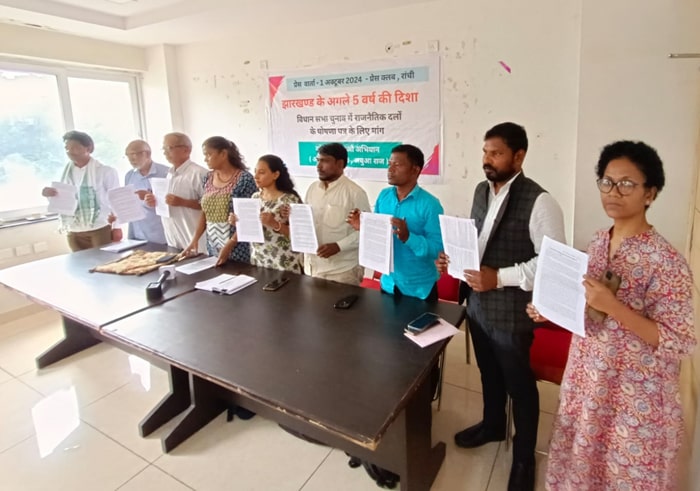
People’s Manifesto Calls for Overhaul: Land Reforms, Corruption Crackdown, and Adivasi Rights in Focus Ahead of Jharkhand Polls

0

Ranchi: A citizen’s charter was made public today in Ranchi ahead of the forthcoming assembly polls in Jharkhand by Loktantra Bachao Abhiyan, a Jharkhand-based campaign aimed at saving democracy. The public manifesto, released for the 2024 Legislative Assembly election, demanded the following:

The Land Acquisition Law (Jharkhand) Amendment 2017 and the Land Bank Policy should be repealed. All projects being established without the consent of the Gram Sabha, that violate land laws, or are opposed by locally affected communities, should be canceled.

A Displacement and Rehabilitation Commission should be formed. Land should be provided to the displaced, landless, Dalits, and poor farmers. In line with a recent Supreme Court decision, the state government should immediately impose a state tax on mining and give at least half of it to the Gram Sabha. PESA rules should be formulated, and provisions of the Sixth Schedule should be implemented in Adivasi-dominated areas like Kolhan and Damini Koh. All pending individual and community forest pattas should be distributed within three months of the formation of the new government.

The campaign calls for action within the first six months of the government’s formation on the issues for which the state was created—jal, jangal, zameen, identity, Adivasi autonomy, and freedom from exploitation.

The Loktantra Bachao Abhiyan (Abua Jharkhand, Abua Raj) held a press conference at the Ranchi Press Club, urging political parties that support communal harmony and constitutional values to include these demands in their manifestos. Following the press conference, the Abhiyan delegation submitted the manifesto to the state leadership of the JMM and Congress.

During the press conference, an assessment was given on the Hemant Soren coalition government’s rule over the last five years. Several initiatives aligned with public expectations were undertaken by the coalition government, such as significant increases in social security pension coverage, the Maiya Samman Yojana, support for migrant workers during and after the COVID-19 lockdown, agricultural loan waivers, withdrawal of cases related to the Pathalgadi and CNT-SPT movements, and halting the extension of the Netarhat Field Firing Range project. Additionally, major demands like the 1932 khatiyan-based domicile policy, 27% reservation for backward classes, and the recommendation for a Sarna religious code were passed by the assembly.

However, the Abhiyan pointed out that many promises made by the coalition parties remain unfulfilled after five years. For instance, the Land Bank and Land Acquisition Law amendments were not repealed, the Icha-Kharkai Project was not canceled, PESA rules were not created, and a mob lynching law was not enacted. Additionally, merged schools were not reopened. Moreover, ground-level corruption in government schemes, including MGNREGA, was not adequately curbed. Many government announcements remained limited to paper, such as providing eggs to children in Anganwadi and mid-day meal programs. Over these five years, the BJP and the Modi government continuously attempted to topple the state government. The central government also blocked many state policies.

Looking forward, the new government needs to address key issues. According to government data from last year, around 15,000 undertrial prisoners are in jail, most of whom are Adivasis, Dalits, backward castes, and Muslims, many incarcerated under false cases. These prisoners should be immediately released, and a high-level judicial inquiry should be established to identify and dismiss false cases against Adivasis and marginalized people.

It was also noted that appointments over the past five years were based on the anti-Jharkhand domicile policy of the Raghubar Das government. The new government should implement a khatiyan-based domicile policy (including special provisions for the landless) within three months, in line with public expectations. Laws should also be enacted to ensure substantial representation of Adivasis and Mulvasis in leadership and decision-making positions in both private and government sectors. In Fifth Schedule areas, locals, especially Adivasis, should be prioritized for decision-making roles in police stations and local administrations. Lakhs of landless Dalits and displaced individuals in the state lack caste certificates, depriving them of education, employment, and other rights. The process of issuing caste/residential certificates should be simplified, and camps should be organized to distribute these certificates.

Various communal organizations and parties are undermining the fabric of Jharkhandi society through divisive politics, using issues like Bangladeshi infiltration, Sarna-Christian, and Hindu-Muslim tensions. Halting such activities should be a priority for the next government. An important step toward equality and communal harmony would be to prohibit the construction of religious-specific worship spaces in police stations, police camps, and government offices. Additionally, it should be ensured that religious flags and symbols installed in public places, roads, electric poles, government offices, police stations, and paramilitary camps for religious events are removed within 48 hours after the event concludes.

Another priority for the new government should be improving the state’s poor public education and healthcare systems. Vacant positions, from primary schools to colleges, should be filled, and regular quality classes must be ensured. Similarly, vacancies in sub-health centers to district hospitals should be filled, and provisions for medicines and tests should be guaranteed. The government should avoid focusing solely on works involving contractors and large sums of money, such as building construction.

To end the widespread migration and unemployment in the state, an urban employment guarantee law should be enacted, and the daily wage rate under MGNREGA should be set at Rs 800. Additionally, the amount of social security pensions should be increased to Rs 3,000, and all pregnant and lactating women should receive Rs 20,000 in maternity benefits without conditions, as is done in Tamil Nadu. To combat malnutrition, the government should ensure that all children receive an egg daily in mid-day meals at Anganwadis and schools. The centralized kitchen system for mid-day meals should be discontinued.

Lastly, tackling ground-level corruption should be a top priority for the next government. Immediate measures should be taken to curb the contractor system, and an active, decentralized grievance redressal system should be established. All commissions, such as the Women’s Commission, Human Rights Commission, and Information Commission, should be appointed and made functional.

The press conference was addressed by Ambika Yadav, Ajay Ekka, Aloka Kujur, Basing Hessa, Dinesh Murmu, Elina Horo, Nand Kishore Ganjhu, Riya Pingua, and Tom Kavala.

Layered Discrimination: How Latent Islamophobia Persists in Bengal’s ‘Secular’ Society

[dropcap]T[/dropcap]he streets of India’s West Bengal State, majorly Kolkata, witnessed numerous protests, long marches, and rallies for the last month in recent times demanding justice and legal punishments against the perpetrators of the heinous incident that occurred on August 9 at Kolkata’s RG Kar Hospital where a junior doctor was reportedly raped and caused to death. People from all walks of life throughout the State, as well as the country, are showing their solidarity either by organizing protest events or by participating in ongoing protest marches against such inhuman and brutal action. It is a very familiar scenario in the State or at its capital of historical importance of such kind from the time of British colonialism and its emancipation from the imperial clutches to showcase such agitations whenever it finds something happening against human rights, injustice, oppression, violations, or political unrest and many more issues around the world.

Conversely, what is unfamiliar within this familiar frame of reference in the post-independent time is the cherry-picking of incidents that suit the ‘consciousness’ of the educated, civil, upper caste-middle class protest organizers from every corner of numerous professions and therefore excluding other genuine significant violations against human rights or injustice or political oppressions considering it as trivial or redundant.

Interestingly, this consideration of triviality gets assured with wilful indifference to issues related to Muslims of Bengal or having Muslim connections.  On the other hand, the same intelligentsia becomes more concerned with the Muslim women, human rights, and political oppression of one group by another in countries where the Muslim population is in majority.

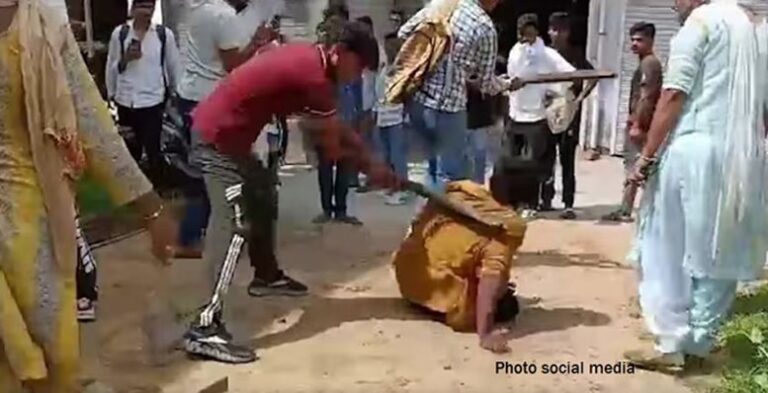
For instance, take the recent incident of the brutal lynching of Sabir Mallick, a Bengali Muslim migrant labourer from Basanti Police Station in West Bengal’s South 24 Pargana district who was thrashed to death in the BJP-ruled State, Haryana, on the 27th of August this year by five self-proclaimed cow vigilantes or cow-terrorists on suspicion of cooking and eating beef at his home. Sabir Mallick, who used to work as a ragpicker in Bandhra village of Haryana’s Charkhi Dadri district with his family to earn his livelihood by gathering discarded materials and rags, was being duped into selling discarded materials by the accused to vent out their hatred against this migrant Muslim labourer. Though this trend of mob lynching on suspicion of cow smuggling, eating beef, or keeping it in a refrigerator has turned out to be a known fact and normalized scenario after the killing of Akhlaq working as migrant workers in BJP ruled States, non-BJP States like West Bengal and the society at large are maintaining silence and numbness against such inhuman activities.

Surprisingly, except for a few, those fighting to ensure justice for the RG Kar incidents have not uttered a single word or included Sabir’s name for justice in their ongoing protests and marches. Furthermore, there were neither any demonstrations of verbal retaliation against the rhetorical question of the chief minister of Haryana when he said, “Who could stop them (the cow-vigilantes)?” by the State leaders, parliamentary representatives from any political parties– irrespective of colours, in the form of a political statement or press release issued as a sign of protest. The reason is crystal clear. His religious identity and his place of residence in the peripheral location- far away from the luminous streets of Kolkata are sufficient for them to be selective and conscious before raising their voices.

Moreover, Bengal—being a secular and non-BJP State where a Muslim vote bank plays a crucial role in deciding who wins the throne, has eight Muslim political representatives altogether in both lower and upper houses and forty-two Members of the Legislative Assembly with few ministerial posts. Unfortunately, none of the Muslim representatives have spoken a word about the lynching of Sabir Mallick, nor has a single protest march been held in the streets of Kolkata by any Muslim organizations, nor any NGOs, which are brimming by leaps and bounds, and the larger salaried Muslim society have not been found in the streets protesting against such rampant events.

However, there is another twist concurrent to this chain of lopsided proceedings of the Bengal society concerning the infertile and sedentary negligence along with compartmentalized pursuit within the excluded Muslim community preferring silence to raise active voices on their issues, except a few social media activists within closed groups. Additionally, at times, a section of educated community sympathizers expresses their discontent over the lack of socio-cultural representations in societal artefacts and anguish over their nominal representations in the electoral forms of governance and holding of posts in the mainstream political parties, irrespective of colour.

Take the example of a recent government circular. On the 28th of August, the Secondary Branch of the School Education Department under the Government of West Bengal published a list of recruitment to the posts of Chairman/Chairperson for its five regions in which there is not a single Muslim candidate selected in the panel list. It has made an uproar among the educated Muslims of the State among the different sections of the community citing it as systematic deprivation and majoritarian supremacy. An outburst of unrest against such discrimination has been visible in social media, print media, and news portals showcasing the violation of fair and equal opportunities stipulated by the Government of India in any recruitment board vide memo no. O.M. No. 42011/15/1995-Estt.(SCT) dated 11th July 1995 and the revised Memo No. F.NO.42011/2/2014-Estt.(Res.) dated 13th July, 2014 which secures the presence of a representative from the minority.  Long story short, the outcry is on the sidelining of Muslim representatives in higher posts in the government sector which is schematically maintained throughout with few exceptions.

Conventionally, Muslim political representatives have been staged as a token of empowerment for the community- obviously for securing vote banks, because of the one-third Muslim population of the State. It’s saddening that their existence involves no actual significance to the acute issues of the community rather than proving their loyalty towards their political custodians. Eventually, such leaders maintain ignorance or silence when issues like Muslim lynchings take place in any part of the country. Naturally, the question arises: why do Bengali Muslims need any community or political leaders at all when they turn out to be mute spectators? Or are their voices being compromised or suppressed by the system they are part of in the power structure of the State? It may be assertive for both questions, especially for those who have closely observed Bengal politics recently.
The silence of the majority community over the recurrent brutal issues against Muslims and silencing the voices of dissatisfaction of Muslim political representatives against the same within the power structure of the Bengal society are sometimes labelled as deprivation and discrimination. Few groups of concerned educated Muslim intelligentsia question these kinds of racist treatments by taking writing as a form of protest against it in community-run newspapers or news portals. But it can be argued that such deprivations and discriminations are being elicited from anti-Muslim or Islamophobic hatred prevalent in Bengal society the initiation of which dates back to the nineteenth-century Bengal reformation in the hands of the then prominent figures, the predecessors of today’s Hindutva ideology, like Bankim Chandra Chatterjee, Ishwar Gupta, and a flock of writers.  The same sentiment and the nurturing of the same against the Bengali Muslims after almost two hundred years are thus visible in the present Bhadralok society in the form of latent Islamophobia. This can be noticed in their movement to divide Bengal for a Hindu Homeland in the 1940s or the deafening silence on sexual abuses in KunanPoshpora or Soni Sori.

Mainstream newspapers and local media are also complicit in the nurturing and conventionalization of latent Islamophobia. The leading media houses specifically cover Muslim issues with grandeur embellishment and insinuate their motive to blame the whole community or their religion when they find any Muslim individual committing any misdeeds and not the specific person. They always ignore covering pertinent issues related to the everyday living of the community. Take the example of the two incidents mentioned above. Neither the popular mainstream Anandabazar Patrika, Ei Samay, Bartaman among other publish any coverage as they usually do with any Muslim links to anti-social activities.

Nevertheless, in both cases, the GoB has taken the so-called positive initiatives; it declared a government job to Sabir’s family; the concerned Department again published a revised circular including three Muslim representatives in the panel list after the uproar by the community people. Contrarily, is it enough for a family and a younger daughter who lost her father for good? Is the weighing of human life with a job and slating brutality with the price of life appropriate enough to let it get normalized in society? Aren’t such initiatives setting the backdrop for more incidents like this to happen? What about justice for a Bengali Muslim minority living in a Hindu-majority State? Though the Haryana police have arrested the five cow vigilantes, who can be assured they will be dealt with stringent punishment for their heinous deeds, when one witnesses the fate of a Dalit or a Muslim in connection with the judicial system of the present country and when non-BJP States like Bengal fails to take that responsibility?

Furthermore, for the latter, this is not the first time such incidents have occurred; this single case is a snapshot only. The tradition of discrimination is deep-rooted either in the form of deprivation in equal share to numerous social fields or violating the roaster system under the Reservation Policy for the Other Backward Class (OBC) in which Muslims have a sizable share. It is untrue that there are ineligible candidates from the Muslim community; there are plenty of them who deserve such higher posts. Because of the systematic manipulation of power and inherent Islamophobic attitude, such cases of latent Islamophobia come out disguised as deprivation or discrimination.

It’s high time to protect and energize the vibrancy of Bengal society from its decadence entangled within the divisive politics of caste, religion, and racism. If a society cannot ensure the safety, security, social justice, and equality of its minorities, it is shameful to uphold the foundational glory and tradition of the said society.

As Kolkata Mourned RG Kar Doctor, Bhopal’s 5-Year-Old Victim Left Forgotten: The Unequal Justice in India’s Outrage

Bhopal: A 5-year-old girl was raped and brutally murdered by a neighbour in Shahjahanbad of Bhopal. The accused Atul Nal strangled the child after committing the rape. After going missing for three days, her body was discovered on September 26 in a water tank within the very building where she lived. Despite extensive search efforts involving over 200 police personnel from multiple stations, drones, and search dogs, authorities were unable to locate the girl in time leading to public outrage and criticism of the police response. The prime accused along with his mother and sister has been arrested for their roles in this horrific crime.

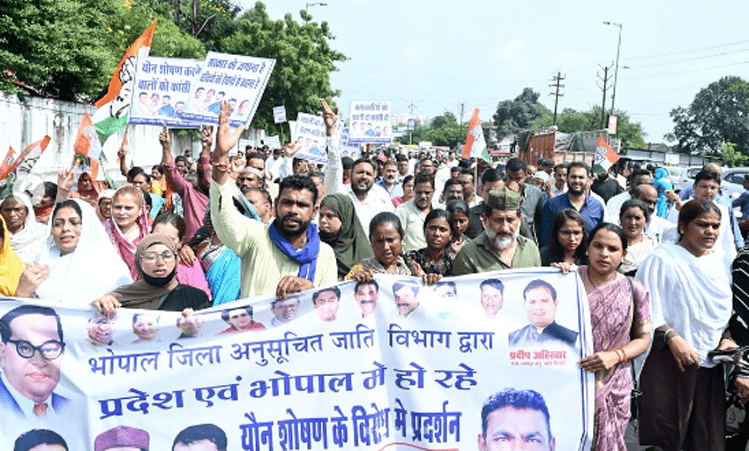
Protests erupted throughout the state capital demanding the death penalty for the accused concerning the increasing crime rates against women and girls. The locals in Shahjahanbad rallied and gathered at the police station voicing their anger and frustration. A Special Investigation Team (SIT) has been formed to investigate the case.

A video showed that the mother and sister of the accused were misleading the police during the investigation. The footage reveals both women alongside the prime accused, Atul, standing at their door during the time of the girl’s death feigning sympathy towards the victim’s family while smoothly concealing their involvement in the crime. They audaciously questioned authorities about the safety of women and children displaying no shame or fear in their demeanor.

Rising crimes against women and children in MP

Data from the city police commissioner revealed rape cases in Bhopal rose from 330 in 2021 to 456 in 2022, 523 in 2023, and 381 in just the first eight months of 2024. NCRB data from 2022 shows Madhya Pradesh ranks second in crimes against children with 20,415 cases just behind Maharashtra’s 20,762.

In 2022, 11,717 children went missing in Madhya Pradesh, with 75% (8,844) being girls, as per RTI data analyzed by the NGO Child Rights and You (CRY). On average, 32 children went missing daily, with over 24 being girls. In 2021, 11,607 children went missing in Madhya Pradesh, with 81% (9,407) being girls, according to NCRB data. In 2022, missing girls declined by 6%, but missing boys increased from 19% to 25%. From 2018 to 2022, 53,125 kids went missing in total, with 78% being girls.

According to the State Crime Record Bureau (SCRB), 5,348 women were sexually assaulted in the state in 2023. The highest number of crimes against women in 2023 occurred in Bhopal and Indore zones. A total of 7,773 women were molested, 10,306 kidnapped, and 13,671 faced obscenities statewide in 2023. Bhopal topped the list with 7,745 cases, followed closely by Indore with 7,738. Gwalior reported 6,331 cases, Rewa 6,296, and Ujjain 5,169.

Interestingly, the Madhya Pradesh Women’s Commission has been dysfunctional for years with the chairperson’s position vacant for over four years.

Death penalty law fails to deter a surge in rape.

BJP MLA Archana Chitnis called the incident unfortunate. Speaking to eNewsroom she said, “The Madhya Pradesh government is the first to pass a law to award capital punishment, yet incidents like these continue. There are multiple factors at play—the influence of entertainment, societal culture, and more—all impacting people’s minds. To prevent such incidents, families, society, government, and even religious organizations must act collectively. The situation is deeply concerning. How do we send our daughters out for education when such cases occur? Many claim Madhya Pradesh has a high number of FIRs, but it’s because our government ensures that an FIR is registered immediately against such anti-social elements. The accused are arrested in large numbers following complaints. Collective efforts can improve this situation. Entertainment, music, literature, and cultural activities shape our personalities, and we must address these issues at multiple levels. The accused have no religion or caste; they are simply criminals. The media should also present these matters in a balanced and healthy manner.”

Chief minister Mohan Yadav in a lengthy post on “X” wrote, “There is a provision of death penalty for such heinous crimes and our government will try to ensure that such criminals get the harshest punishment like death penalty.”

In 2018, the Madhya Pradesh government passed the Criminal Law (Amendment) Bill, 2018 which made the state one of the first in India to introduce the death penalty for rape of girls aged 12 years or younger. This amendment strengthened existing laws under the Indian Penal Code (IPC) specifically Sections 376AB and 376DB to impose the death penalty for such offenses.

Despite harsh penalties like death sentences, this central Indian state saw a 66% rise in rape cases in 2023 with an average of 14 women/girls sexually assaulted daily, as per SCRB data.

Opposition criticizes the government’s failure to protect minors.

Recent cases of child sexual abuse even in educational settings have also raised concerns about the safety of children. A 16-year-old boy was sexually harassed by his chemistry teacher, a 5-year-old girl was abused by her school van driver, and a 3-year-old girl was abused by her IT teacher in the past week. On September 27, Madhya Pradesh Congress President and former cabinet minister Jitu Patwari shared a post on X highlighting seven reported cases of sexual harassment and rape of minor girls across different districts of Madhya Pradesh within a week.

While the rape and murder of a trainee doctor in RG Kar Hospital of Kolkata shook the collective conscience of the nation leading to mass protests, the rape and murder of a minor in Bhopal did not bother countrymen. Additionally, this September, a woman was raped in broad daylight at a busy crossroad in Ujjain. Yet, bystanders chose to film the crime and post it on social media instead of helping the victim, while the nation remained silent. The disparity in reaction raises troubling questions about societal priorities and the perceived value of lives based on political context.

Congress MLA Arif Masood led a protest rally in Shahjahanbad criticizing the state government’s failure to protect women and children. He called for the chief minister’s resignation if he had any shame left. Masood also questioned the accountability of Collector Kaushlendra Vikram Singh, asking, “Where is the collector who once boasted in Berasia? Many incidents have occurred. Why are the collector and SP hiding now?”

On September 12, protests erupted at Berasia police station in Bhopal after three minor schoolgirls were allegedly blackmailed by local men. The accused who were arrested for taking photos and attempting to extort the girls faced demands for action from Hindu organizations including the Bajrang Dal. The situation was controlled when Collector Kaushalendra Singh intervened promising swift action while standing on a car’s bonnet.

The accused were slapped with the NSA (National Security Act). Masood was referring to this incident.

Influence of pornography worrying.

Anurag Pandey of the Madhya Pradesh Commission for Protection of Child Rights (MPCPCR) said that we are focusing on awareness and personal safety in response to rising cases in Bhopal. Aggression levels are increasing despite our efforts. “We have found in reported cases that many perpetrators watch pornography before committing rape while intoxication plays a significant role in diminishing humanity. The Madhya Pradesh government is rapidly reporting all cases and law is doing its part but we seek additional resources and measures. We have discussed prevention strategies regarding intoxicants and tightening the grip on violators. We’re also investigating a troubling new pattern where families support the accused. Shocking instances, like the murder and rape of a minor where the family tried to hide the body, are alarming. This behavior is incomprehensible and we are consulting experts to understand the psychological reasons behind it. Although stricter laws are in place, crime rates continue to rise. Improved reporting does not indicate a decrease in crime, so raising awareness remains essential.”

In another shocking incident, a nine-year-old girl was raped and murdered by her 13-year-old brother in Rewa after watching a pornographic video on her mobile phone. The incident happened in April which the mother and two elder sisters of the accused tried to cover up.

The Supreme Court of India recently ruled that viewing, possessing, and not reporting child pornography is an offence under the POCSO and IT Acts, even if not shared further.

Concerns over liquor and drug consumption and its link to rising crime rates

Congress MLA Atif Aqueel in conversation with eNewsroom said every crime has its complexities but the recent rape and murder in Eidgah Multi highlight a deeper issue: the unchecked illegal sale of substances like hashish, opium, marijuana, and alcohol. These readily available intoxicants often drive individuals toward violent acts. Crime rates continue to rise despite the commissioner rule showing failure to address root causes.

“A young girl was raped and murdered yet authorities have failed to take prompt action against this illegal sale creating fear and insecurity. Women and children no longer feel safe in their neighbourhoods. I raised these concerns with officials six months ago, but no action was taken. Criminals must face justice regardless of their background, especially in cases involving minors. We demand severe penalties including capital punishment to deter such crimes. It’s alarming that even a 5-year-old fell victim. The core problem remains the easy access to intoxicants which diminish humanity. We must stop illegal sales to protect society and prevent more tragedies. The government must act now to ensure the safety and dignity of women and children.”

Liquor consumption in Madhya Pradesh has risen sharply. In 2022-23, people consumed 1,909.18 lakh bulk litres of foreign liquor (malt), almost double the 962.18 lakh bulk litres used in 2021-22. For the spirit category, 684.69 lakh proof litres were consumed in 2022-23, up from 471.03 lakh proof litres the previous year.

Overlooked by Media, Celebrated by Millions: How Wali Rahmani’s Social Media Campaign Built a World-Class School

0

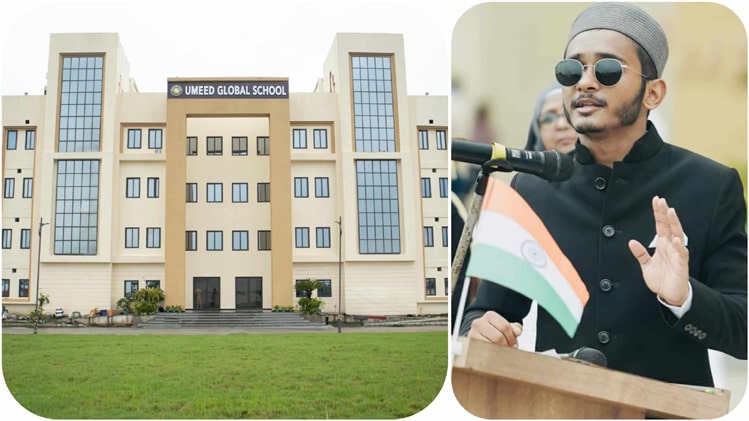
Kolkata: The year he became a law graduate, his dream job at a world-class educational institution was also realized. There was no legacy to follow. It took him 5 years to complete the law course, but this international-level infrastructure took shape within just a year. In 365 days, he not only collected Rs 10 crores from the public but also used it to build a modern school with hostels for the poor kids. When he shared the story on social media a fortnight ago, it garnered 20 million views. This 26-year-old young man is none other than Wali Rahmani.

During his teenage years and while studying, Rahmani started his Umeed Academy with three underprivileged kids in 2017.

The law graduate from Jamia Hamdard University’s achievement might be one of the rarest in the world. But it seems to have not received enough attention from the mainstream Indian media, where you will rarely find his story, with only a few exceptions.

“At present, 350 children are studying at Umeed Global School. While most of them are underprivileged, more than 30 are orphans. Most of the students stay in the hostel. When we had no hostel facility, our students were already following a 12-hour schedule, from 7 am to 7 pm, staying in the academy. As we aim to make them future leaders, without making them feel that they are from weaker sections of society, we not only provide the best education but also focus on their health and extracurricular activities,” Rahmani informed eNewsroom.

Umeed Global School Founder’s September 15 video on YouTube

Best Use of Social Media

In India, social media is mostly used to spread hatred or to earn money through bizarre activities. Young Rahmani, understanding the power of social media as early as the time when he was in Standard 12, used it positively. Almost eight years ago, when most people in India were still unfamiliar with the power of YouTube videos, he uploaded his first video on his channel. The gifted orator soon became a young sensation, with Rahmani’s videos garnering millions of views. During that time, he adopted underprivileged kids and started using the money he earned from YouTube to support them. He also gained a large following on Facebook, Instagram, and Twitter. Through these platforms, he connected with donors for his Umeed Academy. After a few years, he received a piece of land as a donation for Umeed Global School. Rahmani once again utilized social media cleverly, asking only for Rs 100 from everyone. He encouraged his followers to share his video with one million people, from whom Rs 100 could be collected, thereby raising Rs 10 crores.

“And it happened! Within 7 days, I had Rs 7 crores. When the school project was nearing completion, I again requested people to help build the hostels, and once more, our donors chipped in,” Rahmani shared excitedly.

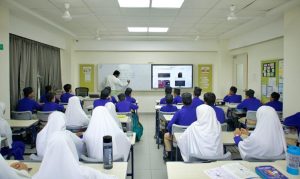
wali rahmani umeed global school crowdfund education Bengal Muslims underprivileged orphans classroom
A classroom in progress at Umeed Global School

An Academy for All

The academy has students from various backgrounds, non-Muslim kids as well as teachers, administrators, and staff from communities other than Muslims.

“We believe in providing better education and life to everyone. Yes, since we are more connected with our community and the academy is situated in a minority-dominated area, we have a higher number of Muslim students,” Rahmani clarified.

“Dean of Academics, Rinku Bhattacharya; General Manager, Abhishek Mukherjee; and architect Subrato Mondal played important roles in the journey from Umeed Academy to Umeed Global School. We have such dedicated people for our cause that, while it might sound unbelievable, two trustee members- Saifuddin Perwez and Mohammed Yakoob, left all their other work for one year to complete this state-of-the-art project within a year. We must show our donors that their hard-earned money is being used in a well-planned and honest manner, and our entire school management team helped make this a reality. It also allowed our students to study in a world-class school environment,” Rahmani mentioned.

Wali Rahmani Umeed Global School education students kickboxing champions
The Champions of State level Kickboxing 2024: Students of Umeed Global School with their medals | Photo credit: Umeed Global School

The school provides everything—books, uniforms, and meals for every student. it has smart classrooms, well equipped computer lab, the school has Innovation and Technology Lab. In this lab, students learn Robotics, Drone making, Coding, Artificial Intelligence, and Designing.

The dedication of the team is reflected in their results: for three consecutive years, Umeed students have become state kickboxing champions. This year, 13 students of Umeed Global got medals.

Whenever a young sportsperson or youth achieves something rare, people and the media often ask what others were doing at that age. In such instances, young Rahmani provides a perfect answer—his achievement is not only personal success but also for the benefit of society and the underprivileged children of India.

The kids lovingly call him Abbaji (father figure). And who better deserves such a respectable title?

Democracy Still Lives in Bengal Says Dr Kafeel And Calls Out UP’s Oppression

0

Kolkata: What will you do to show gratitude to a city that extended its help to you when you were down in the dumps? Come back to show your solidarity with its people when they need you. Well, that’s precisely what Dr Kafeel Khan has been doing for the past few days in Kolkata.

“I am back in Kolkata to show my solidarity with the doctor’s movement demanding justice for Abhaya, which is now a people’s movement,said Dr Khan.

Dr Kafeel on RG Kar Protests

Known for not mincing words, he said,Democracy prevails in Bengal. The people of this state have done what none could do in the past. What happened in RG Kar Hospital, is a deplorable act. The fact that a doctor was not just raped but was tortured to death and then some people in the higher order of the medical college made attempts to cover it up is just shameful.He then paused and added,The protest that followed has shown Indians how to take onto the streets and demand for justice.”

When asked what he thought about the entire episode he said,While the public need to be commended, we just can’t deny the fact that the chief minister Mamata Banerjee went to meet the angry doctors and agreed to meet their demands. No matter how angry you are, please understand that Bengal even today offers a space to voice your concern, to protest. Had this been in UP all the protesters would have been put behind bars and had the National Security Act (NSA) slapped on them.”

He mentioned that he had met the protesting doctors when he arrived in the city to extend his solidarity with their movement.It’s almost two months since the crime was committed. The CBI needs to get down to the result and have the guilty punished,” added Dr Kafeel.

The Victim Doctor

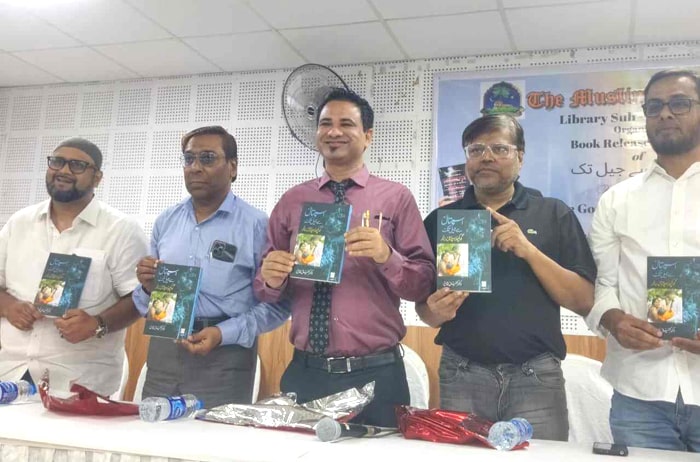
The Gorakhpur doctor whose heart-wrenching story even found a place in Shah Rukh Khan’s hit movie Jawaan, was in Kolkata to launch the Bengali translation of his The Gorakhpur Hospital Tragedy: A Doctor’s Memoir of a Deadly Medical Crisis.

The much-acclaimed book, which Dr Khan says was a way to document his journey, has been published in 11 languages and took much time to translate into Bengali.Bengal has given me much love and support. Bengali Bhadralok was the first to hit the streets demanding justice for Dr Kafeel Khan. So, when I was writing this book, I had a vision to have it simultaneously published in Bengali. But somehow, we didn’t have any publisher till now,he said while showing a copy of the Bengali translation of the book.

The activist doctor, who is celebrating his birthday today while narrating his journey claimed that the vilification he received from the Uttar Pradesh government would have been the same had it been some Mishra or John.The government needed a scapegoat to save itself from being dissolved. And that’s what they did – maligned my name to save the government,said Dr Khan along the sidelines of his book launch organised at the Muslim Institute, Kolkata.

However, he pointed out that the journey from being hailed as a saviour to being labelled as a person with an ulterior agenda for the nation has been tough and that despite having his name cleared off all the allegations levelled at him, he is yet to get justice.

And what does justice mean to him? The doctor answered,Assurance of providing free healthcare services to the poorest of the poor in the country.”

The River of a Billion Lives: Vidya Bhushan Rawat on Sacred, Polluted and the Future of the Ganga

0

Kolkata: Vidya Bhushan Rawat, a dedicated activist, author, and filmmaker, has spent the last three decades working with marginalized communities. His commitment has taken many forms—from conducting padyatras (foot marches) for social causes to delivering lectures, conducting interviews, and producing documentaries. Recently, he achieved a rare milestone: traversing the Ganga from its source in the Himalayas to its mouth in the Bay of Bengal. This journey, which began in September 2021, marks three years of documenting the environmental, cultural, and historical dimensions of India’s most revered river.

Rawat’s extensive work includes numerous documentaries capturing the essence of this journey, and with over 25 published books to his name, his forthcoming work on the Ganga is highly anticipated. On the very next day after completing this extraordinary Ganga yatra (journey), he spoke to eNewsroom, sharing his reflections with a calm demeanor, yet at times brimming with excitement—much like the Ganga itself. Here is an excerpt from that conversation.

eNewsroom: Why did you decide to travel along the Ganga River?

VBR: Being a native of Uttarakhand, my love for rivers and mountains comes naturally. The first time I saw the Ganga was in 1978, when I was just a ten-year-old child. I had traveled to visit a relative’s house in Muni Ki Reti, Rishikesh, and was mesmerized by the beauty of the river. The water was a stunning green, pure and serene. Sitting on the bank and watching the calm flow of the river brought me immense joy.

As I grew older and moved to Dehradun for my studies, visiting Har Ki Pauri in Haridwar became a regular activity. I also knew that in our family, as in many others, it was customary to cremate the deceased on the banks of the Ganga in Haridwar. Even after I migrated to Delhi in 1991, my connection to Uttarakhand remained strong because of my deep love for its natural beauty.

Two decades later, I saw a powerful art exhibition by Ambedkarite artist Savi Savarkar at the Lalit Kala Academy. One of the paintings, titled Debrahminising the Ganga, made a lasting impression on me. However, the real spark for my Ganga journey came after I traveled to the upper Himalayan region of Uttarakhand in 2021, shortly after the Covid-19 lockdowns. I witnessed the mountains being exploited and saw muck flowing into the river. This inspired me to create a short 10-minute video titled Ganga Tum Behti Raho, which was well-received by many of my friends.

river ganga ganges environment yatra culture climate uttarakhand
Ganga in Uttarakhand | Credit: VBR

Having undertaken several padyatras in Uttar Pradesh and Uttarakhand, I began discussing the idea of a boat journey or an exploration of the Ganga. However, logistical and financial challenges made it difficult to realize at the time. Eventually, some friends offered to support my initiative to document the Ganga and the environmental crises it faces, particularly in Uttarakhand. This support helped me begin the project in earnest.

As I delved deeper into the river’s story, I realized that merely documenting the Ganga’s tributaries in the Himalayas would not be enough. I felt compelled to continue the journey all the way to the Bay of Bengal. Although I initially thought the challenges in the Himalayan region were the toughest, I found the low-lying Gangetic plains even more difficult to navigate.

In September 2021, I began my journey with a trek to Gaumukh from Gangotri, covering not just Uttarakhand but also the Yamuna Valley, Tons, Mahakali, and other regions. I traveled through Uttar Pradesh, Jharkhand, and West Bengal, completing the journey from Gangotri to Ganga Sagar. This journey has not only been a fascinating exploration but has also deepened my understanding of people, nature, geography, and the crises faced by both the rivers and the communities living along them.

eNewsroom: How significant was your journey in the context of Indian culture, given that civilizations in India grew around the Ganga?

VBR: For Hindus, the Ganga holds immense religious and spiritual value. To most, she is Maa Ganga. In the Uttarakhand region, however, she is known as Shailputri, the daughter of the Himalayas. Unfortunately, over the last few decades, the Ganga has been reduced to a symbol for rituals, often disregarding her dignity and sanctity. For me, it was equally important to look beyond her religious aspect and understand what draws us to the Ganga. Why is she Maa Ganga for everyone? In this sense, the journey has been profoundly educational for me.

Starting from the Himalayan region, I witnessed firsthand that the area is the abode of both Shiva and Buddha. Shaivism and Buddhism flourished in these mountains, nurturing a liberal cultural value system where man-woman relationships were more open and democratic. The priesthood was not as dominant here, but as the Ganga flows down into the plains, we see the increasing ritualization of the river and the cultural dominance of Brahmanism. More rituals led to more pollution in the plains, where few seemed concerned about the health of the river.

The Ganga is not just a source of religious and cultural fulfillment; it has also been a witness to the growth of various cultures and civilizations in India. Empires and kingdoms flourished along its banks, contributing glorious chapters to Indian history. King Jai Chand of Kannauj, vilified in history textbooks by Brahmanical historians, was actually one of the greatest kings of the region. Before him, King Harsha’s empire also thrived along the Gangetic belt.

river ganga ganges environment yatra culture climate heritage bengal
The historic Imambara of Bandel and the back side the Hooghly passing towards Kolkata | Credit: VBR

One of the most outstanding architectural works that has stood the test of time is Chunar Fort. The Ganga looks magnetic here, just before it reaches Kashi, where it becomes even more beautiful and intensifies the spiritual energy of the people, as millions come to bathe in her waters and worship Lord Shiva. The Ganga also witnessed the anti-Brahmanical and humanist values of legendary saints like Raidas and Kabir. Furthermore, one cannot overlook the importance of Sarnath, which holds immense significance for Buddhists worldwide.

Pataliputra, the capital of the great Ashoka, was located on the banks of the Ganga and its five tributaries. Although Patna city has shifted farther away, it is said that the original city lay on the banks of these five rivers. Today, Ganga, Ghaghara, Sone, and Gandak are still in close proximity to the city. Moreover, we cannot forget that Patna is also the birthplace of Guru Gobind Singh, the 10th Guru of the Sikh religion.

Another significant Buddhist center of learning along the Ganga was Vikramshila, one of the greatest universities after Nalanda. Between Bhagalpur and Sahibganj in Jharkhand, there are numerous Buddhist sites. Rajmahal, a town in Jharkhand situated along the Ganga and the Rajmahal hills, was once the capital of undivided Bengal, which included Bihar, Jharkhand, and Odisha. This designation was made by Raja Man Singh, one of Emperor Akbar’s most trusted generals, who was appointed Governor of Bengal. Today, Rajmahal is home to the beautiful Baradari and Juma Masjid, a mosque built by Raja Man Singh.

In Bengal, the Ganga’s journey is breathtaking and relatively unexplored by outsiders. The region is steeped in history, with remnants of Buddhist architecture in Gour, the pre-Mughal capital of Bengal. In Murshidabad, the capital during the Mughal period, we have the iconic Hazarduari and other stunning structures, all situated on the banks of the Bhagirathi. At Nabadwip, the birthplace of Chaitanya Mahaprabhu, the Bhagirathi meets the Jalangi River and is thereafter known as the Hooghly. At places like Bandel, Chandernagore, Hooghly, and others, we see a rich mix of Mughal, Portuguese, Dutch, French, and British architecture. The British played a significant role in developing the Hooghly river network, and many of the bridges and buildings they constructed are still in use by the administration today. The old Rajbaris and remnants of the zamindari system in Bengal tell their own tales. Interestingly, the zamindars in Bengal were not Rajputs but Brahmins, Muslims, and Kayasthas.

So, from the Himalayas to the Sundarbans, the Ganga is not just a river—it is the lifeline of India, shaping our civilization and giving us our identity. It nurtured the most fertile lands, supported fishermen and folk communities, and inspired enchanting music, like that of Bismillah Khan, created on its banks. The Ganga is our heritage, and we must not only respect and revere it but also protect it.

eNewsroom: How important is this journey for understanding climate change and environmental issues, especially considering that rivers like the Ganga, which impact billions of lives, are neither as clean nor as vast as they once were?

VBR: Yes, this is one of the most critical aspects of the journey. The rapid melting of glaciers is a tragic reality. This year, we saw many mountains without snow as early as May, which was heartbreaking. In addition, extreme weather conditions, floods, and increased forest fires are contributing heavily to disasters. As I traveled through the Gangetic plains, it was disheartening to see the lack of awareness regarding the protection of the river. From the lower parts of Haridwar, you can already see large sandy patches as the river grows narrower and narrower. Floods deposit silt and sand, which enter our fields in many places, devastating the agricultural system.

river ganga ganges environment yatra culture climate varanasi kanpur buxar
From Varansi to Kanpur to Buxar, Rawat found factory nalas, filth, garbage being thrown out in the river

At Kannauj, a farmer told me that there’s more profit in reti (sand) than in kheti (farming), meaning they’re now more involved in sand mining than agriculture. Sand mining is rampant in Uttar Pradesh and Bihar, and it’s leading to greater environmental damage. I must be honest in my assessment: I’m witnessing the desertification of Uttar Pradesh and Bihar. Every year, the rivers—Sarda, Ghaghra, Kosi, Gandak, and Ganga—bring floods that result in widespread destruction. The water level of the Ganga is low in many places, causing it to split and widen. Summers are becoming increasingly hotter. The water quality at Kanpur, Varanasi, and Patna is extremely poor; it’s not even fit for bathing.

As the Ganga enters Bengal, it becomes larger because it’s a low-lying area, but this also means floods wreak havoc on the lives of common people, with water everywhere.

The quality of Ganga’s water is a serious concern, and it should worry not just the authorities but every citizen. All efforts must be made to ensure that no sewage flows into the river. Municipalities and village Panchayats along the Ganga and its tributaries must be empowered to penalize industries that discharge chemical waste into the river. But it’s equally important that these local bodies should also be held accountable and penalized if they fail to stop the sewage from entering the river in their jurisdictions. Religious leaders must educate devotees about the importance of not throwing waste into the river. Disposing of old clothes, waste, plastics, flowers, and other items into the Ganga must stop. Bathing in the river should be regulated, and personally, I would request devotees to refrain from it. Instead, they can worship the river by taking a sip of the water and sprinkling it. That would do a great service to the nation.

I’m always amazed by the duplicity of people who claim Ganga is Maa and yet pollute it by spitting in the river and bathing in it as if they have never taken a bath at home. Taking a dip should fulfill a spiritual need, not turn into a “watersport.” If we continue to spoil our water bodies, we will ruin our sources of clean water. Ganga’s water is considered pure, and it is our national duty to protect it, not pollute it. We must remain vigilant because if Ganga’s pollution is not addressed, it could trigger a massive civilizational and environmental crisis for India.

eNewsroom: What have you learned from this journey? Did it challenge any of your preconceived notions about rivers, particularly the Ganga?

VBR: This journey has strengthened my belief that no journey is ever truly complete. It has given me new insights and made me realize how the Ganga has witnessed the growth of countless civilizations, kingdoms, empires, and contributed to literature, art, and culture. To be honest, I had no idea how vast and complex the river’s journey was. We’re typically familiar with names like Haridwar, Kanpur, Allahabad, Varanasi, and Patna, but there is so much more. Most North Indians don’t even know that the Hooghly is part of the Ganga, and in Bengal, the name Bhagirathi carries deep cultural significance. Many people in Bengal refer to the Hooghly simply as Ganga.

I also had the misconception that the river would feel lifeless after Kanpur, but I was wrong. I didn’t realize that Bihar has some of the most beautiful places along the Ganga. Munger, Bhagalpur, and Kahalgaon are breathtakingly beautiful and should be promoted more. I had no idea that Vikramshila, one of India’s greatest ancient universities, was located on the banks of the Ganga. Another revelation was the historic town of Sahibganj in Jharkhand, which truly opened my eyes. The journey from Sahibganj to Manihari by ship was unforgettable, and I was amazed to see large cargo ships sailing on the Ganga, especially in Bihar. It was an incredible experience to take a 45-minute journey on the river with my car aboard one of these ships—it showed me just how vast the Ganga truly is.

The Ganga in Bengal is particularly complex in terms of its branches, both tidal and non-tidal, which helped me gain a deeper understanding of the region. I wasn’t aware of how intricate the river system was. For a long time, I was confused about the origin of the Hooghly, thinking it began at the Farakka Barrage. But visiting Giria in Murshidabad, where the Hooghly begins, cleared up that confusion. Along the way, I encountered so many palaces, temples, mosques, Gurudwaras, and confluences. It has truly been a lifetime experience, but I know the journey will continue. This expedition has filled me with a deep sense of gratitude and a duty to do everything I can to protect and preserve these rivers, which are not just geographical lines but also our identity and heritage.

eNewsroom: Do you believe the Ganga will lose its importance in the next 20-30 years, or will it remain central to Indian life, or possibly even gain more prominence?

VBR: The Ganga, or any river in India for that matter, can never lose its importance. If that were to happen, our civilization would collapse. We cannot even imagine life without the Ganga. Look at the fertile lands of Western Uttar Pradesh, Bihar, Jharkhand, and Bengal. Ask the fisherfolk about its significance. However, the threat remains—if pollution continues unchecked, we may be left with only sewage water, which would be catastrophic. Religious revivalism has led priests to reduce the Ganga to a mere object for rituals, without any real effort to ensure its cleanliness.

We need to understand that a cleaner Ganga will bring greater satisfaction to us all. Why do people flock to the Himalayas, Devprayag, and Rishikesh just to see the river? It’s because the Ganga there is vibrant, full of life. Its waters appear sublime—so pure and clean that one instinctively wants to drink from it without hesitation. But as the river flows into the plains, we lose that purity. In Kanpur and Varanasi, you can’t even bathe safely in the river (although people still do, unaware of the poor water quality).

It’s time to take the climate crisis seriously. The issues of the Himalayas are critical, not just for the people of Uttarakhand, Ladakh, or Himachal Pradesh, but for the entire country. The government must remain vigilant, and the state governments should also address these concerns—most importantly, with the involvement of local communities. We cannot and should not attempt any solutions without their participation, as doing so would only lead to further disaster.

eNewsroom: What are your suggestions to policymakers for the betterment of the Ganga?

VBR: In my book, I will provide specific suggestions based on my observations in each state, as there are region-specific issues. However, here are a few common points. First, hold local bodies accountable and empower them to take action against industrial units that are polluting the river. Stop the flow of drainage water into the Ganga. The Green Tribunal or municipal corporations must penalize and prosecute companies or factories that fail to act on polluting units or drainage systems that affect the river. Allocate more funds to monitoring agencies. Engage local communities and villagers in efforts to protect and preserve the Ganga.

Religious tourism needs to be regulated. The massive influx of tourists to the Himalayan region will lead to disaster, as these areas lack the infrastructure to accommodate such large numbers of people. The sanctity of places like Kedarnath and the Sundarbans must be preserved at all costs, rather than allowing religious tourism to turn into a profit-driven enterprise. From the Himalayas to the Bay of Bengal, we need to carefully plan tourism so that a heavy influx of visitors does not damage local cultures and ecosystems.

Will Rahul Gandhi’s Rising Popularity Turn the Tide in Haryana’s BJP-Dominated Political Landscape?

0

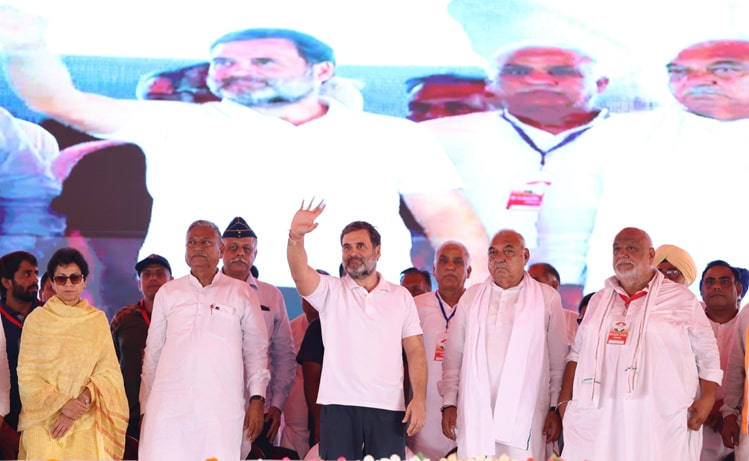
New Delhi: All eyes are on Rahul Gandhi’s Haryana election campaign as Leader of Opposition.

After becoming Leader of the Opposition (LoP), the Haryana and Jammu & Kashmir assembly polls are the first real test for Rahul Gandhi to prove that the Congress party’s improved performance in the Lok Sabha elections was not a fluke. The grand old party, leaning heavily on his campaign, is gaining momentum among the masses, especially in Haryana, where the Congress faces a direct contest with the Bharatiya Janata Party (BJP). For the Congress, regaining power in the state is crucial.

The party is riding on renewed energy from Rahul Gandhi’s growing popularity and the anti-incumbency sentiment against the BJP government. However, Rahul Gandhi’s campaign is not only about winning votes but also about uniting the state’s party leaders, who have been divided into factions—a division that has cost them victories in states like Madhya Pradesh and Rajasthan.

The Congress MP kicked off his campaign on Thursday with two major rallies in the Hisar and Karnal districts. In Karnal, where Rahul Gandhi held his first rally, he managed to bring together Kumari Selja and former Haryana Chief Minister Bhupinder Singh Hooda.

The Raebareli MP is scheduled to address around eight rallies in Haryana. Along with him, his sister Priyanka Gandhi is also expected to join the campaign trail soon.

The most critical task for Rahul Gandhi will be to maintain party unity and fight the elections as a cohesive force against the powerful BJP, which is facing 10 years of anti-incumbency. Opinion polls and election surveys suggest that Congress may have the upper hand.

It will also be interesting to see which issues Rahul Gandhi raises during the assembly poll campaign. The Agniveer scheme and the BJP’s heavy-handed treatment of youth, especially the wrestlers who were dragged in Delhi, may feature prominently. The two prominent faces of the protesting wrestlers, Bajrang Punia and Vinesh Phogat, who fought a long battle against former BJP MP Brij Bhushan Singh, accused of sexual harassment of wrestlers, have joined Congress. Phogat, an Olympian, is also contesting the election.

Rahul Gandhi has consistently raised concerns about the Agniveer scheme, challenging the government over it. The Congress has made its opposition to the scheme clear.

The results of the Haryana elections will also have a bearing on the upcoming Maharashtra and Jharkhand polls. Delhi’s former Chief Minister, Arvind Kejriwal, had earlier requested the Election Commission to conduct state elections alongside those in Maharashtra and Jharkhand. If that happens, an additional election may be on the cards. Given the situation, every move by the Leader of the Opposition will be crucial for the party and its leadership.

Bovine Politics, Human Cost: Why Madhya Pradesh’s Cow Protection Year is Making Headlines for the Wrong Reasons

0

Bhopal: After assuming office, the Mohan Yadav-led BJP government in Madhya Pradesh pledged to celebrate 2024 as ‘Gauvansh Raksha Varsh (Bovine Protection Year),’ emphasizing its campaign on cow protection and preservation. In 2020, the state also constituted the ‘gau cabinet (cow cabinet)’ the first of its kind in the nation. Besides, the central Indian state has also amended the Madhya Pradesh Cow Slaughter Prohibition Act, 2004 empowering the district collectors to confiscate vehicles to prevent illegal transportation or smuggling of cows. In a controversial move, the administration has even demolished the homes of those accused of allegedly keeping beef in their refrigerators.


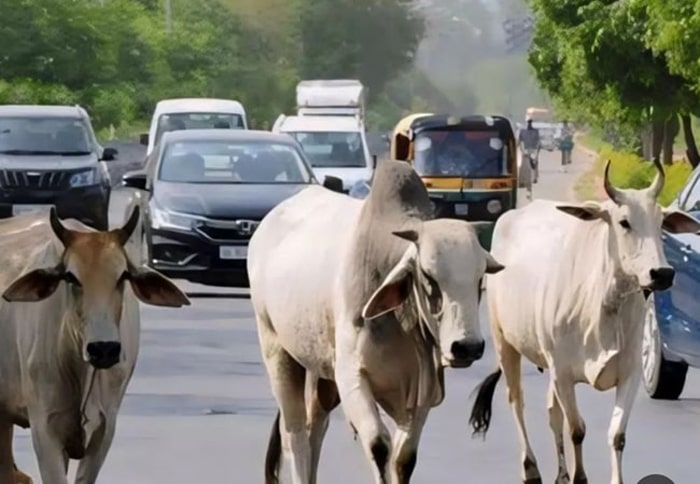
Despite government measures and crackdowns, the condition of cows in the state remains dreadful. Hundreds of cows still wander the roads leading to accidents and deaths— of humans and (sacred animals). However, there is little action against those who fail the government’s campaign and public outrage remains absent.


Cow Welfare in Madhya Pradesh: Claims, Promises And Reality Checks


The Animal Husbandry Department in August reported that 93 cows have died and 295 were injured in road accidents on state highways connecting Bhopal, Raisen, Vidisha, Sehore, Dewas, and Rajgarh cities of the heartland of India. At least three cows died everyday in July. The government reported in June freeing 7,500 cows and arresting 1,000 individuals for illegal cow transportation.


The Madhya Pradesh High Court recently issued a notice to key officials seeking a response from the state on stray cattle blocking national highways. A division bench of Justice Sanjeev Sachdeva and Justice Vinay Saraf questioned why cattle are allowed to gather on roads causing disruptions. The notice came in response to a Public Interest Litigation (PIL) filed by Tikamgarh resident Swami Dev Swaroopanand who raised concerns about the dire condition of cattle hurting religious sentiments of Hindus.


Notably, in August, the Madhya Pradesh government formed a high-level committee to tackle the issue of stray cattle, launching a 15-day special campaign to address the problem.


BJP MLA Vishnu Khatri in conversation with eNewsroom said that addressing the stray cattle issue isn’t simple, especially in rural areas. The government is making efforts. Five years ago, there were no gaushalas (cowsheds) in my assembly; now, we have around 10-12. The Yadav government increased the fodder allowance to Rs 40 per cow which helps. We’ve also involved private organizations to manage some gaushalas like the Tribal community doing an excellent job.


Madhya Pradesh has around 2,000 gaushalas and 9 lakh stray cattle. Funding for cows grew 26 times from 2019 to 2024 with daily funds rising from Rs 1.5 to Rs 20 under the Kamal Nath government, and to Rs 40 under the present BJP government.


Ground realities and resource allocations


Ishika Khakre of Animals With Humanity expressed concerns over the poor conditions of cows on the roads. She identified the lack of dairy by law enforcement as the main reason cows roam the streets. Dairy owners abandon cattle after milking, unable to afford their feed. While the Gauvansh Act in Madhya Pradesh bans cow slaughter, buffaloes can still be sent to slaughterhouses leaving aging cows on the streets. Despite being revered, many cows eat garbage showing a lack of government action.


“If the government were truly active, dairy bylaws would be enforced by now. Recent attempts to relocate cows to gaushalas failed due to poor conditions—no food, sanitation, or care. The problem isn’t a lack of laws but their implementation. Our team shared dairy bylaws with authorities in December but no actions were taken until accidents increased. Now, they’re collaborating with policymakers to implement long-term solutions, urging dairy owners to take responsibility and care for their cattle,” Khakre commented.


The Hindustan Times reported that the Madhya Pradesh government diverted the funds meant for SC/STs for cow welfare. According to the report, Rs 252 crore is allocated for cow welfare through the Gau Samvardhan and Pashi Samvardhan schemes. Rs 95.76 crore of this is from the SC/ST sub-plan. The fund has grown from around ₹90 crore last year.


“This is not a permanent program. Past allocations for cow protection don’t rule out future SC/ST funding. The government addresses various perspectives and fields. While SC/ST funds aim to support their progress, development comes from multiple sources, not just these funds. Any financial shifts are temporary and will improve over time. Previous governments failed to manage gaushalas properly. People only keep cattle for milk and abandon them afterwards. We must instil a sense of responsibility for ageing cattle, similar to caring for elderly parents. Unlike the Congress governments, the BJP is focusing on utilizing resources like cow urine and dung for medicines,” Khatri stated.


Communal tension and legal ramifications


Muslim men have been continuously harassed and lynched in allegations of cow-related offences, including slaughter, smuggling, theft, and transportation of cattle perpetrated by individuals affiliated with Hindutva organizations and right-wing groups. In May 2022, two Tribal men allegedly accused of slaughtering a cow were lynched by a Hindutva mob in tribal-dominated Seoni of Madhya Pradesh. Sixty three butchered bovines were found on June 19 in the district central to the government’s crackdown. Fifty five cases were registered, 99 people were arrested, and 1,301 cows were rescued in the first half of this year.


“Various self-serving organizations and workers take unwanted actions on emotions. Especially, when there is a mob that lacks wisdom. It’s important to differentiate between cow trafficking and animal husbandry during transportation. While unwanted minor incidents may occur, the government intends to protect cows. It has implemented measures to prevent these occurrences and the law takes action in such cases. It protects innocent individuals,” said Khatri.


A livestock transporter informed eNewsroom that his vehicle transporting buffaloes was stopped by RSS last week and an FIR was filed against him. “I only transport buffaloes, not cows. My business is entirely legal yet I face harassment. Farmers from various communities such as Rajputs, Yadavs, and Brahmins bring cattle to the market. The Municipal Corporation gives a receipt when the livestock are purchased. As long as the livestock remains with the seller it is legal.


However, once buyers obtain the receipt, it suddenly becomes illegal. This has happened to me at least 10 times when my transport was seized. I even pay a monthly fee to different police stations despite running a legal business. They make false allegations of animal cruelty but I won’t quit. Why would anybody risk their life transporting cows knowing the dangers?” he questioned.


The IndiaSpend database in 2017 revealed a disturbing trend: India had witnessed 78 cow-related hate crimes since 2012 with a staggering 97% of these incidents occurring after the Bharatiya Janata Party and Prime Minister Narendra Modi came to power in May 2014. Only one incident was reported in both 2012 and 2013. 86% of the victims were Muslims. Data collected by it from 2010 onwards revealed no reported cases during 2010 and 2011.


Eleven Muslim homes were demolished on June 15 in Bhainswahi of Mandla in allegations of illegal beef trade and recovery of 150 cows and beef in their homes. The action was taken just a day before Bakrid left entire families without shelter. In another instance in June, the authorities demolished the homes of four Muslim men in Jaora of Ratlam allegedly for throwing cow parts in the temple.


By July, the state demolished 21 homes in cow-related incidents in 2024.


The Supreme Court of India on September 17 stayed the demolitions of homes including those of accused individuals until October 1. The Court emphasized that even a single instance of illegal demolition undermines the “ethos” of the Constitution. However, this order does not apply to unauthorized structures on public roads, footpaths, railway lines, or water bodies.


“The Indian Constitution and laws do not discriminate based on religion or caste. Everyone has the right to celebrate their festivals. Demolitions typically occur only in cases of illegal encroachments and proper notices should be given. Though it may seem selective in the media, encroachment is still encroachment, regardless of religion. Bulldozers should be used appropriately and within legal parameters. I certainly won’t defend the government on this. It’s the responsibility of the concerned department that encroachments should be stopped immediately, not after incidents occur, as delayed demolitions aren’t justified. Bulldozers do not target only criminals; they operate under due process. There must be planning for development to address encroachments effectively,” remarked Khatri.


Cow holds a sacred status for many Indian Hindus making it a pivotal element in political discourse. In the 2023 state assembly elections, both the BJP and Congress used cow politics to sway voters. Madhya Pradesh Cow Slaughter Prohibition Act, 2004 law strictly prohibits the slaughter of cows, calves, bulls, and bullocks in the state. It criminalizes the act of cow slaughter with provisions for imprisonment and fines. It also bans the transportation of cows for slaughter within and outside the state.


The act amended in 2019 also has provisions against cow vigilantism.


Recently, Prime Minister Narendra Modi shared a picture with a calf on his “X” account amplifying the ongoing political narrative around cow protection and its role in shaping public sentiment.


“The dairy business is rife with malpractices where cows are treated as commodities. They’re often separated from calves to maximize milk output, and illegal drugs like oxytocin are used in 80% of dairies to boost milk production. Despite this, the government slot online ignores these issues while major players like Amul monopolize the industry, even classifying alternatives like soya milk as beverages. Instead of stricter actions against a particular community, the government should focus on addressing the actual issue. If we can channel the same energy used in demolishing homes into implementing existing laws, we could find real solutions,” Khakre added.