



“[dropcap]W[/dropcap]hen I watched Dangal with Chinese subtitles a few years ago, I noticed an uncanny resemblance between the wrestlers’ father and my own,” says Chen Shih-hsin, Taiwan’s first-ever Olympic gold medallist.
Chen clinched gold in the women’s flyweight division (49-kilogram category) in Taekwondo at the 2004 Athens Olympics, ending a 72-year-long gold medal drought for Taiwan. Despite being a self-governing democracy with its own constitution and legislature, Taiwan competes at the Olympics under the fictitious name “Chinese Taipei” – it is neither part of China nor comprised solely of the city of Taipei (which is one of the 23 cities in the island nation).
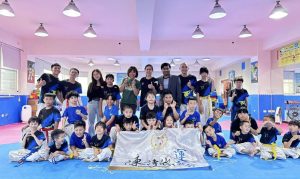
“My father was a hard taskmaster, much like the father portrayed in the film. I feel he was even tougher on me,” shares Chen as she teaches around 100 children at her Taekwondo school in the rural township of Xinfeng, near Taiwan’s semiconductor hub, Hsinchu.
“Yes, you could call me a chip off the old block when it comes to inheriting my father’s grit and toughness, similar to the characters in Dangal,” admits Chen, whose life story is full of dramatic and emotional twists.
She is half-aboriginal, as her mother is from Taiwan’s indigenous Atayal community. Her father, Chen Wei-hsiung, ran a Taekwondo training centre in Taipei and introduced her to martial arts at the age of five. By 15, Chen had already made a mark on the world stage by winning her debut appearance at the World Cup in the Cayman Islands in 1994. Two years later, she secured her second world title in Brazil.
However, her career took an unexpected turn shortly after. “I used to despise my father’s relentless push. One day, at 18, I argued with him and ran away from home,” Chen reveals, recalling her transformation from world champion to a “betel nut beauty” – a term for scantily-clad young women who sold betel nuts at kiosks across Taiwan.
After leaving her family and Taekwondo, Chen survived by vending betel nuts and other products in Taichung. “I felt like a rebel, much like the girl in the Bollywood movie who rebelled after joining the national team. But unlike her outspoken defiance, I simply left,” shares Chen.
Three years later, a poignant line in a radio advertisement about a son unable to care for his ageing parents on their birthday led her to return home. Reuniting with her father, she pledged to resume her training and pursue an Olympic dream together. However, the three lost years cost her a chance to compete in the 2000 Sydney Olympics, where Taekwondo debuted as an Olympic medal sport.
“Being on my own for those three years strengthened me, helping me cope with the disappointment of missing the Sydney Games,” Chen explains.
Her indomitable spirit and her father’s unwavering support fuelled her strenuous preparation for the next four years. “When I reached Athens, my biggest adversary was myself, not my rivals from Cuba, Nepal, Canada, or Nicaragua,” she reflects.
“The Olympic gold was our shared dream.” Chen continues, “Opening a Taekwondo gym and running it for decades was as much my father’s goal as it was mine. His ultimate aim was to bring an Olympic gold medal to the gym.”
On August 26, Chen made history by defeating Cuban opponent Yanelis Labrada to win the first-ever gold medal for her “invisible” nation, herself, and most importantly, her father.
“Over the years, I’ve fought countless matches, shed many tears, and accumulated numerous injuries. That final match in Athens was worth it,” she expresses.
At 25, Chen decided to retire. “These past twenty-odd years have been challenging, but I’ve been fortunate to avoid severe injuries thanks to my father’s meticulous training,” she notes.
Despite achieving her Olympic dream, Chen’s life continued to resemble a gripping film script. She pursued a PhD in sports psychology, secured a position as an associate professor at a leading university, and started a family with two children. However, personal turmoil struck again.
An alleged extramarital affair with a fellow coach tarnished her reputation, forcing her to resign from her university post, leave her home, and yield custody of her daughter to her estranged husband. Yet, Chen rose from the ashes, relocating to Xinfeng with her son.
Today, Chen teaches Taekwondo to local children in her self-established dojang, away from the public eye and the bustle of Taipei. Although her Athens Olympic gold medal resides at her father’s home, she now dreams of earning a gold medal for her Taekwondo school.
The story was first published at the NDTV.

