



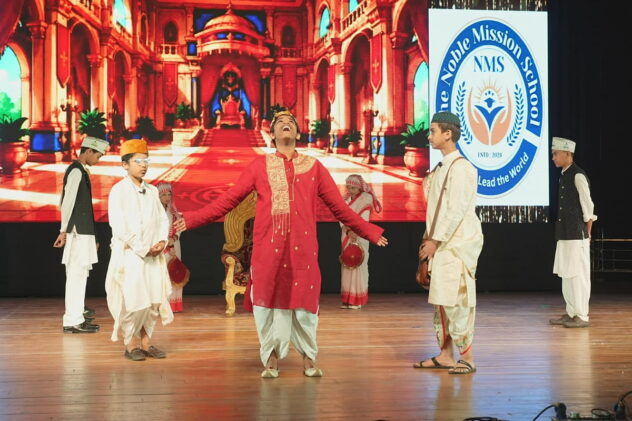
Kolkata: Inside Nazrul Mancha, the packed auditorium suddenly fell into pin-drop silence as the final scene of Ehsas: A Tribute to the Sacrifices of Mother unfolded. On stage, 11-year-old Abbas Ahmed delivered his closing moments with such raw, disarming grace that hundreds in the audience were moved to tears.
For Abbas, a Class VI student of Noble Mission School, this was perhaps just another performance. But for those watching, it was a moment to remember. The young boy, who lives in Topsia, a densely populated neighbourhood of Kolkata, seemed to have found a language of his own on stage.
His performance was among the highlights of Noble Utsav 2026, the school’s annual day celebration. The confidence, emotional depth and spontaneity with which Abbas portrayed Eshan left many convinced that the young performer could have a promising future in theatre and acting.
The evening, however, was not just about one young performer. It was a celebration of creativity, imagination and the possibilities that education can open up for children.
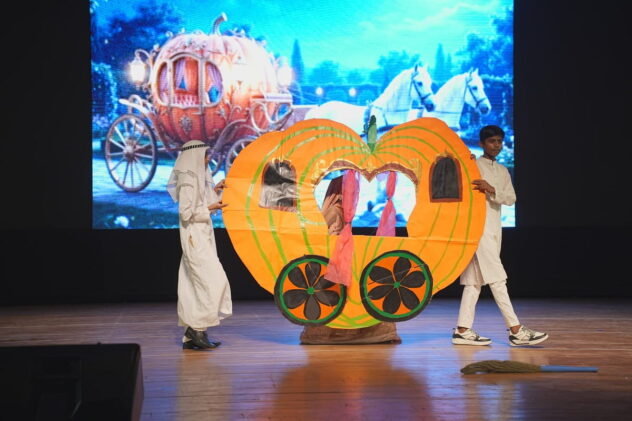
The audience was treated to several other engaging and thought-provoking performances, including Laila: Cinderella in an Arabian Version, a presentation on yoga and a human pyramid, and Rajamoshaier Oddrishho Jama, a Bengali act. Each performance brought a different flavour to the stage, reflecting the students’ enthusiasm and the effort that had gone into preparing them.
The quality of the performances did not go unnoticed. Chief Guest Wali Rahmani, founder of Umeed Global School, mentioned them in his address and specially invited the teacher Shalini Fatima who had directed the plays to acknowledge her contribution. It was a moment of recognition for the person working behind the scenes to help young children discover their confidence and creative abilities.
Noble Mission School: How Topsia’s ‘Laddu Sir’ Built an Affordable Campus
Behind the celebrations lies another story — that of a school which has grown remarkably fast in one of Kolkata’s densely populated neighbourhoods.
Founded in 2024, Noble Mission School, located in Topsia, has around 1,800 students within just three years of its establishment. Offering education up to Class XII, the institution has grown so rapidly that it now operates from two separate buildings.
For its founder, Md Shahnawaz, the idea was never limited to putting children inside classrooms. He wanted to create an environment where students could access opportunities beyond textbooks without placing an unreasonable financial burden on their families.
“The main reason for getting a good number of students in such a short time is that we have kept the fees very low, between 600 to 800 (from Nursery to class XII). We also ensure that all kinds of activities are available for our students,” Shahnawaz said.
The school has a football team, while students receive training in kickboxing and karate from national-level coaches. There is also a dedicated physical training teacher.
For Shahnawaz, who teaches mathematics under the name S Namaz Classes and is affectionately known among his students as ‘Laddu Sir’, the journey from running coaching classes to establishing a higher secondary school has been one of vision, perseverance and a deep understanding of the aspirations of families in Topsia.
In a neighbourhood where access to quality education and extracurricular opportunities can often be constrained by financial circumstances, the school is attempting to offer children a wider world of possibilities.
Wali Rahmani on Education: Why Collaboration Outweighs School Fees
Addressing the gathering, chief guest Wali Rahmani, founder of Umeed Global School, spoke about the larger purpose of education and the role parents play in shaping a child’s future.
“Money is not an alternative to education. Whatever parents pay as school fees goes towards someone’s salary or certain bills. It is not an exchange for education,” he said, urging parents to look beyond the financial aspect of schooling.
Rahmani emphasised that an educational institution could truly flourish only when its three most important stakeholders — students, teachers and parents — worked together.
“There are three parts of an education system: students, teachers and parents. If they work together, any educational institution will flourish,” he added.
Perhaps that was the larger message of the evening at Nazrul Mancha. Education is not merely about examinations, marks or classrooms. It is also about giving children the confidence to stand before an audience, the freedom to express themselves, the courage to explore their talents and the opportunity to dream beyond the limitations of their circumstances.
And as the curtains came down on Maa, little Abbas Ahmed had offered the audience a moving reminder of what a child can achieve when given the right stage.

