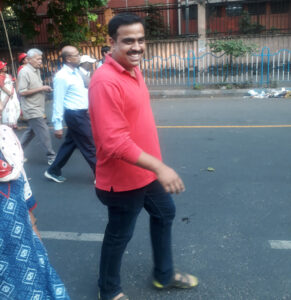
Your hate politics can only appease PM Modi, not Bengalis, son to Mukul Roy

Kolkata: In a significant development in Bengal politics, Subhranshu Roy, two time Trinamul Congress legislator attacked Bhartiya Janata Party (BJP) on Thursday, including his father Mukul Roy, a former senior TMC leader, now in BJP camp.

Subhranshu said that, it is not at all possible for BJP to win the heart of common people of Bengal by bribing them. His father Mukul Roy, former Trinamul Congress Rajya Sabha MP who joined BJP last year is now the key face of the saffron brigade in Bengal.

Political observers are of the view that father-son face-off would weaken BJP’s hold in Bengal.

eNewsroom, had done a story soon after Mukul Roy’s joining of BJP had predicted that Mamata Banerjee will pit Roy junior against Mukul Roy. And with the onset of the Bengal panchayat polls the face-off is being used judiciously by TMC.

Shubhranshu Roy slammed BJP at a public meeting in Barrackpore. He mentioned, Rahulbabu, Dilipbabu, Mukulbabu cannot win people’s heart by such acts. Somebody is assuring smart phone to lure people to vote for BJP, other is playing on people’s fear by stating that he will turn the state into crematorium. But of course prime minister will be happy about it. They would win his heart.”

Talking to media, Shubhranshu Roy welcomed all to vote for Trinamul Congress. He said, CM Mamata Banerjee is his inspiration to join politics. He believed that as Mamata Banerjee government brought development in Bengal so people will vote for Trinamul Congress. The party has lodged a complaint against Mukul Roy with the State Election Commission for violating the model code of conduct.

Incidentally, while addressing an election rally at Ghughudanga area in Jalpaiguri district last Saturday, BJP leader Mukul Roy had promised people smart phones if they select BJP candidates to Zila Parishad seats in panchayat polls.

Like his son Subhranshu, common people too want to know why a seasoned politician likes Mukul Roy, who has such a long career in politics would violate model code of conduct after he promised to provide youths with smart phones if BJP wins.  “Such an act by senior politician like Roy must have been done intentionally. It was a shows his  frustration. And Subhranshu was right in pointing it out. PM Narendra Modi in all his election speeches had talked about ‘aache din’, which is a complete farce. Promising smart phones to voters is just like that promise. In Karnataka election speeches, PM had to praise CM Mamata Banerjee as she has been able to provide jobs to a number of people in Bengal. He had to name Mamata Banerjee to ask for votes in Karnataka. If we monitor closely then we will understand that Mukul Roy is at the helm of affairs when it comes to Bengal’s Panchayat polls as he is the chairman. And he knows very well that he cannot do anything to make BJP win the Panchayat polls. And thus Roy’s political position in BJP would be at risk if he failed to deliver what had been promised by him,” said political analyst Bijan Sarkar to eNewsroom.

A Home Guard in Jharkhand Takes on Global Warming by Planting Trees on Special Occasions

Giridih/Ranchi: Chances of him visiting a household uninvited during family events like birthdays, anniversaries, or funerals is very high. Meet Shivshankar Gope, a home guard from Giridih, who makes it a point to visit houses on special days. But his visit has no police-related work nor does he sport his uniform during these meetings for he has only one agenda –  simply motivate the family members to plant a tree in the name or the memory of their loved ones and save world from the danger of Global Warming.

Believe it or not, this 47-year-old home guard pursues his passion in style. He has a full-fledged team comprising him, a researcher and a lyricist cum folk singer.

Speaking to eNewsroom, Gope said, “We just do not plant trees in the name of a child or a person, but also raise awareness about the benefits that we can avail in the long run by planting trees. During marriage functions, our geet (song) highlights the harmful effects of firecrackers on the environment.”

Explaining the reason for zeroing on birthdays, marriages or other functions, Gope said, “During birthday celebrations, marriage functions and funerals there is a huge number of people present. Also, most get emotional during these events. We have realized that on these days if we approach people to plant trees, then they are more eager to listen to us. Hence we visit houses on such occasions.”


Gope has been working as a home guard for 28 years now. However, it was in 1988 that he began his journey as the Sampark Vyakti for the forest department. His role was to help the villager’s plant trees under Samajik Vahini programme of the forest department.

“It was by chance that I began planting trees and motivating people. My father-in-law late VK Gopalak had requested the forest officials to give me some work. Till 2013, I helped the villager plant more than 25000 trees under this programme. I also developed two nurseries one with the support of the forest department and another by the land conservation department.”

However, the real turn came in his life when he met Vishwanath Mandal, a teacher who had motivated villagers at a mass level in Giridih and neighbouring area when it came to the conservation of trees.

“He had motivated villagers to tie rakhi to trees (Ped Ka Raksha Bandhan) with a promise to save them. He also used to organize rallies in villages to create awareness about tree plantation. He often organized the Night Vigil, where he motivated people to save the forests. Because of his works, he soon began to be known as Van Devta (Lord of Forest),” informed Gope. Vishwanath, Gope’s mentor died in 2008. He mentioned that through his work toward conservation of trees, he is trying to continue the legacy of his Guru.

In the year 2013, on September 22, which globally celebrated as Daughter’s Day, Gope began a campaign called —Vriksh Ganga Abhiyan to save the world from the danger of Global Warming.

“We convince people to plant a tree on the occasion of the birth of girl child and Beti Bidayi (when a daughter leaves her maternal house for to set up her family after the wedding). We have used this plan to have many trees planted in both the district and state,” he informed.

It’s been almost three decades since the green crusader has been doing it voluntarily. He says with a smile, “There are people who believe that I get paid by the forest department for these activities.”

However, he maintains that he has got support from the common people too, just like Sardar Harcharan Singh and his wife, who have got into an association with Gope and many a time sponsor some of the tree plantation events.

The crusader understands the importance of awareness for tree plantation, recalling an incident, he shared, “Once, the district officials including the deputy commissioner, superintendent of police, judge, bank manager, and several other officials planted one tree each at the complex of Kasturba Girl’s School. But, when they visited the premise after six months, they discovered that the trees had become fodder for the stray animals. Following this incident, we decided to plant trees there. We planted 102 trees in the same area, but only after motivating the warden to take care of the tree. This time, almost all trees grew.”

However, the home guard’s contribution to the society and to make the environment better has not been recognised and appreciated much. Only once, in 2016, Giridih district administration awarded Gope for his exemplary work.

MP Chief Minister Chouhan starts showing jitters

0

Madhya Pradesh Chief Minister Shivraj Singh Chouhan is in jitters. The cause of his distress is not the opposition Congress, which is yet to put its house in order, but his own party’s leadership. First, the appointment of Anandiben Patel as Governor. From the day one, she started acting like an additional Chief Minister, visiting places, attending functions, interacting with people, calling reports from bureaucrats and, at least on one occasion, she even told the bureaucrats what to do to ensure votes for the BJP, forgetting that she was holding a Constitutional position and was not an errand lady of Amit Shah. All along, Anandiben has been keeping Chouhan aside.

Then came a bigger shock to Chouhan when Nand Kumar Singh Chauhan was replaced by Rakesh Singh as the State BJP president. Nand Kumar Singh Chauhan was to Shivraj Singh Chouhan what jesters used to be to nawabs in the mediaeval India. Rakesh Singh is a low profile Member of Lok Sabha from Jabalpur. That he was never known to be confidant of Chouhan is one thing. What is more, BJP president Amit Shah flew to Bhopal for a couple of hours in the midst of his do or die election campaign in Karnataka just to introduce Rakesh Singh to senior party functionaries who were summoned from across the State for this special occasion. If Chouhan still had a flicker of hope in his heart, it was mercilessly shattered by Shah by announcing that the party would contest the Assembly elections later this year under collective leadership which was interpreted to mean that Chouhan may not be the chief ministerial candidate.

In the light of these unsavoury developments for Chouhan, it is anybody’s guess if it was a Freudian slip or an expression of his dying hope that at an official function he indicated towards the chair kept for him and remarked that the Chief Minister’s chair was vacant, anyone could sit on it. Later on he did say that he had made the remark in jest but that explanation was irrelevant. The newly nominated PCC chief Kamal Nath was quick to interpret that the reality was slowly dawning on Chouhan that the BJP would be routed out in MP (in the forthcoming elections).

It is being argued in BJP circles that the party leadership is planning to keep Chouhan on the sides and deny ticket to a large number of ministers and MLAs with a view to countering the incumbency of the 15-year BJP rule. Another theory, which looks bizarre by its nature, being discussed is that Prime Minister Narendra Modi may hold the Assembly elections in Madhya Pradesh, Rajasthan and Chhattisgarh not later this year when these are due but hold them along with Lok Sabha elections in May next year, so that there is greater focus on Lok Sabha elections which the BJP hopes to win because of Modi’s oratorical skills. Elections to an Assembly have to be held within a stipulated period from the day the term of the present Assembly expires and there is no precedence of the President’s Rule in a State after the term of the Assembly has ended. But the BJP circles feel that Modi may find a way out.

The State Congress leaders are, on the other hand, euphoric as they have started seeing the end of the 15-year rule of the BJP. PCC chief Kamal Nath is said to be planning a two-pronged strategy to make the Congress formidable enough to take on the BJP. For one, he plans to ask party leaders to submit panels out of which to pick up a specified number of names for inclusion in the PCC working committee so that there is a wide representation in the State party’s decision making body. Secondly, the only criterion for giving party ticket to a person will be his/her winning chances and the candidates will thus be selected after a strict scrutiny. Sounds good. The problem comes when implementing such ideas. The Congress in Madhya Pradesh has a long history of sordid factionalism.

Among seven Indians abducted in Afghanistan, four are from Jharkhand, but company informs only one family

Ranchi: Among seven Indians who got abducted by the suspected Taliban terrorists from Baghlan, Afghanistan four are from Jharkhand. Of these three, probably are from Giridih and one from Hazaribagh.

However, the company KEC International for which these Indians worked, has informed the family of only one worker, Prasadi Mahto.

“On Sunday, we got a call from KEC company. The caller asked me, if we had watched the news of seven Indians being abducted in Afghanisthan. When I confirmed in yes, he informed that, my father was one of them,” said 17-year-old Mohan, son of Prasadi Mahto.

“No other worker’s family has been informed about it, except for Prasadi Mahto’s family. They gave us the number of one Kisun Mahto, who is also from Bagoder. When we contacted him, he informed that not just Prakash Mahto had been abducted but also Hulas Mahto and Kali Mahto,” informed social activist, Sikander Ali, who is also the admin of Pravasi Group and has been relentlessly working towards helping migrant workers from Jharkhand to return back to their states when in distress. Sikander has visited the families of Prasadi, Prakash and Hulas, who all are from Bagoder, Giridih.

Prasadi Mahto indians abduction jharkhand migrant
Prasadi Mahto

Only one Kali Mahto is from Tatijharia, Hazaribagh.

Kali Mahto’s family has also not been informed by the company.

“We have not got any call from the company and on Sunday morning itself, my grandmother (Penia Devi, wife of Kali) had talked to him. But on Tuesday, when we got this news from the locals, we panicked and tried calling him up but his number is not available,” said Pintu Mahto, grandson of Kali, while talking to eNewsroom.

“All of them had gone to work in Afghanistan almost four years back. They along with few others were doing transmission related work for KEC International, since then,” informed Sikander.

Kali has five daughters and a son. And he had visited his family only once in these four years.

Watch the video of Mohan Mahto, son of Prasadi


Prasadi, has four children, two sons and two daughters.

While Prakash Mahto, has two children and Hulash has three.

Sikander added, “The abduction news has shook the families, however, they are having patience till now and hopeful that government will do something and to have themsafely released.”

As the news got public, a delegate from CPI-ML went and met the family and demanded that the Jharkhand and union government should ensure the safe release of those abducted.

Later, Nagendra Mahto, MLA from Bagoder also visited the family.

External Affairs Minister Sushma Swaraj has reportedly talked to Afghanistan Foreign Minister over phone and requested all support to secure safe release of abducted Indians

However, amid all, there loomed a confusion over the identity of those abducted. The Government of India (GoI) is yet to shed some clarity on the same.

Scouting For Jewels From The Underbellies of Kolkata

Kolkata: With full concentration, Nafisa Ali, was seen painting a pot, and when asked about the event she replied, “I like to paint. So, when I was told about this event, I knew that I had to participate. This is the first time that I am participating in such a big event.” Nafisa, was representing Tiljala Shed and most of the other participants who were painting the post in vibrant hues, were little aware of the fact that the judge of the event, Ranodeep Saha, a final year engineering student and founder of Rare Planet, an entrepreneurship that specializes in hand-painted terracotta products, had a surprise for them as well as for event organizers.

Saha, announced on the occasion, “The top three contestants of this event will get a chance to be trained by Rare Earth.”

While he told to eNewsroom, “In India, not many are interested in this form of art. I am impressed by the number of students participating in this event.”

A little away from the creative zone was the most happening zone of BITM – the auditorium, where the participants were all geared to dance and win. “I am a participant for the cultural event. I have participated in many events organized between the Rainbow schools, but this is my first performance in the auditorium. I hope, I am able to give a super performance,” said an excited, Riya Saha, a standard XI student of Loreto Rainbow Home, Elliot Road.

Loreto Rainbow Home is an initiative of all Loreto Schools across Kolkata, where underprivileged young girls from nearby localities are provided quality education.

Another participant, Anjali Paswan from Calcutta Social Project, said, “I am feeling very nervous. I shall be giving a classical dance performance. I am self-tutored. However, I didn’t have much time to prepare, as we had our exams.”

On Sunday morning, Birla Institute of Technical Museum donned a different look, with at least over hundred of teens from at least 10 educational institutes for the underprivileged assembled for a fest that to remember. The one-day extravaganza – Nakshatra, organized by the Kolkata Chapter of Bhumi, an independent volunteer non-profit organisations, which provides educational support to over 20000 kids from the marginalized section of the society.

The event had been segregated into zones – literary, art and cultural, where participants were seen doing pottery painting, paper modelling, answering questions during the quiz, writing stories, reciting, dancing and doing the essential thing – enjoy the first inter-orphanage/shed talent festival.

It was a near replication of the fests or annual events organized by the top schools. “Most of the children that we work with have never had the chance of experiencing what a school fest is like. This is an attempt to give these kids a taste of what it is like to perform in an auditorium or what it is like to have judges deciding on their performances or art,” said, Afreen Zaman, city-associate, Bhumi, Kolkata.

However, the real winners of the event were the volunteers, who devoted several hours a week for almost two months. “We used to meet on the weekends and had a WhatsApp group. This was a very nice attempt at providing a platform to the underprivileged kids, I am glad, that I volunteered,” said Razia Sultana, a public relation professional based in Kolkata.

Kamal Nath: Will he make it this time?

0

Septuagenarian Kamal Nath is close to fulfilling his long-cherished ambition of becoming Chief Minister of Madhya Pradesh. At least so think his fans and supporters of whom there are many – and not only in politics. On the occasion of his son’s marriage in the 1990s, I went to the telegraph office in Bhopal to send a telegram of good wishes. I picked up a phrase from the list of standard greetings phrases (then in vogue) and wrote the address ‘Kamal Nath, Chhindwara’. The clerk read the telegram a few times, looked at me and said hesitantly: “Sir, Kamal Nathji ke naam ke aage Shri likh dijiye. Bahut bade Aadmi hain. Paisa utna hi lagega. (Sir, you can write Shri before Kamal Nathji’s name. he is a big person. The charge for the telegram will be the same).” During the 2008 Assembly elections a British journalist touring Madhya Pradesh to cover the elections for his news agency asked me if Kamal Nath had a chance of becoming the Chief Minister. He remarked that (then Union Commerce Minister) Kamal Nath had made many admirers in Geneva (in the course of his WTO interactions) and they all felt that he deserved to become the Chief Minister of Madhya Pradesh.

Lok Sabha member from Guna, Jyotiraditya Scindia was considered the front-runner in the race for being declared chief ministerial candidate till about a month back when the Congress high command nominated Kamal Nath as the PCC president in place of Arun Yadav towards the end of last month. AICC general secretary and former Chief Minister Digvijaya Singh, who had acquired a new aura after  completing (in six months) the 3,300-km Narmada parikrama, was said to have convinced the high command that he would ensure Congress victory in the Assembly elections, due later this year, if Kamal Nath was made the PCC chief. Scindia was simultaneously appointed chairman of the campaign committee. It is not a secret that Digvijaya Singh does not like Jyotiraditya Scindia nor did he like his late father Madhavrao Scindia.

Kamal Nath’s ambition to occupy the Chief Minister’s chair in Madhya Pradesh goes back to 1980 when he had staked his claim along with Arjun Singh and Shivbhan Singh Solanki, a tribal leader from Jhabua. When the views of the party MLAs were ascertained, Solanki was the choice of the highest number of MLAs while Kamal Nath stood third. The AICC observers, deputed to conduct the election of the legislature party leader, contacted Sanjay Gandhi who was ruling the roost at the time. Gandhi’s choice was Arjun Singh. Kamal Nath, a Sanjay buff, then declared that his votes be added to Arjun Singh’s votes which became more than Solanki and Arjun Singh thus became the Chief Minister.

During the decade Digvijaya Singh was the Chief Minister, Kamal Nath told reporters a few times that he would soon replace Digvijaya Singh. The latter always retorted: ‘he is welcome but where are the MLAs with him.’ Once he called me up from Delhi and said that 55 MLAs had pledged their support to him. Asked about the names, at least of a dozen or so, he prevaricated. A week later he, however, got the story published from Delhi in a prominent paper. Every time the Assembly elections are near, he would descend on Bhopal with the hope (without declaring it openly) that he would somehow manage the Chief Minister’s position if the Congress got the majority. This time, though, he must be feeling a lot of confidence with his position as the PCC chief and Digvijaya Singh’s assurance to make him the Chief Minister.

Kamal Nath feels restless when without any position. Having taken the basic training of politics from the late Sanjay Gandhi (in the Youth Congress), he contested his first Lok Sabha election from Chhindwara in 1980 and he has since been keeping his lien on the constituency. He was denied the ticket in 1996 because of the Havana allegations. But he did not leave the Congress as Madhavrao Scindia had done. So he persuaded the party leadership to nominate his wife Alka Nath in his place. She had won with an impressive margin. However, Kamal Nath became restless within a few months and made Alka Nath resign so that he could himself contest. The word spread at the time was that Alka Nath was not feeling comfortable as a Member of Parliament.  The BJP, which had put forward former Chief Minister Sunderlal Patwa against Kamal Nath in the by-election, gave a twist to the Kamal Nath-Alka Nath relationship and also exploited the confiscation of certain objects by the Customs from Kamal Nath’s luggage on his return from abroad. Few could match Sunderlal Patwa in slander mongering; the former BJP Chief Minister had turned it into a fine art.

Then Jammu and Kashmir chief minister Farooq Abdullah, whom Kamal Nath had invited for campaigning for him, unwittingly helped the BJP cause. He was chatting with some journalists in a relaxed mood. Asked what he thought was the solution to the Kashmir problem, he said that he “personally” felt that the only solution to the problem was that India and Pakistan should be allowed to keep parts of Jammu and Kashmir now under their control and the line of control should be declared international border. What more did the BJP want? Kamal Nath lost to Patwa. That was the only time when the constituency went out of the Congress hands. Kamal Nath took his revenge on Patwa a year later, in 1998, winning the seat with over 58 per cent of the polled votes. He has since been representing Chhindwara in Lok Sabha continuously.

Jharkhand’s Shame, Another Rape Victim Burnt Alive

Ranchi: Within 24 hours of horrific gangrape of a minor, who was burnt alive as her parents witnessed her horrific death in Jharkhand’s Chatra district, a similar violation of a 17-year-old took place, at Pakur district, about 410 kilometres away from Chatra.

The minor girl, was alone at her maternal uncle’s house, when one Bachchan Mandal forcibly entered the house and allegedly raped her, when the 17-year-old girl retaliated, Mandal burnt her alive. The incident took place at an area, which falls under the Muffassil police station of Pakur district.

The girl was class tenth student, she suffered 95 percent burn and undergoing medical treatment at a private hospital in Bengal. According to sources, her condition is critical and the chance of the girl’s survival is slim.

The matter has been reported to the police by the maternal uncle of the girl, who have visited her and recorded her statement. The Superintendent of Police (SP), Pakur Shailendra Prasad Burnwal said, “We have to ascertain the fact whether both the victim and the accused are minor.”

According to unconfirmed reports, the accused has been arrested and is being interrogated by the police.

While in Chatra, where the girl had been burnt by the accused as the panchayat had fined them for their act, Chatra police has arrested fifteen people in this connection, including Panchayat Mukhiya Teleshwari Devi.

Jharkhand has witnessed a drastic rise in rape and other criminal cases in state and even Governor Draupadi Murmu had recently expressed her concerns.

Marxing Public Health Discourse

0

Paying tribute to one of the giant philosophers of all time– Karl Marx, the visionary and fountainhead of justice and equality, as he turns 200 today, is an honour. He stands tall among the socialists of human history.

Karl Marx laid great stress on social equality and social justice. For him, fundamental concepts of social justice were rooted in economic justice. According to him, economic inequality, and the existence of private property, resulted in social injustice. An academic book ‘Shifting Paradigms in Public Health: From Holism to Individualism’ authored by Vijay Kumar Yadavendu and published by Springer, is a must-read for the socialists of today. The book is deeply influenced by Marxian concept of social justice and talks about inequalities in public health. A Marxist intellectual, Yadavendu discusses the theoretical shift with regards to public health that gradually takes place from collective to the individual.

In ancient times, societies and civilisations had tried to discover rules that would ensure good health of a collective. They had understood the fact that an individual is part of the larger collective. The shift of focus started happening after the consolidation of science, which emphasised on individual causations and exactness.

In the arena of natural sciences, the health of an individual is reduced to a bio-physiological and neuro-physiological system, which in turn is broken down into a number of sub-systems – anatomy, cells, molecules and genes that are a functional part of a whole. This constitutes the fulcrum of modern science and medicine, where the disease is considered malfunction of one or many sub-systems resulting in somatic, psychological and social dysfunction and health is just opposite to disease. On the other hand, ancient civilisations like that of the Greeks and other contemporary ones talk about holism in context of health. The health of a population depends on a range of factors both internal and external. It talks about the interaction of an individual with his/her physical, psychological as well as socio-economic environment.  This holistic approach to health cannot be seen only as a bio-physiological occurrence but is also very much determined by historical, cultural, social and economic standards.

Such a holistic approach to public health was the vision of Karl Marx, is missing today as individuals have been reduced to an amalgamation of cells, genes and molecules that constitutes a human body.  Such thoughts have evolved from a positivist school of science. The onus of being healthy or sick lies with the individual. So more and more research work and subsequent improvement in biomedicines and vaccines revolutionised the entire pharmaceutical industry. There is little or no scope and space for a holistic approach to health or disease. Such reductionist outlook paved the way for social inequality that plagued society at large.

One can’t deny the fact that medical science has made lots of improvement in providing adequate healthcare facilities to humans. For instance, in India, life expectancy at birth increased from 22 years at the start of the century to 62 years at the turn of a century, and infant mortality rates declined from 200 to about 66 (per 1,000) during the same period. Huge budgetary allocations were made in the health sector to reduce infectious and communicable diseases in developed countries. As a result, communicable diseases like malaria, tuberculosis became extinct in developed countries such as India.  Though much credit for the improvement of health status has been given to the advancement of bio-medical discipline in developed nations, few public health practitioners viewed that such impressive improvement is due to less exposure to infection, improved nutrition and better living standard coupled with advancement in the bio-medical field. But most of the public health practitioners did not shed light on food security, better standards of living, better housing and working conditions, water supply and sanitation as determinants for better human health. Instead, it chooses to give full credit to the role of bio-medicine and its impact. Thus the major understanding of public health research and the vision of its future growth has remained confined to the reductionist model of science and medicine.

The publication of Black Reportin1980’s shook the edifice of confidence in the United Kingdom. The report stated that despite rapid enhancement of aggregate health status, disparity or inequality in health status among various groups of the nation or between nations has widened. Fresh entrants in the field of diseases like AIDS and resurgence of tuberculosis and malaria especially among impoverished communities and countries shook the faith in bio-medicine.

Health inequalities reflect on the underlying social injustice like poor access to health care, inadequate food, impure water, unsafe living and working conditions and of course extreme poverty. In the words of Laurel Garrett, ‘If the passage of time finds ever-widening health gaps, disappearing middle classes, international financial lawlessness, and still rising individualism, the essential elements of public health will be imperilled, perhaps nonexistent, all over the world.’ As a result, there is a growth of myopic vision that the source of disease and ill health lies within the individual, in his/her genes and molecules or in a form of bacteria that resides in his/her body. It has so much influenced individuals’ mind that the cure lies locked within a pill available in the market, purchased at a cash price. This led to a booming industry of drugs.

Thus attraction to drugs acts as a catalyst to sustain such attitude that certain ‘technological fix’ or ‘behavioural modifications’ would solve all problems, rather than focussing on broader and more effective structural changes. More light is shed on the individual expertise rather than on historical and socio-economic aspects.   In the Sub-Saharan region where AIDS is a major cause of mortality, rampant in plantations, mines and urban squatters, emphasis is on curative medicines and preventive vaccines. There is least effort to improve the socio-economic standards of living of those working in such areas.

The crucial role that IMF and the World Bank plays in disbursing funds to developing and under developing countries facilitates and nurtures the environment of social injustice. These monetary institutions emphasise on cutting down of state expenditure on social welfare schemes in such countries. One gets to witness inflation, unemployment, fund reduction in health sectors, lack of infrastructure, poor or no sanitation, waterworks causing ill health and total disintegration of public health systems. The economic policy of the state in the form of liberalisation and privatisation is definitely lowering the chances of healthy survival of the deprived societies of the state, the author notes.

16-year-old gang raped, burnt alive before parents in Jharkhand

Ranchi: Jharkhand’s Chatra district became witness to a horrific incident, where a 16-year-old girl was gang raped by four men. When her family approached the panchayat seeking justice, a fine of Rs 50000 was imposed on the rapist by the panch. This levying of a fine enraged the culprits who set ablaze the victim’s house, as her parents witness the horrific act of their daughter being burnt to death.

According to the police complaint filed by her parents, the minor girl was going to attend a marriage function at her cousin’s place but on her way, she was picked by one Dhanu Bhuiya and others, in Rajakendua village, which falls under Itkhori police station, Chatra. The accused took her to nearby forest and gang raped. They dumped the girl there only. In the night when she returned home and narrated the ordeal to her parents, who approached the panchayat seeking justice. Outraged by the minor’s parent’s demanding justice and the panch’s decision to fine them for the crime they had committed, these men began trashing the girl’s parent during the meeting itself. Not willing to comply with the decision of the panchayat. They set the victim’s house ablaze and when mother tried to save her daughter, they also broken her hand. The minor was in the house and was burnt to death, as her parent’s witnessed her horrific death.

While the panchayat members and the villagers remain mute spectators of the horrific crime.

Reports coming that two people including mukhiya Teleshwari Devi have been arrested by Chatra police, however Akhilesh Variar the Superintendent of Police (SP), Chatra has yet to confirm it.

The gangrape incident is not one crime in Jharkhand, as the state is witnessing drastic rise in the crime cases in general and rape in particular. Recently, Governor Draupadi Murmu had expressed concern over the rise of crimes in the state.

Jharkhand police’s role in the matter of a child sex abuse with a 3-year-old school boy in Ranchi is also under question.

Candle light vigil to demand justice for three-year-old sexually abused child in Ranchi

Ranchi: “We want justice, we want justice… justice should be given to the innocent… School management should wake up, police administration wake up… Hang the culprit,” was all that could be heard during the candle light vigil, organized at Ranchi.  The general public of the city had assembled at the state capital’s iconic Gandhi statue, demanding swift action and justice to be delivered in the child sex abuse of the three-year-old toddler, a student of Little Angels School, by the school van driver.

The survivor had been admitted in October last year and from March 25, he had begun availing the school van services.  A maid also used to travel along with the kids in the van. Soon, the child began complaining of ill health but continued attending school. On April 4, his mother suspected something unusual and took the child for a medical checkup, where it was reveled that the child was being sexually abused.

“He is only three years of age hence he was not being able to express much about the sexual abuse that he was being subjected to. He had stopped eating and was also having problems in sleeping. Slowly and gradually, I started telling him different stories and he started speaking about the abuse he had undergone,” revealed his mother.

“I was shocked when I came to know that the maid was involved in this act, as she would also him abuse my child,” she added. However, when the parents complained to school, the school authorities negated the possibility of a sexual abuse as a maid used to travel along with the kids in the van.

“Principal Sandhya Bagla even said that, why driver will leave the maid and sexually abuse boy, which is unnatural,” they informed. Later, the principal had given the same logic to eNewsroom during a telephonic interaction.

For 15 days, parents have been pursuing the school authority to take action, but they didn’t budge. Finally, on April 21, the parent met Kuldeep Diwedi, Senior Superintendent of Police (SSP), who said them to lodge a formal complaint with the police.

On April 22, the medical examination of the child was done and the reports have confirmed the child had been subjected to unnatural sexual abuse. But the report is yet to be handed over to the parents or submitted before the court.

The driver has arrested been arrested, while the maid is still free, despite being a partner in crime. The child’s mother has accused the school authority of manipulating the course of investigation.

The vigil was organized by the Jharkhand Parents Association (JPA), and a number of social organization and parents participated in the vigil, demanding justice for the toddler.

“The case got registered on April 21, but neither FIR copy was given to survivor’s parent, nor medical report submitted at the court. These negligence or loop holes raise serious question on the role of police,” said Ajay Rai, President of JPA, while talking to eNewsroom.

“We all know that school is influential and trying every trick to effect the case. The maid has also not been arrested yet.” the JPA president added.