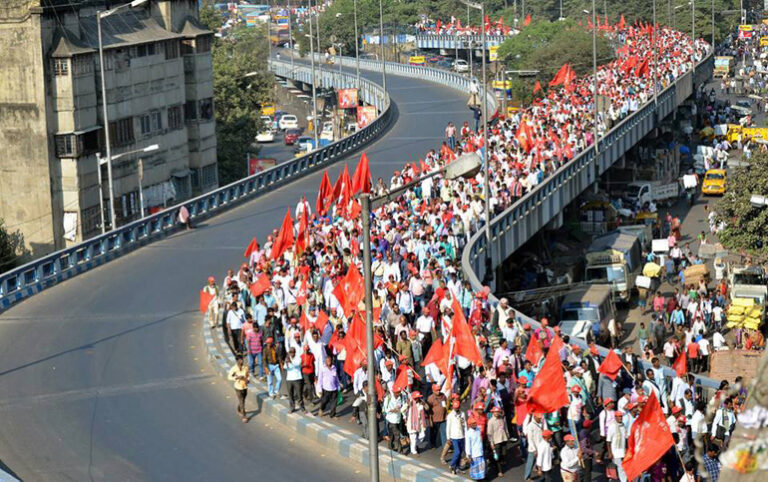
On May Day, thousands of Jharkhand workers demand increase in NREGA wage, removal of Aadhar from payment procedure

Ranchi: Twelve thousand workers from Jharkhand have signed a petition in the past week  to put forward three demands before the government  – increase the wage rate under the Mahatma Gandhi National Rural Employment Guarantee Act (NREGA), increase the number of days of work under NREGA to 200 days per year,  removal of mandatory Aadhaar linkage with NREGA processes, strict action against officials found guilty of fudging the social audits, filing panchayat level vacancies and strict monitoring of field functionaries. The demands made were later made public through a press communiqué issued by NREGA Watch, a non-government organization.

It further mentioned that the International Workers Day or “Mazdoor Diwas” was being celebrated across Jharkhand by collective of individuals and organisations, culminating into a week-long series of intensive activities. Thousands of workers gathered in over twenty five blocks across the state including, Kisko (Lohardaga), Chattarpur (Palamu), Manika and Mahuadandh (Latehar), Raidih and Basia (Gumla), Topchanchi (Dhanbad) and Jaina More (Bokaro). Along with workers, pensioners and other rural residents,  many social activists including Bezwada Wilson (convener of Safai Karmachari Andolan), Jean Drèze (economist), Anil Anshuman (Jharkhand Jan Sanskriti Manch), Balram Jo (Right to Food Campaign), Vijayanand (ex-Chief Secretary Kerala) and representatives of the CPI (ML) and National Campaign on Dalit Human Rights (NCDHR) among other organisations were seen in attendance.

Workers further demanded the immediate payment of maternity entitlements (Rs 6,000 per child without conditions) under the National Food Security Act, no dilution of the SC/ST Atrocities Act and an increase in pension amounts from the prevailing rate of Rs. 600 to Rs. 2,000 per month or at least half of the minimum wage.

In a run up to May Day, NREGA Sahayta Kendras went on a verification spree of MIS data and found some shocking irregularities. A 115 percent discrepancy was found in the list of ‘workers who completed 100 days’  in data furnished by two Gram Panchayats and after concerted effort only 2 percent of rejected payments issues were resolved in Basia. Despite these crippling supply side deficiencies, workers were seen upbeat about fighting for their right to work. Hundreds of them, in fact have  demanded work over the past week, and over a thousand pending complaints have been filed in West Singbhum district itself and over sixty in Shikaripara district of Jharkhand.

Due to the incredibly complicated architecture of the wage payments, there is a growing phenomenon of “rejected payments” which are simply lost in the transit. This has also been raised in an ongoing Public Interest Litigation where the Ministry of Rural Development has repeatedly made attempts to mislead the Hon’ble Court insisting that “real time payments are made within 48 hours.” The ground reality, of course paints  a completely different picture.

In Jharkhand alone, the pending “rejected payments” amounted to Rs. 56 crore during the financial year 2016-17 and 15 crore in 2017-18. Needless to say, not a single functionary has been held accountable for these violations. The growing culture of e-banking with no documents or passbooks given to workers is being abused and despite the workers demanding a full and complete receipt of all their banking transactions.

Slogan were also raised during the May Day celebration . “Before they ask for a vote, we ask for our rights, ”  stated Bezwada Wilson, but now it seems, that this slogan will now be owned by the workers.

Sexual assault on a minor-girl in Kolkata Orphanage, Complaint filed after months

2

Kolkata: A minor inmate of one of India’s largest Muslim orphanage located in central Kolkata was sexually abused by a labour hired for the ongoing construction work in the orphanage. Based on the complaint filed by the orphanage authority, an investigation has been initiated in the rape case.

There are around 500 inmate living at the orphanage, meant exclusively for girls.

Speaking to eNewsroom, DC South, Miraj Khalid said, “We have initiated an investigation with regards to the child abuse case of the Muslim orphanage. The incident had happened in December but the complaint has been filed on April 30, 2018. The girl is being examined, post that we will be inserting the sections under which an FIR will be initiated.”

The alleged abused shockingly happened in December 2017 and came to the light of the orphanage’s committee members only on Sunday. Sana Ahmed, one of the members of the orphanage committee and councilor of ward 62, while speaking to eNewsroom said, “We are equally shocked with the news and have already taken action against two sub-committee members for allegedly hushing up the matter till now. We have given full access to the investigating agency to look into the matter. The minor-child has already been sent for a medical check-up.”

According to sources, a new building is being constructed inside the orphanage campus, for which a contractor had been hired. One of the labours employed had grabbed the 10-year-old minor into one of the orphanage room and raped her. The news was highlighted when one of the members of the orphanage committee had recorded the girl’s statement over the phone, where she described how she had been abused by a labour. He had covered his face with a cloth, the girl revealed.

Just hours before being sacked, Jabeen Khan, one of the women committee members of the orphanage, said, “We will see to that the girl gets justice, we rallied for Kathua victim and we will do the same for this girl. The girl is being examined. We will get to know the truth.” However, when asked if the delay in initiating a case could weaken the girl’s case, she was quiet for a moment and then said, “Yes. I would suggest you speak to the president and secretary of the committee.” Both Khan and another sub-committee member have been sacked for allegedly hushing up the case till now. Also sacked were the warden and nurse of the orphanage.

Iqbal Ahmed, the deputy mayor of Kolkata and a member of the orphanage committee, after the internal meeting of the committee members, hinted at the possibility of a vested agenda. “Some influential members of the committee who want to head the management of the orphanage are spreading rumours.”

The Muslim orphanage, established in 1892 is one of the largest orphanages and has been a recipient of the President’s medal in 1998. The news of the alleged rape within the orphanage campus has invited sharp criticism from the community.

Sabir S Ghaffar, a Kolkata-based social activist took on to Facebook and wrote, “The office bearers of the orphanage need to take the moral responsibility of the barbaric incident of rape that took place within an institution which received the President’s award.”

My journey has not been a cakewalk, says ex-constable, now all set to become an IPS officer

Jaipur: He was 19-years-old when he became constable and a decade later, he is all set to become an Indian Police Service (IPS) officer. Meet Manoj Kumar Rawat, a resident of Jaipur’s Shyampura village in Rajasthan, who has secured an all India rank of 824 in the coveted Union Public Service Commission (UPSC) Examination, 2017.

Manoj claims that his phone hasn’t stopped ringing ever since the results have been declared. He told eNewsroom, “I am overwhelmed by the congratulatory message and calls that are pouring in. But believe me, this journey of mine has not been a cakewalk.”

A fan of Sunny Deol, Manoj was inspired by the cine star’s Bollywood flick, Indian, to become a police. It was this inspiration that saw him taking up the job of a constable, which he quit to become a lower divisional clerk at a lower court in Rajasthan. However, despite having a secure job, he was not happy with what he was doing. “I always felt that I am destined to be an IPS officer and must appear for the UPSC exam. But that meant dedicated preparation for the exam, which wouldn’t be possible till I was in a fulltime job.”

Perhaps it was this dream that eventually made him quit his job, packed his bags and move on to Delhi, where Manoj stayed and prepared to bell the UPSC exam. “I was ridiculed by many for having quit my job as a constable and then that of a lower divisional clerk at a lower court. They laughed at me. But I knew what I was doing and why,” he says.

It was Manoj’s fifth attempt that turned out to be lucky for him. “After five years of sustained effort has I have realized a dream that I had seen as a child. I come from a humble background; my father is a school teacher and my mother a homemaker. So, yes it a big achievement for me, given the fact that even today, life of Dalits in India is still difficult.”  He aspires to bring about a social change and work towards countering violence against women and atrocities against Dalits if he makes it to the IPS category, which is very evident.

Speaking about his decision to move to Delhi, he said, “A lot of preparation and serious study is needed to crack UPSC. It’s not just me, thousands of civil service aspirants arrive to Delhi, with the sole objective of get the best training to crack this exam. Thereby, creating an environment where 24×7 aspirants live in an ambiance that make them focus on one thing, which is to clear the UPSC. My decision to move on to Delhi definitely helped me achieve my goal. With access to learning resources, books, coaching and more, Delhi is the best place to be for any UPSC aspirant.”

Interestingly, Manoj, who has cleared UPSC in his fifth attempt, informs, that he had cleared the UPSC prelims thrice and mains once, before tasting success. However, hailing from a humble background, made him realize that he didn’t have the luxury of time or resources so he enrolled for his PhD. Also he got selected for the Junior Research Fellowship (JRF) not once but twice and had also cracked the examination for CISF’s assistant commandant’s post.

Elaborating on his subject for PhD subject, he says, “Ambedkar View: Dalit Empowerment and Social Justice is my research topic, which I shall be submitting next year for review. I must add that the JRF stipend has helped me fund the expense for my UPSC preparations.”

More women should be in police service, it will help reduce crime against women, feels Garima, UPSC 241 rank holder

0

Khargone/Kolkata: Garima Agrawal, did something that most Union Public Service Commission (UPSC) aspirants fail to do – crack the UPSC 2017 examination in her very first attempt. The 26-year-old, a resident of Khargone, Madhya Pradesh happens to be the second topper from the heartland of India. She also is the third in India, whose sibling too has cleared the UPSC. It’s not just cracking India’s most prestigious examination that makes her stand apart but her outlook towards the society and women empowerment.

Garima, who in all probability will become an Indian Police Service (IPS) officer, while speaking to eNewsroom, said, “I always aspired to join the police service, so I am not disappointed for not securing a rank which would allow me to become an IAS officer.”

Explaining her choice, she said, “I believe that more women should be in the police service. At present there is a need of women to be at the helm of handling the law and order of the country. For, when a woman remains at the top position like Superintendent of Police (SP), other women themselves feel connected and look up to her.”

Garima’s elder sister Preeti Agrawal too had cleared UPSC in 2013 and is now working with the Indian Postal Service. Preeti’s husband, Shekhar Kumar, from Giridih, is an Indian Revenue Service (IRS) officer. The couple is posted in Delhi.

So, did that help in any way – having civil servants within the family? Answering that she said, “No doubt, it adds to your confidence. But one has to study alone and put in a lot of hard work, no one can do that for you.” Then she added, “But, as a matter of fact, two sisters clearing UPSC has really sent https://practicas.ulpgc.es/ out a message that every girl is capable of doing wonders, provided she gets enough support and encouragement from family. In our case, while our parents were very supportive. They let us dream big, despite the society as a whole not being with us. We come from a Marwari community, where people still believe that for a girl, the ultimate thing is to get married and settle down.”

Elaborating on her journey, she maintained that her path was definitely not an easy one, despite her sister having walked on that track. “I chose to anchor myself in Delhi to prepare for my UPSC examination. My parents were worried for my safety while the society was creating pressure of a different sort. I had a tough time to convince and be at Delhi to pursue dream.”

Garima, an engineer, from IIIT, Hyderabad, did her internship in Germany. Following which she had even got a job offer from Germany, which she turned down, as she wanted to stay in India.

When asked, why most engineers opt for civil services? In fact, this year number of engineering background candidates clearing UPSC is the highest, she replied, “I had been asked a similar question during the UPSC interview. They had asked, why so many candidates from engineering background candidates had made it to the interview list. My response remains the same, there is a good number of engineering colleges in India. And Mathematics being a core subject in engineering, the engineers do better in cracking the written tests. Their reasoning skills also are better, and approach remains scientific.”

Garima maintains that her schooling from a Hindi medium school has in no ways been an obstacle for her. She had secured 92 percent for her secondary and 89 percent for her higher secondary examinations. He excellent state board result had helped her bag a year of education in the United States. Through Rotary International Youth Exchange Programme, she completed a year of her higher secondary education from Minnesota, USA.

Her father Kalyan Agarwal is a state convener of BJP’s business wing.

From corporate to civil services, with a mission to serve the nation

0

Kolkata: Thirty-year-old Azar Zia was leading a life that he had dreamt of – a cushy corporate job and a handsome salary that took care of all his expenses. However, three years into the corporate madness and he realized that despite having achieved all that he had aspired for, something was missing. A little introspection made him realize that civil service was his true calling.

Zia, a resident of Kolkata’s Beniapukur locality, one of the Union Public Service Commission (UPSC) 2017 cracker, bagged the 97 position, this year. The St James alumnus, while speaking to eNewsroom, from New Delhi, said, “Being a convent education child, my aspirations were very different. I never wanted to take up civil services as my career. Corporate was my true calling, I had believed, back them. As a consequence, after my completing my engineering from Kolkata, I opted to do my MBA from Delhi University Faculty of Management Studies. Following which, I took up the job that I had always wanted to do. But three years into it I chose to hang my boots and make a career in civil services, as the spirit of serving my nation is in my genes.” The young man does have a point, his father is retired West Bengal Civil Service (WBCS) officer and his uncles too are civil servants.

“My father always asked me to appear for civil service examinations, but I wasn’t really interested till I almost reached the fag end of my educational career. I was 28 years of age when I quit my job. My mother was extremely disappointed as she was very much interested in me settling down and here I was saying adieu to a very successful career. But then I was not happy with the way I was working. There was nothing to look forward to, socially, other than huge salary packages and designations,” recounts Zia.

He maintained that the decision of quitting and then devoting two years to train himself for the UPSC examination was a difficult call, as that meant surviving without a salary. However, he added that he had saved enough to help him float through the self-imposed lean phase.

“It took me three attempts to secure this position and a lot of hard work to crack the UPSC examination. However, I would like to add, that I never had a fixed routine. I studied according to my convenience, sometimes for as many as 12 hours and sometime as little as 2 hours, but each time that I studied, I ensured that I gave quality time to my books,” he revealed. He added that his passion to crack the UPSC made him leave his city Kolkata and make Delhi his base for UPSC preparation. Explaining the choices made, he said, “Kolkata still doesn’t have many UPSC aspirants. It could be because of the fact that the examinations are conducted in English and Hindi, an option that not many are comfortable with, so, most of the aspirants for civil services end up appearing for the WBCS examination. As a consequence there are not really good coaching centres for UPSC aspirants in Kolkata.”

However, realizing that the number of attempts for him to take was limited, he made a complete plan as to how he should go about realizing his dream. He appeared for an entrance examination of Hamdard Study Circle, New Delhi, an educational organization that helps students belonging to all five minority community prepare for the UPSC examination. “I shifted to Delhi as it’s a great place for UPSC aspirants. However, since I did my MBA from here itself, I was well aware of the challenges that students face while studying in Delhi. Power cuts and water are huge problems. Hence I opted for this study circle as it ensures that the environment is conducive enough for UPSC aspirants to study along with the coaching that was provided by them. It also has a great library which is open for 18 hours a day,” he explained.

He added that the fact that he is not very active on social media helped him in many ways. He said, “I never managed to develop an affinity for social media. I am not on Twitter and I can’t recall when I had last logged on to my Facebook account. So, I didn’t have this distraction to address while preparing for UPSC.”

On being asked if he had any plans, he replied that poverty alleviation and education are two areas that interest him and he would be working on these areas. The young lad when asked, if was aware of the fact that he was the second Muslim to clear UPSC from Bengal, he replied with immense pride, “I have always considered myself as an Indian first. I appeared for UPSC as I want to serve my country. Also, I presume, now the craze for UPSC is increasing in Bengal. As I mentioned earlier, choice of language (English and Hindi) made UPSC lose its appeal to the Bengali bhadralok. But things are changing, let’s not generalize things.”

Second Innings of companionship for Kolkata’s seniors

Kolkata: Seventy-year-old Ashish Ganguly, leads an extremely lonely life after he lost his wife to cancer seven years ago. With his children getting busy in their own circle of life, Ganguly often finds no one to share his feelings and thoughts with.

So, when a city-based NGO, Thikana Shimla Family, organised a swayamvar or meeting for elderly people to choose a companion for themselves, Ganguly along with several others assembled at the Calcutta Sports Journalist Club. The organisers added that they had received and overwhelming response, but many chose to back out from the meeting organised, primarily because of the social stigma associated with senior citizens dating or planning to remarry.

Sharing her share of resistance faced was Bagbazar’s Chanda Ghosh, The septuagenarian had decided to attend the meet. “My children were shocked with the idea of me attending the swayamvar. They gave me an earful. I think the society is yet to think about the need of a partner or companion for the elderly,” she expressed her feeling.

Where the kids and society are failing to understand the needs of the old, there Dr Amitava Desarkar, founder secretary of the NGO and a social gerontologist feels that much need to done to tackle the problems of the elderly, who often lead an unhappy life, after losing their partners. Talking to eNewsroom, Dr Desarkar said, “Being an activist working on the problems of the elderly, I realised that loneliness and social isolation was their biggest issue. It took me about four years come up with the idea of acting as a facilitator for senior citizen matrimony. While researching, I realised that most of the time loneliness in elders was due to the death of one of the partner. Hence, I decided to make such elderly men and women interact and pick up new partners so that they could have a companion to share their views with.”

However, the NGO realises that results can’t be achieved with a single day programme. Hence they have begun a closed Face book group where the old and lonely can connect and get into a new relationship. “Apart from the FB group, we will be organising dating tours and workshop on how to use a smart phone and ATM cards. We will also hosts events for Valentine’s Day and have a senior citizens’ beauty contest, among many other events that we have exclusively designed for them.”

However, Dr Desarkar, who has been working on this initiative for four years now, feels that the social stigma is too high when it comes to elderly dating services. He revealed, “I have even been threatened by the family members on several occasions. While some question our motive and while a few think that we are here to make money out of these gullible people.” He further added that the response so far has not been that warm. “The group so far has attracted only 15 members of which eight are women. We charge an annual fee of only INR 600. Only male members are needed to pay the membership fee, for women it’s free.” When asked, why the women are not being charged, he said, “This has been done to attract female members.”

However, to ensure online safety, those joining this group need to fill up a form giving the details, along with an identity, residence, age and singlehood proof like a photocopy of the passport, Aadhar Card, death certificate of spouse or divorce certificate. “People have been hailing this initiative as a good one but most are reluctant to come forward and endorse or seek its service in public. Few are even contemplating about social acceptance as well,” added Dr Desarkar.

Speaking about need of companionship in old age is way higher. He pointed out that most of single elderly look for friendship than sexual relation. “The trend is high for legal friendship than live-in or marriages Perhaps they are looking for companions who can listen to them,” he summed up.

Three-year-old sexually abused in Jharkhand, parents yet to get copy of fir and medical report

Ranchi: A mother admitted her 3-year-old son to Little Angles, a play school in Ranchi, Jharkhand. She was quite relaxed about her child’s safety as the school claimed that it was their foremost concern. Things were fine post admission. However, ever since she subscribed to the school van services, her son got targeted by the driver, who did sexual abuse with the child for 10 days.

Significantly, a maid, used to travel in the van as a chaperon, but she never objected or raised an alarm when the child was being abused.

Ironically, when the parents approached the school Principal, her reaction was shocking. She exclaimed, “Why would the driver leave the ‘aaya’ and molest a child? That is unnatural.”

Speaking to eNewsroom, the mother of the child informed, “I started sending my son to the school, situated 2 kilometers way from my residence from March 25, 2018. The driver and an ‘aaya’ (maid) used to travel with kids. They are school employees.”

When the child began complaining of being unwell, the mother inquired about his health. But the child didn’t speak up.

“On April 5, he came with injuries in his body. He was unwell too, so we took him to doctor who revealed to us that the child has been sexually abused,” narrated the child’s mother. Her voice almost broke while sharing the details.

The child was traumatised and it was only after a few days that he was able to narrate the details of the abuse. The driver used to take the boy to a desolate place and undress him. All the boy was able to recollect that it was a filthy place, where he could hear the dogs bark. The ‘aaya’ used to go away when the driver molested the child and would come back only when the driver was done with his misdeed.

She sadly added, that her child doesn’t even know that he has been sexually abused.

“Next day, we contacted the school administration, but were shocked by Principal Sandhya Bagla’s reply.”

The school authorities were more concerned about brushing aside the issue.

For 15 days, parents have been requesting the school authorities to take action against the driver and maid, but school is yet to take any action.

“Finally on April 21, we met Senior Superintendent of Police (SSP) Ranchi, Kuldeep Diwedi, who asked us to register an FIR , so that he could take action,” said the mother.

After the registration of FIR at Kotwali Police Station (no 19/18), driver was arrested by Ranchi the police. And a medical examination has been done by a board on April 23.

The mother added, “I want justice for my child. I want to fight. Though I have registered a police complaint, I have come to know that the principal is trying to ‘manage’ the officers as well as the medical reports. The Doctors had affirmed it then that the child has been sexually assaulted. The bruises were there. But I fear that, as time passes by, they would erase all the evidences. They might influence the doctors. For them, the prestige of their school is more important than the psychological scars that my child has suffered.”

When contacted, Sandhya Bagla, the principal, she said, “No such incident has taken place in our school.” She then reiterated the same logic, “Driver is 52 year old and maid is 27, so why leaving her, he will molest the child?”

However, mother claimed that driver was not older than 35 years. The driver Kunwar Kespotta has been arrested by Ranchi police.

The principal also claimed that they have a GPS system in the van, and there was no record of the van deviating from its routined path.

Mother again claimed that principal giving wrong information, as GPS had been installed in the van, only after April 5, which was after they had complained to the school authority regarding the child’s molestation.

SSP, Ranchi being on leave, in-charge Sanjay Singh told eNewsroom, “”I have no idea about the case, but if an FIR has been registered, there will be no manipulation either in the FIR or in the medical report,” he claimed.

Asaram to spend his life in jail until death for raping a minor school girl

0

Jodhpur: Five years after being arrested for having raped a minor on pretext of exorcism, Jodhpur Scheduled Caste and Scheduled Tribe Court, gave a landmark judgment by sentencing Asaram, a self-styled Godman, for lifetime. His associates, Shilpi and Sharad, will now have to spend 20 years in jail, as they have been awarded 20 years of imprisonment.

Operator’s phone number in several Aadhar cards, gets control of all data

0

Ranchi: Last year in March, Sakshi Dhoni, wife of former Team India, captain, Mahendra Singh Dhoni had raised an alarm concerning the M S Dhoni’s confidential data listed in Aadhar being leaked. She had also complained regarding the same to Union Law and Information Technology Minister Ravi Shankar Prasad. With the government giving an assurance that there would not be a repeat, it was believed that no Aadhar information would ever be leaked in Jharkhand.

But, within a year, this incident where a Common Service Center (CSC) operator, at Ganwah More, Ganwah block, Giridih has put his phone number in most of the Aadhar cards made through him, has exposed once again, as to how vulnerable the data listed in one’s Aadhar identity proof is.

The center used to operate from Ganwah Panchayat Building, has now been shutdown, with Aadhar now being made at banks. But till January 31, 2018 one Raju Kumar, had put one single phone number in every Aadhar card that was applied for through his centre. A little bit of investigation revealed that the number belongs to him. Several Aadhar cards and the enrollment slips have the same phone number—8969877638 listed in it.

Phone number listed in the Aadhar card has great significance as now one can only get rations, pensions and several other welfare scheme’s benefits authentification get done only after submitting OTP (One Time Password).

When eNewsroom contacted Raju on the number listed on the card, he received the call and explained that he had had his number listed as he wanted to help certain people who didn’t have any phone or mobile numbers to list. “If I would not have added my number, they would have not been able to get an Aadhar,” he told eNewsroom.

On being asked, if he was aware of the fact that his action of listing his own number was a punishable offence and that the Unique Identification Authority of India (UIDAI) can book him, or that the card owner would be dependent on him for life, Raju had no answer. However, his modus operandi exposes the fact that Aadhar credentials can easily be manipulated or accessed by anyone.

When contacted Shambhu Singh, General Manager, Technology SCS eGovernance Services, he told eNewsroom, “The person (Raju Kumar) has been removed from CSC center in March itself for some other reason.”

“However, we had no idea about this issue, and now when UIDAI will instruct us, then only we can take action against him,” he added.

This year in January, The Tribune newspaper had done a story, which had shown how by paying just Rs 500 anybody can get access to millions of personal Aadhar data.

PM Modi, when 19 cr becomes 100 cr, its either magic or fantasy!

0

[dropcap]P[/dropcap]rime Minister Narendra Modi, it appears, lives in his own fantasy world. He fantasises something about his achievements and then starts believing it to be true. The latest example is the claim, he made during his recent interaction with the Indian diaspora in London. He said that he, as the Chief Minister of Gujarat, had been receiving gifts which he had auctioned over Rs 100 crore. He said that he spent this amount on girl education. Following which people started giving him cheques for girls’ education. In his own words: —

फिर मैं उसका valuation करवाने लगा, फिर मैंने उसका ऑक्‍शन करवाना शुरू किया। हम लोग जानते हैं हिंदुस्‍तान में राजनेताओं के साथ ऐसी बातें, सब सच होती हैं ऐसा भी मैं नहीं कहता हूं, झूठ होती हैं ये भी मैं नहीं कह सकता। लेकिन ये तो होता कि यार वो फलाना था, कितना ले गया। लेकिन मैं गर्व से कहता हूं कि जब मैंने गुजरात छोड़ा था तो ये जो मुझे मिलती थीं चीजें, मैं उसका लगातार ऑक्‍शन करता था पब्लिक में। और ऑक्‍शन करके उससे जो पैसा आता था वो मैं girl child education के लिए सरकार में donate कर देता था। और करीब-करीब 100 करोड़ से ज्‍यादा रुपए ऑक्‍शन से और फिर लोग मुझे चैक भी देने लगे। किसी फंक्‍शन में जाता था तो चीज देने के बजाय girl child education के लिए चैक देने लगे। ये amount करीब-करीब 100 करोड़ से ज्‍यादा था, जो मैं बच्चियों की शिक्षा के लिए दे देता था।

But in reality, all that Narendra Modi had received from the auction of the gifts during his 12-year tenure was only Rs 19 crore. Indian Express, Ahmedabad edition, had reported it on January 2, 2014: ‘In the 12 years of being at the helm in Gujarat, Chief Minister Narendra Modi has been able to contribute about Rs 19 crore to the Kanya Kelavani, a programme floated by his government for girls’ education in the state. Modi contributed the money to the state treasury after auctioning 18,000-plus gifts, that he had received by him, in a public auctions, stated an official release here on Wednesday”.

With so much zeal displayed by Modi towards improving the life of girls, it will not be out of place to have a look at the state of girls’ education in Gujarat when he left the State to become the Prime Minister. In June 2014, the then Human Resource Development (HRD) Minister Smriti Irani was invited to Gujarat to participate in a school function. There she promptly announced that she would replicate the Gujarat school education model to other States. She was, however, stopped by the officials of her own Ministry from making any move. She was then said to have been given a report prepared by the HRD Ministry around the same time.

The report titled ‘Elementary Education in India: Progress towards Universal Elementary Education’ had found that the average dropout rate of girls in the upper primary level in Gujarat was 8.19 per cent, which was higher than all States except Madhya Pradesh (10.27 per cent). The all-India average dropout rate for girls at the higher primary level was 4.01 percent only. Obviously the Gujarat government’s ‘Kanya Kelavani’ drive for ensuring girl child participation in education had failed. The dropout rate for the boys, too, at the upper primary level was quite high – 2.75 per cent, whereas the all-India average was 2.30 per cent.

The enrollment rate for children was also far below the objective set in the Right to Education Act of 2009. The all-India average was 88.05 per cent at the lower primary level and 70.20 per cent at the upper primary level. Gujarat lagged behind all-India average here also, with 82.92 per cent at the lower primary level and 68.39 per cent at the upper primary level. Figures of enrolment at the lower primary level for some other States were: Bihar 91.66 per cent, Chhattisgarh 93.79 per cent, Jharkhand 96.49 per cent, Madhya Pradesh 93.66 per cent, Odisha 89.05 per cent, and Uttar Pradesh 87.03 per cent.