गिरिडीह: झारखंड विधानसभा चुनाव के चौथे चरण के मतदान में जिन विधानसभा में वोटिंग होनी है, उन सब में सबसे खास महत्व वाली सीटों में से एक गिरिडीह विधान सभा है।
वैसे गिरिडीह ज़िला के राजनीतिक महत्व को इस तरह समझा जा सकता है के इस ज़िले ने झारखंड को पहला मुख्यमंत्री दिया।
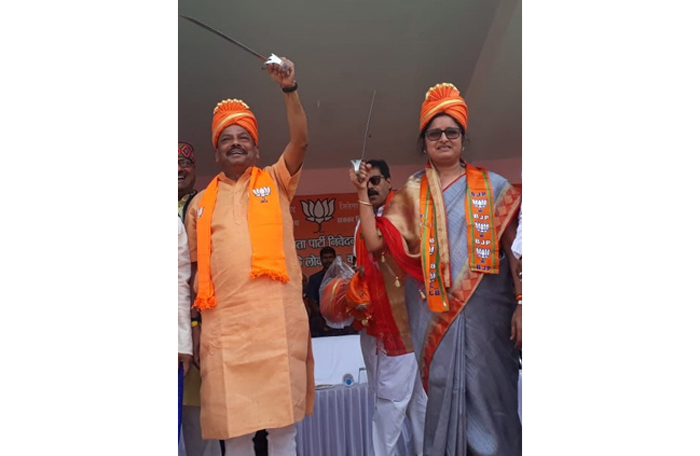
2014 से यहाँ से निर्भय कुमार शाहाबादी विधायक हैं, जो दूसरी बार चुन के आए। इस बार शाहाबादी भारतीय जनता पार्टी (भाजपा) से जीते थे, और पहली बार झारखंड विकास मोर्चा (जेवीएम) से जीत कर आए थे। पर जब पिछले चुनाव में शाहाबादी जीते तो वो सिर्फ अकेले नहीं, बल्के गिरिडीह ज़िला से तीन और विधायक भाजपा से जीत कर झारखंड विधान सभा गए थे। और पूरे गिरिडीह ज़िला के लोगों को लगा के ज़िला से एक मंत्री जरूर बनेगा। शाहाबादी जो दूसरी बार जीते थे वो प्रबल दावेदार थे, पर भाजपा जिसे पूर्ण बहुमत नहीं मिला था, उसने बहुमत तो जुगाड़ कर लिया, लेकिन प्रदेश के मुखिया, रघुवर दास ने कभी बारहवां कैबिनेट मंत्री नहीं बनाया।
झारखंड कैबिनेट सिर्फ 11 मंत्रियों से पूरे पाँच साल चला जो असंवैधानिक था। और इससे 68 साल के शाहाबादी के मंत्री बनने की आस पूरी नहीं हो पायी।
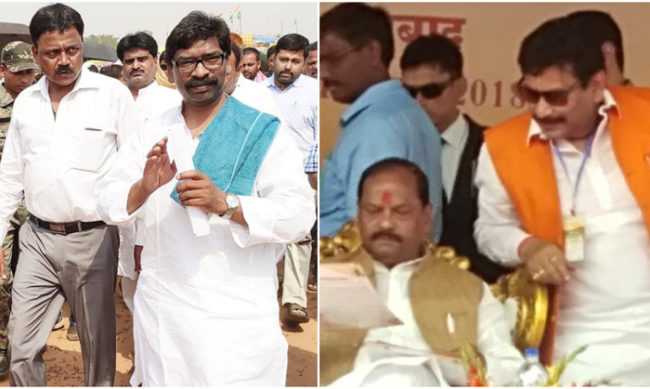
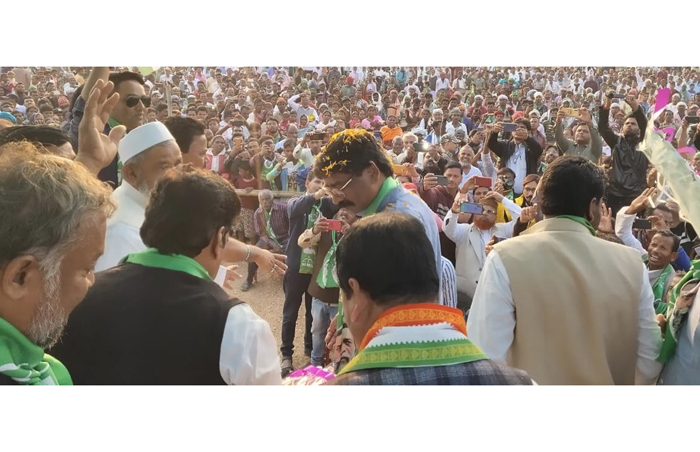
वहीं दूसरी तरफ झारखंड मुक्ति मोर्चा के प्रत्याशी हैं सुदिव्य कुमार सोनू। सोनू, पिछले चुनाव में दूसरे नंबर पर थे और 10 हज़ार से कम वोटों के अंतर से शाहाबादी से हारे थे।
सोनू, जेएमएम के संस्थापक और गुरुजी के नाम से मशहूर शिबू सोरेन के परिवार से काफी करीबी माने जाते हैं। सोनू अब जेएमएम के कार्यकारी अध्यक्ष हेमंत सोरेन के साथ भी कई महतवपूर्ण मौके पर साथ नज़र आए है। जेएमएम उम्मीदवार सोनू के प्रचार के लिए भी दोनों, शिबू सोरेन और हेमंत गिरिडीह आए।
हालांकि जब सोनू से ईन्यूज़रूम ने ये पूछा के उनके सोरेन परिवार से नजदीकी का लाभ गिरिडीह कि जनता को मिलेगा, तो सोनू का जवाब था, “मैं 30 सालों से जेएमएम का कार्यकर्ता रहा हूँ और जब आप जूतों की तरह पार्टियाँ नहीं बदलते हैं तो आपकी पार्टी फॉरम पे सुनी जाती है। वैसे इलैक्शन जीतना और मंत्री बनना अलग बात है, पर जब भी मैंने अपने इलाके की बात रखी है, इसे ध्यान से सुना भी गया है और माना भी गया है”।
एक दूसरी बात जिसे गिरिडीह के मतदाता भूल नहीं पा रहे हैं कि जब शाहाबादी 2014 में चुने गए उस वक़्त नरेंद्र मोदी की सरकार दिल्ली में बन गयी थी और गिरिडीह से भाजपा के सांसद, रघुवर दास की सरकार, बाद में मेयर, उप मेयर सभी जगह बस भाजपा ही थी।
पर गिरिडीह जो विकास के निचले पैदान पर है, यहाँ कोई बड़ा काम नहीं हुआ। और तमाम तरह की समस्या जल संकट, लाइट का जाना आम बात बन गयी, प्रदूषण, शहरी इलाको की सड़कों का बुरा हाल, स्वास्थ सेवाओं का बुरा हाल तो सब जानते हैं। और तो और जो ऑफिसर अच्छा काम कर रहे थे उनका ट्रान्सफर विधायक-मेयर के वजह से होना चलता रहा।
प्रचार के आखिरी दिन, निर्भय शाहबादी के लिए वोट मांगने गृहमंत्री और भाजपा के राष्ट्रीय अध्यक्ष अमित शाह भी गिरिडीह पहुंचे।
अब 16 दिसम्बर जो सिर्फ दो दिनों की बात है, वो गिरिडीह के लिए बदलाव लेकर आता है या पुराने चेहरे को दुहराता है, यह 23 दिसंबर को पता चल ही जायेगा।
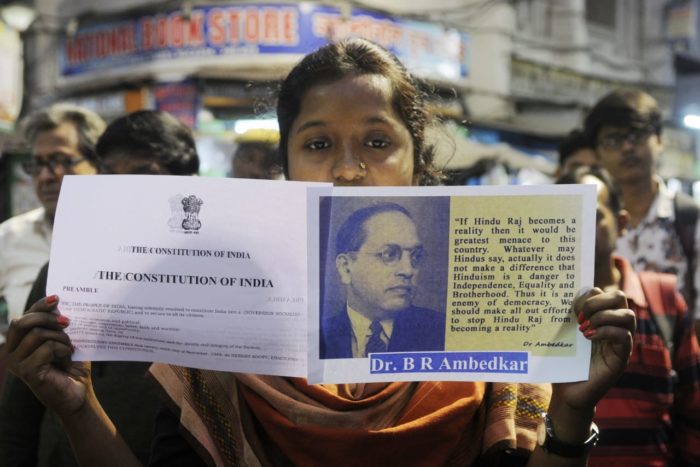
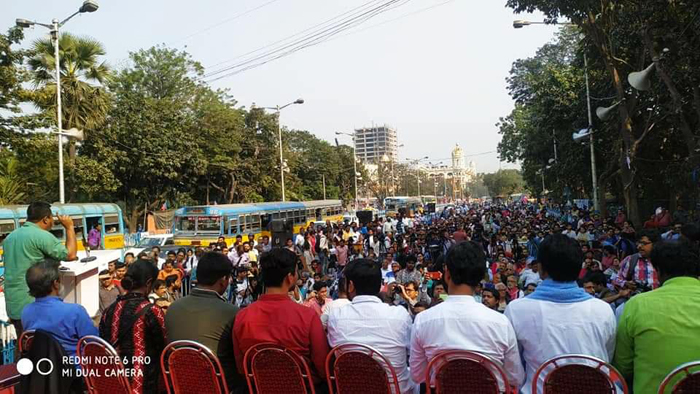
Kolkata: The fight over National Register of Citizens (NRC) and Citizen Amendment Bill (CAB) issue took a volatile turn on Thursday when the protesting students of Presidency University took to streets to submit a copy of Indian constitution to the state BJP headquarters in Central Kolkata.
Ayan, a Biology student of the university claimed that the purpose to submitting the copy to the BJP office was to remind the BJP leaders that not only Hindus even Muslims have equal rights to reside in India.
“The Constitution clearly states ‘We the people of India’. This proves that India is a secular country and people of all faiths have equal right to reside here. But the BJP led Central government has forgotten our own constitution. There anti-Muslim agenda is ruining the democracy of the country,” said Ayan.
Kaberi Guha, another protesting student alleged that saffron camp is an ‘anti-national party’ and also that the BJP is keen on destroying the harmony of the country.
Students protest against CAB and NRC before the office of the BJP
“Abiding the constitution the saffron camp was voted to power. Soon after coming to power the BJP is disrupting the harmony of the country. The Constitution clearly mentions that every citizens of India is entitled to enjoy all the facilities of the country but due to the appeasement politics the BJP is apparently giving freedom to the Hindus just to keep their vote bank,” said Guha.
The police who had barricaded the street near IISWBM College Street campus found it difficult to manage the crowd as the BJP cadres chanting slogans in favour of NRC came from the other side of the road. The police had even restricted the saffron cadres’ movement to so as to avoid untoward incidents.
But verbal slugfest continued as the BJP cadres’ called the Presi students ‘anti-nationals’ and chanted ‘Jai Sri Ram’ slogans. Countering the ‘Jai Sri Ram’ slogan the agitating students chanted slogans criticising the BJP government.
Talking to eNewsroom, BJP media- in charge Saptarshi Chowdhury said that the agitating students are naxals and are not students.
“First the students should prove that they are genuine students. They are Left cadres if not Naxals. Chanting slogans in favour of Ram is our tradition and no one can stop us to work for the development of the country,” said Chowdhury.
A student states about the danger CAB can bring to the common people and society
BJP national secretary Rahul Sinha said that no matter who hit the streets, BJP will make India ‘illegal infiltrators free country’.
“Hitting the streets and abusing BJP will not help anyone. We have pledged to develop the country and will clean India and will throw out all the illegal immigrants from the country. The Infiltrators are enjoying the benefits due for the original citizens of the country.
The local book shop owners in College Streets however stood by the agitating students and few of them have even mentioned that the saffron camp in order to find out the illegal immigrants is also destroying the peace of genuine citizens of the country and also that the BJP should rethink before implementing the NRC in West Bengal.
“History says that the Bengal once had two sides, East and the West. After partition of Bengal several Hindu and Mulims from now Bangladesh had fled to India. They are genuine people and they shouldn’t be harmed,” said a shopkeeper.
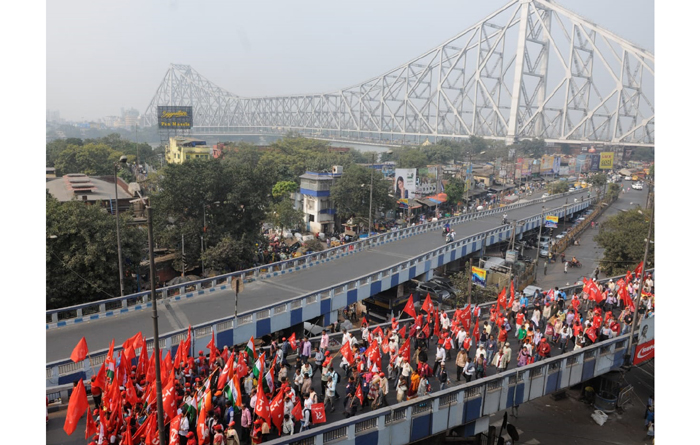
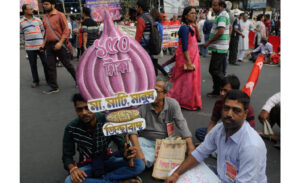
Kolkata: The streets of Central Kolkata’s Esplanade got red on Wednesday as 12 days Long March called by the Left Front and INTUC culminated at Rani Rashmoni road. Over eighteen thousand people mostly farmers from across West Bengal had gathered and shouted slogans against the Bharatiya Janata Party (BJP) for implementing NRC forcefully. And also against the different anti-people and anti-farmer policies of the BJP.
In 2018 also, a similar Long March was conducted and had concluded on December 1.
On the occassion, Tapan Sen national general secretary, CITU said that the central government is trying to sell all the industries to foreigners and is not working for the benefits of the people.
“The BJP for having majority is trying to pass several bills which they think is beneficial for the country, but people now came to know their actual intention and won’t support them in implementing them. The BJP government has completely destroyed the labour act too,” said Sen.
Taking a potshot at BJP government all India farmer association general secretary Ashok Dhawale alleged that farmers are being deprived by the saffron camp.
The farmers at Long March in Kolkata. Courtesy: Ashok Nath Dey
“Farmers are being deprived by the BJP across the country. They are even denied of their basic rights. The farmers’ protest movement has intensified so much that even women in Tamil Nadu have hit the streets. Interest of farmers is being overlooked so they are committing suicide. More than 3.4 lakhs farmers have ended their life as they didn’t manage to make their both ends meet. The BJP and the RSS are trying to sell the country to America’s crème businessmen. BJP and RSS have destroyed the country in just five years in comparison to the damages that took place since independence” said Dhawale.
Dhawale also added that over 10 lakhs workers in automobile sector has lost their job.
“Corporate sector is being tax free. Those who had fled by inappropriating funds over 12.54 thousand crore bank are getting photo clicked with the Prime Minister Narendra Modi. NRC and CAB are being used to divide Hindus and Muslims. They are following the footprints of British. All India strike on January 8 called by the farmers will be attended by the farmers across the country and BJP government will see the power of unity,” announced national general secretary of farmers’ association.
Echoing the voice of Dhawale, Santosh Karmakar, a farmer from Singur said that on one side BJP government had destroyed the democratic structure of the country on the other ruling Trinamool Congress in West Bengal is also depriving the farmers by not giving a substitute land for growing crops.
“There are several middlemen for which much of our products goes waste and we do not even get the minimum prices against it. On top of that Prime Minister despite promising subsidy for the farmers didn’t implement it. They are destroying the democracy. Every deprived farmers will attend the protest rally at national capital on January 8 to mount pressure on the BJP,” said Karmakar.
A farmer with onion cut out during the march. Courtesy: Ashok Nath Dey
While Ashok Bose National General Secretary of UTUC pointed out, “Everyone is thinking that people in hoards come together when rally is called by the Trinamool Congress government. No one thought that the Left- Congress alliance march will also see huge crowd. This is another cause of worry for the chief minister Mamata Banerjee. Common people have right on the constitution but government is spoiling the constitution and is not working for the interest of people. Government is manipulating the constitution as per their own interest.”
TUCC general secretary, T Debranjan said on the occassion, “Without consulting, BJP is passing bills as per their choices and is killing the democracy. BJP is selling the country to the foreigners and is purposely keeping people busy so that they cannot hit the streets. NRC in Assam is not accepted even by the Hindus,” mentioned Debranjan.
In the Long March, a simple participant has clear and strong views on the issues India is facing now. A CPI (M) worker, Ranajoy Sen said that the Left Front will hit the streets more to inform people about the corruption of the saffron camp and also about the negative impacts that the NRC will have if implemented in the country.
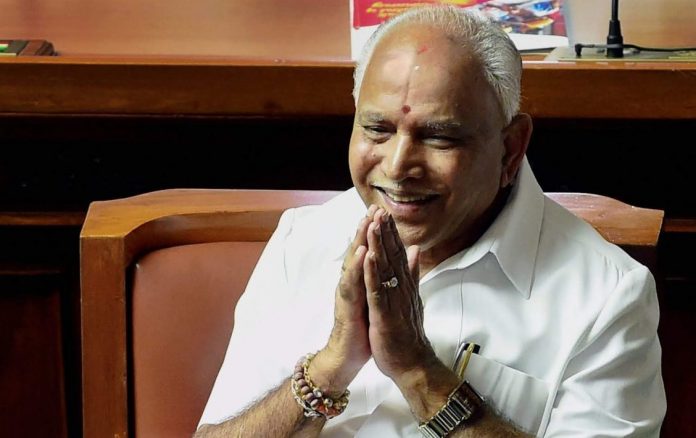
It’s been a respite for the Bharatiya Janata Party (BJP) which saw its clout jolted in Maharashtra and also to a certain extent, in Haryana where they were left with no option other than seeking support from the JJP to form the government. And the BJP top brass has no one but veteran Karnataka leader BS Yediyurappa (BSY) to thank for writing the ship at such a crucial juncture. The not-so-expected results in Karnataka have definitely bolstered the party with an eye on the future polls.
At a time, when the BJP is facing flak over a depleted economy, deteriorating law and order and the contentious Citizenship Amendment Bill (CAB) and the National Registrar of Citizens (NRC) among others, a one-sided victory in the bypolls in the southern state gives Prime Minister Narendra Modi and Home Minister Amit Shah a shot in the arm. Nobody could imagine that Yediyurappa who reportedly lost favour with the high command, would be able to steer the party to victories in 12 seats out of the 15 where bypolls were held after 17 Congress and JD (S) legislators defected to the saffron unit bringing the Congress-JD (S) government under HD Kumaraswamy down and ‘propelling’ Yediyurappa back to the CM’s seat that drew criticism from his opponents.
The Supreme Court verdict that found the defected legislators guilty of violating the anti-defection law, however allowed them to contest the elections, much to the jubilation of the Yediyuruppa camp which was fighting a lone battle with absolutely no support from the national leaders.
Modi who was earlier miffed with YSY, has hailed the mandate and also blamed the Congress for ‘subverting’ the earlier results to stitch an unstable coalition with the JD (S). However, the learned Prime Minister must be deliberately overlooking the fact that it is his party which has made it a habit to go against the mandate be it in Goa, Manipur, Maharashtra and even in Karnataka where shifting of loyalties of Congress-JD (S) MLAs was ‘orchestrated’ by the BJP machinery.
The results brings forth two key issues that cannot be decried- the BJP comeback in Karnataka is a wake- up call not just for the saffron wing but also for the opposition – Congress-JD (S). Secondly, the victory has reinforced people’s desire for a stable government and not an administration run by an amalgam of outfits standing on different sides of the ideological spectrum. The failure of the Congress-JD (S) government is a testimony to stability and not precariousness. And in this context the Grand Old Party’s alliance with the Shiv Sena and the Nationalist Congress Party (NCP) in Maharashtra will also come under scrutiny. We will come to it later.
It’s celebration time for the BJP unit in Karnataka which has proved all pre-poll predictions wrong. But elaborating on the wake-up call factor, it is important for the party not to misuse the verdict and stamp its authority with developmental works that were hampered due to ‘constant consternation’ between the Congress and the JD (S) at the behest of former CM Siddaramaiah. If Modi is harping on stability, the BSY government has to lend credence to it.
Modi who was earlier miffed with YSY, has hailed the mandate and also blamed the Congress for ‘subverting’ the earlier results to stitch an unstable coalition with the JD (S). However, the learned Prime Minister must be deliberately overlooking the fact that it is his party which has made it a habit to go against the mandate be it in Goa, Manipur, Maharashtra and even in Karnataka where shifting of loyalties of Congress-JD (S) MLAs was ‘orchestrated’ by the BJP machinery.
Without taking political sides, when Modi preaches honesty and boasts of political ethics, he should introspect into what led his party to resort to machinations to grab power by hook or crook in several states despite the people’s mandate going against it. Similarly, he would be day-dreaming if he expects the Karnataka results to have an impact on the polls in Jharkhand and Delhi, two states that run on different political dynamics.
Maharashtra is a glaring example of how the ruling party at the centre ‘cajoled’ NCP leader Ajit Pawar to lend his support to a Devendra Phadnavis-led government at a time when the stage was all set for the Sena-Congress-NCP combination to stake claim. However, BJP’s misdemeanour turned out to be a damp squib with Maratha strongman Sharad Pawar pulling the rug from under its feet leading to the swearing-in of Uddhav Thackeray as the CM.
Without taking political sides, when Modi preaches honesty and boasts of political ethics, he should introspect into what led his party to resort to machinations to grab power by hook or crook in several states despite the people’s mandate going against it. Similarly, he would be day-dreaming if he expects the Karnataka results to have an impact on the polls in Jharkhand and Delhi, two states that run on different political dynamics.
As regards, the impact of Karnataka on Maharashtra, the trio running the state should take a leaf out of Karnataka’s book and ensure that vested interests do not have a telling effect on the functioning of the government in a state where people’s grievances are only piling up. In fact, the Sena-Congress-NCP team should take one of Modi’s many reactions after the Karnataka bypolls seriously. “They spent the whole one-year squabbling. Congress held the chief minister at gun-point and the poor CM would go to people crying. They (Congress) made the condition of the CM of Karnataka worse than somebody who has been kidnapped,” said Modi while campaigning in Jharkhand.
That is the point to be noted – keeping the CM on tenterhooks 24×7 would only belittle his position which could cut the partners sorry figures in people’s eyes.
राँची: झारखंड में दो चरण के चुनाव सम्पन्न होने के बाद अब तक के आकलन से महत्वपूर्ण निष्कर्ष सामने आ रहे हैं। स्वतंत्र पर्यवेक्षकों तथा दिल्ली से आए मीडियाकर्मियों से मिली जानकारी के साथ ही खुद भाजपा के विभिन्न राज्यों से आए नेताओं का आकलन बताता है कि सीटों के उम्मीदवार चयन में भाजपा ने भारी लापरवाही की है। हत्या, रेप या भ्रष्टाचार के कुछ आरोपियों को टिकट देने के कारण भाजपा के खिलाफ माहौल बना। इसके कारण पारंपरिक वोटरों की नाराजगी ने भाजपा नेताओं को चिंता में डाल दिया है।
सबसे ज्यादा नुकसान जमशेदपुर पश्चिमी और रांची सीट के उम्मीदवार को लेकर होने का आकलन किया जा रहा है। दोनों सीटें शहरी और राजनीतिक तौर पर सर्वाधिक हॉट सीट होने के कारण इसका नुकसान पूरे राज्य में होता दिख रहा है। झारखंड में प्रचार के लिए आए एक वरिष्ठ नेता ने आपसी चर्चा में खुलकर आश्चर्य जताया कि जमशेदपुर पश्चिमी सीट से सरयू राय को टिकट नहीं देकर ऐसा आत्मघाती कदम उठाने के पीछे कौन जिम्मेवार है।
इसलिए यह माना जा रहा है कि इसका असर सिर्फ रांची पर नहीं बल्कि राज्य की अन्य सीटों पर भी पड़ रहा है। भाजपा का जो पारंपरिक वोटबैंक अब तक खुलकर वोट देता आया था, उसका इस तरह बगावत पर उतर आना यह साबित करता है कि भाजपा नेतृत्व किस तरह जड़ों से कट गया है। दिल्ली से आए एक पर्यवेक्षक ने हैरानी जताई कि जब सीपी सिंह के खिलाफ इतनी ज्यादा शिकायत थी, तो यह बात प्रदेश भाजपा नेताओं ने अपने आलाकमान को क्यों नहीं बताई।
इसी तरह, राजधानी रांची में स्थानीय नागरिकों खासकर भाजपा और संघ के पुराने समर्पित लोगों और व्यवसायी वर्ग द्वारा लंबे समय से स्पष्ट मांग किये जाने के बावजूद सीपी सिंह को उम्मीदवार बनाने को भी एक बड़ी चूक के तौर पर देखा जा रहा है। इससे नाराज होकर निर्दलीय प्रत्याशी के तौर पर पूरे समाज ने जिस तरह पवन कुमार शर्मा को समर्थन दिया है, उससे भाजपा के परंपरागत वोटबैंक को भारी झटका लगा है। पवन कुमार शर्मा झारखंड चैंबर ऑफ कॉमर्स तथा इंडस्ट्रीज से जुड़े हैं। इस संगठन की पहुंच पूरे झारखंड के व्यवसायी समुदाय तक होने के कारण राज्य की कई सीटों में भाजपा का पारंपरिक व्यवसायी तबका पूरी तरह नाराज दिख रहा है।
इसलिए यह माना जा रहा है कि इसका असर सिर्फ रांची पर नहीं बल्कि राज्य की अन्य सीटों पर भी पड़ रहा है। भाजपा का जो पारंपरिक वोटबैंक अब तक खुलकर वोट देता आया था, उसका इस तरह बगावत पर उतर आना यह साबित करता है कि भाजपा नेतृत्व किस तरह जड़ों से कट गया है। दिल्ली से आए एक पर्यवेक्षक ने हैरानी जताई कि जब सीपी सिंह के खिलाफ इतनी ज्यादा शिकायत थी, तो यह बात प्रदेश भाजपा नेताओं ने अपने आलाकमान को क्यों नहीं बताई।
धनवार सीट, पे भी उसी तरह का मामला है, पार्टी ने जिसे उम्मीदवार बनाया, इससे के पार्टी के लोग खुश नहीं थे और फिर अब एक निर्दलय प्रत्याशी को ज्यादा समर्थन मिल रहा। धनवार एक ऐसी सीट बन गयी हैं जहां भाजपा को रेस में रहने के लिए मुशक्कत करना पढ़ रहा।
वही टिकट बटवारे के इलावा, रघुबर दास की कार्यशैली से भी पारंपरिक वोट बैंक की नाराजगी है।
समझा जाता है कि चुनाव के बाद ऐसे मुद्दों की समीक्षा की जाएगी तथा संगठन के प्रमुख दायित्व पर बैठे ऐसे पदाधिकारियों की भूमिका की जांच होगी, जिनकी लापरवाही के कारण भाजपा को अपने पारंपरिक वोटबैंक की नाराजगी का सामना करना पड़ रहा है।
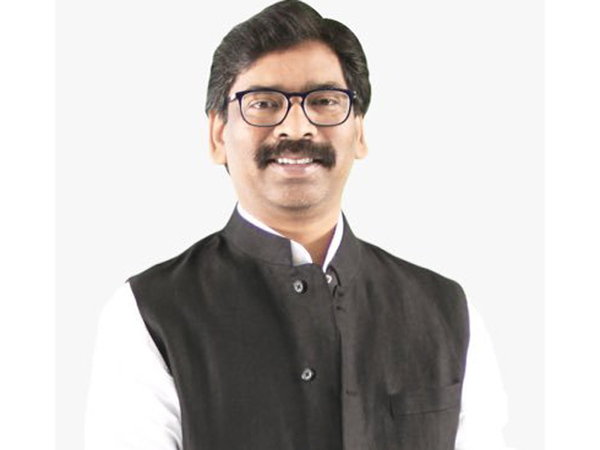
मधुपुर : झारखंड के नेता प्रतिपक्ष और झारखंड मुक्ति मोर्चा के कार्यकारी अध्यक्ष हेमंत सोरेन ने रघुवर दास की भाजपा सरकार के ऊपर तीखे प्रहार किए और गंभीर आरोप लगाए।
तीसरे चरण के अपने प्रचार में हेमंत सोरेन मधुपुर में जेएमएम उम्मीदवार हाजी हुसैन अंसारी के समर्थन में वोट मांग रहे थे।
हेमंत सोरेन ने अपने भाषण की शुरुआत आजसू और भाजपा के रिश्ते से की।
“आजसू भाजपा को भाषण सुना रहा है और अमित शाह आजसू को अपना साथी बता रहे हैं। आजसू और भाजपा का रिश्ता गाय और बछड़े जैसा है। आजसू का पघा रघुबर दास और अमित शाह पकड़ कर रखे हुए हैं”।
रघुवर दास के पाँच साल के शासन काल के बारे में बोलते हुए नेता प्रतिपक्ष ने कहा, “पाँच साल दलित, शोषित, आदिवासी और अल्पसंखयकों पर जो अत्याचार किया है, जिस तरीके से रुलाया है वो ये लोग कभी नहीं भूल सकते, वे रोने पर मजबूर हैं। पारा-टीचर्स अपना अधिकार मांगते-मांगते मर गए। आँगनबड़ी की सेविका-सहायिका पर लाठी-चार्ज हुआ”।
पूर्व मुख्यमंत्री ने राजनाथ सिंह के ऊपर भी तंज़ कसा, “एक दिन डिफेंस मिनिस्टर राजनाथ सिंह कहते हैं कि राज्य में भय, भूख, भ्रष्टाचार का वातावरण खत्म हो गया और दूसरे दिन नक्सली हमला हो जाता है”।
रघुवर दास और भाजपा के कार्यकाल के बारे में जेएमएम के नेता ने आगे कहा, “पाँच साल में राज्य को एक डरावना राज्य बना दिया। कहीं बच्चा चोरी के नाम पे लोगों की हत्या हो रही है, कहीं गौ तस्करी के नाम पर अल्पसंख्यकों की मोब लिंचिंग हो रही है, तो कहीं डायन-बिसाही के नाम पर महिलाओं की हत्या हो रही है। महिलाओं पर तो हर दिन अत्याचार हो रहा है। व्यापारियों को दिन-दहाड़े गोली मारी जा रही है। कोई ऐसा दिन नहीं जब लूट, हत्या की वारदातें नहीं हो रही हों। चुनाव के दौरान महिलाओं का रेप हो रहा, तो आम दिनों का तो हाल समझ सकते हैं। किसानो, मजदूरों को कुछ दिया नहीं और उनको भूखा मरने के लिए छोड़ दिया। हमे ऐसा लगा ही नहीं की राज्य में सरकार है”।
दूसरे चरण के वोटिंग का जिक्र कर कहा, “रघुवर दास सरकार घमंड में चूर है, और ये चुनाव इसी अहंकार को तोड़ने के लिए है। डबल इंजन की सरकार में एक झारखंड को और एक देश को लूट रहा है। पर दो चरण का चुनाव बता रहा है कि एक इंजन सीज कर चुका है”।
पूर्व मुख्यमंत्री ने राजनाथ सिंह के ऊपर भी तंज़ कसा, “एक दिन डिफेंस मिनिस्टर राजनाथ सिंह कहते हैं कि राज्य में भय, भूख, भ्रष्टाचार का वातावरण खत्म हो गया और दूसरे दिन नक्सली हमला हो जाता है”।
हेमंत सोरेन ने केंद्र सरकार द्वारा झारखंड को दिये 5 लाख करोड़ के इस्तेमाल का भी मुद्दा उठाया, “दिल्ली से आकर केंद्र सरकार के लोग कहते हैं के हमने झारखंड को 5 लाख करोड़ रुपया दिया है। अगर राज्य में 5 लाख करोड़ रुपया आया तो मैं पूछना चाहता हूँ, रघुवर दास से कि 5 लाख करोड़ रुपया आया तो भूख से क्यूँ मौत हुई? पारा-टीचर्स का पैसा क्यूँ नहीं बढ़ा पायी सरकार? इतना रुपया आया तो अंगनबाड़ी वर्कर्स को क्यूँ नहीं दिया? इतना रुपया आया तो नौजवानों को रोजगार क्यूँ नहीं मिला? इतना रुपया आया तो किसान आत्म हत्या करने को क्यूँ मजबूर हुए”।
“भाजपा कभी राम मंदिर के नाम पर, कभी सरदार पटेल, कभी धारा 370 की बात करेंगे। धारा 370 कश्मीर की बात है, वो यहाँ किस लिए बात करते हैं। हम बात करेंगे यहाँ कि स्थानीयता, हम बात यहाँ के वन अधिकार का, हम बात करेंगे सीएनटी/एसपीटी एक्ट का, हम बात करेंगे नौजवानो के रोजगार का,” भाजपा को हेमंत सोरेन ने घेरते हुए कहा।
पर सबसे बड़ा हमला विधान सभा में लगी आग को लेकर किया, “इनके घोटाले की लिस्ट लंबी है। हाई कोर्ट बनाने में भी घोटाला हो रहा है। आज विधान सभा में जो आग लगी है, वो लगी है या लगाई गयी है? 500 करोड़ का मेडिकल कॉलेज में डॉक्टर नहीं, इनफ्रास्ट्रक्चर नहीं है”।
“भाजपा कभी राम मंदिर के नाम पर, कभी सरदार पटेल, कभी धारा 370 की बात करेंगे। धारा 370 कश्मीर की बात है, वो यहाँ किस लिए बात करते हैं। हम बात करेंगे यहाँ कि स्थानीयता, हम बात यहाँ के वन अधिकार का, हम बात करेंगे सीएनटी/एसपीटी एक्ट का, हम बात करेंगे नौजवानो के रोजगार का,” भाजपा को हेमंत सोरेन ने घेरते हुए कहा।
राम मंदिर के सुप्रीम कोर्ट के फैसला को भाजपा द्वारा अपनी उपलब्धि बताने पर हेमंत सोरेन ने कहा, ये सुप्रीम कोर्ट का फैसला है और बीजेपी इसमे अपनी पीठ थपथपा रही, “पर झारखंड के गरीब मेरे लिए राम है, गरीब का घर ही अयोध्या है, गरीब का पेट ही हमारा मंदिर है। भाजपा ने मूर्ति बनाया पर देश को नंगा कर दिया”।
“बीजेपी ने कुछ दिया नहीं पर एक नालायक बेटा की तरह जो बाप का दिया वो भी बेच रहे। कभी रेलवे, कभी बीएसएनएल को बेच रहा। धीरे- धीरे सब सरकारी कंपनियो को बेच देंगे”।
हेमंत सोरेन ने चाणक्य के एक वाक्य का भी इस्तेमाल अपने भाषण में किया, “चाणक्य जैसे विद्वान ने कहा था, जिस देश का राजा व्यापारी होता है, उस देश की प्रजा भिखारी हो जाती है”।
मधुपुर: झारखंड के नेता प्रतिपक्ष और झारखंड मुक्ति मोर्चा के कार्यकारी अध्यक्ष हेमंत सोरेन ने रघुवर दास की भाजपा सरकार के ऊपर तीखे प्रहार किए और गंभीर आरोप लगाए।
तीसरे चरण के अपने प्रचार में हेमंत सोरेन मधुपुर में जेएमएम उम्मीदवार हाजी हुसैन अंसारी के समर्थन में वोट मांग रहे थे।
हेमंत सोरेन ने अपने भाषण की शुरुआत आजसू और भाजपा के रिश्ते से की।
“आजसू भाजपा को भाषण सुना रहा है और अमित शाह आजसू को अपना साथी बता रहे हैं। आजसू और भाजपा का रिश्ता गाय और बछड़े जैसा है। आजसू का पघा रघुबर दास और अमित शाह पकड़ कर रखे हुए हैं”।
रघुवर दास के पाँच साल के शासन काल के बारे में बोलते हुए नेता प्रतिपक्ष ने कहा, “पाँच साल दलित, शोषित, आदिवासी और अल्पसंखयकों पर जो अत्याचार किया है, जिस तरीके से रुलाया है वो ये लोग कभी नहीं भूल सकते, वे रोने पर मजबूर हैं। पारा-टीचर्स अपना अधिकार मांगते-मांगते मर गए। आँगनबड़ी की सेविका-सहायिका पर लाठी-चार्ज हुआ”।
पूर्व मुख्यमंत्री ने राजनाथ सिंह के ऊपर भी तंज़ कसा, “एक दिन डिफेंस मिनिस्टर राजनाथ सिंह कहते हैं कि राज्य में भय, भूख, भ्रष्टाचार का वातावरण खत्म हो गया और दूसरे दिन नक्सली हमला हो जाता है”।
रघुवर दास और भाजपा के कार्यकाल के बारे में जेएमएम के नेता ने आगे कहा, “पाँच साल में राज्य को एक डरावना राज्य बना दिया। कहीं बच्चा चोरी के नाम पे लोगों की हत्या हो रही है, कहीं गौ तस्करी के नाम पर अल्पसंख्यकों की मोब लिंचिंग हो रही है, तो कहीं डायन-बिसाही के नाम पर महिलाओं की हत्या हो रही है। महिलाओं पर तो हर दिन अत्याचार हो रहा है। व्यापारियों को दिन-दहाड़े गोली मारी जा रही है। कोई ऐसा दिन नहीं जब लूट, हत्या की वारदातें नहीं हो रही हों। चुनाव के दौरान महिलाओं का रेप हो रहा, तो आम दिनों का तो हाल समझ सकते हैं। किसानो, मजदूरों को कुछ दिया नहीं और उनको भूखा मरने के लिए छोड़ दिया। हमे ऐसा लगा ही नहीं की राज्य में सरकार है”।
दूसरे चरण के वोटिंग का जिक्र कर कहा, “रघुवर दास सरकार घमंड में चूर है, और ये चुनाव इसी अहंकार को तोड़ने के लिए है। डबल इंजन की सरकार में एक झारखंड को और एक देश को लूट रहा है। पर दो चरण का चुनाव बता रहा है कि एक इंजन सीज कर चुका है”।
पूर्व मुख्यमंत्री ने राजनाथ सिंह के ऊपर भी तंज़ कसा, “एक दिन डिफेंस मिनिस्टर राजनाथ सिंह कहते हैं कि राज्य में भय, भूख, भ्रष्टाचार का वातावरण खत्म हो गया और दूसरे दिन नक्सली हमला हो जाता है”।
हेमंत सोरेन ने केंद्र सरकार द्वारा झारखंड को दिये 5 लाख करोड़ के इस्तेमाल का भी मुद्दा उठाया, “दिल्ली से आकर केंद्र सरकार के लोग कहते हैं के हमने झारखंड को 5 लाख करोड़ रुपया दिया है। अगर राज्य में 5 लाख करोड़ रुपया आया तो मैं पूछना चाहता हूँ, रघुवर दास से कि 5 लाख करोड़ रुपया आया तो भूख से क्यूँ मौत हुई? पारा-टीचर्स का पैसा क्यूँ नहीं बढ़ा पायी सरकार? इतना रुपया आया तो अंगनबाड़ी वर्कर्स को क्यूँ नहीं दिया? इतना रुपया आया तो नौजवानों को रोजगार क्यूँ नहीं मिला? इतना रुपया आया तो किसान आत्म हत्या करने को क्यूँ मजबूर हुए”।
“भाजपा कभी राम मंदिर के नाम पर, कभी सरदार पटेल, कभी धारा 370 की बात करेंगे। धारा 370 कश्मीर की बात है, वो यहाँ किस लिए बात करते हैं। हम बात करेंगे यहाँ कि स्थानीयता, हम बात यहाँ के वन अधिकार का, हम बात करेंगे सीएनटी/एसपीटी एक्ट का, हम बात करेंगे नौजवानो के रोजगार का,” भाजपा को हेमंत सोरेन ने घेरते हुए कहा।
पर सबसे बड़ा हमला विधान सभा में लगी आग को लेकर किया, “इनके घोटाले की लिस्ट लंबी है। हाई कोर्ट बनाने में भी घोटाला हो रहा है। आज विधान सभा में जो आग लगी है, वो लगी है या लगाई गयी है? 500 करोड़ का मेडिकल कॉलेज में डॉक्टर नहीं, इनफ्रास्ट्रक्चर नहीं है”।
“भाजपा कभी राम मंदिर के नाम पर, कभी सरदार पटेल, कभी धारा 370 की बात करेंगे। धारा 370 कश्मीर की बात है, वो यहाँ किस लिए बात करते हैं। हम बात करेंगे यहाँ कि स्थानीयता, हम बात यहाँ के वन अधिकार का, हम बात करेंगे सीएनटी/एसपीटी एक्ट का, हम बात करेंगे नौजवानो के रोजगार का,” भाजपा को हेमंत सोरेन ने घेरते हुए कहा।
राम मंदिर के सुप्रीम कोर्ट के फैसला को भाजपा द्वारा अपनी उपलब्धि बताने पर हेमंत सोरेन ने कहा, ये सुप्रीम कोर्ट का फैसला है और बीजेपी इसमे अपनी पीठ थपथपा रही, “पर झारखंड के गरीब मेरे लिए राम है, गरीब का घर ही अयोध्या है, गरीब का पेट ही हमारा मंदिर है। भाजपा ने मूर्ति बनाया पर देश को नंगा कर दिया”।
“बीजेपी ने कुछ दिया नहीं पर एक नालायक बेटा की तरह जो बाप का दिया वो भी बेच रहे। कभी रेलवे, कभी बीएसएनएल को बेच रहा। धीरे- धीरे सब सरकारी कंपनियो को बेच देंगे”।
हेमंत सोरेन ने चाणक्य के एक वाक्य का भी इस्तेमाल अपने भाषण में किया, “चाणक्य जैसे विद्वान ने कहा था, जिस देश का राजा व्यापारी होता है, उस देश की प्रजा भिखारी हो जाती है”।
Kolkata: Speaking at the public rally, former Jawaharlal Nehru University (JNU) student union president Kanhaiya Kumar said that NRC and CAB are nothing but a diversion tactic of the BJP-led central government.
“BJP had formed the union government, constitutionally, for the second time, but after coming to power they are not abiding by it. So, we the people of this country should disown this government. Prime Minister Narendra Modi had guaranteed us Achhe Din (good days) if voted to power but has completely failed. The complete economic breakdown and the growing unemployment is not much of a worry for the Modi government. But they are very keen on NRC, which is just a way to divide the country or create new history to divert attention,” reiterated Kumar.
Kumar also accused Narendra Modi and Union Home minister Amit Shah of treading upon the path set by Vinayak Damodar Savarkar and Muhammad Ali Jinnah. Urging the citizens to start ‘non-cooperation movement’ against the BJP government, Kanhaiya said that December 19 (death anniversary of freedom fighter and best friends Ashfaqullah Khan and Ram Prasad Bismil) to be celebrated as ‘Unity Day’ across India.
Secretary of the All India Progressive Women’s Association, Kavita Krishnan stated, “BJP is fooling people. Not just the Muslims, the BJP government is also playing with the sentiments of the Hindus. Everyone should take a stance and inform people across the country about the evils of the NRC and NPR.”
Protest march against NRC and CAB in Kolkata. Courtesy Manzar Jameel/ Facebook
Krishnan also mentioned that the BJP government ahead of the Lok Sabha election had introduced election bonds where crème businessmen had used their black-money to purchase such bond.
Echoing similar view, Saswata Chatterjee, a former BJP supporter said that initially, he used to support the BJP hoping that the party would work for the uplift of the Hindu community but on seeing that the BJP is playing divisive politics for their benefits, Chatterjee now raises his voice against the BJP government and is likely to join the Joint Forum to fight the evil of NRC in Bengal and other states.
Forward Bloc leader Ali Imran Ramz (Victor) said that one side the TMC supremo is saying that she will not allow implementation in Bengal, on the other hand, she is giving NPR training to the state government officials.
“All the political parties play divisive politics. On August 4, 2005, Mamata Banerjee wanted to implement NRC and now she on playing a dubious role with the same. Banerjee went to meet Modi and Shah soon after CBI enquiry started against former top cop Rajeev Kumar. There she must have reached an understanding, which would be to oppose NRC but have NPR, the first step to NRC implemented in Bengal.”
He added, “Modi is trying to create India a Hindu Rashtra but not a single Hindu is safe under the BJP rule. 1127 Hindus were killed in encounter in Uttar Pradesh. On one side Modi government and Vishwa Hindu Parishad is trying to build Ram mandir on the other side thousands of Sita’s are being raped and victimised.”
Questioning BJP government, Joint Forum convenors Prasenjit Bose and Imtiaz Ahmed Molla asked the BJP government to clear their stand concerning the fate of people sent to detention camps.
“We will not leave Modi and Shah. We will take stock of every political party to identify the actual traitor. Modi and Shah will not find a place to hide. They are depriving the people of getting the basic amenities,” said Molla.
Molla also said, “It is in the constitution that if either of the parents is Indian, the children are Indian. In 2003 Vajpayee government said that only if both the parents are Indian then the children are Indian. It is not possible for people to get the birth documents of the great grandfather so what’s going to be our fate?”
He added, “BJP government cannot throw them out of the country illegally as those citizens are residing in India for decades and have also have voting rights and many of them might have even voted for the BJP.”
Sanghamitra Sen, a lawyer attending the mass meeting said, she is also fearing that the BJP government might throw their entire family out of the country, as her father’s paper are not in order.
“Several people detained in the detention camp have died without medical help. Now if we are also sent to detention camp don’t know how many families will die. Even if our identity cards and documents are in order but father’s and even grandfather’s birth certificates are missing, but that doesn’t mean that we are not Indian,” said Sen.
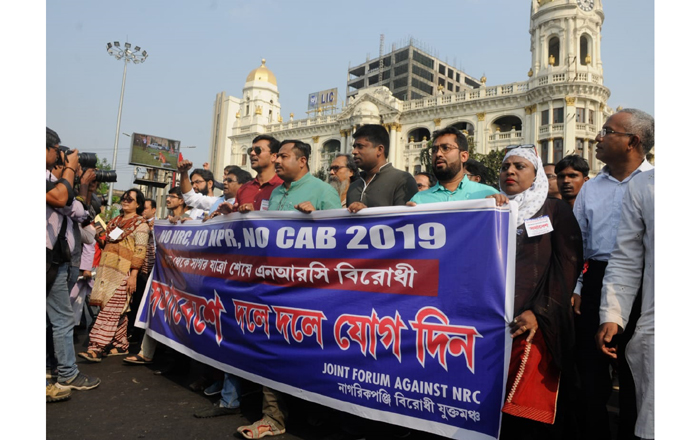
Kolkata: At a time when political leaders were busy in the Parliament debating on Citizenship Amendment Bill (CAB) as it was introduced by Home Minister Amit Shah, Kavita Krishnan along with other CPIML leaders were briskly walking down Creek Row Kolkata, to assemble at Raja Subodh Mullick Square, where firebrand leader – Kannan Gopinathan had already reached to flag off the Anti-National Register for Citizenship (NRC) and Anti-CAB rally called by the Joint Forum Against NRC.
The rally concluded at Rani Rashmoni Road, where the youth leaders and members of the forum not just addressed a huge gathering but also tore apart the myths associated with CAB and NRC.
“The Muslims are lucky, as they know the anti-Muslim government stand. They are getting their documents in place. But what about the millions of Hindus who are believing the government? They are definitely being taken for a ride. For when the law is passed, the officials you meet will only believe in the documents your produce. So, despite being an Indian Hindu, you will first be termed as an illegal migrant, your citizenship will be stripped away, following which you would need to apply for it (citizenship) and then like a lollipop, you will be given your Indian status,” explained Kannan.
He went on to say, “Unlike many who accuse this government of being fascist, I would like to call them foolish, for they don’t know what to do while executing their agenda. Look, during demonetisation, we all supported Modi and his government. But what happened? Did the money come back? On the contrary, RBI has recently announced that they are no longer printing Rs 2000 notes, as too many fake 2000 notes of good quality are in circulation. They introduced GST, but then look at the end result?”
As the audience burst into laughter, Kannan, continued, “Then came NRC in Assam. The result is out – the NRC process executed in Assam, for which INR 1600 crore gathered from tax-payers money was used, stands nullified. Fresh NRC will take place in Assam along with the now much-hyped NRIC, which they plan to have it executed sometime soon. But what next, on identifying the so-called infiltrators? The government, in this case, is also, like a headless chicken, running around knowing not what to do next.
Social activist Kavita Krishnan and former IAS officer Gopinathan Kannan at the rally against CAB and NRC in Kolkata
Taking on from Kanan, was CPI-ML leader and women right activist, Kavita Krishnan. She chose to warn the common man, against the divisive policy of the present regime. Kavita said, “Ghar agar padosi ka jalega to aap ka bhi jalega.” The audience applauded as she said, “Don’t get misled by the carrot of citizenship being dangled before the Hindus. This is an agenda of creating a cheap workforce for the rich. For the so-called infiltrators will not be sent back, but be kept in detention centres, to work as cheap labour.”
Following her, taking on the dais was youth leader Kanhaiya Kumar, he said, “Let me remind you all that it was Savarkar who wrote to the British monarch, asking them to not leave India and even if they did then the King of Nepal be made the ruler of India so that India stays a Hindu Rashtra. It was Jinnah and Savarkar who proposed the two-nation theory. And let me tell you, neither Jinnah was a practicing Muslim, nor Savarkar a practicing Hindu.”
As the audience applauded, Kahaiya declared, “We need to reject NRC, CAB and NPR as all three are unconstitutional. History is a witness to this fact that every time that there is a mass movement, civil disobedience or non-cooperation movement, the government have had to give in.”
Kanhaiya, even sarcastically, said, “Most of the Hindutva supporters call for Akhand Bharat comprising Afghanistan, Pakistan, Bangladesh, Sri Lanka and India. Then if some people from these neighbouring countries have come into India, shouldn’t they be accepted?”
Echoing a similar sentiment were almost all speakers, at the anti-NRC event. Addressing the crowd, Prasenjit Bose, Convener of Joint Forum Against NRC said, “Our protest will continue till everyone left out of NRC list in Assam are given citizenship. NPR, NRC and CAB need to scrapped immediately as they are unconstitutional.”
While co-convener of the Forum, Deborshi Chakraborty, said, “We till now have not said a word against the state government, as we want to believe CM Mamata Banerjee’s claim of not implementing NRC in Bengal. But given the fact that detention centres are coming up in our state, and the recent ads, that is trying to pass off NPR as a normal census, is not in the right taste. This is the land of revolutionaries, of freedom fighters, and let me tell, you all, if NRC is implemented in Bengal, we will be out on the streets and fight tooth and nail for our rights. Let us not forget, no movement has taken place under political banners but have been initiated by common people like us.”
SaradinduUddipan of Jai Bhim Network, reminded the crowd, that it is the poor and tribal and adivasis who will be the worst affected. “According to a survey done by us only 20 per cent adivasis have documents. What will happen to the remaining 80 per cent? Do the indigenous people of India have to prove their country of origin? We reject this law, which aims to divide India once again in the name of religion and ethnicity.”
The rally marked the culmination of the Pahaad Theke Sagar (From the Mountain to the Sea) campaign flagged off by Joint Forum Against NRC. The month-long campaign saw the social activists and leaders campaigning across Bengal to drum up but awareness and support for the anti-NRC movement in India.
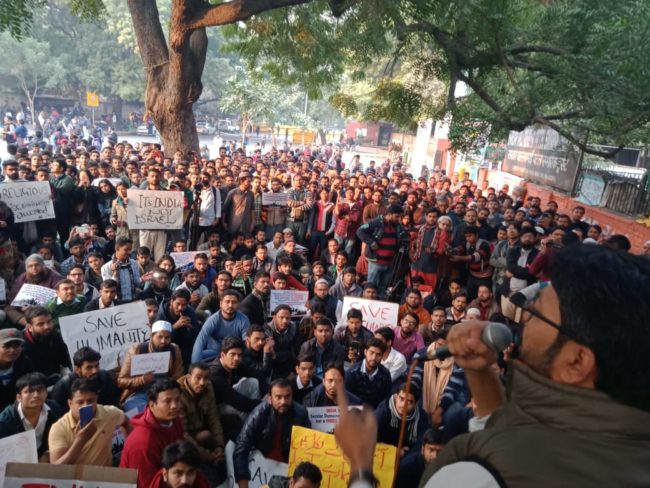
New Delhi: Hundreds of students, activists and concerned citizens assembled at the Jantar Mantar on December 7, to oppose the National Register of Citizens (NRC) and the tabled Citizenship Amendment Bill (CAB) in parliament. They decided to start a countrywide civil disobedience movement against CAB and NRC, NPR process.
The mass meeting, to educate and mobilise people about the repercussions that would take place if the bills become a law, was called by United Against Hate (UAH), a citizen’s group, which has a first-hand experience of the plight and despair that engulfed Assam, when the now-discarded NRC was being implemented.
Addressing the mass assembly also included Yogendra Yadav of Swaraj India Abhiyan, who pointed out, “CAB sabotages the fundamental secular character of India. Yes, Indian secularism has many limitations but CAB tends to destroy it completely. The CAB does not talk about persecuted minorities from non-Muslim nations. It does not talk about Muslim minorities from Muslim nation. It is highly discriminatory.”
The huge congregation, was also addressed by Javed Ali, Congress MP from Kishanganj. The lone MP present at the gathering claimed, “BJP-led government is being brazenly majoritarian. They are also Muslim haters and they are no-longer hiding this fact. We have been elected in the parliament to safeguard the constitution and we will fight for it.”
Ali during his speech also challenged Bihar CM Nitish Kumar to prove his secular credentials by taking a clear stand against CAB and NRC.
Nadeem Khan of UAH said, “Irrespective of the opposition parties, the citizens of this country will completely boycott NRC and CAB. We will do a Civil Disobedience against this. We shall also question and surround the opposition party leaders who will betray us.”
While youth leader Umar Khalid said on the occassion, “This is a renewed attempt to implement Savarkar’s Two Nations Theory. NRC and CAB has to be completely boycotted in order to safeguard our democracy.” Khalid is also a member of UAH.
Nadeem Khan of UAH said, “Irrespective of the opposition parties, the citizens of this country will completely boycott NRC and CAB. We will do a Civil Disobedience against this. We shall also question and surround the opposition party leaders who will betray us.”
Meanwhile, Satish Ch Yadav, General Secretary JNUSU, call for all the students across India to fight against the attempts being made to communally polarise this country.
While N. Sai Balaji, All India President of AISA said, “CAB or NRC is a dream of Golwalkar and Savarkar. Leaders like Sardar Patel had rejected this poisonous ideology. People across India are struggling for jobs, economy, women’s safety and protection of the constitution. NRC and CAB is anti-people, anti-tribals, anti-dalits and anti-minority, we will fight tooth and nail against it.”
Afreen Fatima, one of the participants maintained that mere assembling at the Jantar Mantar to voice anti-NRC and anti-CAB mood of the society didn’t end with the recently concluded meet. Rather, it has marked the beginning of the public fight against the biased policy.
Manmohan Gama from Samajwadi party mentioned that by taking such inhuman steps government is also hiding economic failure, “This government constantly tries to divert the population from real agenda. NRC is a desperate attempt to cover the economic slowdown. Muslims who stayed back during Partition are the real patriots and no one can drive them away from the country. This is a democracy and the despots will be one day driven away.”
Huzaifa Rashid, General Secretary from AMUSU condemned NRC and the communal anti-constitutional CAB and has vouched to fight against it. The Jantar Mantar programme concluded with the attendees resolving to continue and intensify the fight against NRC and CAB.