



Kolkata: On 19 August, a proposed general body (GB) meeting called by the Faculty of Engineering and Technology Students’ Union (FETSU) of Jadavpur University in Kolkata sparked an altercation between members of the Akhil Bharatiya Vidyarthi Parishad (ABVP) and Left-backed student organisations. What unfolded during the intervening night of August 19 and 20, however, was unprecedented even for a campus with a long history of intense student politics, Left-wing activism, and exposure to State-led violence.
The campus was reportedly taken hostage when a mob, armed with sticks and iron rods, engaged in stone-pelting, vandalism, and the burning of flags and festoons.
According to Tanay Dutta, a third-year Chemical Engineering student, it all started when attendees were labelled ‘Naxals’ and verbally abused, even as organisers tried to prevent confrontation. As the situation escalated, “groups of outsiders appeared; some individuals were carrying bamboo poles, and the overall atmosphere became increasingly aggressive,” Dutta said.
Saptak Mistri, a fourth-year Bengali student and All India Students’ Association (AISA) member, described the mob as “100-150 men, some well into their 40s and 50s, and visibly drunk”.
Mistri described the mob’s mood and momentum as signifying a stance of “jobordokhol”, or forcible occupation, as if to invade and mark a territory yet to be conquered as their own.
“Don’t Return; You Might Die”
After the meeting broke up, students saw groups loitering near Gate No. 1. When assaults began, they repeatedly asked security personnel for help. “The guards said the assaults were happening outside the immediate campus boundary. But we felt they were indifferent,” Dutta recalled.
Several injured students, many with head injuries, were taken to MR Bangur Hospital in the university ambulance; more were sent when the ambulance returned. Treatment continued until around midnight. While at the hospital, students received messages that fires had been set inside campus, a large crowd had entered, and buildings were being targeted. “Those of us who were outside, between hospital trips, were told not to return—we could die,” Dutta said.
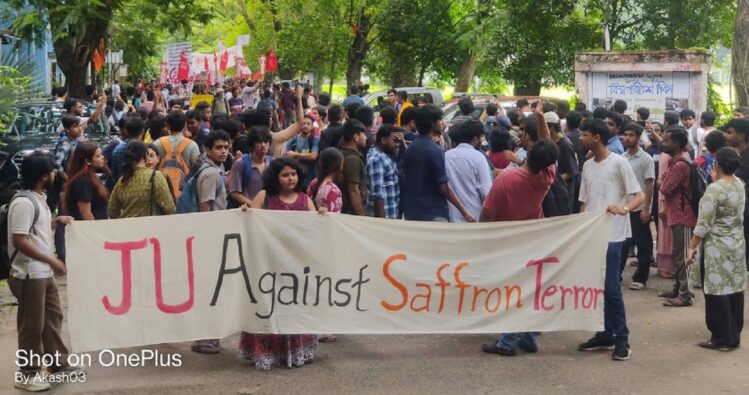
Violence, Inquiry and the Questions Now Facing Jadavpur University
On 24 August, Vice-Chancellor Chiranjib Bhattacharjee announced a five-member inquiry committee headed by former Calcutta High Court judge Pranab Chatterjee to investigate the 19-20 August vandalism.
The university also dissolved its students’ grievance cell, previously headed by former Vice-Chancellor Buddhadeb Sau. A Times of India report cited CCTV footage showing Sau entering campus as the mob rampaged early on 20 August, and speaking with Subhabrata Adhikary, a member of ABVP’s central working committee, while outsiders vandalised the campus. Sau is an office-bearer of the Akhil Bharatiya Rashtriya Shaikshik Mahasangh (ABRSM); both ABVP and ABRSM are affiliated with Rashtriya Swayamsevak Sangh (RSS), a Hindu far-right network.
Mistri said demands at the all-stakeholder meeting included an inquiry into the alleged role of Jadavpur BJP MLA Sarbari Mukherjee in leading the midnight “tandav”, deployment of more female security guards, and restoration of an on-campus medical facility now occupied by BJP-RSS as its office—a move he described as contrary to students’ interests and welfare.
Was the FETSU GB Meeting Illegal? The Legal and Political Dispute Behind the Clash
Talking to the media, Somsurya Banerjee, who describes himself on Facebook as a Founding Member of the Nationalist Students’ Front (NSF), questioned the validity of the FETSU-called GB meeting. In a Facebook post on August 20, he alleged FETSU tried to seize the General Secretary’s post through an ‘illegal’ GB meeting, and that ‘Naxalite/Naxal-oriented’ Democratic Students’ Front (DSF) cadres launched a ‘barbaric attack’ on ABVP members who protested this ‘undemocratic’ bid.
NSF, Banerjee wrote, “extends unconditional solidarity to ABVP in this fight for campus democracy and student rights”. ABVP is a student organisation affiliated with the RSS; NSF has no official RSS affiliation. ABVP alleged the “general body was called even though there are no official union representatives in the university”.
In his post, Banerjee cited RTI documents and the Calcutta High Court’s order in WPA (P) 241 of 2025, claiming they show unauthorised student unions or GB meetings lack legal recognition.
When eNewsroom contacted Banerjee for a response, he elaborated on his allegations: “While NSF condemns any violence inside campus, the available CCTV footage doesn’t show any public property being destroyed or any student being beaten up; we can only see flags being burnt and posters being torn. And while that is wrong, what is worse is the khap-panchayat style politics in the name of a GB meeting, which can’t be held without an election in the first place. For the past two years, we have been raising our voice against the dirty politics practised in the name of unions; imposing union politics on students, making them scared about losing scholarships and jobs if they don’t participate.”
He further elaborated that “what is more shocking and condemnable is that the Left unions, despite calling themselves Communists, used casteist slurs against ABVP members. Two ABVP members had to be hospitalised as a result of the violence inflicted on them, just because their political ideology is different.”
“If people are found guilty of engaging in violence and vandalism, they should be prosecuted. We would also recommend the deployment of police outposts outside the campus for greater security,” Banerjee added.
Dutta told eNewsroom that this is a ‘false narrative’, saying the 19 August, 5.30 PM GB meeting was called to address administrative issues around student-run bodies and campus resources.
According to Dutta, the GB meeting agenda covered bank account signatories, access to the mail, and FETSU Facebook page adminship. “The idea is that all students should know who has administrative access. Nobody should be able to secretly control the Facebook page. Students should know who is managing it, so that issues can be raised if necessary,” he explained. These included access to FETSU accounts for Srijan, the annual techno-management fest and Sanskriti, a cultural initiative associated with FETSU.
“Apart from that, throughout the year—not just during festivals—there are sponsorship activities and other campus-related events. For those purposes, someone needs authority over banners and related matters. Security and accountability require that there be a designated signatory. We demanded that this be formalised through the GB process,” Dutta said. The meeting also discussed access to organisational email accounts and procedures for transferring control between office-bearers.
“Every year, through the GB meeting, there is supposed to be a signatory. The signatory holds access to these accounts as a beneficiary during that period. Later, whenever a new signatory is chosen, the access is transferred to that person. This is part of the system,” he explained.
The accessible copy of WPA (P) 241 of 2025 is an order dated July 3, 2025 in Sayan Banerjee v State of West Bengal & Ors. It notes a government affidavit listing universities where student-union elections had not been held recently, and no student council was functioning, and directs that where there is no recognised body or council, student-union rooms should be locked and access controlled by written permission from the Registrar or another competent authority.
On the material available, the order concerns the absence of a recognised student body or council; control and access to student-union rooms; and preventing unauthorised use of those rooms. It does not automatically prove that every student-organised GB meeting is illegal; that FETSU has no authority to hold any internal meeting; that a meeting discussing accounts or digital resources is legally void; or that a person selected at such a meeting cannot perform any organisational function.
The distinction between unauthorised use of a union room, an unrecognised student body, an invalid university election, and an illegal meeting is legally important. Banerjee’s post, however, treats these separate questions as one claim, although the order does not expressly resolve all of them.
Dutta maintained the meeting was not an ‘election’ but a selection process via the GB mechanism to ensure continuity in managing these resources. “What we did was not an election; it was a selection. Through the GB, we wanted to select who would hold access to the GS account,” he explained.
The published JU election rules state a General Secretary is elected by students of the concerned faculty. JU’s last documented students’ union election was on 19 February 2020—six years and six months before the disputed meeting. In the 2020 election, Students Federation of India (SFI) retained the Arts Faculty, We The Independent (WTI) the Science Faculty, and Democratic Students Front (DSF) the Engineering Faculty; ABVP contested nine of 13 central-panel seats and failed to secure a single office-bearer position.
eNewsroom didn’t verify either Banerjee’s or Dutta’s claims independently.
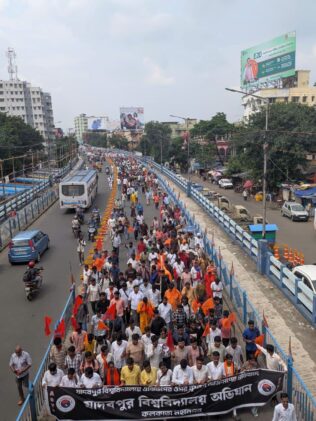
From ‘Dimagi Naxal’ to The Bengal Files: How Jadavpur Became an Ideological Battleground
A significant moment in the ABVP’s ideological terrain-marking drive arrived with a screening of The Bengal Files inside the Jadavpur campus on August 16, 2026, a day after Prime Minister Narendra Modi coined the term ‘Dimagi Naxal’. The third instalment in Vivek Agnihotri’s Files franchise, banned from screening by the former Trinamool Congress government, has been criticised as furthering Hindutva propaganda.
In Modi’s speech, ‘dimagi Naxal’ referred to people with a Naxal or Maoist mindset rather than armed cadres. Sanjib Acharya, Professor of Mechanical Engineering at Jadavpur, called it “yet another addition to the long-existing tradition of a stigma-inducing vocabulary, including phrases such as ‘urban Naxals’, used to paint students, academics, rationalists, free-thinkers as the other, cut off from the rest, and therefore dangerous. Such labels serve the agenda of the ruling regime to portray them as suspect and a threat to peaceful existence.”
Acharya reminded that Jadavpur has largely had a ‘Bam gharana’ of ‘Left-leaning culture’, and in the current climate, the August vandalism must be understood as an attempt to occupy the progressive space and redraw it through communalisation.
Manas Ghosh, Assistant Professor of Film Studies, said, “The irony is that the phrase is no longer a taboo, as it is intended to be.” Soon after Modi’s call, a digital page called Dimagi Naxal Party appeared on Instagram, following a genesis similar to that of Cockroach Janata Party (CJP), which emerged after derogatory remarks by CJI Justice Surya Kant and quickly evolved into an online and on-ground youth movement.
“Why should there be an issue if an engineering student, who has come to the university for four years, also learns to care about Nandigram, Singur, or hawker evictions or Palestine? Why should there be a problem if they cultivate and nurture a social consciousness? The problem is that the ruling regime would like it if students were mere careerists, and not thinkers, and never raised a slogan or walked in solidarity with oppressed people.”
Ahead of the 2026 West Bengal Assembly election, Modi singled out Jadavpur, decrying ‘anti-national’ messaging on campus walls. The professor argued for a ‘panorama’ of nationalism: “Indian nationalism first took its roots in the anti-colonial struggle, but it can never be reduced to any one school. The nationalism of Rabindranath Tagore is different from that of Mahatma Gandhi, and Gandhi’s from Ambedkar, and so on. Moreover, the Congress, the socialists, the communists—all contributed to the nationalist struggle in their own ways. But no history book has found any positive contribution of the RSS and Hindu Mahasabha in anti-colonial discourses.” “A distinction must be made between a nationalist and a State-ist.”
Ghosh pointed out, “The former is a shared sentiment of belonging, the latter demands absolute obedience to a legal-political mechanism.”
Beyond Campus Politics: Why the Jadavpur Clash Is Also a Battle Over Public Education
Ujan, a third-year Comparative Literature student, broke down the cost of a Humanities degree at Jadavpur: Rs 1,235 for the first year, Rs 950 for the second and third. Describing the ‘freeship’ for disadvantaged sections, she described the August violence a battle between ‘free thinking’ and the agenda of privatisation of the education sector. “The ruling regime is insisting on private schools so that only one section of society, those who can afford it, will get education,” Barsha Baral, joint secretary of AISA West Bengal, added. Baral has pursued her graduation and post-graduation degrees in Sociology from Jadavpur University, and is currently pursuing a PhD from Presidency University.
“One must look at the scams at the heart of the National Testing Agency (NTA) and the controversies surrounding the National Education Policy (NEP) and see how the ruling regime is in favour of a monolithic educational model and treats education as a commodity, rather than a right,” Ujan said. The NEP has also been criticised for eroding federal autonomy and embodying the “three Cs” of centralisation, commercialisation, and communalisation, with a “one-syllabus model” promoting sanitised, government-approved books.
Ujan described the attack on Jadavpur as an attack on this inclusive ‘Jadavpur model’, following a pattern of police brutality, digital surveillance, and State-led violence unleashed on scores of youth protestors in New Delhi and elsewhere. A NITI Aayog report notes an average of 25 schools closing daily in India over the past decade. As the second wave of the Cockroach Janata Party (CJP) movement addresses school reforms, Baral said the attack on Jadavpur is part of a long-term project to strip its autonomy and delegitimise its egalitarian voice.
BJP, ABVP and the ‘Final Battle’: Why Jadavpur Matters to Bengal’s Campus Politics
After the vandalism, West Bengal BJP president Samik Bhattacharya said ABVP is not the student wing of BJP and functions independently, though it is RSS-affiliated.
Yet Minister of Urban Development and Municipal Affairs Agnimitra Paul called it an “ideological battle against dimagi Naxals”.
Minister Dilip Ghosh described Jawaharlal Nehru University (JNU), Delhi University (DU), and Osmania as already transformed, and called Jadavpur the ‘final battle’ of this BJP-led campus transformation, asserting “change has happened” and “everything will happen” within six months. Baral countered that this ‘final frontier’ has traditionally been a bastion of “free, secular, and democratic thinking”, a citadel of inclusive public education.
“Under the current ‘double-engine’ government in West Bengal, the ABVP enjoys impunity, and with this impunity they want to impose their vision of a monolithic India; an India without diversity. They want to impose the idea of ‘One Nation, One Election’, and also ‘One Nation, One Party’, which is not only an attack on the multifaceted, multicultural, pluralistic identities of India but on democracy itself,” Mistri said.
From Jadavpur to Presidency and Midnapore: How Campus Clashes Are Spreading Across Bengal
The violence reverberated across West Bengal, with clashes between ABVP and AISA-SFI supporters at Presidency University and Midnapore College. Mistri described a disturbing pattern: under Bengal’s ‘dada culture’, senior ABVP ideologues threaten students to join rallies, warning of registration card cancellation. “And it’s not just a Kolkata phenomenon; it’s a Bengal-wide phenomenon,” he said, noting fear from Barasat to Midnapore.
Reacting to BJP leader Ghosh’s comment that “Jadavpur is an exceptional place, like an island”, Ujan said, “Jadavpur is not an isolated or disconnected island; here, students take up causes that affect them collectively, as they grapple with concerns of placement, job insecurity, and increasing dependence on gig work. Here, students also speak up for greater social good.”
For Ujan, the August vandalism also carried a Brahminical, Manuwadi undertone, viewing the “woman’s body as a battleground”.
Adding to the concerns over the gendered undertones of the confrontation, a source who requested anonymity shared with eNewsroom a WhatsApp status posted by an NSF member that read: “It’s time we start talking about women good for d**cks and women good for heart. If you confuse between both u r a dead man.”

