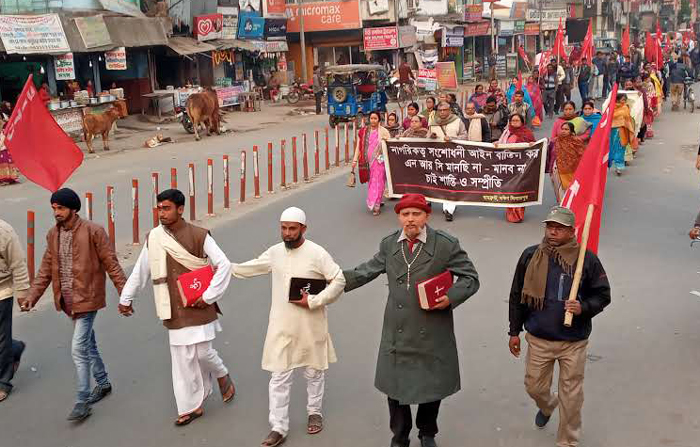
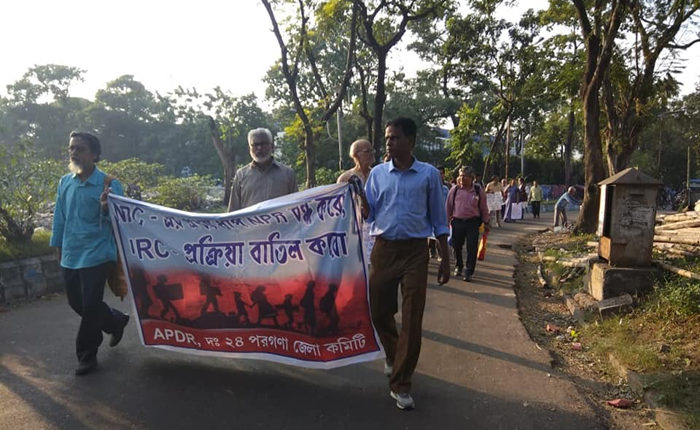
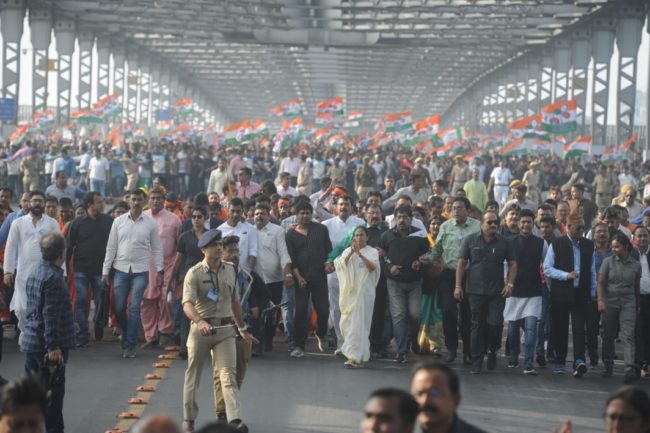
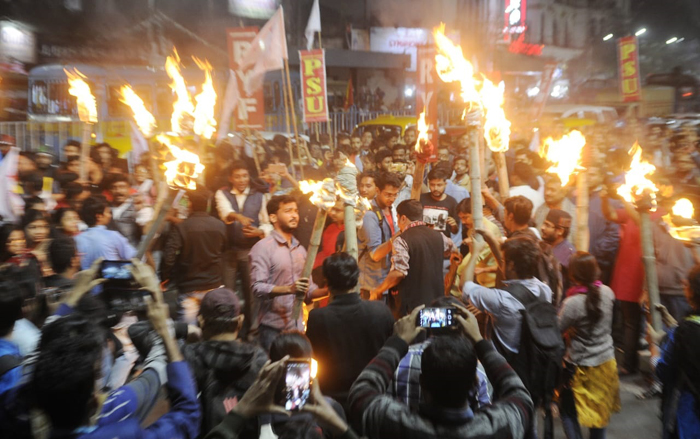
From labours constructing detention centers to Army man serving at border all face the wrath of NRC Assam process

0

Delhi: Forty-nine-year-old Pradip Kumar Saha, from Assam’s Ranopatti, cast his vote in the 1989 General Elections, but in 2002 he got listed as a D Voter. Despite having approached the Foreign Tribunal (FT) and providing all the necessary documents, his name has not made it to the National Register of Citizens (NRC) released recently in Assam.

“We are a family of 22 and only eight made it to the NRC list, while 14 members were excluded. My father has also not made it to the NRC whereas he had his passport issued in 1955. Government is saying CAB (Citizen Amendment Bill) will come to the rescue for people like us. But how can we trust politicians. They make tall promises and implement none,” rued Saha.

A sense of helpless grips 39-year-old Bassu Ali when he is asked, about his citizenship status and the possibility of him being sent to the detention centres being made in Assam. With a dejected look he states, “If I am denied of my citizenship, I will commit suicide but will never go to the detention centre.”

Daily wage labours building the detention centre. “My name hasn’t come in NRC despite having complete papers,” said Sipali Hajang who hails from Pusimatia in Assam. Sipali is a daily wage labourer at the detention centre. “I am afraid of coming here but have no option but to work for money. I don’t know they will keep me here or not,” she added

The misery began for Ali, the sole bread earner of his family when police arrested him in an alleged false case. “The police arrested me on January 26, 2014, from my residence. Following which I was sent to jail after having spent a single day in the police station. The police called me by another name – Bachchu Sheik. My lawyer also cheated me, by asking me to toe in with what the officials told me. During the interrogation when I told the officers that I was from Karbala, they told me that I was a Bangladeshi and not an Indian. I wasn’t sent off to the detention centre but put up at a small cell with 50 other individuals. I will die, I will commit suicide but will never go there,” says Ali

He claims that he has all the documents but none of the officials what to see it. “They say such documents are available at Pan shop. They say that I am a Bangladeshi. My lawyer also cheated me. When I was in jail my mother used to run the house begging.” Ali who is out on bail has 1951 legacy certificate and Voter ID but has not made it to NRC, Assam.

The tale of Ali is no different from that of Tinkonia Banaipara’s Vinita Banai. She said, “I have all the papers with me and yet my name is not there. My son’s name is there but mine is excluded. I am a daily wager and living in fear as to when I will be sent to jail. I have no money to fight my case.”

However, worse are the cases of daily wage labours building the detention centre. “My name hasn’t come in NRC despite having complete papers,” said Sipali Hajang who hails from Pusimatia in Assam. Sipali is a daily wage labourer at the detention centre. “I am afraid of coming here but have no option but to work for money. I don’t know they will keep me here or not,” she added.

Sanjay Hegde said, “Citizenship is a right to have rights, which itself has been put into questions through NRC. Descendants over generations are now asked to show papers to prove their citizenship. Absence of someone from the NRC list does not prove that someone is not an Indian citizen. To the minds of many people in Assam, all Bengali speaking Muslims are Bangladeshis which is baseless. Behind the 20 lakh people mentioned in NRC, are 20 lakh families and many more lakh people going destitute paying lawyers. This will lead to disenfranchisement and a humongous humanitarian crisis which will put the entire democracy in jeopardy.”

These are the few faces of the 19 lakh individuals in Assam who have not made it to the final NRC list and who share the same destiny – living the much-dreaded detention centres coming up in Assam.

A fact-finding team of United Against Hate (UAH), a people’s collective of individuals working to reduce the hatred mushrooming in India off late, visited Assam recently to explore the aftermath of the final list of NRC. After having spent a couple of days in Assam, they put together their findings in a report and a documentary, which they formally released during a press meet organised at Press Club, New Delhi on September 17.

The team which visited Assam included Nadeem Khan from UAH, senior journalist Prashant Tandon, journalist Sanjay Kumar and documentary filmmaker Afroz Ahmed Sahil. However, the press meet also included Ravi Nair, Supreme Court Advocates Sanjay Hegde and Fuzail Ayyubi as guest speakers.

Nair said, “People migrate for jobs all over India. These poor labourers often lack documents but now they are thinking of making this project All India. India will have to face severe criticism in the upcoming sessions of the UN Human Rights Council. Universal declaration of human rights is being violated dreadfully by this NRC project. Right to nationality is after all non-negotiable.”

Fuzail Ayyubi mentioned, “Foreign Tribunal takes away the basic identity of people. Facing FT itself is harassment. Moreover, the people sitting in the FT are not competent enough to take such major decisions about the lives of millions of people. NO Appellate authority is present within FT. There is no upper layer of appeal making this project more inhuman”.

Nadeem Khan also added that it is on record in Assam Assembly that the CM has met the FT members twice to give directions. This itself questions the unbiased judicial nature of the Foreign Tribunal.

Sanjay Hegde said, “Citizenship is a right to have rights, which itself has been put into questions through NRC. Descendants over generations are now asked to show papers to prove their citizenship. Absence of someone from the NRC list does not prove that someone is not an Indian citizen. To the minds of many people in Assam, all Bengali speaking Muslims are Bangladeshis which is baseless. Behind the 20 lakh people mentioned in NRC, are 20 lakh families and many more lakh people going destitute paying lawyers. This will lead to disenfranchisement and a humongous humanitarian crisis which will put the entire democracy in jeopardy.”

During the meet, a short documentary called “The state of Stateless in Assam” produced and directed by Afroz Ahmed Sahil, a member of the Fact-Finding Team was also screened.

Did Amit Shah mislead Lok Sabha on Farooq Abdullah’s detention?

0

Supreme Court was told on August 16 that National Conference leader and member of Lok Sabha Farooq Abdullah had been detained and was not allowed to move freely. It came during the hearing of a petition moved by MDMK chief Vaiko seeking a direction to the Union Government and Jammu and Kashmir administration to produce Farooq Abdullah before the Court. Farooq was said to have been detained, along with other political leaders, as the Modi government had moved to abrogate Article 370 of the Constitution granting special status to Jammu and Kashmir in early august. He did not attend even the monsoon session of Lok Sabha.

When some members had expressed concern at Farooq’s absence in the House, Union Home Minister Amit Shah had told Lok Sabha on August 6 that the veteran Jammu and Kashmir leader was perfectly fine and was staying away out at his own free will. He was neither under house arrest nor was he detained. “I am saying it for the fourth time, and I have the patience to say it for the tenth time; Farooq Abdullah has neither been detained nor arrested,” the Home Minister had asserted.

Amit Shah’s August 6 assertion on Farooq Abdullah in Lok Sabha amounts to a gross contempt of the House, mainly on two counts: for willfully and illegally preventing a member from attending the House in session and for deliberately and willfully misleading the House with a false statement

If what the Supreme Court was told on September 16 is true, Amit Shah’s August 6 assertion on Farooq Abdullah in Lok Sabha amounts to a gross contempt of the House, mainly on two counts: for willfully and illegally preventing a member from attending the House in session and for deliberately and willfully misleading the House with a false statement. A sad thing, however, is that the Opposition has not yet shown the signs of recovery from the jounce it had received with Narendra Modi’s coming to power in May 2014. There were several occasions when it failed to raise the issue either in the courts or in Parliament.

For instance, Narendra Modi was first sworn in as Prime Minister on May 26, 2014. The same day he got twice retired bureaucrat Nripendra Misra appointed as Principal Secretary to Prime Minister. Misra was not eligible for any appointment in the government on that day. But President Pranab Mukherjee obliged Narendra Modi and made the appointment in flagrant violation of the existing provisions of the law. Only the next day, the Modi government drafted an Ordinance. President Pranab Mukherjee again obliged Modi and promulgated the Ordinance removing illegality in the appointment of Nripendra Misra retrospectively.

It was not challenged in a court of law and the legality of the manner of appointment of Misra could not be tested. The Opposition was perhaps too stunned by Modi’s unexpectedly massive win. During the first session of Parliament, Modi went to Arunachal Pradesh and announced at a public rally a Rs 58,000 crore package for development of the North-East. Announcing a major decision outside when Parliament is in session clearly amounts to contempt of the House. In this manner went on the defiance of rules and procedures by Modi and the Opposition continued to be afflicted with inertia. There is little sign of it being recovered.

Jharkhand IAS officers tweet to make #JharkhandWithModi trend on Twitter

1

Ranchi: “Prabhat Tara Maidan is all set to welcome the honorable @PMOIndia sri @narendramodi for the launch of schemes that will redefine India 20 years from now”.

“After the creation of Jharkhand, for the first time, in Raghubar government only, schedule caste commission has been formed”.

“In the 108 Ambulance of Jharkhand, all the latest medical equipment are stalled including ventilator, basic life support system, so that patient’s life could be saved. So far, more than 2.6 lakh patients have got swift treatment”.

#JharkhandWithModi was also trending on Twitter for some time. Co-founder of Alt News, Mohammed Zubair tweeted on Thursday late night that at least 79 tweets were posted by Deputy Commissioners posted in Jharkhand. Some deputy commissioners like East Singhbhum DC (twitter handle @DCEastSinghbhum) posted 12 tweets. Besides them, the tweets with #JharkhandWithModi came from other deputy commissioners including DC Pakur, DC Chatra, DC Latehar and DC Koderma.

Above mentioned quotes are tweets, tweeted not from Bharatiya Janata Party (BJP) workers or leaders, MP or MLAs, but from the handles of Indian Administrative Service (IAS) officers posted in Jharkhand. The first one is from DC Ranchi. The second tweet is from DC East Singhbhum. The last one is from DC Giridih.

Tweets jharkhand ias PM narendra modi DC
IAS officers tweeting #JharkhandWithModi

Since Narendra Modi became the Prime Minister of India, in 2014, he has visited Jharkhand, many times and launched major schemes from the Tribal dominated state including Ayushman Bharat.

On September 12 too, PM Modi chose to launch farmer pension scheme—Kisan Maan Dhan Yojna from here. But, this visit of Narendra Modi was different, as apart from BJP leaders and Chief Minister of Jharkhand Raghubar Das, the Deputy Commissioners of different districts of Jharkhand were welcoming the Prime Minister, and highlighting Jharkhand government’s progress in different welfare schemes.

Tweets jharkhand ias PM narendra modi DC
Screenshot of former Chief Minister Hemant Soren’s tweet on IAS officers trending #JharkhandWithModi

#JharkhandWithModi was also trending on Twitter for some time. Co-founder of Alt News, Mohammed Zubair tweeted on Thursday late night that at least 79 tweets were posted by Deputy Commissioners posted in Jharkhand. Some deputy commissioners like East Singhbhum DC (twitter handle @DCEastSinghbhum) posted 12 tweets. Besides them, the tweets with #JharkhandWithModi came from other deputy commissioners including DC Pakur, DC Chatra, DC Latehar and DC Koderma.

The opposition party and its leaders, especially Jharkhand Mukhti Morcha (JMM) and former Chief Minister Hemant Soren has tagged IAS Association and sought their intervention and to question how officers are compromising with the constitution and betraying the country.

eNewsroom has tried contacting Deputy Commissioner, Giridih Rahul Sinha and sent a message too, but is yet to get a reply from him. Later his number was found switched off.

The officials not just tweeted to praise the PM but also forced private schools to lend their buses to ferry farmers. Such dictates were given in Bokaro too. Times of India did a story that in Ranchi, a large number of schools gave off and cancelled exam scheduled for September 12 as buses had been sent to ferry farmers and participants from various places to attend the PM’s rally.

Like Pehlu Khan, No One Lynched Tabrez Ansari

0

Ranchi: The entire episode of the mob lynching of Tabrez Ansari, a 24-year-old resident of Saraikela-Kharsawan is documented in the video which was shared by one of those present at the scene of crime. The brutality with which Ansari was mercilessly beaten for allegedly stealing a bike and later forced to chant Jai Sri Ram by Hindu extremist is still fresh in everyone’s mind. Even the Sub-divisional magistrate (SDM) report had claimed that both the police and the doctor were careless and had not treated the victim in the right manner.

This lynching case had deeply impacted the Indians, thereby leading to a widespread protest across the country. The matter was even raised at the United Nations’ Security Council (UNSC) and its Human Rights Commission (UNHRC), following which India was even asked to file a detailed report before UNSC.

However, like most of the lynching cases in India, where justice has been denied to the victim, here too, the Jharkhand police’s charge sheet now claims that Ansari had not succumbed to his injuries, but had died from a cardiac arrest.

The incident

On the night of June 17, Ansari and his two friends were returning home on a bike, when they were stopped at Dhadkidih, alleging that they had stolen a bike. Two of his accompanies escaped but Ansari got caught by the mob. He was tied to an electric pole and was not only beaten mercilessly but was even forced to chant Jai Shri Ram. Later, the police came and took Ansari to the police station. But family alleged that while Ansari had sustained severe injuries, police had only provided him with basic first aid and sent him to jail, without consulting any doctor.

“I have lost everything, my life has got ruined. Because of stress, I lost my child and now I live in tension. Please help me in getting justice,” said Shahista. This is how she starts her conversation with every new person and while talking to this reporter, she mentioned it thrice.

Shahista demanded, “I want CBI (Central Bureau of Investigation) inquiry into the murder of my husband. As police are not doing its duty. Police have changed everything in this case.”

The widow added, “I want the murders of my husband to be hanged. They should be punished severely.”

After two days, when again Ansari complained of severe pain including headache, he was sent to Sadar Hospital from Jail, but the doctor there did not treat him well and declared him dead while he was alive. When he was taken to another doctor, it was very late and Ansari succumbed to his injuries.

Ansari used to work in Pune and had returned two months before his death, for his marriage, which was solemnised on April 26, 2019.

Wife demands CBI inquiry

Shahista Perween, wife of Tabrez, who was trying to get on with her life, discovered that she was pregnant. But her stress and weak health caused miscarriage and she lost her first child. The dual loss had shattered the life of a newly married woman. Rubbing salt to her injuring is the news of the police removing murder charges from the charge sheet.

“I have lost everything, my life has got ruined. Because of stress, I lost my child and now I live in tension. Please help me in getting justice,” said Shahista. This is how she starts her conversation with every new person and while talking to this reporter, she mentioned it thrice.

While speaking to eNewsroom, Shahista demanded, “I want CBI (Central Bureau of Investigation) inquiry into the murder of my husband. As police are not doing its duty. Police have changed everything in this case.”

The widow added, “I want the murders of my husband to be hanged. They should be punished severely.”

Lawyer to challenge charge sheet

Her lawyer Altaf told eNewsroom, that court has not yet taken cognizance on the charge sheet filed by the police. “We have prayed to the court that as there are several witnesses (32) in the case which makes it a fit case of Section 302 of IPC, so police dropping 302 and making it a case of Section 304 of IPC should not be accepted by the court.”

He further said, “If the court accepts our petition then it’s fine, else we will move to High Court to challenge the charge sheet.”

The Investigation Office (IO) of the case, R Narayan said he dropped the murder charge as post-mortem report mentioned that Ansari died from cardiac arrest.

Significantly, Saraikela-Kharsawan has no fast track court and the case is yet to be taken up by the Chief Judicial Magistrate (CJM) court.

“As soon as court will take cognizance of the case, we will pray to hear it on day to day basis,” said the lawyer.

Lynchings in Jharkhand and Pehlu Khan

So far almost two dozen lives have been lost because of mob lynching incidents in Jharkhand sometime over cattle trading, sometimes over beef-eating allegations, sometimes over child-lifting charges. Most of the victims either remain, Muslim, Dalit or Tribals. And in most cases, police remains casual towards the heinous crime while filing the charge sheet.

Going beyond Jharkhand, Phelu Khan, a dairy farmer’s case, was lynched in broad day light in Alwar, Rajasthan. This lynching was also filmed, but the court had acquitted all the six accused, thereby making many say that no one killed Pehlu Khan. Some of the accused, were even mentioned in the dying declaration of Pehlu Khan.

With the wife of Tabrez wanting a CBI inquiry, will Jharkhand chief minister Raghubar Das pay heed to her agony and listen to the plight of the 20-year-old widow?

To NRC or Not: West Bengal Resolution against NRC builds up political steam in the state

0

Kolkata: On September 7 West Bengal became the first Indian state to officially protest against the National Register of Citizens (NRC) exercise in Assam, which has left out over 19 lakh individuals in its final list. After passing the resolution, which was supported by both the Left and Congress, the ruling party even ruled out the possibility of NRC implementation in Bengal.

NRC has become an important issue not just because of the state’s proximity to Assam and its porous Indo-Bangladesh border but also because of the repeated assertions made by both the central and state BJP leader for the implementation of NRC in Bengal to weed out illegal immigrants in the state.

Bengal united against NRC

Understanding the need to take stringent steps to create a people’s movement in Bengal and other parts of the country several civil societies, voluntary organisations and Forums have been holding discussions and meets. The path for the resolution to be passed was paved by Joint Forum Against NRC, when they submitted a memorandum before the speaker of the West Bengal Assembly, expressing their demand to pass a resolution against NRC implementation in Assam on August 29. Opposition leaders too around the same time frame had also expressed a similar need.

Bose added, “The Union Home Ministry has already notified in the Gazette on July 31, 2019, that the process of house-to-house enumeration across the country for the Population Register will be undertaken between April to September 2020, under the Citizenship (Registration of Citizens and Issue of National Identity Cards) Rules, 2003. This is the initial step towards the preparation of the “National Register for Indian Citizens”. The rationale behind this exercise and the modalities of establishing the citizenship of residents must be questioned, including the provisions of the Citizenship Amendment Act, 2003.”

One of the members of the Forum, Prasenjit Bose, reacted, “The passage of the Assembly Resolution is a positive first step. The Joint Forum calls upon all the political parties in West Bengal who have supported the Assembly Resolution to build united resistance against the NRC exercise.”

Bose added, “The Union Home Ministry has already notified in the Gazette on July 31, 2019, that the process of house-to-house enumeration across the country for the Population Register will be undertaken between April to September 2020, under the Citizenship (Registration of Citizens and Issue of National Identity Cards) Rules, 2003. This is the initial step towards the preparation of the “National Register for Indian Citizens”. The rationale behind this exercise and the modalities of establishing the citizenship of residents must be questioned, including the provisions of the Citizenship Amendment Act, 2003.”

Legal implications of the resolution

Picking on the legal significance of the resolution of Faizan Mustafa, renowned jurist on constitutional law and vice-chancellor of NALSAR Hyderabad, told eNewsroom, “Citizenship falls under the purview of the centre. The state government can do little if the centre passed an amendment or direction. This type of resolutions has little legal significance.”

On being asked what would they do if the centre directs every state to have it implemented by passing the Citizen’s Amendment Bill, the TMC MP replied, “We will oppose it. We are not puppet of the central government. This entire exercise of having citizenship is a political vendetta against a certain section of the Indian society. A notification has been sent to all states to set up detention centres. We are against it and will not have it implemented here at any cost.”

However, Colin Gonsalves, senior advocate at the Supreme Court felt that this resolution has immense significance. Speaking to eNewsroom, he said, “In Assam Bengali speaking were the most affected, so the Bengal government has made a political stand when it passed this resolution, that it doesn’t stand alongside the centre in this NRC exercise in Assam. We need to understand that this resolution was against NRC exercise in Assam and not Bengal.”

Adding to that Nesar Khan , former secretary of West Bengal Assembly explained, “The resolution is like a warning to the centre. It has no legal standing. If the centre implements NRC in Bengal then the state government wouldn’t help them and would rather create obstacles.”

But Sajda Ahmed, TMC MP told eNewsroom, “The resolution passed in the Assembly is an official statement from the WB government that we are not open to NRC being implemented in our state. Even the opposition parties barring BJP have supported this move.”

On being asked what would they do if the centre directs every state to have it implemented by passing the Citizen’s Amendment Bill, she replied, “We will oppose it. We are not puppet of the central government. This entire exercise of having citizenship is a political vendetta against a certain section of the Indian society. A notification has been sent to all states to set up detention centres. We are against it and will not have it implemented here at any cost.”

She added, “The saddest part is that the poor people are not even fully aware of what NRC or CAB is all about. We are trying to create awareness among the masses regarding the same.”

Tanmay Ghosh, secretary, Bangla Sanskriti Manch, a non-governmental organisation working for Human Right issues said, “NRC is draconian. We can see its ill effects in Assam. We can’t let the same happen in Bengal. We know the BJP narrative – of illegal immigration and are aware of how it will play on the same to create pressure and have it implemented here. But we need to understand that there is no official evidence of the presence of a large number of such ‘illegal migrants’. Steps like the NRC, which affects the entire population of a state, cannot be implemented based on hearsay.”

Road Ahead

Reacting to the resolution passed, Dr Mohit Roy, senior BJP leader and convenor of BJP’s Refugee cell, said, “The resolution means nothing to us. They have done it for political mileage. But let me be very clear, given the demography of Bengal, NRC is a must for this state and BJP has resolved to implement something along the line to weed out illegal immigrants from Bengal.” He paused and then added, “There is no other alternative in Bengal.”

Reacting to same, Tanmay Ghosh, secretary, Bangla Sanskriti Manch, a non-governmental organisation working for Human Right issues said, “NRC is draconian. We can see its ill effects in Assam. We can’t let the same happen in Bengal. We know the BJP narrative – of illegal immigration and are aware of how it will play on the same to create pressure and have it implemented here. But we need to understand that there is no official evidence of the presence of a large number of such ‘illegal migrants’. Steps like the NRC, which affects the entire population of a state, cannot be implemented based on hearsay.”

He added, “Understanding the BJP narrative and intention, several forums and social activists and organisations like ours should explain to the common man across state, what NRC means and the implication of its implementation in Bengal or the enactment of the Citizen’s Amendment Bill, which they are planning to reintroduce in the coming session in the Parliament.”

Five cases of mob lynching amid child-lifting rumours reported in a single day in Jharkhand, one dies

Ranchi: Jharkhand, which is infamous for mob lynching incidents over cattle transportation or beef-eating suspicion, is now witnessing lynching incidents over child-lifting rumours on daily basis.

And leave aside the common people, police not sporting uniform, are also being termed as child-lifters and are being attacked.

On Wednesday, at least five cases of mob lynching took place in Jharkhand. All the incidents were triggered by rumours of child-lifting. Such incidents have caused the death of one individual while many have sustained serious injuries.

On Tuesday night, villagers at Gandakey, Ramgarh beat one unidentified man mercilessly terming him as a child-lifter. He was later taken to RIMS, Ranchi for treatment, where he succumbed to his injuries on Wednesday.

According to Ramgarh police, they have arrested five people and registered FIR against 50 to 60 villagers.

Ramgarh, a neighbouring district of Jharkhand’s state capital Ranchi, is the place where Alimuddin Ansari, was lynched to death for allegedly transporting beef in 2017.

At Bokaro’s Jarangdih village, police too have been attacked on being mistaken as child-lifters. Police, on the instruction of Superintendent of Police, in casual dress, had gone to arrest two men accused of coal theft —Tinku Pandit and Sandeep Singh from Jarangdih. But, while arresting the two, the policemen were attacked for being alleged child-lifters by the supporters of the two accused. Police service revolver had also been stanched, leading to the escape of the coal thieves.

Eleven criminals were sentenced for life term by the Ramgarh session court for killing Alimuddin, but later they got bail from High Court, and the ruling Bharatiya Janata Party (BJP) leader Jayant Sinha had not just welcomed the criminals but had also garlanded them. The garlanding of murders by Sinha was termed as an encouragement to such criminals by social activists, and it seems like that it has served the purpose, as the residents of Ramgarh are not restraining from taking law into their hands.

As in Ramgarh itself, on Wednesday, in Chikor village which falls under Bhurkunda block, one Dhaneshwar Ganjhu (32) was beaten for allegedly being a child-lifter. Ganjhu was drunk and knocked a door and immediately collapsed in front of the door. Later, villagers gathered and started beating him, alleging that he is a child-lifter. He was tied to an electric pole and thrashed by villagers. He is under treatment right now.

Again at Tala village, Chanho, Ranchi three people handed over to police, who have been caught on suspicion of being child-lifters on Wednesday. Thanks to few alert villagers, who interfered and did not let mob beat much the victims.

Meanwhile, at Bokaro’s Jarangdih village, police too have been attacked on being mistaken as child-lifters. Police, on the instruction of Superintendent of Police, in casual dress, had gone to arrest two men accused of coal theft —Tinku Pandit and Sandeep Singh from Jarangdih. But, while arresting the two, the policemen were attacked for being alleged child-lifters by the supporters of the two accused. Police service revolver had also been stanched, leading to the escape of the coal thieves.

Similarly, on Tuesday, under Jainagar police station, at least six people had lynched villagers. The allegations were the same. Three tribal youth while going to visit the sister of one f the boys, stopped at Pratapur to ask the route. Mistaken as child-lifters the trio was being beaten, when three passerbys stopped and asked the mob, as to why they were beating them, they were also attacked and branded as the partners of the tribal boys.

And when the police was taking the injured youth for treatment, the mob pulled down tribals from the ambulance and attacked them again.

Koderma Superintendent of Police M Tamil Banan said that two cases have been registered in case where six people had been lynched – one for the attack and a separate FIR for obstructing government sanctioned work.

A week back, in Giridih, a woman who was consoling a child, on her mother’s request at a bank, was beaten after being mistaken as a child-lifter.

In past 7 days, news reports suggest that more than 44 people become victims of such rumours.

Jharkhand DGP, K N Chaubey claims to have alerted on-field officers to take swift action.

“I have told police officers to arrest as many accused as possible in such cases,” told the DGP.

The DGP also claimed that police is holding meetings with people and cautioning them against mob violence, but it needs the society’s contribution to control it.

76 percent applicants in Jharkhand did not get any installment of PMMVY since inception

0

Ranchi: Jaya, a resident of Raidih, Gumla had applied in 2017 for Pradhan Mantri Matru Vandan Yojna (PMMVY). She had provided all the documents to the respective Anganwadi centre, but she did not receive a single installment.

Rani and Sweta of Shikaripara, Dumka faced a similar fate. They complaints registered at the Anganwadi also went in vain.

And same happened with Ganga of Peterwar, Bokaro, who had applied for PMMVY two years back but did not receive any installment.

The four women are among the 202 women from 42 gram panchayats, who had interacted with a team of social activists headed by renowned Development Economist Jean Dreze. The meeting took place in six blocks of Jharkhand’s five districts to know how well the PMMVY had been implemented in Jharkhand.

Under PMMVY, Rs 5000 is given to a pregnant woman, if she gets registered to an angawadi centre and delivers a child in any government hospital. The First installment is of Rs 1000 while second and third are of Rs 2000 each.

Jean Dreze told eNewsroom, “Pregnancy is a time of hardship and uncertainty for rural women, when their special needs for food, rest and health care get little attention. Maternity benefit is a legal right under the National Food Security Act. It can be of great help to them and their children. Alas, the PMMVY’s restricted coverage, reduced entitlements and bloated formalities have undermined this essential right.”

But a survey done by non-government organization (NGO) volunteers found that 76 per cent women, who had applied for PMMVY benefits, since it got implemented, did not receive any installment.

Only 24 per cent of the total women applicants of PMMVY received any installment. And only 8 per cent received all the three installments.

The survey’s report was presented today at Ranchi during a press conference.

The study also found that the National Food Security Act 2013 (NFSA) directs the central government to provide all pregnant women a maternity benefit of Rs 6000, unless they qualify for maternity benefits as formal-sector employees. After negating this responsibility for four years, the central government launched the PMMVY in 2017. The PMMVY provides for maternity benefits of Rs.5000 in three installments, but only for the first child.

And women have to fulfill conditions such as early registration of pregnancy, an ante-natal check-up, and immunisation of the child. They also have to fill a long application form at the local Anganwadi for each installment.

The entire PMMVY system runs on the shoulders of Anganwadi workers, but in Jharkhand, the workers have not been paid for many months, thereby directly affecting the scheme.

The team also submitted a letter to Amitabh Kaushal, Principal Secretary, Social Welfare, Women and Child Development and demanded that the PMMVY scheme to be universalized as it will only cost Rs 400 crore for the Jharkhand government, 0.5 percent of the state’s budget. It also demanded for transparent in its process for both information and payments. Also the need for the payment to be timely was also expressed. And also the scheme should also be well-publicized or advertised to let know the people about the scheme as most of the rural women are not even aware about it.

After the PC was over, economist Jean Dreze told eNewsroom, “Pregnancy is a time of hardship and uncertainty for rural women, when their special needs for food, rest and health care get little attention. Maternity benefit is a legal right under the National Food Security Act. It can be of great help to them and their children. Alas, the PMMVY’s restricted coverage, reduced entitlements and bloated formalities have undermined this essential right.”

Note: Names of the women have been changed.

Six mob lynched in Jharkhand allegedly for being child-lifters

Ranchi:  In yet another mob lynching case in Jharkhand, six people (three from Jharkhand and three from Uttar Pradesh) have been mercilessly beaten on suspicion of being child-lifters in Koderma district, on Tuesday.

Three tribal youth—Naresh Soren, Anil Soren and Mahadev Soren were riding a bike, to reach their sister’s house. However, when they stopped at Pratappur to ask about the correct route to Ghodthambha, the trio was attacked on suspicion of being child lifters. And when these three youths were being assaulted, three other small traders from Uttar Pradesh travelling through the area came to their rescue; they were also beaten mercilessly for allegedly being the partners of the tribals.

“We were crossing by, when we saw, a mob beating some men. We get down from our car and just asked – ‘What happened bhai? Why are you all beating them?’ On hearing us, they turned towards us saying, that we are also child-lifters and partners,” narrated Mohammad Aslam, one of the three small traders to eNewsroom.

When police reached the incident site and were taking the youth from the ambulance, the mob pulled down the tribals and beat them in the presence of two policemen. Later, when more police came, they lathicharged on the mob and disbursed them

Thirty six-year-old Aslam is married and has four children, while his two partners—Mohammed Bilal and Karamat Ali both are of same age group, 22-years of age and are married. Aslam and others used to do the same work in Bihar too and recently started it in Jharkhand.

Aslam was hit on eyes and body, while others were hit on their body parts.

“They broke our car, took away all the items from it. We had around Rs 12000 in a bag and 2000 in my wallet, they took it all,” he said.

A horrified Aslam, who, along with five other victims are in Jai Nagar police station added, “We come here as we can sell our items with the sole intention of making slightly better profit and nothing else. Now, I do not want to lodge any case, I just want to go from here.”

mob lynching child-lifters Koderma Jharkhand
The ambulance that brought to tribal victims to Sadar Hospital

Meanwhile, the witnesses on the spot said that when police reached the incident site and were taking the youth from the ambulance, the mob pulled down the tribals and beat them in the presence of two policemen. Later, when more police came, they lathicharged on the mob and disbursed them.

However, even after 24 hours of the incident, there has been no arresting so far in the case. In fact, police has yet to register an FIR in the incident.

Koderma Superintendent of Police Dr M Tamil Banan did not respond to repeated calls made by eNewsroom. But Jai Nagar Officer-in-charge Ravi Kishore Prasad told eNewsroom. “We were first providing treatment to the victims. Now all are doing well. We have informed their parents and waiting for them to come and pick them.”

“Today, we will register FIR and then act on it, added Prashad.

Jharkhand is infamous for having highest number of mob lynching cases in India. According to data available the lynching cases take place, sometimes for cattle transportation, sometimes for alleged beef eating, in the name of witch-craft practice, besides child-lifting allegations. More than 20 cases have been reported in last three years.

Bring Resolution in West Bengal Assembly to stall NRC process in Bengal demands Anti-NRC forum

0

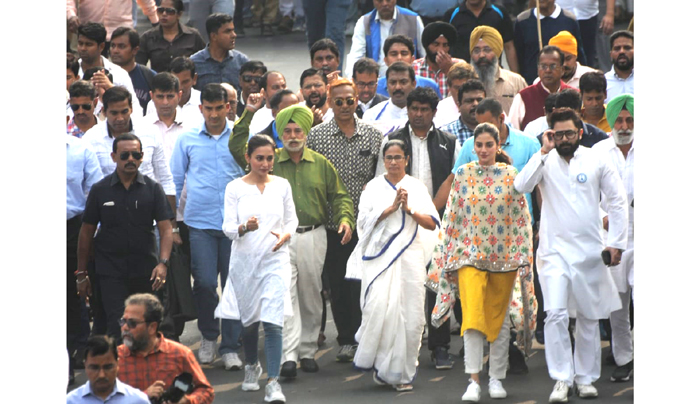
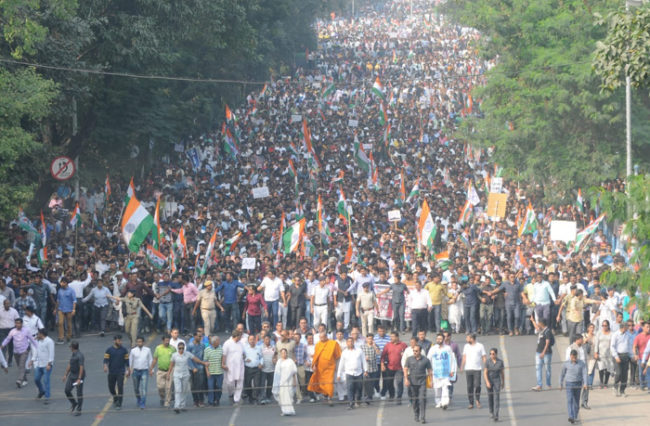
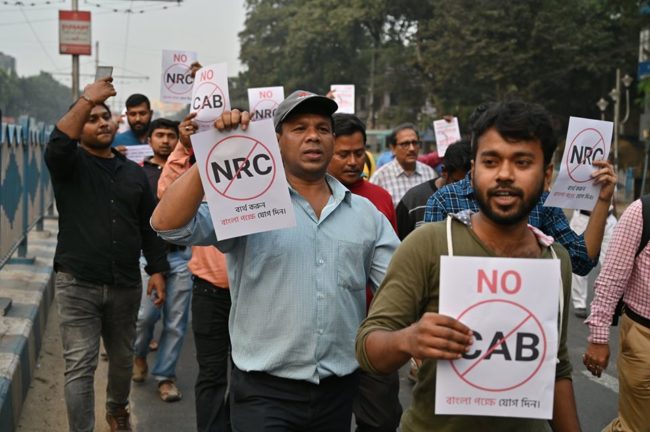
Kolkata: After the final list of National Register for Citizen (NRC) in Assam was released on Saturday the first protest against it took place in Kolkata in front of Assam House where members of Joint Forum Against NRC (JFANRC) demonstrated and demanded that no NRC process be initiated in Bengal and the rest of India.

The protest meeting organised by JFANRC witnessed large numbers of representatives from different social platforms presenting their views and reasons against NRC. Speaking to eNewsroom, Prasenjit Bose, Kolkata-based economist and social activist said, “We are appealing to all political parties in Bengal to initiate talks of having a resolution to stall NRC implantation in Bengal as we have seen the inhuman side of this process in Assam. Around 19 lakh individuals who have not made it to the NRC list are on the verge of becoming stateless. It is violation of Human Rights.”

Bose further added, “We do not want NRC for West Bengal. Bengal witnessed an influx of refugees since the First World War. It has a history of having large number of refugees so how will these people prove their citizenship? We have gathered here also to place a demand before the CM of Assam to grant citizenship to these 19 lakh individuals who have been excluded from the final NRC list on humanitarian grounds, if nothing else. The way people are being excluded from the list is itself questionable.”

[embedyt] https://www.youtube.com/watch?v=sojrB87x1mA[/embedyt]


Imtiaz Ahmed Mollah, another speaker said, ” Deportation of even a tiny fraction of the NRC-excluded persons is an impossibility. The only just and humane solution to the problem is to initiate the process of granting Indian citizenship to those who have been excluded irrespective of their religion, language, caste or ethnic background. Any discriminatory treatment vis-a-vis the NRC-excluded individuals on the grounds of religion, place of birth etc. would be a violation of Constitutional provisions and the Universal Declaration of Human Rights to which India is a signatory.”

Raising their voice and concern over the NRC exclusions and their fate in detention centres, Gitali Thakur, an Assamese lady based in Kolkata, expressed concern and said, “Life in detention centres is worse than what we can even imagine. They are devoid of basic amenities. The basic idea for NRC was to eliminate the non-Indians from Assam, but the way it has been implemented has exposed a sinister agenda of basically targeting the minorities, something which we don’t endorse.”

NRC Assam West Bengal Kolkata Citizenship Detention Center Assam House
Two demonstrators with their placards before Assam House, Kolkata

Students present outside Assam House also expressed their concern. Jaysree, a young college student who preferred being addressed by her first name, said, “Whatever that is happening in Assam will happen at a much larger scale here, if NRC gets implemented in Bengal, given the size of our state. The sifting of individuals based on the documents of their forefathers is cruel, as back in the Fifties not many were educated.”

She added, “The way even documentary evidences have not been taken into account as in cases of certain renowned individuals, like the family members of the former President of India, scares me a lot. We have the documents of my grandmother, who had shifted to Bengal way ahead of 1971, but am sceptical about how the officials would respond to the documentary evidences that we have.”

Adding to that her contemporary Debarghya said, “The foundation of India’s independence and democracy is being violated by NRC, which I believe is highly anti-national.”

More the things change, more they stay the same

0

[dropcap]T[/dropcap]he more the things change, the more they stay the same. Even may get worse.

It was in the early 1980s. I was posted in Indore. I wanted to see a judgement delivered by the court in Neemuch a few days earlier. I reached there by taking an overnight bus and was in the court before 10. A woman in her late 20s was in charge of the record room. I identified myself and told her the purpose of my visit to Neemuch. She asked me to come three days later. Staying there three days was not possible for me. I pleaded and pleaded and pleaded with her but to no effect. Feeling dejected, I stood by a pillar in the veranda when a lawyer came to me and asked about my business in the court. I explained to him everything. He asked me to give the lady ten rupees and she would show me the file. I was horrified. I did not have the courage to offer ten rupees to a woman. So I requested his help and gave him a 20-rupee note. From his purse he took out two ten-rupee notes; one he gave me, took me to the woman and gave her the other tenner. Promptly, the lady told me sweetly: Vo saamne ki almari mein upar ke khane mein us case ki file hai, aap nikaal lijiye (There in the upper shelf of the Almira is the file of the case. Please take it).

Now the case which took me to Neemuch. There was a Muslim family in Ajmer. The man was head master of a high school. His two young sons were studying in the same school. Wife’s brother was settled in Pakistan (perhaps Karachi). The boys went to Pakistan to spend some time in Mama (Maternal Uncle)’s house. While they were there, relations between the two countries deteriorated following Bangladesh war. Pakistan declared India an enemy country. In panic, Mama destroyed the Indian passports of the boys and managed Pakistani passports for them.

Normal relations were restored between the two countries during the Janata Party government of Morarji Desai. The two brothers came to India on Pakistani passports and applied for Indian passports explaining the circumstances in which they had to acquire the Pakistani passports. Their case was pleaded by Barrister Umashankar Trivedi, who was an eminent Supreme Court lawyer and had specialised in such cases. The Ministry of External Affairs, however, denied them the Indian passports. The Ministry’s decision was challenged in the court. I don’t remember now how the case was shifted to Neemuch. The Neemuch court, however, upheld the government decision.

On reaching Neemuch, I first met Barrister Trivedi, who lived in Neemuch. He was absolutely confident about the boys getting the Indian passports as they were born and brought up in India. After seeing the judgement and taking necessary notes, I went to the police station where the boys were supposed to be kept in havalat. But the Thanedar said: Hum ne ye roj roj ka jhanjhat nibta diya.

On Barrister Umashankar Trivedi’s instructions, an Indore lawyer (known to me) challenged the Neemuch court judgement in the Madhya Pradesh High Court (Indore Bench). That’s how I came to know of the case.

On reaching Neemuch, I first met Barrister Trivedi, who lived in Neemuch. He was absolutely confident about the boys getting the Indian passports as they were born and brought up in India. After seeing the judgement and taking necessary notes, I went to the police station where the boys were supposed to be kept in havalat. But the Thanedar (police officer) said: Hum ne ye roj roj ka jhanjhat nibta diya. Hum unhe jeep mein baithake Barmer le gaye aur seema se us paar Pakistan mein push kar diya. Ab Pakistan jaane aur vo jaanen (We have removed this everyday problem. We took them in a jeep to the India-Pakistan border in Barmer district and pushed them on the Pakistan side. Now it is between Pakistan and them).

When I reported this to Barrister Trivedi, he was simply devastated. For quite some time he was not able to speak.


Opinions expressed in this column are those of the author and not of eNewsroom. This is an open forum and we try
to give space to every school of thought.