



Kolkata: After the final list of National Register for Citizen (NRC) in Assam was released on Saturday the first protest against it took place in Kolkata in front of Assam House where members of Joint Forum Against NRC (JFANRC) demonstrated and demanded that no NRC process be initiated in Bengal and the rest of India.
The protest meeting organised by JFANRC witnessed large numbers of representatives from different social platforms presenting their views and reasons against NRC. Speaking to eNewsroom, Prasenjit Bose, Kolkata-based economist and social activist said, “We are appealing to all political parties in Bengal to initiate talks of having a resolution to stall NRC implantation in Bengal as we have seen the inhuman side of this process in Assam. Around 19 lakh individuals who have not made it to the NRC list are on the verge of becoming stateless. It is violation of Human Rights.”
Bose further added, “We do not want NRC for West Bengal. Bengal witnessed an influx of refugees since the First World War. It has a history of having large number of refugees so how will these people prove their citizenship? We have gathered here also to place a demand before the CM of Assam to grant citizenship to these 19 lakh individuals who have been excluded from the final NRC list on humanitarian grounds, if nothing else. The way people are being excluded from the list is itself questionable.”
[embedyt] https://www.youtube.com/watch?v=sojrB87x1mA[/embedyt]
Imtiaz Ahmed Mollah, another speaker said, ” Deportation of even a tiny fraction of the NRC-excluded persons is an impossibility. The only just and humane solution to the problem is to initiate the process of granting Indian citizenship to those who have been excluded irrespective of their religion, language, caste or ethnic background. Any discriminatory treatment vis-a-vis the NRC-excluded individuals on the grounds of religion, place of birth etc. would be a violation of Constitutional provisions and the Universal Declaration of Human Rights to which India is a signatory.”
Raising their voice and concern over the NRC exclusions and their fate in detention centres, Gitali Thakur, an Assamese lady based in Kolkata, expressed concern and said, “Life in detention centres is worse than what we can even imagine. They are devoid of basic amenities. The basic idea for NRC was to eliminate the non-Indians from Assam, but the way it has been implemented has exposed a sinister agenda of basically targeting the minorities, something which we don’t endorse.”
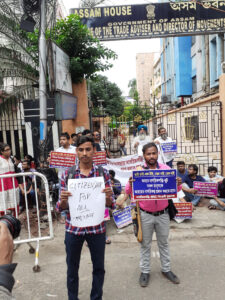
Students present outside Assam House also expressed their concern. Jaysree, a young college student who preferred being addressed by her first name, said, “Whatever that is happening in Assam will happen at a much larger scale here, if NRC gets implemented in Bengal, given the size of our state. The sifting of individuals based on the documents of their forefathers is cruel, as back in the Fifties not many were educated.”
She added, “The way even documentary evidences have not been taken into account as in cases of certain renowned individuals, like the family members of the former President of India, scares me a lot. We have the documents of my grandmother, who had shifted to Bengal way ahead of 1971, but am sceptical about how the officials would respond to the documentary evidences that we have.”
Adding to that her contemporary Debarghya said, “The foundation of India’s independence and democracy is being violated by NRC, which I believe is highly anti-national.”

