



Ranchi: Reminiscences of the 39 Indian abducted and killed in Iraq and the Narendra Modi government not sharing the news of them being killed is still fresh in the memory of the common man. And perhaps that is making it difficult for the families of the seven Indians who were recently abducted in Afghanistan. These Indians are employees of KEC International and were working in Afghanistan when unknown gunmen abducted them about a fortnight ago. Among the seven, four are from Jharkhand. The Afghanistan media suspects the role of Taliban in the abduction.
Ironically, even after a fortnight, neither the company has contacted the families (except one) of those abducted, nor has the Ministry of External Affairs spoken out a word about the victims.
The four men from Jharkhand — Prasadi Mahto, Hulas Mahto and Prakash Mahto from (Bagoder) Giridih and Kali Mahto from (Vishnugarh) Hazaribagh district, along with a few more had gone to work with KEC International four years ago. During this span of time, the company had given them the permission to visit their family only once. These men, also happen to be the sole bread earners of the family.
The KEC officials have contacted and informed the family of Prasadi Mahto, about the abduction, because of which later, Sikander Ali, an admin of Pravasi, a WhatsApp Group, came to know about three more people of Jharkhand having been abducted.
It was because of Sikander Ali’s investigation, that the local media could report about the families of the victims. Following which Giridih’s Deputy Commissioner Manoj Kumar visited the families. However, no official announcements has been made by MEA.
Not happy with the silence, the family members of the three victims, staged a sit-in before the Raj Bhavan on Monday. The protest was organized by CPI-ML.
“We are demanding that the government should take swift action in this case. I had also met Jharkhand’s Chief Minister Raghubar Das and had requested him to talk to Ministry of External Affairs to send a delegate comprising central and Jharkhand officials to Kabul, so that the matter can be investigated in the right way. But the government is yet to take any action in this regard,” Vinod Singh, former MLA of Bagoder, told eNewsroom.
He then added, “Now, the families are feeling that their wards have been left on their own.”
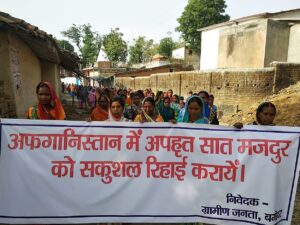
Before the dharna at state capital, on May 19, villagers of Bagoder, mostly women took out a rally, demanding the immediate release of Indians abducted in Afghanistan. Earlier, Bagoder’s MLA Nagendra Mahto had also met Raghubar Das, but no concrete step has been taken either by the state government or by the central government so far.
In the interim, the condition of the family members is going from bad to worse with every passing day. Pemia Devi, wife of Kali Mahto, has fallen ill and her condition is deteriorating fast. With no money for treatment, the Pravasi group is now crowd funding for her treatment. Kali has five daughters and a son and had visited his family only once in these four years.
Take the case of Hulas Mahto, he had just married off his sister and opted for this well-paying job in Afghanistan, in hope of clearing off the loan. He too has three kids, while Prasadi had four children and Prakash Mahto, has two.
“Since when we have heard the news about him (Kali Mahto) being abduction, we have left eating. He has small children, what they will do? He has only one son, and who is even mentally stable. I request government to send him (Kali) back earliest,” requested Pemia Devi.
Among the other three Indians who have been abducted, Mantu Singh is from Bihar, while Rajan Kaushik and Murlidharn are from Kerala. However, like the four men from Jharkhand, the name of these three people has also not been officially confirmed by the government.
In March, Minister of External Affairs Sushma Swaraj broke the news before the Parliament that all the 39 Indians, who were abducted by ISIS three years ago, got killed by the terrorists.
The Indian construction workers, who were from Punjab, Bihar, Himachal Pradesh and Bengal, had been taken hostage when the ISIS invaded Mosul, Iraq’s second largest city, in 2014. The workers were trying to leave Mosul when they were caught.
The revelation was a shocking one as only a year back, Swaraj had indicated the possibility of them being alive, and opposition leaders had made it a point to remind the Minister of External Affairs the same.

