



Kolkata: Ujjwal Das was neither a disgraced policeman trying to prove himself as in the film Traffic nor Superman. But he definitely became a superhero for the family of 39-year-old Dilchand Singh on Monday. The man of the moment, traversed 20 kilometres in 18 minutes to ferry the live heart from Kolkata Airport to Fortis Hospital, Anandapur, through a green corridor created from the airport to the hospital.
Singh, a resident of Deogarh, Jharkhand, was suffering from dilated cardiomyopathy, a condition where the heart loses its elasticity to pump blood due to enlargement of the left ventricle and was in need of urgent heart transplant. He had been on the wait list since 2017.
His wait came to an end with a heart being harvested from a 21-year-old donor who was declared brain dead after meeting a tragic road accident in Bengaluru. A concerted effort by several agencies, both government and private led to the creation of a green corridor, which made it possible for the live heart to be harvested at SPARSH Superspecialty hospital, Yeshwantpur to the Fortis hospital in flat four hours.
Eastern India’s first heart transplant was also marked by the first green-channel transportation of a vital organ to Kolkata from another city.
The journey spanning 2,000 km could be completed in four hours, flat because of the green corridors created both in Bangalore and Kolkata, involving the traffic police. This made it conducive for the ambulance drivers to drive fast in order to facilitate a fast organ transit.
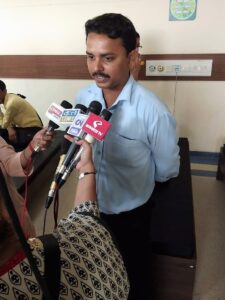
The ambulance ferrying the heart took only 26 minutes to cover the 32km from the Yeshwantpur hospital to the airport. While, in Kolkata, the 20km journey from the airport to the hospital was made in 18 minutes by the other ambulance driver Ujjwal Das.
With the donor heart reaching the hospital, a three-hour-long surgery was performed under the supervision of Dr K R Balakrishnan, Director, Cardiac Sciences and Dr Suresh Rao, Chief Cardiac Anesthetist, of Fortis Malar Hospital. They had been flown in from Chennai for the first human heart transplant in eastern India. A team of 15 doctors successfully conducted the transplant surgery. Dr Tapas Raychaudhury, Director, Cardio-Thoracic & Vascular Surgery and Dr K M Mandana, Director, Cardio-Thoracic & Vascular Surgery along with Dr Saikat Bandopadhyay, Senior Consultant, Cardiac Anesthesiologist & Intensivist from Fortis Hospital, Anandpur performed it.
Minutes after the surgery, Dr Balakrishnan said, “We had never experimented with something like this. Most of the time, the family of bread dead patients refuse to donate organs. We are hoping that this surgery paves the path for many more such operations.”
While Dr Tapas Raychaudhury added, “We are extremely happy to have successfully performed the first heart transplant in eastern India. We are confident of the fact that this surgery marks the beginning of a robust Heart Transplant Programme in Kolkata. We have benefited from the expertise in heart transplant acquired by Fortis group over the past decade.”
Singh’s brother, Umesh, who accompanied him to Kolkata from Jharkhand, mentioned, “We left our city within two hours of having received a call from the hospital that a donor’s heart had been arranged. It’s a major surgery. We are hopeful for the best to happen.”
Going by the success rate of such transplants, in general, it has been observed that in 95 percent cases the recipient survive for over 30 days, while in 85 percent cases, they survive for five years and in 70 percent case, they live beyond a decade.
However, keeping the statistics into account, Dr K M Mandana noted, “The patient is under constant observation for next 24 to 48 hours. His condition is stable.”

