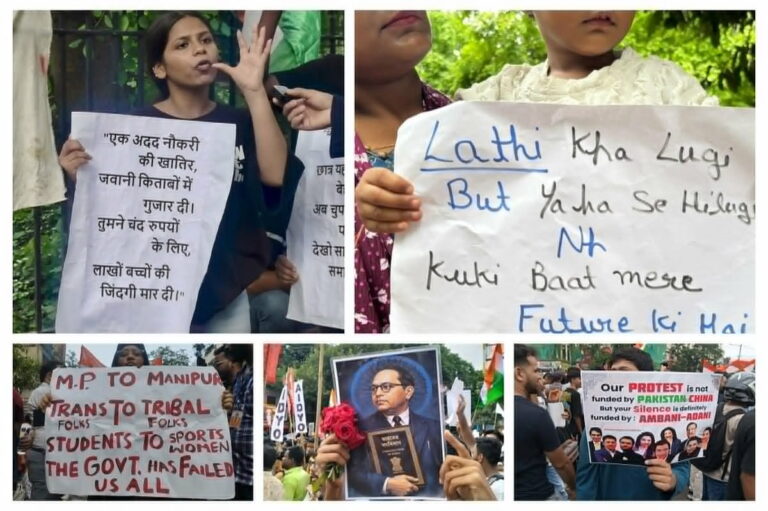
Delhi/Kolkata: They arrived on overnight trains from the heartland of Bihar, carrying nothing more than rolled-up sleeping mats, heavy backpacks, and cardboard placards written by hand.
They are engineering graduates who spent their youth studying for exams that were leaked before the papers even hit the desk. Beside them stand factory workers from Maharashtra, job-seekers from Assam, and parents who have watched years of their children’s lives vanish into thin air.
What started as a frantic protest against examination scams has exploded into one of the largest, most formidable civil society uprisings India has seen in years: The Cockroach Janata Party (CJP) Movement.
A Spark at Jantar Mantar, An Echo Across the Globe
The epicenter remains a cramped stretch of asphalt at Delhi’s Jantar Mantar, but the shockwaves are spilling across borders.
“This is no longer just about a leaked test paper. This is about a stolen future.”
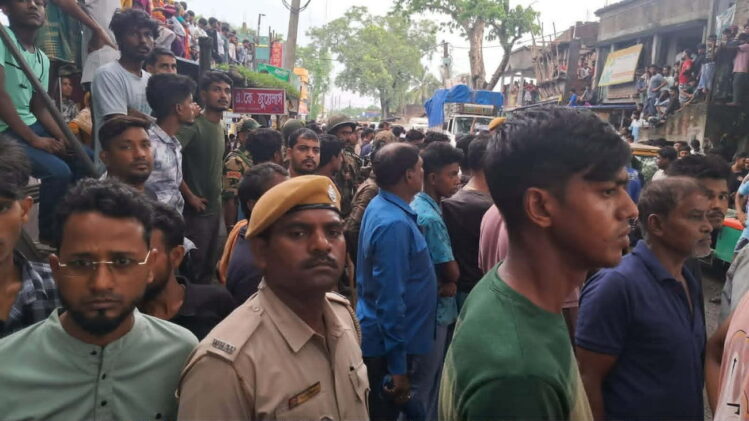
Across India: Mass solidarity rallies erupted in Kolkata—choking traffic at Sealdah and Dharamtalla—following coordinated protests in major metro hubs.
Across the World: From London and Dublin to New York and San Jose, the Indian diaspora took to the streets to demand systemic answers.
Even after activist Sonam Wangchuk concluded his high-profile 26-day hunger strike, the fire hasn’t dimmed. CJP founder Abhijeet Dipke made it clear: the fast ended to protect a life, not to surrender the fight.
Alongside emerging student leader Neha Bora—now one of the movement’s most compelling public voices—organizers are projecting a stark message: This is not a partisan feud. It is a citizens’ revolt.
Baton Charges, Tear Gas, and Tents Built in the Rain
The flashpoint arrived on July 20, when thousands attempted a “Sansad Chalo” march toward Parliament.
Police met the peaceful procession with iron barricades, tear gas canisters, and violent lathi charges. Within minutes, images of bleeding students flooded social media, triggering an unprecedented wave of public fury.
Congress leader Rahul Gandhi stepped directly into the storm, hosting a fiery press conference alongside a demonstrator injured by police pellet fire, accusing the administration of using brutal state force against peaceful youth.
When authorities tore down the protest site, the students didn’t scatter. They built it back—with bare hands, under pouring monsoon rain, turning a wrecked campsite into an indestructible symbol of youth resilience.
Fast-Track Laws vs. Real Accountability
In response to the mounting pressure, Prime Minister Narendra Modi announced a slate of reforms: fast-track courts, stringent anti-paper leak legislation, and administrative overhauls in the Education Ministry.
Protesters say it is far too little, far too late.
Their central demands remain unyielding:
The immediate resignation of Union Education Minister Dharmendra Pradhan.
A ground-up overhaul of India’s national examination machinery.
Institutional accountability for millions of lost career years.
What began as anger over compromised test keys has evolved into a scathing national trial on youth unemployment, dwindling economic mobility, and institutional trust.
The tents at Jantar Mantar are still standing in the mud. The crowds in Kolkata are only growing larger. Whether or not the government yields, one thing is clear: India’s young generation has stopped waiting for answers—and started demanding them.
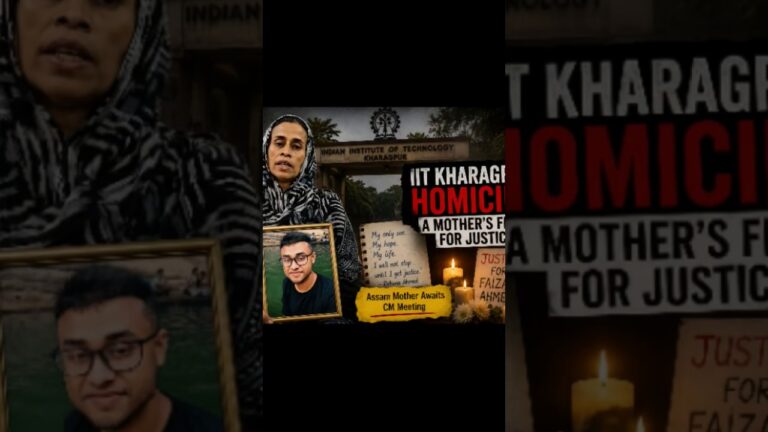
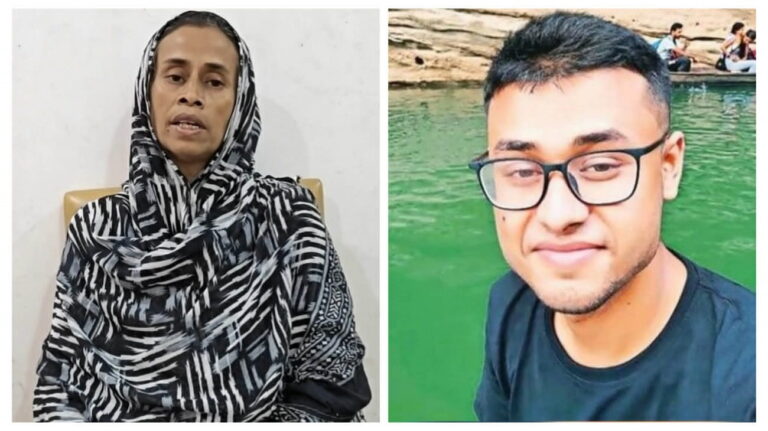
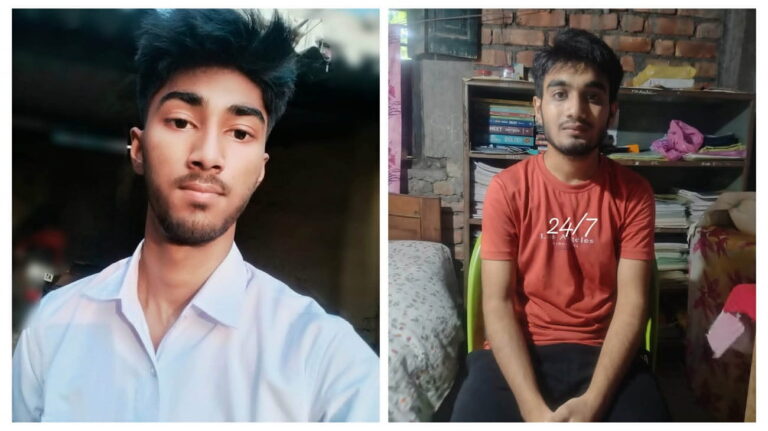
Kolkata: Nearly four years after losing her only son, Rehana Ahmed has returned to Kolkata with a single hope—to secure justice for 23-year-old IIT Kharagpur student Faizan Ahmed, whose death was initially declared a suicide before a court-ordered second autopsy concluded that he had been murdered.
Faizan Ahmed, a brilliant student from Assam, secured an All India Rank (AIR) of 11 in IIT-JEE 2020. With such an exceptional rank, he could have enrolled at any IIT in the country. Instead, he chose IIT Kharagpur because he wanted to study at the institution where Google CEO Sundar Pichai had studied. After pandemic-related delays, he joined the Mechanical Engineering programme in December 2021 and soon became involved in robotics research projects, earning recognition as a promising young researcher.
In October 2022, less than a year after arriving on campus, Faizan’s partially decomposed body was found inside his hostel room. The first post-mortem concluded that he had died by suicide, but his parents challenged the findings before the Calcutta High Court.
The High Court appointed a retired forensic expert, who found signs inconsistent with suicide and recommended a second post-mortem. The fresh autopsy concluded that Faizan had been murdered, prompting the High Court to declare the case a homicide and constitute a Special Investigation Team (SIT). Despite these directions, the investigation has made little visible progress.
Now in Kolkata since July 17, Rehana and her husband, Salim Ahmed, are hoping to meet West Bengal Chief Minister Suvendu Adhikari and seek the state government’s support in reviving the stalled probe. Rehana says she believes the new government may help deliver justice. She recalled that Assam Chief Minister Himanta Biswa Sarma had written to the then West Bengal Chief Minister Mamata Banerjee seeking justice and later demanded a CBI probe. She also approached the National Commission for Minorities and the previous state government, but says her efforts yielded little progress.
The couple had been scheduled to meet the Chief Minister this week, but the meeting could not take place. They say they will remain in Kolkata until they get an opportunity to present their plea.
Kolkata: Nearly four years after losing her only son, Rehana Ahmed has returned to Kolkata with one hope—to secure justice for 23-year-old IIT Kharagpur student Faizan Ahmed, whose death was initially declared a suicide before a court-ordered second autopsy concluded that he had been murdered.
The grieving mother wants to meet West Bengal Chief Minister Suvendu Adhikari and seek the state government’s support in ensuring that the stalled investigation finally reaches its logical conclusion.
A resident of Tinsukia in Assam, Rehana believes the change in government has revived hope in a case that has remained in limbo despite repeated interventions by the Calcutta High Court.
From IIT Dream to a Mysterious Death
Faizan Ahmed, the only child of Salim and Rehana Ahmed, was a brilliant student from Assam who cracked the IIT-JEE in 2020 with an All India Rank (AIR) of 11 before choosing to pursue Mechanical Engineering at IIT Kharagpur. Because of the COVID-19 pandemic, he joined the campus only in December 2021. During his brief stay, he became involved in two robotics-related research projects, earning recognition as a promising young researcher.
Less than a year after arriving on campus, tragedy struck. In October 2022, Faizan’s partially decomposed body was found inside his hostel room. The initial post-mortem concluded that he had died by suicide—a finding his parents refused to accept.
Watch the interview
Court-Ordered Autopsy Changed Everything
Refusing to accept the suicide theory, Faizan’s parents approached the Calcutta High Court.
The High Court first appointed a retired forensic expert who, after examining photographs of the body, pointed to signs of haemorrhage and recommended a second post-mortem examination.
The second post-mortem transformed the investigation. It concluded that Faizan had been murdered, prompting the Calcutta High Court to declare the case a homicide and constitute a Special Investigation Team (SIT) to probe the killing.
Although IIT Kharagpur challenged the order before a Division Bench, the High Court upheld the decision. Despite this, the investigation has made little visible progress over the past four years.
A Grieving Mother’s Hope Rests on the New Government
“In 2022, after receiving the news of Faizan’s death, Assam Chief Minister Himanta Biswa Sarma wrote to the then West Bengal Chief Minister Mamata Banerjee, seeking justice. He later also demanded a CBI investigation into the case,” Rehana said.
She said she had also written to the National Commission for Minorities and to Mamata Banerjee, but received no response that brought the investigation forward.
“I believe the new government will ensure justice. Chief Minister Suvendu Adhikari has reopened several cases from the previous regime. I hope he will also help us get justice for my son,” she said.
Rehana said her hopes have been renewed because the new government has announced fresh investigations into several high-profile cases from the previous administration, including the alleged murders of student leader Anish Khan and minor girl Tamanna.
Rehana and her husband, Salim Ahmed, have been in Kolkata since July 17, hoping to meet the Chief Minister. They had been given an appointment to meet him at the BJP party office on Wednesday, but the meeting could not take place as the Chief Minister did not visit the office that day.
The couple says they are determined to remain in Kolkata until they get an opportunity to place their plea before the Chief Minister, hoping that after nearly four years, their long wait for justice will finally begin to move forward.
Rehana’s battle for justice comes at a time when lakhs of students across India are protesting over paper leaks, alleged examination irregularities and the demand for a fair, transparent and accountable education system. While their protests focus on the integrity of examinations, her four-year struggle raises another equally urgent question: Can India’s educational institutions truly claim excellence if they fail to guarantee the safety, dignity and justice of the students entrusted to them?
For Rehana Ahmed, the fight is no longer just about solving her son’s murder. It is about ensuring that no other parent has to spend years seeking answers after sending a child to one of the country’s most prestigious educational institutions.
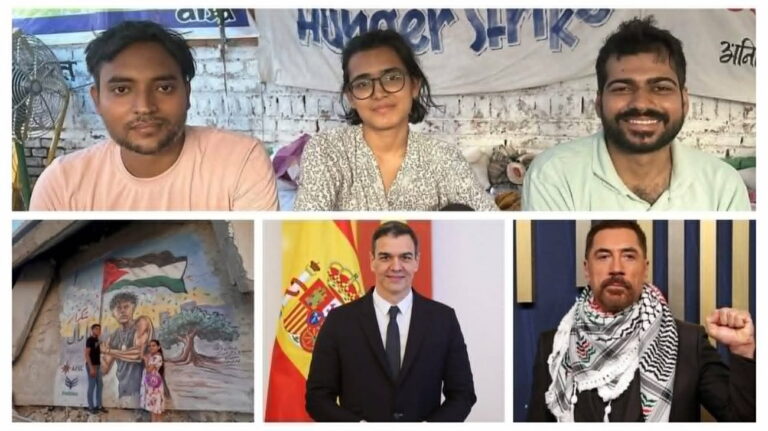
The Spanish victory in the FIFA World Cup was a treat. The match might not have been of the highest quality, but under Pedro Sánchez, Spain became a symbol of hope for millions of people across the world who seek justice and peace for the Palestinian people.
The victory was a slap in the face to the Trump-led American politics of dominance that has violated international norms. If you watched Trump’s body language during the final moments and the trophy presentation ceremony, you would have realised how uncomfortable he appeared.
From Sobers, Ali to Yamal: When Sports Speak Beyond the Field
It is heartening to see the entire Spanish team stand for the cause of Palestine. Israel has been completely exposed.
A couple of days ago, the legendary Garry Sobers passed away, having brought immense glory to the Caribbean. His success inspired a generation of fast bowlers and batsmen in the West Indies. They subsequently dominated the world stage, though not before facing racial prejudice.
In 1976, England captain Tony Greig made an atrocious and racist remark just before Clive Lloyd’s West Indian team arrived in England to play a five-Test series. The comment outraged the Caribbean players. The result was a 3-0 victory for the West Indies. Vivian Richards scored 827 runs in just four Tests and seven innings at an average of 118.42.
Sports cannot be separated from important political events that affect nations and societies. Veteran boxer Muhammad Ali was unequivocal in his opposition to white supremacy, which he consistently criticised and condemned.
Look at the Spanish team and their support for the Palestinian cause. Lamine Yamal is already on his way to becoming a legend, not merely for his brilliance on the field but also for standing up for what he believes is a just cause.
All this compels us to take a serious look at our stars and the media, who remain completely out of touch with ordinary people. Students- Neha Bora, Manish Kumar and Aameen Amitoj have been protesting for the last 23 days, yet most of these superstars—both the Bombay cinema wallahs and the IPL billionaires—have remained silent, except for people like Shabana Azmi and Prakash Raj, who have stood in solidarity with the students.
The “Manustream media”, which can aptly be called both Modi media and Godi media, have shamelessly become experts at distorting facts and twisting them to suit the interests of their bosses.
Spain, Palestine and the Politics of Football
At the moment, one can say that Spain’s victory has gladdened the hearts of all those who support the liberation of Palestine and seek accountability for Israel’s brutal and illegal military operation against the Palestinian people. The good thing is that Spain’s victory has once again brought the issue of Palestine to international headlines. A big salute to Prime Minister Pedro Sánchez and the Spanish football team, who have stood rock solid for the Palestinian cause.
Student Protests, Media Coverage and the Test of Democracy
Let us now see how the Indian media reports on police violence against unarmed students at Parliament Street. The other day, we heard a young reporter saying that students were raising the slogans “Inquilab Zindabad” and “Azadi”. It is surprising and shocking that someone reporting for a so-called national channel does not know the history of the slogan “Inquilab Zindabad”, which became one of the defining slogans of India’s freedom movement and was popularised by Shaheed-e-Azam Bhagat Singh.
Such ignorance only reflects that the Manuwadi media has now truly turned into a Bania ki Dukan, exposing the hollowness of its much-vaunted “merit”.
Anyway, let us see how a democratically elected government handles these protests. Will it engage with the students and resolve the issue, or will it continue to rely on conspiracy theories involving China, Pakistan, Soros, Hindus and Muslims? So far, the government has succeeded in harvesting the crop of hatred, but will that continue?
The Nirbhaya movement severely damaged the credibility of the Congress. Will the present student movement similarly damage Narendra Modi politically?
During the Nirbhaya movement, the conscience of many of our film stars, media personalities and intellectuals appeared to awaken. So far, however, with regard to the student movement, they seem to be still asleep. Or perhaps, frankly speaking, they are pretending to sleep. You can wake those who are asleep, but not those who pretend to be asleep.
So, wait for more conspiracy theories on your prime-time television. Meanwhile, enjoy Spain’s victory, and wish the Palestinian people strength and better days ahead.
Malda: Defying financial hardships and multiple failed attempts, two determined young men from Malda district have cracked the National Eligibility-cum-Entrance Test (NEET-UG), bringing immense pride to their respective villages. Ruhul Amin cleared the prestigious medical entrance exam on his third attempt, while Sahil Ahmed achieved success on his fifth, turning years of grit into inspiring success stories.
The results, announced by the National Testing Agency (NTA) on Thursday, sparked widespread celebrations across the district. While Ruhul secured an All India Rank (AIR) of 20,302 with 575 marks, Sahil secured an AIR of 43,208, scoring 543 marks. Both boys come from humble backgrounds—Ruhul is the son of a struggling farmer, and Sahil is the son of a driver.
Ruhul is the only son of Rafiqul Alam, a farmer who also provides basic medical assistance to villagers, and homemaker Jesmira Arju. Despite the family’s financial difficulties, his parents continued to support his education.
Ruhul completed his secondary education at DIB High School in Chanchal in 2021, securing 92 per cent marks. He completed his higher secondary education at Daxarah High School in Howrah in 2023, scoring 77 per cent.
He subsequently began preparing for the medical entrance examination. He initially studied from his village home before enrolling at Al-Amin Mission in New Town, Kolkata, for further preparation. Ruhul failed to qualify for NEET in his first two attempts. However, he continued preparing and succeeded on his third attempt.
“This is the first time that someone from our village will become a doctor. Ruhul is the pride of the entire village. Everyone is happy with his success,” said Abdul Khalek, a local resident.
A Father’s Unfulfilled Dream and a Son’s Promise
Speaking to eNewsroom, Ruhul’s father, Rafiqul Alam, said he had faced financial difficulties throughout his life.
“I completed my BA despite financial problems and wanted to secure a government job. Despite several attempts, I could not achieve that dream. I then hoped to fulfil that dream through my son. After he cleared NEET, I feel that my dream has taken one step towards fulfilment. The day my son returns to the village as a qualified doctor will be the day my dream is truly fulfilled,” he said.
Rafiqul said he earns around ₹20,000 a month through agricultural work and providing basic medical assistance to villagers.
“It was difficult to support the family, fund my son’s education and meet other household expenses with that income. But I never allowed my son to feel the pressure. Today, I feel that the hard work has finally borne fruit,” he said.
Ruhul said that no doctor had previously emerged from his village and that he hoped to become the first.
“I want to provide free medical care to poor people in my village,” he said.
Speaking about his motivation, Ruhul said his father often treated villagers suffering from minor ailments.
“When people suffer from serious illnesses, many families face financial difficulties in seeking proper medical treatment. Healthcare is becoming increasingly unaffordable for ordinary people. My dream is to become a doctor and serve the people of my village,” he said.
Malda’s Sahil Ahmed Clears NEET After Four Failed Attempts
Ruhul’s success has also brought renewed attention to another NEET achiever from Malda. Sahil Ahmed, a resident of the Mohana area of Enayetpur in Manikchak block, cleared NEET after failing to qualify in four consecutive attempts. He succeeded on his fifth attempt, scoring 543 marks and securing an All India Rank (AIR) of 43,208.
Sahil is the son of driver Md Sajahan and homemaker Sabina Yasmin. His father said the family was proud of his achievement.
“With determination, sacrifice and continuous effort, my son has moved closer to fulfilling his dream. I am extremely happy with his success and pray that he achieves even greater things in life,” Sajahan said.
The achievements of Ruhul and Sahil have inspired students across Malda, demonstrating how perseverance and determination can help young people overcome repeated setbacks and financial hardship in pursuit of their dreams.
`When you lose faith in the earth beneath your feet’ was how a leading international publication described the 2001 earthquake in Gujarat, which claimed thousands of lives and continued to strike fear into the hearts of its residents with aftershocks for a long time.
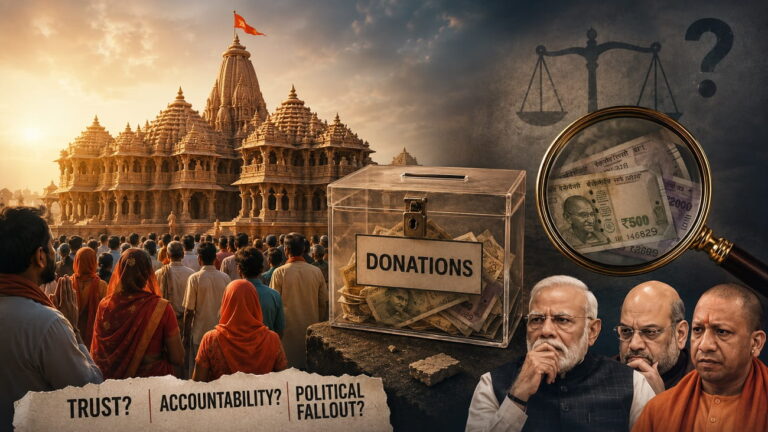
That tragedy was an act of nature and cannot be compared with anything else. But the evocative idea of losing faith in the foundation may resonate with devotees who feel betrayed by the alleged theft of donations from the Ram temple in Ayodhya. This man-made calamity has shaken the faith of believers, many of whom equated the temple movement with cultural resurgence.
Reports from the temple town suggest a significant decline in the number of worshippers visiting the temple after the allegations came to light. Owners of hotels and guesthouses in and around Ayodhya have complained about low occupancy. Many of those visiting the temple these days come only from nearby places and don’t need accommodation.
The reduced footfall may be temporary, and devotees will return sooner or later, especially on days of religious significance. Tragedies like stampedes, including those leading to the loss of hundreds of lives at religious places, are not uncommon in the country. Numbers go down in the immediate aftermath, but devotees return, some with conviction.
Devotees of Ram will not lose faith in the deity itself, but what will remain deeply ingrained for a long time is chanda chori, the pejorative allegation. Atheists and agnostics may have different interpretations, but the unprecedented nature of the controversy has drawn their attention too.
The first sign of hurt sentiments came when the Faizabad Bar Association passed a resolution asking its members not to represent the eight accused arrested in the case. Citing Supreme Court rulings, legal experts say the resolution itself could be illegal and cannot be justified.
That may be the case, but by passing the resolution, the advocates conveyed their anger against the accused. It’s not unusual for bar associations to pass such resolutions, but they do so when it comes to terrorists and those accused of raping minors. The Faizabad resolution is a rare instance.
After a long time, the BJP and the larger Sangh Parivar have found themselves unable to come up with a coherent response, mainly because the buck can’t be passed to anyone. Also, there is every likelihood that, other than those already behind bars, more could be involved. At every level of authority, from the Central government to the temple administration, those ideologically invested are in charge.
Though the temple movement predates the BJP, it benefited immensely from the mobilisation carried out by its predecessors and other allied organisations.
Ayodhya Controversy Gives Opposition Fresh Political Ammunition
By the time the temple was built and inaugurated ahead of the 2024 general elections, it had lost traction as an electoral issue. The BJP not only lost the parliamentary seat, of which the temple town is a part, but also many more in the electorally crucial state.
Ironically, the donation theft case has given the Opposition a huge stick to beat the ruling party, months ahead of the assembly elections in Uttar Pradesh and at the national level.
The initial attempts to underplay the controversy didn’t work because the Opposition was unrelenting, having sensed an opportunity to give the BJP a taste of its own medicine. The argument that some opposition leaders did not visit the temple and, therefore, lacked the authority to comment didn’t wash with anyone. Asking the Opposition to come clean on their stand on Kashi and Mathura hasn’t worked either.
What acted as a force multiplier was the comprehensive coverage by television channels. For once, the INDIA bloc couldn’t accuse a large section of the media of ignoring controversies and developments likely to bring a bad name to the saffron party.
The controversy may also have been on the front burner due to the internal dynamics of the Sangh Parivar and the alleged friction among leaders at different levels. It took the RSS several days to offer its first official comment, while Yogi Adityanath spoke of strict action instantly.
Whether more heads are rolled or more are sent to jail, or whether attempts are made to hush up further revelations, the BJP is unlikely to score any brownie points. The Supreme Court is now hearing pleas for a CBI probe.
Only time will tell whether the BJP pays any electoral cost for the alleged theft of donations, which opponents compare to loot. It will need God’s blessings to do better than it did in the last general election.
Almost 73 years after Bimal Roy’s Do Bigha Zamin, where a rich, young couple races two rickshaw pullers like they are battery-operated toys till one of them crumbles and crashes, we recently witnessed something called a Tirri prank. Pranksters remotely shut down e-rickshaws via battery-management apps, leaving drivers desperate and, at times, in tears mid-route. Cruelty is the flavor of the season, and that brings me to Ajay Devgn.
The last shot of The Legend of Bhagat Singh (2002) was a close-up of Devgn’s eyes. Resolute. Clear-sighted. Looking into the soul of a nation. To remind us of the sacrifices and bravery that won us our independence. And now the same Devgn is playing a character who is all for pellet guns aimed at the eyes of the Kashmiris. Where partial or total blindness of Indian citizens is a negligible cost to keep the new version of Nationhood ticking. The idea of India, birthed by the unified defiance of a colonizing foreign power, has now been reduced to performative cruelty against Indian citizens. Today, we seem to take pride in a system that demolishes homes at whim, ignores on-camera lynchings, normalizes hate rhetoric and the dehumanization of fellow Indians.
Devgn’s entry into opportunistic cinema is recent, though. His Singham Returns (2014) had dedicated a song to a Sufi peer, and the villain was a corrupt Godman. This was 2014, though, and the penny had not yet dropped. From Lajja (2001) where he played a dacoit out to protect women from the atrocities of upper-caste men, to The Legend of Bhagat Singh where India was equated with all its people, to Halla Bol (2008) where he was the disciple of a street revolutionary reminiscent of Safdar Hashmi, to the full-blown historical revisionism of Tanhaji: The Unsung Warrior and now Chauhan, he has been on quite a journey. The success of Tanhaji shows that Devgn has now hit upon a profitable theme with endless possibilities.
The Calculated Shift in Cinematic Archetypes
Don’t also miss the taunt to a Pathan by a Chauhan in the poster. The jibe is intentional. It draws a clear battle line within the film industry and beyond. It is loaded, and its religious and caste connotations are hard to miss.
A far cry from the era of Rahul Rawail’s Arjun (1985) and Ram Gopal Varma’s Shiva (1990). Two heroes with mythological names who were not propagandists or hate vendors but lone warriors battling the nexus between crime and politics. The films had no subtext demonizing the minorities because the two heroes were in a minority like us and outnumbered by corrupt, violent, manipulative power-mongers. Both films showed how the young are lured into goondaism by powerful politicians and then discarded once their purpose is served. Their initial weapons? A cycle chain. And sticks. Not the might of the state.
In 2021, Akshay Kumar’s Sooryavanshi, much like Chauhan, had proudly announced, “Aa rahi hai police” in a poster crowded with faceless figures in combat gear. This was the era post the Jamia library attack, and the role the police had played during the CAA and farmers’ protests.
Such films, much like American Sniper, Rambo, and First Blood, appear to assert a singular identity powered by a simplistic, gun-toting nationalism blind to the root causes of divisions, if any.
The Erasure of Systemic Empathy
Not too long ago, though, empathy came naturally to us and to our cinema. In Arjun, for instance, the protagonist (played by Sunny Deol) finds that the sister of his dead friend has been pushed into prostitution. The man giving him this news chuckles gleefully and uses a cuss word for her. Arjun, as heroes were known to do then, schooled the man for laughing at a tragedy and told him to imagine his own sister in the same situation. We did not laugh at the weak then.
Even Ghayal’s (1990) gun-toting vigilante hero had empathy. This Rajkumar Santoshi film showed openly how a corrupt, politicized “system” defangs the police and protects criminals. In one scene, a police officer slaps a young student, and the hero tells the silently weeping boy, “Conserve these tears. One day, these tears will turn into a sailab and cleanse this country!” In the final scene, he is caught only because he is trying to save a little girl from the villain. A lone man being overpowered by a large cluster of policemen in the climax was also rather symbolic.
Our cinema then helped us to not just escape the toxicity of the world but also connect us to something bigger than ourselves. To the humanity of one another and gave us hope that one day we would find our way to love, friendship, social equity and justice.
The Weaponization of Contempt
This was much before the laughter emoji was weaponized to mock lynched men, raped women, brutalized students and imprisoned activists and journalists. And before Manoj Muntashir strutted on a podium to exhort the audience to plunge bhagva into “ahankar ki chhati.”
Ram Gopal Varma’s Shiva built upon the template Javed Akhtar had created in Arjun. Of a group of boys who decide they will fight and not comply with the system that oppresses the weak. In Arjun, the primary concern was unemployment. In Shiva, it was the weaponization of student leaders by corrupt politicians.
Two scenes in Arjun resonate to date. A young boy is lynched on a rainy day in a crowded street, but nobody notices because everyone is safe within the confines of their umbrellas. The other is when Arjun is running for his life in the end through streets lined with the posters and cutouts of a man who has come into power by using his innocence and idealism. Everywhere he turns, there is this pervasive image with folded hands. Plastered on walls, peering from hoardings.
Still, the film ended on a note of hopefulness. To show that the system works if you insist upon seeking justice. There was no such closure in Shiva. It has many scenes that mirror situations and shots from Arjun, including a cycle chase, but it ends with the realization that if one bully is taken out, another one will erupt because the ground realities do not change for ordinary Indians.
Engineering the “Enemy Within”
Today, cultural, cinematic, and political iconography is largely led by violent male archetypes with sprawling chests, and it has seeped into our consciousness and our cinema via one-sided, repetitive, multi-layered propaganda. The audience may have changed, too. The Chauhans and the Sooryavanshis succeed precisely because they are imperviously cruel. The actors playing such characters have tasted blood as well. They know secularism is no longer the nation’s primary currency. So they are ready to profit from what is.
As for our cinema’s shift to this lucrative ideology, it arguably began with Akshay Kumar’s Baby (2015). Akshay went from a rebellious lover boy in his debut film Saugandh (1991) to a superhuman khiladi to an ensemble star of comedies and then struck gold with films like Singh Is Kinng and Namastey London, where he played the bumbling outsider in foreign climes. Reminding people of what they were missing out on by not being closer to their roots. Whatever was the trend of the day, he encashed it and full points to his resilience.
Baby, however, was a turning point of another kind. Because it started something that has now culminated into a Sooryavanshi cop representing the might of the state. He eyeballs and hectors bearded men who are the “enemy within.” The enemy in Baby was ostensibly Pakistan, but it subtly turned the audience’s gaze towards the crowded Muslim-majority areas in Mumbai for traces of “anti-nationalism.”
In Sooryavanshi, the enemy was a sleeper Lashkar cell with potential terrorists hiding in plain sight among unsuspecting Indians. Throw in some exploding cars, helicopter stunts and punchlines about Mumbai police, and you have another Us vs Them narrative disguised as an entertainer. There was a quote by Gandhi hidden somewhere in the trailer, but that is all he is useful for now. A few quotes, and the symbolic use of his charkha and spectacles on special occasions.
The Monetization of Combative Nationalism
Historically, most successful cop films in India (Zanjeer, Ardh Satya, Khakee, Shool and many more) almost always explored the rot within society, policing and political systems. Introspection has, however, gone out of our mainstream films. And this has happened gradually.
Baby’s core team, exploring a conspiracy, did have a Muslim. A girl, no less. Shabana Khan, played by Taapsee Pannu. The film also had two well-known Pakistani actors in key roles. The nationalism genre was, though, being tweaked subtly and unmistakably. The year was 2015, after all, and it was too early to paint all Muslims with one brush. So we had Danny Denzongpa’s Feroz Ali Khan heading the counter-terrorism unit, just so you knew that the film was NOT against a religion but only the anti-nationals.
There was jingoism even before Baby. There was Anil Sharma’s Gadar: Ek Prem Katha, where an uprooted hand pump took on Pakistan, and the lone hero killed hundreds, if not thousands, on his way to his watan on a burning train with his wife and kid. Then there was John Matthew Matthan’s 1999 hit Sarfarosh, where a nationalist ACP takes on a Pakistani singer called Ghulam Hassan (hint, hint).
But the first was also a love story between an Indian and a Pakistani. And Sarfarosh had a Muslim subordinate of the hero making an important point about always being on the defensive about his religion because he was called upon again and again to prove his nationalism.
A Wednesday!, Neeraj Pandey’s debut, was clear in its intent that the only way to counter terrorism was to blow up terrorists without any legal intervention. But it also had a Muslim cop saving Mumbai from the terror-spreading “vermin.” The danger in the film was contained, but in Baby, Pandey’s narrative took a clear stand like Bush in the post-9/11 era that those who were not “with” us were “against” us.
Also, the security agent played by Akshay had a sense of entitlement almost as heavy as his surname. His name is Ajay Singh Rajput (no mistaking the caste assertion here, just like Ajay Devgn’s Chauhan) and he habitually throws punches because he can. In one scene, he smashes the jaw of a witness willing to cooperate, uproots his tooth, and when asked why he did that, he says, “aadat hai.”
He also mentions helpfully how, during the Gujarat riots, he protected a Muslim family from a trishul-waving mob because he is a proud Indian. Yet, the only people plotting trouble in the film are Muslims. The naive engineer being brainwashed by a community leader, the agent who switches loyalties, the terrorist (Kay Kay Menon wasted in a sketchy role) who wants to be given better facilities in the prison because he has killed more people than Kasab.
Don’t also miss Minister saab, who is called the “face of change” and dresses like someone we know as the harbinger of “achhe din.” Unlike Black Friday, where terror was treated as an all-encompassing tragedy, there was no sociological subtext here. Just terrorists and those who swat them as members of a crack team called “Baby.” Like the awful, bloody makeup you saw on Baby’s victims, and Akshay Kumar’s rather jarringly fake mustache, the ideological territory this film inhabited was hurried and ad hoc.
The new generation of dhuradhars know that timing is everything, and not surprisingly, they are now replacing Akshay as the most successful brand ambassador of combative nationalism. He may have once interviewed the “face of the change,” and endorsed political “masterstrokes” through his films and his tweets, but he is no longer the man of the moment. We now have the next generation of astute actors who don’t really care about a moral compass as long as there are unearned awards and exploding box-office returns to relish.
“Doctor, he is only fifteen. Why does he already have neck pain?”
It is a question I now hear almost every day in my clinic.
Not long ago, chronic neck pain, shoulder stiffness, backache, and wrist problems were complaints of middle-aged office workers after years of desk jobs and repetitive strain. Today, many of the same symptoms walk into my clinic carried by school bags instead of briefcases.
As a neurologist, I usually evaluate headaches, tingling, numbness, and nerve-related symptoms. Increasingly, however, when I trace these complaints back to their source, the answer is often the same: hours spent each day with the neck bent over a six-inch screen. Teenagers are now presenting with persistent neck pain, aching shoulders, upper back stiffness, wrist pain, hand fatigue, and headaches that worsen after prolonged smartphone use. Some struggle to sit comfortably through classes, while others complain of pain while writing or tingling in their fingers after hours of gaming or scrolling.
Parents almost always recognise the problem. Most have tried to reduce screen time, and most admit defeat. “He studies on the phone.” “Her homework is online.” “Everyone in the class is on social media. “The smartphone has quietly become the most powerful member of many households. It accompanies children to the dining table, bedroom, study desk, family outings, and sometimes even the bathroom. Asking a teenager to put it away often feels like asking them to give up a part of their world.
The irony is hard to miss. We carefully choose ergonomic school bags to protect our children’s backs, yet many spend four to six hours every day with their necks bent over a small screen.
This article focuses only on the musculoskeletal and neurological consequences of excessive smartphone use. The behavioural, psychological, sleep-related, and social effects are equally important, but deserve a separate discussion.
Medical Evidence: The Global Teen Text Neck Crisis
What clinicians are seeing is now reflected in research.
A 2023 study among adolescents in Kolkata found that all participants used a smartphone, nearly one-third spent 3 hours or more daily on it, and almost half reported neck pain. From studies in West Bengal, AIIMS in New Delhi, JIPMER in Puducherry and Chennai, to research from Europe, North America, and East Asia, the message is remarkably consistent. Teenagers are spending unprecedented hours on digital devices, and the price is increasingly being paid by their necks, shoulders, backs, wrists, and hands. Although most studies are observational and cannot prove a direct cause-and-effect relationship, the consistency of findings across countries and populations makes the warning difficult to ignore.
Why Smartphones Damage Developing Teen Bodies
The obvious question then is: why are teenagers, who should be at the healthiest stage of life, developing these problems so early? A teenager’s body is still developing. Bones continue to grow, muscles are strengthening, ligaments remain adaptable, and the spine is still maturing. Yet modern technology asks this growing body to remain almost motionless for hours, with the head bent forward while the hands perform thousands of repetitive movements.
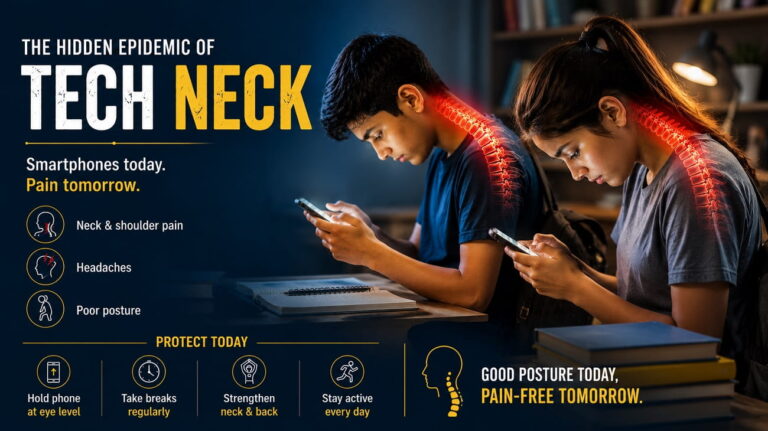
Unlike outdoor play or sports, smartphone use promotes prolonged static posture. The muscles are constantly working—but without movement. And muscles are simply not designed to stay still for hours. One of the best-known consequences is “text neck or tech neck.” When the head is upright, it weighs about 4–5 kilograms. As it tilts forward, the load on the cervical spine increases dramatically. Initially, the muscles cope. Eventually, they tire. Then they hurt.
Beyond Text Neck: Shoulder, Wrist, and Nerve Pain
The shoulders also suffer. Holding a phone encourages rounded shoulders and a hunched upper back, placing continuous strain on the muscles around the neck and shoulder blades. Over time, this leads to stiffness, fatigue, and persistent aching. The hands are equally affected. Scrolling, texting, gaming, and typing involve thousands of repetitive thumb and finger movements each day. I increasingly see teenagers with thumb pain, wrist discomfort, hand fatigue, and reduced grip strength—complaints that were once largely confined to adults with occupational repetitive strain injuries. The tingling some teenagers experience after prolonged gaming or scrolling should not be dismissed either. It may represent early nerve irritation caused by sustained wrist positioning and serves as an important warning that the body is under stress.
Movement Is the Best Medicine
Technology is not the enemy. The real problem is prolonged, uninterrupted use combined with poor posture.
Fortunately, many of these problems are preventable. Holding the phone closer to eye level, changing posture frequently, taking a short movement break every 20–30 minutes, stretching the neck, shoulders, and wrists, and using both hands while typing can substantially reduce mechanical strain. Equally important is ensuring that children spend at least an hour each day engaged in outdoor play, sports, or other physical activity.
These habits should not depend on parents alone. Schools must also prepare children for healthy digital living. Just as they teach nutrition, hygiene, and road safety, they should include digital ergonomics in health education. Short stretching breaks during classes, encouraging reading printed books alongside digital learning, and promoting regular participation in outdoor games and sports can go a long way in protecting children’s developing bodies.
Parents, too, must lead by example. A parent asking a child to put away the phone while remaining glued to one themselves sends a mixed message. Screen-free family meals, dedicated no-phone hours at home, reading books together, taking evening walks, and playing outdoor games create habits that children naturally imitate. Healthy digital behaviour is far easier to model than to enforce.
Protecting Teen Physical Health in a Digital World
Smartphones are now indispensable for education, communication, and daily life. Asking teenagers to abandon them is neither practical nor desirable. But normalising pain in adolescence is equally unacceptable. Neck pain, shoulder stiffness, backache, wrist pain, and posture-related headaches should not become part of growing up. The question is no longer whether smartphones are here to stay—they are. The real question is whether we can teach children to use them without sacrificing their physical health.
Surjyapur, Baruipur: On Saturday afternoon, July 4, eleven-year-old stepped out of her home carrying a simple plan.
She was going to buy a birthday gift for a friend.
The market was only a short walk away. In Surjyapur, a semi-rural settlement in South 24 Parganas district, people know one another by name. The road from her house to the shops takes only a few minutes on foot. Her family expected her back almost immediately.
She never returned.
By evening, concern had spread beyond her home. Relatives began searching nearby lanes. Neighbours joined in. Shopkeepers were asked if they had seen the child. As daylight faded, the search expanded across the village.
No one imagined that over the next several hours the residents of Surjyapur would reconstruct the movements of a missing child, identify a suspect, confront him, and eventually recover her body from a pond hidden beneath dense water hyacinths.
The story that unfolded over the next two days is not only about the brutal rape and murder of an eleven-year-old girl. It is also about what happens when an entire community believes it cannot afford to wait.
A village begins looking for answers
The family first approached Baruipur Police Station after the child failed to return home. According to relatives and residents, they expected a swift search for a missing minor.
Instead, they say, the urgency they hoped for never materialised.
As anxiety turned into desperation, the search gradually shifted from homes and fields to electronic evidence.
Young men from local clubs began visiting shops one after another, requesting CCTV recordings. Shopkeepers willingly opened their systems. Residents moved from one camera to the next, trying to establish the girl’s last known movements.
By early morning, they had collected nearly ten CCTV clips from different locations.
Among them, two pieces of footage stood out.
Recorded at approximately 4.27 pm and 4.42 pm, they appeared to show the girl walking with a man known in the locality.
The timestamps puzzled the villagers.
The distance between the market and the girl’s home could normally be covered in just two or three minutes. Why had she remained on the road for so much longer?
The discrepancy became the first significant clue.
Long before forensic experts arrived or investigators reconstructed the sequence of events, residents had begun doing it themselves.
Villagers near the house of victim at Surjyapur village | Antara Swarnakar
Following the CCTV trail
The footage quickly became the centre of the search.
People who knew the area began comparing routes, timings and locations. Residents discussed where the child had last been seen, which roads she might have taken and who had accompanied her.
The man appearing beside her in the footage was recognised almost immediately.
His name was Prabhas Mondal.
The villagers informed the police and continued requesting immediate intervention. According to residents, repeated calls were made to the police station as the night progressed.
But with every passing hour, they felt the search was slipping away.
Unable to wait any longer, local club members turned to civic volunteers stationed nearby, asking them to join the search.
Together, residents and three civic police personnel headed towards Mondal’s house.
The shoes inside the house
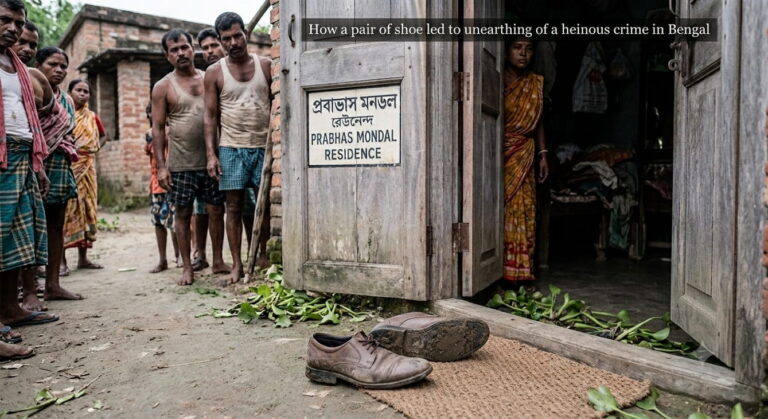
When the group reached the suspect’s residence, his wife told them he was not home.
Some residents were unconvinced.
Standing outside, they noticed a pair of shoes inside the house.
If he had gone out, they wondered, whose shoes were they?
The crowd refused to leave.
The house was surrounded until Mondal eventually emerged.
He was taken to a nearby civic volunteer barrack where questioning began.
Residents who were present say Mondal repeatedly changed his account before finally admitting that he was the man seen with the child in the CCTV footage.
According to those present, he also disclosed the names of several others allegedly involved in the crime.
Yet even then, villagers say, they continued waiting for additional police personnel to arrive.
Residents claim that more than ten calls were made from the barrack requesting reinforcement.
They say no regular police team reached them during that period.
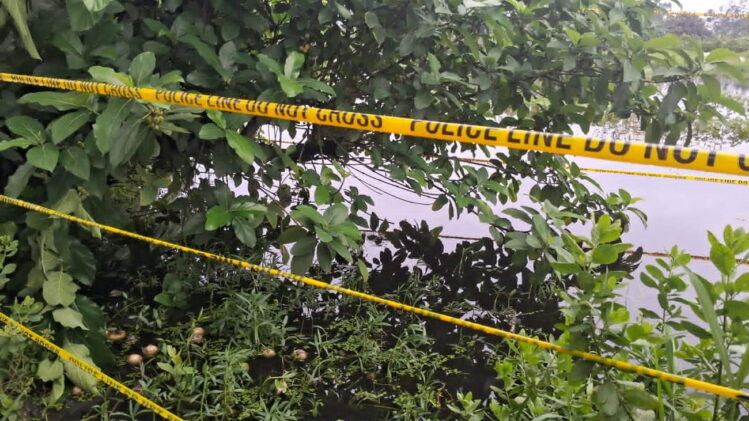
Pond at Surjyapur from where the dead body of the 11-year-old was recovered | Antara SwarnakarThe search enters the marshland
Questioning alone was no longer enough.
The child was still missing.
Residents insisted that Mondal lead them to wherever he had last seen her.
Accompanied by civic volunteers and villagers, he walked through muddy tracks, overgrown vegetation and narrow embankments near Surjyapur railway station.
The journey became increasingly slow as the landscape turned marshy.
After repeatedly changing direction, Mondal eventually pointed towards a small pond almost entirely concealed beneath thick water hyacinths.
Nothing about it suggested that it concealed evidence of a crime.
Villagers entered the water.
Some pulled away the floating vegetation while others searched beneath it.
Then they found a plastic sheet.
Wrapped inside it was a sack.
As residents pulled it towards the bank, the covering tore slightly.
A child’s leg became visible.
“I was stunned,” recalled Julie Seikh, who helped recover the body.
“I couldn’t believe what I was seeing. Since that day I haven’t been able to eat or sleep.”
Another resident, Sagir Ali, said he remained some distance away.
“I was there,” he said. “But I couldn’t go closer. She was just a little girl.”
Residents insist there were no regular police officers at the site when the body was recovered.
For many in Surjyapur, that moment changed the nature of the tragedy.
Until then, they had been searching for a missing child.
Now they believed they had become the first people to uncover a murder.
A Body Recovered, A Village in Revolt
When the sack was pulled from the pond, the search ended.
Another story had just begun.
The child was found naked, her body wrapped first in plastic and then stuffed into a sack. Villagers say it had been hidden beneath thick layers of water hyacinths, suggesting an attempt to conceal both the body and the crime scene.
For those who had spent the entire night searching, the discovery was overwhelming.
Seikh, who helped recover the body, says the image has remained with him ever since.
“I saw her leg when the sack tore,” she recalled. “I have not been able to eat or sleep since.”
Sagir Ali, another resident, chose to stand at a distance.
“I was afraid to go near,” he said. “She was just a little girl.”
Residents say there were no regular police officers present when the body was recovered. That allegation has become one of the central questions surrounding the case.
Questions over the police response
According to villagers, the suspect had already admitted to appearing in the CCTV footage and had identified others allegedly involved in the crime while being questioned at the civic volunteer barrack.
Yet confusion persisted over what happened next.
Members of the victim’s family allege that despite the suspect’s statements, there was no immediate move to formally secure him or begin a coordinated investigation.
One relative described what followed as deeply disturbing.
According to the family, a local political functionary who had joined the search eventually transported one of the accused from the civic barrack to Baruipur Police Station in an electric rickshaw rather than in a police vehicle.
The allegation has not been independently verified, but it has become one of the questions repeatedly raised by the family.
“When someone admits involvement in such a crime, the responsibility of taking him into custody rests with the police,” the relative said. “Instead, we felt we were left to manage everything ourselves.”
The family believes the investigation initially failed to receive the urgency that the disappearance of a child demanded.
From grief to protest
By Sunday morning, word of the recovery had spread across Surjyapur and neighbouring villages.
Residents placed the child’s body on a bench, wrapped in cloth and plastic, refusing to allow it to be taken away until senior officials reached the spot.
Some members of the family also contacted Childline (1098), seeking intervention.
When police eventually attempted to remove the body, the situation deteriorated rapidly.
Residents blocked roads.
Thousands gathered around Surjyapur.
The Sealdah-Namkhana railway line was brought to a halt.
The Baruipur-Joynagar Road was blocked for hours.
Tyres were set on fire.
A police vehicle was damaged.
Police responded with a lathi charge.
Some protesters threw stones.
The confrontation reflected something larger than anger over a single crime. For many residents, it was also about a growing belief that they had been forced to investigate the disappearance themselves before the machinery of the State responded.
Amid the unrest, another tragedy unfolded.
A man identified as Indrajit Mondal, suspected by sections of the crowd to have been involved in the crime, was lynched by an angry mob.
Police later arrested 32 people in connection with the violence and the lynching.
The case had now moved beyond a criminal investigation.
It had become a test of public trust.
What the post-mortem revealed
The preliminary autopsy report introduced another devastating dimension.
Doctors found mud and silt inside the child’s lungs and stomach.
According to the medical findings, she was still alive when she entered the pond.
The report also recorded a severe blunt-force injury to the back of her head, which had caused extensive bleeding and rendered her unconscious before she was thrown into the water.
Investigators believe she had been sexually assaulted before the killing.
The post-mortem findings transformed public outrage into horror.
For residents who had recovered the body themselves, the report deepened the trauma of what they had witnessed.
The encounter that shifted the debate
Two days later, the investigation took another dramatic turn.
Prabhas Mondal, one of the principal accused and the man allegedly seen with the victim in CCTV footage, was killed during a police operation.
According to Baruipur Superintendent of Police Palash Chandra Dhali, the accused attempted to snatch a firearm from a police officer shortly before investigators were to reconstruct the crime scene.
Police said he fired at officers while attempting to escape, prompting retaliatory firing in which he was fatally injured.
Before his death, police said, Mondal had helped investigators identify other accused and had disclosed that he had allegedly been offered money to bring the child to them.
The encounter immediately divided public opinion.
Some residents welcomed it, saying the accused had received the punishment he deserved.
Others questioned whether the death of a key accused could affect the investigation into the wider conspiracy.
Legal experts and political leaders also raised constitutional concerns.
The Supreme Court’s 2014 judgment in People’s Union for Civil Liberties vs State of Maharashtra requires every police encounter resulting in death to be independently investigated through procedures designed to protect the rule of law.
Critics argued that regardless of the allegations against the accused, the investigation had lost a crucial witness whose testimony might have revealed the complete sequence of events.
Perhaps the most striking response came from Mondal’s own mother.
She refused to accept her son’s body.
“He got the punishment for what he did,” she told reporters.
“I don’t want to take his body.”
Her words captured the moral complexity surrounding the case.
For one family, there was grief without justice.
For another, there was shame without defence.
Beyond Surjyapur
Senior police officers later visited the village.
The Director General of Police inspected the crime scene.
The National Commission for Women sought a detailed report.
Political leaders across party lines met the victim’s family.
A Special Investigation Team continues to examine the crime, the roles of the accused and the circumstances surrounding the encounter.
But in Surjyapur, many residents continue to return to an earlier question.
Not how the child died.
Not how many people were involved.
But why, when an eleven-year-old girl disappeared on a short walk to buy a birthday gift, it was ordinary villagers who first pieced together her final journey.
That question reaches beyond one village in South 24 Parganas.
It speaks to a larger concern about policing, public confidence and what happens when citizens believe they cannot afford to wait for the State to act.
When Citizens Become Detectives
By the time senior police officers, politicians and investigators reached Surjyapur, the village had already answered many of the questions that usually confront investigators after a child goes missing.
Residents had reconstructed the girl’s last known movements.
They had identified the man seen with her in CCTV footage.
They had confronted him.
They had searched the marshland where he led them.
And they had recovered the body.
The formal investigation would continue for days.
But its first breakthrough had come not from the State, but from ordinary citizens.
That sequence of events has transformed the Surjyapur case into something larger than a criminal investigation. It has become a story about public trust, policing and the increasingly active role that communities are playing when institutions appear slow to respond.
The investigation before the investigation
There was nothing sophisticated about the methods adopted by the villagers.
No forensic laboratories.
No cyber experts.
No surveillance command centres.
Instead, there was familiarity with the locality.
Shopkeepers who willingly opened their CCTV systems.
Young men who walked from one camera to another comparing timestamps.
Neighbours who knew every shortcut and every face.
Residents who recognised a man walking beside a child.
It was local knowledge that connected the first pieces of evidence.
The technology merely preserved them.
That distinction matters.
The CCTV cameras did not solve the case.
People did.
A changing relationship with policing
Across India, mobile phones, CCTV cameras and neighbourhood messaging groups have increasingly become part of how communities respond to emergencies.
When children go missing, photographs circulate within minutes.
Local volunteers organise search parties.
Residents begin looking for digital evidence before investigators arrive.
The Surjyapur case illustrates both the strengths and the risks of that transformation.
Without the persistence of villagers, crucial evidence might have taken longer to emerge.
Yet the same anger that drove the search also fuelled violent protests and, eventually, the lynching of a man suspected by the crowd of involvement.
The story therefore carries two truths at the same time.
Collective action helped uncover the crime.
Collective anger also crossed into violence.
Both deserve equal attention.
Justice and due process
The police encounter that killed one of the principal accused introduced another difficult question.
Many residents welcomed it.
Others questioned whether the death of a key accused could complicate efforts to establish the complete chain of events.
India’s Constitution promises justice through legal process, not public sentiment.
The Supreme Court has repeatedly held that every encounter death must be independently investigated, regardless of the allegations against the deceased.
Those safeguards exist not to protect criminals, but to protect the integrity of criminal investigations and public confidence in the justice system.
In Surjyapur, both demands now exist side by side.
The demand for swift punishment.
And the demand for lawful justice.
Neither cancels the other.
The burden carried by witnesses
Long after television cameras leave, villages continue living with what they have witnessed.
Seikh says he still struggles to sleep after helping recover the child’s body.
Others describe avoiding the pond where she was found.
Parents now accompany children on walks that once seemed routine.
The water hyacinths have begun growing again across the pond’s surface.
But residents say they cannot look at the place without remembering what lay beneath them.
Trauma rarely ends when an investigation begins.
For communities that become unwilling witnesses, it often lasts much longer.
A question beyond Surjyapur
Every crime leaves behind evidence.
Some also leave behind questions that extend far beyond the place where they occurred.
The question emerging from Surjyapur is not simply how an eleven-year-old girl was abducted, assaulted and killed.
Investigators will continue searching for those answers.
The larger question is different.
What happens when citizens believe they cannot wait for institutions to act?
In Surjyapur, the answer was extraordinary.
An entire village became investigators.
It gathered evidence.
It identified a suspect.
It recovered a child.
It demanded accountability.
That determination deserves recognition.
So does the uncomfortable question it leaves behind.
In a constitutional democracy, should grieving citizens ever have to do the work that they believe belongs to the State?
Preventive health check-ups have become one of the fastest-growing segments of modern healthcare. Attractive advertisements promise early detection, complete peace of mind, and packages offering 60, 80 or even more than 100 tests—all at heavily discounted prices with free home sample collection. Within hours, a detailed laboratory report lands in your inbox.
Preventive screening has undoubtedly transformed healthcare. Detecting conditions such as diabetes, hypertension, high cholesterol and certain cancers before symptoms appear can save lives and prevent complications. The problem is not preventive health check-ups themselves, but the growing perception that more tests automatically mean better healthcare.
Good preventive medicine has never been about performing the maximum number of investigations. It has always been about choosing the right tests, for the right person, at the right time.
From Health Awareness to Fear of Disease
Public awareness about health has improved tremendously over the past few decades, encouraging healthier lifestyles and earlier medical consultation. However, alongside this positive change, another trend has quietly emerged. In many settings, the focus has gradually shifted from health awareness to disease awareness, and increasingly to the fear of developing disease.
Instead of simply encouraging people to stay healthy, some promotional campaigns leave healthy individuals wondering whether they may already be harbouring a serious illness. Gradually, the question changes from “How can I stay healthy?” to “What disease might I have?”
This fear naturally drives demand for increasingly larger health packages. Labels such as “Comprehensive,” “Executive,” “Complete,” or “Full Body Check-up” create the impression that a single package can provide a complete assessment of one’s health. In reality, no health package—however extensive—can guarantee that a person is disease-free.
The Illusion of the ‘100-Test’ Package
One of the biggest misconceptions in preventive healthcare is that a larger package must be a better package.
Packages advertising 60, 80 or even over 100 tests appear impressive, but these numbers can be misleading. A complete blood count (CBC) is often divided into more than twenty individual parameters. A lipid profile is listed as multiple separate items. Many reported values are simply mathematical calculations automatically generated from the primary laboratory measurements. While these parameters are clinically useful and should be reported, counting each one as a separate “test” creates an exaggerated impression of comprehensiveness.
The quality of a health check-up is not determined by the number of investigations it contains but by whether those investigations are appropriate for the individual.
Screening may identify minor abnormalities that would never have caused illness, yet these findings often lead to anxiety, repeat investigations and unnecessary consultations. To start with, patients who opts for these tests already have fear of disease in back of their mind. Conversely, a “normal” package may create false reassurance, leading people to ignore symptoms or unhealthy lifestyles. The purpose of preventive screening is not to detect every possible abnormality but to identify diseases that are common, important and treatable at an early stage.
The Shift from Clinical Assessment to Home Blood Testing
Perhaps the most significant change in preventive healthcare is the gradual shift from comprehensive clinical assessment to home blood testing.
Home sample collection has made healthcare more convenient, particularly for elderly individuals and those with limited mobility. This is undoubtedly a welcome advancement. However, convenience should complement clinical care—not replace it.
Increasingly, preventive health check-ups begin with a blood sample collected at home and end with a laboratory report, without the individual ever undergoing a proper medical consultation or physical examination.
Yet some of the most valuable diagnostic information comes not from the laboratory but from the bedside. A detailed medical history, blood pressure measurement, pulse examination, body weight, waist circumference, examination with a stethoscope, and simple investigations such as an ECG often provide clues that no blood test can. Depending on the patient’s symptoms and risk profile, an X-ray, ultrasound, echocardiography or other targeted investigations may be far more informative than adding another panel of blood tests.
A “cardiac package” has limited value if no one has listened to the heart, measured blood pressure or interpreted the patient’s symptoms and family history. Likewise, many neurological, respiratory and abdominal disorders cannot be diagnosed from a blood sample alone.
Laboratory investigations answer clinical questions—they should never replace the clinical assessment that generates those questions.
Choosing Health Check-ups Wisely
A meaningful preventive health assessment should begin with the patient—not with a package. Age, family history, lifestyle, occupation and existing medical conditions should determine which investigations are appropriate.
Before booking a preventive health package, ask yourself a few simple questions. Is this package suitable for my age and health risks? Are these investigations supported by scientific evidence? Will a qualified doctor examine me and explain the results? If something abnormal is detected, who will guide the next step?
A laboratory report should never be mistaken for a complete health assessment. A doctor’s consultation is not merely a gateway to ordering tests—it is itself one of the most powerful diagnostic tools in medicine. Laboratory investigations, ECGs, imaging studies and other tests are invaluable, but they are designed to complement clinical judgement, not replace it.
Preventive healthcare remains one of medicine’s greatest achievements, but its success depends on using it wisely. As technology continues to transform healthcare, we must ensure that convenience never comes at the cost of good clinical practice. The future of preventive medicine is not about performing more tests—it is about making better clinical decisions. The stethoscope, the blood pressure cuff, the ECG, the doctor’s examination and carefully selected investigations together make a health check-up meaningful. A blood sample alone never can.