Mumbai/Ranchi: The death of a Covid-19 patient in Dharavi, Asia’s largest slum on Wednesday has not only worried officials in India’s financial capital but also the residents of the slum too.
Besides the death of 56-year-old resident of Dharavi, another 52-year-old man who is civic worker living in Worli but posted in Dharavi has also tested positive from the highly contagious virus.
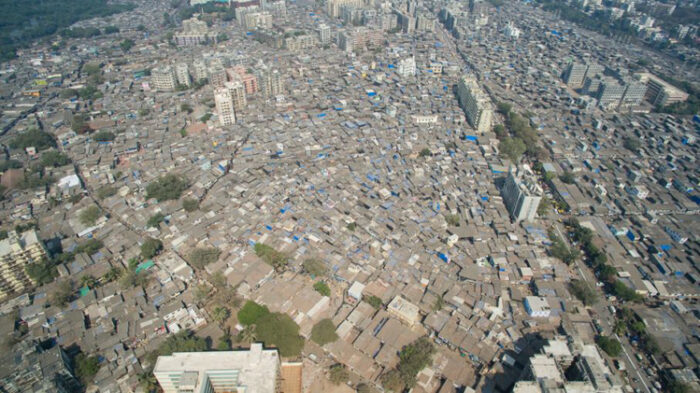
The slum is spread over some 6 sq km of land (520 acres) but houses 1.5 million people. The huts are separated by narrow lanes and most of the residents live cheek by jowl with other residents. Social distancing is virtually impossible.
“I reside near the building where one person has died from corona virus. The building has been sealed, but it has increased our worry that it will affect us too,” Jalil Ansari, a native of Giridih rued to eNewsroom over phone.
The inhabitants of most of these slums are migrant labourers, who work here in hundreds of small scale industries mainly making readymade garments, leather goods and pottery items. There are more 20,000 workers from Jharkhand who live in the tin-shed homes of Dharavi.
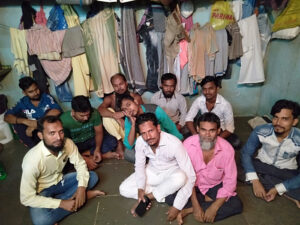
During lockdown, migrant workers from Giridih inside their house in Dharavi
Another worker from Jharkhand, Rupesh Kumar expressed his fear and the grim situation he is facing: “We are living in fear. There is the everyday challenge of fighting with hunger as our owners have disowned us, but we now have round the clock worry that we may get infected from the virus. It has made our life a living hell.”
Since the lockdown began – from the midnight of March 24 – only 10 to 20 per cent of the migrant workers from Jharkhand could move out. The rest are still stuck there.
Jharkhand’s social activist, Sikandar Ali, who works among migrants said: “I have visited and stayed with many of the migrant workers who belong to my native place. It is not possible to maintain social distancing in that area. Around 6 to 8 people live together in a room which is about 10X8 square feet. They do not have toilets, and go outside to public toilets.”
Independent report suggests that over 70 percent of Dharavi residents used community toilets.
While Jharkhand’s CPI-ML MLA Vinod Singh, who raises issues of migrant workers regularly told eNewsroom, “We know that the workers who are in Dharavi are facing a very difficult situation. But we are in touch with them as well as with the area MLA Varsha Gaikwad, who along with some NGOs are providing essentials items to them.”
“As we are in the middle of the lockdown and all the borders have been sealed, I would request all the workers in Dharavi to stay inside their homes and go out with precautions. We are trying to get food to them inside their houses,” added the Bagoder legislator.
As of 8:30pm on Friday, Maharashtra has the highest number of Covid-19 cases (335) and highest fatalities (16) in the country, according to mygov.in/covid-19/ site. In Mumbai alone 181 cases have surfaced and nine deaths have taken place in the maximum city.
India now has 2433 Covid-19 cases and so far 62 people have died from it across the country.
रांची: देश में जारी 21 दिनों के लॉकडाउन में सबसे ज्यादा परेशानी प्रवासी मजदूरों को झेलना पङ रहा है और इसमें झारखंड के मजदूर की संख्या लाखों में है, पर झारखंड मुक्ति मोर्चा का कहना है कि पिछले दिनों हुए दो विडियो कॉन्फ्रेंसिंग में प्रधानमंत्री नरेंद्र मोदी ने मुख्यमंत्री हेमंत सोरेन से कुछ भी बात नहीं की।
महासचिव सह प्रवक्ता, केन्द्रीय समिति, झामुमो, सुप्रियो भट्टाचार्य के हवाले से जारी आज एक प्रेस विज्ञप्ति में ये भी कहा कि प्रधानमंत्री मोदी ने आज सुबह जो आह्वान किया है कि अप्रैल 5 को रात 9 बजे देशवासी दीया-बाती जलाए, का विज्ञान के दौर में टोना-टोटका कर महामारी को टालने जैसा है और निराशा का संदेश देता है।
जेएमएम की आपत्ति
प्रेस विज्ञप्ति की शुरुआत में ही जेएमएम ने प्रधानमंत्री के आज के संदेश पर आपत्ति दर्ज की। “नॉवेल कोरोना (Covid-19) के कारण महाप्रलयकारी विश्व व्यापी मानवता को बचाने के इस संकट कालीन दौर में देश के प्रधानमंत्री द्वारा आज प्रातः 9 बजे देशवासियों के लिए दिए गए संदेश में झारखण्ड राज्य समेत समस्त देशवासियों को निराशा की तरफ ले जाने का संदेश मिला।,”
“विज्ञान और तर्क के इस युग में टोना-टोटका द्वारा इस महासंकट को टालने की जो कोशिश या पहल की जा रही है वह कहीं से भी उचित प्रतीत नहीं होता है”।
विज्ञप्ति में झारखंड के खस्ताहाल स्वास्थ्य संरचना को भी लिखा गया, “झारखण्ड जैसे अत्यंत दुर्गम एवं पिछड़े राज्य में जहां विगत पांच वर्षों में इवेंट के नाम पर खजाना खाली कर दिया गया एवं देश के समस्त मुख्यमंत्रियों से प्रधानमंत्री द्वारा विगत दिनों दो बार वीडियो कॉन्फ्रेंसिंग के जरिये संवाद स्थापित किया गया, लेकिन दुर्भाग्यवश दोनों ही बार झारखण्ड राज्य के मुख्यमंत्री श्री हेमन्त सोरेन जी से राज्य की पीड़ा एवं असुविधाओं के संबंध में कोई भी संवाद स्थापित नहीं किया गया।
“इस राज्य में विगत शासन के द्वारा जो खस्ताहाल स्वास्थ्य संरचना एवं आधारभूत सुविधाओं को नज़रअंदाज़ किया गया, उसके कारण राज्य में आज स्वास्थ्य सेवा को लेकर चिंता की स्थिति है”।
पार्टी के द्वारा जारी रिलीज में एक जगह बोल्ड अक्षर में भी लिखा गया,
“ताली-थाली, दीया-बाती से कोरोना के खिलाफ जंग नहीं जीता जा सकता। क्या घर की सारी बत्तियां बन्द कर देने से कोरोना किसी का घर पहचान नहीं पाएगा या टॉर्च जलाकर देशवासी अपने घर के बाहर निकल कर कोरोना को खोजने का काम करेंगे”।
ये भी ज़िक्र किया गया कि कैसे कोरोना वाइरस देश के बाहर आने-जाने वाले लोगों के तरफ से फैलाया हुआ एक महामारी है पर इसकी सज़ा देश के गरीब लोग उठा रहे हैं, “पासपोर्ट की खता बीपीएल, एपीएल सहित 80 प्रतिशत देशवासियों को चुकाना पड़ रहा है। यह समय इवेंट का नहीं हो सकता”।
और आखिर में मोदी सरकार से बकाया जीएसटी की मांग की गयी, “केंद्र सरकार अविलम्ब राज्य सरकार को सही अर्थों में यदि मदद करना चाहती है तो पर्याप्त मात्रा में हैंड सेनिटाइजर, N95 मास्क, स्वास्थ्यकर्मियों के लिए पर्सनल प्रोटेक्शन इक्विपमेंट, सेनिटाइजेशन मोबाइल यूनिट, वेंटिलेटर, Covid-19 डिटेक्शन किट, राज्य के बकाया जीएसटी एवं अन्य प्राप्य राशि का भुगतान कर सहयोग करे”।
Corona virus apparently has globally punctured the inflated egos of many megalomaniacs. Otherwise, did we ever expect that our Prime Minister to seek kshama (pardon), particularly, from the poor for imposing 21-day-long Lockdown, which has thrown our lives completely out of gear? Have we ever heard any words of regrets from Narendra Modi on Gujarat 2002 pogrom or Notebandi 2016? But the question which remains to be answered is – what prompted him to seek public forgiveness in the latest Man Ki Baat episode? Secondly, is this a sincere, heartfelt gesture or a mere publicity stunt, something which he has undoubtedly mastered over these many years?
The images of migrant workers- with children and their luggage trudging through highways to reach their homes in far off states on being thrown out of jobs in Delhi and other major cities, are inviting bad publicity in the international media. Even the most ardent ‘Godi’ media or the institution’s lapdogs could not suppress the images and reports of thousands stranded on the Indian streets, waiting desperately at bus depots and railway stations, despite knowing that the regime had stopped all public transports, albeit abruptly. Adding to their woes was the Centre’s refusal to make arrangements for alternative transport for those stranded on the streets, fearing that it would lead to proliferation of corona virus.
According to Media reports 22 hapless migrants- are dead during this exodus, while many have fallen sick on the roads due to exhaustion, hunger and chaos. Adding to the agony and misery of these migrant labours is the police harassment and brutality inflicted on them by the police trying to stop them from crossing the inter-state borders. The videos of them being forced to hop like frogs or being showered with chemical disinfectants en masse with their children bear an uncanny resemblance to the images of old-age imported slave families. They were disturbing even for the most complacent middle class supporters of Modi-Amit Shah regime, including their echo-chambers in social media.
Nevertheless, a primary study of Modi government’s moves before and after the lockdown including the series of government orders compels one to highlight the complete indifference and utter callousness towards the plight of the migrant labours and other poor Indians in the wake of his Tughlaq-style fiat. Given the fact that most migrant labours working in Delhi, Punjab and Haryana were from UP and Bihar, it’s most likely that Modi and his minions feared loss of substantial support among the poor in the Hindi heartland Hindus. They are more concerned about BJP’s main stronghold in UP and poll-bound Bihar where the party rules with JD(U). Perhaps that arithmetic made the Prime Minister ‘apologetic’ and forced UP CM Ajay Singh Bhist to make arrangement for buses to ferry some of the migrants to their destinations. But the allegations of Bhist charging over INR 600 to ferry the workers, may be left aside for a debate later.
According to the 2017 Report of the Working Group on Migration, Ministry of Housing and Urban Poverty Alleviation, ‘migration of labour is an important factor affecting the course of socio-economic development in India as about 28.3 percent of the workforce in India are migrants’. It stated, “Migrants fuel the Indian economy by carrying human capital to regions where it is needed, and enabling the acquisition of new skills and a better standard of living.”
Given the routine, we have become rather accustomed to our Mota Bhai’s monthly monologues. Although, it is always interspersed with carefully choreographed Vox Populi, the podcast is meant only for trumpeting the glory of his imperious governance and personality cult. He has stopped meeting media, except for the few chosen sycophants since his Gujarat years.
Most of his sweeping decisions have been announced through televisions behind the back of designated authorities like the RBI in case of the demonetization. Even his cabinet members have become inconsequential. His aversion to Parliamentary democracy became evident as he declared the momentous decision for prolonged lockdown on March 24 evening, immediately after the parliament was adjourned on the day.
Watch: a migrant labour walked 350 km- Kolkata to Giridih to reach his home
Government completely ignored the Migrants
India’s internal migrant labours, both inter-states and intra-states can’t be ignored both on the count of humanitarian and economic ground. Mostly absorbed in unorganized sectors and urban households, a huge number is engaged in agriculture and other rural work. The population is more than the official estimate of 45.14 crore since census data is a decade-old and enumerators could not reach many migrants.
According to the 2017 Report of the Working Group on Migration, Ministry of Housing and Urban Poverty Alleviation, ‘migration of labour is an important factor affecting the course of socio-economic development in India as about 28.3 percent of the workforce in India are migrants’. It stated, “Migrants fuel the Indian economy by carrying human capital to regions where it is needed, and enabling the acquisition of new skills and a better standard of living. According to Census 2011, there were 454 million migrants in India. This had risen by 139 million from 315 million in 2001 in Census 2011 and 220 million in 1991, a doubling over 1991-2011.”
Even a week after media and social media went agog on the post-lockdown plight of those people, the centre’s ‘advisory to the states on quarantine of migrants’ on March 31 had no mention of government’s role in ensuring food and shelter including medical facilities for the poor who can’t afford it, after losing their livelihoods and homes in big cities.
Uttar Pradesh and Bihar are the biggest source states, followed closely by Madhya Pradesh, Punjab, Rajasthan, Uttarakhand, Jammu and Kashmir and West Bengal. The major destination states are Delhi, Maharashtra, Tamil Nadu, Gujarat, Andhra Pradesh and Kerala.
However, the annexure to the Ministry of Home Affairs order no. 40-3/2020-D 24.3.2020, the day Modi declared the lockdown, it did not mention any dos and don’ts for the government agencies regarding stranded people including migrant labours.
Even a week after media and social media went agog on the post-lockdown plight of those people, the centre’s ‘advisory to the states on quarantine of migrants’ on March 31 had no mention of government’s role in ensuring food and shelter including medical facilities for the poor who can’t afford it, after losing their livelihoods and homes in big cities.
It only stressed on the proliferation of the virus, which can be caused by the migrant workers during their journey and after reaching home. “Migrant workers from peri-urban and rural parts of the country who migrate to large cities constitute a sizable segment of urban population across the country. During outbreak of a communicable disease or social distancing measures as being undertaken for Covid-19 pandemic, such populations tend to return back to their homes. In such a scenario, the resultant congregations of migrant workers in bus stations/state borders may make them susceptible to Covid-19 infection. Further such exposed individuals may later become infected and carry this infection to far flung rural localities. Also it would be difficult to track them and their contacts,” reads the official statement released by the centre.
The Health Ministry advisory on April 1 asked the states to follow the directives laid down by the Apex Court. But the centre has clearly washed its hands in this issue – caring for the poor migrant workers stranded on the streets. If the advisory offers any glimpse into the Leviathan’s mind.
It further ordered, “The migrant workers will remain at their regular place of work/local residence within the city. They will not be evacuated either by their employer/landlord. Action to this effect and to address other related issues will be taken by local administration as per advisories being issued by Ministry of Home Affairs.” Ironically, by the time this order was formulated, most of the landlords and employers have got rid of their troubles, who are now left stranded on the streets!
SC orders to help the migrants
It was only after some public interest litigations was filed in Supreme Court and the highest judiciary intervened to stop the migrants but also asked the state government to make arrangements for their upkeep while dealing with them humanly. The Health Ministry advisory on April 1 asked the states to follow the directives laid down by the Apex Court. But the centre has clearly washed its hands in this issue – caring for the poor migrant workers stranded on the streets. If the advisory offers any glimpse into the Leviathan’s mind.
It said: “The Hon’ble Supreme Court of lndia while disposing the Writ petitions No. 468/2020 & 469/2020 in public interest for redressal of grievances of migrant laborers in different parts of country has given the following directions: i) The migrant workers in Relief camps/shelter homes should be provided adequate medical facilities besides proper arrangements for food, clean drinking water and sanitation. ii) The trained counselor and/or community group leaders belonging to all faiths will visit the relief camps/shelter homes and deal with any consternation that the migrants might be going through.”
It also mentioned: “The anxiety and fear of the migrants should be understood by the police and other authorities and they should deal with the migrants in a humane manner. The state governments/union territories should Endeavour to engage volunteers along with the police to supervise the welfare activities of the migrants and all concerned to appreciate the trepidation of the poor men, women and children and treat them with kindness.”
Shillong: The northeast states are on alert after several incidents of racism against youths from the region in mainland India.The Manipur government launched an app on Tuesday for reaching out to those from the state living outside the region. The mobile app, named Tenbang, will help youths register themselves.
“Many of them are stuck outside as flights and trains have been cancelled. We are trying to reach out to them. They can register so that even in case of financial need, the state government can transfer money to their bank accounts. For any other help too, they can use the app,” said Manipur Chief Secretary Suresh Babu, adding that Tenbang website already exists for receiving aid for fighting Corona virus.
There is also a toll-free helpline managed by the Centre which takes complaints. “We have designated a resident commissioner in Delhi who is in touch with other states. On Monday, we have designated two senior secretaries for each state and their contact numbers have been circulated,” Suresh Babu said.
Cases of harassment of Manipuri residents have been reported from Pune, Hyderabad and Bengaluru. A man has been arrested in Delhi for spitting on a woman from Manipur.
The chief secretaries of the Northeastern states are also coordinating among themselves and “are in constant touch with each other through a WhatsApp group”, informed Arunachal Pradesh Chief Secretary Naresh Kumar.
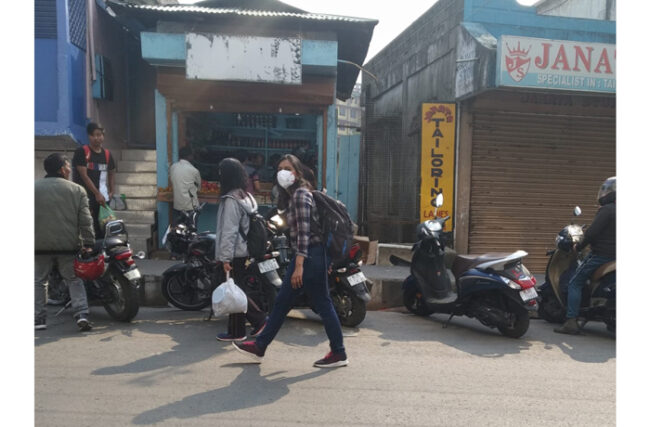
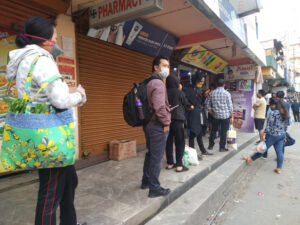
Northeast people stand at a shop (maintaining social distancing) to buy groceries
Talking about his experience of working in tandem with other states, Kumar said, “Whenever any news of any type of problem being faced by our students in any part of India was reported, my experience is that concerned state administration responded quickly. My experience with the governments of Telangana, Uttarakhand, Assam and Tamil Nadu in the last one week was positive.”
According to Kumar, the main problems now are crisis of food rations, rental accommodation and that many locals are stuck midway. “The Uttarakhand chief minister has made arrangement for rations for our students. I believe this is the time to work in a harmonious environment by all of us,” he added.
Nagaland Chief Secretary Temjen Toy recently tweeted his email ID and his team’s contact numbers so that locals facing racial discrimination can seek help.
“There are many Nagas stranded in several cities like Bengaluru, Mumbai and Kolkata and I have been in constant touch with states. This racial profiling is a sad thing and nobody likes it. But the main issue now is that our people, wherever they are, should not be stranded and feel helpless. I am addressing that issue first. The profiling other things are most unfortunate and should not happen anywhere. I am grateful to the chief secretaries of Maharashtra and Karnataka who responded to my letters and they appointed nodal officers. Many other states have also done that,” he said.
Recently, two Naga youths were not allowed to buy groceries from a shop in Mysuru. The video went viral and caused much uproar. Meghalaya Chief Minister Conrad Sangma got in touch with Mysuru MP Pratap Simha to address the issue of racial profiling of people from the Northeast.
Meghalaya Home Minister Lahkhmen Rymbui said the Centre has “clearly notified that these kinds of things should not be tolerated”.
“The Centre is taking it seriously and I hope that such things will not happen in future. In this time of crisis, we should all work together irrespective of our caste, creed and religion,” said Rymbui, adding that the Bengaluru police commissioner has already taken action after the Mysuru incident was brought to his notice.
Though “it is not possible to deploy officials in every state”, the Meghalaya government is trying to promptly respond to complaints, Rymbui said.
Two youths from Shillong were harassed in Kolkata more than once.
Lalnunmawia Chuaungo, the chief secretary of Mizoram, said so far there has been no report of any Mizo resident being harassed and “if it is outside the state then it is the responsibility of the respective states” to ensure safety.
“Discrimination is against the people of Northeast and we are not outside the purview. Though we have not received any specific complaints we are compiling all details so that we can reach out to them,” Chuaungo said, adding that Mizoram does not have presence in all states in the form of liaison offices and “we have to depend on the respective Mizo civil societies and state governments for help”.
Workers stranded in Mizoram are also being provided food and shelter, he informed.
Recently, a video of a woman covering her mouth at a mall in Pune when she saw another woman from Mizoram went viral on social media. The Pune Mirror quoted the Mizo woman as saying, “I have lived and worked here for ten years. Just recently, two instances of intolerance have left me sad and insecure.”
News reports also said a girl from Assam was harassed in Delhi.
Assam chief secretary Kumar Sanjay Krishna said he has not received any complaint about incidents of racial discrimination and he is in constant touch with the resident commissioner in Delhi. “If I hear anything about discrimination, I will take it up immediately with that state government concerned,” be added.
Assam too is coordinating with authorities concerned and the police to prevent such incidents, especially at a time when the country is facing a crisis.
Union Minister Kiren Rijiju took up the issue of racism with the North East division in the Ministry of Home Affairs. Advisories were also issued in this regard.
Prime Minister Narendra Modi has a penchant for exploring new avenues for collecting money from public. The latest is the surreptitious creation, on March 28, of ‘Prime Minister’s Citizen Assistance and Relief in Emergency Situations Fund’ or ‘PM CARES Fund’. A Press Information Bureau (PIB) release said: ‘Keeping in mind the need for having a dedicated national fund with the primary objective of dealing with any kind of emergency or distress situation, like posed by the COVID-19 pandemic, and to provide relief to the affected, a public charitable trust under the name of ‘Prime Minister’s Citizen Assistance and Relief in Emergency Situations Fund’ (PM CARES Fund)’ has been set up. Prime Minister is the Chairman of this trust and its Members include Defence Minister, Home Minister and Finance Minister.
Prime Minister’s latest venture invited instant criticism from different quarters. Noted historian Ram Chandra Guha tweeted: ‘Why a new fund when a Prime Minister’s Relief Fund exists? And why the self-aggrandizing name, PM CARES? Must a colossal national tragedy also be (mis)used to enhance the cult of personality?’ Guha also wanted to know when it was decided to form a Public Charitable Trust, what the compelling reasons to do so were, and what were the advantages of forming a new Public Charitable Trust as against the existing Prime Minister’s National Relief Fund (PMNRF). Guha wondered why ‘cronies like Akshay Canada Kumar, Vijay PayTM, Jay BCCI Shah etc are falling over each other to donate to this freshly baked Public Charitable Trust instead of the institutionalised PMNRF’.
Congress, too, wondered what was the need to create a separate trust when Rs 3,800 crore was lying unused in PM National Relief Fund. Party leader Shashi Tharoor said in a tweet: ‘PM, you owe the country an explanation for this high unusual step’. Congress spokesperson Gaurav Vallabh said that when Rs 3,800 crore were remaining unused in the PM National Relief Fund, what was the need to have a separate trust in the name of PM CARES.
Modi had created another Fund only a few months after becoming Prime Minister in 2014. It was called Swachh Bharat Kosh (SBK) and consisted of contributions received from Corporate Sector, philanthropists and individuals. Its objective was to ‘clean’ India by 2019. Nothing has since been heard of this Kosh; how much money it received and how that was spent. Besides, almost all municipal corporations and municipal committees in the country collect from the residents cleanliness cess. Was there any mechanism developed to coordinate utilisation of the money collected by SBK and local bodies?
Prime Minister’s National Relief Fund was created in January 1948 by then Prime Minister Jawaharlal Nehru to help the people subjected to violence and displacement following the partition of India. The resources of the PMNRF are utilised primarily to render immediate relief to families of those killed in natural calamities like floods, cyclones and earthquakes, etc, and to the victims of the major accidents and riots. Assistance from PMNRF is also rendered to defray the expenses for treatment like heart surgeries, kidney transplantation, cancer treatment and acid attack among others. The fund consists of only public contributions.
Modi had created another Fund only a few months after becoming Prime Minister in 2014. It was called Swachh Bharat Kosh (SBK) and consisted of contributions received from Corporate Sector, philanthropists and individuals. Its objective was to ‘clean’ India by 2019. Nothing has since been heard of this Kosh; how much money it received and how that was spent. Besides, almost all municipal corporations and municipal committees in the country collect from the residents cleanliness cess. Was there any mechanism developed to coordinate utilisation of the money collected by SBK and local bodies?
The Modi government had, in the meantime, mischievously introduced Electoral Bonds, apparently in flagrant violation of the Constitutional provisions. The Election Commission had expressed the apprehension in its communication to the government that the Electoral Bonds would lead to money laundering by setting up of shell companies for diverting funds for donating to political parties. Needless to say that Modi’s party has been the major beneficiary of the scheme. Constitutional validity of Electoral Bonds scheme was challenged in the Supreme Court. The matter got stuck there as then Chief Justice of India Ranjan Gogoi succumbed to sexual harassment blackmail and changed the goal of his life.
Views expressed here, are the author’s personal opinion
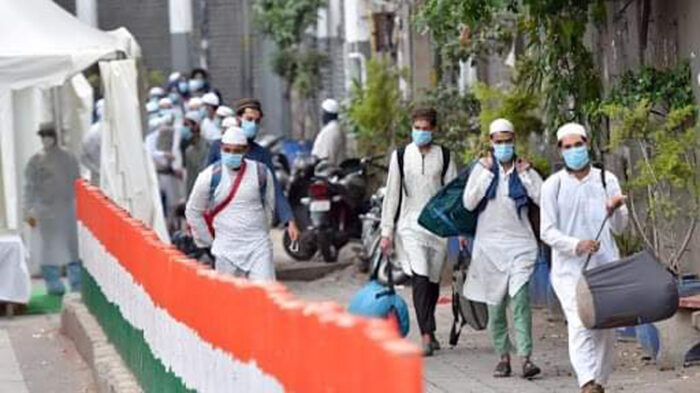
New Delhi: Even as the Delhi government sought to lodge a first information report (FIR) against the Tablighi Jamaat for allegedly violating coronavirus guidelines, the Muslim group refuted the charges saying it complied with the norms by stopping any gathering besides informing the authorities about the preachers trapped inside due to lockdown.
After several people who had attended an ‘ijtema’ (congregation) organised by the Tablighi Jamaat at its markaz (headquarters) in Nizamuddin West on March 15 developed symptoms of COVID-19 infection, they were rushed to Delhi government’s hospitals on the intervening night of March 29-30 and even later. The government said their screenings were being conducted.
The congregation was attended by people from Kyrgyzstan, Saudi Arabia, Indonesia and Malaysia. While six men from Telangana, who attended the congregation died in Telangana on March 15, a visitor died last week in Srinagar. Before coming to Delhi, the deceased had also gone to the Deoband seminary in Uttar Pradesh.
According to Delhi Health Minister Satyendra Jain, 24 attendees were tested positive, 700 were quarantined in Nizamuddin West area and at least 335 admitted in hospitals.
IS MORALITY RESPONSIBLE WHERE LEGALITY FAILS?
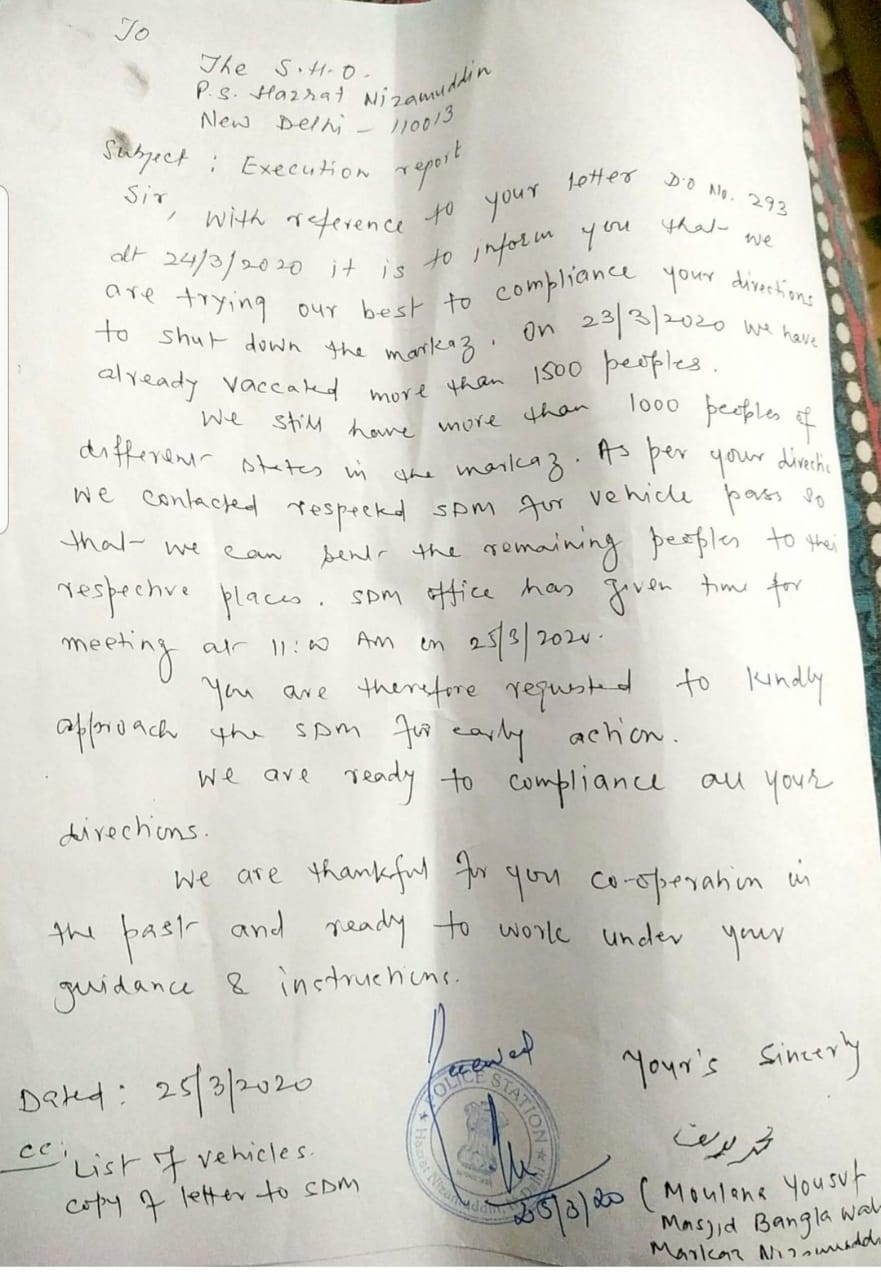
However, documents accessed by Newsclick suggest serious lapses on the part of the city administration. Following the sudden lockdown announcement on March 24, the markaz administration, in a press release, said it had sent out an execution report to the Nizamuddin Police Station, informing them that 1,500 people, who were present in the headquarters, were sent back. Over 1,000 people were still at the premises and unable to leave in absence of required vehicles’ passes and cancellation of trains, it said.
The markaz administration also claimed it contacted the SDM the same day and got an appointment for the next day. They were given an appointment on March 25 at 11 a.m. It said no urgency was exhibited from SDM’s side.
The markaz also urged the SHO to expedite the matter so that the people who were stranded could be sent back to their respective states.
“With respect to your letter D.O. No. 293 dated March 24, 2020, it is to inform you that we are trying our best to comply with your directions to shut down the markaz. On March 23, 2020, we have already vacated more than 1,500 people. We still have more than 1,000 people of different states in the markaz. As per your direction, we contacted respected SDM for vehicle pass so that we can send the remaining people to their respective places. The SDM office has given time for meeting at 11 a.m. on March 25, 2020. You are therefore requested to kindly approach the SDM for early action. We are ready to comply all your directions,” reads the application dated March 25 signed by one Maulana Yousuf, seen by Newsclick.
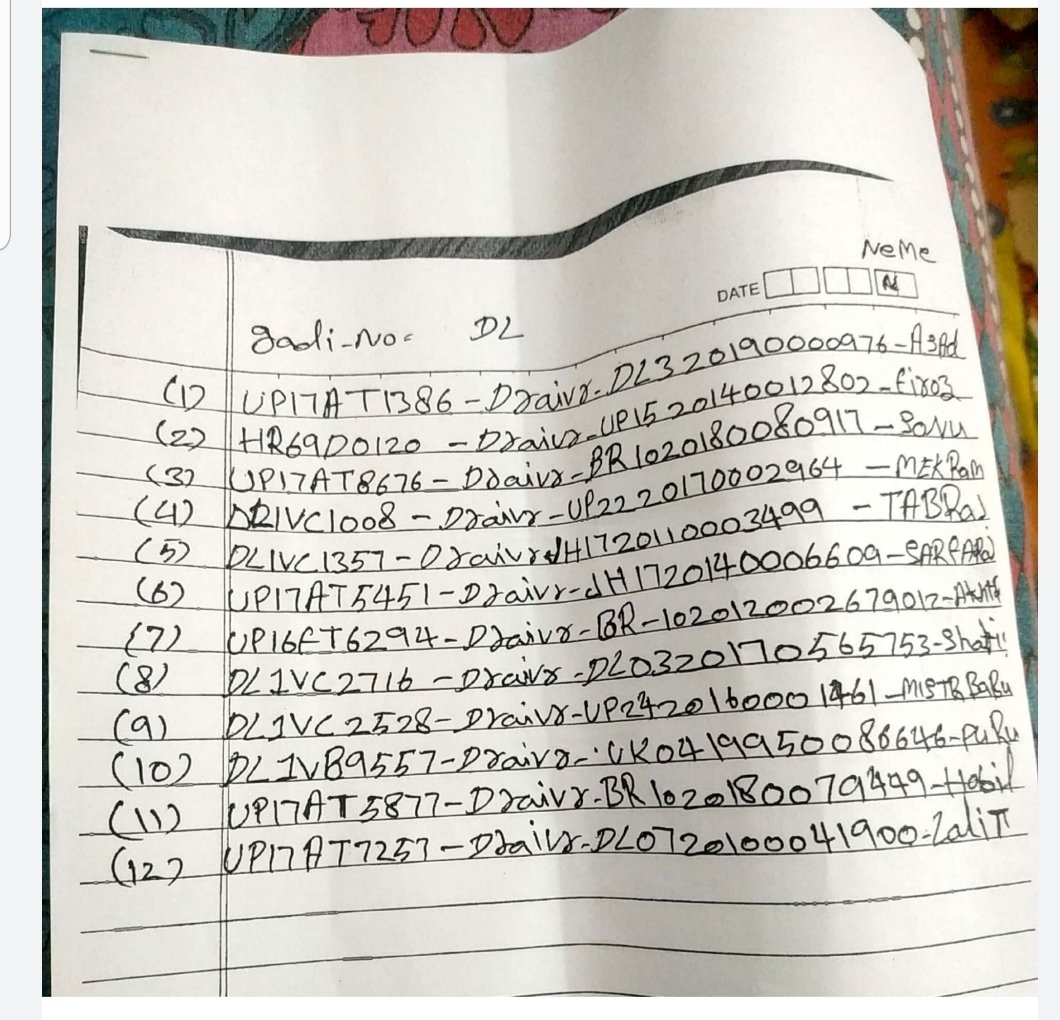
A list of 17 vehicles with their registration number and drivers’ names and licence numbers were annexed with the application, said the press release.
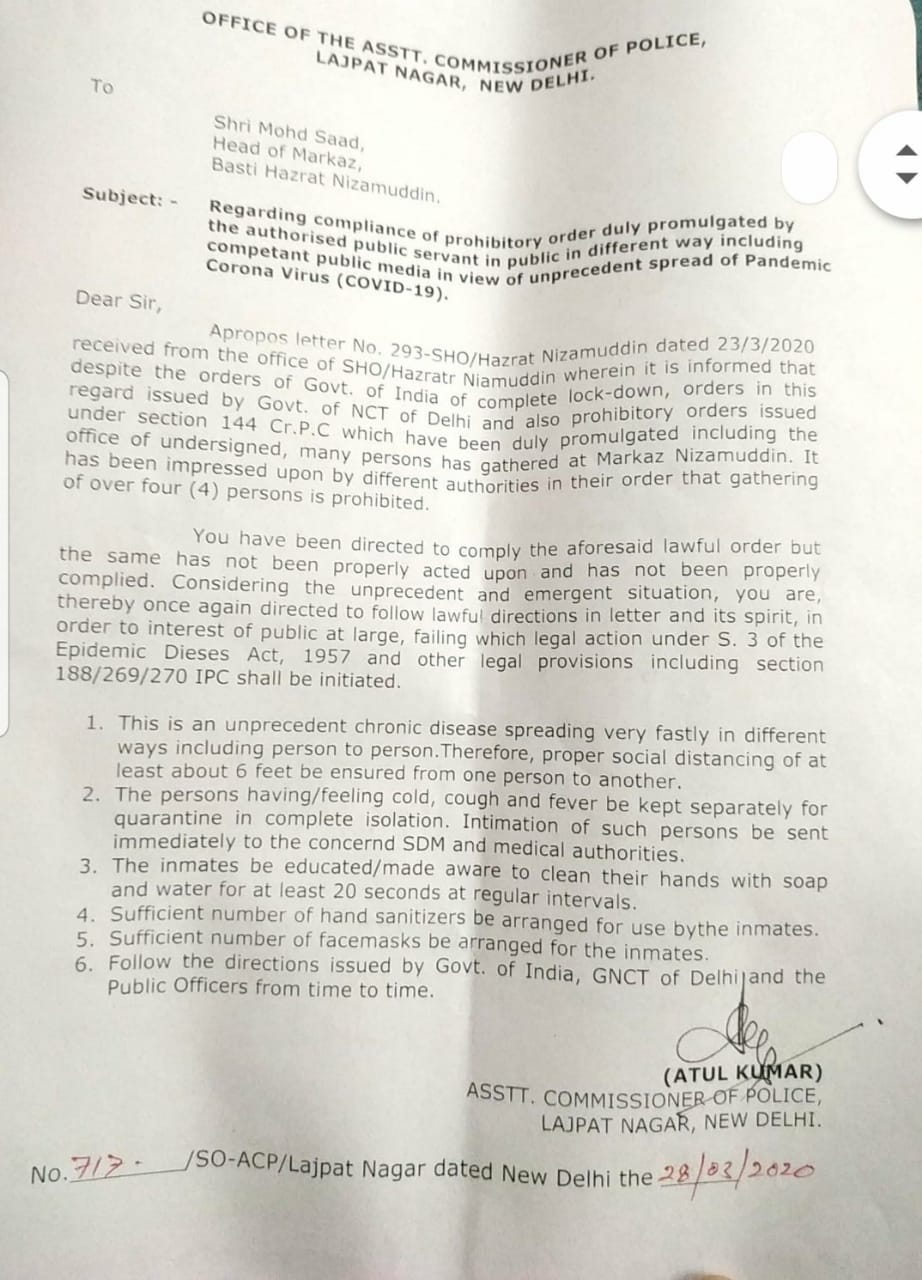
Despite the compliance report-cum-application already sent to the SHO, Hazrat Nizamuddin Police Station, a letter dated March 28 was sent out by Atul Kumar, assistant commissioner of police (ACP), Lajpat Nagar, saying the “order has not been properly acted upon”. He asked the markaz administration to consider the unprecedented and emergent situation. A warning was sent out of legal action under Epidemic Diseases Act 1957.
“Apropos letter number 293-SHO/Hazrat Nizamuddin dated March 23, 2020 received from the office of SHO/Hazrat Nizamuddin wherein it is informed that despite the orders of the Government of India of complete lock-down, orders in this regard issued by the Government of NCT of Delhi and also prohibitory orders issued under Section 144 Cr.P.C. which have been duly promulgated, including the office of undersigned, many persons have gathered at Markaz, Nizamuddin. It has been impressed upon by different authorities in their order that gathering of over four (4) persons is prohibited.”
“You have been directed to comply the aforesaid lawful order but the same has been properly acted upon and has not been properly complied. Considering the unprecedented and emergent situation, you are thereby once again directed to follow lawful directions in letter and its spirit in order to interest of public at large, failing which legal actions under Section 3 of the Epidemic Disease Act, 1957 and other legal provisions, including sections 188/269/270 of the IPC (Indian Penal Code) shall be initiated,” read the letter listing out six directions such as ensuring social distancing of at least six feet, quarantining and keeping in complete isolation those who feeling of cold, cough and fever and immediately informing concerned SDM and medical authorities about the same, educating the inmates to wash their hands with soaps on regular intervals, making arrangements of sanitisers and face masks for the inmates and following the directions issued by the Delhi government and public officers.
The permission letter
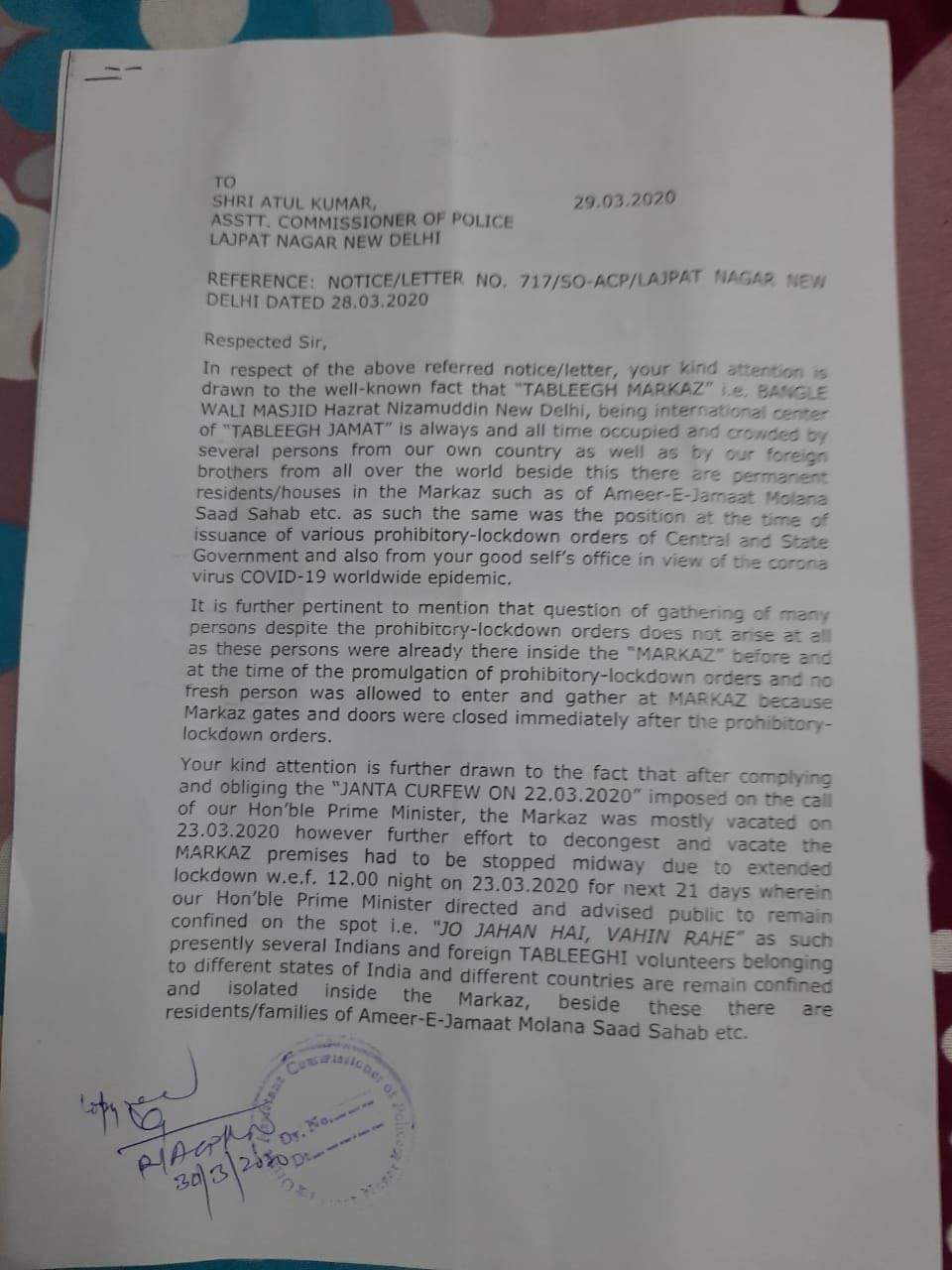
The letter was replied by the markaz administration on March 29 where in it was stated that ‘Tableegh Markaz’ i.e. Bangle Wali Masjid, Hazrat Nizamuddin, New Delhi, being “international centre” of Tablighi Jamaat is “always and all time occupied and crowded by several persons from our country as well as by our foreign residents”.
“The same was the position at the time of issuance of various prohibitory lock-down orders of the Central and state governments and also from your good self’s office in view of the coronavirus worldwide epidemic,” reads the letter, which countering the allegation of gathering in the headquarter despite lock-down states that “…the question of gathering of many persons despite the prohibitory-lockdown orders does not arise at all as these persons were already there inside the markaz before and at the time of the promulgation of prohibitory-lockdown orders and no fresh person was allowed to enter and gather at the markaz because all the doors were immediately closed after the lockdown orders”.
The markaz claimed that it complied the “Janta Curfew” on March 22 announced by Prime Minister Narendra Modi. It further said that the markaz was “mostly vacated” on March 23. “Further efforts to decongest and vacate the markaz premises had to be stopped midway due to extended lockdown with effect from 12 night on March 23 for the next 21 days wherein the Honourable Prime Minister had directed and advised the public to remain confined on the spot where he is. Therefore, several Indian and foreign Tablighi volunteers remained confined and isolated inside the markaz,” read the letter written to the ACP.
When contacted, the SDM and the ACP refused to comment on the entire episode.
THE MARKAZ’S RESPONSE
In a press statement released on Tuesday, the markaz said visitors, guests, devotees, worshippers from across the globe throng the place for pre-scheduled programmes lasting for no more than three-five days. All the programmes are decided a year in advance in order to facilitate visitors from far-off places to plan their participation, it added.
It said that when Prime Minister Modi announced the ‘Janta Curfew’ for March 22, the ongoing programme was discontinued immediately; however, due to sudden suspension of rail services across the country on 21st March 2020, a large group of visitors who had to depart by way of railways got stuck in the markaz premises.
The release went on to add that on March 22, ‘Janta Curfew’ was observed and accordingly visitors were advised not to venture out until 9 p.m as desired by the Prime Minister.
“Therefore, the plans of people to move back to their native places by way of means other than railways also did not materialise. Before the ‘Janta Curfew’ could be lifted at 9 pm, Delhi Chief Minister Arvind Kejriwal announced complete lock-down of the city, beginning at 6 am on March 23, till March 31, thereby further diminishing any chances of these visitors availing road transport for their journey back home. Despite this challenging situation, with the help of the markaz administration, around 1,500 visitors left the Nizamuddin headquarters by availing whatever meagre transport was available,” the statement added.
The markaz said thereafter, on March 23 evening, a further nationwide lockdown was suddenly announced by the Prime Minister, with a clear message for people to stay wherever they are.
“Under such compelling circumstances, there was no option for the Markaz Nizamuddin but to accommodate the stranded visitors with prescribed medical precautions till such time that situation becomes conducive for their movement or arrangements are made by the authorities” the release added.
“On 24th March 2020, suddenly a notice was issued by the SHO, Hazrat Nizamuddin Police Station, seeking closure of markaz premises. The same was responded on March 24, stating that the compliance of the directions regarding closure of the markaz is already underway and around 1,500 people had departed the previous day, thus leaving around 1,000 visitors belonging to different states and nationalities in the markaz,” it said, further clarifying its position.
“It was also informed that the SDM concerned had been requested to issue vehicle passes so that the remaining people could be sent back to their native places outside of Delhi. It is relevant to indicate here that lists of 17 vehicles with registration numbers along with the names of the drivers plus their license details were submitted to the SDM so that the stranded visitors/guests could be ferried towards their destination. The requisite permission is still awaited,” it added.
The markaz claimed that on March 25, the Tehsildaar along with a medical team visited and got “full cooperation” for their inspection and preparation of a list of visitors, many of whom were examined by them.
“On March 26, the SDM visited Markaz Nizamuddin and called us for a further meeting with the District Magistrate. We met the DM, apprised him of the stranded visitors and once again sought permission for the vehicles arranged by us,”
The next day (March 27), six persons were taken for medical check-up. On March 28, the SDM and a team of the World Health Organisation (WHO) visited the markaz and 33 people were taken for medical check-up to Rajiv Gandhi Cancer Hospital, the release added.
“Surprisingly, on the same day, another notice was issued. This time by the Office of the ACP, Lajpat Nagar, reiterating the prohibitory orders and warning of legal action, this being totally oblivious of the above deliberations and steps that had already been taken by Markaz Nizamuddin in consultation with the authorities. However, the same was replied in detail vide letter dated March 29” the release said.
The markaz said after rumours started gaining ground on Monday across the social media that COVID-19 infected people were present in the markaz and certain deaths had occurred due to the same, the Delhi Chief Minister Arvind Kejriwwal, as per ANI, said he had directed the authorities to take legal action against the administration of the markaz.
“If the above fact-check would have been done by the Office of the Chief Minister, the authorities would have apprised him about their visits, deliberations and cooperation extended by the markaz in order to disperse the remaining visitors,” the release said.
The Markaz Nizamuddin claimed that during this entire episode, it had “never violated any provision of law and always tried to act with compassion and reason towards the visitors who came to Delhi from different states. It did not let them violate the medical guidelines by thronging ISBTs or roaming on streets.”
It also offered its entire premises as a quarantine facility to help the authorities tide-over the challenge of the current pandemic, adding that throughout its 100-year existence, it had an “unblemished history” of cooperating with administration/authorities and always upholding the rule of law in letter and spirit.
SELECTIVE TARGETING?
It be noted that in the wake of the novel coronavirus outbreak, Section 144 of CrPC was imposed in Delhi with effect from 9 p.m on March 22 to 12 midnight of March 31.
Chief Minister Arvind Kejriwal had said that no gathering of more than five people would be allowed.
The Tablighi Jamaat claimed it had already vacated 1,500 people. And they could not move the rest over 1,000 people because a complete shutdown was announced on March 24 and that they were assisted by the district administration in de-congestion.
On March 5, the Union Ministry of Health and Family Welfare had issued an advisory, asking people to avoid mass gathering and stay indoors. But on March 13, the government refused to call it a “medical emergency” despite the fact that the number of positive cases had risen to 81.
The Vaishno Devi pilgrimage, which is a much larger gathering, was stopped on March 18. The fact is that when the Tablighi Jamaat’s congregation happened on March 15, Parliament was in session. Madhya Pradesh MLAs were herded together in Bangalore. Several mass gatherings, some of them were political, had been organised.
Several video footages also emerged of people defying the ‘Janta Curfew’ and coming out on roads in large numbers to clap and clang utensils on the call of the Prime Minister.
In fact, the Congress has also questioned how UP chief minister Adityanath could defy the countrywide 21-day lockdown the very next day by landing up in Ayodhya with a huge crowd.
Ranchi/Kolkata: United States (US) national Franz Gastler, founder of Non-Governmental Organisation (NGO) Yuwa, has trained and empowered many tribal girls, was recently forced to move out of Hutup village in Jharkhand, as some locals thought he could bring in Corona infection to them. This village had been his habitat for 10 years. eNewsroom talked to the coach, who is now living at a friend’s place in Ranchi.
eNewsroom: How are you now?
Franz: We’re grateful to all of our friends in India for their amazing messages of support. So many people have called to ask us, requesting us to stay with them. Indian hospitality is legendary. Even the owner of the saloon where I used to get my hair cut for years messaged me asking us to stay with his family for as long as we’d like.
eNewsroom: Where are you staying now in Ranchi?
Franz: We’re staying with a close friend and his family.
eNewsroom: What was your reaction when you heard people talking about you?
Franz: There are always people who are going to make problems. Recently, a woman demanded that one of our young coaches teach her English to her son. When our coach refused, saying her classes were only for the girls in her football team, the lady went door-to-door telling people not to send their daughters to Yuwa, alleging that we would sell their daughters. She even told people the reason for Yuwa giving milk shakes to our players was to fatten them so that we get a better price when we would traffic them. Some ill-intent and rumors are normal. What makes the situation different now is the growing panic over COVID-19 and we realized that this rumour was much more dangerous for our family.
eNewsroom: What was your family’s reaction?
Franz: Our families are concerned but they trust our judgement and are very supportive.
eNewsroom: Did anyone stop you when you decided to move out of the village?
Franz: No, we’d requested an escort from the SSP Ranchi because officially no one was allowed to travel because of the lockdown.
Jubilant Yuwa girls during a football match (file picture)
eNewsroom: What next? Do you plan to go back to the village again?
Franz: Definitely. Our work will continue once the COVID panic dies down and the government gives the order to reopen schools and sporting activities.
eNewsroom: What has been the local administration’s response to the whole episode?
Franz: They’ve been excellent! The SSP Ranchi and Ormanjhi thana were quick to respond, and very kind. My wife and I volunteered for a medical check at Medanta Hospital to assure everyone we’re healthy, and completed that, even after the head of the Jharkhand health department told me several times none of us need a test since none of us had traveled recently. Also, we were concerned that we might get exposed to the virus by visiting a hospital. We got the all clearance from the doctors there. The DC of Ranchi has also responded to my request to sent a few medical professionals to our area to facilitate the medical check-up of our young coaches who are being harassed by some people in their communities and are blaming them for COVID-19 pandemic. They are saying, “You travel and associate with foreigners.”
eNewsroom: Being from the US, how did you land up in Jharkhand?
Franz: I started Yuwa in 2009 with three of my high school friends from Minnesota. I did my BA and Masters from the University Professors programme at Boston University, and completed the Programme on Negotiation at Harvard Law School. I was driven by a curiosity to understand the real dynamics at the so-called “Bottom of the Pyramid”. Supported by Sam Pitroda, I first came to India to work with CII on corporate CSR models in Gurgaon. After a year, I left CII to get a more real on-the-ground experience, and landed in an NGO in Jharkhand. I left the NGO to do something more meaningful and impactful – living in a village and starting youth programmes. Originally, Yuwa was a scholarship foundation for hard-working students from a government school to attend a private English medium school. My other co-founders and I pooled our money together for the scholarships. The scholarship programme didn’t work out, but it led to other things.
eNewsroom: Tell our readers about your work at Yuwa.
Franz: In rural Jharkhand, 6 in 10 girls drop out of school and become child brides. Jharkhand has the lowest ratio of teachers per government school in India, and is among the worst for female literacy. The state ranks among the worst for human trafficking and sanitation. These key issues create challenges for empowering girls and women. Yuwa aims to put girls’ futures back into their own hands – to rewrite the script that society has assigned to them. Yuwa does more than simply delay marriages until the age of 18. We are enabling girls to break the cycle of poverty and make powerful decisions about their futures. Our intensive, holistic programmes provide girls with the tools and skills they need to reach their full academic potential, develop critical and creative thinking skills, and become compassionate, empowered leaders in their communities.
Currently, Yuwa has 51 young coaches who have come up through our programmes. Around 43 of these coaches are girls between the age of 14 and 22. These coaches lead daily practices and life-skills workshops for over 500 girls who participate in Yuwa’s football programmes. They act as positive role models and mentors, inspiring hundreds of girls to dream of a different future.
eNewsroom: US is also battling a major outbreak? Are you in touch with your friends there?
Franz: Like most countries, the US was unprepared and it looks like we missed a lot of opportunities to slow the spread of the virus. My friend who’s a nurse said they haven’t seen any cases yet in Minneapolis but the hospital is bracing for it. Another friend moved out of San Francisco with his family before the lockdown and is staying at an Airbnb in rural California until July. When we really take a hard look at the disregard and cruelty with which we as a global society treat animals – both wildlife and animals in agriculture – it’s hard for any of us to just point a finger at China. Their meat markets are barbarous, and yet our industrial poultry farms and slaughterhouses in the US are as bad or worse.
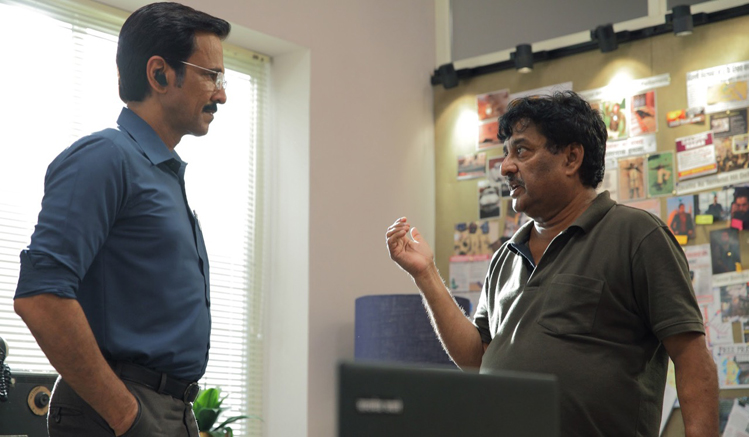
Special Ops, the six-and-a-half hour, eight part web series, co-directed by Shivam Nair and Neeraj Pandey of A Wednesday, Baby, MS Dhoni: The Untold Story fame, has been the talk of the town off late. This espionage thriller which is airing on Hotstar Originals since March 17, is a slow burning thriller based on the 2001 Parliament Attack.
Nair who had earlier partnered with Pandey to direct Tapasee Pannu starrer thriller Naam Shabana, engaged for a short chat with eNewsroom, on the first Sunday of 21-Day lockdown in India to break the chain of Covid-19. Following are the excerpt from the conversation that transpired:
eNewsroom: What made you excited to direct a web series?
Nair: Neeraj (Pandey) is the creator of this web-series. He has even co-scripted this espionage thriller. When he discussed this story with me, then it was just a three-page-tale. But the story line was very interesting and engaging. The script narration, in a way, made me say yes to this thriller.
eNewsroom: What is the essence of Special Ops?
Nair: The story is the hero of our series. The twist that this series has makes it worthwhile to watch. We all knew that five terrorists were involved in the 2001 Parliament attack. But while narrating the script Neeraj informed me there were six involved in the dastardly attack. So this web-series is about the 19-year-long search for the sixth man by the RAW officer, played by Kay Kay Menon.
eNewsroom: How is Special Ops different from other web series?
Nair: The speciality of our series are the characters that we have created. The narration, character building and the thickening of the plot is similar to reading a novel. Just like when we finish reading a book the characters linger on our mind, similar will be the experience of the viewers who will watch our web-series.
eNewsroom: What is special about the cast of Special Ops? Was it done with an agenda?
Nair: Neeraj has done the casting and he has excelled in it. He has chosen the best cast. Actors like Kay Kay Menon, Divya Dutta, Vinay Pathak, Sharad Kelkar, or for that matter even the lesser characters of this web-series have been selected in such a way that they add on the natural progress of the plot. Every character has been minutely layered and all of them have earnestly played the part to perfection.
eNewsroom: Can you tell us about the bond you share with Neeraj owing to your long association with him?
Nair: I have known Neeraj for years now. I had read the script of A Wednesday even before it was made into a film. Talking about him, he is a very disciplined and creative person and is extremely passionate about his work. This discipline and passion reflects in his team too. Every time he surprises me with his creativity. This is the reason for me having said yes to his offer to co-direct Naam Shabana with him. And after that as they say, rest is history.
Kolkata: Prime Minister Narendra Modi might have asked the general public to applaud the doctors and caregivers at 5 pm when Janata Curfew was on. But weeks later people who applauded the doctors working round the clock during the COVID-19 pandemic break out are using social media to spread rumours about the doctors.
Take the instance of Khan Imran, who took to Facebook to warn people from visiting Bright Street Area, in Kolkata’s Park Circus area. Imran alias Emy, wrote on his FB wall, “Avoid going to Bright Street Area as Dr Mustaq has returned with Corona positive, after a patient having symptoms of high fever recently returned from Canada visited him. His family has been kept in isolation and the chamber has been sealed by police! (sic),” on March 27. The post, when eNewsroom last checked his FB profile, seems to be deleted.
The same message around the same time was doing the rounds in the WhatsApp messenger of people residing near Park Circus area. Given the fear that most of the people are living in, those knowing Dr Mustaq Ahmed kept calling him either out of concern or to confirm the news.
Speaking to eNewsroom, Dr Mustaq Ahmed, said, “It’s sad to see people spreading rumours about doctors in the wake of the COVID-19 pandemic outbreak. The other day I saw a similar rumour being spread about some doctor working at the Beleghata ID hospital. Suck reckless people need to be booked and punished.”
In a bid to debunk the rumour, the doctor even released a video to clear his stand. He even lodged a formal complaint with the Karaya Police Station, in which he wrote, “ I want to bring to your notice that some unknown miscreants are running a false malicious campaign on various social media platforms that I have been infected with COVID-19. I want to make it clear that I am absolutely healthy and have been restricted to my residence honouring the lockdown imposed by the government.”
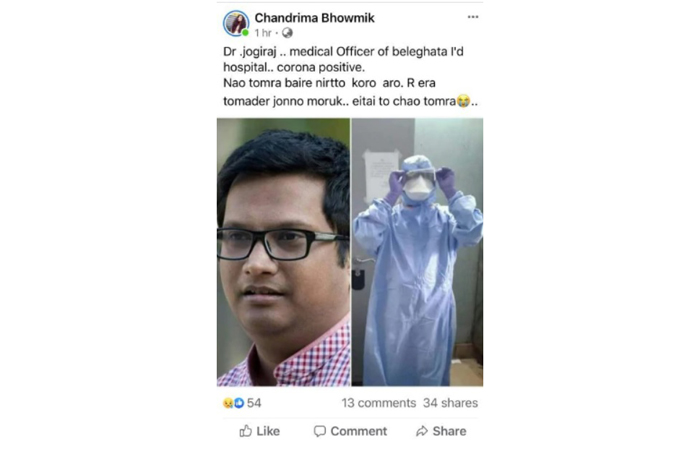
As indicated by Dr Ahmed, in the rumour propagation case involving a Beleghata ID hospital doctor, a lady called Chandrima Bhowmik has been arrested by Kolkata police for spreading false information. The matter was highlighted when the concerned doctor’s wife took to Facebook to debunk Bhowmik’s post in which she wrote that Dr Jogiraj, the medical officer at Beleghata ID hospital was detected to be Corona Positive. In the same post, she was seen reprimanding the errant public who were venturing out during the lockdown. She even held them responsible for the doctor’s alleged condition.
With the case involving a doctor working for COVID-19 patients, the rumour came to Chief Minister Mamata Banerjee’s notice, who has now instructed the detective and cyber department to be alert.
Muralidhar Sharma, Joint CP Crime, when contacted said, “Yes, we are aware of such rumours being spread. Strict action will be taken against those spreading such rumours.”
Given the scare that the pandemic has created in people across the world, it is making people circulate news without cross-checking during the lockdown. eNewsroom came across another fake news which credited the Indian Army of creating a 1000-bed quarantine facility in Barmer, Rajasthan. Given the speed with which this news became viral even prompted ADG PI- Indian Army tweeted, “A fake input is circulating on social media that #IndianArmy has established a 1000 bed quarantine facility in Barmer. This is untrue.”
As responsible citizens, this lockdown period needs to be utilised responsibly. Posting information related to COVID-19, or sharing such posts without confirming, is not a responsible act and might have police landing at your doorstep. Be safe, post safe!
Kolkata: In this time of the corona virus pandemic, the West Bengal government needs to step up its game in providing protection to its caregivers. They are vital in our fight against the deadly virus.
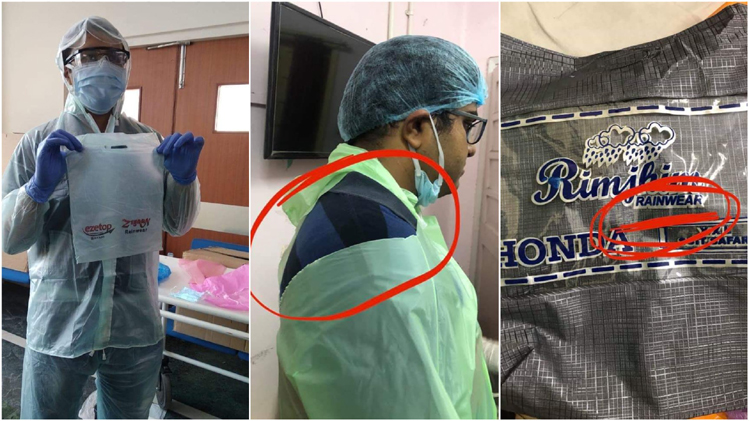
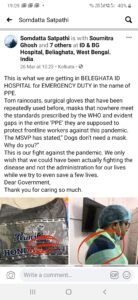
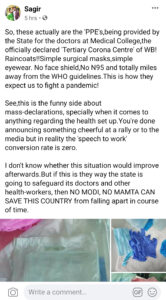
Doctors in some medical colleges have received inferior quality Personal Protective Equipment (PPE). Sources said doctors at Calcutta Medical College, which is a tertiary centre for Covid-19 treatment, and Beliaghata ID Hospital have received raincoats instead of proper medical gowns and simple surgical masks instead of N95 and eye gear.
“The eye gears which have been distributed are the simple ones which we use during Holi. The masks which we have received are the cotton ones, which can prevent dust particles but not bacteria and virus,” said an intern at Murshidabad Medical College.
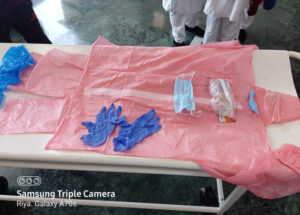
The items provided in the name of PPEs to medical staffs
Though there have been no positive cases in Murshidabad so far, the fear remains as there large numbers of migrant workers from here who work in other states where there are more cases of the corona virus. “We should have got a positive case by now. But tests are also not being done properly,” the intern said.
Several Facebook posts with photographs pointed out the lacunae in the safety measures being taken in various city hospitals.
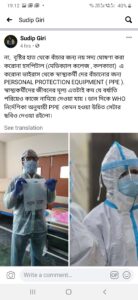
A post in Bengali on Facebook with the photo of a doctor dressed in a raincoat, mask and gloves said, “No, this is not to protect from the rain but Personal Protective Equipment to protect from corona virus at the recently declared corona centre (Medical College, Kolkata). Is the value of health workers’ lives so less that they will be given rain coats at work?” The post also has the photograph of a health worker in full gear as directed by WHO.
Another post said, “So, these actually are the PPEs provided by the State for the doctors at Medical College… No face shield, No N95 (masks) and totally miles away from the WHO guidelines.”
One more post had photographs of torn rain coats provided to the doctors at ID Hospital. “This is what we are getting at BELEGHATA ID HOSPITAL for EMERGENCY DUTY in the name of PPE,” it read. The post also pointed out that the masks they were given have been repeatedly used.
Midnapore Medical College received N95 masks only a week back. “We have three masks for a week. We use and reuse them,” said the intern at Murshidabad college.
When contacted, Sudeshna Gupta, Special Secretary, Health acknowledged that she had heard about such posts. “But I cannot say whether they are true or what is being done,” Special Secretary told eNewsroom.
There is a shortage of N95 masks in the country and the shortage may get worse worldwide, a report had said. However, doctors and other health workers who are dealing with COVID-19 patients are required to have proper protective gear to avoid getting infected. One of three doctors in Mumbai who was infected died recently.
The shortage of proper PPE has also been reported from other parts of the country.
The health ministry falls under Chief Minister Mamata Banerjee, whose work so far against coronavirus has been lauded as she has led from front and has been seen on many videos meeting medical staffs, marking social distancing circles for customers at market. But the situation of lack of PPEs in government hospitals needs her immediate attention.





 There is a shortage of N95 masks in the country and the shortage may get worse worldwide, a report had said. However, doctors and other health workers who are dealing with COVID-19 patients are required to have proper protective gear to avoid getting infected. One of three doctors in Mumbai who was infected died recently.