



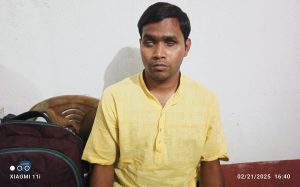
Kolkata: Osnai Sheikh, a 30-year-old visually impaired man from Thanarpara Fazilnagar in Karimpur II block of Nadia, has overcome unimaginable hardships to pursue education and self-reliance. Losing his sight at the tender age of four and becoming an orphan at five, his journey has been one of resilience, determination, and the unwavering support of his village. While many in his position would have succumbed to despair, Osnai chose to fight for his future, navigating the challenges of poverty and disability to achieve what seemed impossible.
An Extraordinary Academic Journey
Despite severe financial constraints, he pursued his education with unrelenting commitment. In 2017, he completed his secondary education (Madhyamik) from Behala Blind School in Kolkata, securing 54%. Two years later, in 2019, he passed his Higher Secondary (HS) exams from Madanpur Central Adarsha Vidyapith High School with 49%. Encouraged by the villagers, who became his guardians, he continued his academic journey.
Determined to go further, he pursued higher studies and earned a degree in political science from Rabindra Bharati University in 2022, securing an impressive 65%. Not stopping there, he completed his post-graduation in political science from Burdwan University in 2024 with 55%. Currently, he is enrolled in a private institution in East Burdwan, striving to complete his Bachelor in Education (BEd). However, financial constraints now pose a serious threat to his education. “I need around Rs 1 lakh for my BEd. I somehow managed to deposit Rs 25,000, but I am unsure how I will arrange the remaining amount. If I don’t get the funds, I may have to discontinue my studies,” he shared.
A Childhood Marked by Struggles
Osnai’s early years were filled with hardship. Losing his mother at the age of five, he found solace in his father’s care—only to lose him nine years later. Suddenly orphaned, his future became a matter of concern for the entire village. With no immediate family to rely on, he was taken in by his paternal aunt, Sonabanu Khatun. A single woman working as a domestic helper, Sonabanu herself struggled daily to make ends meet. Yet, despite her limited means, she took on the formidable task of raising Osnai, ensuring he never lost hope.
The family’s financial condition remained dire. With Sonabanu’s advancing age and deteriorating health, their hardships only increased. Some days, they survived on the generosity of villagers who offered food and financial help. “Sometimes, villagers would provide them with meals. Their condition is still miserable,” said Rabiul Sheikh, a local resident.
The Fight for Employment
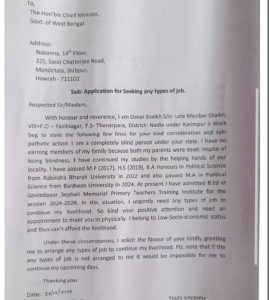
Though he has conquered the world of academia, the battle for self-sufficiency remains. With no income and his aunt unable to work, Osnai is desperate to find employment. Determined to secure a livelihood, he has submitted a written application to the District Magistrate, Sub-Divisional Officer, and Block Development Officer of Nadia district, requesting a government job. He has also appealed to his local MP and MLA, as well as Chief Minister Mamata Banerjee, but has yet to receive a response.
“I have done everything I could. I’ve gone from office to office, submitted applications, but I am still waiting for a response,” Osnai rued to eNewsroom. Despite his efforts, his future remains uncertain, highlighting the broader issue of limited employment opportunities for persons with disabilities.
A Community’s Collective Hope
Osnai’s resilience has won him the admiration of his village. Many believe he deserves a stable government job, not just as a reward for his perseverance but as a necessity for his survival. “Even students from privileged backgrounds struggle to complete post-graduation, yet Osnai has done it despite being visually impaired. It is heartbreaking to see him running from one office to another in search of work,” remarked a local resident.
Rebaul Mondal, a teacher, echoed the sentiment, saying, “This young man could have chosen to beg, but instead, he fought against all odds to complete his education. He now wants to stand on his own feet, but the government is not giving him a chance. It’s deeply unfortunate.”
Adding to the frustration is the lack of recruitment despite job vacancies in various government departments. “People advise him to take the government job exams, but the real question is—where are the vacancies? Many government offices have openings, yet no hiring is taking place,” Mondal added.
The Endless Wait
As days pass, the uncertainty surrounding Osnai’s future grows heavier. “How long will I rely on others? My aunt raised me with immense difficulty. Now, it’s my turn to support her, but I have no means to do so. If I get a government job, I can take care of my family. But I’ve been to so many offices, and no one is responding. How long will I remain unemployed?” he questioned, his voice filled with despair.
Karimpur II Block Development Officer (BDO) Supratik Majumdar acknowledged Osnai’s plight but expressed his limitations in helping. “I don’t have the authority to offer him the kind of work he wants. All government employees here are appointed through job exams. I cannot give him a job from the BDO office,” he explained.
A Call for Action
Osnai Sheikh’s journey is not just a story of one man’s struggle; it is a reflection of the larger systemic challenges faced by persons with disabilities. Despite his determination, intelligence, and educational achievements, he stands at a crossroads, waiting for an opportunity that may never come unless the system acknowledges his efforts and steps in to help.
His village continues to stand by him, hoping that their collective voice will reach the right ears. Latib Ansari, another local resident reacted, “If he gets a government job, it will not only change his life but also bring relief to his family. The government should step forward to help him”.

