



Maulana Abul Kalam Azad is remembered across India as a freedom fighter, scholar, journalist and independent India’s first Education Minister. His contribution to the freedom struggle, his commitment to Hindu-Muslim unity and his vision of education as the foundation of nation-building have secured him a permanent place in India’s history.
But there is another, relatively lesser-known chapter of lifehis that connects him to Bengal. Through his marriage to Zulaikha Begum, whose family belonged to Pandua-Magura in Hooghly district, Azad developed a personal bond with a region steeped in history, religious scholarship and cultural traditions. It was a connection that extended beyond marriage, bringing him into the fold of a family whose roots were firmly embedded in Bengal.
For Pandua-Magura, this was more than an association with a celebrated national leader. It became part of a family history that continues to be remembered across generations.
Maulana Abul Kalam Azad’s Early Education and Intellectual Foundations in Calcutta
Born in Mecca in 1888, Abul Kalam Ghulam Muhiyuddin Ahmed, later known as Maulana Abul Kalam Azad, grew up in an intellectually rich household. His father, Maulana Khairuddin, was a noted Islamic scholar, while his mother, Aliya Begum, belonged to a respected scholarly family connected with Medina.
The family returned to Calcutta when Azad was young. He received a rigorous traditional Islamic education at home, studying Arabic, Persian, theology, philosophy and other subjects under the guidance of his father and other scholars.
His paternal ancestors had migrated from Herat to India during the reign of Babur. They initially settled in Agra before moving to Delhi. Known for their scholarship, Sufi traditions and association with the Mughal court, the family had a long history of religious and intellectual engagement. Azad traced his ancestry to Maulana Jamaluddin, a scholar associated with the court of Emperor Akbar.
This background helps explain the intellectual foundation on which Azad built his life. For him, education was never merely an individual achievement or a means of social advancement. Knowledge carried a larger responsibility: to enlighten society, encourage understanding and serve humanity.
That belief would later find expression in his journalism, political philosophy and vision for independent India.
Inside Pandua, Hooghly: The Forgotten Medieval Bengal Town Tied to Azad’s Family
Pandua in Hooghly district has a history that deserves greater recognition. Its medieval monuments, mosques, tombs and architectural remains tell the story of a region where different religious and cultural traditions intersected.
The historic settlement is particularly known for its imposing minar, the remains of an old mosque and other archaeological structures. The Archaeological Survey of India recognises the mosque at Pandua as a protected monument, with its architectural features pointing to the early medieval period of Islamic architecture in Bengal.
The mosque and the surrounding monuments reflect the region’s historical importance during the expansion of Islamic political and cultural influence in Bengal. Pandua’s history is also connected with the neighbouring settlements of Mahanad and Tribeni, which developed as important centres of religious and cultural activity.
Over time, political changes, economic transformations and the movement of influential families towards Calcutta altered the social character of the region. Yet its heritage survived through its monuments, religious institutions and, perhaps most importantly, family histories.
For families such as the one into which Maulana Azad married, Pandua was not simply a historical place. It was home. It represented ancestral relationships, inherited traditions, religious learning, land and a sense of belonging.
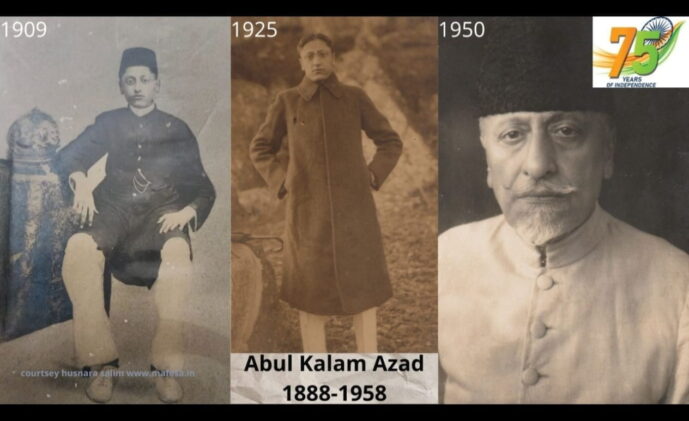
From Pandua to the Bharat Ratna: The Bengal Family That Stood Behind Maulana Azad
Maulana Azad married Zulaikha Begum when he was very young. She was the daughter of Maulavi Aftabuddin of the Pandua-Magura family. Aftabuddin was a spiritual disciple and admirer of Azad’s father, Maulana Khairuddin. The relationship between the two families eventually brought Azad into a close personal association with Pandua.
Zulaikha Begum was herself educated. She knew Urdu and Persian and had a working knowledge of elementary Arabic. Through the difficult years of Azad’s political life, she remained a source of strength and companionship.
Her family included her sisters Zohra Begum, Hafiza Begum and Hanifa Begum, and her brother Badruddin. These relationships created an extended family network that connected Azad to several households in Pandua-Magura and beyond.
Some of the important family relationships are remembered as follows:
Family member Relationship and significance
Maulavi Aftabuddin Father of Zulaikha Begum, Azad’s father-in-law and a spiritual disciple of Maulana Khairuddin.
Zulaikha Begum Wife of Maulana Abul Kalam Azad; daughter of Aftabuddin of the Pandua-Magura family.
Zohra Begum Sister of Zulaikha Begum; married Abdul Jalil.
Abdus Salim Son of Zohra Begum and Abdul Jalil; remembered for receiving the Bharat Ratna on behalf of the family following its posthumous conferment on Azad in 1992.
Husnara Salim Grandniece of Maulana Azad and a custodian of the family’s continuing legacy through education and social service.
The relationship between these families was not merely formal. It was sustained through visits, personal interactions and a shared sense of belonging. Family histories preserve memories of Azad as someone who remained connected to his wife’s relatives despite the demands of public life.
Beyond Politics: Memories of Maulana Azad’s Quiet Train Journeys to Pandua-Magura
For Maulana Azad, Pandua-Magura was not just a name on a family tree. It was a place he visited and where he maintained personal relationships.
The railway connection between Howrah and Pandua, through the Howrah-Bardhaman main line, made journeys between Calcutta and the region easier. During the 1930s and 1940s, these journeys helped sustain family relationships and social connections.
Family recollections speak of Azad’s visits to Pandua-Magura and his interactions with people beyond his immediate circle of relatives.
Among the families he is remembered to have visited was that of the late Syed Jahurun Nabi, son of the late Mohammed Nabi, who served in the Postal Department in Calcutta.
These visits are recalled with affection. They offer a glimpse of a side of Azad that is often missing from accounts of his public life. Away from political meetings, debates and the responsibilities of national leadership, he was also a husband, a son-in-law, a relative and a guest who made time for people connected to his family.
Such memories bring the national leader closer to ordinary lives. They remind us that even those who occupy the highest positions in public history have personal worlds shaped by relationships, affection and a sense of home.
Choosing India in 1947: Maulana Azad’s Moral Authority During the Trauma of Partition
Perhaps one of the most significant aspects of Azad’s legacy, as remembered by families connected with Pandua-Magura, was his influence during the turbulent years surrounding Partition.
The division of India in 1947 brought enormous uncertainty, fear and anxiety, particularly among Muslim families. Many were confronted with an agonising choice: whether to remain in India or move to the newly created Pakistan.
For families that had lived in Bengal for generations, the decision was not simply about geography. It involved questions of identity, security, property, livelihood, relationships and the future of their children.
Azad’s commitment to a united India and his conviction that Muslims had an equal stake in the country’s future offered reassurance to many who were struggling with this uncertainty.
Family accounts suggest that his counsel and moral authority encouraged several established Muslim families to remain in India and continue contributing to society.
It was not an easy choice. Partition had created deep wounds, and the anxieties of the time cannot be understood through political statements alone. Families had to make decisions amid fear and uncertainty, often without knowing what the future would hold.
For those who stayed, however, the decision became a legacy in itself. They educated their children, continued their professions, served their communities and preserved their cultural and family traditions.
Azad’s message was ultimately about belonging. India, in his vision, could not be the inheritance of one religious community alone. It belonged equally to all its citizens.
The stories of families who chose to remain are an important part of that larger history. They deserve to be documented through personal testimonies and family archives, because the story of Partition is also the story of ordinary people who chose to rebuild their lives amid extraordinary circumstances.
Carrying Azad’s Legacy Forward: How MAFESA Works for Education and Harmony in Kolkata and Delhi
The connection with Maulana Azad is not merely a matter of family pride or historical remembrance. It also carries a responsibility to uphold the values he stood for.
I founded MAFESA — Maulana Azad Foundation for Education and Social Amity — to carry forward some of those ideals. Based at 124, Karaya Road, Kolkata 700017, the foundation works in Kolkata and Delhi, focusing on education, communal harmony and social service.
MAFESA’s activities draw inspiration from Azad’s belief that education is central to individual dignity and national progress. The foundation seeks to promote educational opportunities, women’s empowerment, inter-community understanding and practical support for people in need.
For me, this work is not simply an institutional initiative. It is a continuation of a family responsibility that has its roots in the traditions of learning, social engagement and service associated with Pandua-Magura.
The journey has not always been easy. My husband has been completely bedridden, presenting immense personal challenges. Yet I have continued to lead the foundation’s activities and work with communities in Kolkata and Delhi.
There are moments when personal responsibilities can make public service difficult. But the belief that education and social engagement can change lives has kept me going. I see this work as a way of keeping alive the values that Maulana Azad represented.
As his grandniece, I regard this inheritance not as a privilege to be celebrated but as a responsibility to be fulfilled. Gathering family histories, reconnecting with our roots and working for the community are ways of ensuring that the legacy does not remain confined to photographs, monuments and commemorative speeches.
Preserving Bengal’s Living History: Why Pandua’s Intellectual Heritage Needs a Revival
Pandua’s historical importance should not be remembered only through its old monuments or the stories of families that once lived there. Its heritage can become a source of inspiration for a new generation.
Schools, libraries, local history projects, women’s education and community initiatives can help reconnect people with the intellectual and cultural traditions of the region. There is also a need to document the memories of older residents and families before valuable histories disappear with them.
The story of Maulana Azad’s connection with Pandua-Magura offers an opportunity to rediscover a part of Bengal’s past through a national figure whose life was devoted to education, freedom and communal harmony.
His legacy reminds us that history is not made only in legislatures, political movements or the corridors of power. It also lives in homes, family relationships, local institutions and the choices people make during difficult times.
Pandua may have changed over the centuries, but the values associated with its heritage need not disappear.
If Maulana Azad’s life teaches us anything, it is that knowledge becomes meaningful when it reaches people, that education must create opportunities for all, and that a nation becomes stronger when its people learn to live together.
That, to me, is the inheritance worth carrying forward.

