The Angry Young (Man) CM: Hemant Soren’s Fierce Fight Against BJP

0

Giridih: During the 70s, Amitabh Bachchan, the “angry young man,” brought to the cinema screen the reflection of common men who were anti-establishment and angry at the system. Hemant Soren, the incumbent Chief Minister and also one of the youngest Chief Ministers of India, after serving five months in jail, seems like an angry man campaigning aggressively against the Bharatiya Janata Party (BJP) in Jharkhand.

“Himanta Biswa Sarma (Assam Chief Minister) is roaming in Jharkhand, leaving work in Assam for more than a year, and even sent me to jail. But you know, Jako Rakhe Saiya Maar Sake Na Koi (the one who is guarded or protected by God cannot be killed by anyone), and again, I am standing tall before you,” Hemant Soren began his speech at Boro Airport, Giridih. He sought votes for Sudivya Kumar Sonu, the Giridih MLA, who is considered very close to the Soren family.

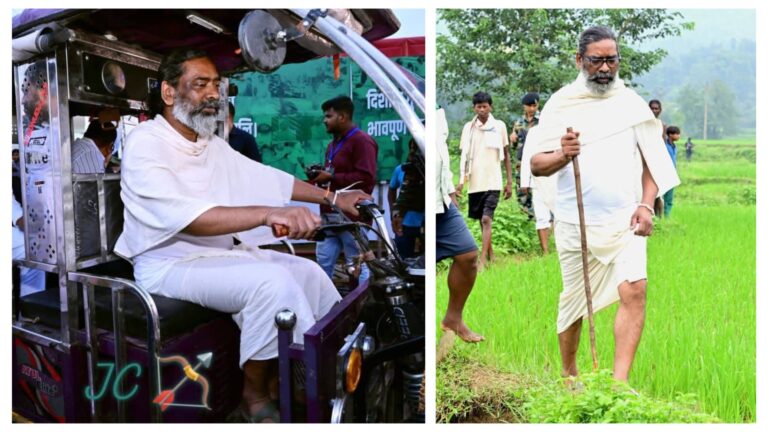
Five years ago, when he was campaigning for Sudivya Sonu on the same ground, Hemant Soren was clean-shaven. But in this election, he has got a completely different look, with long hair, a beard, and a changed body language. Though his wife, Kalpana Soren, is canvassing effectively for INDIA bloc candidates and has become a crowd-puller, CM Soren seems to have taken it upon himself to bring INDIA back to power.

Counters BJP with Bilkis Bano and Manipur burning examples

Recently, during the assembly election campaigning, Prime Minister Narendra Modi claimed that if the BJP returned to power in Jharkhand, they would “save the daughters of Jharkhand.” Without mentioning PM Modi directly, Hemant Soren said, “In Gujarat, gangrape victim Bilkis Bano’s rapists were released by the BJP. In Manipur, Adivasi daughters were not saved. The Prime Minister did not have the courage to visit Manipur, but the BJP is claiming to save Adivasi daughters in Jharkhand,” said an aggressive Soren.

“Girls in Jharkhand will not be a burden on their families. Our government will bear all their educational and marriage expenses,” he emphasized.

Listen to Hemant Soren, speaking at Boro, Giridih

He sharply criticized the Assam Chief Minister on the issue of infiltration (ghuspaith). “The Assam Chief Minister has spent one year trying to topple our government but has failed to resolve the ghuspaith issue in Assam. He is also the chairman of the North East Council, but has he done anything significant in this regard? He and all BJP leaders only lie,” added the Chief Minister.

Reports suggest that the Jharkhand Mukti Morcha working president is delivering similar speeches at other rallies too.

“Even while being aggressive and countering the BJP boldly, he is not using foul language. A few days ago, when ED raids were conducted on the premises of his secretary, he responded to newsmen calmly. On the other hand, even senior BJP leaders have used foul language in their speeches during the elections,” said an officer based in Ranchi, on the condition of anonymity.

पहले चरण में नफरत की राजनीति खारिज, जन मुद्दों पर जनता का विश्वास- लोकतंत्र बचाओ अभियान

0

दुमका/रांची: झारखंड विधानसभा चुनाव के पहले चरण में 43 सीटों पर हुए मतदान ने साफ कर दिया है कि जनता ने नफरत और विभाजन की राजनीति को खारिज कर, जन मुद्दों को प्राथमिकता दी है। दुमका के जोहार में आयोजित एक प्रेस वार्ता में लोकतंत्र बचाओ अभियान (अबुआ झारखंड, अबुआ राज) के सदस्यों ने यह दावा किया। इस अभियान के तहत राज्य के विभिन्न क्षेत्रों में लोगों को उनके अधिकारों के लिए संगठित किया जा रहा है।

अभियान के सदस्यों ने आरोप लगाया कि भाजपा का सांप्रदायिक और विभाजनकारी एजेंडा अब जनता के सामने उजागर हो चुका है। भाजपा आदिवासियों और मूलवासियों के अधिकारों पर बात करने के बजाय धार्मिक ध्रुवीकरण के मुद्दों को हवा दे रही है। बांग्लादेशी घुसपैठ का राग अलापकर भाजपा ने क्षेत्र में सांप्रदायिक तनाव बढ़ाने की कोशिश की, लेकिन जमीनी हकीकत इसके उलट है। अभियान ने अपने तथ्यात्मक विश्लेषण में पाया कि संथाल परगना में प्रचारित घुसपैठ का कोई प्रमाण नहीं है। खुद केंद्र सरकार ने उच्च न्यायालय और संसद में स्वीकार किया है कि उनके पास घुसपैठियों का कोई आंकड़ा नहीं है, और अधिकांश विवाद स्थानीय हैं।

वास्तविक मुद्दों पर चुप्पी साधे भाजपा

अभियान ने भाजपा पर आरोप लगाया कि वह आदिवासियों और मूलवासियों के ज्वलंत सवालों—जैसे कि सीएनटी-एसपीटी कानून, सरना कोड, खतियान आधारित स्थानीय नीति, जल-जंगल-जमीन के अधिकार, और न्यूनतम समर्थन मूल्य (एमएसपी)—पर चुप्पी साधे हुए है। इसके विपरीत, झारखंड मुक्ति मोर्चा (झामुमो) ने अपने घोषणापत्र में 1932 खतियान आधारित स्थानीय नीति लागू करने और लैंड बैंक रद्द करने का वादा किया है।

भाजपा की आदिवासी-विरोधी राजनीति का उदाहरण यह भी है कि उनके घोषणापत्र में सरना कोड का उल्लेख तक नहीं है। जहां झामुमो और INDIA गठबंधन इसे लागू करने की बात कर रहे हैं, वहीं भाजपा के नेता आदिवासियों को सरना और ईसाई समुदायों में बांटने की कोशिश कर रहे हैं। केंद्र सरकार ने सरना कोड और स्थानीयता नीति को 9वीं अनुसूची में डालने के राज्य प्रस्ताव को रोक रखा है, और पिछड़ों के आरक्षण को 27% करने के राज्य सरकार के प्रस्ताव को भी मंजूरी नहीं दी है।

सामाजिक सुरक्षा और विकास पर दिखा फर्क

भाजपा और झामुमो के घोषणापत्रों में सामाजिक और पोषण सुरक्षा के मुद्दों पर बड़ा अंतर दिखा। मोदी सरकार ने आंगनवाड़ी और मध्याह्न भोजन के बजट में कटौती की है, जबकि झामुमो ने बच्चों को प्रतिदिन अंडा या फल उपलब्ध कराने का वादा किया है। बुजुर्गों को केंद्र सरकार केवल ₹200 प्रति माह पेंशन देती है, जबकि हेमंत सरकार ₹800 दे रही है और इसे ₹2500 तक बढ़ाने का ऐलान किया है। झामुमो ने पेंशनधारियों की संख्या 6.6 लाख से बढ़ाकर 30 लाख कर दी है।

INDIA गठबंधन ने राशन की मात्रा 5 किलो से बढ़ाकर 7 किलो करने की बात की है, जबकि भाजपा इस पर भी मौन है।

बांग्लादेश को बिजली, झारखंड अंधेरे में

अभियान ने अडानी पावर प्रोजेक्ट का मुद्दा उठाते हुए कहा कि भाजपा सरकार ने आदिवासियों की जमीन का जबरन अधिग्रहण कर झारखंड को घाटे में रखा और बांग्लादेश को बिजली दी। संथाल परगना को बिजली से वंचित रखकर बांग्लादेश को लाभ पहुंचाना भाजपा की दोहरी राजनीति को दर्शाता है।

सांप्रदायिकता और नफरत की राजनीति

अभियान के अनुसार, प्रधानमंत्री, गृह मंत्री, और भाजपा नेताओं ने सांप्रदायिक भाषणों से चुनावी माहौल को खराब किया है। भाजपा सांसद निशिकांत दुबे ने झारखंड को तोड़कर संथाल परगना को अलग करने का सुझाव तक दे डाला। भाजपा की सोशल मीडिया रणनीति पर शोध रिपोर्ट में खुलासा हुआ है कि करोड़ों रुपये खर्च कर फर्जी अकाउंट के माध्यम से नफरत और झूठ फैलाया जा रहा है।

जनता का विश्वास जन मुद्दों पर

अभियान के प्रतिनिधियों का मानना है कि जैसे पहले चरण में जनता ने नफरत की राजनीति को नकारा, वैसा ही दूसरे चरण में भी होगा। झारखंड के आदिवासी और मूलवासी जल-जंगल-जमीन और अस्तित्व के सवालों को प्राथमिकता देते हुए लोकतंत्र और अपने अधिकारों की रक्षा करेंगे।

The ‘Extra Armour’ of INDIA Bloc: How Kalpana Soren is Redefining Jharkhand’s Political Landscape

0

Ranchi/Kolkata: On Wednesday, when Kalpana Soren reached Harladih village in Pirtand, Giridih, she addressed an unexpectedly large crowd. The area, once known as a hub of Naxal activities, rarely hosted political rallies. However, it also holds significance as the former work area of JMM founder Shibu Soren, and the large crowd seemed eager to catch a glimpse of, and listen to, their Guruji’s daughter-in-law.

Kalpana Soren campaigned in the Pirtand area to rally support for Giridih’s JMM MLA, Sudivya Kumar Sonu, who noted after the rally, “The huge turnout makes it clear that the people of Pirtand have not forgotten Dishom Guru (Shibu Soren).”

In the crucial Jharkhand assembly election, the prominent leaders or star campaigners from each contesting party remain mostly the same as in the 2019 assembly election—except for one: Kalpana Murmu Soren. The legislator from Gandey and wife of Chief Minister Hemant Soren, who began her political career on March 4 this year when Hemant Soren was inside jail, is proving to be a significant difference between the INDIA bloc and the NDA. Kalpana Soren, now in demand by INDIA bloc candidates to campaign in their constituencies, emphasizes Jharkhandi pride in her speeches and highlights the accomplishments of the Hemant Soren-led Gath Bandhan (INDIA) government. However, her primary issue is the 1.36 lakh crores in coal dues owed to Jharkhand by the Indian government.

Hemant Soren’s wife and mother of two, Kalpana speaks at least four languages—Hindi, Santhali, English, and Odia. Despite only eight months in her political career and five months as an MLA, she addresses her audiences with the confidence of a seasoned politician. An engineering and MBA graduate, she articulates her views without hesitation.

The success of her rallies can be gauged by the fact that her helicopter was recently grounded, citing security reasons, preventing her from addressing a rally in Latehar. Kalpana is also contesting the assembly seat in Gandey, where the NDA has fielded a female opponent against her. In the bypoll, her first election, the BJP candidate, a male, lost by over 26,000 votes.

“JMM claims that Hemant Soren is fighting alone against the NDA and BJP’s powerful machinery, but Kalpana Soren stands firmly beside the Jharkhand CM. While technically Kalpana is an MLA and Hemant Soren is the chief minister and top leader of the party, making him the lone fighter, the Gandey MLA has emerged as an additional strength for the INDIA bloc. She’s also strengthening INDIA’s connection with female voters, which may increase due to programs like the Maiya Samman Yojna,” remarked Anand Dutta, a Ranchi-based journalist.

Himanta’s Hypocrisy Exposed: Assam CM Campaigns for Alleged Bangladeshi While Targeting Jharkhand

0

Ranchi/Kolkata: Himanta Biswa Sarma, Assam Chief Minister and in-charge of the Bharatiya Janata Party’s (BJP) Jharkhand unit, is known for alleging that Bangladeshi infiltrators are present in Jharkhand. In a significant turn of events, however, he is now campaigning for a BJP candidate in an Assam bypoll who has been accused of being a Bangladeshi.

In Dholai, Nihar Ranjan Das, the BJP candidate, faces allegations of Bangladeshi origin, first raised by independent candidate Amiya Kanti Das. Amiya Kanti, previously with the BJP, filed his nomination independently after being denied a ticket but later withdrew it. Now, the Congress has raised concerns, questioning why Assam’s Chief Minister is campaigning for a candidate alleged to be of Bangladeshi nationality.

On November 3, Assam Congress President Bhupen Kumar Borah asked, “Why is a Bangladeshi national contesting on a BJP ticket from Dholai?” The Assam Congress’s X (formerly Twitter) account posted a video of Borah’s statement, demanding an answer from Chief Minister Himanta Biswa Sarma. Das has since downplayed the issue.

Sarma responded to the Congress raising questions about the citizenship of his 48-year-old BJP candidate from Dholai on Tuesday, contending that raising such questions could provoke the foreigners tribunal to send notices to other Bengali Hindus leading to their harassment.

Since Assam chief minister’s appointment as BJP’s in-charge of Jharkhand, he has repeatedly alleged that Bangladeshi infiltration is occurring in Jharkhand with the support of the ruling Jharkhand Mukti Morcha-led INDIA bloc. His rhetoric intensified following the announcement of the state assembly polls.

Complaints for Sarma’s hate speech

Aside from these allegations, the chief minister has also faced accusations of delivering hate speeches. “We have filed three complaints with the Election Commission and met with Chief Election Commissioner of Jharkhand, K Ravi Kumar, to demand action against Himanta Biswa Sarma for his hate speeches. We also requested that the Assam Chief Minister be barred from entering Jharkhand,” Siraj Dutta, a prominent activist of Jharkhand Janadhikar Mahasabha told eNewsroom.

The INDIA bloc candidate from Hussainabad Kushwaha Shivpujan Mehta has also filed a case (3359/2024) in the Daltonganj court, Palamau against the BJP chief minister for a hate speech delivered in the area.

However, the Election Commission has yet to take any action on these complaints.

Targeted by BJP, Championed by JMM: Can Hemant Soren Break Jharkhand’s One-Term Curse?

0

Ranchi/Delhi: No chief minister in Jharkhand has won a second consecutive term since the state’s inception in 2000. Historically, the odds are against JMM leader Hemant Soren, who seeks another term in office as the state goes to the polls in two phases in November.

But what also goes in the incumbent CM’s favour is that he is the first JMM leader to ensure the party once elections complete its 5-year term in office. However, in the interim, Soren himself had to quit for a brief period after his arrest by the ED in a PMLA case.

That is precisely what JMM has made its trump card as it leads the INDIA bloc in the elections against the NDA. The road ahead, though, for the JMM, Congress, RJD, and CPI (ML) combined is far from easy.

BJP has this time, gone the extra mile to avoid its rout in the 2019 elections in the tribal-dominated seats. The party has promoted tribal leadership in the state. Babulal Marandi, the first chief minister, is also state BJP president. BJP has inducted strong leaders from the JMM camp like Champai Soren to challenge JMM’s dominance in 30 tribal seats. 

BJP is hoping to make an inroad into the Kolhan region, where it failed to win a single seat out of 14 up for grabs in 2019. Similarly, in the Santhal Pargana, it would be a challenge for the BJP to wrest back seats where it lost 13 out of 18 to JMM in the last elections.

In addition to corruption allegations, BJP has also revived its familiar tactic of communal rhetoric in election speeches, targeting the state’s Muslim population and raising the issue of alleged Bangladeshi infiltration. Assam CM and Jharkhand BJP in-charge, Himanta Biswa Sarma, even faced a police case on Friday for a communal remark made in Hussainabad

JMM hopes to tide over allegations of corruption and anti-incumbency against its MLAs by playing the son of the soil card. The party has made Hemant Soren’s arrest by the ED its main poll plank as it accuses the BJP oftargetingJMM leaders.

JMM is also trying to outdo the BJP in handing out doles, especially targeted at women voters. Just ahead of the polls, the state government increased the money being given under theMaiya Samman Yojana’, from Rs 1,000 to Rs. 2500 per month to women between the age group of 18-50 years.

The state government has also highly incentivised power tariffs. Soren government has so far waived unpaid power bills to the tune of Rs 3,584 crore while another agriculture Rs 400.66 crore was waived besides promising 200 units of free power to the poor.

In a twist that adds momentum to JMM’s campaign, several leaders from rival parties, particularly BJP, have recently shifted their allegiance. On Saturday, BJP leaders Pranav Verma and Dara Hazra made headlines by deserting the saffron camp to join JMM. With these two, more than 15 BJP leaders have joined JMM so far, signaling potential cracks in the party base as the polls approach.

But will all these social sector schemes be enough to give Hemant Soren a second consecutive shot at power?

Outsmarting BJP? How JMM Adopts BJP Tactics in Jharkhand Election Battle

0

Ranchi/Kolkata: Jharkhand Mukti Morcha (JMM), the leading party in the INDIA bloc in Jharkhand, has adopted a tactic often seen in the Bharatiya Janata Party’s playbook during the assembly polls. In at least two ways, it mirrors the BJP’s approach—by accepting defectors from the BJP and framing the election as Hemant Soren versus everyone.

In recent years, the BJP has become known for welcoming leaders from other parties, even if they face serious corruption or criminal charges. Many cases have been dismissed by authorities once the leaders join the saffron camp. During the Jharkhand assembly polls, more than a dozen current and former BJP legislators joined JMM, and many have received tickets to contest.

As the BJP claimed during the Lok Sabha elections that Narendra Modi was single-handedly fighting against the opposition, JMM is now projecting Hemant Soren as the lone warrior taking on present and former BJP chief ministers. This group includes Jharkhand’s Assam in-charge, Himanta Biswa Sarma, Union Agriculture Minister and former chief minister Shivraj Singh Chouhan, ex-CMs from Jharkhand Babulal Marandi, Champai Soren, Arjun Munda, and Madhu Koda. Additionally, Raghubar Das, currently the Governor of Odisha, can be counted in the fight against Soren, as his daughter-in-law is contesting under the BJP symbol. Senior party leaders like Prime Minister Narendra Modi and Home Minister Amit Shah are expected to lead the BJP’s campaign in Jharkhand against JMM’s executive president Hemant Soren.

However, unlike the BJP, JMM has not focused on uniting smaller parties and has instead repeated the mistake Congress made in the recent Haryana assembly polls. JMM has fielded its candidate from a seat where the CPI (ML) has a strong presence and had a solid chance against BJP state president Babulal Marandi.

Ranchi-based journalist Anand Dutta sees JMM’s approach as timely politics. “The JMM is responding to the opponent’s tactics with similar moves, which is necessary at this moment. It’s not just Hemant Soren but also Kalpana Soren leading the charge for JMM.”

“But for me, the main issue is that JMM and Congress did not learn from the Haryana poll results. They should have accommodated the CPI (ML). The BJP not only allotted an appropriate number of seats to AJSU but also to LJP, yet INDIA bloc leaders, for whom Vinod Singh has stood in times of crisis, have overlooked his party,” added Anand.

Only the election results will reveal whether JMM’s imitation of BJP’s stylebook pays off.

Who is Mandal Murmu? CM Proposer’s Meeting and Detention Fuels Fresh Election Controversy

0

Ranchi/Giridih: At least a dozen Bharatiya Janata Party leaders, including sitting and former legislators, have joined the Jharkhand Mukti Morcha during the ongoing assembly elections in Jharkhand. The BJP, long accustomed to benefiting from such defections, was looking for a high-profile recruit to shift the narrative. Mandal Murmu, the proposer for Hemant Soren from Berhait, was seen as a potential asset. Nishikant Dubey, a Member of Parliament from Godda, also met with Murmu on Sunday. However, it appears that the JMM has thwarted its rival’s plans.

On October 24, incumbent Chief Minister Hemant Soren filed his nomination for re-election from Berhait, with Mandal Murmu as one of his proposers.

Who is Mandal Murmu?

The 29-year-old Murmu hails from Bhognadih, Sahibganj. His social media bio notes that he is a descendant of Sidhu Kanhu, a 1855 freedom fighter and an iconic figure among tribals. Murmu, who has an engineering background and is active in social work, reportedly faced a health crisis in 2020 when he was diagnosed with a brain tumor. JMM figures, including former MLA Sita Soren and Hemant Soren, assisted in his treatment.

According to Godda MP Nishikant Dubey, Murmu had come to meet him and was on his way to Ranchi to meet senior BJP leaders.

The entire episode

This episode gained public attention when, while crossing through Giridih district, Mandal Murmu was stopped by the Giridih police. At 1:47 PM, Nishant Dubey posted a photo with Murmu on social media, alleging that he had been arrested by Giridih police while en route to meet senior BJP leaders in Ranchi, and called on the Election Commission to investigate.

A few hours later, JMM spokesperson Supriyo Bhattacharya clarified at a press briefing in the state capital that Giridih police had detained Murmu’s vehicle on suspicion, as the occupants of the vehicle could not provide satisfactory answers. The spokesperson also alleged that Murmu might have been kidnapped. However, he was subsequently released from Giridih police custody by three officials: Chief Election Commissioner K Ravi Kumar and IPS officers Sanjay Anand Latekar and AV Homkar.

hemant soren proposer mandal murmu jharkhand election JMM

“We have demanded that the Election Commission remove all three officials, particularly the Chief Election Commissioner, as under his oversight, free and fair elections cannot be ensured,” Bhattacharya stated at the press conference. The JMM has also shared its formal complaint with the Election Commission.

When asked about Murmu’s current whereabouts, Bhattacharya replied, “We have no information on where Mandal Murmu is at present.”

Since the announcement of the assembly polls, several major BJP figures have defected to the JMM, including Kedar Hazra and Umakant Rajak (both sitting MLAs), former minister and MLA Louis Marandi, ex-legislators Kunal Sarangi, Amit Mahto, Ghatsila’s Ganesh Mahali, and Laxman Tuddu. Other leaders, such as former MP Kameshwar Baitha (currently with the TMC) and BSP’s Videndra Saw, have also joined the JMM.

Sources suggest that additional BJP leaders may soon switch allegiance to the JMM.

Two months ago, in August, former Chief Minister Champai Soren and Lobin Hembron from the JMM also defected.

The Rs 300 Question: Can Madhya Pradesh’s Menstrual Hygiene Funds Truly Empower Young Women?

0

Bhopal: Chief Minister Mohan Yadav-led BJP government of Madhya Pradesh in August credited ₹300 to schoolgirls from classes 7 to 12 to address menstrual hygiene. Rs 57 crore 18 lakh were transferred to the bank accounts of girls under the Samagra Shiksha Program for Sanitation and Hygiene Scheme— taking all the praises and even lauded by UNICEF.We appreciate the Chief Minister of Madhya Pradesh, Dr Mohan Yadav’s initiative to promote menstrual health among adolescents,a post on UNICEF India’s X account said. This funding was meant to cover sanitary napkins for a year, with some media hailing it as the country’s first-ever experiment. However, the scheme raises fundamental questions about whether financial allocations genuinely address the issue of menstrual hygiene for Madhya Pradesh’s adolescents.

Scale of program and menstrual hygiene practices

According to the 2011 Census, Madhya Pradesh has a population of 7.27 crore, with 3.76 crore males and 3.51 crore females. The state’s adolescent population (aged 10-19) is 11.6 million, making up 22% of the state’s total. This includes 8.4 million males and 7.6 million females. 

Notably, the state transferred funds to the accounts of over 1.9 million schoolgirls for sanitary napkins. 

While the Madhya Pradesh government is often commended for its women-centric initiatives—raising the budget for the Women and Child Development Department by 81% to ₹26,560 crore for 2024-25—the question remains about whether the financial support provided is truly enough.

Many criticize the current government approach. Congress leader Dr Jaya Thakur in conversation with eNewsroom said crediting money to a girl’s account for menstrual hygiene is not the solution when there’s already a severe lack of awareness.What would they buy if they don’t know what they need? Pharmacies are far away in many places, and the presence of male shopkeepers discourages girls from purchasing pads. Providing a product instead will be a much better approach ensuring to reach those who need it with fewer chances for corruption. Money can be misused but pads will serve their intended purpose.”

According to NHFS-4, only 42% of women aged 15-24 used sanitary napkins, 62% used cloth, and 16% relied on locally made napkins, with 58% overall using a hygienic method of menstrual protection. Rural women comprised 48% of the population, while 78% of urban women used sanitary methods. By NHFS-5, the numbers slightly improved 64% of women in the same age group used sanitary napkins, 50% still used cloth, and 15% used locally made napkins. Overall, 78% of women adopted hygienic practices, with 73% in rural areas and 90% in urban areas. However, Bihar (59%), Madhya Pradesh (61%), and Meghalaya (65%) had the lowest percentages of women using hygienic methods.

Type of Menstrual Protection Percentage of Women (15-24 years)
Cloth 64.8%
Locally Prepared Napkins 11.6%
Sanitary Napkins 49.8%
Tampons 1.2%
Menstrual Cup 0.6%
Other 0.3%
Nothing 0.1%
Percentage Using a Hygienic Method 60.9%

(Menstrual hygiene practices among women in Madhya Pradesh aged 15-24 years, as per NHFS-5)

Concerns and push for uniform menstrual hygiene policy

NGO worker Gouri Balpoure, who started the firstSashakt Suraksha Pad Bankin Betul criticized the government’s financial policy for sanitary pads.I don’t understand the logic behind the policy of crediting ₹300. Even if a pad cost ₹30, which it doesn’t, women could only buy 10 packs, each containing just 5 or 6 pads. While the government promotes menstrual hygiene, this forces women to use the same pad for too long. Women have different needs, and policies made by men fail to account for that. The government could direct Ladli Behnas to use the funds for sanitary pads as well instead of focusing only on schoolgirls. 

Addressing menstrual hygiene is difficult as the government sees no benefit beyond supplying basics. Udita Corners were launched but exist in name only with either no pads or poor-quality pads from self-help groups. This is about a woman’s self-respect. The stain on clothes stains the provider’s goodwill,Balpoure stated. 

The Madhya Pradesh government launched Project Udita in 2016 promoting menstrual hygiene and health among adolescent girls. The project educates girls on menstruation, sexually transmitted diseases, and anaemia through Anganwadi workers while providing affordable or free-of-cost sanitary napkins to all adolescents and women up to 49 years old. Former Chief Minister Shivraj Singh Chouhan had claimed to establish special Udita corners in 22,000 Anganwadis across the states.

Dr Jaya Thakur, also a social worker filed a writ petition in the Supreme Court in 2022 under Article 32 of the Constitution seeking public interest relief. The petition urged the Union of India, the States, and Union Territories to provide free sanitary pads to every girl studying in classes 6 to 12 and ensure separate toilets for females in all government-aided and residential schools. Despite the Supreme Court’s April 2023 directive to the Union government to work with States and Union Territories on a uniform menstrual hygiene policy, only Delhi, Haryana, West Bengal, and Uttar Pradesh responded. The Court later issued a stern warning to the States and Union Territories. The Union in July 2024 informed the Court that the formulated policy is in the advanced stage. 

Article 32 of the Constitution of India guarantees the right to constitutional remedies, which allows citizens to approach the Supreme Court to enforce their fundamental rights. The Constitution of India does not explicitly recognize the right to health as a basic right. However, the Supreme Court, through various rulings has interpreted the right to health as an integral part of the right to life under Article 21.

Schemes falling short amidst electoral win

An Anganwadi worker from Bhopal shared that the government rarely provides sanitary pads, and when they do, it’s every two or three months with poor quality pads that last only 2-3 hours.I’ve been working since 2016 but I’ve never heard of Project Udita or seen any vending machines. There is a stark difference between advertisements and reality. What’s being done is basic at best. Pads need to be of good quality. If women receive pads that don’t even last three hours, what’s the point? Many already see menstruation as an added financial burden. The seven days become even more difficult for those who can’t afford pads. Many women, despite advice, continue using dirty clothes because they have no other choice.” 

The Ministry of Health and Family Welfare, in a written reply to the question in Lok Sabha (Year 2023), informed the total number of adolescent girls (10-19 years) provided with Sanitary Napkins under the Menstrual Hygiene Schemes state-wise and year-wise.

Year Sanitary Napkin Distributed
2017-18 34870
2018-19 22474
2019-20 106129
2020-21 172075
2021-22 21501

(Distribution of sanitary napkins in five years in Madhya Pradesh. As replied in Lok Sabha)

Balpoure said that six months back a minister in Betul claimed that sanitary pads would be available for ₹1. I questioned him, pointing out that Betul does not even have Jan Aushadhi Kendra, so how would they provide pads for ₹1? If the government is serious about menstrual health and the Swachh Bharat mission, they should distribute pads through ration shops where villagers frequently go. Why provide free ration but not free pads? He was baffled. When Prime Minister Narendra Modi online inaugurated the Jan Aushadhi Kendra, I asked for a sanitary pad but they told me it wasn’t available. It reflects that the government has its stereotypes. 

An ASHA worker who regularly conducts menstrual hygiene camps said the scheme isn’t effectively implemented because the government doesn’t allocate enough budget, not even to the Anganwadis.Our medical officer provides pads when we request them. We distribute them to those in need. The government should ensure monthly supplies for those below the poverty line,she emphasized. 

Despite these challenges, BJP in Madhya Pradesh defied 18 years of anti-incumbency in the 2023 state assembly election, it swept the grand-old Congress Party in the 18th Lok Sabha elections turning the state saffron—winning all 29 constituencies. Of the 76% women voter turnout, 47% voted for the BJP. In comparison, 43% supported Congress in state elections held in November 2023 with the women-centric Ladli Behna Yojna playing a prominent factor in BJP’s landslide victory.  An additional ₹250 was added to the ₹1,250 given to Ladli Behnas raising it to ₹1500 for that month on Raksha Bandhan. 

Close, Closer, Closest: US Pollsters Brace for Presidential Election Too Tight to Predict

0

Delhi: In what’s shaping up to be one of the tightest presidential races in US history, Vice President Kamala Harris and former President Donald Trump are locked in a fierce competition, with both candidates securing 48 percent of the popular vote according to the latest New York Times/Siena poll. Political analysts are calling it a “50-50 election,” noting the striking closeness of this year’s polls and the difficulty of making any clear predictions.

The Path to Harris-Trump Face-Off

The unusual dynamics of the 2024 race emerged after a surprising turn earlier in the campaign season. Following a less-than-stellar first debate performance, President Joe Biden withdrew from the race, prompting the Democratic Party to nominate Vice President Kamala Harris. Harris’s entry, initially viewed skeptically by many as she was seen as a “lightweight,” quickly turned the tide as she demonstrated her political prowess. Her commitment to defending reproductive rights and a strong stance on issues critical to women brought her significant momentum and boosted her polling numbers.

However, as the campaign progressed, Trump capitalized on his grassroots appeal and leveraged his base to close the gap with Harris. Now, with only days until the November 5 election, the race remains intensely close, creating mounting tension in both camps.

A Focus on Seven Swing States

With national polling at a standstill, Harris and Trump have turned their full attention to the seven pivotal battleground states—Pennsylvania, North Carolina, Georgia, Nevada, Wisconsin, Arizona, and Michigan—where even a marginal advantage could decide the presidency. These states hold the key to the Electoral College, where 270 votes are needed to secure the presidency. This system famously allows a candidate to win the popular vote yet lose the election, as seen in the 2016 race when Hillary Clinton outpaced Trump in popular votes but lost due to his strategic victories in swing states.

The Impact of Electoral College Dynamics

The Electoral College, with its 538 electors spread across all 50 states, awards the entirety of a state’s electoral votes to the candidate who wins the most votes in that state. This winner-takes-all model means that states with slim margins can become decisive. In this context, both candidates are banking on massive turnout in swing states to tilt the Electoral College in their favor. Pollsters, meanwhile, remain hesitant to project outcomes, wary of the volatility that has defined past elections and this year’s unprecedentedly close contest.

Key Issues and Voter Demographics

The campaign’s intensity has highlighted stark contrasts in policy and priorities between the candidates. Harris’s support for reproductive rights has drawn significant backing from women, particularly in suburban and urban areas. Trump, meanwhile, continues to rally his core supporters, focusing on issues like immigration, economic growth, and national security to appeal to white, conservative voters. The African American vote remains crucial, and analysts believe it could be a determining factor, especially in the swing states.

As election day approaches, the nation’s eyes remain fixed on the polling data and the candidates’ final campaign strategies. With the popular vote and the Electoral College potentially delivering differing outcomes, this election may be yet another test of the American electoral system’s resilience. One thing is certain: the 2024 US presidential election will be a historic battle, with the entire world watching closely as America decides its future.