The Christmas celebration pictures you should not miss

0

Jaipur: December 25 was the most exciting day for the children of Jaipur, as during Christmas celebration, a procession moved around Gaurav Tower in which performers had not only become Santa Cluas, but Spiderman and Black Spiderman, British Drummer and many more. Hundreds of children had gathered on both sides of roads with their parents to enjoy it.

Bollywood actor Dia Mirza had also visited the Pink City and sang Christmas carol.

Earlier in the day, hundreds of women had ran as Santa in the event called Women Santa Run, in the city.

Jaipur is fast growing as a center of multicultural metro city and it is hosting several activities of different cultures and faiths. And this year’s Christmas celebration was very attractive and enjoyed a lot by the kids. World Trade Park has specially created a page where in its gallery, Xmas activity pictures have been uploaded for its visitors.

Recently, the Indian government announced December 25 as Good Governance Day and because of it, most of the offices remain open on the day. Since then fewer Christmas-related activities have been conducted in public places, and the Jaipur celebration has surprised everyone, especially children. 

Pictures by Chandra Mohan Aloria.

Hampi, a window to ancient India

0

Hampi/Bellary: Between Hospet and Bellary in Karnataka State, lies a small village of Hampi, one of India’s important heritage sites. Aging monuments, dilapidated structures and temples complimented with big boulders adds on an irresistible appeal to Hampi. This city, now a historical attraction, and often thronged by visitors , was once the thriving capital of Vijayanagar (the city of Victory) of the Deccan empire that covered the entire South India barring the Kerala Coasts. Walking through the Hampi evokes a sense of wonder in visitors in terms of beautiful stone architecture.

Districts of Hospet and Bellary, is best known for extensive iron ore mining and quarrying other than farmlands of bananas, sugarcane plantations and paddy fields.

From mid-fourteenth century to 1565 CE, it served as the capital of the Vijayanagara Empire, famous for King Krishnadevrai and his jester and minister Tenalirama. Though the kingdom of Vijayanagara is long gone, the remains etched on these magnificent palaces and ornate temples. Besides Deccan Empire, this village also has a Ramayana connection.

These are the stories which we listened to and learnt in our childhood. So this was exactly a new opportunity for me to reach at a dream place and find the source of these stories. During my currently ongoing solo cycle journey across India, this was another chance of taking a detour towards another beautiful escapade. On having entered into Karnataka state, I decided to venture here to learn more about its history and sensational stories of Indian mythology.

Archives

Hampi remained undiscovered until the mid-9th century, when Alexander Greenlaw visited and photographed the site in 1856. These photographs were held in a private collection in the United Kingdom and were not published until 1980.They are the most valuable source of the mid-19th-century state of Hampi monuments to scholars.

Many travellers have talked in detail about Hampi, in Chronicles left behind by the Persian, European and Portuguese travellers. All have describes it as a prosperous, wealthy and grand city near the Tungabhadra River. Memoirs of Niccolò de’ Conti, an Italian merchant and traveller who visited Hampi in 1420 CE, mentions about its fortification in his book. In 1442, Abdul Razzaq, a Persian traveller described it as a city with seven layers of forts.

Richness and prosperity

By 1500 CE, Hampi-Vijayanagara, ranked as the second richest city in the world, standing second to only Beijing. It had many travellers from Persia and Portugal visiting it for business. According to legends, heaps of diamonds and precious stones were traded openly in the markets of Hampi. Several factors worked for the development of the city, right from its geographical location to its rugged terrain.  Even today, Hampi, stands charismatic even in its ruins.

Hampi karnataka hindu unesco
Virupaksha Temple, Hampi

Origin of name

River Tungabhadra, which flows through the city, was earlier called Pampa. Hampi is considered to be derived from Pampa. According to folklores, it was in the Hemkunta Hills that Parvati wooed Shiva, who is also known as Pampapati. Thus the river flowing by the hill began to be called Pampa. Over the years, Pampa got distorted to Hampa in Kannada, and thus the area where Parvati pursued Shiva, got named as Hampi.

Vitthala temple and market complex

This temple and market complex spans across three kilometres and is a very famous tourist spot. The temple, itself is dedicated to Lord Vishnu, who is called ‘Venugopala’ in South India. It is unclear when the temple complex was built, and who built it; most scholars call it 16th century architecture. The inscriptions include male and female names, suggesting that the complex was built by multiple sponsors. The temple was dedicated to Vitthala, an incarnation of Krishna Vithoba. The temple has a stone chariot in the courtyard; similar to the one at Mahabalipuram and the Konark temple, which is the biggest one.

Outside the temple compound, is a colonnaded market street almost a kilometre long, but in ruins now. To the north, there is another market and a south-facing shrine with carvings and drawings of Ramayana scenes, Mahabharata scenes and of Vaishnava saints. The temples have some very intricate designs that are a source of inspiration for the designs seen in the famous Kanchipuram silk sarees.

Water infrastructure

The Square Water Pavilion, also called the Queen’s Bath, is a pavilion water basin, which uses the method of moving fresh water to remove wash water and overflows. The building’s interior arches have a strong Indo-Islamic influence.

Vijayanagara Empire built an extensive water infrastructure. According to an inscription, the Manmatha tank was upgraded and a Durga shrine was added to it, in 1199 CE. The inclusion of artwork at the tank, such as a warrior fighting a lion, is dated to the 13th century, when Hoysalas frequented Hampi.

Water was harvested during the monsoon season in a great tank, near the village and was channelled through big stoned drainages into the royal centre where it flowed from one enclosure to the next, filling ponds and pools.

Hampi Karnataka Hindu UNESCO
The Elephant Stable, Hampi

Tales from the Ramayana

The village of Hampi has many tales from the Ramayana. Anegundi, is a village located on the right banks of Tungabhadra river which is believed to be the monkey kingdom of Kishkindha mentioned in the Ramayana. It is at a distance of 5 km from the historical site of Hampi. Anjanadri hill, the birthplace of monkey-god Hanuman, and the mountain Rishimuka are the other places near Anegundi are associated with Ramayana. It is said to have one of the oldest plateaus on the planet, estimated to be 3,000 million years old.

Three dynasties of Hampi

From Vijayanagara, three dynasties ruled over: Sangama (1336-1485), Saluva (1485-1505) and Taluva (1505-65), the rulers of which assumed the title of Devraya or King.

Also the present king from the dynasty of Krishnadevrai lives in the village of Anegundi. His name is Ramdevrai. Though he is not the direct descendants of the same lineage but has the indirect connection to the dynasty.

Hampi today

Hampi and its surrounding region are today undergoing profound changes. It’s a UNESCO world Heritage site now. Besides government and Archaeological survey of India, some private enterprises are developing this site by giving conservation techniques to young architects and archaeologists and also promoting educational programmes that will raise awareness among young people. Cleaning of Hampi village is also on the agenda. However, government and private agencies are yet to determine the best strategies for ensuring the preservation of its prestigious history and advertise the site to attract more tourists. Hampi is now part of most southern Indian travel itineraries but according to the local people government of Karnataka lacks the skills of promoting tourism. They are expecting some cultural events like ‘Hampi by nite’ which is not happening for long

Another aspect of worrying is the inappropriate ‘renewing’ or ‘refurbishing’ of the ruins. In consequence, some of Vijayanagara sculptures and monuments have been irreversibly altered, such as the torso and face of the great Narsimha monolith as well as the rebuilding of the Vitthala temple with plaster and new stones.

Traveling to Hampi

Most of the visitors to Hampi arrive at the well connected Hospet Junction railway station, located about 13km from Hampi. Hospet town also has a bus station with long distance and interstate connections. The nearest airport is 60 kms away at Ballary district. Consider a 3 days itinerary for a fulfilling experience.

Thank You note: The author extends his gratitude to his supporters, Innovation Roots from Bangalore and the Round Table India are supporting him to make a documentary on his cycle journey of India.

For a First: Jaipur witnesses large number of Women Santa on streets

0

Jaipur: For the first time in India, a large number of women ran on the streets of Jaipur, as Santa Claus and spread the message of ‘Healthy Women Healthy Family’. The 5 kilometers long run was organized by AU Bank, Biyani Group of Colleges and Aladdin on Saturday. The participants were not only young girls from school and colleges but also a good number of mid-age women. Before the run, participants also did Jumba.

Women Santa

Pandit Suresh Mishra of AU Bank Jaipur Marathon, said, “Seeing this huge number of girls participating is really a good feeling.” At a time when the age old Christmas celebration is under attack and in Rajasthan also, recently Christians were attacked for singing carols, women ran as Santas are heartening to watch, felt most onlookers.

The concept of women santa (in large numbers) was seen for the first time anywhere in India. And it was not only liked by the passerby, but by the children as well.

So this year, it was not a male-old Santa Clause distributing gifts to kids or fulfilling their wishes, but the fair sex were also seen celebrating being Santa Clause.

Merry Christmas and Happy Xmas to all the readers of eNewsroom.

Pictures Credit: Chandra Mohan Aloria

Soon Google to warn readers on cross checking news authenticity: Pratik Sinha

0

Kolkata: Having a cup of tea, on a windy winter evening at the university, Pratik Sinha, the founder of Alt News, who is giving sleepless nights to fake news producers  says, “We need to fight this menace even more sternly. With the 2019 General Election inching closer, the number or frequency of fake news being circulated via Facebook and WhatsApp will be on the rise.” Pratik, the man who has debunked hundreds of fake news through his now so-famous website, Alt News, in this post truth era, adds, “They need to be countered as they influence electoral choices, polarize opinions and of course creates an environment which is more conducive of creating social unrest at the slightest provocation.” He maintains that this is very much needed, as the chances of almost every political party using such news is on the rise with every passing day.

First time net users most vulnerable

With the ongoing telecom war in India and slashing down of internet charges and advent of Jio, internet has been able to reach the most remote areas of India. It is these newbie internet users, equipped with a smart phone or even a feature phone loaded with WhatsApp or Facebook, that are the most suitable consumers of fake news, warns Pratik Sinha. He states, “These people located in remote Indian villages neither know about Google or how to cross check facts. Add on to that their conditioning, which makes them susceptible to believing the fake news that is circulated these days. And that’s dangerous. They will believe the news being propagated by hate mongers or those wanting to make quick buck.” On being asked, how could certain people who refuse to believe or question the authenticity of fake news being circulated. He sadly adds, “Well, to be honest, there will always be a section, which will refuse to believe, till they suffer the loss.” Citing an example he says, “There was fan of mine, who kept calling me names on social media. He even used to message me about how biased I am. I chose to ignore him. And then viola, one day he messages me and tells me how correct I was. A chat with him revealed that he had lost his.”

Business of Fake News

Fact checking while doing stories is not the in thing maintains the fake news buster. “Today, revenue generation is the primary target. Even mainstream media, is falling to the click bait. Eye grabbing stories are more important, so what is fact checking is thrown out of the window,” he adds.

He reveals, that business follows a simple tenet – the more the number of clicks, the more foot fall for the website and the more the chances of generating revenue via ads. “This simple math is making fake news churners and at times even seasoned journalists to dish out half-baked news or half-truths,” he says. According to him fighting such fake news churners is not that easy. “We bust one site; they come up with another site and get as many followers and a bigger business. A little research revealed that most of these companies have set up multiple Facebook pages, dedicated to eminent personalities and ideologies. Interestingly, these pages have a huge fan following, which ultimately leads to a huge number of clicks, which boils down to great business,” he reveals.

WhatsApp the most lethal

According to this fake news buster, WhatsApp, is the most dangerous social media platform when it comes to sharing inciting posts, fake news or video content. “Unlike other tool of communication, WhatsApp offers end to end encryption facility to its users. This thereby makes it absolutely impossible for the police to trace the origin of fake news, when circulated on this platform,” reveals Pratik.

He adds that most of the inflammatory videos as in the case of Muzaffarnagar riots or the Bashirhaat riots or the lynching of Naeem Khan, was  due rumours circulated via WhatsApp. According to him the only way to tackle fake news spread via WhatsApp is that the police to releases mass advisories to the common man aware of fake news.

Dealing with the menace

The three fake news busters of India—Alt News, Haox Slayer and Boom Live, fighting the epidemic, had recently raised the issue with Google at a global conference. Revealing the outcome he says, “Google has agreed to incorporate certain recommendations like adding on a word of warning to news uploaded by online portals, which have been marked as fake news producers. They also might run the news links of stories that debunk the claim of the fake news portal as suggested links. This has been incorporated in the United States, and will soon be implemented.”

He adds that dealing with the menace is not that easy.  “We can’t expect Google to completely take off certain news as it might amount to violation of one’s right to freedom of expression. Same is the case with Facebook. However, Facebook has agreed to reduce the ranking of communities or groups that propagate hate via fake news,” says Pratik.

In search of sparkle: is corporate inaction on mica condemning Indian children to death?

0

GIRIDIH, India (Thomson Reuters Foundation) – Since 12-year-old Laxmi Kumari was buried alive in a mica mine eight months ago, her family’s grief has turned to despair on realizing promises by global companies to end child labor in the mines in eastern India have so far led to nothing.

Just over a year ago, a Thomson Reuters Foundation investigation found children in India were dying in the depths of crumbling, illegal mines for the prized mineral that puts the sparkle in make-up and car paint – but their deaths covered up.

The discovery that seven children had died in two months alone prompted pledges by multinationals sourcing mica from India to clean up their supply chains, and state authorities vowed to accelerate plans to legalize and regulate the sector.

But returning to the major mica producing areas in India’s Jharkhand and Bihar states in recent weeks, the Thomson Reuters Foundation found that children were continuing to die in these remote, abandoned “ghost” mines.

Interviews with local communities, government officials and charity workers, along with local newspaper reports, revealed at least nine people – including Laxmi and three other children – have died in collapses at unregulated mines this year.

Laxmi and three others from her village in Jharkhand’s Giridih district, including a teenage girl, died on May 1.

By the time her mother Parwatiya Devi got word that the mine had collapsed and made the one hour trek from her village to the makeshift mine, it was too late.

“We dug with our bare hands. We found my younger daughter who had clawed and dragged herself out of soil despite her broken leg,” said Parawatiya, sitting beside the 10-year-old who could still barely walk, outside their mud home in Duba village.

“But Laxmi was dead by the time we found her. She was not breathing. There was no life in her.”

TOLL MUCH HIGHER

Campaigners fear the death toll is likely much higher than nine as bodies are often not recovered from the rubble, or are quickly and silently cremated in the forests by mine operators.

Yet as children continue to risk their lives, an initiative set up in January and backed by multi-billion dollar companies to end child labor in India’s mica supply chain by 2022 has failed to have any tangible action on the ground, they said.

The Responsible Mica Initiative (RMI) – whose 39 members include cosmetics firms Estee Lauder and L‘Oréal, and German drugs and chemical group Merck KGaA – has raised little funds, and village activities to curb child labor have not started.

“The RMI is an initiative with a lot of promise, yet it has in the last year failed to live up to that promise,” said Sushant Verma from Nobel Laureate Kailash Satyarthi Children’s Foundation (KSCF), a charity working to end child labor in mica mines for over a decade that initially supported the RMI.

“Could the companies have done more? The answer is yes. They had a year and yet there is little to show on the ground. Children are dying in these mines, but there is no sense of urgency to really tackle the problem.”

The Paris-based RMI, however, said its first year was a “preparation year” dedicated to setting up the organization, enlisting members and raising funds. Projects to improve the lives of rural communities are expected to begin next year.

“When I compare many other initiatives, it’s incredible that already around 40 members have decided to join and take action altogether and have a five-year program with real impact,” said RMI’s Executive Director Fanny Frémont.

“I don’t think it could have been done any quicker. You need to align all the stakeholders. It’s actually a very short time if you compare it to similar organizations.”

RMI members such as Merck KGaA dismissed claims the poor show of funds in 2017 – around 4 percent of its targeted budget of $12 million – reflects a lack of commitment from corporates.

Many companies have also dedicated resources, such as staff time and expertise, which cannot be monetized, they said.

“2017 was a preparation phase for RMI set-up and even not a full year for collecting contributions,” said Matthias Lergenmueller from Merck KGaA, which holds RMI’s vice-presidency and will take over as RMI president in January 2018.

“The increased number of members by 2017 year-end and higher contributions of individual members will certainly make sure the full budget will be reached for the entire project duration at RMI, namely for the implementation phase starting 2018.”

COVER-UPS AND BLOOD MONEY

India is one of the world’s largest producers of the silver-colored mineral found in a list of consumer goods from make-up and car paint, to electronics and construction materials.

Once boasting over 700 mines with over 20,000 workers, the industry was hit by 1980 legislation to limit deforestation and the discovery of substitutes for natural mica, forcing most mines to close due to cost and stringent environmental rules.

But renewed interest in mica from China’s economic boom and a global craze for “natural” cosmetics saw illegal operators scurry to abandoned mines, creating a lucrative black market.

In one of the poorest regions of India, children as young as five are part of an opaque supply chain – beginning in Giridih’s decrepit mines and ending in Paris’ fragrant beauty stores.

Indian law forbids children below the age of 18 working in mines and other hazardous industries, but many families living in extreme poverty rely on children to boost household incomes which average around 200 rupees ($3) daily.

“I started going to the mines with my parents when I was about five or six years old,” said a former child worker Basant Kumar, now 22, from Faguni village, a mud-and-brick settlement of 40 families in Bihar’s Nawada district.

“There was no school in the village then and there was no-one to look after me so I went along with my parents … We knew it was dangerous but there was little choice.”

The Thomson Reuters Foundation’s August 2016 investigation found child workers not only suffer injuries and respiratory infections but they risked being killed with deaths hushed-up.

In some cases, the victims’ families are threatened by mine operators or buyers not to report the deaths, or they are given “blood money” to keep silent so the illicit industry continues with few other ways to earn money available.

Campaigners estimate this illegal trade accounts for some 25 percent of the global production of mica and involves up to 50,000 child workers in India.

“TOP-MOST PRIORITY”

In the past year, the Jharkhand government has moved ahead with plans to legalize and regulate the industry.

Geological surveys to determine the size of mica deposits are underway and demarcated blocks will be auctioned next year.

The state has also begun selling old mica dumps where children often gather, squatting with small hammers which they use to break off shiny flakes of mica from discarded rocks.

Sunil Kumar Barnwal, Jharkhand’s Secretary for Mines, said legalization will ensure fairer wages, health and safety standards for workers, and inspections to check on child labor.

Ghost mica illegal mines

“Legalizing the industry is one of our top-most priorities,” Barnwal told the Thomson Reuters Foundation by phone from Ranchi, Jharkhand’s state capital.

“It will solve the child labor problem to a certain extent because it will come under regulation and that will help enforcement agencies to enforce the law and ensure any work in the mines is governed by labor laws.”

District officials said schemes to help communities shift from mica to other forms of income generation such as goat and cattle-rearing are being rolled out while police are cracking down on so-called “mica mafias” by conducting raids on mines.

But they added multinational firms – who have for decades profited from purchasing the mineral at dirt-cheap rates from India’s illegal mica trade – must also play their part.
Slideshow (2 Images)

“These companies have a responsibility. The problem is this has all been an illegal process and we couldn’t involve them before,” said Uma Shankar Singh, Giridih’s district collector.

“But once mica mining is legally authorized, they will be expected to do corporate social responsibility activities to improve the lives of the communities.”

CHILD-FRIENDLY VILLAGES

Some corporates have in recent years attempted to address the problem of child workers in their supply chains.

Merck KGaA, which procures most of its mica from India, said it has completely overhauled its supply chain since 2008, only sourcing from legal, audited child labor-free mines.

The firm said it runs three schools, a health center and provides tailoring and carpentry training courses to villagers.

Cosmetics manufacturer Estée Lauder Cos Inc said even though less than 10 percent of its mica is from India, it has been working with KSCF’s sister agency Bachpan Bachao Andolan, since 2005 to eliminate child labor by funding schools in mica areas.

Another major buyer, Chinese pigment manufacturer Fujian Kuncai Material Technology Co Ltd, said in 2016 it donated 500,000 euros ($591,330) to child rights group Terre des Hommes (TDH) to fund KSCF to establish 20 “child-friendly villages”.

The child-friendly village model is a three-year project developed and implemented by KSCF, where villages ban child labor and all children aged under 14 go to school. They also learn their rights and collectively organize to speak out.

But corporate representatives admit their efforts up until last year had barely made a dent toward ending child labor, as a collective effort from all stakeholders was missing – which is why RMI was established.

However, representatives from some civil society groups said RMI’s progress has been disappointing, and development activities could have begun earlier if RMI members had paid their dues quicker to fund local charity projects on the ground.

RMI raised 400,000 euros in its first year.

“The money needed is peanuts for these companies who earn such big profits,” said a senior representative from a charity fighting child labor in mica who did not want to be named.

RMI’s Frémont said the organization hoped to raise up to 1.5 million euros in 2018, mostly to fund grassroots activities.

She added RMI was also working with KSCF to establish 40 child-friendly villages – but KSCF said this work started before RMI was set up and could not be directly attributed to the RMI.

Fujian Kuncai said, in partnership with RMI members electronics company Phillips and TDH, it gained a 450,000 euro grant in October from the Dutch government to improve conditions for mica miners such as ensuring fair prices.

Companies said they have made progress toward mapping the mica supply chain by developing software tools to allow them to securely provide their data without sharing it with competitors.

RMI founding member, cosmetics firm L‘Oréal – which states over 99 percent of its mica comes from “legal gated mines” free of child workers – said companies will begin divulging supply chain details when the technology is piloted next year.

“Our ambition with our partners and the RMI is to achieve a compliant and fair mica sector in India over the next five years,” a spokesperson from L‘Oréal said.

But for communities in these remote, forested pockets of Jharkhand and Bihar, the promises at the top of the mica supply chain have not so far stopped children being sent to the mines.

“I don’t know about any company coming and helping here. I don’t even know what this mica is used for,” said Parwatiya.

“But even with the death of my child and three others in this village, people are still sending their children to collect mica. That’s all we have. There is nothing else.”

Hema Malini: BJP poster girl, who loves Urdu shayari

0

She is one politician from Bhartiya Janata Party (BJP) who is everything the party mouthpieces would label as un-sanskari. She married an already married man (love jihad anyone?). She has a penchant for Urdu (Pakistani and Muslim?) poetry thanks to her husband and actor Dharmendra, who writes couplets in Urdu and she even sings Urdu ghazals (Oh the horror for those wanting to ban anything Urdu, Pakistani, and Muslim). So, if you are looking for juicy secrets or surprises then let me warn you that Hemal Malini, Beyond the Dream Girl is not the book for you. But it is definitely a great read on the woman who has set trends and carved a niche for herself in the multiple roles and professions she has taken up.

She truly epitomises the woman of substance and could easily be a feminist icon as well as the poster girl of the party she supports. Unfortunately what probably comes in the way is her marriage to an already married man and one who writes couplets in a language that is being touted to be alien to the Indian culture. Nevertheless, the couple continue to live life on their terms. And that is probably what makes Hema Malini an enigma as well as an inspiration to her fans.

The book is the authorised biography of the actor-MP by journalist-author Ram Kamal Mukherjee, a self-confessed fan since his growing up years.

When Prime Minister Narendra Modi himself writes the foreword, the book needs no introduction. But for her fans across the globe, the book did not need an introduction in the first place. Hema Malini continues to rule the hearts since she first appeared on screen with Raj Kapoor in Sapno Ka Saudagar. She has been under public scrutiny for the last half century and has lived life on her terms.

She continues to do so even today as a politician. And film director Ramesh Sippy, who directed her in the immensely popular films like Seeta Aur Geeta and Sholay aptly describes her when he says, “She is not a feminist. She is an individualist. To my mind, she is an individual who proved that you can live your life the way you want to, and need to, and makes the world respect you for it.”

Ram Kamal had earlier written a coffee table book on the diva more than a decade back and that had started an association with the actor that naturally resulted in this book. Full of details about her personal life, the book could make for a misty eyed fascinating read only if the author did not try to skim through the emotional parts and stick to making it a sanitised read. But full credit goes to him for presenting Hema Malini as a woman of flesh and blood, rather than a celestial being and a lot of it goes to the relationship he has forged with her.

Hema Malini the diva makes no appearance in this tale of a protected young girl from a middle class family who is catapulted to fame and stardom. A woman who seems unaffected by all the storms that life blew her way and one who remained grounded and focused in the face of adversity. As she says it, “Being liberated means to be strong, firm, to do what you feel is right…” But one wonders if she will be able to remain liberal in a political environment that is feeding hatred to the masses and trying to impose patriarchal values in the name of sanskar (culture). It is a no surprise that a God loving Hema joined the BJP, a party that is vocal about its Hindu identity. But how does she support their views on polygamy, love jihad and anti Urdu culture, to name a few?

To be fair to the author, he addresses every gossip or controversy that has ever surrounded the lady bereft of any masala or spice that we are so accustomed to. Despite being a hard core romantic, but obviously, Hema herself looks at life pragmatically. Probably this explains her enduring charisma. And the book helps in bringing her closer to those who look up to her for inspiration. She epitomises the dictum: Give your best, the rest will follow. Ram Kamal, on his part, has been the perfect biographer who writes lucidly without letting his personal feelings infringe the narration. A good read that leaves room for her autobiography.

Because of these four cities, BJP could get mandate in Gujarat

0

Ahmedabad/Kolkata: Gujarat assembly polls, 2017 has been a nerve breaking one ever since the voting date was announced and election code of conduct was implemented. The political importance of this year’s assembly election was so much that when voting dates were not announced along with Himachal Pradesh as scheduled, then the election commission had to face criticism. And when the date was announced, then the ruling Bhartiya Janata Party (BJP), even delayed the winter session of the Parliament, to keep campaigning and insure win.

Now, that the verdict has been declared, it clearly shows the fight indeed was neck-and-neck, for both BJP and Congress. Despite Gujarat being the home state of both Prime Minister of India Narendra Modi, and party’s National President Amit Shah, ruling party could not cross the 100 mark, for the 182 assembly seats.

However, four districts, out of the 33—Ahmedabad, Surat, Rajkot and Vadodara got almost half seats for BJP. Ahmedabad has 21, BJP won 16, Vadodara 9 out of 10 and Rajkot 6 out of 8.

In fact, out of 16, BJP won 15 seats from India’s textile industry hub Surat. Such large number of seats from Surat comes as a surprise as there was a massive protest in the city, when the industry was taxed under Goods and Services Tax (GST). Congress during its election campaign had termed GST as Gabbar Singh Tax and it had even been widely shared on the social media, both in and outside the state.

Surat and three other districts helped BJP to retain power in Gujarat. Whereas in rural Gujarat, which has 127 seats, Congress won 71 seats and BJP could get a majority in only 56.

Senior journalist Rajdeep Sardesai also tweeted the same that how urban Gujarat saved the day for saffron brigade in its citadel.

“Fifty five seats of urban Gujarat: BJP 43, Cong 12; 127 rural seats: BJP 56, Cong 71. That is the story of #GujaratVerdict . A mirror cracked is the best way to describe it,” Rajdeep tweeted.

More than caste, development or national politics, the urban-rural divide mattered the most deciding the government, in this much hyped Gujarat election.

The real PadMan– Story of the real superhero of every woman

Coimbatore/Mumbai/Kolkata: He is elusive. He is moody. He doesn’t take calls but when he makes a commitment, he makes sure that he delivers. For many, who have recently woke up to a new phenomenon called – PadMan, after the official launch of Twinkle Khanna’s film production debut, we are talking about superhero of rural Indian women – Arunachalam Muruganantham, the man who made menstruation hygienic for them.

The grass root innovator

Muruganantham, a school dropout, during the conversation reveals that it was only after his marriage that he came to know about menstruation. “I often saw blood soaked clothes discarded near our toilet but never really understood where it came from. It was only after marriage that one day, my wife, explained all about it to me. It pained me a lot to know that cost factor was forcing my wife and sisters to use rags that I wouldn’t even use to clean bicycle work for their periods. This gave me the idea of designing low cost pads for them. Thus began my experiments, which almost became an obsession for me to come up with a low cost pad, which the rural India or the poor India could afford.”

Till then, a welder by profession, Muruganatham, quit his job, after getting obsessed with the idea of making a low cost sanitary napkin making machine.

The grass root innovator, who has scouted by Padma Shri Anil Gupta way back in the 2009, for having designed a low cost sanitary napkin production machine, recalls, “Even when I had won the national award in 2009, I didn’t get as many calls as I am getting today. Many publications were conservative when it came to publicizing my innovation. But by 2009, I had won many a battle in my village, from being a mad man, I was slowly being recognized as a man trying to solve an issue, which till date is a taboo.”

Not that easy path

The social stigma, his going to medical students requesting them for their used sanitary towels to study, to wearing a goat bladder filled with goat blood to test the self-designed pads, was taking a toll on his personal life. The wife that he was so besotted to soon left him and so did his mother. “They simply couldn’t understand what I was doing and why. It pained me a lot when they left me. But I also understood that I was doing something new. I was addressing an issue which no one liked to talk about. Even when my wife would be asked to give me a feedback about the pad I had designed for her, she would face the wall and answer. So they were justified. But I knew that I couldn’t also leave my research half-way through. So, even after they left me I kept innovating, till one day one of the medical students, who used to sample test my pads, said that the pads designed by me made her forget that she was having her period.”

Evolution of being called pervert to a Padma Shri winner

That was when he realized that he had tasted success. By then his machine, had also been scouted as one of the unique innovation, which had the potential changing the menstrual habits of rural India. “Professor Anil Gupta and National Innovation Foundation played major role in giving me the initial platform. However, the real turn about came when I won the Padma Shri. It was then that people and media started taking notice of me.”

He candidly states that the path that he followed was both testing and tough. However, he feels better that India, is finally ready to talk about periods. “The fact that a mainstream film is being made on me indicates that India is ready to openly talk about the menstrual health. I am also very excited about this film. I am expecting the film to carry my message to remote villages that I am yet to travel to,” he adds.

Pad-Man-sanitary-napkin-akshay-kumar
Arunachalam Muruganantham, with his wife, Producer Twinkle Khanna, and Director Balki

 Superhero of a different sort

Muruganantham, who had to face the wrath of the society for landing up at the doors of college student, requesting for used sanitary napkins, is now the ‘padded superhero’ of women. Once shunned by his village mates, deserted by his wife and mother, is now nothing short of even being called messiah for women of rural India, who even till date use rags during those days.

“Back in the nineties, when I was trying to create a low cost sanitary towel for my wife, I had earned the image of being the village pervert. People started avoiding me. Unable to understand my mission or research, they even began stories about me being infected with some disease,” recounts Muruganantham.

The prestigious Time magazine had also listed Muruganatham among 100 Most Influential People of the world.

 Tryst with Bollywood

 On being asked, if he did actually make Twinkle Khanna wait for a year and a half to give a go ahead on making his biopic. He laughs and adds, “Yes, that’s true. Initially I wasn’t really convinced. But her perseverance to keep following me, her determination to make a film on this issue managed to convince me. I was in London for one of these meets on low cost sanitary napkin production when I got meet her. During our talk she managed to convince me.”

On being asked about the film’s trailer, which has been trending since its launch, he says, “I am very happy with the trailer. The film has addressed the issue in the right way, which is telling the story in a light way.” He then reveals, “The film had been initially called I Pad, but then there could have been a copyright issue, hence the film was called Pad Man.”

Interestingly, he has shared his story with Twinkle Khanna for zero fees. “I don’t want money. If I had wanted money then I could have shared by design with some company. I want to empower women through this machine. Most of the machines have been set up in villages which invited me, and I have trained the women to make sanitary towels. So in a way, it’s of women, for women and by women,” he adds.

As we wrap up, he is asked, has his family reconciled with their Pad Man? He laughs and says, “After five years of separation my mother and wife, they all came back.”

Sad, Sad story of a Bihar’s liquor drinking rickshaw puller

0

[dropcap]B[/dropcap]ijan Rai (45), a rickshaw puller, came to Phagwara (Punjab) from Patna in June 2016—nearly two months after the Nitish Kumar Government clamped prohibition in Bihar.

Bijan—a Yadav by caste and resident of a Saran district’s village—had been plying rickshaw on Patna streets for 15 years before landing at Phagwara to carry on with what he was doing at Bihar’s capital.

The other day, while going to catch a train at Phagwara railway station, I chanced to board Bijan’s rickshaw, asking him to drop me at the railway station. When Bijan sensed some similarity in the way of our speaking, he asked, “Apne Bihar ke baani ka ? (Do you belong to Bihar?). Once, he came to know that I too belonged to his native state he came out with his story on how he migrated to Phagwara.

“After Nitish Kumar clamped prohibition, it became hard to get liquor. Somehow, I had arranged a pouch of liquor, by paying double of the amount I used to pay before the liquor ban in Bihar”.

“After plying the rickshaw for the whole day, I drank that pouch of liquor and slept on the pavement near the Gandhi Maidan, Patna. A policeman came driving his stick in my stomach and jerking me off my sleep”.

“I was in drunken stupor. The policeman started raining his stick on my back. I told the policeman that I was a poor man… If he broke my back and legs, how would I earn the living for my wife and three children. I requested him to send me to jail instead of beating me. Then the policeman asked for money. I don’t remember how much money I had in my pocket then. But, immediately, I took out all the notes and coins that I had and gave it to the policemen”.

Bijan quoted the policeman as saying, “Pahl-e hi paisa de-diya hota to mar nahin lagti (Had you given money earlier, I would not have beaten you)”.

“On the same night I concluded that Bihar ab ke khatarnak jagah ho gaya hai (Bihar has become a dangerous place) and decided to leave the state. Next, morning I deposited the rickshaw with the malik (owner) and boarded a Jalandhar bound train. I had many friends from Bihar in Jalandhar and Phagwara, pulling rickshaw or doing other such works. About four/five months ago, I brought my wife and three children too”.

 “Babu! I don’t drink too much. I drink a pouch every evening after doing the hard work of pulling rickshaw. I request you to visit my place. I have never quarrelled with my wife and my wife has no complaints about my drinking habit. Din bhar mihnat ka kam karne ke baad ek gilas pi liya tou kya ho-jayega (Heaven will not fall if I drink a glass of liquor after the long day of hard work)”.

Bijan was looking happy and relieved. At the same time he was melancholic also. “Yahan ek gilas daru pin-e ke liye koi tang nahin karta (No one pesters me here for drinking a glass of liquor). The earning is also good. I have got my two sons admitted to a government school which are better than that of Chhapra and Patna. My wife too is happy for a rich Punjabi farmer has allowed us to live in his outhouse free of cost”.

“But apna desh chhut gaya, Babu (I am deprived of my own land). I am still unable to understand why Nitish made us leave our land.

Bijan informed me that, at least, 300 rickshaw pullers from Chhapra, Hajipur and Patna, have migrated to Punjab and Phagwara alone after Nitish clamping the liquor ban.

When I asked him if he would go to his native place to vote against Nitish in next election, Bijan turned philosophical, “Garibon ko apna ghar-bar chudakar agar Nitish raaj karna chahte hain tou karein. Bhagwan unka bhala kar-e. (If Nitish wants to rule Bihar by driving out the poor people let him do so. May God bless him”.

Let me confess here that I no longer operate as a reporter and as such I don’t have time to verify the truth in Bijan’s claim about 300 rickshaw pullers migrating to Jalandhar and Phagwara in the wake of liquor ban in Bihar.

But Bijan’s story moved me. I paid him Rs 50 against his demand of Rs 20, suggesting him to drink his quota of liquor on the day from my money. Bijan blessed me. “Bhagwan aapko tarakki dein..Apan ke bal-bachcha khush rahe (May God give you promotion. May God keep your children happy)”.

I have not gone judgemental in writing Bijan’s story. I have produced it the way I heard from Bijan. It is for the readers to make judgement. I, personally, have opposed Nitish’s liquor ban in Bihar for a variety of reasons and have written volubly on it as a journalist, prior to joining as a teacher at LPU.

How Rs 275000 was collected in three days for Shambhu Lal Regar?

0

Rajsamand/Kolkata: Five hundred and sixteen Indians within three days had donated around Rs 275000 in three days in the account of Seeta Regar of Rajsamand. Getting tip off on this sudden donation being made in Seeta’s account has forced the Rajasthan to freeze her account for the time being. Thereby, upsetting the initiative of several new-found well wishers of Shambhu Lal Regar aka Shambhu Bhawani the new Citizen Kane of India.

Shambu, a smalltime businessman from Rajsamand, who had to wrap up his business post demonitisation made it to the headlines after he shared a video of him murdering a Bengali Muslim labour contractor in the most gruesome way. The video recorded by his 14-year-old nephew, shocked India with his cruelty and hate dialogue, through which he tried justifying his act.

Facebook, the new crowd funding platform

Shambhu, who is at present in police custody, has become the hero of a sizeable population of Indian Hindu, who are seen plastering Facebook pages with slogans like ‘Jaag utha Shambhu” “Jai Shambhu Jai Mahakal”. So, when a series of protests were being organized across India to condemn the dastardly murder, a bunch of Right Wing foot soldiers were busy consolidating their army to support Shambhu and his family fight the legal battle.

The Hindu fanatics were seen openly seeking support on Facebook groups. Posts like, “Bhabhi ji se mile hai. Agar aap chahey to Shambhu ji ki family ki madad kar saktey hai. Yeh raha bhabhi ji ka Union Bank account number (Met bhabhi ji, if you want to help Shambhu ji then this is her account number).” Many urged the Hindu society to donate anything between Rs 10 to any maximum amount that they could afford to help support the family of the accused.

These posts almost went viral, with around 516 people openly donating and sharing transaction details on Facebook and Twitter. “These posts went viral and hence came to our notice. Thereby, forcing us to free Seeta Regar’s account,” informed Anand Srivastava, IG, Udaipur Range.

Not just the masses

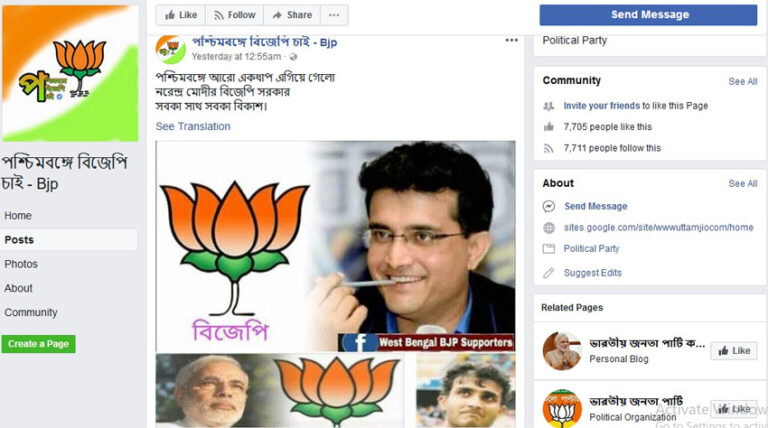
Breaking the myth that it’s the rural India which is communal and in ways supporting hate crime in India was Vargab Pathak, an associate consultant with one of India’s leading IT service, Consultancy and Digital solution provider. Currently based in Maidenhead, Berkshire, England, has initiated a crowd funding campaign on GoFundMe, a crowd funding platform. He posted about the same on Pashchimbanga Shonkhaloghu Hindu (West Bengal Minority Hindu), a Facebook group, seeking support. He posted on the page, “Hi everyone, please click here to support my GoFundMe campaign, Save the Brave: Shambhu Bhawani.” The campaign, however, has attracted only two likes in the group and is yet to witness any amount being funded to cause of collecting 10,000 pounds for the murderer’s family.

Call for free legal aid

In a country, where Junaid’s (the teenage boy who was stabbed to death in a Haryana bound train) is finding it difficult to arrange funds to seek justice, every attempt is being made to make legal aid available to the accused, who is still in police custody. A Facebook post, asking people in Rajsamand contact a certain Sushil Jain of Indore, to make free legal help available to Shambu. The post which was shared by one Ojal Suthar read, “Main Sushil Jain, Indore, is Hindu veer Bhambhu ji ke court case anewale kharch ki sampoorn jawabdati lene ke liye tayyar hoon (I, Sushil Jain of Indore am ready to completely bear the cost for legal help offered to Hindi valiant Shambhu ji).” However, attempts made to contact Jain on the number shared on the post, failed as the phone was switched off.

Also, the lawyer Sameer Vyas, who had travelled to Rajsamand for the juvenile’s bail instead of charging a fee paid, handed over a cheque of Rs 50,000 to his family. “The family of the accused had not yet hired a lawyer they said. But today morning we did see a lawyer from Jaipur, Sameer Vyas, who had come to file a bail application for the juvenile. He said that the bail of Shambhu would be filed soon after charge sheet would be filed and that would be filed soon as the evidence gathering stage was almost over. He also handed over a cheque of Rs 50,000 to the family,” stated a report filed by PUCL’s fact finding team which had reached Rajsamand with social activists like Harsh Mandar and John Dayal.

Account freeze triggers anger

What could be called shocking was a series of tweets which were vindictive and threatening in nature, made to the Chief Minister of Rajasthan Vasundhara Raje. Those wanting to raise the fund, felt let down by the government’s move to freeze the account. A tweet read, “@VasundharaBJP u blocked seta regar a/C. Don’t worry Hindu will teach u lesion in coming election mulli rani (sic).” Several such tweets were all over Twitter criticizing the government for having frozen the account.”