


Gariyaband/Raipur: “World’s most precious stones lies beneath your land,” officers told me. Praye Lal begin to narrate his story. He further said, “And your land is worth billions, but from now onwards, it will be used for the government. Give us your land and in exchange you will get a job, following which you wont have to wander to eke out a living. You will be made a guard for your land. You will be paid a salary to feed your family. Keep this Rs 12000. Following this incident, I was made the guard, but I was never paid the promised salary. After sometime, the officers removed me from the job.”
Around 240 kilometers away from Chattisgarh’s capital, Raipur, in the village of Sendimuda, in Gariyaband, lived a family of five. They neither had many utensil, nor even of earthen pots.
About 25 years ago, Pyare Lal, used to cultivate paddies in his two acres of land. Back then, his life was not really happy but then he and his family never had to skip meals. But life changed, once these stones were discovered under her field. These precious stones soon proved to be a curse for him, as now he has become a daily wage labour. The name of the priceless stone discovered beneath his farm is- Alexandrite.
Alexandrite, is a precious gemstone, which changes its colour depending on the intensity of light. During the day it turns green and gradually changes its colour to brown, violet and red as the day fades into night. Scientists call it the Alexandrite effect. It is said that in 1831, mineralogist Nals Gustaf Nordenscold, had discovered it in the Ural Mountain of Russia for the first time. And was named after Russia’s Tsar Alexander II. In Russia, 5 carat (1000 Miligram) Alexandrite has been found. Brazil too has deposits of Alexandrite of same weight. Other than these countries, this precious stone is also found in India, Sri Lanka, Madagascar and Tanzania. However, in these nations, only 3 carat Alexandrite are available.
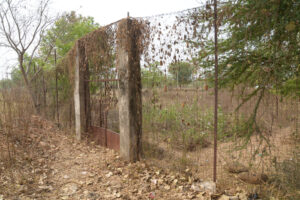
Coming back to Pyare Lal, he does not even know the names of the gemstone. “These gemstones, neither could help me nor the people of our village. We also do not know what it is used for. Today also, the patta of the mining area is in my name, but I am not allowed to go inside my own field. My land has been fenced and taken away by the government. However, I have not been given any farming land in exchange,” he rued.
In 2000, Chattisgarh was carved out from Madhya Pradesh. The State Mineral Department’s retired regional chief officer NK Chandrakar says, “In 1993, the entire had been taken under police custody and handed over to the Mineral Department. Same year, under the department’s guidance a survey was conducted. But we could not begin mining in the area, as we didn’t get the permission from the state government.” The department officially states, that 1918 pockets were dug, which yielded 307 gram Alexandrite.
Deputy of Deobhog Janpad, Deshbandhu Nayak informs, “Illegal mining began to take place, despite the area being under the custody of the department between 1993-98. Only when the villagers began to protest against illegal mining that it was curbed.”
On the other hand, Pyare Lal, who was forced to become a labour from farmer, has another grievance, “I have worked as a labour under MNREGA, but I was not paid my wage for 60 days.” He then questions, “Even after making me labour, government is not giving me my wage. Why is the government deceiving me again and again?”