



Kolkata: Twenty-one-year-old Sobhan Mukherjee, an MSc (Geography) student of Ashutosh College, has been silently installing Bandhan sanitary napkin boxes in the public toilets of Bansdhroni, Golpark and Naktala area of Kolkata. The agenda of Kolkata’s Padman is simple, women travelling or in emergency need not rush to a chemist. First the aid then the purchase.
It all began with a query
He wears no fancy attire but he has a superpower – commonsense, which many lack. So, when one of his female friends excused from a college meeting citing some emergency, he asked his friend the reason. “She told me that she had got her periods and wasn’t carrying a sanitary pad. So, she needed to go to the chemist. I found this incident very disturbing. In an emergency like situation, she had to rush to a chemist. This was when I thought, if some sanitary napkin could be stocked in public toilets, it would definitely come handy in such emergency-like situation,” narrates Sobhan.
With this came the idea of installing boxes, under the name of Bandhan in public toilets. “I began with Tridhara, toilets from transgender. Sometime back, I had played a vital role in convincing local councilors to have a separate toilet for this community within the premise of public toilets. So, I took my study table and set it up on the toilet premise. I purchased some sanitary napkins and displayed them on the table for women to use during emergencies.”
Bandhan for women
Since then there has been no looking back for him. “From October 2017 I have been meeting local councilors with this request of having a Bandhan box installed in public toilets of their area. The support has been good so far. We will be meeting the mayor soon, and that will definitely speed up the process.”
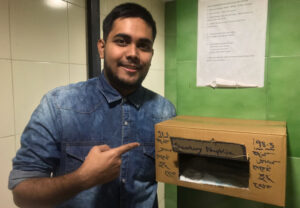
The Bandhan box is nothing but a carton designed to stock sanitary napkins in public washrooms. A cheap and effective answer to the many sanitary pad vending machines installed in 150 government colleges of India under the direction of the West Bengal government in 2015. Unfortunately most lie defunct today. He says, “The vending machines in colleges are non-functional and those working have not been refueled. Also, not many girls know about the existence of such boxes. However, we are hopeful of Bandhan taking off very well, as we are using social media, making videos, creating posters to make women aware of these boxes, which can come handy during emergencies or for women who can’t really afford expensive sanitary napkins.”
He then adds, “Even today in remote areas women use sand during periods. My aim is to reach out to that woman in that remote village of India. This is just the beginning. Bandhan boxes are getting a good response. Earlier these pads were available free of cost. But now I am charging Rs 2 for each napkin. The money collected will be used to supply pads to women of remote areas.”
Padman’s message
On being asked if he has heard of Arunachalam Muruganantham and the upcoming film called Padman? He says, “Of course! I think the film will help me in a huge way. You see Arunachalam, Padman and me, all are working words removing the taboo surrounding menstruation. It’s normal. It’s not a disorder. So, why not discuss it in the open? Why this secrecy? I think this mainstream film will definitely help all those activists working toward women health in a huge way. But remember, we first need, to make women realize that napkins are a need and not luxury and under no circumstances, they should use any other substitute. If we are unable to convince them, they will keep going back to rags, sand and what not.” He also adds, “Sanitary napkins should be made cheaper for the poor women.”
Help from all quarters
Coming back to his activism, Sobhan reveals that he dedicates all his evenings to this cause and often spends from his pocket to stock up napkins in the public restrooms.
However, with people getting to know about his cause, few are coming forward to help him out. “There is a well-wisher from Manipal, who has promised to bear the cost of supplying the required amount of sanitary napkins for three months. Local sanitary napkin producers are also helping me by selling the unpackaged product at lower rates. The only catch is, I have to pack them in a plastic packet at home.”
My Mother Rocks!


Hello sobhan mukharjee, my name is Samrat, how may I contact you. 7003523123 is my no and my email id- dey.sam001@gmail.com. Please contact me. I am also want to help you in this wonderful awareness.