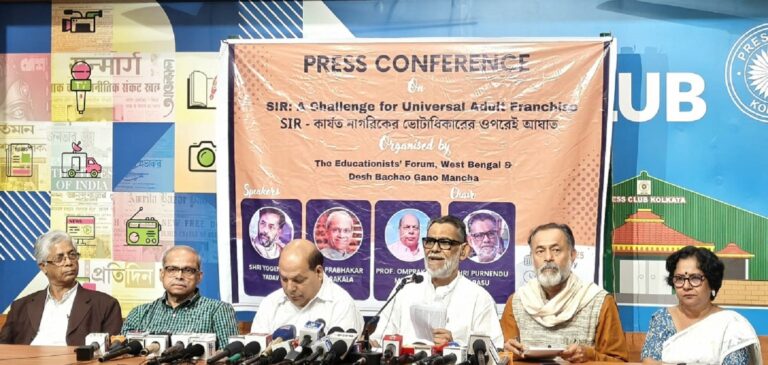
Kolkata: Stage two of the Special Intensive Revision (SIR) of the voter list in West Bengal will be more dangerous, claimed Yogendra Yadav, the social activist who has been raising doubts about the real intentions behind the Election Commission of India’s SIR process and had also approached the Supreme Court against it during Bihar’s SIR.
“The second phase will be when the election commission (ERO) will send notice for the hearing to those voters who could not establish their lineage according to the election commission,” said Yadav during his half-hour address at Press Club in the event named SIR: A Challenge for Universal Adult Franchisee, organised by Desh Bachao Gano Mancha and The Educationists’ Forum, West Bengal.
Phase Two May Trigger Massive Voter Deletions
The founder of Swaraj India further said, “In Bihar, after the Supreme Court’s objections, the election commissions had not conducted the second phase of voters’ hearing, and said okay, there will be no more deletions of voters.”
“But in Bengal, the notice could be sent to any number of voters — it may be 50 lakhs to two crores. However, there is no established protocol or SOP (standard operating procedure) for how those documents will be assessed. This will be an arbitrary decision by the EROs,” he pointed out.
Voters of Border Areas, Women and Migrants Most at Risk
“This may be done especially in the bordering areas of Bengal. While women and migrant workers are the most vulnerable,” said Yadav.
The social activist also mentioned earlier that in the first phase, those voters who do not fill out the enumeration forms will have their names deleted instantly, without enquiring anything from those voters, simply saying that since they did not fill the form their names are being removed.
Yadav, citing evidence he had placed before the Supreme Court during Bihar’s SIR, also claimed that the Election Commission has no intention to clean up the electoral roll, but to remove such voters who can vote against the Bharatiya Janata Party (BJP). The Election Commission has not remained an umpire anymore, he said, but has become a player.
“After the final publication of the electoral roll in Bihar, I saw in the Supreme Court that there are 20 lakh households which have more than 10 voters, which means election officials need to verify them physically, but it did not happen. There were also 800 voters in one single house in ten such cases. But the Election Commission did not act.”
“My fear is, Bengal can have the largest number of disenfranchised voters in India or maybe in the world,” he added.
‘Bloodless Political Genocide’: Sharp Warnings Issued
Before Yadav, Dr Parakala Prabhakar, an economist and political commentator, argued, “SIR is bloodless political genocide.”
“SIR is nothing but bloodless political genocide. Earlier genocides happened by killing people. But here it is by depriving a large number of people of their fundamental right, which is the right to vote. Once that is taken out, the essence of citizenship is gone. Then the person or persons are no longer meaningful participants in the political process. That is why I say that with SIR, a new phase is coming — earlier, we voters used to choose governments; now government will choose voters. SIR is an assault on constitutional values. It is a political cleansing of India.”
The other speakers were Professor Om Prakash Mishra and Syed Tanveer Nasreen, while Purnendu Basu moderated the event.
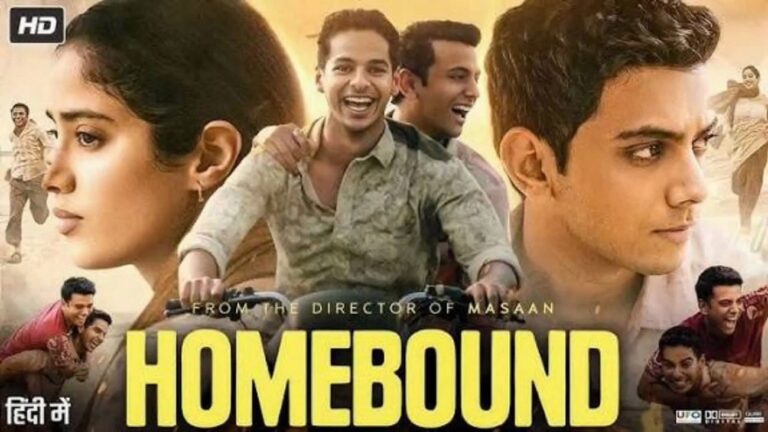
Although I have always been a film buff, I hadn’t gone to a theatre in a long time. But last evening, after hearing about Homebound, India’s Oscar nominee for 2026, something stirred within me. I booked my ticket online, reached INOX, and lo and behold—what a powerful film it turned out to be.
It is not merely a movie. It is an elegy of our time—etched on celluloid—of our country, of our contemporary era. What begins as the story of two young men and their personal losses soon expands into a haunting collective experience. It becomes a commentary on our societal and cultural decline: a mourning of lost optimism, shattered dreams, fading ideals, and the fragmentation of communities.
The film by Neeraj Ghaywan on the story by Basharat Peer holds up a mirror to social injustice, human struggle, and even environmental crises like the COVID-19 outbreak. This “elegy of our time” captures the collective grief and anxieties of today, urging us not just to lament but to rethink the very texture of life in the present.
The movie opens with the two protagonists Ishan Khatter as Shoaib Ali and Vishal Jethwa as Chandan Kumar travelling to appear for a competitive exam—a journey that itself feels like a battle. The railway station scene is unforgettable: chaos everywhere, hopelessness deeply etched on the faces of the young. You feel the weight of a generation fighting for breath.
The film is full of such searing images:
The construction site where Chandan’s mother works barefoot, a stark reminder of inherited suffering—katile pair hi virasat mein.
Shoaib struggling to produce his parents’ Aadhaar cards—a commentary on bureaucratic heartlessness.
The stark transition between black-and-white and sepia tones, reflecting memory, trauma, and time.
Entrenched untouchability, shown through children withdrawing from school meals because a Dalit cooked them.
The centuries-old caste system, refusing to die.
Chandan’s idealism touched me deeply. His reasoning—“If I get a job through reservation, I will still be mopping office floors without dignity”—is both heartbreaking and profoundly insightful.
The office cricket match, with its taunts and covert bigotry, hits hard. As Muslims, many of us have lived that reality. The film’s honesty is disarming; it is so true, so authentic, so painfully genuine. The systematic marginalisation of Muslims in India is portrayed not with exaggeration, but with quiet, precise truth.
Sudha’s tender plea to Chandan—“Paapa ko itni baar haarte huye dekha hai… I wanted to fulfil his dreams through you”—is one of the film’s emotional peaks.
Then comes the sudden outbreak of COVID—the government’s knee-jerk lockdown, mills closing overnight, an eerie silence descending upon the city. Workers, desperate to return home, begin their long exodus. Police brutality, fear, confusion, paranoia—everything is captured with devastating accuracy.
When Chandan is thrown out of the truck mid-journey, the scene is unforgettable. Villagers hurl stones at exhausted migrants, refusing them entry. Yet, in that darkness, a lone woman steps forward with water—resisting pressure, embodying the last flicker of humanity.
The dying scene—quiet, raw, unadorned—will remain etched in the memory of every viewer.
The performances are extraordinary. Ishaan Khatter delivers the finest role of his career, and his co-star Vishal Jethwa matches him every step of the way, both embodying a generation caught between despair and resilience. Janhvi Kapoor, Harshita Parmar as Vaishali and Shalini Vatsa as Phool Chandan’s mother were remarkable as were other casts too. The dialogues are sharp and hard hitting.
Homebound is not just a film—it is a document of our times. A lament, a mirror, and perhaps even a warning.
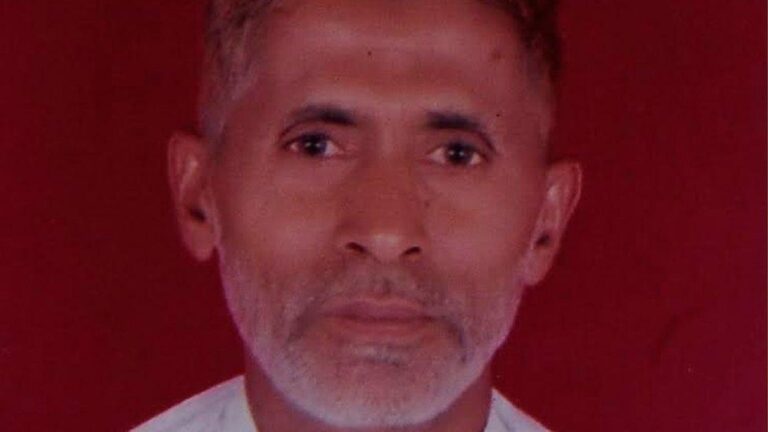
Ten whole years since a mob dragged Mohammad Akhlaq out of his home in Dadri, beat him to death with bricks and rods because someone spread the lie that he had beef in his fridge. Forensic tests later proved it was mutton. But Akhlaq was already dead, his son Danish was fighting for life, and the country was burning with shame.
The mob was led by the son and nephew of a local BJP leader.
They were arrested, charged with murder, then quietly released on bail.
For a decade, the trial crawled at a snail’s pace, prosecution witnesses barely began to be examined, and the killers walked free among us.
And now, in 2025, the BJP government of Uttar Pradesh wakes up and decides: “Let’s just drop the entire case.”
An application under Section 321 CrPC has been filed to withdraw the murder prosecution. The reasons? “Inconsistent statements,” “no sharp weapons recovered,” “no prior enmity.”
The same tired excuses that courts routinely reject in every mob-lynching trial. These are not legal grounds; they are political cover.
This is not an oversight. This is not incompetence.
This is a blatant attempt to bury justice because the accused have the right political connections and the victims are from the “wrong” faith.
The court is not bound to accept this shameful withdrawal. The law is crystal clear.
But will the judge dare to stand up to a government that has spent years intimidating the judiciary, transferring “inconvenient” judges, and turning courts into extensions of the ruling party?
We saw what happened at the Supreme Court level, collegium battles, midnight transfers, judges afraid to even take up certain cases.
If the highest court can be brought to its knees, what chance does a district judge in Gautam Buddh Nagar have?
If this withdrawal is allowed, every future lynching will carry a silent footnote: “Kill now, we will clean it up later.” Share this if your blood is still capable of boiling.
Tag every judge, every lawyer, every citizen who still believes India is a country of laws, not of lynch mobs and their political godfathers.
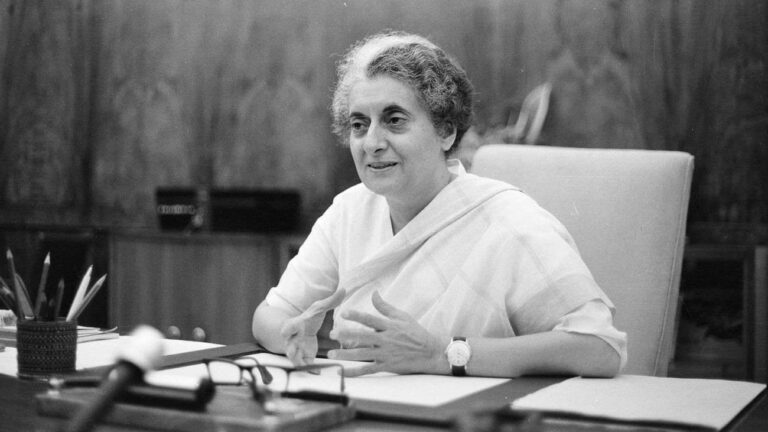
Let us recall the achievements of Indira Gandhi, whose birth anniversary we celebrate today. She has undoubtedly been one of India’s most powerful rulers ever — with a baggage of controversy as well.
She took over as the Prime Minister of India on 24 January 1966, following the unexpected death of Lal Bahadur Shastri. The senior leaders in the Congress assumed that, as she was a frail woman and quite inexperienced, they would continue to rule with her as an ornamental PM.
Right from day one, she started asserting herself and created her own small group of senior, middle, and talented junior ministers, like Pranab Mukherjee. They began differing from the orthodox line of the old guard so much that she, the Prime Minister, was expelled from Congress in 1969.
She was unfazed in such a big crisis and got her followers together to constitute a “New” Congress Party, that openly challenged the old and financially better off old guard who held on the the ‘original’ Congress, with all the offices, infrastructure, funds, and supporters, as the Congress (O) — O for ‘Organisation’.
Indira then retaliated against the moneybags that supported her opponents and announced the nationalisation of 14 commercial banks in India on July 19,1969. This was a historic and bold step that she followed up by nationalising other private banks, and she was determined to use public funds in favour of the masses. It ensured that farmers, small and tiny enterprises, as well as the rural populace, had easier access to banking services and credit facilities. It was her first step towards taking the Indian economy along a socialist pattern.
In the 1971 Lok Sabha elections, Indira toured all over India, sending out strong messages for change and betterment of the masses. She coined the very popular slogan “Garibi Hatao, Desh Bachao” (Remove Poverty, Save the Country). The masses were bowled over by the image of feminine grit and power that she conveyed. Her New Congress group achieved a landslide victory by defeating a coalition of conservative parties.
In 1971, she brought in the 26th Amendment to the Indian Constitution 1971, which struck down Articles 291 and 362 of the Constitution and eliminated the Privy Purse cash reward that erstwhile princes and nawabs were given– ensuring social justice and signalling a more egalitarian society.
Even before she could settle in, West Pakistan unleashed a genocide in East Pakistan– which led to a massive number of one crore Bengali refugees crossing the border for asylum in India. This was a massive human problem, and Indians were terribly agitated at the manner in which the Pakistani army went about slaughtering the Bengali population of East Pakistan. To garner world opinion on India’s side, she went abroad and met all important world leaders and signed a historic Indo Soviet Pact to pass on a message to Nixon-Kissinger, who were dangerously biased in support of the Pak army in its genocide.
Finally, after gaining a strong majority in parliament and with the support of many world leaders, she started to extend direct and indirect assistance to the provisional government of Bangladesh, formed in East Pakistan. On 3rd December, Pakistan recklessly invaded India. Indira led the battle on both the western and eastern fronts, as she was prepared. The Indian army entered East Pakistan and joined forces with the Mukti Bahini in liberating that country and declaring a new free country called Bangladesh.
This was surely India’s finest hour!
The victory over Pakistan and the creation of Bangladesh soared her popularity. In March 1972, her party won a significant number of state elections. But soon thereafter, several forces grouped together and started a civil disobedience movement in Gujarat first, and then in Bihar, under the veteran leader, Jayaprakash Narayan — the Total Revolution.
In retaliation, Indira imposed a national emergency on the ground of internal disturbance on the 25th of June 1975. She jailed all important political leaders, muzzled the press, curtailed civil liberties and ushered in a totalitarian regime that India holds against her, even till now. When she felt that the opposition had been crushed, she lifted the Emergency on till 21 March 1977 and called for parliamentary elections.
In this election of 1977, she was routed by a strong articulating widespread public opposition to her Emergency. The victorious opposition cobbled together and formed a ‘united’ Janata Party government under Morarji Desai. In early 1978, Gandhi and her supporters formally split from the Congress Party and formed Congress (I) Party (the “I” standing for Indira). The Janata government was unable to offer stability, but was united in imprisoning her during the period of October 1977–December 1978 on the charges of corruption.
However, post her release from jail, Gandhi was again elected to the Lok Sabha in November 1978, and her Congress (I) Party started to gain strength, sweeping a landslide victory in the General Elections in January 1980.
Indira Gandhi returned to power and followed her father’s socialist industrial development policies. In 1975, she introduced the Twenty Point Programme, which was the first ever comprehensive plan aimed at eradicating poverty and raising the standard of living of the poor. The Programme’s goals were in line with the Development Goals. Her other notable achievement was the emphasis on the Green Revolution, which revolutionised India’s agricultural sector. She then nationalised the coal sector too.
Early in the 1980s, Indira Gandhi sensed threats to India’s political integrity. Sikh extremist leader Bhindranwale led a violent movement in Punjab, demanding an independent country called Khalistan. Indira was accused of having helped Bhindranwale’s earlier rise to power to curb the Akali Dal in Punjab. But when the situation went out of hand, she sent the army into the holiest precincts of Sikhs, the Golden Temple, to finish off the Khalistan movement. This Operation Blue Star angered the Sikhs, and her own trusted Sikh bodyguards assassinated her in her own New Delhi home on 31 October 1984.
Let history judge her great achievements and her minuses as well.
झारखंड अपनी 25वीं वर्षगांठ मना रहा है, लेकिन झारखंड आंदोलन के सपने पहले से कहीं ज़्यादा दूर हैं। इस अवसर पर, झारखंड जनाधिकार महासभा सभी राजनीतिक दलों के नेताओं को संबोधित करते हुए वक्तव्य जारी कर रही है। यह वक्तव्य वर्तमान स्थिति के लिए राजनीतिक वर्ग को ज़िम्मेदार ठहराता है और राजनीतिक नेताओं से अपने तौर-तरीके सुधारने की अपील करता है।
सभी पार्टियों के विधायक और राजनीतिक नेतागण,
झारखंड की 25वीं सालगिरह के मौके पर, हम आपको यह बताने के लिए लिख रहे हैं कि हम आपके काम से कितने निराश हैं, और आपसे अपील करते हैं कि आप अपने तरीके सुधारें।
झारखंड का बनना एक लंबे संघर्ष का नतीजा था। सभी समुदायों के जनहितैषी लोगों ने इस आंदोलन में अहम भूमिका निभाई। कई लोगों ने इसके लिए अपनी जान कुर्बान कर दी। उनका सपना था कि झारखंड बनने से इस इलाके के आदिवासी-मूलवासी अपने मूल्यों के अनुसार विकास कर पाएंगे – आज़ादी, समानता, दोस्ती और प्रकृति के साथ तालमेल के मूल्य। झारखंड की आज़ादी से बाहरी लोगों के शोषण का भी अंत होना था।
पच्चीस साल बाद, यह सपना मात्र बन के रह गया है। इसमें कोई शक नहीं कि झारखंड में ज़्यादातर लोग आज पच्चीस साल पहले के मुकाबले थोड़ी बेहतर स्थिति में हैं। लेकिन लाखों लोग आज भी घोर गरीबी में जी रहे हैं। और झारखंड वैसा नहीं है जैसा उसे होना चाहिए था। छोटानागपुर और संथाल परगना की खूबसूरत सभ्यता खत्म होने के खतरे में है क्योंकि ताकतवर कंपनियाँ इसकी ज़मीन, खनिज और दूसरे प्राकृतिक संसाधनों पर नज़र गड़ाए हुए हैं। झारखंड के आज़ाद और स्वाभिमानी किसान मज़दूर बन रहे हैं और बदहाल शहरों की ओर जा रहे हैं। जल्द ही, झारखंड का अनोखापन खतम हो जाएगा और बाकी भारत से अलग शायद ही कुछ बचेगा, सिवाय इसके कि यह ज़्यादा गरीब होगा।
आप, झारखंड के राजनीतिक नेता, इसके लिए मुख्य रूप से ज़िम्मेदार हैं। झारखंड आंदोलन के दिग्गजों से प्रेरणा और सीख लेने और आम लोगों के लिए काम करने के बजाय, आपने खुद को अमीर बनाने के लिए शोषकों के साथ हाथ मिला लिया है। आप स्थानीय लोगों की कीमत पर झारखंड के कीमती संसाधनों को लालची कंपनियों और व्यापारियों को बेच रहे हैं। आपने सार्वजनिक शिक्षा व्यवस्था को बर्बाद होने दिया है, जिससे लाखों युवाओं को प्रवासी मज़दूर बनने पर मजबूर होना पड़ा है। आपने भ्रष्ट ठेकेदारों के साथ मिलकर नरेगा को लूटा है, जिससे लाखों लोगों से उनके काम का अधिकार छीन लिया गया है। पच्चीस सालों में, आप PESA के लिए नियम बनाने में नाकाम रहे हैं। आपने CNT-SPT एक्ट और वन अधिकार अधिनियम का घोर उल्लंघन होने दिया है। आपने बड़े-बड़े ठेकाओं से खूब पैसा कमाया है, जबकि पीने का पानी, नाली और फुटपाथ जैसी बुनियादी सुविधाएँ हर जगह, यहाँ तक कि रांची में भी गायब हैं।
आप में से कुछ लोगों ने झारखंड के लोगों को बाँटा भी है और अपनी ताकत बढ़ाने के लिए उन्हें एक-दूसरे के खिलाफ भड़काया है। “धन नहीं, एकता सही ” झारखंड संघर्ष के लोकप्रिय नारों में से एक था। आज इस एकता का बहुत कम हिस्सा बचा है। जब लोग आपस में लड़ते हैं तो शोषण करने वालों की मौज हो जाती है।
जब तक राजनैतिक नेता अपना तरीका नहीं बदलते, तब तक हालात सुधरने की उम्मीद नहीं है। हम आप में से कुछ लोगों को पहले से ही अपना साथी मानते हैं, और दूसरों से भी हमें कुछ उम्मीद है। लेकिन अगर आप सब ने अपना रवैया नहीं सुधारा, तो कहीं ऐसा न हो कि आप पूर्ण रूप से नकार दिए जायें। हम उम्मीद कर रहे हैं कि नेतृत्व की एक नई पीढ़ी सामने आएगी, जिसमें ऐसे पुरुष और औरतें होंगी जो लोगों के हितों को दिल से समझते हैं। हम पहले से ही आप में से कुछ लोगों को उनमें गिनते हैं, लेकिन ज्यादा नहीं। अपनी तरफ से, हम अपने तरीके से बदलाव के लिए काम करते रहेंगे।
महासभा और अन्य संगठन मिलकर 15 नवंबर 2025 को बिरसा समाधि स्थल, कोकर, रांची से सैनिक बाज़ार तक एक “झारखंडी एकता यात्रा” का आयोजन करेंगे ताकि लोगों को झारखंड आंदोलन के सपनों की याद दिलाई जा सके।
The seizure of the city of El Fashir in North Darfur by the paramilitary Rapid Support Forces (RSF) has given us some horrific images. On 26–27 October 2025, after an 18-month siege, RSF forces overran the city that had been the last major stronghold of the Sudanese Armed Forces (SAF) in Darfur.
Sudanese medical and rights groups, including the Sudan Doctors Network, have accused the RSF of committing massacres, mass detentions, and attacks on hospitals.
Sudan’s transition to democracy began with extraordinary hope and ended in blood. In April 2019, a broad civilian uprising toppled Omar al-Bashir, whose 30-year dictatorship had left behind a legacy of repression, corruption, and civil war. The revolution’s slogan — “Freedom, peace, and justice” — became a unifying cry for a nation long divided by region, ethnicity, and class.
After Bashir’s ouster, a fragile power-sharing arrangement was formed between the military and the civilian coalition known as the Forces of Freedom and Change (FFC). That arrangement, formalised in the 2019 Constitutional Declaration, promised a transitional government leading to elections. But beneath the surface, the military never ceded real power.
The two dominant armed entities — General Abdel Fattah al-Burhan’s Sudanese Armed Forces (SAF) and General Mohamed Hamdan Dagalo’s (known as Hemedti) Rapid Support Forces (RSF) — both sought to control the state’s future, its gold wealth, and its foreign partnerships.
By late 2021, the transition had effectively collapsed. In October of that year, Burhan and Hemedti staged a coup, dissolving the civilian government and arresting Prime Minister Abdalla Hamdok. What followed was a return to military rule disguised as “stabilisation.”
Efforts to revive the transition faltered as mistrust between the SAF and RSF deepened, particularly over plans to integrate the RSF into the regular army. The disagreement was less about structure than supremacy: who would control Sudan’s economy, foreign policy, and post-Bashir order.
In April 2023, tensions exploded into open war in Khartoum, then spread rapidly to Darfur and other regions — derailing Sudan’s democratic dream and plunging millions back into the nightmare they had risked everything to escape.
The Darfur Genocide
The events unfolding in El Fashir evoke grim memories of the early 2000s, when Darfur became synonymous with ethnic cleansing and state-sponsored terror.
The RSF, born out of the infamous Janjaweed militias that orchestrated the first Darfur genocide, has reverted to its original logic of ethnic warfare. Reports from survivors describe house-to-house searches, the targeting of non-Arab communities such as the Fur, Masalit, and Zaghawa, and the systematic destruction of civilian infrastructure.
Some of the verified images and videos emerging from El Fashir and other parts of Darfur in late 2025 are among the most disturbing to have surfaced since the start of Sudan’s civil war. Although access to the region is severely restricted, visual evidence has filtered out through humanitarian workers, local journalists, and satellite verification groups like Amnesty International’s Crisis Evidence Lab and BBC Verify.
The International Backers
Several foreign powers have played active roles in Sudan’s war, each pursuing distinct economic and strategic objectives.
The United Arab Emirates (UAE) has been the most significant external supporter of the RSF. Its involvement is motivated by access to Sudan’s gold resources and a desire to expand its influence in the Horn of Africa. The RSF controls major gold mines in Darfur, and much of that gold is exported through the UAE into the international bullion market.
The Sudanese Armed Forces have received assistance from Iran, Turkey, Egypt, and Qatar — each maintaining their own stake in the conflict. Turkey and Qatar, for example, invested heavily in Sudan during the Bashir era, particularly in agriculture and port infrastructure, which they now hope to protect.
The war has extracted an enormous toll, with more than 150,000 killed and another 522,000 children dead due to malnutrition. It has also displaced 8.8 million people, while 3.5 million have been made refugees.
With both parties to the civil war having consolidated their hold in various regions across the country, the people have continued to suffer.
Dubai: Literature enthusiasts from India and Dubai gathered at the India Club for a memorable evening with celebrated author and journalist Rasheed Kidwai. The engaging session was part of The Write Circle series — a prestigious initiative of the Prabha Khaitan Foundation that brings eminent authors, poets, and thought leaders to global audiences.
The event began with a warm and graceful welcome address by Kajal Sagar, the Ehsaas Woman of Dubai. The evening’s conversation was skilfully moderated by Madiha Saidi, also an Ehsaas Woman of Dubai, who guided the audience through Rasheed Kidwai’s remarkable literary and journalistic journey.
A noted author, political commentator, and columnist, Rasheed Kidwai is known for his insightful analysis of India’s political landscape and the intersection of cinema and power. His acclaimed books — Neta Abhineta: Bollywood Star Power in Indian Politics and House of Scindias — have been widely praised for their depth of research and engaging narratives that bridge the worlds of governance and glamour.
An Insightful Dialogue on Politics, Cinema, and Power
The conversation delved deep into House of Scindias and Neta Abhineta, as Kidwai shared fascinating insights and lesser-known anecdotes about India’s top political figures and film personalities, offering a behind-the-scenes glimpse into the corridors of power and celebrity.
Saidi’s incisive questions explored the complex relationship between Indian cinema and politics, and the challenges of reporting on influential public figures. Kidwai, known for his sharp political analysis and candid storytelling, kept the audience engaged with his trademark wit and depth of observation.
“The relationship between Bollywood and politics is an abiding one,” Kidwai observed. “Film stars from across the country have joined politics, won elections, and held important positions in government. At the Centre, Shatrughan Sinha, Sunil Dutt, Vinod Khanna, and Smriti Irani went on to become Union ministers. Kirron Kher and Paresh Rawal entered the Lok Sabha through the BJP, while Raj Babbar once headed the Uttar Pradesh Congress unit. Even Amitabh Bachchan served as a Congress MP from 1984 to 1986 and was a close aide of Rajiv Gandhi. Film icons such as Rajesh Khanna, Govinda, Jaya Bachchan, Jaya Prada, Dharmendra, and Hema Malini have all played a role in central politics — each with varying impact.”
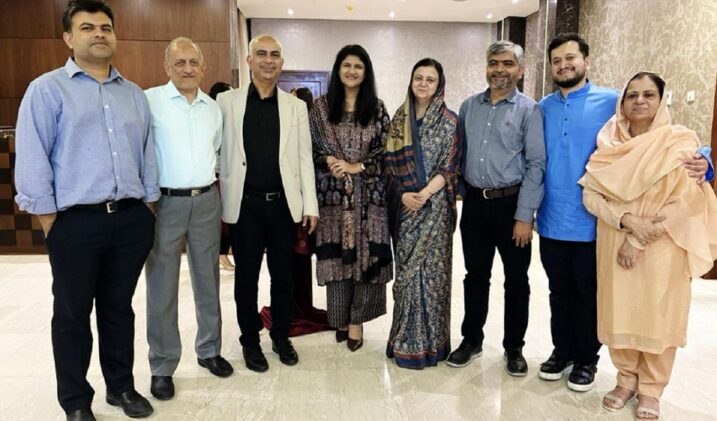
Rasheed Kidwai with his wife Dr Farah Kidwai (in Saree) and other family members at the India Club in Dubai | Arranged
Cinema as a Unifying Force in Indian Society
Expanding on this theme, Kidwai reflected,
“At another level, this phenomenon highlights political parties’ inability to find credible leaders as candidates. The BJP, Trinamool Congress, Shiv Sena, and the Congress have all relied on reel-life heroes to further their political causes. Meanwhile, actors seek longevity and relevance in public life through electoral politics. In a country as diverse as India — divided by ethnicity, class, caste, religion, and language — cinema acts as a unifying and popularity-driving force. Film stars often provide a more consensual and likable alternative to conventional politicians, carrying an aura that inspires admiration and connects instantly with the masses.”
His reflections offered the audience a thoughtful understanding of how celebrity culture and electoral politics intersect in modern India.
A Celebration of Literature, Conversation, and Ideas
The Write Circle series, an initiative of the Prabha Khaitan Foundation, continues to promote literature, cultural dialogue, and meaningful exchange among global audiences. The Dubai edition once again proved how storytelling and reflective dialogue can bridge continents, languages, and ideas.
The evening concluded with an interactive Q&A session, where participants posed thought-provoking questions about political journalism, celebrity influence, and the evolving nature of India’s democracy. The discussion left the audience both informed and inspired — marking yet another successful and memorable chapter of The Write Circle in Dubai.
The programme was graced by several distinguished citizens of Dubai from diverse walks of life, including Shree Vasu Dada Shroff, Naved Saidi, Yasar Khan, and many others.
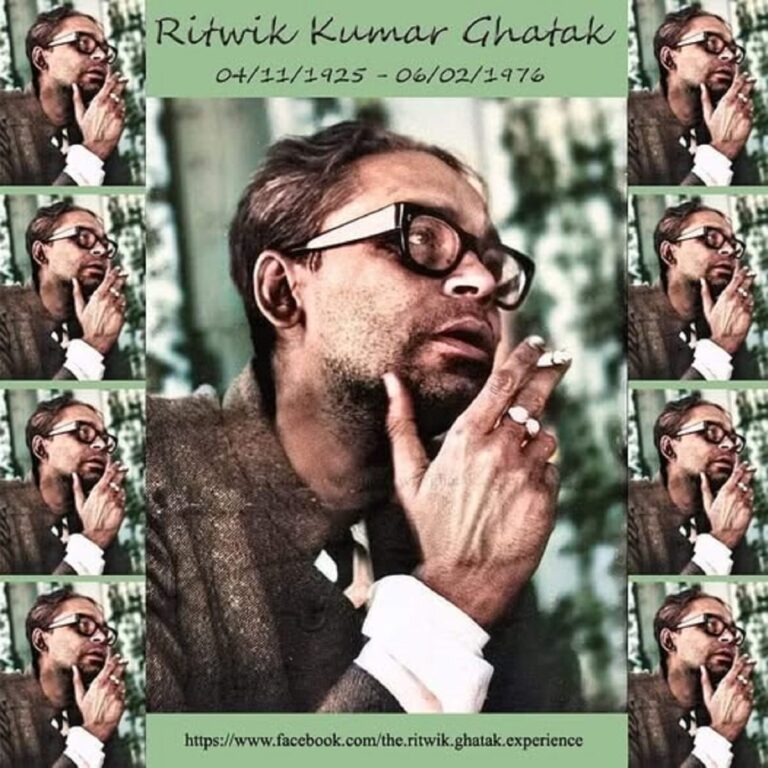
The World Cinema Project has restored, among other films, Titas Ekti Nodir Naam by Ritwik Ghatak. Martin Scorsese, the revered Hollywood film-maker who is also the founder of the project, didn’t know much about Ritwik Ghatak, who made the film in 1972-73, until recently. He quite candidly admits that he knew little about Indian cinema outside of Satyajit Ray and Bollywood. When he finally came across Ghatak, though, Scorsese saw “an extremely refined vision of cinema” and films that were “thematically dense and layered”.
Many film-watchers in India are no more likely to have encountered Ghatak—although that is only partly their fault. Ray had famously said, in 1989, to a French journalist in a broadcast interview, “We have a fairly backward audience here, I must say, in spite of the film society movement and all that. If you consider the larger audience, it is a backward audience, an unsophisticated audience.”
Ray was lashing out at the audience’s, and critics’, response to Devi, his film with a very young Sharmila Tagore as the lead actress. One of his true masterpieces, the film is about a young woman who is interpreted (perhaps not the right word for it) as an avatar of goddess Kali by her father-in-law, and the unsavoury reverberations of it. Ray said, “It [the film] dealt with religious dogmatism, it didn’t attack religion as such; it attacked dogmatism, the extreme form of religion… But people [are] writing in the papers that ‘Oh, because Mr Ray is not a Hindu, he is a Brahmo, he is making such films against Hinduism’ and all that. But they are stupid people, you can’t take them into account.”
What, then, of the socially, politically, morally, and much-elsely conscious cinema of Ghatak?
Yet, in this, his centenary year, I have discovered to my great joy over the past many months of working on Unmechanical: Ritwik Ghatak in 50 Fragments as its editor, an anthology of essays just published by Westland Books, that his work has its audience and is finding new viewers—and its place in Indian and world cinema.
Ritwik Ghatak’s Raw Genius: The Rebel Voice of Bengali Cinema
Ghatak was usually less polished in his demeanour than Ray was, just rawer; perhaps that could be said about their cinema too. If he embarked on a diatribe against Bengali cinema-watchers, Ghatak would probably have dealt in the language of the streets. I say probably, but by all accounts, that’s exactly what he used to do.
Drunk much of time in the last fifteen years of his fifty-year-long life and out of work for large swathes in that period—he didn’t make a full-length film between 1962 and 1972-73, though he did make some short films and documentaries. He was vice-principal at the Film and Television Institute of India (FTII) in Poona (now Pune) — Ghatak was disillusioned with what we often refer to with the all-encompassing word — ‘system’, and wasn’t shy of giving vent to his frustration.
Partition, Politics, and Pain: The Forces That Shaped Ghatak’s Cinema
His films attacked the very class of Bengalis he belonged to, the middle-class bhadralok, which was—and remains—the chief patron of the arts.
An unusually creative and sensitive young person, it appears that Ghatak could have had his pick of careers, coming as he did from a well-off family. But the times made the man: as a teenager, he lived through World War II, the struggle for independence, the Great Bengal Famine, the many communal riots, and, finally, the freedom and Partition of India, followed by more riots and killings and the refugee crisis.
From the writings of his twin, Pratiti, we find that even in his early teens, he was spending a lot of time with labourers and workers of various hues, and around the time of independence, taking active part in civil society initiatives that brought him closer and closer to the marginalised, and causing him to be disillusioned with the world of the urban elite. His ideas first burst through in writing—poetry and short stories—and then theatre, and finally cinema, as is well documented, in order to converse and communicate with more and more people.
That was the primary impulse, to speak to people, but, of course, he had the artist’s quest for recognition too. Letters to his wife Surama, when he was working at Filmistan Studios in Bombay, briefly, in the mid-1950s, speak of the fame he had hoped to find along the way.
From Idealism to Isolation: The Making and Unmaking of Ritwik Ghatak
And therein lies the unravelling of Ghatak.
His first film, Nagarik, made in 1952, went unreleased till after his death in 1976. Why? Because he had had his differences with the Communist Party of India (and the Indian People’s Theatre Association) he belonged to, and was expelled. And, from what I have picked up from various people I have spoken to, members of that party prevented the film from getting a release.
A similar fate befell Subarnarekha, made in 1962 but only released in 1965, because of issues with the censors. Apparently they objected to the film’s climax in which the drunk protagonist walks into the quarters of his sister, who has turned to prostitution, in the dead of night, prompting the sister to kill herself. It’s a gut punch of a scene in a magnificent film.
Komal Gandhar, made just before Subarnarekha in 1961, did get released on schedule, but only in limited theatres. It was scuppered by forces—it’s impossible for me to say who was chiefly responsible, though I have heard it said it was the Communist Party again—that played the pettiest of tricks: planting people in the audience in theatres that would laugh at gritty or emotional scenes and howl at the lighter moments.
By all accounts, Ghatak didn’t start out being the man he became—bitter, an alcoholic—when still only in his thirties. He was an idealist, a man full of ideas.
Yes, he wanted recognition, not necessarily a lot of money. Yet, from the early 1950s all the way to the time of his death in the mid-1970s, he also deliberately kicked every chance at success out of his path. To put it simply, he sought glory, but not by compromising. He wanted to do his work, his way, and only his way, and wanted the world to accept him for it.
Art, Conviction, and Conflict: The Price of Staying True
Does that suggest entitlement?
Or, naïveté?
Who knows?
Q: But what if the audience doesn’t accept the artist, or the artist’s worldview? What should the artist do—stay firm in his/her convictions or think about their worldview based on what the audience tells them? Where does the independence of the artist end?
A: An artist must always remain firm in their convictions.
The Q&A above is translated from an interview published posthumously in Ritwik: Nijer Kothay, Nijer Lekhay.
“I had a chance and made the film. It was fun all the way through—it is still fun while it is grossing exactly nothing at the box office.”
This is about Ajantrik (1958). Another colossal failure at the box office, but now regarded as an all-time global classic. But, then, as Safdar Hashmi said of him:
“Far from being a rebel protesting against ‘constraints’ within the cultural movement, Ritwik, unlike many erstwhile luminaries of the progressive cultural movement, never wavered in his pursuit of a medium and a message that is true to the people and carries on their struggles in the artistic sphere, he never placed his art at the disposal of commercial cinema or fell prey to the attractions of glamour and riches. In his films, he used no populist elements, the shortcuts to popularity resorted to by so many of our so-called ‘radical’ film-makers these days.”
Or consider what versatile Bengali actor Anil Chatterjee said about Meghe Dhaka Tara (1960): “The distributor, Mahendra Gupta, had suggested a different ending to the film: the sister should survive, and she would return home with her brother. Ritwikda shot that ending. But he told me, ‘This ending will not be used, I will shoot an alternate ending. This film must end in tragedy. The sister must die. She can’t survive.’ He didn’t compromise.”
He really didn’t. What happened instead, though, was steady deterioration, of his health, his relationships, even perhaps his work. Jukti, Tokko aar Goppo, his final film, can be thought of as a classic, a film so different from anything ever made, at least in India; it is autobiographical, raw and abrasive, a comment and a statement more than anything else. Of the film, Safdar Hashmi writes:
“In 1974, in a state of ill-health and near nervous breakdown, he completed his last film, Jukti, Tokko aar Goppo, a film so daring in its complete disregard of the very language and grammar of cinema he had mastered and developed that it is difficult to understand how it achieves its intense intimacy with the audience. It is as if the characters step out of the screen to talk to you and you are forced to respond to them, to react very sharply for or against them. The central character, played by Ritwik himself, parodies his real life in such a way that it compels the audience to reflect and criticise him. Perhaps that is just what Ritwik had been struggling to do through cinema all his life. Ironically, perhaps he wanted to see whether it could be achieved only through a conscious rejection of much of what has come to be accepted as the language of cinema.”
I get what he’s saying of the film, but I don’t agree.
The writer and poet Nabarun Bhattacharya says about Jukti, Tokko aar Goppo:
“When the film was made, and we watched it, I couldn’t understand it at all. In fact, I had a raging row with Ritwik about it. I remember telling him, ‘Enough is enough! You think you can do whatever you want and everyone has to sit and watch it? I can’t accept that you will walk to the camera lens and pour alcohol on it as a defence of your alcoholism.’ He conceded defeat at the time. He said so. He finished by quoting Shakespeare: ‘Then mum’s the word.’”
“But I have been astounded each time I have watched the film since, the modernity of it is incredible. Just watch it. See the heights he has reached, see where each image has travelled. And that film talked about every political issue in Bengal, and even in the rest of the world, at the time. This epic quality of Ritwik’s framing motivates me every day. Every day some new prostitutes are born, and every other day, their elder brothers reach them at night, drunk. But only Ritwik could have captured this in such a bold sequence.”
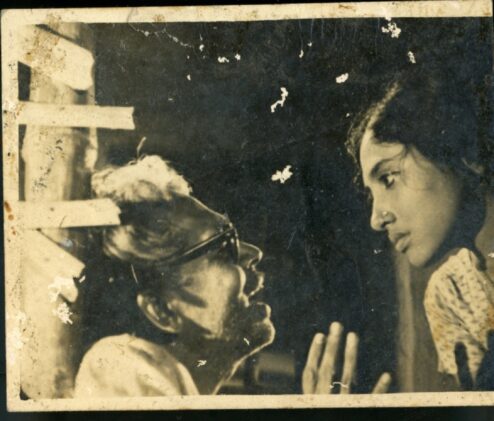
Photo courtesy: NFDC – National Film Archive of India
My view is of a piece with Nabarun’s first impression. It was self-indulgent. It was entitled. It was roguish.
Knowing he wasn’t going to get better, knowing that he was going to die sooner rather than later—as his conversations with niece Aroma Dutta tell us—did Ritwik plan his swansong thus?
I will do what I want, with the National Film Development Corporation’s money at that, and you have to watch it.
Who can say?
What we can say with some certainty and conviction, though, is that this was a man who truly believed in the sanctity and relevance of his art and of his thoughts and theories. He did nothing he didn’t believe in.
Ritwik Ghatak’s Legacy: Shunned Then, Celebrated Now
He was willing to shun work, suffer deeply and waste away till he got a chance to do what he did. Lesser mortals would have compromised, taken the path more travelled. But here we stand today: this man, fifty years after his death, is more relevant than ever.
A giant of world cinema.
Shunned in his lifetime, proven right at the end of it all.
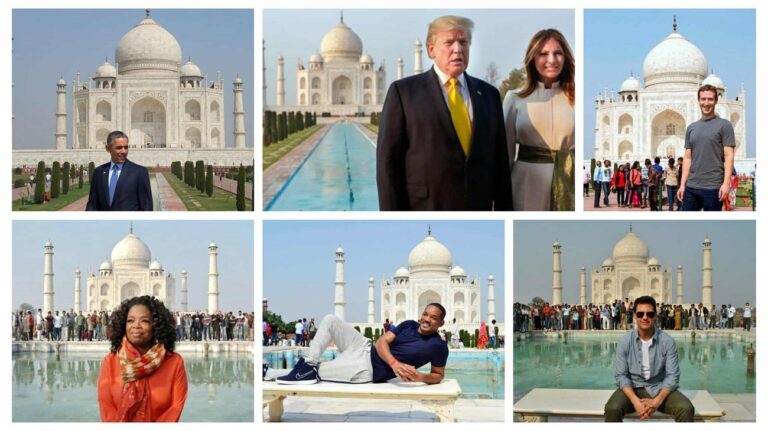
[dropcap]T[/dropcap]he Taj Mahal, regarded as one of the Seven Wonders of the World, is one of the major markers of India on the world map. It is a poem in marble; Gurudev Rabindranath Tagore described it as “a drop of tear on the cheek of time.” Its beauty and fascination as a symbol of love are remarkable. It is a UNESCO World Heritage Site and is maintained by the Archaeological Survey of India (ASI). A marvel in marble, its replicas have often been given as gifts to visiting heads of state.
Since it was constructed by the Mughal ruler Shah Jahan in memory of his wife Mumtaz Mahal, it has been an eyesore to the Hindu right wing. Though its history has been settled by the ASI—and even the Culture Minister Mahesh Sharma said in 2017, during the Modi regime, that it was not a Shiva temple—the controversies are deliberately raised time and again by right-wing leaders and ideologues to boost communal divides. The ASI has repeatedly clarified that it is a mausoleum, not a temple.
Right-Wing Attempts to Rewrite History
The first major controversy around it was created when Yogi Adityanath became the Chief Minister of Uttar Pradesh. His tourism department published a booklet about sites of tourist attraction in the state, but it did not mention the Taj as one of them, despite nearly 12,000 visitors being attracted to this marvel daily. The monument draws 23% of all tourists to India. When questioned, Adityanath retorted that the Taj does not reflect Indian culture.
Now, another film by Paresh Rawal is set to be released. Its trailer shows that as the dome of the Taj is lifted, Lord Shiva appears. The forthcoming film, The Taj Story, as it appears from its trailer, is an attempt to propagate the idea that the Taj is Tejo Mahalaya, a Shiva temple that was converted into a tomb by Shah Jahan.
The argument of the film is that the Taj was a Hindu temple—Tejo Mahalaya—built in the 4th century (later revised to the 11th century) and converted into a mausoleum by the Mughal ruler Shah Jahan. The claim that it was a 4th-century temple was first put forward by a lawyer, PN Oak. Historian Ruchika Sharma has rubbished Oak’s theory on the basis of historical evidence: “Oak, who did not know Farsi, perhaps missed this vital detail that refutes his theory of the Taj being a reused 4th-century palace.” Historians such as Giles Tillotson have also challenged Oak’s theory, asserting that “the technical know-how to create a building with the structural form of the Taj simply did not exist in pre-Mughal India.”
The mystery of the 21 empty rooms at the bottom was also clarified by the ASI. Architecturally, they were built to provide stability to the structure and are used for maintenance purposes. This clarification, too, came during the Modi regime.
Once the 4th-century theory did not work, Oak revised it, claiming that it was a 12th-century temple. Sharma notes, “Yet, Oak armed himself with make-believe and propaganda and petitioned the Supreme Court of India in July 2000, claiming that the Taj was constructed by Raja Paramar Dev’s chief minister Salakshan in the 12th century and was therefore a Hindu structure, Tejo Mahalaya, and not made by the Mughals.”
Oak went up to the Supreme Court to make his point, but the highest court rebuffed his fantasy, which was bereft of historical evidence. His main arguments were based on the architectural aspects of the tomb—the dome at the top, the inverted lotus, and the 21 empty rooms at the bottom. Similarly, later, one Amarnath Mishra approached the Allahabad High Court, petitioning that it was built by the Chandela king Parmardi, but this was also dismissed by the court in 2005.
From PN Oak to Today’s Propaganda Films
There are detailed and impeccable historical accounts available about the construction of the Taj. Travelers Peter Mundy and Jean-Baptiste Tavernier mention that during their visit to India, they learned of Shah Jahan’s grief and his determination to build a grand structure in memory of his wife Mumtaz Mahal. Shah Jahan made elaborate plans, involving several architects—the chief architect being Ustad Ahmad Lahori, a Muslim, and one of his major associates a Hindu architect. Badshah Nama, the biography of Shah Jahan, provides a detailed account of the entire process and the group of people who planned and executed it.
The land chosen for the Taj had belonged to Raja Jai Singh. There are two versions of how it was acquired: one says that it was procured by giving due compensation; the other mentions that Raja Jai Singh gifted it to the emperor, as they were on friendly terms. The architecture of the Taj reflects the syncretic traditions that prevailed at the time. The double-dome structures were introduced by Mughal architects—examples include the Red Fort and Humayun’s Tomb. Earlier Hindu temples had triangular superstructures. Later, domes were also introduced in temples. Architecture is never an exclusive process; the mixture of architectural styles is part of the evolution of civilizations.
Nearly twenty thousand artisans were hired for the construction. As the Mughal administration had a dedicated construction division, the magnificent structures of North India were not sudden miracles. The rumor that the workers’ hands were cut off is baseless—there is no source to substantiate it. The account books and documents from Shah Jahan’s time clearly record detailed expenditures incurred in building the Taj, including the cost of Makrana marble and wages paid to workers. Some prevalent Hindu motifs were incorporated into the design, as Hindu architects and workers were also part of the construction process.
In a lighter vein, one should mention PN Oak’s fertile yet banal imagination, which placed the roots of all world civilizations in Hindu culture. For him, Christianity was Krishna Niti; Vatican came from Vatika; and Rome from Ram! Despite such superficial claims devoid of any historical evidence, he kept publishing books and pamphlets, which were circulated in RSS shakhas to propagate his theories until they became part of popular social understanding.
A Political Project Masquerading as History
Most of the points raised by the upcoming film (as seen in its trailer) about the Taj Mahal were clarified more than a decade ago. The revival of these falsehoods is a political move intended to serve the Hindu nationalist agenda by spreading hate against Mughal rulers—and by extension, today’s Muslims.
This film is yet another propaganda project in a series that includes The Kashmir Files, The Bengal Files, The Kerala Story, and others—each aimed at intensifying right-wing propaganda. The Taj Story will likely be yet another tool for divisiveness and hate that continues to dominate contemporary India.
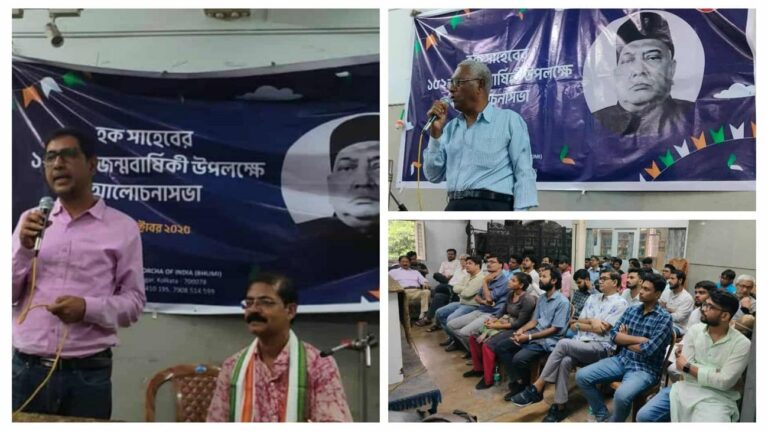
Kolkata: “In many colleges and universities, students and even teachers are unaware of who Fazlul Huq truly was,” said Sabir Ahmed of the Pratichi Institute and Know Your Neighbour initiative, as Bengal’s iconic Coffee House resonated with reflection and resolve on Sunday. “We will include Sher-e-Bangla’s life and contributions in our outreach activities to ensure greater public awareness of his vision and work,” he added.
The occasion was the 152nd birth anniversary of Sher-e-Bangla Abul Kasem Fazlul Huq, Bengal’s legendary statesman and people’s leader, organized by the Bhumiputra Unnayan Morcha of India (BHUMI) in the historic “Boichitra” hall of the Indian Coffee House on College Street. The programme drew an audience of social workers, educators, writers, students, researchers, and journalists, and was gracefully moderated by Dr. Abu Sayed Ahmed.
The event began with floral tributes to Sher-e-Bangla’s portrait, followed by impassioned discussions on his life, vision, and his far-reaching role in Bengal’s political, educational, and social awakening.
“The Partition of Bengal Was Not the Fault of Muslims”
Retired teacher and essayist Alimuzzaman delivered a thought-provoking address, revisiting the 1940 Lahore Resolution and the complex politics surrounding the partition of Bengal. He argued that Fazlul Huq’s call for autonomy in Muslim-majority provinces stemmed from the principles of political justice, not separatism.
“The Lahore Resolution was distorted by the politics of its time,” he said. “The partition of Bengal was not the fault of Muslims but the consequence of the upper-caste Hindu leadership’s unwillingness to accept a Muslim-majority Bengal and their desire for dominance through division.”
Drawing parallels with the present, Alimuzzaman added, “Even today, poor Muslim workers in Bengal are branded as ‘Bangladeshis’ and subjected to humiliation. Sher-e-Bangla dedicated his entire life to uplifting such marginalized communities, fighting for their dignity and rightful place in society.”
Fazlul Huq’s Early Life: “Education Was a Right, Not a Privilege”
Renowned doctor Kazi Mohit shared two defining anecdotes from Fazlul Huq’s youth that revealed his determination and egalitarian spirit.
He narrated how a young Huq, upon learning that sitting on the front bench required passing a test, immediately asked to take it—and passed the same day. Later, during his Presidency College years, Huq was told that Muslims were weak in mathematics. He took it as a challenge and topped his class within six months.
“These stories show how deeply he believed that education was not a privilege for a few but a right for all—an idea that shaped his educational reforms as Education Minister of undivided Bengal,” said Dr. Mohit, whose words drew warm applause from the audience.
“Fighting Brahminical Domination, Standing with the Working Class”
Essayist Gautam Ray rejected the communal label often attached to Fazlul Huq, stressing that “advocating for one’s community’s rights does not make one communal.”
Advocate Shamim Ahmed placed Huq’s ideology in the context of today’s India. “What the BJP and RSS seek today is a revival of Brahminical domination, while Fazlul Huq envisioned the liberation of the working class. He fought for those whose lives are now being made unbearable by such forces,” he said, earning nods from the audience.
“Politics of Emancipation, Not Power”
At the end, Dr. Ramiz Raja, convenor of BHUMI, reflected on Sher-e-Bangla’s enduring relevance: “Fazlul Huq’s politics were the politics of emancipation. His lifelong struggle on behalf of farmers, laborers, and the marginalized continues to inspire us. He proved that the essence of politics lies in human development.”
Other distinguished speakers—Dr. Suranjan Midde, Dr. Nurul Islam, and Jane Alam—added intellectual depth with their insights into Huq’s social and educational philosophy.
The commemoration ended with a collective pledge to uphold Sher-e-Bangla’s principles of equality, justice, and inclusive progress, with organizers vowing to celebrate his legacy on an even larger scale next year.