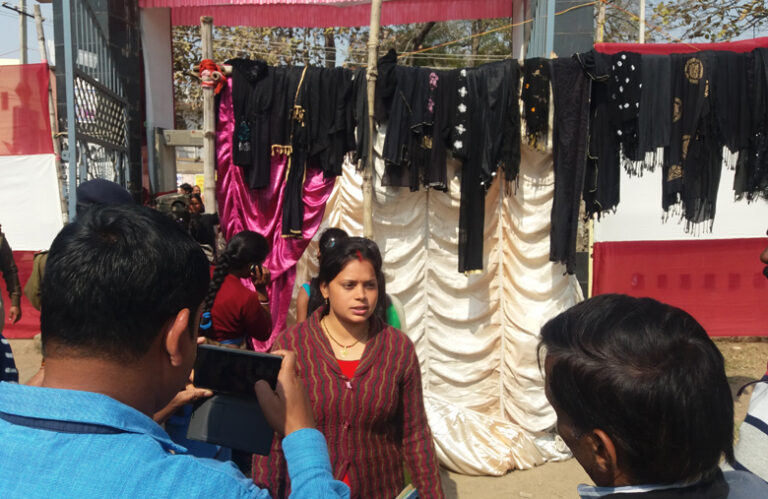
Giridih/Ranchi: Jharkhand Chief Minister Raghubar Das has a fear for ‘black’. During Sukanya Yojna programme in Giridih, all the visitors and beneficiaries mostly females had to undergo rigorous check-ups. Guess what? If the ladies had anything black on them, be it a stole or dupatta or even a hijab then were being asked to remove the black garment pieces by the security officials.
A large number of children, girls, women, and old men had to face this strict scrutiny. While in his half an hour long speech, Das used flowery words for the females, hundreds of them sat far away from the stage without their dupattas and shawls.
When the deployed police officers were asked for the reason, they expressed helplessness as senior officials had given instructions which they were following.
However, even in this situation, Das did not forget to take a selfie with the girls his speech ended.
Das was in Giridih on Sunday to attend Bharatiya Janata Party (BJP)’s three Lok Sabha seat cadre meet. The meet was also addressed by Uttarakhand Chief Minister Trivendra Singh Rawat.
However, visitors being asked to do away with their black garments was not the only controversy which the CM’s programme had. Jal Sahiya stopped CM’s cavalcade and in the presence of Jharkhand Chief Minister, when Uttrakhand Chief Minister was addressing the party cadres, a group started shouting Giridih Ka MP Kaisa Ho, Dhullu Mahto Jaisa Ho (How should be the MP of Giridih, it should be like Dhullu Mahto).
In response to the chants, Uttarakhand Chief Minister from the dais said that such people would never get a ticket.
Dhullu Mahto, BJP MLA from Baghmara and Giridih MP Ravindra Pandey had a spat in public few months ago. Both have been accused of sexual harassment, but Jharkhand police did not take any action against them as of now.
While for the upcoming Lok Sabha polls, Baghmara MLA has thrown his hat in the ring for MP candidature.
Jharkhand’s Chief Minister, who is known to copy Prime Minister Narendra Modi’s steps in almost everything, did not interact with the media, despite staying at Giridih for three hours.
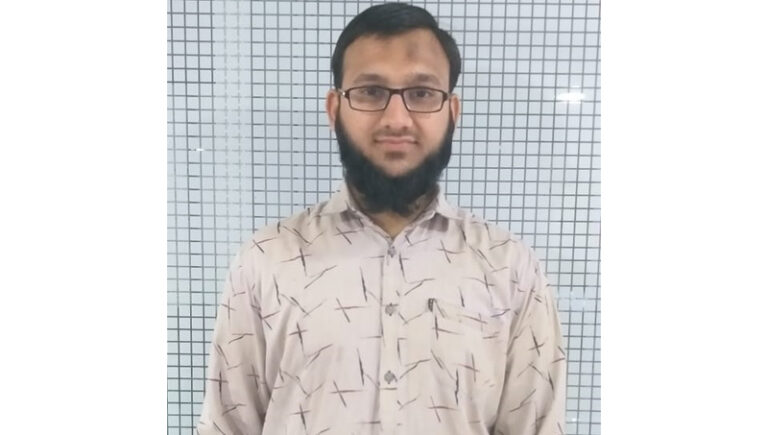
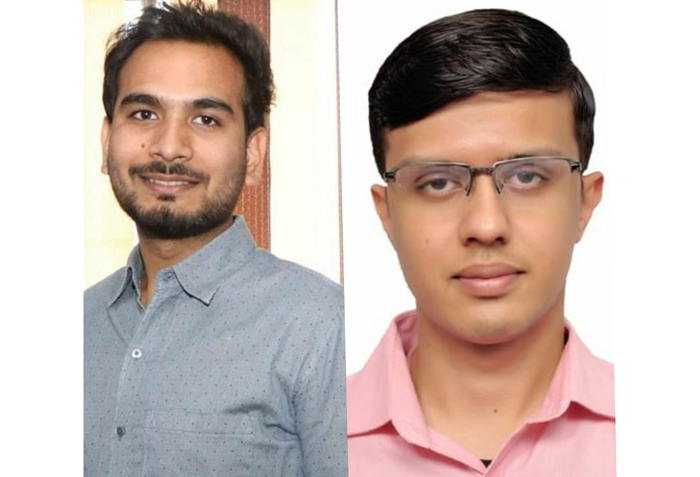
Vadodara/Kolkata: Have you met a genius, recently? If not then get set to meet Ashraf Kesrani, the boy from Vadodara who has recently created history of a sort. But then securing good percentage is nothing new for him. Asharf has 92 percent in his secondary examination and 93 percent in senior secondary examination. Following which he bagged the 14th rank in Gujarat Medical Council entrance 2013 for Bachelor of Medicine and Bachelor of Surgery (MBBS).
And guess what? Ashraf did it all without getting enrolled in any of the coaching centres, which often medical aspirants throng. Throughout his MBBS continued doing great result. In the fourth and final year he had secured the first rank. Following which, Ashraf, a Baroda Medical College appeared for the All India National Eligibility cum Entrance Test (NEET) for Post Graduate course, along with 143147 doctors only to emerge as a national topper. This year only 79633 doctors could qualify for the PG course.
A humble Ashraf told eNewsroom, “I always had a feeling that I can also top. But I had never anticipated that my dream will come true. The news of securing an All India Rank one is indeed a good feeling.” What more, the 25-year-old doctor, has not only secured 1006 marks out of 1200 in NEET PG entrance but has also become the highest scorer in the history of NEET examination. This year second topper has got 985 marks. Last year NEET PG topper Rachit Agrawal has secured 975 marks.
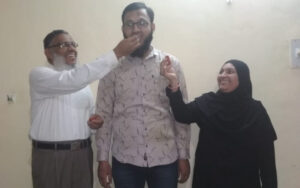
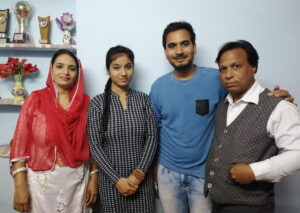
Ashraf Kesrani with his parents after the NEET PG results
Ashraf further said, “I come from a middle class family. And my father Muhammad Hussain works in my uncle’s shop. My uncle, Fazal Muhammad has supported our education.”
Eldest among siblings, Ashraf has two brothers and a sister. This genius loves to play cricket and his favourite player is Virendra Sehwag.
Ashraf had wanted to do PG from AIIMS, Delhi but as NEET PG does not cover AIIMS, so he wants to do pursue his PG from Maulana Azad Medical College (MAMC), Delhi.
Given that most IITians and IIM pass outs move over to the United States or other countries in search of a better future. On being asked if he had any such plans, he said, “I have no plan to work outside India. In fact, I came into medical field to serve India, to serve the people of my country.”
Significantly, Ashraf is the second boy from Gujarat who has made it to the top of the All India Ranking. Earlier last week, Shahid Memon from Koday secured the second ranking in Charted Accountant (CA) examination.
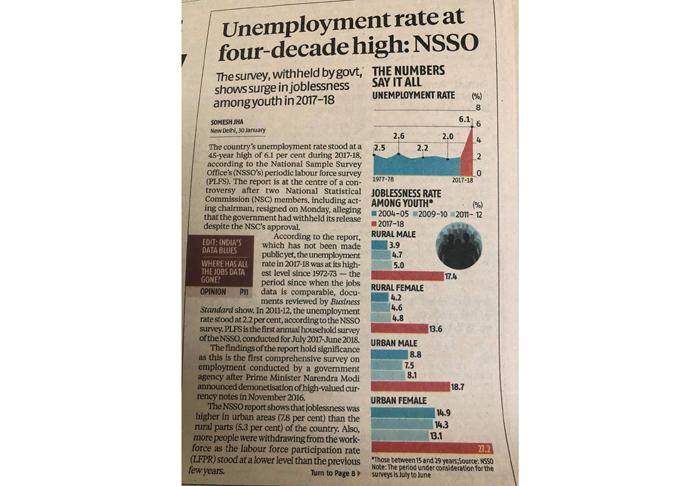
2017-18 के लिए नेशनल सैंपल सर्वे आफिस की तरफ से कराये जाने वाले श्रम शक्ति सर्वे के नतीजों को सरकार दबा रही है। इस साल पिछले 45 साल में बेरोज़गारी की दर सबसे अधिक रही है। दिसंबर 2018 के पहले हफ्ते में राष्ट्रीय सांख्यिकी आयोग( NSC) ने सर्वे को मंज़ूर कर सरकार के पास भेज दिया लेकिन सरकार उस पर बैठ गई। यही आरोप लगाते हुए आयोग के प्रभारी प्रमुख मोहनन और एक सदस्य जे वी मीमांसा ने इस्तीफ़ा दे दिया है।
बिज़नेस स्टैंडर्ड के सोमेश झा ने इस रिपोर्ट की बातें सामने ला दी है। एक रिपोर्टर का यही काम होता है। जो सरकार छिपाए उसे बाहर ला दे। अब सोचिए अगर सरकार खुद यह रिपोर्ट जारी करे कि 2017-18 में बेरोज़गारी की दर 6.1 हो गई थी जो 45 साल में सबसे अधिक है तो उसकी नाकामियों का ढोल फट जाएगा। इतनी बेरोज़गारी तो 1972-73 में थी। शहरों में तो बेरोज़गारी की दर 7.8 प्रतिशत हो गई थी और काम न मिलने के कारण लोग घरों में बैठने लगे थे।
सेंटर फ़ॉर मॉनिटरिंग इंडियन इंकॉनमी(CMIE) के महेश व्यास तो पिछले तीन साल से बेरोज़गारी के आँकड़े सामने ला रहे हैं। उनके कारण जब बेरोज़गारी के आँकड़ों पर बात होने लगी तो सरकार ने लेबर रिपोर्ट जारी करनी बंद कर दी। उन्होंने पिछले महीने के प्राइम टाइम में बताया था कि बेरोज़गारी की दर नौ प्रतिशत से भी ज़्यादा है जो कि अति है।
आप इंटरनेट पर रोज़गार और रोज़गार के आँकड़ों से संबंधित ख़बरों को सर्च करें। आपको पता चलेगा कि लोगों में उम्मीद पैदा करते रहने के लिए ख़बरें पैदा की जाती रही हैं। बाद में उन ख़बरों का कोई अता-पता नहीं मिलता है। जैसे फ़रवरी 2018 में सरकार अपने मंत्रालयों से कहती है कि अपने सेक्टर में पैदा हुए रोज़गार की सूची बनाएँ। एक साल बाद वो सूची कहाँ हैं।
पिछले साल टी सी ए अनंत की अध्यक्षता में एक नया पैनल बना था। उसे बताना था कि रोज़गार के विश्वसनीय आँकड़े जमा करने के लिए क्या किया जाए। इसके नाम पहले जो लेबर रिपोर्ट जारी होती थी, वह बंद कर दी गई। जुलाई 2018 इस पैनल को अपनी रिपोर्ट देनी थी मगर उसने छह महीने का विस्तार माँग लिया।
इसीलिए बेहतर आँकड़े की व्यवस्था के नाम पर उन्होंने पुरानी रिपोर्ट बंद कर दी क्योंकि उसके कारण सवाल उठने लगते थे। अब जब राष्ट्रीय सांख्यिकी आयोग की रिपोर्ट आई है तो उसे दबाया जा रहा है। सोचिए सरकार चाहती है कि आप उसका मूल्याँकन सिर्फ झूठ, धार्मिक और भावुक बातों पर करें।
सरकार की आर्थिक नीतियाँ फ़ेल हो चुकी हैं। इसलिए भाषण को आकर्षक बनाए रखने के लिए अमरीकी मॉडल की तरह स्टेडियम को सजाया जा रहा है। अच्छी लाइटिंग के ज़रिए प्रधानमंत्री को फिर से महान उपदेशक की तरह पेश किया जा रहा है। उन्होंने शिक्षा और रोज़गार को अपने एजेंडे और भाषणों से ग़ायब कर दिया है। उन्हें पता है कि अब काम करने का मौक़ा भी चला गया।
इसलिए उन्होंने एक तरह प्रधानमंत्री कार्यालय छोड़ सा दिया है। भारत के प्रधानमंत्री सौ सौ रैलियाँ कर रहा हैं लेकिन एक में भी शिक्षा और रोज़गार पर बात नहीं कर रहे हैं। मैंने इतना नौजवान विरोधी प्रधानमंत्री नहीं देखा। सरकारी ख़र्चे पर होने वाली इन सौ रैलियों के कारण प्रधानमंत्री बीस दिन के बराबर काम नहीं करेंगे। इसे अगर बारह-बारह घंटे में बाँटे तो चालीस दिन के बराबर काम नहीं करेंगे। वे दिन रात कैमरे की नज़र में रहते हैं। आप ही सोचिए वे काम कब करते हैं ?
न्यूज़ चैनलों के ज़रिए धार्मिक मसलों का बवंडर पैदा किया जा रहा है ताकि लोगों के सवाल बदल जाएँ। वे नौकरी छोड़ कर सेना की बहादुरी और मंदिर की बात करने लग जाएँ। हमारी सेना तो हमेशा से ही बहादुर रही है। सारी दुनिया लोहा मानती है। प्रधानमंत्री क्यों बार बार सेना-सेना कर रहे हैं? क्या सैनिक के बच्चे को शिक्षा और रोज़गार नहीं चाहिए? उन्हें पता है कि धार्मिक कट्टरता ही बचा सकती है। इसलिए एक तरफ अर्ध कुंभ को कुंभ बताकर माहौल बनवाया जा रहा है तो दूसरी तरह रोज़गार के सवाल ग़ायब करने के लिए अनाप-शनाप मुद्दे पैदा किए जा रहे हैं।
हे भारत के बेरोज़गार नौजवानों ईश्वर तुम्हारा भला करे ! मगर वो भी नहीं करेगा क्योंकि उसका भी इस्तमाल चुनाव में होने लगा है। तुम्हारी नियति पर किसी ने कील ठीक दी है। हर बार नाम बताने की ज़रूरत नहीं है।
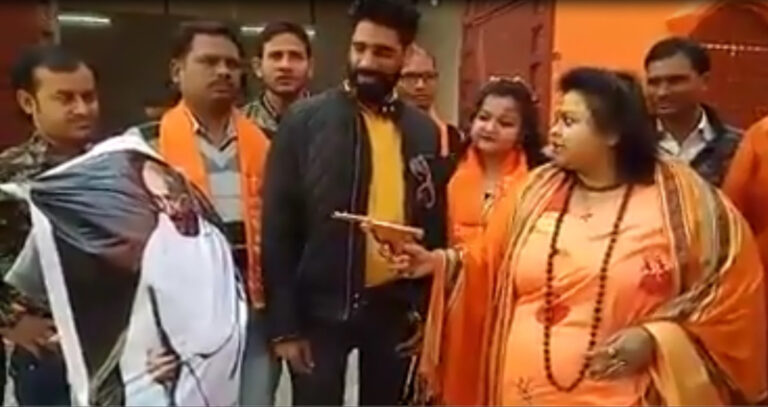
Kolkata: On the occassion of 71th death anniversary of Mohandas Karamchand Gandhi, alias Mahatma Gandhi, father of the nation, Hindu Mahasabha again reminded the people of India about Gandhi being assassinated by Nathuram Godse on January 30, 1948. Office bearers and members of Hindu Mahasabha enacted the killing in Aligarh, by shooting on an effigy of Gandhi. As the effigy bled, they burn it.
Surprisingly, this time a woman office bearer enacted the assassination and even had it recorded. They even chantedMahatma Nathuram GodseAmar Rahey (Long Live Nathu Ram Godse).
Mahatma Gandhi, the 79-year-old leader, who led India to independence and taught non-violence and civil disobedience to the world, has been one of the tallest leader that the world has ever seen. He was assassinated by one of Hindu Mahasabha's member Nathuram Godse within six months of India getting freedom from the British rule.
Watch the video to witness how the killers of Mahatma Gandhi still feel proud of the heinous act of Godse.
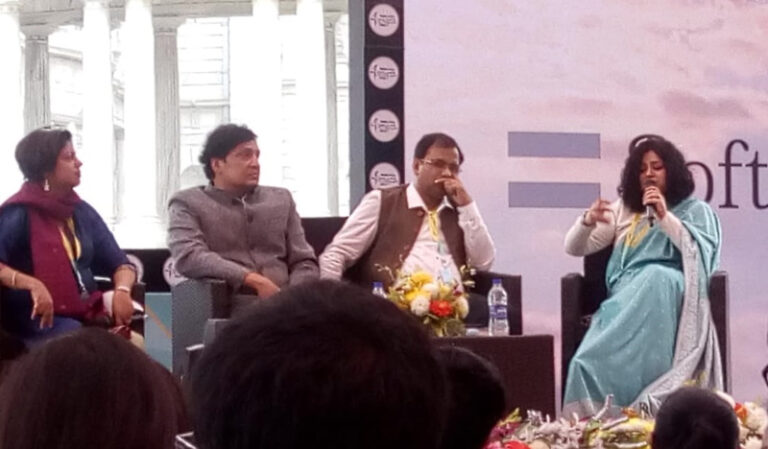
Kolkata: Creating convergence to neutralise fault lines present between communities on the basis of religion, caste, class and regionalism was the topic where writers like Nazia Erum, Tabish Khair and Abdullah Khan spoke at length at Kolkata Literary Meet on Republic Day. With Paroma Roy Chowdhury as the moderator, all panelists agreed that literature is a powerful tool to bridge the gap of hatred and prejudice that exist.
Fault lines have always existed but now the gaps have deepened. “And the most harmful thing that is done is that we have involved our children in to it, the future generation of our country,” said Nazia Erum author of Mothering A Muslim Child. Both Tabish Khair and Abdullah Khan also maintained that fault lines do exist.
“While growing up in a small town of Motihari, I came across this two liner which moholla children used to say- Chai garam Chai garam, Mia beta mar gaya parwa nahi hain (tea is hot tea is hot. Death of a Muslim son doesn’t bother me) and I used to replace the word Mia with another word. Though in Islam there is no caste system as per scriptures but Indian Muslims follow a caste system- The Khans, The Pathans etc. So this is a fault line. I remember when I was transferred to Punjab, someone said you are a Bihari but you don’t look like one’. This is another form of fault lines,” said Khan, author of Patna Blues. Khan has portrayed these fault lines beautifully in his novel, through his protagonist Arif, who has an affair with a Hindu married woman Sumitra, who loves Urdu poetry. Despite the sexual tension between the two, they keep denying it on moral grounds. Later, when Sumitra’s daughter falls for a Muslim boy, she gets infuriated, but only to realise that she is doing the same. This fault line is omnipresent in the Indian society.
Nazia, originally from Assam has been living in Delhi now, reminisced about her childhood days in Assam where the fault lines were not visible. She talked about Namghars in Assam where the committee had a maulana of the local mosque. Similarly the local mosque committee had a pujari of the local namghar. “This was India I grew up,” she said.
While travelling to twelve cities for her book, Nazia came across several human stories. She talked about five-year-old kids asking each other about their religious identity. “Surprisingly, they start hating and fighting with each other when the Muslim identity is revealed.” She then added, “When a child says ‘I am a Muslim but I don’t eat beef”, it reflects the India in its present form. This is what we have done to our kids. Bullying happens for many reasons be it the colour of your skin, the way you speak, about how cool or uncool you are but when bullying is done on the basis of one’s religion, it penetrates deep and deeply it infiltrates one’s being,” said Erum.
The moderator Paroma Roy Chowdhury shared a story about her Muslim friend. “Given the situation like today, it would not have happened, with such hate mongering all around,” said Paroma, who has been friends with her Muslim friend for over four decades now. She questioned the panelists about the roles of literature in bridging the gaps and creating convergence.
Answering that, Khair said, “I have devoted my entire life to literature. Though I come from a family of doctors but was never interested in becoming a doctor. My father, who was a doctor refused to talk to me when I announced that I had decided to write. But of course he later realised that my choice was good. I feel that literature is the best antidote to fundamentalism, be it religious, political or economic fundamentalism. Literature is the oldest thinking device known to humans. Religion has used stories, poetries to make us think. Now what you do with such stories is important.”
For Khan, the duty of a writer is to mirror the truth of the society, to present it in front of the readers. “Literature works as anti-venom,” he said. Nazia too felt that the onus is on both the sides to bridge gaps. “The stereotype pedalled 24×7 in television needs to be questioned. Literature plays a positive part in it,” summed up Erum.
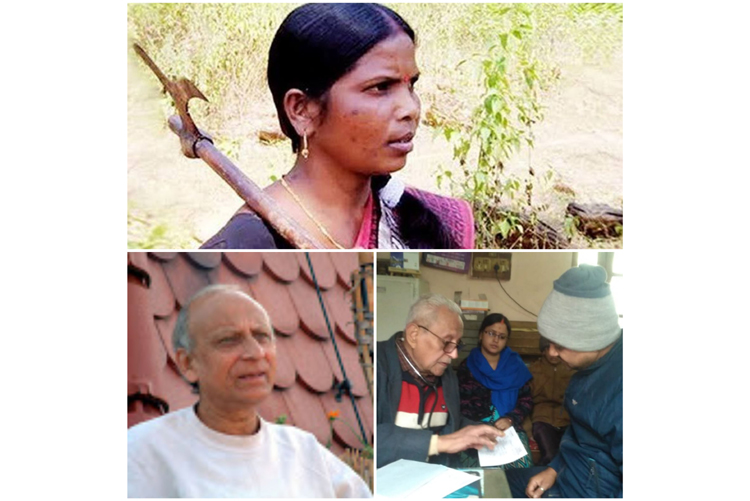
Ranchi: Seventy-seven-year-old Bulu Imam dons many a cap, he is an activist protecting the environment, promoting tribal culture and heritage. Imam, a Hazaribagh (Jharkhand) based environmentalist made it to the list of Padma Shri, 2019. The names were announced by President Ram Nath Kovind on Friday. Imam, like many unsung heroes has been silently waging a non-violent fight protecting environment in Upper Damaodar Valley (Karanpura) area of Jharkhand, for the past four decades.
Coming from one of India’s most distinguished families, which has produced a steady stream of intellectuals for the past two centuries, Imam took up the idea of protecting environment. Bulu’s grandfather Syed Hasan Imam was president of the Indian National Congress in 1918. Bulu said, “The award is going to encourage and inspire me to fight against the powerful mining companies which are directly or indirectly ruining our natural resources.” Imam after taking up the crusade against mining being done at the Upper Damodar Valley (Karanpura) has decided to take up his fight against stone mining done at Ichak and other areas of Hazaribagh district.
He said, “There are more than 300 stone mining units in Ichak area. In the name of development such as construction of highways are other projects every day trees are being cuts and jungles being wiped out. Even the forest of Hazaribagh National Park has not been spared. If we do not protect our forest today our future generations will have to pay the price.”
Similar, is the tale of another environmentalist from Jharkhan -Jamuna Tuddu who too has made it to the list of Padma Shri. The 38-year old woman environmentalist Tuddu has been relentlessly working in East Singhbhum district for over two decades protecting the Jal and Jungle of her area. Tuddu started to protect the forest in her area about two decades ago, when she began living at her in-laws house in 1998. She was upset with the trees being felled in her area in the name of the livelihood of the local villagers. To protect the forest she formed a committee with the help of with the help of some fellow villagers, primarily females, who began working towards creating an awareness about conservation of the environment.
Jamuna said, “In 1998 when I reached my in-law’s house at Muturkhana village under Chakulia block of district, I was upset seeing large scale deforestation going on in the area. The villagers were cutting down Saal trees just for money. I was pained and decided to create an awareness for the protection of trees.”
Initially, there was a small group, which over the years now has 300 committees working for the common cause. Each committee comprising 10 to 15 people work for the protection of environment.
The list of unsung heroes from Jharkhand who received Padma Shri also included “Poor Man’s Doctor” – Dr Shyama Prasad Mukherjee, from Ranchi. Mukherjee serves his poor patients by charging them mere Rs 5 for consultation. Many a time, he even consults for free. Mukherjee, an octogenarian has been treating people for past fifty years running a clinic at the posh Lalpur Chowk of the state capital. Mukherjee who had done his MBBS from Patna Medical College and Hospital (PMCH) in 1957, said, “I had never thought of earning money to lead a lavish life. It is indeed a proud moment for me that the government has recognized my contribution towards the society and selected me for the prestigious award.”
The list of Padma awardees from state also includes senior BJP leader and Khunti MP Karia Munda and mountaineer Bachendri Pal. Both Munda and Bachendri have also received the Padma Bhushan awards.
Kota/Kolkata: He was frantically trying to find out his result online. But slow internet connectivity was playing a truant. A quick call made to his office colleague brought the sweetest news to his ears. He was in a sense of disbelief.
“When my office friend called me back, informing me about me having secured the first rank in CA examination, I was in a denial mode. I had heard that the president had called the topper and I had not received any such calls. But later, I realized that I had actually topped when the President of India called me to congratulate me on my achievement,” he shared.
Overcoming adversities
Meet Kota’s Shadab Hussain, the tailor’s son, who made it to rank one in his first attempt for the Chartered Accountant (CA) exam this year. Shadab, overcame all adversities to make it big in his life. However, despite all the hard work and labour put in, he feels that his father is the bigger hero. “He is a ladies tailor and only a matric pass. My mother, on the other hand, is a school dropout, but they never compromised with our education. My three sisters are all graduates and my father kept motivating me to work. He always believed that I could top the CA exam,” he revealed.
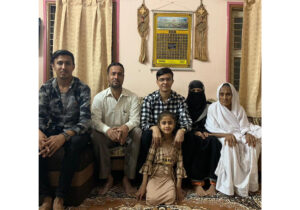
CA Shadab Hussain with his family members
However, the boy from Kota, who has kind of written history, by becoming the first Muslim to top the CA exam (old syllabus), had to face many financial constraints. He even took up a job as an accountant at a private firm. “It was really difficult for me. I used to study from 6 am to 10 am and then work from 11 am until six in the evening, following which I would again study till 10 pm. Long walks and badminton session were my way of distressing,” recounts Shadab, who now wants to join a big corporate house.
On being asked, why he chose to become a CA when aspirants come to Kota with the dream of cracking the engineering and medical entrance examinations, he replied, “The future at present looks bleak for the engineering aspirants. There are too many engineers around. That apart, it’s an expensive course, in comparison to doing MCom along with preparing to crack the CA exam.”
From Kota to Koday
Scoring only 13 marks lesser than Shadab, approximately 837 kilometres away from Kota, in Gujarat’s Koday village, is Shahid Husen Shokat Menon. United by their identity of being representative of the minority community, both have confronted their shares of adversities to make it to the first and second rank of one the most difficult examination to crack in India.
“I come from a small village in the Kutch region of Gujarat. My father is into business. So, financially it was not very difficult for us. But the biggest challenge was to travel 100 kilometres on a daily basis for my preparatory classes for the CA Integrated Professional Competence Course examination,” revealed Shahid.
CA Shahid Shokat Menon with his family members
Even as a school student, he had to travel 10 kilometres a day to his alma mater, St Xavier’s School. Commerce, as a subject had always interested him, hence CA was an obvious career choice for the 23-year-old. Surprisingly, when he had expressed his desire to become a CA, his family, where almost everyone is a businessman, supported him in every possible way.
He said, “When I took the decision of cracking the CA exam, I gave my 100 per cent for the preparation and left the rest to the almighty. I believed that since I had put in my best, my result would also be good.”
What it means for the community?
On being asked what it meant for the community, he said, “Two Muslims securing the top two rank for the CA exam is definitely good news for the community. Our success story for sure will inspire many. It feels great when leaders message to congratulate.”
Answering the same question Kota’s pride, Shadab said, “It’s really amazing to see Muslim youths performing well in competitive exams. It will also make people believe that hard work can help one scale any obstacle. Our success will make many realize that our religion is not a barrier to our community and individual success. Talent and hard work are all that is needed to make it big in life.”
He also added, “Apart from joining a big corporate house, I also plan to do something for students from financially backward families. Once in a job, I will try my best to support the education of at least three students on an annual basis. We need to help such students so that the poor in our country get empowered.” Shahid too aspires to join a big corporate firm to make it big professionally.
India has vowed to be a socialist, secular, democratic republic. Sadly, all these values are steadily being eroded in the present political developments. About 20 intellectuals, professionals, activists who are working for the fundamental rights of the poor and marginalized and upholding the above mentioned constitutional values are being labeled ‘urban naxals’ and are being harassed no end either as ‘accused’ or as ‘suspects’. Their premises have been raided, their electronic devices seized, serious cases filed. Some are already in prison, others face arrest anytime.
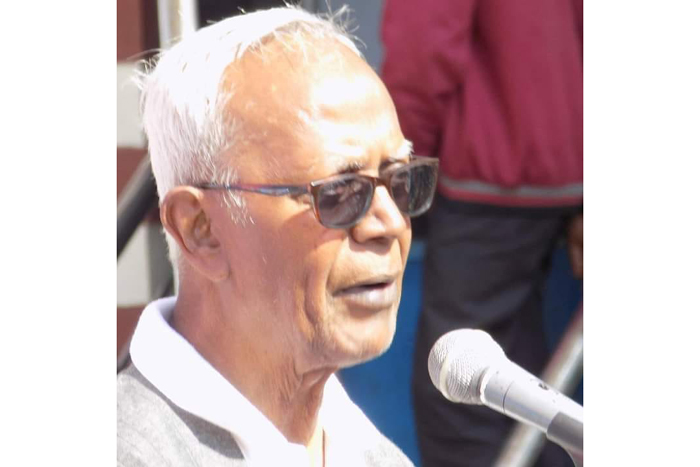
I {Stan Swamy) am one of the ‘suspects’, I was also raided on 28th August 2018, even after more than four months Pune police have not made any charges, and when I appealed to Bombay HC [No.4741 of 2018] to quash the FIR against me my petition was rejected. Instead it authorized Pune police to continue its investigation on me, without prescribing any time frame, to see if I have committed any offence under UAPA and if needed take strong legal action. Really an open-ended offer to the police!
Several of the accused have refuted the charges against them. But the court seems to go by police’s version with scant regard to what petitioners are saying.
This is an appeal to all democratic minded individuals/groups/organizations/ movements/ordinary citizens who are genuinely concerned about the steadily deteriorating human rights situation in our country and to raise their voice against it. – Stan Swamy
The following considerations may be taken for what they are worth:
Justice PB Sawant, one of the organizers of the Bhima-Koregaon ‘Elgar Parishad’ event on 1st January 2018, in an interview testified that “For years these pilgrims had been going to Bhima Koregaon, no incident happened. Why did it happen last year only? Our sources tell us that these two people (Bhide and Ekbote) were working at least two months before the violence there because they knew many people were going to come because of the 200th anniversary.
This government wants to protect the Hindutva forces. They have been consistently trying to protect Hindutva activists who had indulged in violence… no Maoists were involved in the programme and the activists had been arrested because they criticised the government.“
Why the Investigating Officer and the courts did not pay attention to the above statement of a respected judge is a point of concern.
Various fact-findings took place, the most prominent amongst them was one conducted at the behest of Pune Rural IG, Vishwas Nagare Patil, wherein ex-mayor of Pune was part of the team which visited many places and submitted its report on January 20, 2018. Summarising the report we find the following chronological events narrated in the report. Note the careful planning by communal forces.
OnDecember 16, 2017, one person namely Kaustubh Kasture had posted on Facebook that there would be riot on January 01, 2018, this person is supporter of Sambhaji Bhide and Milind Ekbote
On December 30, 2017, Milind Ekbote took a meeting in Bhima Koregaon, whereat he decided to treat January 01, 2018 as black day and ensure bandh all across the area.
On December 29, 2017, memorial of Govind Mahar, who has legend to his credit of having shown courage to cremate the dead of Sambhaji Maharaj son of Shivaji Maharaj, came to be defiled. This resulted into a riot like situation in Vadu Budruk and adjacent areas, however all the villagers acted with responsibility and sorted out the issue amongst themselves and peace was restored. By December 30, 2017, though the issue at the Vadu Budruk was resolved peacefully, it is said that Sambhaji Bhide and Milind Ekbote, instigated the villagers.
On December 30, 2017, a message was circulated on social media that there is a meeting called by Sambhaji Bhide in Vadu Village on January 01, 2018 and the supporters should gather in large numbers.
On the night of December 31, 2017Pradip Kand, Anil Kand and Ganesh Kand were threatening hotel owners to ensure bandh on January 01, 2018.
Women in the vicinity knew prior about the riot on January 01, 2018, President of Tanta Mukti (dispute resolution) Committee, namely Vaibhav Yadav, had stored sticks and swords in his shop a night before.
Suddenly on late night December 31, 2017, a letter was sent to police station, near Bhima Koregaon purportedly written by Bhima Koregoan Gram Panchayat, wherein police were informed about the bandh to be observed next day. [Nihal Singh Rathod in The Leaflet, 6 January 2019]
The Bombay HC while giving credence to the police version of the events has not asked the police whether any other reports were made. Could it have asked for this report to see the other side of the coin?
Within a week, the Pune Rural Police registered at least 22 FIRs, including Anita Sawale’s, in multiple incidents of attacks against the pilgrims across different routes leading to the war memorial. The state government has stated before a Pune court that there are over 1,400 suspects in these cases, and estimated a total loss to public property of over Rs 1.5 crore. In the first information report registered against her complaint, Sawale named Manohar Bhide, president of the Shiv Jagar Pratishthan, Milind Ekbote, president of the Hindu Janjagran Samiti, and their “savarnasathidar”—savarna associates. [The CARAVAN – News – 14 September.2018 by Sagar]
To my knowledge, no courts have directed the police to act upon these FIRs. It is strange that one man’s FIR has galvanized against human rights activists and the defenders of the poor but 22 FIRs got no response and interestingly the judiciary did not comment on it.
The raid of my living room-cum-office by Pune police on 28th August 2018 was illegal and inhuman.
Both the Search Order and the Report-cum-inventory were written in Marathi language which i could not understand.
The search on my premises at 6 am 28th August 2018 by Pune police accompanied by a contingent of Namkum police thana, Ranchi, Jharkhand, was illegal. When I asked to see the Search Warrant the Pune police showed a Search Order. It was in Marathi language which I do not know. Hence I asked them to give me a translation of the Search Order either in Hindi or English so I could understand the nature of the order. The Pune police responded that it was not possible and that the search had to be carried out immediately. Thus they forcibly entered my room and spent three hours scrutinizing everything. They seized my laptop computer, a tablet, a camera, mobile phone and some instrumental music CDs.
Then they produced a report-cum-inventory of seized articles which was also in Marathi language and asked me to sign the same. At this point I refused to sign a document in Marathi language which I do not understand until after an oral translation was done.
Pune police had brought two persons from Pune as ‘Panch’ which makes the Search illegal
The law on Search prescribes that a few respectable civilian people in the area be present during the search and that they sign as witnesses. But Pune police had brought two ‘panch’ along with them who signed as witnesses. This is a gross violation of the law and caused injustice to me.
There were raids all over India on those who speak against injustices, but these raids did not follow the well-laid procedures. Its illegal nature is blatant.
Torture in Police Custody: Adv. Arun Ferreira, one of the accused, was tortured in Pune Police Custody.
“Arun Ferreira alleged in the court that he was beaten up during custodial interrogation. He said that on November 4 around 4 pm, during the interrogation he was punched about 8-10 times by the Investigating Officer (I.O.) Shivaji Pawar. The IO also hit him in the eye. While beating up Ferriera, IO Pawar was asking him questions about Indian Association of People’s Lawyers (IAPL). On November 5, he was taken to the Sassoon hospital. Injuries and contusion near eye were noted by the doctors at Sassoon hospital while conducting his medical examination.” [Sushmita in Sabrang News, 6 November 2018]
This is a serious human rights issue. Just last year when the United Nations Human Rights Council was trying to muster the nations of the world to sign the Treaty Against Torture, the Indian envoy loudly proclaimed “The very idea of torture is completely alien to Indian culture” ! On this basis India did not sign the UN document against torture. But everyone knows the police everywhere in India do torture prisoners to extract ‘confessions’. And when even eminent persons who have dedicated their life for the cause of the oppressed masses are subjected to this inhuman practice it is a matter of serious concern. This is also a violation of Supreme Court observing “ ‘custodial torture’ as a violation of human dignity and degradation that destroys self-esteem of the victim and does not even spare his personality.” [SC – SCC No. 416 / 1997 D.K.Basu vs State of WB]
But strangely enough, the judge at the Pune court did not comment on the petitioner’s mention of the torture. Silence from the judiciary on this vital aspect of human rights is painful.
I have thought these things aloud. I am sharing some questions that popped out. I do hope we can get answers.
[This Appeal is released on the occasion of the Republic Day when India took on the mantle of a “socialist, secular, democratic Republic’.]
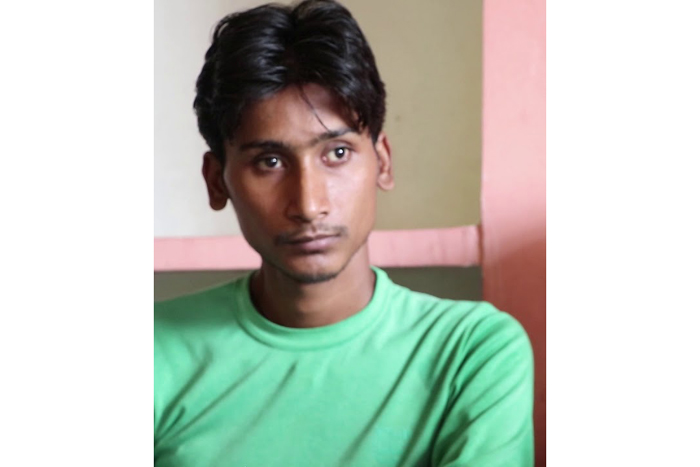
Ranchi: The elder son of Alimuddin Ansari, who was lynched by a mob in Ramgarh on suspicion of carrying beef died today at a private hospital in Ranchi after complain of headache.
Twenty-two-year-old Shahzad Ansari was looking after the family after the brutal killing of his father, on June 29, 2017.
“Yesterday, he complained of headache. We did not take him to a government but private hospital, Lake View, in hope of availing better treatment for him. He wasn’t into any form of addiction. After the CT Scan, doctors told us that there was no issue and that he would be fine,” said Mariam Khatoon, the grieving mother told eNewsroom.
Mariam, however, suspects foul play in the part of hospital. She added, “The hospital killed my son. He was given so many injections, saying that it would help him to sleep. But my son never woke up again.”
The family on not being satisfied with the replies from hospital authorities had got discharged Shahzad and took him to RIMS, Ranchi, where he was declared brought dead.
Alimuddin’s second son, Shahbaj is also unable to understand how his brother died. He said, “Three years back, he had complain of a headache but it was never so serious, and he had got well soon after.”
Alimuddin, is survived by three sons and three daughters. Among the six, only eldest daughter had been married off. Sahzad along with her mother had fought a tough battle to get justice after his father’s killing. However, it had not last for long, as within a few months of the conviction (11 accused given a life term), all got bail by from the Jharkhand High Court.
Union Minister and MP from Hazaribagh, Jayant Sinha, who openly issued a statement in favour of the killers, had also garlanded them at his Hazaribagh residence when they got bailed.
The Minister, who never got the time to meet Alimuddin’s family, had to express regret for his action only after a worldwide outrage.
Shahzad’s death comes as another setback for the family, who has been a victim of India’s new found mob lynching culture.
When eNewsroom contact the Bablu Khan, the administrative head of Lake View Hospital, he claimed that there is negligence in the part of hospital. “We were not aware that Shahzad was son of Alimuddin Ansari, still on assessing economic situation of patient we did not take Rs 4600, the bill of the medicines.”
The treating Neurosurgeon, Dr Waqar told eNewsroom, “I had no idea that Shahzad was son of a lynching victim. He had a serious accident in 2013. And most probably had some internal injury. But his condition was not so serious yesterday when he was brought here. And the CT Scan was also not life threatening. But today morning, he was feeling drowsy and it was a matter of concern for me. Then I had suggested the family to shift the patient to ICU, but they did not get ready for it due to their financial condition. They wanted to take him to a government hospital for further treatment. I request the same to them in the afternoon, and when they again shown helplessness I agreed to discharge him.”
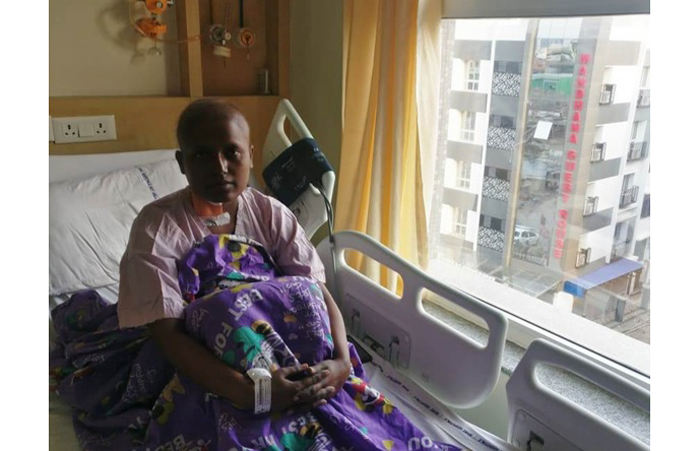
Kolkata: Twenty-seven-year-old Rima Begum, a resident of Chittagong, Bangladesh, was diagnosed with leukemia (blood cancer) almost a year ago. Rima had lost all hope of undergoing the bone marrow transplant recommended by doctors in Bangladesh.
“Lack of resources was the primary reason. We didn’t have enough funds for the life-saving treatment,” recounts Shafiqul Islam, Rima’s husband. He adds, “I was devastated when I learned that my wife had leukemia and needed a bone marrow transplant. We decided to come to Kolkata for the treatment, but we were clueless about how to make the necessary arrangements.”
Despite the odds, they began searching for healthcare facilitators who could guide them toward proper treatment. That’s when they came across GlobalMedin India Healthcare Private Company, which helps Bangladeshi citizens access healthcare facilities in India.
“We immediately contacted MedInIndia officials, who were very approachable. When we explained our financial crisis, the company’s partners helped us secure the best medical treatment, logistics, and medication. They not only raised funds to support my wife’s bone marrow transplant but also guided us throughout the five months we spent in Kolkata,” Islam shared.
Rubayat Kadir, Managing Director of MedInIndia, elaborated, “We realized that they needed immediate help to save Rima. Honestly, we were just a few months old as a company when Shafiqul approached us. We are committed to helping those in need of medical treatment in India. When they shared their case with us, we initiated a crowdfunding campaign. Contributions from people in Bangladesh and India covered 50% of the total treatment cost. For the remaining 50%, MedInIndia stepped in to assist. Dr. Joydeep Chakrabartty, a top haemato-oncologist and bone marrow transplant expert, successfully performed the transplant at AMRI, Kolkata.”
Rima remains deeply grateful to her saviors. “We stayed in Kolkata for five months for the complete treatment. The company not only helped us secure appointments, meet doctors, undergo tests, and obtain medicines at discounted prices, but they also assisted us in renting an apartment for the recovery period. I successfully underwent the bone marrow transplant at AMRI and have now returned to Chittagong, healthy and grateful,” said Rima.