Mohammed Siraj Didn’t Just Win Matches—He Fought Stereotypes

[dropcap]E[/dropcap]ven today, that final scene from Shah Rukh Khan’s film Chak De! India brings tears to my eyes. After returning victorious with the women’s hockey team crowned world champions, when “Kabir Khan” (played by Shah Rukh) returns to his old home with his mother, a teenager is seen wiping off the word “traitor” scrawled on the wall. Once labeled a traitor for losing a match to Pakistan, how many years did it take for that Indian hockey star to earn the right to have that scar scrubbed clean?

Mohammed Siraj, who was branded a ‘traitor’ by the so-called troll army after catching Harry Brook only for the ball to cross the boundary, took five wickets and led India to a historic victory. Has he now managed to wipe off that ‘traitor’ tag? Time alone will answer that. But as an Indian Muslim, I understand exactly why Shimit Amin, the director of Chak De!, included that powerful scene. Why is it that Mohammed Shami, Mohammed Siraj, or even players from the previous generation like Zaheer Khan and Mohammad Kaif must constantly prove their patriotism?

Why do they have to repeatedly declare that wearing the Indian jersey fills them with pride and that they gain honor only by winning for India?

Even after 78 years of independence, Indian Muslims continue to face this crisis — they are still asked to prove their loyalty to the nation. And perhaps Siraj has just done that once more, on English soil.

A Wicket for Every Wound

As Mohammed Siraj dismantled England with five wickets and sealed a six-run victory for India, one had to wonder — which India are we living in?

We live in an India where a propaganda film like The Kerala Story, a movie laced with Islamophobia, receives a National Award. And the award is given by none other than Ashutosh Gowariker, filmmaker of masterpieces like Lagaan and Jodhaa Akbar, and now chairperson of the jury board.

In the same India where The Kerala Story is celebrated, Bengali Muslims are regularly branded “Bangladeshi,” and the Bengali language itself is often dismissed as “a language of Bangladeshis.” The rich legacy of Syed Mujtaba Ali, Syed Mustafa Siraj, and Abul Bashar is thus blatantly denied, with Bengali language and culture painted as foreign.

More Than Just a Cricketer

In such a hostile landscape, when a Muslim like Mohammed Siraj single-handedly destroys England and brings India victory, it holds a different, deeper meaning.

Let’s not forget the humiliation and racism Siraj has endured — the slurs hurled at him while fielding in Australia, the sneers after dismissing Travis Head. The boy who rose from the gullies of Hyderabad, whose father Mohammad Ghaus drove an auto-rickshaw, was likely taught that humiliation must be answered on the field — that’s the only way one can pass the test of being Indian.

Maybe Siraj has passed that test — for now.

But we can’t forget what Mohammed Shami faced when he failed to take wickets against Pakistan. No matter that Prime Minister Narendra Modi embraced him after the World Cup final — Shami had already felt the sting of India’s saffron troll brigade. He, like many others, knows exactly how Hindu-supremacist politics and hyper-nationalist rhetoric see a Muslim player in today’s India.

These accusations of being a “traitor” — do people understand how deeply they wound? It’s like being stripped bare and paraded in Connaught Place or Dharmatala. We, Indian Muslims, understand. And that’s why Siraj’s words, his success, stir us deeply.

Everyone makes mistakes — Hindu, Muslim, Buddhist, Christian — all of us. But the festering wounds of Partition and Jinnah’s two-nation theory continue to breed hate. If an Indian Muslim makes a mistake, it becomes a “double mistake.” In our everyday lives, even a minor slip feels like Siraj’s boundary-line mishap.

The Unspoken Burden

This burden of being Muslim has been made heavier by the saffron troll brigade — the same people who won’t even acknowledge Bengali as a language. To them, Syed Mujtaba Ali’s discipleship under Tagore means nothing, Syed Mustafa Siraj’s literary genius rooted in Murshidabad’s soil is irrelevant, and Abul Bashar’s tales of Bengali Muslim life carry no value. They simply refuse to accept us as Indian, as Bengali.

Yet ironically, people like Amit Malviya, in rejecting the entire Bengali https://www.meridianpint.com/touchless-menu/ identity, may have unintentionally opened new avenues for Hindu-Muslim solidarity. Perhaps if he hadn’t dismissed the Bengali language entirely, we wouldn’t have begun to place both Sunil Gangopadhyay and Syed Mustafa Siraj on the same literary pedestal.

In these turbulent times — with Donald Trump issuing threats and Netanyahu carrying out what can only be described as human sacrifice — Siraj’s success shines bright. It lights a torch of hope in our hearts. It re-ignites our spirits.

And perhaps, from Hyderabad — the same city that gave us Mohammed Azharuddin — or from some other corner of India, a Muslim teenager will now find the courage to dream of cricket. Siraj’s journey will give them that belief, that assurance.

Siraj is not just a name. In today’s India, he is a symbol — of excellence, of Indian identity, and of the power to erase the traitor label repeatedly slapped on us.

From Lalu’s Lalooland to Gorakhnath’s Legacy: Nalin Verma Tells India’s Untold Stories

0

[dropcap]A[/dropcap] good reporter can smell a story from a distance. A great one writes it with a flair that lingers long after the print fades. Nearly four decades ago, I saw in Nalin Verma such a storyteller—someone who knew that journalism wasn’t just about facts, but also about textures, atmosphere, emotion. He could transform the most prosaic assignment into poetry on newsprint.

I remember sending him to report from the field. What came back wasn’t just a routine dispatch but a story that began with the lyrical description of a tree under whose barren branches an accused was tied, for the police station had no lock-up.

A tree, a prisoner, and an almost surreal stillness—Nalin gave us not just information but atmosphere. The only hiccup? Photographer AP Dubey’s picture revealed the tree was completely leafless, quite at odds with his leafy prose. The story had to be edited. But even then, it stood out—not for the error, but for the imagination that fuelled it. It was a mistake only a writer could make.

Between Facts and Feelings: A Journalist’s Journey to Fiction

That literary impulse has now found a new and striking expression in Nalin’s latest foray into fiction, Lores of Love, after his The Greatest Folk Tales of Bihar. Coming after decades as a journalist, biographer, columnist, and teacher, this book reads not as a debut but as the fruit of long and deep engagement with storytelling—not just in form, but in spirit. This is not reportage disguised as fiction; it is fiction with the depth of lived experience, oral traditions, and cultural intimacy.

It’s not often that journalists retain their idealism past the deadlines and cynicism that newsrooms breed. Many fade out, bitter or burnt out. Nalin is not one of them. He has, if anything, become more prolific, more curious, more daring—with no airs or pretensions about him.

Twenty years ago, I had the pleasure of having him on a reporting trip through North Bihar. That journey, which took us through Siwan—his home district—gave me a glimpse into the rich oral culture, inter-religious harmony, and colourful personalities that shaped his worldview. He spoke lovingly of his parents, fondly of friends, and knowledgeably about Islamic customs picked up not from books but from lives lived side by side.

He introduced me to a farmer in his bare minimal dress who turned out to be Lalu Prasad Yadav’s brother. We later visited Chief Minister Rabri Devi’s ancestral home, where I interviewed her formidable mother—thanks to Nalin’s deft interpretation. The result was my essay “Three Days in Lalooland”, which KC Yadav found good enough to include in an anthology on Lalu.

It wouldn’t have been possible without Nalin’s eye for setting and his deep network of trust across caste and creed. He knew the texture of Bihar’s soul—its contradictions, its laughter, and its scars.

Syncretic Soul of Bihar and the Gorakhnath Legacy

It is this same texture that permeates Lores of Love. The book is anchored in the Gorakhnath tradition—now widely known for its association with Uttar Pradesh’s Chief Minister Yogi Adityanath. But this book does something remarkable: it peels away the layers of political appropriation to reveal a rich, syncretic past.

As the authors write in their introduction, “Historical accounts suggest that Asaf-ud-Daulah, the Nawab of Awadh, donated over 52 acres of land to Baba Roshan Ali, a fakir and devotee of Gorakhnath, in the eighteenth century, which helped rejuvenate the temple and enhance its glory and grandeur.”

This is not the tale we hear today, when the temple is projected as a monolithic symbol of Hindu might. Instead, Nalin and Lalu present a world where the Gorakhnath tradition welcomed both Hindus and Muslims, Sufis and Siddhas.

On a visit to the Gorakhnath Temple in Gorakhpur after Yogi Adityanath came to power, I was surprised to find, among other things, a Dosa stall within the premises and a glass room filled with busts of the temple’s past heads. Verma’s book brought alive this legacy for me in a way that was not dryly academic but richly narrative.

In Gorakhpur, I tried in vain to meet a Muslim woman who defeated the BJP candidate in the municipal constituency that included the temple complex. It was a symbolic body blow to the reigning political narrative—and a reminder that history is more complex than we are often led to believe.

The strength of Lores of Love lies not in its polemics but in its passions. This is a book of folktales, yes—but also of longing, of sensuality, and of spiritual transcendence. Nalin doesn’t merely retell stories; he reimagines them, lending flesh and fire to characters that are often confined to moral parables or rustic jokes.

In his hands, carnal love is neither a sin nor a distraction. It is the thread that connects the sacred and the profane. The mythic and the real collide in tales where gods fall in love with mortals, sages burn with anger, and lovers soar—literally—in aircraft “that land and fly without noise.” These are not tales to be dissected but to be experienced. As the narrators remind us, “This is the mortal world. People here are bound by greed. They commit sins to fulfil their greed and desire.”

And yet, love here is also a form of rebellion, a transcendence over worldly decay. Consider the story of Sorthi, who is found floating on a river, like a desi Moses. There’s both tenderness and wonder in such tales. And the authors know how to mine them for pathos, without veering into melodrama.

Nalin is one of the rare writers who applies equal aesthetic attention to both men and women. In his pages, men are not mere action figures or foils. One character is described thus: “He is very handsome. His forehead glistens like the moon. He has robust arms and well-rounded thighs like banana tree trunks. I haven’t seen a more handsome man in my life.”

The women, too, are sculpted with loving eyes: “The aroma of sandalwood is wafting from you. Your lips resemble a blossoming lotus. I can’t take my eyes off you. Your gaze has pierced my heart.”

It’s refreshing to read prose that is unapologetically sensuous, unafraid of beauty in a world that often hides behind irony or detachment. The stories here are grounded in flesh, fantasy, and faith—all at once.
The religious overtones of the Gorakhnath tradition are not ignored either. One of the most powerful lines in the book captures this mythic energy: “No fire can match the fire of a sage who has been meditating for years on the ground. Even Lord Shiva, Lord Vishnu and Lord Brahma can’t help against the wrath of Gorakhnath.”

This is a myth as a metaphor. The sage’s fire is not just spiritual—it is also political. In a world where power has become synonymous with violence, the book reminds us that spiritual power once meant something else—renunciation, discipline, moral fury.

A Defiant Celebration of Sensuality, Spirituality, and Story

A few years ago, when reports emerged that Lalu was dying, a Malayalam newspaper requested an obituary. I checked with Nalin, who laughed and said, “He’s unwell, but not dying yet.” I wrote the piece anyway, which may still be lying in the paper’s morgue. The irony is not lost on me that both Lalu and Nalin remain very much alive—and vital.

In many ways, Lores of Love is a tribute not only to the oral traditions of India but also to the strength of those who keep such traditions alive. It is a defiant book in a time of manufactured silences. Nalin writes of love in an age of hate. He celebrates syncretism in an era of polarisation. And he does it not with lectures but with stories.
I will not summarise the stories here. To do so would be to betray them. They deserve to be read in full, not digested in bullet points. They are stories that refuse to be fenced in—by genre, by religion, by realism. They are free, like love, like myth, like Nalin himself. In the end, the highest compliment I can pay this book is that it is utterly readable. At a time when prose is often tortured in the name of profundity, Nalin and Lalu offer us clarity, colour, and cadence.

To summarise, stories are stories, and one does not have to approach them clinically. They need to be read and appreciated. So read Lores of Love. Read it not just with your mind, but with your senses—and your soul.

जिनसे लड़े, उनके बच्चों को भी अपनाया; कार्यकर्ताओं को तराशा, बहू को सशक्त किया: शिबू सोरेन की सियासत कुछ अलग थी

[dropcap]झा[/dropcap]रखंड के सोरेन परिवार पर अक्सर वंशवाद का इल्ज़ाम लगता रहा है, खासकर भारतीय जनता पार्टी की तरफ़ से। लेकिन झारखंड मुक्ति मोर्चा (जेएमएम) के संस्थापक शिबू सोरेन ने सिर्फ अपने परिवार को नहीं, बल्कि पार्टी कार्यकर्ताओं और यहां तक कि ज़मींदारों के बेटों को भी आगे बढ़ाया—जिन ज़मींदारों के ख़िलाफ़ उन्होंने कभी ज़ोरदार आंदोलन चलाया था।

शिबू सोरेन के वालिद शोबरन मांझी, जो एक शिक्षक थे, की हत्या तब कर दी गई थी जब सोरेन आठवीं कक्षा में पढ़ते थे। ये हत्या ज़मींदारों ने की थी। इसके बाद सोरेन ने स्कूल छोड़ दिया और ज़मींदारी प्रथा के ख़िलाफ़ एक मज़बूत आंदोलन शुरू किया। उन्होंने गिरिडीह, धनबाद, बोकारो और जामताड़ा इलाकों में ‘धान कटनी आंदोलन’ चलाया।

ज़मींदारों से लड़े, लेकिन उनके बच्चों साथ खड़े रहें

धान कटनी आंदोलन काफ़ी तेज़ और टकराव वाला आंदोलन था। उस वक़्त ज़मींदार अब भी ताक़तवर थे और उन्होंने इस आदिवासी-आधारित किसान आंदोलन को कुचलने की भरपूर कोशिश की। लेकिन शिबू सोरेन की क़ियादत में आंदोलन दिन-ब-दिन मज़बूत होता गया। 1970 में उन्होंने ‘सानोत संथाल समाज’ बनाया और इस पूरे इलाक़े में अपनी पकड़ बना ली। धीरे-धीरे ज़मींदारों का दबदबा टूटता गया।

इसी दौरान एक ज़मींदार गुणधर दान ने शिबू सोरेन से मुलाक़ात की। उन्होंने कहा कि आंदोलन की वजह से उनका रोज़गार छिन गया है और अब वह अपने बच्चों को पालने में भी असमर्थ हैं। उन्होंने अपने बेटे संजीव को आगे की पढ़ाई के लिए बाहर भेजने की ख़्वाहिश जताई।

शिबू सोरेन ने उनकी बात सुनी और उन्हें भरोसा दिलाया कि वह उनके बेटे की मदद करेंगे। उन्होंने एलान किया कि वह संजीव कुमार को गोद लेकर पढ़ाई में मदद करेंगे।

धनबाद के टुंडी के मनियाडीह गांव के रहने वाले संजीव ने रांची यूनिवर्सिटी से बीएससी और दिल्ली यूनिवर्सिटी से एलएलबी किया। वह सुप्रीम कोर्ट में वकील बने और शिबू सोरेन के लगभग सभी केस उन्होंने ही लड़े। बाद में जेएमएम ने उन्हें राज्यसभा भेजा।

पार्टी कार्यकर्ताओं को भी आगे बढाया

झारखंड सरकार में मंत्री और जेएमएम नेता सुदिव्य कुमार याद करते हैं, “जब मैंने जेएमएम जॉइन किया और पूरा समय पार्टी को देने लगा तो मेरे पिता को मेरी फ़िक्र होने लगी। तभी पिरटांड डबल मर्डर केस दोबारा खुला और गुरुजी अक्सर गिरिडीह आने लगे। मैं ज़्यादातर वक़्त उनके साथ रहने लगा।”

“एक दिन वो हमारे घर आए, मेरे पिता से मिले और कहा कि मुझे उनके साथ रहने दिया जाए। उन्होंने भरोसा दिया कि वो मुझे बेटे की तरह गाइड करेंगे।”

इसके बाद सुदिव्य कुमार को विधायक का टिकट मिला, दो बार चुनाव जीते और आज मंत्री हैं।

पिछले पांच दशकों में जेएमएम की यात्रा के दौरान यह बात आम है कि गुरुजी ने कई समर्पित कार्यकर्ताओं को आगे बढ़ाया और उन्हें पार्टी और सरकार दोनों में अहम जगह दिलाई।

महिला सशक्तिकरण

शिबू सोरेन की बहू, कल्पना सोरेन, जिनका सशक्तिकरण भी गुरुजी की लगातार की गई मार्गदर्शना का हिस्सा रहा है। वरना किसी महिला के लिए 18 सालों तक गृहनी बनकर रहना फिर सक्रिय राजनीति में आना, एक अनुभवी नेता की तरह चुनाव प्रचार करना और पार्टी को दोबारा सत्ता में लाना इतना आसान नहीं होता।

एक पारिवारिक शख्स

81 साल की उम्र में शिबू सोरेन के इंतिकाल के बाद झारखंड सरकार ने तीन दिन का राजकीय शोक घोषित किया है। सोशल मीडिया पर कई लोग मांग कर रहे हैं कि यह शोक अवधि सात दिन की होनी चाहिए क्योंकि उनका निधन झारखंड के लिए एक बहुत बड़ी क्षति है।

शिबू सोरेन के परिवार में पत्नी रूपी सोरेन, तीन बेटे—दुर्गा, हेमंत और बसंत—और एक बेटी अंजलि हैं। वो ज़िंदगी भर शाकाहारी रहे और कभी शराब नहीं पी।

अब कई लोगों की मांग है कि ‘दिशोम गुरु’ को भारत रत्न दिया जाए—एक ऐसा नेता जिन्होंने भारतीय सियासत के लगभग हर बड़े मंच पर अपनी मौजूदगी दर्ज कराई, झारखंड के तीन बार मुख्यमंत्री रहे और केंद्रीय मंत्री भी बने।

He Lost His Father to Zamindars—Then Gave a Zamindar’s Son a Future

0

[dropcap]J[/dropcap]harkhand’s Soren family has often been accused by opposition parties, particularly the Bharatiya Janata Party, of engaging in dynasty politics. However, Shibu Soren, the founder of the Jharkhand Mukti Morcha, also promoted party cadres—and even the son of a Jamindar (landlord), against whom he had once waged a fierce battle to eradicate the Zamindari Pratha in his region.

Shibu Soren’s father, Shobran Manjhi, a teacher, was murdered by Jamindars when Soren was in Class VIII. He dropped out of school and launched a movement against the landlords. He led the Dhan Katni Andolan (Reap the Crop Movement) across the Giridih, Dhanbad, Bokaro, and Jamtara regions.

Fought Against Jamindars, But Uplifted Their Families

The Dhan Katni Andolan was a violent movement. The landlords, then still powerful, used every means to suppress the uprising by poor peasants, mostly tribals. However, the movement grew stronger under Soren’s leadership. He formed the Sanot Shanthal Samaj (SSS) in 1970 to take control of the region. The landlords’ grip crumbled.

One such landlord, Gunadhar Dan, once approached Sibu Soren slot online in despair. He told Soren that his people had destroyed his means of livelihood and that he now struggled to raise his children. He wished to send his son away for higher education. Soren assured him of help and declared that he would adopt and support Dan’s son, Sanjiv.

A resident of Maniyadih, Tundi (Dhanbad), Sanjiv went on to complete his BSc from Ranchi University and LLB from Delhi University. He became a practising lawyer in the Supreme Court and fought nearly all the legal cases filed against Shibu Soren. Later, the JMM nominated him to the Rajya Sabha.

Uplifted Party Cadres

“When I joined the JMM and began dedicating myself to it full-time, my father grew worried about my future,” recalled Sudivya Kumar, now a minister in Hemant Soren’s cabinet. “Around that time, the Pirtand double murder case was reopened, and Guruji began visiting Giridih frequently. I was spending most of my time with him.”

“One day, he came to my house, met my father, and requested him to let me stay with him and work for the party. He promised to guide me like a father.”

Kumar later became a district president, got a party ticket, won the MLA seat twice, and is now a minister with key portfolios.

Over JMM’s five-decade journey, it is widely said that Guruji mentored and elevated several party workers, placing them in influential roles within both government and party ranks.

A Family Man

On the death of the 81-year-old leader, the Jharkhand government has declared three days of mourning. Some netizens are demanding a seven-day mourning period, arguing that Soren’s death is a monumental loss for the people of Jharkhand.

Sibu Soren is survived by his wife, Rupi Soren, three sons—Durga, Hemant, and Basant—and a daughter, Anjali. He was a lifelong vegetarian and a teetotaler.

There is now a growing demand to confer the Bharat Ratna on the Dishom Guru, who not only represented nearly every house in Indian politics but also served as Jharkhand’s chief minister three times and was a Union minister.

किताबों से निकले, जंगलों में लड़े, संसद तक पहुंचे—शिबू सोरेन की ज़िंदगी एक पाठशाला

[dropcap]सा[/dropcap]ल 2005 में जब झारखंड में पहली बार विधानसभा चुनाव हो रहे थे, तब झारखंड मुक्ति मोर्चा (JMM) ने गुरुजी—शिबू सोरेन—के लिए एक हेलिकॉप्टर किराए पर लिया था। एक हफ्ते की ताबड़तोड़ रैलियों के बाद जब पायलट मीर को विदा करने का वक्त आया, तो हम सबने साथ में एक कप कॉफी पी। बातचीत के दौरान मीर, जो पिछले तीन दशकों में देश के लगभग हर बड़े नेता को उड़ा चुके थे—एलके अडवाणी, लालू प्रसाद यादव, शरद पवार से लेकर जयललिता तक—एक बात कह गए जो हमें सोचने पर मजबूर कर गई।

उन्होंने कहा, “मैंने ऐसा नेता पहले कभी नहीं देखा।”

“हम समझ नहीं पाए कि वो क्या कहना चाहते हैं। हमें लगा, शायद गुरुजी की सादगी ने उन्हें प्रभावित किया होगा। मैंने हैरानी से पूछा—‘ऐसा क्या देखा आपने उनमें?’” ये बात गिरिडीह से JMM विधायक सुदिव्य कुमार सोनू ने याद करते हुए बताई।

एक ऐसा नेता जो लोगों को हंसाता नहीं, रुला देता था

पायलट मीर ने जवाब दिया, “सभी नेता ऐसी बातें करते हैं जिससे लोग हंसते हैं। लेकिन तुम्हारा नेता ऐसी बातें करता है जिससे लोग रो पड़ते हैं।”

यही गुरुजी की सबसे बड़ी ख़ासियत थी, सोनू कहते हैं।

“वो अपने संघर्ष की कहानियां सुनाते थे, झारखंड की लड़ाई में दिए गए बलिदानों को याद करते थे, शराब छोड़ने की सलाह देते थे, और शिक्षा की अहमियत बताते थे। उनकी बातें लोगों को अंदर तक झकझोर देती थीं। हम तो इसके गवाह थे ही, लेकिन बाहर के लोग आकर जब ये बताते थे, तब हमें समझ में आता था कि गुरुजी वाकई अलग थे।”

लेकिन गुरुजी सिर्फ भाषण देने वाले नेता नहीं थे।

शिबू सोरेन, जो पूरी ज़िंदगी नशे से दूर रहे, शाकाहारी रहे, 1970 के दशक में ही सामूहिक खेती करते थे, रात में बड़ों के लिए साक्षरता क्लास चलाते थे, और गांवों में झगड़े सुलझाने के लिए पंचायतें लगाते थे।

अपने आंदोलन के दौर में वो ज़्यादातर पैदल ही चलते थे—गिरिडीह, धनबाद, बोकारो और जामताड़ा के जंगलों से होकर।

81 साल के शिबू सोरेन, जिनका आज दिल्ली के गंगाराम अस्पताल में इंतक़ाल हो गया, आम नेताओं से बिल्कुल अलग थे। वो उन चंद नेताओं में थे, जिन्हें राजनीति में लाने वाले एक आईएएस अफसर थे और जिनकी तरबियत एक इंजीनियर-से-समाजसेवी-से-सांसद बने इंसान ने की थी।

दबे-कुचले लोगों की आवाज़ थे गुरुजी

गुरुजी की पकड़ झारखंड के आदिवासी समाज और शोषित तबके पर इतनी मज़बूत थी कि धनबाद से तीन बार सांसद रह चुके एक और बड़े नेता एके रॉय और वरिष्ठ वकील विनोद बिहारी महतो ने भी उनके आंदोलन को दिशा दी।

एमरजेंसी के दौरान एक DC ने बदला गुरुजी का रास्ता

लेकिन जिन्हें सबसे बड़ा क्रेडिट जाता है, वो थे धनबाद के उस वक़्त के डिप्टी कमिश्नर—आईएएस अफसर कुंवर बहादुर (केबी) सक्सेना।

यह वो समय था जब देश में इमरजेंसी लगी थी। उस दौरान बीसीसीएल (भारत कोकिंग कोल लिमिटेड) में काम करने वाले तारा बाबू मरांडी टुंडी के पोखरिया आश्रम में गुरुजी की मदद कर रहे थे। उन्होंने एक अजीब वाकया याद किया।

“एक आदमी साइकिल पर आया और कहा कि वो गुरुजी की बाइक ठीक करने आया है। मैंने कहा—बाइक तो चल ही नहीं रही। उसने पूछा—‘पैसे कौन देगा?’ मैंने कहा—‘गुरुजी देंगे।’ लेकिन उसने ज़िद की कि पहले वो गुरुजी से मिले। मैं उसे पारसनाथ पहाड़ी ले गया, जहां गुरुजी थे। वहां उसने पहचान बताई—वो था धनबाद का डीसी,” मरांडी ने बताया।

उस वक़्त गुरुजी ज़मींदारों के ख़िलाफ़ आंदोलन चला रहे थे और आदिवासी अधिकारों की बात कर रहे थे। डीसी सक्सेना ने उन्हें समझाया कि इमरजेंसी और बढ़ती हिंसा के बीच या तो वो मारे जाएंगे या ज़िंदगीभर जंगलों में छिपकर रहेंगे।

“गुरुजी ने डीसी की बात ध्यान से सुनी। सक्सेना ने कहा—कोर्ट में सरेंडर करो, जेल चले जाओ, फिर वैध राजनीति के रास्ते से आंदोलन को आगे बढ़ाओ। उसी दिन गुरुजी ने आत्मसमर्पण कर दिया,” मरांडी ने याद किया।

आंदोलन के साथियों की कहानियां

गुरुजी के विचारों से प्रभावित होकर मरांडी ने अपनी सरकारी नौकरी छोड़ दी। ऐसा ही किया शिक्षक छोटू राम टुड्डू ने। उन्हें ज़मींदारों ने कुदको दोहरा हत्याकांड के बाद इतना मारा कि उन्हें मरा समझकर छोड़ दिया—सिगरेट से चेहरा जलाया, जीप से घसीटा।

“मैं तो उस दिन शादी में था, जब घटना हुई। लेकिन लौटते ही मुझे उठा लिया गया और मारा गया,” टुड्डू ने कहा, जो अब 73 साल के हैं। उनके बेटे आज रांची में बीडीओ हैं।

1980 में जब गुरुजी दुमका से सांसद बने, तो अपने पुराने साथियों से मिलने पिरटांड़, गिरिडीह पहुंचे।

“वो हंसते हुए बोले—‘मैं बड़ा चपरासी हो गया हूं, विधायक लोग छोटे चपरासी हैं।’ हम सब हंस पड़े,” ये यादें हैं बाबू राम हेम्ब्रम की, जो धान कटनी आंदोलन के शुरुआती दौर से गुरुजी के साथ थे।

एक बचपन जो ज़ुल्म से बना, एक जीवन जो संघर्ष से चमका

आज जब कुछ नेता खुद को चौकीदार कहकर गर्व करते हैं, तो याद रखना चाहिए कि गुरुजी ने सबसे पहले ऐसा रूपक इस्तेमाल किया था।

उनका संघर्ष बचपन से ही शुरू हो गया था। उनके पिता शोबरन मांझी, एक शिक्षक थे, जिन्हें ज़मींदारों ने मार डाला था। उस वक़्त गुरुजी सिर्फ 13 साल के थे और आठवीं क्लास में पढ़ते थे। जब उन्हें यह खबर मिली, तो स्कूल से सीधे उस जगह पहुंचे जहां पिता की हत्या हुई थी। फिर कभी स्कूल नहीं गए। उसी दिन उनका जीवन बदल गया।

सत्ता उनके लिए कभी प्राथमिकता नहीं रही। वो तीन बार झारखंड के मुख्यमंत्री बने, लेकिन कभी एक भी कार्यकाल पूरा नहीं कर पाए। लेकिन उन्हें इसका मलाल नहीं था। शिबू सोरेन—जिन्हें लोग प्यार से ‘गुरुजी’ या ‘दिशोम गुरु’ कहते थे—जनता के नेता थे।

सत्ता से ज़्यादा उन्हें समाज की सुध थी

उन्होंने 1970 के दशक में ही आदिवासियों से शराब छोड़ने की अपील की थी। कहते थे—“शराब पीने से इंसान का इरादा कमज़ोर हो जाता है और ज़मींदार उसका फ़ायदा उठाते हैं।” दशकों बाद भी, जब वो चुनाव प्रचार में जाते थे, तो यही बात दोहराते थे।

पांच दशक की राजनीति में उन्होंने आठ बार लोकसभा, दो बार राज्यसभा और तीन बार विधानसभा की सदस्यता पाई। लेकिन विवादों से भी उनका नाता रहा। ज़मींदारों के ख़िलाफ़ आंदोलन के दौरान उन पर दो हत्याओं के आरोप लगे। बाद में, एक सचिव की हत्या और नरसिम्हा राव सरकार के दौरान वोट के बदले पैसे लेने का मामला भी आया।

फिर भी, शिबू सोरेन झारखंड की राजनीति के एक ऐतिहासिक किरदार बनकर रहेंगे—एक ऐसा शख्स जो जंगलों और गांवों से उठकर संसद तक पहुंचा, लेकिन हमेशा अपने लोगों के लिए जिया।

आज वो हमारे बीच नहीं हैं, लेकिन एक सच्चे आदिवासी नेता की ये कहानी आने वाली नस्लों को हमेशा हिम्मत और हौसला देती रहेगी।

The Real Chowkidar: Shibu Soren Spoke the Language of the People

[dropcap]I[/dropcap]n 2005, during Jharkhand’s first-ever assembly polls, the Jharkhand Mukti Morcha (JMM) had hired a chopper for Guruji—Shibu Soren. After a week of campaigning, when it was time to see off the pilot, a man named Meer, we sat together for a cup of coffee. As we chatted, Meer—a veteran pilot who had flown almost every big political leader of India in the past three decades, from LK Advani and Lalu Prasad Yadav to Sharad Pawar and Jayalalitha—remarked that he had never met a leader like Shibu Soren.

“We didn’t understand what he meant. We thought perhaps it was Guruji’s simplicity that had impressed him. I asked in surprise, ‘What’s so unique about him?’” recalled JMM MLA from Giridih, Sudivya Kumar Sonu.

A Leader Who Made People Cry, Not Laugh

“The pilot replied, ‘All politicians give speeches that make people laugh. But your leader makes them cry.’”
That, Sonu said, was a defining characteristic of Guruji.

“He would recount his struggles, the sacrifices made for Jharkhand’s formation, why people shouldn’t drink, and why education matters. His words made people reflect deeply. We witnessed it often, but it took an outsider to make us realize how different Guruji’s speeches truly were.”

But it wasn’t just about speeches.

Shibu Soren, a lifelong teetotaler and vegetarian, practiced community farming, held adult literacy classes at night, and organized panchayats to resolve family disputes—in the 1970s itself. At the height of his movement, he travelled mostly on foot through the forests of Giridih, Dhanbad, Bokaro, and Jamtara.

The 81-year-old Soren, who breathed his last today at Delhi’s Gangaram Hospital, stood apart from most Indian politicians. He was one of the rare leaders who was brought into mainstream politics by an IAS officer and mentored by an engineer-turned-social-activist-turned-MP.

Soren’s hold on the oppressed classes—particularly tribal communities—was so strong that even two prominent leaders of the Jharkhand region, Arun Kumar (AK) Roy, a three-time MP from Dhanbad, and advocate Vinod Bihari Mahto, helped shape his political path and the larger movement.

During the Emergency, How a DC in Disguise Brought Guruji into the Mainstream

But the person who brought Guruji into the mainstream was Dhanbad’s then-Deputy Commissioner, IAS officer Kunwar Bahadur (KB) Saxena.

It was during the Emergency declared by Prime Minister Indira Gandhi. At the time, Tara Babu Marandi, a government employee at Bharat Coking Coal Limited (BCCL), was helping run the Pokharia Ashram in Tundi. He recalled an unusual visitor who arrived on a bicycle, claiming to be a bike mechanic.

“He said he had come to repair Guruji’s bike. When I told him the bike wasn’t working, he asked who would pay him. I said, ‘Guruji will.’ But he insisted on meeting him first. So, I took him to Parasnath Hills where Guruji was. There, the man revealed his identity by showing an ID card—he was the DC of Dhanbad,” Marandi recounted.

Soren was leading a movement against oppressive landlords and advocating for tribal rights. Saxena advised him to surrender to the court, warning that the Emergency and the increasing violence would either get him killed or force him to spend life hiding in forests.

“Guruji listened to the DC patiently. Saxena told him to go to jail temporarily and then return to the movement through legitimate political means. That same day, Guruji surrendered,” Marandi recalled.

Marandi wasn’t the only one inspired by Soren’s vision. He left his government job to join Soren’s movement, as did Chotu Ram Tuddu, a teacher. Tuddu was tortured by landlords after the Kudko double murder case—his head was burnt with cigarettes and he was tied to a jeep and dragged. Believing him https://lbs.uol.edu.pk/ dead, they left his body behind.
“I wasn’t even there when the murder happened—I was attending a wedding. But when I returned, I was tortured anyway,” said Tuddu, now 73. His son is currently a Block Development Officer in Ranchi.

In 1980, after Soren was elected MP from Dumka, he visited his comrades in Pirtand, Giridih.

“He told us jokingly, ‘I’m the Bada Chaprasi (senior gatekeeper), and MLAs are Chota Chaprasi (junior gatekeepers).’ We laughed then,” said Babu Ram Hembram, who was with Soren from the early days of the Dhaan Katni (reap the crop) movement.

A Childhood Marked by Tragedy, A Life Shaped by Resolve

“Today, some leaders call themselves Chowkidars and claim to have coined that concept. But it was Guruji who first used such metaphors.”

The roots of Soren’s life struggle go back to his childhood. His father, Sobran Manjhi, a teacher, was killed by landlords when Soren was just 13. He was in Class 8 when the news reached him. He went directly from school to the site where his father had been killed—and never returned to the classroom. That moment changed his life and set him on the path of resistance.

Despite a lifetime of struggle and electoral victories, Soren never enjoyed long tenures in power. Though he became minister and chief minister, he never completed a full term in office. But that was never his goal. Shibu Soren—known affectionately as Guruji and Dishom Guru—belonged to the people.

He never gave up on the idea of social reform. In the 1970s, he urged tribal villagers to give up drinking, warning them that liquor weakened their resolve and made them easy prey for landlords. Decades later, even while campaigning, he would urge people to shun alcohol.

In his five-decade-long public life, Soren served as an eight-time Lok Sabha MP, two-time Rajya Sabha MP, three-time MLA, and three-time Chief Minister of Jharkhand. Yet, his career was not without controversy.

During the movement against landlords, he was accused in two murder cases. Later, in national politics, he was accused of killing his secretary and of accepting bribes during the Narasimha Rao government’s efforts to survive a no-confidence motion.

Even so, Shibu Soren remains a towering figure in Jharkhand’s political history—a man who rose from forest trails and grassroots protests to the halls of Parliament, driven by a singular mission: justice and dignity for the tribal people of Jharkhand.

He may have passed away, but this true tribal leader’s story will continue to inspire generations.

2.3% and Under Siege: The Myth of Christian Conversions in India

[dropcap]O[/dropcap]n July 26, 2025, two Christian nuns were detained at Durg station in Madhya Pradesh. The charges against them were serious, but the matter was simple: they were accompanying three women who wanted to be trained as professional nurses. An all-party delegation led by Vrinda Karat of the CPI(M) was not easily permitted to meet them. The charges related to human trafficking and attempted conversion. While the Chief Minister of the state insists on the charges of human trafficking and conversion, the parents of the women stated that they had given permission for their daughters to go in search of better job opportunities.

Harassment Normalised in Remote Areas

This intimidation of Christians—on one pretext or another—has been on the rise over the last 11 years, particularly in BJP-ruled states. Various reports from local and international agencies have documented the increasing harassment of Christians in India. Prayer meetings are attacked on the pretext that they are being organised for conversions. Pastors and nuns in remote areas are increasingly susceptible to being harassed or assaulted on one ground or another. Bajrang Dal activists are particularly aggressive in taking direct action against vulnerable pastors and nuns in these distant regions.

Denied Even in Death: Burial Rights Under Threat

Another issue that has come to light is the denial of burial rights to Christians. They are being prevented from burying their dead in shared or Adivasi burial grounds. For example, on April 26, 2024, in Chhattisgarh, a 65-year-old Christian man died in a hospital. His grieving family faced further distress when local religious extremists blocked them from burying him in the village and demanded their “reconversion” to Hinduism. The family was able to conduct the burial according to Christian customs only under the protection of about 500 police officers, which ensured peace in the village.

“Every day, we have four or five attacks on churches and pastors, and every Sunday it doubles to roughly ten—this we have never seen before,” said a persecuted Christian leader of a major denomination in 2023. According to him, the main source of Christian persecution in India is the Sangh Parivar, a group of Hindu nationalist organisations that includes the influential paramilitary group RSS (Rashtriya Swayamsevak Sangh), the ruling BJP, and the Bajrang Dal, a violent youth wing.

The major organisations Open Doors (at the global level) and Persecution Relief (at the Indian level) are doing vital work in monitoring these atrocities, as mainstream print and television media are either silent on the issue or misrepresent the facts.

Data Confirms Escalation in Hate Crimes against Christians

In its 2020 report, Persecution Relief noted: “Hate crimes against Christians in India have risen by an alarming 40.87 percent… That increase came despite a complete nationwide lockdown that lasted three months to stem the spread of Covid-19 infections.” According to Open Doors, India ranked 11th on the 2024 list of countries of particular concern in terms of Christian persecution.

Sudhi Selvaraj and Kenneth Neilson rightly observe: “This (anti-Christian) violence is… characterized by a strong convergence of direct, structural, and cultural forms of violence, involving vigilante attacks and police complicity, but also an increasingly coercive use of state law, coupled with the production of a wider cultural common sense about the anti-national essence of non-Hindu religious minorities.”

The broader picture of the rise in anti-Christian violence across diverse forms has become increasingly clear over the past few decades. It is not that such violence is new—it has long existed as an undercurrent, especially in remote areas. In contrast to anti-Muslim violence, which often takes on horrific proportions and garners wide media attention, anti-Christian violence has typically remained more insidious and less visible. Except for the high-profile incidents like the burning of Pastor Stains and the Kandhamal violence, it has continued largely unnoticed.

The first major incident was the brutal hacking of Rani Maria in Indore in 1995. This was followed by the horrific killing of Pastor Graham Stains in 1999, an Australian missionary working with leprosy patients in Keonjhar, Odisha. He was accused of conversion activities. The attack against him was led by Bajrang Dal’s Dara Singh, who incited people to violence. Stains and his two minor sons, Timothy and Philip, were burned alive while sleeping in an open jeep.

Then-President KR Narayanan described the attack as belonging to “the world’s inventory of black deeds.” The NDA-BJP government, led by Atal Bihari Vajpayee, at first dismissed the incident as a conspiracy by foreign powers to defame the government. However, the Wadhwa Commission later identified Rajendra Pal, alias Dara Singh of Bajrang Dal, as the main conspirator. He is currently serving a life sentence in prison.

A Long History of Demonising Christian Missions

Prior to this, the RSS had established Vanvasi Kalyan Ashrams to promote the belief that Christian missionaries were using education and healthcare work as a front for conversions. These ashrams were set up in regions like Dangs (Gujarat), Jhabua (Madhya Pradesh), and Kandhamal (Odisha). Figures like Swami Aseemanand and Swami Laxmananand propagated anti-Christian sentiments in these regions. At the same time, cultural-religious events like the Shabri Kumbh were organised to convert Adivasis to Hinduism.

In these Adivasi areas, Shabri—a symbol of destitution—was transformed into a goddess figure, and Hanuman was promoted as the ideal devotee of Ram. Temples were erected in their names. Amidst all this, what is often forgotten is that Christianity has ancient roots in India. The apostle St. Thomas is believed to have established a church on the Malabar Coast in AD 52. Despite nearly two millennia of Christian presence in India, Christians make up only 2.3% of the population today. Interestingly, in 1971, Christians made up 2.6%—a figure that has actually declined—while propaganda continues to claim that conversions are happening on a massive scale through force, fraud, and allurement.

Several states have enacted anti-conversion laws that further intimidate missionary workers.

MS Golwalkar, the second Sarsanghchalak of the RSS, had written in Bunch of Thoughts that Muslims, Christians, and Communists are the internal threats to the Hindu nation. After years of anti-Muslim violence, the anti-Christian agenda is now becoming more visible and dangerous.

Beyond Periyar’s Legacy: Honour Killings Betray Tamil Nadu’s Social Justice Promise

[dropcap]A[/dropcap]nother ‘honour’ killing has shaken Tamil Nadu—this time in Tirunelveli—where a software engineer from the Scheduled Caste community was hacked to death by the family of the girl he had loved since childhood. Kevin Selvaganesh, just 27, was once a brilliant student and had secured a job at Tata Consultancy Services. He was in a relationship with Subashini, his school-days girlfriend, and they had planned to marry. It appears that her family was aware of their relationship. Both of Subashini’s parents serve in the Tamil Nadu Police, and it seems a plan was hatched within the household to eliminate Kevin.

Subashini’s brother, Surjith, lured Kevin out under the pretext of resolving issues between the two. Trusting Surjith, Kevin went with him. But after a distance, Surjith stopped his scooter, verbally abused Kevin, and hacked him to death with a sickle he had carried. Thus, another promising young life was brutally cut short in Tamil Nadu—this time, in the name of false caste ‘honour’. These chilling crimes are no longer isolated incidents in the state.

Sadly, this is not unique to Tamil Nadu. We recently witnessed the case of Radhika Yadav in Gurugram, where a young girl was murdered by her own father. Although it wasn’t labelled as an honour killing, the elements were clear. Tamil Nadu, often held up as a model state by those who admire the legacy of the Dravidian movement and the contributions of Thanthai Periyar, seems to be grappling with a deep contradiction. While Periyar’s ideas of justice and dignity have inspired generations, the political parties claiming allegiance to his ideology have done little beyond ritualistic rhetoric on caste atrocities.

The anti-caste movement and philosophy cannot merely be an anti-brahmin movement. It must also embrace the individual’s right to choose, to love, to marry, and to live freely—values championed by both Baba Saheb Ambedkar and Thanthai Periyar.

A State of Social Contradictions

The rise in honour killings in Tamil Nadu reflects a deeper truth about Indian society—social reform is tolerated only as long as it doesn’t threaten the entrenched caste order. Despite Tamil Nadu’s impressive performance on many development indicators, it continues to be a deeply violent society when caste hierarchies are challenged, especially through inter-caste relationships.

Between 2018 and 2023, Tamil Nadu reportedly witnessed nearly 400 ‘dishonour’ crimes, including honour killings. Yet, the state officially recorded just 13 cases. Nationally, government data shows about 500 honour killings since 2014—mostly targeting women. Activists argue the real number is much higher due to rampant underreporting, and because many cases are disguised as suicides.

As Dr. Ambedkar said, India remains a society proud of its ‘graded inequality’. Here, individual rights are often crushed under the collective weight of caste identities. In such a system, murdering someone for love becomes permissible—so long as it restores the ‘honour’ of the caste group. Laws are rarely implemented sincerely, and political parties treat caste more as a vote-bank tool than a social issue to be addressed.

Brutalisation of Dalits and the Caste Order

Kevin’s and Subashini’s backgrounds reveal much. Kevin’s mother was a panchayat teacher and his father a farm worker. Kevin excelled academically, completed engineering, and joined TCS. Subashini had finished her Bachelor of Siddha Medicine and Surgery and was working at a private Siddha clinic. Her parents, both sub-inspectors in the Tamil Nadu Police, represent the state’s educated middle class. Yet, even education failed to break their caste mindset.

This shows how deeply embedded caste remains, despite education and upward mobility. All sociological theories aside, caste remains the central identity in Indian society. Every caste wants to preserve its distinction, claim purity, and glorify its history. And that’s the brutal reality.

Kevin belonged to the Devendra Kula Vellalar community, officially listed as a Scheduled Caste. Subashini was from the Maravar community, categorised as a Most Backward Community (MBC). Ironically, the Devendra Kula Vellalar—comprising seven sub-groups—has been campaigning for delisting from the SC category. Dr. K. Krishnasamy, leader of the Puthiya Tamilagam party, once inspired by the Bahujan Samaj Party’s rise in Uttar Pradesh, now champions this cause.

When I asked some in the community why they wished to disassociate from the SC category, they said they did not consider themselves ‘untouchables’ and wanted to escape the stigma. Yet, a young man from that very community is hacked to death for daring to love a woman from an MBC community—considered ‘superior’ in the caste hierarchy. That’s the bitter irony.

Dalits, especially when they assert themselves or cross caste boundaries through love and mobility, often become targets of such violence. Dominant caste groups like Thevars, Vanniyars, and Maravars lash out when their imagined purity is threatened. Even within OBC and MBC communities, inter-caste mobility invites similar brutality—as we saw in the 2020 killing of M. Sudhakar, an MBC youth, for marrying a Vanniyar woman.

No political party is interested in ending this. Caste is too powerful a tool for mobilisation. You don’t need to improve lives—just invoke historical pride, and thousands will rally behind you. Even those championing Hindutva are not free of caste—they too operate within its logic of purity and pollution.

The Constitution vs Caste: A Battle We Haven’t Fought

That Subashini’s parents are both police officers should shake us. What does it say about our society when even protectors of law participate in such violence? It reflects a painful truth: the Constitution is not a part of our social consciousness. We refer to it only when in trouble—otherwise, caste rules us.

Go to any Indian village, and you will hear caste names—never OBC, Dalit, or MBC. These administrative categories exist only for policy convenience; they have no bearing on people’s lived realities. As long as caste norms remain unchallenged, everything appears fine. But the moment someone marries outside their caste, the masks fall.

In political rallies, we shout slogans of Dalit-Bahujan unity. But in practice, every leader, every party, manipulates these identities for their own gain. Caste remains the most potent political currency—but one that can destroy lives when individuals dare to cross its lines.

The anti-caste movement today stands diluted. While we demand rights as communities, we’re hesitant to give up caste privileges. In cities and universities, Dalits, OBCs, and others face isolation and hostility. In villages, caste gives collective strength—until someone crosses the line of tradition.

Whether you marry within your caste or outside, the threat remains real. The moment love challenges the logic of caste, violence is almost inevitable.

Rethinking the Anti-Caste Movement

The anti-caste movement cannot survive if it fails to challenge all forms of caste violence. Today, political parties amplify caste pride for votes. Rarely do honour killings get reported honestly; most are recorded as simple murders and disappear after brief media attention. The mainstream media has little time for these stories—unless they can be spun for political benefit.

The silence of many ‘caste intellectuals’ and ‘social justice’ champions is telling. Just days ago, Radhika Yadav was murdered by her father in Gurugram—a clear case of honour killing. Yet, there was no outrage. The issue would only have become a ‘caste atrocity’ if someone from another caste had killed her. This selective outrage exposes the hypocrisy within the anti-caste discourse.

Tamil Nadu’s Dravidian movement, born of Periyar’s revolutionary ideas, sought to destroy caste hierarchies. Yet, the rise in honour killings reveals how far we are from that goal. The movement’s emphasis on self-respect marriages has faded. Today, caste pride is once again being weaponised for political mileage.

The absence of a dedicated national law against honour killings, and the weak application of existing legal provisions like the SC/ST (Prevention of Atrocities) Act, allow perpetrators to escape justice.

Kausalya’s Struggle: A Light in the Darkness

One cannot forget the case of Kausalya and Sankar in 2016. Kausalya, from the Thevar community, chose to marry Sankar, a Dalit. Her family brutally murdered him in broad daylight. But Kausalya did not surrender. She stayed with Sankar’s family, testified against her own parents, and fought for justice. A trial court sentenced six people, including her father, to death. But in 2020, the Madras High Court overturned most of the convictions. The case is now in the Supreme Court.

Kausalya continues her activism, refusing to be silenced. She remains a powerful symbol of resistance against caste-based violence in Tamil Nadu.

Kevin’s murder has now pushed the issue of caste violence back into focus. Will Subashini show the same courage as Kausalya? Will she stand up for Kevin, defy her family, and demand justice? Only time will tell.

But this much is clear: the Tamil Nadu government must act swiftly and decisively. A special court should be constituted. Justice must not be delayed, and the state must demonstrate that it will not tolerate caste killings—however they are justified.

Kevin Selvaganesh deserves justice. And so does every individual whose life is destroyed in the name of caste ‘honour’.

Did Nehru Really Swear Allegiance to British Crown? Here’s Fake Claim Breaking Internet

[dropcap]R[/dropcap]ecent social media posts have sparked controversy by claiming that Prime Minister Narendra Modi has surpassed Indira Gandhi’s uninterrupted tenure as India’s prime minister. These narratives conveniently omit that Indira Gandhi served not only from 1966 to 1977 but also from 1980 until her tragic assassination on October 31, 1984. More disturbingly, some have falsely labelled Jawaharlal Nehru as an “unelected” prime minister from 1946 to 1952, alleging he swore allegiance to the British Crown rather than the Indian Constitution. Such claims, often propagated by ideologically driven groups, distort India’s political history and undermine the legacy of its freedom struggle. This article sets the record straight by examining the facts surrounding Nehru’s tenure and the interim government of 1946–47.

The Interim Government of 1946: A Diverse Coalition

The interim government, formed on September 2, 1946, under the leadership of Jawaharlal Nehru, was a critical step in India’s transition to independence. It was not a unilateral appointment but a coalition reflecting India’s diverse political landscape. The first cabinet included:

Jawaharlal Nehru – Vice-President of the Executive Council, External Affairs & Commonwealth Relations

Vallabhbhai Patel – Home Affairs, Information & Broadcasting

Baldev Singh – Defence

John Matthai – Finance

C Rajagopalachari – Education

CH Bhabha – Commerce

Rajendra Prasad – Food & Agriculture

Asaf Ali – Transport & Railways

Jagjivan Ram – Labour

Sarat Chandra Bose – Works, Mines & Power (resigned; replaced by Vallabhbhai Patel)

Syed Ali Zaheer – Law

Cooverji Hormusji Bhabha – Commerce (later handled Works, Mines & Power)

On October 26, 1946, the Muslim League joined, adding members such as Liaquat Ali Khan (Finance), I.I. Chundrigar (Commerce), Abdur Rab Nishtar (Posts & Air), Ghazanfar Ali Khan (Health), and Jogendra Nath Mandal (Law, representing the Scheduled Castes). This coalition, formed under British oversight, required all members to take an oath of allegiance to their office, administered by the Viceroy. There is no evidence suggesting Nehru’s oath differed from that of his colleagues, including Patel or Mandal.

The First Cabinet of Independent India

After India’s independence on August 15, 1947, Nehru led India’s first cabinet, sworn in under Governor-General Lord Mountbatten. This cabinet was equally diverse, comprising:

Jawaharlal Nehru – Prime Minister, External Affairs & Commonwealth Relations, Scientific Research

Vallabhbhai Patel – Home Affairs, Information & Broadcasting, States

Baldev Singh – Defence

Rajendra Prasad – Food & Agriculture

Maulana Abul Kalam Azad – Education

John Matthai – Railways & Transport

Rafi Ahmed Kidwai – Communications

Rajkumari Amrit Kaur – Health

BR Ambedkar – Law

RK Shanmukham Chetty – Finance

Syama Prasad Mookerjee – Industry & Supply

CH Bhabha – Commerce

Jagjivan Ram – Labour

NV Gadgil – Works, Mines & Power

This cabinet included luminaries like Patel, Ambedkar, and Mookerjee, all of whom took the same oath of office as Nehru. Claims that Nehru alone swore allegiance to the British Crown are baseless and lack documentary evidence. The oath was a standard procedure for all ministers during the transitional period.

Debunking the “Unelected” Myth

The assertion that Nehru was an “unelected” prime minister from 1946 to 1952 is a gross misrepresentation. The interim government was formed following the 1946 provincial elections, where the Indian National Congress secured a significant mandate. Nehru was chosen as the leader by elected representatives, not appointed by the British. The Constituent Assembly, tasked with drafting India’s Constitution, was also elected indirectly through provincial assemblies. To dismiss Nehru’s leadership as “unelected” is to question the legitimacy of the entire Constituent Assembly, including the contributions of figures like Ambedkar, who drafted the Constitution, and Patel, who unified the princely states.

The transfer of power was a gradual process, beginning in the 1930s with the Government of India Act, 1935, which introduced provincial autonomy and elections. The Indian National Congress boycotted the 1930 elections but participated fully in 1937 and 1946, winning majorities in most provinces. Nehru’s appointment as head of the interim government and later as India’s first prime minister was rooted in this democratic mandate, not British fiat.

The RSS and Historical Revisionism

Certain groups, often aligned with the RSS, have propagated narratives that vilify Nehru while ignoring the collective contributions of his contemporaries. These narratives falsely single out Nehru for taking an oath of allegiance, conveniently ignoring that Patel, Mookerjee, and others took the same oath. Such selective storytelling aims to discredit Nehru’s legacy while whitewashing the contributions of others who worked alongside him.

The claim that Nehru was solely responsible for post-independence challenges is equally misleading. The partition, communal violence, and economic difficulties were complex issues tackled by the entire cabinet. Patel’s role in integrating princely states, Ambedkar’s work on the Constitution, and Azad’s contributions to education were integral to India’s early years. To pin all failures on Nehru while ignoring the collective responsibility of his cabinet is intellectually dishonest.

A Unified Vision for India

Nehru, Patel, Ambedkar, and their contemporaries had differences, as is natural in a democracy. However, they shared a commitment to a secular, democratic, and inclusive India. Their debates—whether between Nehru and Patel on governance or Nehru and Ambedkar on social reforms—were rooted in a shared vision for a united nation. The Constitution, a product of their collective efforts, embodies this vision with its emphasis on secularism, socialism, and republican democracy.

Critics who reject secularism or socialism as foundational principles are, in effect, challenging the very framework of India’s Constitution. The freedom struggle, led by these leaders, was not a gift from the British but a hard-won victory through decades of sacrifice. To reduce it to petty political point-scoring is to diminish the legacy of India’s independence movement.

India’s rise as a global power owes much to the visionary leadership of Nehru, Patel, Ambedkar, and others who laid its foundation. Distorting their contributions for political gain undermines the nation’s history and the sacrifices of its freedom fighters. Nehru was not an unelected leader imposed by the British; he was a democratically chosen prime minister who led a diverse cabinet through tumultuous times. The facts are clear: Nehru, like his colleagues, took the same oath, worked for the same nation, and shared the same dream of a free, inclusive India. Let us honour their legacy by embracing truth over propaganda. Moreover, it is equally important that a prime minister might have a short tenure but might be much more respected for their life. Two of India’s greatest prime ministers were Lal Bahadur Shastri and Vishwanath Pratap Singh, and their term was limited, but when history was written, their roles as political leaders, their simplicity of life, and honesty of ideology would always be remembered. Let us be clear that a nation will not count days and years of somebody’s prime ministership. Leaders remain in our hearts with the empathy they have for people and the vision for the future, which is inclusive in nature and respects diversity, liberal values and social justice.

झारखंड: आफ़ताब अंसारी के क़ातिल कौन हैं?

रामगढ़: रामगढ़ ज़िला के एक विवाहित युवक आफताब अंसारी पर एक महिला द्वारा यौन शोषण का आरोप लगाया गया. इस मामले में 23 जुलाई को उनके विरुद्ध रामगढ़ थाना में महिला ने एक लिखित शिकायत दर्ज की.

लेकिन उसी दिन शाम को लगभग तीन बजे अर्शी गारमेंट्स जहां आफ़ताब अंसारी काम करते थे, वहां 

कुछ व्यक्तियों ने आफ़ताब अंसारी के साथ दुकान में घुसकर उनके साथ मारपीट की. उसके बाद उनको घसीट कर बाहर लें आए. बाहर लाकर फिर मारपीट की. जिसका वीडियो भी वायरल हुआ.

इस मारपीट को लेकर आफ़ताब की पत्नी सालेहा खातून ने दावा किया कि घटना के बाद रामगढ़ थाना की पुलिस आफ़ताब को थाने ले गई.

सलेहा खातून के अनुसार थाने में आफ़ताब अंसारी 24 तारीख की दोपहर तक मौजूद रहे लेकिन उसके बाद से उनकी कोई सुचना नहीं मिली.

26 जुलाई को पत्नी ने करवाई गुमशुदगी की रिपोर्ट दर्ज 

सालेहा खातून ने अपनी लिखित शिकायत में 23 जुलाई को आफ़ताब अंसारी के साथ हुई मारपीट का ज़िक्र करते हुए दावा किया कि मारपीट करने वाले टाइगर फोर्स के सदस्य हैं.

मारपीट करने वालों की पुष्टि करते हुए रामगढ़ के SP अजय कुमार ने बताया कि हिंदू टाइगर फ़ोर्स के एक सदस्य की गिरफ्तारी हुई है. मामले की जांच के लिए एक टीम गठित की गई है जो जांच कर रही  है. जबकि मामले में दो FIR हुई हैं. एक सलेहा खातून के आवेदन पर तो दूसरी अर्शी गारमेंट्स की मालिक नेहा सिंह के आवेदन पर. 

SP के अनुसार मामले में BNS की 329, 333, 115, 126, 109, 79, 299 आदि के अलावा 

IT एक्ट की धारा भी लगी है. 

जब रामगढ़ SP से पूछा गया कि सलेहा खातून का दावा है कि आफ़ताब अंसारी 24 जुलाई की दोपहर तक आफ़ताब रंगढ़ थाने में थे, तो वह वह कब और कैसे बाहर निकल गए? इस सवाल पर उन्होंने बताया कि आफ़ताब 24 जुलाई को 12 बजे थाना से चुपचाप निकले, जिसकी CCTV फुटेज भी है. 

26 जुलाई की रात आफ़ताब का शव दामोदर नदी के निकट मिला 

आफताब की गुमशुदगी की खबर फैलते ही शनिवार देर रात तक बड़ी संख्या में लोगों ने सड़कों पर उतरकर प्रदर्शन किया. देर रात पुलिस को दामोदर नदी के निकट आफ़ताब अंसारी का शव मिला. 

जिसे प्रदर्शनकारियों ने मॉब लिंचिंग की वारदात करार देते हुए आरोपियों के खिलाफ सख्त कार्रवाई की मांग की. 

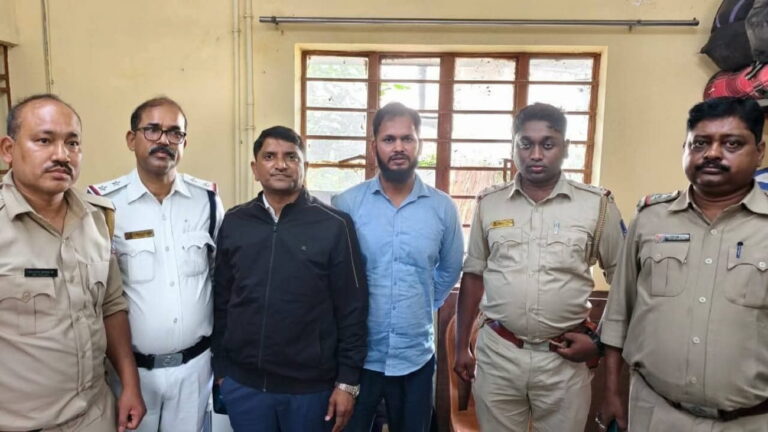
पुलिस ने आफताब अंसारी की मौत के मामले में रविवार को हिंदू टाइगर फोर्स के एक सदस्य राजेश सिन्हा को गिरफ्तार कर लिया है. 

बाकी आरोपियों की गिरफ्तारी के लिए एसपी ने टीमें गठित की हैं. 

तो दूसरी तरफ उनका पोस्टमार्टम राँचीके रिम्स मेडिकल कॉलेज में हुआ है. 

राजनीति भी है जारी 

जबकि आफताब अंसारी की संदिग्ध मौत पर स्वास्थ्य मंत्री इरफान अंसारी ने भाजपा पर गंभीर आरोप लगाए हैं. उन्होंने बजरंग दल पर दबाव बनाने और बाबूलाल मरांडी के ट्वीट्स को नफरत फैलाने का कारण बताते हुए उन्होंने हिंदू टाइगर फोर्स पर प्रतिबंध की मांग की.

दरअसल बाबूलाल मरांडी ने 26 जुलाई की शाम को X पर लिखा कि “रामगढ़ में नौकरी का झांसा देकर आदिवासी बेटी के साथ भयावह अपराध हुआ. आफताब अंसारी नामक व्यक्ति ने उसके साथ दुष्कर्म किया, और वीडियो बनाकर धर्म परिवर्तन के लिए भी मजबूर किया. इस घिनौने षड्यंत्र में ARSHI Garments का मालिक भी शामिल बताया जा रहा है. “