Not Just a Daughter’s Story: Arundhati Roy’s Memoir Is India’s Mirror

2

[dropcap]I [/dropcap]smiled. Particularly looking at the deliberately chosen cover. She could have picked anything, but— a bidi-smoking Arundhati Roy was quite impressive. Brave. I, too, need a photograph of a sort. Iconic. One at least. Before my hair turns grey, I want to have it on my table. Fearless. I have just finished reading God of Small Things. My longest ever read, which took me a year. I turned crazy. Excited. I was finally familiar with the language and concept. It was painful. Tragic and beautiful. I was 28 years late reading it. While I was still engrossed, Roy launched ‘Mother Mary Comes To Me’. I was reading a pirated digital copy. A well-wisher had shared. I decided that a reader has no ethics. Crime justified. I was intrigued already.

In the opening chapter, she warns, ‘Perhaps what I am about to write is a betrayal of my younger self by the person I have become.’ The hook for me. It was us. All of us. Obscuring the trauma beneath the coatings of the long-erased past. The people we became. Heroes. A good friend sent me a hardcover as a birthday present. I read it like a spoiled teenager. Appreciating her rebellion and discerning her fear. How not to romanticize survival. How to recognize the wild pigs— perverts.

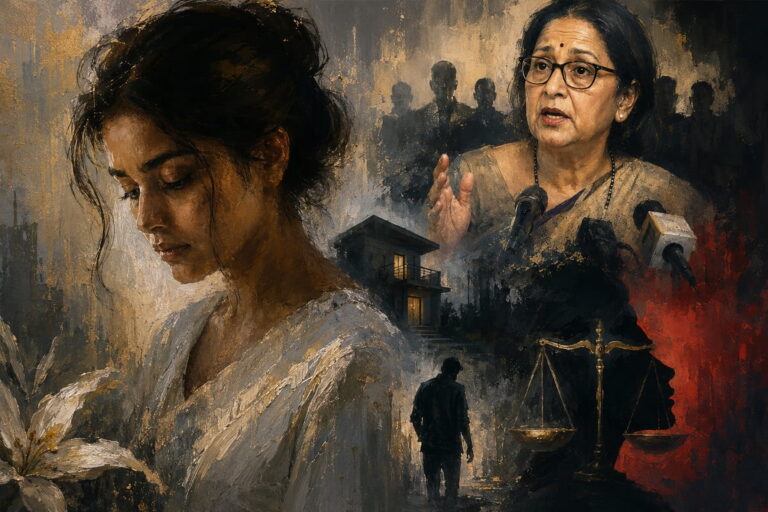
Turning the pages, it became clear that Roy’s defiance was inherited from her bloodline as much as it was earned through her art. Her mother, Mary Roy—the force who shaped and wounded her in equal measure—anchors this memoir.

The Mother Who Made and Marked Her

The mother-daughter relationship here is neither simple nor sentimental between Arundhati Roy and Mary Roy. She does not hide the bruises of that relationship; instead holds them up to the light. It carries friction, a lens through which Roy frames it: ‘When she got angry with me, she would mimic my way of speaking. She was a good mimic and made me sound ridiculous to myself.’ Roy pinpoints her brother, saying, ‘She treated nobody as badly as she treated you.’ Also reflecting: ‘I can understand him feeling that I was humiliating myself by not acknowledging what had happened to us as children. But I had put that behind me a long time ago.’

The memoir throughout reflects that Roy did not live through poverty alone, but a harsh childhood and youth that her mother shaped. Mary Roy could be cruel, even monstrous, in her actions. Yet she becomes a hero in her contradictions.

Yet Roy allows a sliver of something softer. Tenderness flickers beneath anger and unguarded defiance. Butterflies stirred inside me. When she died, some more, on her crush and ultimately separated with words, ‘The thing about women like you is that you will do anything to get what you want. You’ll even sell your body.’

Men do this when they fail to manipulate and dominate a woman—the struggles of life in those pages. And the struggles of building Arundhati Roy consume the reader. ‘I played the fool in class, made no effort, and understood nothing,’ I immediately connected. I yearned for a language. They imposed it. I resisted— by depriving myself of one.

From the wounds of childhood, Roy turns toward her mother’s fierce public self—the teacher, the reformer, the woman who refused to bow. ‘Mrs Roy made it her mission to disabuse boys of their seemingly God-given sense of entitlement,’ it reads like a sharp social observation on the surface without using heavy and technical words. Not patriarchy. Not misogyny. Only disabuse.

A daughter remembering her mother at work, absorbing her stubborn courage and carrying forward in her own life and writing. She captures the truth many women know: ‘As casually one might ask for a cigarette, he asked me if I would marry him,’ and in the next paragraph, she goes, ‘he had saved me from something bad. I was shaken and felt the least I could do was to marry him.’ Aren’t we women like this? We feel sorry for claiming our agency. For saying a ‘NO’. Perhaps we were raised this way. But not Arundhati Roy. That crazy mother of hers allowed no room for such a regret.

She writes without ornaments, plainly yet heavier: ‘I didn’t have the bandwidth to accommodate Delhi’s male commuters who thought of women passengers as snacks, as they could help themselves to whenever they felt like it. The indignity made me oscillate between self-pity and violent fantasies of vengeance. There were days when I would get off a bus mid-journey and walk, hating myself for the tears of shame and rage I could not control. Millions of women put up with this every day.’

I had to put down the book for a while. I froze with something shaking inside me. Silent, helpless, and furious at myself for being both. A touch, a stare, an invasion— is violence. The guilt stays forever because, as a woman, speaking for yourself is an arduous task. She comforted every woman who felt late, lost, and unfinished: ‘My recklessness took the edge off my anxiety.’ It is fine to be restless and uncertain if you have not found success yet. Her wildness is a permission to live, fail, and try again without shame.

A Woman Writing Against Silence and Shame

Even then, in her reckless world, she was not confined to her own boundaries but absorbing stories of women and violence, power and punishment: ‘It was 1983. In my halting Italian, I read about the massacre of thousands of Muslims in Nellie, Assam, by a local tribe, egged on by Assamese and mainstream Hindu nationalists. I read about how Phoolan Devi – the legendary female bandit of the Chambal Valley– had surrendered before a crowd of thousands and been put into prison.’ She was shaping her sense of justice, grief, and rage. The events became part of her emotional language long before she began writing fiction or essays. They taught her that the personal is always political, and the political is always personal.

She goes: ‘Even then, I knew that the language I wrote in was not mine…’ I felt something inside my skin because I have felt the distance between my feelings and words, allowing me to say. Roy is not talking about English or Malayalam but the private, untamed language every writer craves for— belonging to no nation, grammar, only to truth. Her honesty makes her writing so human.

She was not chasing silence at thirty-two: ‘I needed to cut out the noise and for once in my life stop running. I was tired of collaborative thinking. I wanted to think alone. I wanted to know what I thought about when I thought alone.’ To be alone with one’s own thoughts. She describes solitude as a bodily need, like hunger, like sleep, like sex. I think that’s where her writing begins. In desperation. Learning without interruption.

Even as she claimed her private voice, the world outside sought to cage it with names and labels. Names of women who speak too much are inconveniences: ‘They often referred to me as ‘that woman.’ The courtroom patriarchy. That woman has a name, Milords. It almost feels like the violence of being unnamed. ‘I was soon being called a ‘writer-activist’, a term I found absurd because it suggested that writing about things that vitally affected people’s lives was not the remit of a writer.’ It reminds me of how individual journalists reporting on human rights and marginalized communities are dismissed as ‘journalist-activists’—as if questioning, feeling, and dissenting are not part of the craft itself. They label to reduce. To isolate. Roy refused to divide.

Her refusal to be silenced or categorized is beyond personal attacks in the political arena. Roy does the wild confession here: ‘The more I was hounded as an anti-national, the surer I was that India was the place I loved, the place to which I belonged. Where else could I be the hooligan that I was becoming? Where else would I find co-Hooligans I so admired? And who among us supposed equals had the right to decide what was ‘pro’ and ‘anti’ national?’ Belonging is not obedience. I almost accepted the challenge before my brain sent a red signal. Are we in a position to afford such waywardness? Treason.

Belonging Without Obedience: The Rebel’s Reckoning

Roy did not look away from the injustice in the world. She phrases violence ostensibly: ‘The killing was justified as ‘Hindu’ revenge for a terrible tragedy that had taken place on 27 February.’ Gujarat. She rightly called it the first tremor of an idea that has now grown into the reality of Hindu Rashtra— Narendra Modi 3.0. Further reminding: ‘They hanged a man to win an election.’ Those six words carry a weight that no argument could match. She means justice can be traded for votes in the theatre of power.

Life tested them in every way, yet in the end, mother and daughter found their way back to each other. And perhaps the most lasting question she leaves us with comes not in an argument. In these words: ‘Why was I not arrested while so many others were? Who knows. Maybe my readers protected me. Maybe my iron angel did.’ Their relationship had its storms. Mrs Roy and her daughter clashed, testing love and patience. In the end, they found their way back to each other. There is no better way to close than with the song they sang together.

A song of love is a sad song

A song of love is a song of woe

Don’t ask me how I know

And in that song, mother and daughter find their peace — and so do we.

Tushar Gandhi: PM Modi Bows Before Gandhi Statues, But Not His Values

Kolkata: “The most dangerous thing happening in India today is the disregard for Gandhian ideology in society,” said Tushar Arun Gandhi, the great-grandson of Mahatma Gandhi. “While the political class had disowned it long ago, today, the people themselves are doing the same.”

In an engaging conversation on eNewsroom Podcast – Olive Talks, Tushar Gandhi spoke candidly about how he continues to follow Bapu’s teachings in his personal life, and why Gandhi’s vision remains the moral compass India urgently needs. He acknowledged that it’s almost impossible for anyone—whether a leader or a common citizen—to live by all of Gandhiji’s principles. But even if one tries to imbibe a few of them, he said, “it will be a big thing.”

Reflecting on India’s 78 years of independence, Tushar Gandhi observed that there have been only a few moments when Gandhian ideals were truly visible in public movements. “The JP movement, the farmers’ agitation, the CAA-NRC protests, and now Sonam Wangchuk’s peaceful struggle in Ladakh—these are examples that remind us of Gandhi’s Satyagraha spirit,” he said. He also credited Rajiv Gandhi’s implementation of Panchayati Raj as one of the rare times when Gandhiji’s dream of grassroots democracy was realized in policy.

Tushar Gandhi lamented that in today’s political landscape, Gandhi’s ideology has been completely erased, though his photos continue to adorn government offices and public events. “Rahul Gandhi, to some extent, aligns with Gandhi’s thought,” he remarked. “But our Prime Minister, who bows before Gandhi statues across the world, stays silent when his own partymen abuse Bapu.”

He expressed deep concern over the prevailing “bulldozer justice system,” calling it a direct assault on Gandhi’s idea of India. “What we see today—where power is celebrated and dissent is crushed—is the antithesis of what Bapu stood for,” he said.

The Gandhian scion believes that the ultimate hope lies in India’s youth. “If today’s generation can internalize the ideals of Bhagat Singh, Ambedkar, and Gandhi together, they can take India forward,” he asserted.

Listen to the full conversation on eNewsroom Podcast – Olive Talks with Tushar Gandhi, where he delves deep into Gandhi’s dream of India, the erosion of his values, and why reclaiming them is crucial for the nation’s future.

“If Future Doctors Are in Stress, Who Will Heal the Nation?”: Ex-Army Officer Writes to Deepika Padukone

New Delhi: Soon after Bollywood actor Deepika Padukone was appointed as the Mental Health Ambassador by the Ministry of Health, Kargil Hero and Army veteran Balbir Singh Chandel has written an open letter to her, urging her to focus on the growing mental health crisis among India’s medical students.

Chandel, who runs a helpline for medical students, cited the alarming findings of the National Task Force on Mental Health of Medical Students, which reported that in a study of 787 medical students, 37% had suicidal thoughts, 11% planned suicide, 3% attempted suicide, and 7% were at risk of future suicidal behaviour.

“If the future doctors are in stress, who will cure the common people?” Chandel wrote, stressing that Deepika’s new role gives her a platform to highlight this urgent crisis.

Sharing his own daughter’s ordeal, the veteran narrated how his daughter, Anviksha Chandel, a first-year MBBS student at Mayo Institute of Medical Sciences (MIMS), Barabanki, was allegedly harassed by the college administration after he raised objections to fees being collected beyond the prescribed limit set by the Directorate General of Medical Education (DGME), Lucknow.

Following his complaint, DGME Lucknow initiated an inquiry and found the college management at fault. “Since then, my daughter was targeted, and in a conspiracy, she was suspended for seven days in August 2025, which led to a shortage of attendance,” he wrote.

Despite another DGME inquiry again finding MIMS Barabanki at fault and issuing a specific order, the college still did not allow his daughter to appear in the MBBS examination held on October 4, 2025, Chandel claimed.

Calling such harassment and administrative pressure “the root cause of self-harm and mental distress among medical students,” he urged Deepika Padukone to personally visit major medical institutions like AIIMS Delhi, GB Pant Hospital, RML Hospital (Delhi), KGMU Lucknow, and MIMS Barabanki to witness firsthand how toxic academic environments, long duty hours, and relentless stress impact students’ mental health.

“By visiting these institutions and speaking to students, you can motivate them to prioritise their mental health and bring real change,” Chandel appealed.

The Army veteran, who served the nation for over 28 years and actively participated in Operation Vijay (Kargil), concluded by expressing hope that Deepika’s involvement could “bring a significant shift in how India treats mental health—especially for those training to serve as future doctors.”

Diwali and Delhi’s Air Pollution Crisis: Balancing Festivity and Environmental Responsibility

0

Delhi: Diwali, the “Festival of Lights,” is celebrated with grandeur across India to mark the triumph of good over evil and light over darkness. Families decorate homes with diyas, candles, and lights, exchange sweets and gifts, and pray to Goddess Lakshmi for prosperity. However, amid this joyous spirit, one tradition—bursting firecrackers—has increasingly come under scrutiny, particularly in Delhi, where it worsens one of the world’s most severe air pollution crises.

Delhi’s Air Quality: A Year-Round Challenge

Delhi consistently ranks among the most polluted capitals globally. According to the World Air Quality Report 2023 by IQAir, Delhi retained its position as the world’s most polluted capital for the fourth consecutive year, with an average PM2.5 level of 92.6 µg/m³, nearly 18 times higher than the WHO’s safe limit. The city’s air quality deteriorates each winter due to multiple factors—vehicle emissions, construction dust, industrial discharge, and stubble burning in neighboring states like Punjab and Haryana.

During late October and November, temperature inversion and calm winds trap pollutants close to the surface, forming dense smog. When Diwali fireworks add bursts of particulate matter, nitrogen dioxide, and sulfur dioxide to the mix, the city’s Air Quality Index (AQI) often shoots beyond 500, falling into the “severe” or “hazardous” category.

The Health and Environmental Impact

The consequences are immediate and widespread. After Diwali night, hospitals across Delhi-NCR report a 25–30% spike in respiratory and cardiac cases, according to data from the Safdarjung and LNJP hospitals. Children, the elderly, and those with asthma or heart disease are the worst affected. Even healthy individuals experience eye irritation, coughing, and shortness of breath.

Prolonged exposure to high PM2.5 levels can lead to chronic bronchitis, reduced lung function, and increased risk of heart attack and stroke. The Centre for Science and Environment (CSE) notes that air pollution shortens the average life expectancy in Delhi by up to 11.9 years. Beyond humans, the smog also harms animals, reduces photosynthesis in plants, and accelerates environmental degradation.

Measures and Challenges in Implementation

Recognizing the severity of the situation, the Supreme Court and the National Green Tribunal (NGT) have repeatedly banned the sale and use of conventional firecrackers in Delhi and adjoining areas. “Green crackers,” which emit about 30% less particulate matter and noise, have been introduced, but enforcement remains inconsistent. Despite restrictions, local authorities seized over 1,200 kg of illegal firecrackers in Delhi ahead of Diwali 2024, reflecting both public resistance and enforcement challenges.

Towards an Eco-Friendly Diwali

Public awareness is slowly shifting. Schools, NGOs, and media campaigns have successfully encouraged many to opt for eco-friendly Diwali celebrations—lighting diyas instead of fireworks, using green crackers, planting trees, or donating to underprivileged families. Social media movements like #CleanAirDiwali and #SayNoToCrackers are gaining traction among the youth.

A Festival That Truly Spreads Light

The essence of Diwali lies in illumination, not pollution. A collective move toward sustainable celebration can help Delhi breathe easier and ensure that future generations inherit not just a tradition of lights, but a cleaner, healthier environment. A green and mindful Diwali can truly reflect the victory of light over darkness—in every sense.

‘Who Killed My Son?’ — Three Years After IIT Kharagpur Student Faizan Ahmed’s Death, No Answers Yet

Kolkata: It has been three years since IIT Kharagpur student Faizan Ahmed was found dead in his hostel room, yet the fight for justice continues. What was initially dismissed as a suicide has been proven, through relentless struggle, to be murder — but even today, no one has been held accountable.

On October 14, 2022, 23-year-old Faizan Ahmed, a third-year mechanical engineering student from Tinsukia, Assam, was found dead inside his hostel. The first autopsy, conducted at Midnapore Medical College, hastily labelled the case a suicide, overlooking crucial evidence: injuries on the body, bloodstains on the walls, and inconsistencies in the forensic report.

Unwilling to accept this, Faizan’s parents approached the Calcutta High Court, seeking truth and accountability. The court appointed forensic expert Dr Ajay Kumar Gupta, who reviewed the postmortem footage and discovered a hematoma and severe head injuries, indicating homicide. Acting on this, the Calcutta High Court ordered a second postmortem, which was carried out in May 2023 at Calcutta Medical College after the body was exhumed from Tinsukia.

The second postmortem confirmed what the family always believed — Faizan was murdered. Justice Rajasekhar Mantha then declared the case a homicide and directed the formation of a Special Investigation Team (SIT) to find the culprits.

Yet, three years on, the SIT has failed to name a single accused or present any concrete progress. In September 2025, the West Bengal government’s counsel even appealed to the High Court to form a medical board to review both autopsies, a move Faizan’s family fears will dilute the homicide finding and derail justice once again.

Speaking exclusively on the Olive Talks by eNewsroom Podcast, Faizan’s mother, Rehana Ahmed, breaks her silence. Her voice trembles as she recalls her son’s dreams and her three-year fight against indifference. “I feel hopeless now,” she says, “I have lost faith in everything — the police, the court, the system. I just want justice for my son.”

Big Tech’s Bloody Code: How Microsoft, Google, and Amazon Power the Gaza Genocide

0

[dropcap]T[/dropcap]he most recent revelations about Microsoft’s deep ties with Israel’s war machine have once again laid bare the central role of US Big Tech in enabling the genocide in Gaza. A joint investigation by The Guardian, +972 Magazine and Hebrew-language outlet Local Call exposed how Israel’s Unit 8200 intelligence corps has been storing and processing audio recordings of every single Palestinian phone call on Microsoft’s Azure cloud platform. According to the report, this partnership has given the Israeli military unprecedented surveillance capabilities, transforming the private communications of millions of Palestinians into raw material for occupation and war. Israel realised that its own servers did not have the computing power or the storage space required and then turned to Microsoft.

This is not the first time Microsoft’s complicity with Israel’s military has come to light. A +972 Magazine investigation in January 2025 revealed deep institutional ties between Microsoft and the Israeli army, including collaboration between Azure and OpenAI in projects that directly support military operations. Microsoft, like its Big Tech peers, has fully integrated itself into Israel’s apparatus of occupation, repression, and mass killing. Among the Israeli army units revealed to be relying on Azure are the Air Force’s Ofek Unit, which manages large databases of potential targets of sites and individuals for lethal airstrikes; the Matspen Unit, which designs operational and combat support systems; the Sapir Unit, responsible for the ICT backbone of Military Intelligence; and even the Military Advocate General’s Corps, which oversees both the prosecution of Palestinians and the rare disciplinary cases against soldiers in the occupied territories.

But Microsoft is not alone in integrating itself into Israel’s Gaza genocide. Google, Amazon, and Palantir are all cashing in on the genocide, embedding themselves in Israel’s war machine while projecting an image of innovation and progress to the world. Together, they form the digital backbone of the U.S. military-industrial complex and its imperialist project, of which Israel’s 21-month onslaught on Gaza is a central front.

Microsoft: Cloud Partner of Surveillance and Occupation

The Azure revelations are particularly chilling. For decades, Israel’s Unit 8200 has intercepted Palestinian communications as part of its occupation strategy. What is new is the massive industrial scale of this surveillance operation. By outsourcing data storage and processing to Microsoft, Israel has been able to build a cloud-based dragnet—an archive of Palestinian life—and weaponise it against the people of Gaza.

The integration of Azure with Unit 8200 shows how Microsoft is not a neutral service provider but a direct partner in the occupation and its genocide in Gaza. Far from merely renting out servers, it co-develops technologies with Israeli institutions, invests in local surveillance startups, and runs research labs in the country. The company has become indispensable to the machinery of Israel’s colonial control.

Google and Amazon: Project Nimbus

Google and Amazon, not to be left behind, have signed Project Nimbus, a $1.2 billion contract with the Israeli state and military. Nimbus provides advanced cloud infrastructure and AI tools, including facial recognition, sentiment analysis, and predictive policing. These are not abstract capabilities—they are the very technologies used to surveil Palestinians, generate databases of “suspects in East Jerusalem,” and enable the algorithmic production of kill lists in Gaza.

Far from being an internal Israeli project, Nimbus is powered by U.S. corporate expertise and capital. Employees inside both of these companies have blown the whistle, warning that their work is fueling apartheid and genocide. Walkouts, petitions, and internal dissent have been met with firings and intimidation. Yet Google and Amazon continue to boast of their commitment to Israel. Profits and imperial loyalties outweigh any moral considerations.

Palantir: The Data Arms Dealer

If Microsoft, Google, and Amazon supply the infrastructure, Palantir provides the analytical engine. Born from CIA seed funding, Palantir has made its name turning vast surveillance data into actionable military intelligence. Its platforms fuse phone records, drone feeds, and social media activity into a seamless targeting system.

The company has aggressively pitched its services to the Israeli military, boasting of its role in helping Western allies “win wars.” In Gaza, such systems accelerate the kill chain—turning raw surveillance into bomb coordinates with frightening efficiency. Palantir thrives on war; each new atrocity becomes a marketing opportunity for its tools.

AI Kill Lists and the Automation of Genocide

At the heart of Israel’s onslaught is the industrialisation of death through artificial intelligence. Investigations by +972 Magazine revealed how the Israeli army’s AI system, “Lavender,” generates automated kill lists by flagging tens of thousands of Palestinians as suspected militants. Human oversight is minimal; the machine’s decisions are translated into bombings with catastrophic civilian tolls.

We have detailed in a previous People’s Democracy article how such kill lists underpin Israel’s campaign of extermination. But the Tech for Genocide continues to evolve. Newer AI tools, modelled on generative platforms like ChatGPT, are being developed by Israeli intelligence to accelerate surveillance, incrimination, and arrest. These are not isolated experiments limited to the Genocide in Gaza – they are the future of automated warfare and genocide, co-developed with and powered by U.S. Big Tech. It reminds us of how chemical giants in Nazi Germany, such as I.G Farben developed and produced the poison gases used to kill Jews, communists and other “undesirables” in various concentration camps. After the war, IG Farben was broken up into its successor companies, including BASF and Bayer.

Israel as Laboratory for Empire

What ties these threads together is Israel’s role as a laboratory for U.S. imperialism. Every tool of occupation tested on Palestinians becomes a global export. Predictive policing or surveillance software pioneered in the West Bank is sold to American police departments. Biometric checkpoints trialled in East Jerusalem appear on the U.S.-Mexico border. AI surveillance tested in Gaza is marketed to authoritarian regimes worldwide.

For Big Tech, Israel is both a lucrative client and a proving ground. By embedding themselves in Israel’s military machine, Microsoft, Google, Amazon, and Palantir co-develop technologies of repression that can be scaled up and sold across the globe. Gaza’s destruction becomes not only a geopolitical project but also a business model for surveillance, war and genocide.

The UN Rapporteur’s Warning

The United Nations Special Rapporteur on Palestine, Francesca Albanese, has already sounded the alarm. In her report to the Human Rights Council, she documented the deep involvement of U.S. Big Tech in Israel’s 21-month assault on Gaza, stressing how these corporations enable war crimes by providing critical infrastructure and services.

Her findings underline a simple truth: Big Tech is not a bystander. It is a willing participant in the Gaza genocide and part of imperialist warfare.

Big Tech and the U.S. Military-Industrial Complex

None of this should come as a surprise. The world’s largest technology firms are also the Pentagon’s and NSA’s most valued contractors. Amazon Web Services hosts the CIA’s data; Microsoft Azure powers U.S. defence networks; Google collaborates on AI projects for the military; Palantir was born as a tool for intelligence agencies.

The fusion of Big Tech and the military-industrial-surveillance complex is complete. Israel is one frontline of this project, but it is global in scope. From Gaza to Ukraine, from Baghdad to San Diego, the same corporations profit from surveillance, targeting, and repression.

Resistance and the Road Ahead

There is resistance. Workers at Google and Amazon continue to speak out. Students on campuses across the world are demanding that universities sever ties with war profiteers. Human rights groups are documenting and exposing corporate complicity. In Palestine itself, the resilience of the people against overwhelming odds testifies to the spirit that no algorithm can erase.

But resistance must expand. Just as movements once targeted arms manufacturers that armed apartheid South Africa, so too must we now confront the digital arms dealers of today. Microsoft, Google, Amazon, and Palantir are not mere tech corporations: they are weapons manufacturers of the digital age, producing the infrastructure of genocide.

When Even the CJI Isn’t Safe: Hari Om’s Lynching Tells the Rest

0

[dropcap]T[/dropcap]he shocking incident of an attempted assault on the Chief Justice of India Bhushan Ramakrishna Gavai inside his courtroom has shaken the nation. That such acts can be carried out in the name of “Sanatan” reflects the disturbing climate of impunity prevailing in India today. While this may appear to be an isolated incident, it is far from simple. The CJI BR Gavai’s decision not to press charges against the criminal lawyer involved does not erase the deeper malaise—the normalisation of hate, now the most powerful and lethal weapon wielded by hate mongers.

Although the BJP’s top leadership, including the Prime Minister, has condemned the attack, the way hate influencers have turned this into a meme fest on social media is deeply alarming. These posts are not merely justifying the assault but glorifying it. Who is promoting and amplifying these narratives? Will the authorities—particularly the Home Ministry—have the courage to investigate and act against these hate influencers? What stops the government from taking decisive action against these criminals?

At the same time, we must confront the casteist undercurrents that fuel such hostility. Those angered by the CJI’s rejection of certain petitions are often driven by deep-seated caste prejudice. Many of these lawyers thrive on manufacturing controversies; there is an entire ecosystem built around exploiting the legal system to prolong communal and caste disputes. Having stirred up cases around Kashi and Mathura, they now seek to “dig” into every site and every issue, weaponizing faith and legality to serve hate.

Once, the law was India’s greatest strength—our shield against injustice. Today, it has become a tool in the hands of the privileged, a weapon of the dominant to preserve the status quo and suppress the marginalised. Justice, for the ordinary citizen, feels more distant than ever.

What the Chief Justice faced was not a mere outburst—it was caste hatred. The fact that it is being “celebrated” on social media speaks volumes. The same hate mongers who abuse Dalits, Adivasis, and Muslims are now glorifying an attack on the head of the judiciary—and nothing happens to them. They know well that in the name of “Sanatan,” they can say or do anything and still escape accountability.

Hari Om’s Lynching: The Real Face of ‘Sanatan Justice’

This is why the Supreme Court must take up the case of Hari Om, who was brutally lynched just yesterday. The Court should order a comprehensive probe into caste crimes and hate crimes—go to the roots, enforce its own judgments, and ensure genuine implementation.

Tragically, the case of Hari Om has also exposed the hypocrisy of political parties and many so-called Bahujan intellectuals. The Samajwadi Party chief, Akhilesh Yadav, who never misses a chance to comment on stray cattle, has maintained a shameful silence. The Bahujan Samaj Party, too, has not spoken officially, despite a few sympathisers expressing concern online. The Congress has issued a tepid response, appearing hesitant and half-hearted. Are they all afraid of alienating caste groups implicated in the violence? Their silence is nothing short of atrocious.

Both the attack on the Chief Justice of India and the mob killing of Hari Om are caste crimes committed by those shouting victory slogans of “Sanatan Dharma.” The same ecosystem that glorifies hate is celebrating these incidents.

I do not expect much from political parties that operate purely on electoral calculations. But what explains the silence of intellectuals and activists who claim to stand for justice and equality? The Supreme Court must intervene, order a full investigation, and ensure that such caste-driven hate crimes are neither ignored nor repeated.

City of Joy, City of Safety: NCRB Names Kolkata India’s Safest Again

Delhi: For the fourth consecutive year, Kolkata has emerged as India’s safest city, according to the latest National Crime Records Bureau (NCRB) 2023 report. Among 19 major Indian metros with populations above 20 lakh, the city recorded the lowest rate of cognisable offences — 83.9 per lakh population, showing a steady decline from 86.5 in 2022 and 103.5 in 2021.

This sustained performance places Kolkata ahead of cities like Pune, Hyderabad, and Chennai. Police officials attribute the trend to the use of surveillance technology, stronger night patrolling, improved community policing, and a visible focus on women’s safety.

Equally significant is the improvement in crime against women. The NCRB data reveals a drop from 1,890 cases in 2022 to 1,746 in 2023. The city’s **crime rate against women—25.7 per lakh population—**remains one of the lowest in India’s major metros, a fact that has drawn both praise and scrutiny.

Mamata Credits Kolkata Police, Warns Critics Against ‘Maligning the State’

Chief Minister Mamata Banerjee lauded the Kolkata Police for maintaining peace and safety in the city. At a recent public programme, she remarked, “Kolkata is the safest city in the country, and its police are among the most efficient. People can move freely even at midnight because of the confidence they have in our police. There may be one or two stray incidents, but overall, citizens live in peace.”

Reacting to critics who question Bengal’s law and order, Banerjee added, “According to NCRB, Kolkata has been adjudged the safest city for years. Those trying to malign the state with false narratives are ignoring these facts. I am not bothered by criticism, but I will protest if West Bengal is misrepresented.”

Leaders from her party, the Trinamool Congress (TMC), echoed her sentiment. Minister Shashi Panja said, “The NCRB data vindicates our claim that Kolkata is safe and exposes the baseless political rhetoric of the opposition.” Mayor Firhad Hakim attributed the consistent record to “proactive policing, citizen cooperation, and use of modern technology.”

Opposition Questions Data, Cites Underreporting Concerns

While the ruling TMC celebrated the NCRB findings, opposition leaders voiced skepticism. BJP’s Rahul Sinha claimed the ranking “does not reflect ground reality,” alleging that “many crimes go unreported or FIRs are not registered.” Similarly, state BJP president Shamik Bhattacharya called the ranking “a joke of the year,” asserting that NCRB data relies on state-submitted records.

Critics also pointed to the RG Kar Medical College rape-murder case, arguing that high-profile incidents often expose flaws in law enforcement despite positive statistics. The victim’s father told media outlets, “At least 90 per cent of incidents are not registered as FIRs. This report ignores harsh ground realities.”

However, data at the state level presents a broader picture. West Bengal’s overall cognisable crime rate—181.6 per lakh population—remains well below the national average of 433. Experts believe this consistency reflects an improvement in administrative monitoring and an active police network that prioritizes quick response and public trust.

Despite the political debate, the NCRB report reinforces Kolkata’s image as one of the most secure and livable cities in India. While underreporting and isolated cases remain concerns, the downward trend in overall crime and crimes against women indicates that Bengal’s capital continues to chart a positive trajectory in urban safety and governance.

Weaponizing Faith, Normalizing Hate: The Political Project Behind ‘I Love Mohammad’ FIRs

0

[dropcap]C[/dropcap]ommunal violence has been the bane of Indian politics for over a century. Most scholars consider such violence a planned phenomenon. This violence is generally followed by rising communal polarization. Scholars have also observed that “riots produce ethnic polarization that benefits ethno-religious parties at the expense of the Congress.” They maintain that while Hindu-Muslim riots are electorally costly for the Congress, these riots, in effect, strengthen ethno-religious parties at the expense of multi-ethnic ones like the Congress. True to this observation, more and more pretexts are generated to instigate violence and reap its electoral benefits.

New pretexts continue to be added to the long list—playing loud music in front of mosques, throwing beef in temples, and spreading rumours—each becoming central to the phenomenon of spreading hate. To this has been added the demonization of Muslim kings, accusations of temple destruction by them, the claim that Islam was spread by the sword, and the portrayal of large Muslim families as a threat to Hindus’ becoming a minority in the country. In recent decades, new hate-creation mechanisms have emerged around issues such as cow protection, beef-eating, “love jihad,” and many other imagined jihads—the most notorious being “Corona Jihad,” “Land Jihad,” and, most recently, “Paper Leak Jihad.”

All this comes to mind as the country now witnesses violence constructed around an innocuous slogan—“I Love Mohammad.” It began in Kanpur, when, during Milad-un-Nabi—the procession celebrating the birthday of Prophet Mohammad—some people objected to the banner “I Love Mohammad,” claiming that a new tradition was being added to the religious festival. A section of the police accepted this argument and filed FIRs against those carrying such posters. This was a complete violation of democratic norms. A peaceful procession expressing love and respect for the Prophet cannot be seen as a breach of any law. Yet, violence around this issue spread to several districts across Uttar Pradesh.

When Faith Becomes a Faultline

The Kanpur incident was the first, followed by similar episodes in Bareilly, Barabanki, Mau, and in Kashipur of Udham Singh Nagar district in Uttarakhand, among several other places. In each instance, poster-tearing and violence followed, further vitiating the atmosphere. According to the documentation by the Association for Protection of Civil Rights (APCR), there have been 21 FIRs related to the “I Love Mohammad” campaign, affecting 1,324 people, with 38 arrests. In Bareilly, the internet was suspended for a few days, and local leader Maulana Tauqeer Raza Khan was placed under house arrest for a week. He alleged that Muslims were being harassed indiscriminately. He had called for submitting a memorandum on the Kanpur incident but did not turn up himself, which led to chaos. This irresponsible act resulted in the arrest of many Muslims.

This entire sequence of events brought to the fore the deep-seated hatred against Muslims. As often happens, top communal leaders gave dog whistles that triggered local elements to intensify their hate campaigns, ultimately leading to violence. Prime Minister Narendra Modi has been doing this time and again, mostly around election periods. This time, their campaign has revived the term “ghuspaithiye” (infiltrators), a word that has become a curse for Muslims, especially in Bihar and Assam. One justification for the dreaded Special Intensive Registration (SIR)—which the government plans to expand nationwide after Bihar—is that over 47 lakh voters were disenfranchised there under its pretext.

Hate as a Political Strategy

In Uttar Pradesh, where the maximum number of such incidents have occurred, Chief Minister Yogi Adityanath made statements unbecoming of a state leader. He said he would “give tickets to hell” to those dreaming of raising the “Gazwa-e-Hind” slogan. But where does this “Gazwa-e-Hind” even come from? Indian Muslims, a section of whom were merely expressing affection with the slogan “I Love Mohammad,” are now being accused of something they never invoked. The term “Gazwa-e-Hind” has been used by Taliban-type groups, and the Hindu Right is now accusing the entire Muslim community of harboring this idea. As such, “Gazwa-e-Hind” finds no mention in the Quran. It appears only in a doubtful Hadith, and even there, the term “Hind” refers to Basra, not India. Some hotheads in Pakistan have used it metaphorically to describe wars with India, but to generalize this to all Indian Muslims is malicious and absurd.

Yogi further claimed that “I Love Mohammad” posters were being used to instill anarchy. He urged Hindus to stay alert against “anti-Hindu and anti-national activities” (Indian Express, Mumbai Edition, September 29, p.6). This is a shocking attempt to create ill will against India’s largest minority. How can such a slogan—an expression of faith and affection—be seen as anarchic or anti-national? Such statements defy democratic values and the constitutional right to free expression.

Weaponizing Festivals, Wounding Fraternity

The “I Love Mohammad” episode is yet another attempt to intimidate and marginalize Muslims. A peaceful display of affection for one’s Prophet falls squarely within the bounds of democratic expression. Ironically, while Muslim processions are being criminalized, Hindu religious processions such as those on Ram Navami often feature DJs blasting loud music, with saffron flags hoisted atop mosques. Some of our festivals are being weaponized. As documented by Irfan Engineer and Neha Dabhade in their book Weaponization of Hindu Festivals, ground-level investigations show that the Ram Navami procession, in particular, has often been used to create nuisance around mosques and Muslim-majority areas. The converse of this is the demonization of Muslim festivals—Milad-un-Nabi with its “I Love Mohammad” banner being a painful example.

Such hateful responses to Muslim festivals deepen the partition of hearts, fuel polarization, and erode the spirit of fraternity—an essential value enshrined in the Indian Constitution. The statements made by the UP Chief Minister also violate constitutional morality. In such times, the Muslim community must remain realistic and cautious, avoiding any pretext that communal forces could exploit to demonize them further.

‘Betrayal of Ladakh’: Rahul Gandhi, Kharge Slam Modi Over Killing of Kargil Veteran

0

New Delhi: One week after the deadly protests in Leh, the political firestorm surrounding the Ladakh violence has intensified. Rahul Gandhi and Mallikarjun Kharge continue to lambast Prime Minister Narendra Modi for a “betrayal” of Ladakhi citizens, while tensions on the ground and legal maneuvering have added new dimensions to the standoff.

Opposition Renewed: Gandhi and Kharge Amplify Charge of State Violence

Rahul Gandhi, currently in South America, posted a video on X featuring the anguished father of ex-serviceman Tsewang Tharchin, reiterating sharp criticism of the central government. “Father and son — both in the army — yet the BJP government shot and killed this brave son,” he said, demanding a judicial inquiry and “harshest punishment” for perpetrators. He urged Modi to “stop the politics of violence and fear.”

Congress president Mallikarjun Kharge echoed the sentiment, asserting that Ladakh’s grief is “the sorrow of the nation.” He contrasted the 2025 killing of a war veteran with the apparent “clean chit” extended to China after the 2020 Galwan clash, asking, “What respect will they show for the martyrdom of brave soldiers like Tsewang Tharchin?”

Key Developments Since the Firing

Magisterial Probe but Rejected by Ladakhi Leaders

The Ladakh administration has directed a magisterial (SDM-level) enquiry into the September 24 violence, with instructions to submit a report within four weeks. But both the Leh Apex Body (LAB) and Kargil Democratic Alliance (KDA) have rejected this, demanding that any probe be a judicial inquiry to ensure impartiality. They have suspended talks with New Delhi until detainees are freed and a credible investigation is guaranteed.

Partial Releases and Continued Detention of Wangchuk

In a gesture seen as de-escalatory, the government released 26 persons detained during the protests. Families and local leaders welcomed them in Leh, though activist Sonam Wangchuk remains in Jodhpur jail, held under the National Security Act (NSA).

On October 2, his wife Gitanjali J Angmo filed a Habeas Corpus petition in the Supreme Court, challenging his detention as arbitrary and unconstitutional. She raised questions about lack of access to him, his health, and the absence of clarity on the reasons for detention. The SC, currently on recess, is likely to convene on October 6 to hear the petition.

Ground Conditions & Local Response

Curfew restrictions and internet blackouts persist in Leh, though authorities have eased some curbs, allowing schools up to Class 8 to reopen.

Meanwhile, the LAB has formally declined further talks until normalcy is restored, citing “an atmosphere of fear and anger” across the region.

Narratives of National & Strategic Stakes

Analysts have flagged how unrest in Ladakh carries strategic as well as political risks. A Foreign Policy piece warned that sustained discontent in a border region may strain New Delhi’s broader push to project stability in the Himalayas.

The Ladakh administration, for its part, has defended the moves against Wangchuk and others, stating that actions were based on “credible inputs.”

Tsewang Tharchin, whose death intensified the backlash, was a war veteran of the Ladakh Scouts and community activist. He is survived by his family and was laid to rest under tight security on September 29 in Leh.

What’s at Stake Now

The political contest is no longer just about how the violence began but who bears ultimate responsibility. By framing that a war veteran was gunned down by the state, the Opposition is seeking to redefine the moral narrative.

If the government stops at a magisterial inquiry and holds onto Wangchuk and related detainees, it risks eroding its moral credibility in Ladakh. On the other hand, offering a judicial probe and releasing those held could be framed by BJP critics as succumbing to pressure, though many see it as essential for restoring trust.

Scheduled talks on October 6 now hang in balance. The LAB and KDA have made clear they will not reengage until their conditions — judicial inquiry, release of protesters, free communication with detainees — are met.

In the wider view, Ladakh’s discontent stems from deeper structural grievances: lack of local autonomy, ecological pressures, land rights, and underemployment. The government’s choices in the next few days will determine whether the crisis is defused or deepened into a prolonged political and strategic challenge.