



Kolkata: “In a year, you will see that we will be countering all the hate speeches and hate crimes in India. Even now, we are working to prevent Dalits (Scheduled Castes) from participating in riots against Muslims. Reports suggest that such riots are manufactured to benefit a particular political party. Many Dalit brothers, knowingly or unknowingly, get involved in these incidents, and we are working to disengage them from such activities,” said Chandrashekhar Azad, Member of Parliament and National President of the Azad Samaj Party.
Nagina MP is also the founder of the Bhim Army, a social organization. The young MP mentioned his intention to expand his organization by including ideologically committed individuals.
“First of all, we should understand that there is not much hatred among common people at the social level. This hatred has been largely propagated by ‘Godi Media’ to benefit a particular political party. We know that one party thrives on creating division between Hindus and Muslims,” he said.
“After the Pahalgam attack, when the country was preparing to fight terrorists, who was it that was inciting hatred among the people of this country? That’s why we have to counter ‘Godi Media’ and the IT Cell, and we are already working on that. During Operation Sindoor, some media houses even went inside Islamabad and Karachi—I brought them back to the TV studio,” Azad added with a smile.
He was responding to a question from eNewsroom about his party and organization’s strategy to intellectually counter the ongoing hate speeches and crimes in the country, during a meeting organized by the SR Foundation on Saturday evening.
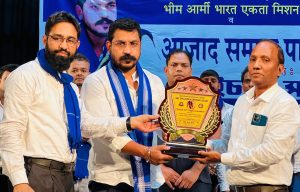
Earlier in the day, Azad attended a Bhai-Chara (brotherhood) meeting organized by the Azad Samaj Party in Kolkata.
He also questioned the Bharatiya Janata Party’s Tiranga Yatra. “I have already asked in Parliament what the purpose of the Tiranga Yatra is, and why there is a celebration of Operation Sindoor,” he said.
Azad made it clear that the Azad Samaj Party will contest the upcoming West Bengal Assembly elections scheduled for next year.
He has a piece of advice for Muslim community as well, which did not get adequate share by political parties. “I have read Hazrat Umar and Hazrat Ali and several other books, and I find that even many Muslims today do not follow their teachings correctly. Islam promotes equality, but we are trying to crush the lower strata of society to get ahead in life.”
He concluded by reflecting on his personal journey: “These tough times have taught us many things. These times have made me who I am—Chandrashekhar Azad. If I remain alive, after ten years, people will remember their gods and after that pray for my well-being. This is just the beginning. Right now, I am just an MP. The real work of our organization is yet to come.”
Advocate Azad, who hails from a farming family, has no political lineage. “My grandfather was a farmer, and my father was a teacher,” he said.
“I never intended to enter politics. But after facing so much torture during my activism, I had no choice but to contest elections,” he added.

