


Kolkata: After the announcement of longest ever polls dates in West Bengal by election commission of India, opposition Left parties including CPIM and CPIML as well as ruling TMC, all have expressed surprise and asked the reason to stretch it for two months.
The ECI has announced poll dates for five state assemblies on Friday. In Kerala, Tamil Nadu and Pudducherry polls could be wrapped up in a single day, in Assam it would be in three phases, but in Bengal it would take place in eight phases.
According to poll dates in Bengal, in some districts, polls will take place in single district, in three phases.
“These elections are going to be crucial. The overall objective today is to keep the BJP at bay, which is making all unscrupulous attempts in order to capture power in these States. In Bengal, the basic alternative that is emerging, on the strength of the people’s struggles in the past few months, braving the repression of TMC government, is the secular democratic alliance of the Left-Congress,” CPIM general secretary Sitaram Yechury said.
While D Raja, CPI general secretary stated that the ECI should give convincing explanation. The ECI should have explained the apprehensions because of which they were extending the polls over eight phases in Bengal, he said.
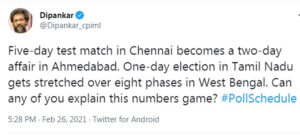
Dipankar Bhattacharya, the general secretary of CPIML tweeted, “Five-day test match in Chennai becomes a two-day affair in Ahmedabad. One-day election in Tamil Nadu gets stretched over eight phases in West Bengal. Can any of you explain this numbers game? #PollSchedule (sic)”
Chief Minister Mamata Banerjee, also questioned the ECI and asked, “Whether election dates were announced at the instructions of Narendra Modi and Amit Shah?”
“West Bengal has 294 seats, why will elections be held here in eight phases? This is for the benefit of whom? There should be some rationale behind the decision,” Banerjee said hours after the ECI announced the Assembly poll schedule.
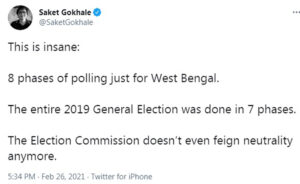
Netizens also expressed surprised that in 234 seats Tamil Nadu polls will be conducted in single phase, but 294 seats Bengal will have eight phase. Saket Gokhale, tweeted, “The Election Commission doesn’t even feign neutrality anymore.”
However, BJP has welcomed the eight-phased longest ever polls during the peak of summer in Bengal.
State BJP spokesperson Shamik Bhattacharya said, while in Opposition, Banerjee has been demanding that Assembly polls in the State should be held in several phases with deployment of central forces.