



[dropcap]K[/dropcap]olkata’s Durga Puja is no longer just a puja, it has also become a specimen of artwork. During the days of puja, Kolkata turns into a moving art gallery. People of all religions are enjoying this art without paying any entry fee. Several puja committees this year have, even before the puja formally begins, arranged for special entry passes so that people can see the work of the artists.
One such puja is Behala Friends, which will leave many stunned when they experience it. The theme of the puja is Nabanna—War, Wounds and Hunger. The main artist is Pradip Das. Pradip, one of the members of the Behala-based artist collective Chander Hat, has already created several works in Kolkata pandals on Partition and its pain. This year, the surprise presented by Behala Friends in South Kolkata will undoubtedly create a stir in the minds of people.
When Gaza Meets 1943 Bengal
Who suffers the most in wars? Do those who wage wars or fight in them even get a scratch? When an economic crisis deepens, when food shortages appear, when a small shelter turns into ruins before one’s eyes, perhaps some people enjoy it on the screens of televisions or mobiles—but do we have any idea what effect it leaves on the minds and bodies of those who actually live through it?
A poet named Nima Hassan, unable to find a roof over her head or even a little food, was forced to leave Palestine with her seven children and expressed her condition in poetry. And when the Palestinian theatre worker Riyadah is heard in Arabic saying, “The daily act of making bread no longer exists in this country,” it somehow merges with the image of Bengal’s famine of 1943.
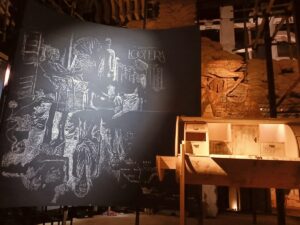
A mother carrying her child roams the streets of Kolkata in search of some food, her body worn-out and exhausted, while the cry of “fan dao… fan dao…” (give us rice water) echoes around. In some strange way, Gaza of 2025 and Bengal of 1943 blend into one. It is from here that the theme Nabanna of Behala Friends begins.
At the entrance of the pandal, on one side, are the words Free Palestine—this writing, carrying the cries for survival, is also a collection of writings from many people. On the opposite side, the word Genocide is written using the Coca-Cola font. There is a reason behind using this font: these multinationals are the ones who indirectly sponsor such genocides.
From Anne Frank’s Piano to Bengal’s Famine
Next comes the second part of the pandal. Bullet wounds are clearly visible on the walls, and magnifying glasses are placed as part of the installation so that the depth of the wounds can be seen even more starkly.
Behind that, through a small opening, one can see a piano—as if Anne Frank’s hidden piano during the genocide in Germany. In artist Pradip Das’s conception, this piano is like the hidden piano from Roman Polanski’s 2002 Polish film The Pianist. Even when everything is snatched away, even when everything is lost, somehow something remains, surviving again out of the ruins.
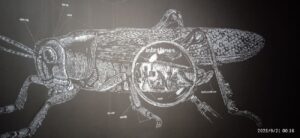
Then come the locusts, and with them the famine of Bengal in 1943. Although the soil of Bengal was so fertile and so full of crops, how the people of Bengal suffered such misery—because of colonial rulers, profiteers and neglect—has been tried to be portrayed in the third section of the pandal.
Those memories were kept alive by the artists, writers and playwrights of that time. The poetry of Sukanta Bhattacharya, the plays of Bijon Bhattacharya, the paintings of Somnath Hore, Chittaprosad and Zainul Abedin all captured the images of that period. Fragments of those poems, plays and pictures have again been brought alive in the brushes of Pradip Das and other collaborating artists. For the past three months, with tireless labour, the pictures of people’s cries from Bengal’s famine have been merged with the cries of survival from today’s Gaza.
History Repeats Through Hunger
Journalist and historian Vijay Prashad, in a 2025 essay, wrote that in 2024, those who survived in Gaza were already hungry, and that number is steadily increasing. Yet the food produced in Gaza was enough to feed all the people there, but still, people go to sleep hungry every day.
The condition of the people of Bengal at that time was, in many ways, similar to today’s Gaza. In 1995, Professor Amartya Sen had written that the Bengal famine was not caused by a shortage of food but by unequal distribution of food and the greed of a few people. The income gap between a handful of profiteers and the majority of ordinary people was so wide that, while hoarders flourished, mothers with emaciated children in their arms wandered the streets of Kolkata in search of a morsel of food.
It may be that the geographical distance between Gaza and Bengal is 5,000 kilometres, the difference in time more than 80 years, but somehow the cries of ordinary people from both places merge into one. And this work of merging has been achieved by artist Pradip Das.
George Orwell once wrote—those who propagate for war, those who want war, do they themselves ever go to war? Then for whom is this destruction written? In 1995, Mahasweta Devi wrote that history is not just the stories of kings and rulers, of bravery and valour; history is also the story of people’s sweat, blood and labour. History also tells the story of people’s daily survival.
That is why Bijon Bhattacharya, in his play Nabanna, brought the stories of those people, saying, “We did not die in famine, we built our homes upon dead bodies.”
This pandal in Behala not only rekindles those memories, it also provides food for thought. That is why, standing before the idol of Durga, one finds reflections of that time. Yet within it, there is also hope, there is also survival. Amidst the conflict of good and evil arises another maternal figure. Somewhere, Gaza’s Nima Hassan and the mothers of Bengal from that time merge into one. There remains no distance of space or time.
If someone calls this pandal a work made only about Gaza or Palestine, that would be wrong; and if someone says it has captured only the famine of Bengal in 1943, that too would be wrong. Space, time and people all fuse together and take form through the artistry of Pradip Das. Through a combination of images, poems and songs, Kolkata sees its neighbour 5,000 kilometres away. It identifies with the mother of 80 years ago.
Nabanna means the festival of survival; Nabanna means the celebration of food.

