



Kolkata: Swaraj India founder Yogendra Yadav’s latest visit to Kolkata was as hectic as anticipated, after all, he was supposed to meet the “Women of Bengal” who have been protesting against Citizenship Amendment Act (CAA), National Population Register (NPR) and National Register of Citizens (NRC) at various parts of Bengal capital and Howrah.
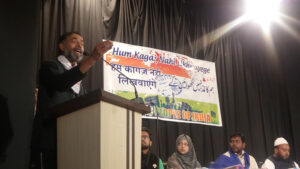
Yogendra Yadav’s schedule included visits to Metiabruz, Nawab Ali Park, Khidderpore, Park Circus, Shireenbagh (Raja Bazar), Belgachia and Zakarkia streets, which was neatly punctuated with Yadav addressing an event – Hum Kagaz Nahi Likhwaenge and CM Mamata Banerjee’s Bhasha Diwas event at Deshapriya Park.
When eNewsroom caught up with him around 9 pm, as he drove towards Park Circus, Yadav was yet to visit three more protest sites in the city. When quizzed about the much approaching NPR, he said, “NPR is the first step towards, NRIC. And I am not saying this on my own. This is mentioned on the government website. Let me be clear – NPR and NRIC can be a huge catastrophe for a large section of the Indian population which is both poor and marginalised. Hence it becomes the duty of the state government to resist it in the interest of its population.”
On being asked about Maharashtra and Jharkhand, who despite being non-BJP ruled states are yet to make their stand clear on NPR, he said, “It becomes the duty of the state governments who have issued statements against NRC to take a stand. Such states instead of having an ambivalent stand should come forward and take concrete steps along the lines of Kerala and West Bengal, where NPR has been stalled.”
He further said, “I again urge all the CMs of the non-BJP ruled states (Jharkhand, Maharashtra and others) to come forward and convert their words into action.”
On the question of what could be the repercussion, if the Apex Court asks the protesters of Shaheen Bagh to vacate the area, he said, “We need to understand, that the name Shaheen Bagh is no longer associated with a particular locality in Delhi. For me, it has become the spirit of this movement or revolution. They can remove one Shaheen Bagh, but what about the 200 other Shaheen Baghs that have come up across India. However, I am hopeful of the Supreme Court giving a balanced judgement.”
When asked, how long could this movement last, he replied, “The fight is going to be a long one and we should be prepared about the same. Let me be clear on this, given the intensity of this movement, the government will be forced to step back on NPR and NRC but it won’t on CAA, as this law promises them of electoral dividend. And we need to be prepared to take this fight forward, till CAA is rolled back.”

