



Kolkata: A day after Home Minister Amit Shah accused Mamata Banerjee and the TMC of facilitating infiltration into Bengal with the help of Bangladeshis and Rohingyas, Congress leader Kanhaiya Kumar hit back with a sharp jibe. “Who is the Home Minister of the country? Dipankar Bhattacharya?” he asked sarcastically.
Kumar, a youth leader, was speaking at the “Save Constitution, Save Country” convention in Kolkata on Monday. “It is time to save the Constitution. And to do that, if you can act—act. If you can speak—speak up. If you can write—write. If you can’t do anything, at least put a copy of the Constitution on your wall,” he said.
“We are living in a time when those who once did sycophancy in the courts of kings, acted as informers, and never sacrificed for the nation—such people are now misusing the power of democracy to kill democracy,” Kumar continued in his more than half-an-hour-long speech.
Taking a dig at Amit Shah, he added, “The father of Jay Shah—who was here yesterday—made a statement. Politics has sunk so low that if you want to map it, just listen to Jay Shah’s father. He said the government is working to stop infiltration in Bengal. Then who is responsible for stopping it? Who is the Home Minister—Dipankar Bhattacharya?” (At this, Bhattacharya, the CPI(ML) general secretary and another speaker at the event, smiled.)
“Who controls the international borders—the state government or the Union government? Who is responsible for national security?” Kumar asked, sharply criticizing the BJP for deflecting blame.
In his speech, Kumar also mentioned the controversial Waqf Act 2025 brought in by the BJP government. “The media that works for BJP claimed there was corruption in Waqf. So the BJP brought a new bill claiming it would benefit Muslims. But where has corruption been eliminated? Today, governments are run with the support of the corrupt. The more corrupt someone is, the higher the rank they get in politics. In whichever department you go, pay a commission and your work gets done.”
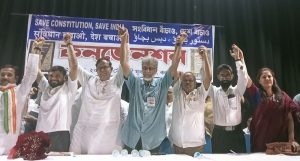
The convention began late, as the Moula Ali Yuva Kendra turned out to be too small for the gathering. Organizers claimed they had tried to book a bigger hall, but the administration under the Mamata Banerjee government did not permit it.
Earlier, Dipankar Bhattacharya addressed the audience in Bangla for 22 minutes. “Before the Pahalgam terrorist strike, the BJP claimed Narendra Modi was a strong leader with international stature. But apart from Israel—which has to sell its weapons to India—not a single country supported India after the India-Pakistan conflict. Even Nepal didn’t,” he said. “That is the failure of Narendra Modi’s foreign policy.”
Siddharth Varadarajan, founding editor of The Wire, whose site was partially blocked during the India-Pakistan conflict, was the convention’s first speaker. He warned that free speech, a constitutional guarantee, is under https://www.sarahannlorethphotography.com/conceptual-photography/ serious threat under the Modi regime.
“Of course, Modi and Amit Shah may say Prasenjit Bose [the host] gave a fiery speech and held a convention. But I recall what Idi Amin once said: ‘Yes, I guarantee freedom of speech—but not what happens afterward,’” Varadarajan said.
“From college students to academics and journalists, many have been arrested for expressing their views. Recently, Ali Khan Mahmudabad wrote to save the Constitution—and what he wrote is now being echoed by all well-meaning people. There was nothing wrong in him saying that, just as Colonel Qureishi was brought forward for Operation Sindoor, the government should also bring forward Muslims who face mob lynching and daily atrocities in India. Yet he was arrested. Journalist Siddique Kappan was jailed for two and a half years just for going to report on the Hathras gang rape and murder of a Dalit girl.”
CPI(M) state secretary Mohammed Salim appealed to the people to rise above caste, creed, and religion to save the Constitution.
ISF MLA Naushad Siddiqui emphasized how the BJP’s Waqf Act 2025 is an attack on constitutional principles. CPI(M) leader Saira Shah Halim also spoke, criticizing Modi’s open support for Israeli Prime Minister Benjamin Netanyahu in what she called genocide against Palestine—an action she said goes against India’s historic foreign policy.
Azad Samaj Party’s state president Imtiaz Mollah said that more than the speakers, it is the people of India who will save the Constitution.
A resolution passed at the convention rejected religion-based nationalism and demanded the immediate convening of a Parliament session. It expressed solidarity with the armed forces for Operation Sindoor against cross-border terrorism but condemned the RSS-BJP’s divisive politics. The resolution also stated that the Modi government is keeping both Parliament and the Indian public in the dark on crucial national security matters. It called for the rollback of unconstitutional laws and demanded the restoration of democracy—not just at the national level but also in West Bengal, where democratic erosion has steadily continued under Chief Minister Mamata Banerjee’s rule.
There were six conveners of the event– Prasenjit Bose, Ali Imran Ramz, Atanu Chakraborty, Biswajit Maiti, Umar Awais and Kallol Mazumdar.

