



Kolkata: In a major haul by special anti-Fake Indian Currency Note team of Special Task Force, Kolkata, unearthed an illegal arms manufacturing factory and seized fake Indian currency worth Rs one lakh on Monday.
The FICN team first nabbed three men from the area adjoining the Kolkata Police Paddock and Manohar Das Tarang Pond of the city. The accused 38-year-old Suku Sekh, of Kaliachak Malda, 26-year-old Md Abdulla and Amjad Rayeen of Hazratganj, Bihar were dealing in a transaction of fake Indian currency notes and semi-finished country-made improvised guns among themselves, when the police intercepted them.
“During the arrest, the accused had about fake Indian currency notes of denomination 500 worth Rs 1,00,000 and about 40 semi-finished country made improvised arms in their possession,” informed an official of FICN team.
On interrogation, the statement of Md Abdulla, one of the arrested accused, lead the Anti FICN team of the STF to an illegal arms manufacturing factory in Choto Sreerampore, which falls under the Jaggatdal Police Station area of the Barrackpore Commissariat.
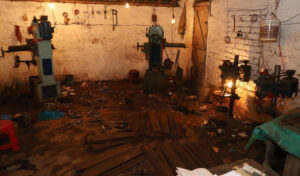
“The raid at this arms manufacturing factory further lead to the arrest of six more people, who were working inside the illegal arms factory,” told Murlidhar Sharma, a senior police official of STF, Bengal Police to eNewsroom.
Interestingly, among all those arrested from the illegal manufacturing arm unit, none were residents of Bengal. One was from Navi Mumbai, four from Bihar’s Munger district, which is a specialist in manufacturing country made guns and one from Bihar’s Begusarai district.
The arrested from the illegal arm factory are– Navi Mumbai’s Mohammad Sabir Raien (28yrs), Bihar’s Md. Shaud Alam alias Sonu (24yrs), Md. Shanwaz alias Mister (25 yrs), Md Faisal (24 yrs), Md. Razi alias Raju (19 yrs) and Md. Chand alias Domu (24 yrs).
According to the officials, 20 pieces of semi-finished country-made improvised fire arms, one lathe machine, two milling machines and two drilling machines along with a huge amount of country-made improvised fire arms parts, raw materials and instruments were seized from the seized the factory.
Those arrested have been booked under section 120B, 489B, 489C of the Indian Penal Code r/w 25(1)(a)/ 25 (1B)(a) Arms Act vide STF PS Case no. 12 dated 31.07.2018.
All the above mentioned accused persons will be produced before the Ld. Court of Chief Metropolitan Magistrate, Calcutta, today.

