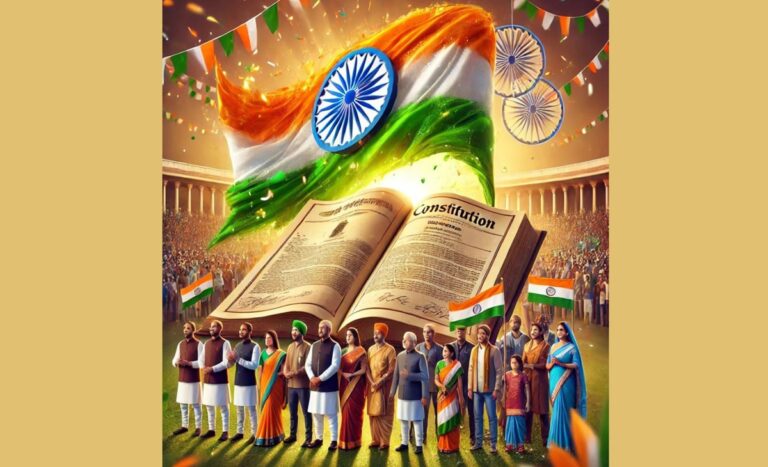
[dropcap]पू[/dropcap]रे देशवासियों को 76वें गणतंत्र दिवस की दिली मुबारकबाद। 75 साल का सफर पूरा करने के बाद आज हम ‘रिपब्लिक ऑफ इंडिया’ के नाम से पहचाने जाने वाले भारत का गणतंत्र मना रहे हैं। रिपब्लिक का मतलब है एक ऐसा सिस्टम, जो पूरी तरह जनता के लिए और जनता के द्वारा चलता है। इसका मतलब है कि हर नागरिक (citizen) का इसमें बराबरी का योगदान हो।
गणतंत्र का यही ताना-बाना हमारे संविधान में बखूबी समझाया गया है। संविधान न सिर्फ हर इंसान को समान अधिकार (equal rights) देता है, बल्कि उसकी हिफाजत भी करता है। ये यकीन दिलाता है कि दो नागरिकों के बीच किसी भी तरह का भेदभाव (discrimination) नहीं होगा। संविधान की प्रस्तावना (preamble) में इन बातों का खासतौर पर जिक्र किया गया है।
हमारा देश सिर्फ गणतंत्र नहीं, बल्कि लोकतंत्र (democracy) भी है। इसका मतलब है कि जनता की चुनी हुई सरकार उनके लिए काम करेगी। लेकिन पिछले 75 सालों में, जहां हमारा लोकतंत्र और गणतंत्र मजबूत हुआ है, वहीं इस दौरान कई तरह की चुनौतियों का भी सामना करना पड़ा है।
75 साल का सफर और संविधान की ताकत
आज जब हम 76वें गणतंत्र दिवस की खुशियां मना रहे हैं, हमें यह भी याद रखना चाहिए कि हमारे संविधान ने हर दौर की मुश्किलों में हमारी मदद की है। 75 साल पहले हमारे बुजुर्गों ने एक ऐसे भारत की बुनियाद रखी थी, जहां हर धर्म और तबके के लोगों को बराबरी के हक दिए गए।
लेकिन 2014 के बाद हालात धीरे-धीरे बदलने लगे। संवैधानिक और लोकतांत्रिक संस्थाओं पर दबाव डालकर, संविधान के मूल्यों को कमजोर करने की कोशिशें हो रही हैं। आज जरूरत है कि हम संविधान के उसूलों को समझें और इन्हें बचाने के लिए आवाज उठाएं।
भेदभाव के बढ़ते मामले और प्रशासन का रवैया
संविधान में यह साफ कहा गया है कि किसी भी नागरिक के साथ मजहब, जाति, या रंग के आधार पर भेदभाव नहीं होगा। लेकिन हाल के सालों में कुछ घटनाएं ऐसी हुई हैं, जो संविधान के इस बुनियादी उसूल के खिलाफ जाती हैं।
उत्तर प्रदेश जैसे राज्यों में भेदभाव साफ नजर आता है। संभल की घटना इसका उदाहरण है। पांच मुस्लिम युवाओं की मौत के बाद प्रशासन का रवैया भेदभावपूर्ण रहा। यहां तक कि सिविल कोर्ट के एक जज का बयान भी अल्पसंख्यक समुदाय के खिलाफ था।
देशभर में मॉब लिंचिंग की घटनाएं बढ़ रही हैं। कई जगह मुस्लिमों को जबरदस्ती ‘जय श्री राम’ के नारे लगवाए गए। यह नफरत बच्चों तक भी पहुंच चुकी है।
बांका की घटनाएं: नफरत की तस्वीर
हाल ही में बिहार के बांका जिले में दो घटनाएं सामने आईं, जो इस्लामोफोबिया (Islamophobia) की ओर इशारा करती हैं। पहली घटना 24 जनवरी 2024 की है। चार लड़कों ने मदरसे के मासूम बच्चों (10-12 साल) से जबरन ‘जय श्री राम’ के नारे लगवाए और उन्हें मारा-पीटा।
हालांकि, पुलिस ने फौरन कार्रवाई करते हुए चारों आरोपियों को गिरफ्तार कर लिया। इस घटना में एसईआरएफ (SERF) और कुछ अन्य संगठनों ने दबाव बनाया, जिसके चलते यह कार्रवाई मुमकिन हो पाई। लेकिन यह कहना गलत नहीं होगा कि ऐसी फौरन कार्रवाई देश के दूसरे हिस्सों में बहुत कम देखने को मिलती है।
दूसरी घटना बांका के रजौन प्रखंड में हुई। इंडियन बैंक के मैनेजर ने बुर्का पहनी एक मुस्लिम महिला को आतंकवादी कह दिया। यह घटना महिला के पति के सामने हुई, जिससे यह साफ होता है कि इस्लामोफोबिया समाज में कितना गहरा असर कर चुका है।
मदरसों और मस्जिदों को निशाना बनाने की साजिश
मुस्लिम समुदाय को निशाना बनाने की घटनाएं बढ़ रही हैं। 2014 के बाद मदरसों और मस्जिदों पर हमले तेज हुए हैं। कुछ लोग मदरसों को आतंकवाद से जोड़ने की कोशिश करते हैं, लेकिन यह सिर्फ एक नफरती नैरेटिव है। इंदिरा गांधी के दौर में भी मदरसों की जांच हुई थी, लेकिन किसी तरह का सबूत नहीं मिला।
दरअसल, यह सिर्फ मुसलमानों को दोयम दर्जे का नागरिक (second-class citizen) बनाने की साजिश का हिस्सा है। सामाजिक कार्यकर्ता हर्ष मंदर और कई सुप्रीम कोर्ट के वकील इस पर चिंता जाहिर कर चुके हैं।
अल्पसंख्यकों के खिलाफ बढ़ती नफरत
2014 के बाद, मस्जिदों और मदरसों के अलावा मुस्लिम समाज की पहचान से जुड़े प्रतीकों पर भी हमले बढ़े हैं। मॉब लिंचिंग के अलावा, कई राज्यों में मुस्लिमों से जबरदस्ती नारे लगवाए गए और उनकी धार्मिक स्वतंत्रता पर सवाल उठाए गए।
यह सब संविधान की उस मूल सोच के खिलाफ है, जो हर नागरिक को समान अधिकार और इज्जत देने की बात करती है।
गणतंत्र के असल मायने
हम आज 76वां गणतंत्र दिवस मना रहे हैं। लेकिन यह सिर्फ एक तहरीक नहीं, बल्कि जिम्मेदारी भी है कि संविधान के उसूलों को बचाया जाए। गणतंत्र का मतलब सिर्फ झंडा फहराना नहीं है, बल्कि हर नागरिक को बराबरी का हक और इज्जत देना है।
अगर हम संविधान की इस बुनियाद को कमजोर होने देंगे, तो हमारा गणतंत्र सिर्फ नाम का रह जाएगा। हमें मिलकर यह यकीन दिलाना होगा कि हर मजहब और तबके को बराबरी का दर्जा मिले, क्योंकि यही असली गणतंत्र है।
(लेखक अफ्फान नोमानी लेक्चरर और स्तंभकार हैं और एसईआरएफ इंडिया से जुड़े हैं।)
গত নভেম্বরে মুর্শিদাবাদ জেলার বেলডাঙায় জগদ্ধাত্রীপুজোর সময়ে এক প্যান্ডেলের ইলেকট্রনিক ডিসপ্লেতে কিছু মুসলমানবিদ্বেষী কথাবার্তা লেখা হওয়া থেকে সাম্প্রদায়িক উত্তেজনা ছড়ায়। মুসলমান সম্প্রদায়ের অনেকে ওই বার্তা উত্তেজিত হয়ে পড়েন, ফলে হিন্দু-মুসলমান সংঘর্ষ হয়। দুপক্ষ থেকেই ঢিল ছোড়াছুড়ি হয় বলে জানা গেছে, যার ফলে ভাংচুর এবং আহত হওয়ার ঘটনা ঘটে। বহু মানুষ আহত হন। জেলা প্রশাসনকে পরিস্থিতি নিয়ন্ত্রণে আনতে কঠোর নিষেধাজ্ঞা জারি করতে হয় এবং ইন্টারনেট পরিষেবা বন্ধ রাখতে হয়।
অথচ পশ্চিমবঙ্গের মূলধারার সংবাদমাধ্যমে এই ঘটনাবলীর যে প্রতিবেদনগুলো প্রকাশিত হয়েছিল, তাতে আইনশৃঙ্খলার অবনতির উপরেই জোর দেওয়া হয়। যে মুসলমানবিদ্বেষী বার্তা প্ররোচনা হিসাবে কাজ করেছিল তার উপর নয়। এমনিতেও দেখা যায়, যেসব ঘটনায় অভিযুক্ত মুসলমান, সেখানে সংবাদমাধ্যম ওই ব্যক্তির ধর্মীয় পরিচয়ের উপর জোর দেয়। প্রায়শই দেখা যায় শিরোনামে তার মুসলমান পরিচয়ে জোর দেওয়া হচ্ছে, যদি তা ওই মামলায় প্রাসঙ্গিক না-ও হয়। এই ধরনের ভাষ্য বাঙালি মুসলমান মানেই ‘জন্ম থেকে অপরাধী’ বা ‘সমাজবিরোধী’ – এই বাঁধাধরা ভাবনাকে স্বীকৃতি দেয়। যেমন মালদা, মুর্শিদাবাদের মত সীমান্তবর্তী জেলায় সাধারণ চুরির ঘটনাকেও ‘বাংলাদেশি মুসলমান’-দের করা ‘সংগঠিত অপরাধ’ হিসাবে দেখানো হয়। তাতে সীমান্তের ওপারের সঙ্গে কোনো যোগাযোগ বা সাম্প্রদায়িক উদ্দেশ্যের প্রমাণ পাওয়া যাক আর না-ই যাক।
সাম্প্রদায়িক হিংসার ক্ষেত্রে আবার প্রায়শই দেখা যায়, একদিকে সংবাদমাধ্যম হিংসার শিকার হিন্দুদের ধর্মীয় পরিচয়ের উপর জোর দেয়, অন্যদিকে মুসলমানদের উপর আক্রমণের ঘটনাকে কম গুরুত্ব দেয় বা অগ্রাহ্য করে। ঘটনাবলীকে এইভাবে তুলে ধরার প্রবণতায় হিংসার কারণ থেকে মানুষের নজর সরে যায় আর বাঙালি মুসলমান সমাজকে হিন্দু নাগরিকদের চোখে দানবিক করে তোলে। ফলে তাঁরা সমাজে আরও বেশি করে প্রান্তিক হয়ে পড়েন। তাত্ত্বিকভাবে বলতে গেলে, এসব হল বর্ণবিদ্বেষী বাঁধাধরা ভাবনা তৈরি করার যে নির্দিষ্ট ভাষ্য আছে তার উদাহরণ। এতে সূক্ষ্মভাবে একপেশে চিন্তাভাবনা নির্মাণ করা হয়। একে পণ্ডিতরা বলেন জ্ঞানতাত্ত্বিক মুসলমানবিদ্বেষ (epistemic Islamophobia)। এ জিনিস সংখ্যাগুরু সম্প্রদায়ের থেকে মুসলমান সমাজকে কেবল বিচ্ছিন্ন করছে না, বাংলার বহুত্ববাদী সামাজিক গঠনেরও বারোটা বাজাচ্ছে।
জ্ঞানতাত্ত্বিক মুসলমানবিদ্বেষ কী?
জ্ঞানতাত্ত্বিক মুসলমানবিদ্বেষ বলতে বোঝানো হয় এমন এক মুসলমানবিদ্বেষকে যা ইসলামিয় বিশ্বাস সম্পর্কে, মুসলমানদের সম্পর্কে এবং তাঁদের সাংস্কৃতিক পরিচয় সম্পর্কে সমাজে বিকৃত বা ভুল ধারণাকে লালন করে। উত্তর-ঔপনিবেশিক গবেষণার পণ্ডিত র্যামন গ্রসফগুয়েল এই কথাটার উদ্গাতা। তিনি এই শব্দবন্ধ ব্যবহার করেছেন ইসলাম সম্পর্কে এমন শত্রুভাবাপন্ন মানসিকতাকে বোঝাতে যা সাধারণ কুসংস্কার বা বৈষম্যকেও ছাড়িয়ে যায়। আলিয়া আল-সাজি, তারিক মওদুদ, জিয়াউদ্দিন সর্দার, নাভেদ বাকালি, সামি জুবেইদা আর খালেদ আবু এল ফাদল ইসলাম ধর্ম ও মুসলমানদের বিরুদ্ধে যেসব পক্ষপাত ও ভ্রান্ত ধারণা আছে সেগুলোর কাটাছেঁড়া করে দেখিয়ে জ্ঞানতাত্ত্বিক মুসলমানবিদ্বেষ ব্যাপারটাকে বোঝানোর ক্ষেত্রে উল্লেখযোগ্য অবদান রেখেছেন। পাশ্চাত্য জ্ঞানতত্ত্ব, উত্তর-উপনিবেশবাদ এবং বৈষম্যবিরোধী ভাবনায় জারিত তাঁদের কাজ মুসলমানবিদ্বেষ দূর করার প্রয়াসে গুরুত্বপূর্ণ মাইলফলক।
জ্ঞানতাত্ত্বিক মুসলমানবিদ্বেষ কেবল বর্ণনা বা অভিব্যক্তির মাধ্যমে ইসলাম ধর্ম ও মুসলমানদের বিরুদ্ধে নেতিবাচক ধারণা তৈরি করে না। বরং শিক্ষাক্ষেত্র, সংবাদমাধ্যম, সাহিত্য, ইতিহাস এবং সমাজে আধিপত্যকারী সাংস্কৃতিক দৃষ্টিভঙ্গি থেকে তৈরি হওয়া সাংস্কৃতিক পক্ষপাত থেকেই এই ধরনের মুসলমানবিদ্বেষ জন্ম নেয়। এই ধরনের মুসলমানবিদ্বেষ দীর্ঘকাল ধরে বাঁধাধরা ভাবনাগুলোকে গড়ে তোলে। এতে মুসলমানদের ন্যায়নীতিবোধহীন, অশিক্ষিত, অসভ্য অথবা সমাজের পক্ষে বিপজ্জনক বলে চিত্রিত করা হয়। ফলে মুসলমানদের ধর্ম, সংস্কৃতি এবং সামাজিক পরিচয় সম্পর্কে ভুল অথবা পক্ষপাতদুষ্ট ভাবনার জন্ম হয়। ফলে মুসলমানদের প্রতি বৈষম্য, অবজ্ঞা, এমনকি নিপীড়নেরও যুক্তি তৈরি হয়ে যায়।
যদিও এটাকে পশ্চিমি বয়ান বলে ধরা হয়, এই বয়ান আমাদের এখানেও সমানভাবে প্রযোজ্য। যেমন পশ্চিমবঙ্গের ভিত রয়েছে ঔপনিবেশিক ইতিহাসে এবং উনবিংশ শতকের বাংলার নবজাগরণের সময়কার ধর্মীয় সংস্কার আন্দোলনে। তার প্রভাব আজও বিদ্যমান। জ্ঞানতাত্ত্বিক মুসলমানবিদ্বেষ পশ্চিমবঙ্গের সমাজে নানা চেহারায় দেখা যায়। স্কুল, কলেজ, বিশ্ববিদ্যালয়ে পাঠ্যবইগুলো প্রায়শই মুসলমানদের ইতিহাস, সংস্কৃতি এবং অবদানকে অগ্রাহ্য করে বা বিকৃত করে। বাংলার ইতিহাসে মুসলমানদের ভূমিকাকে পক্ষপাত এবং নেতিবাচক ভাবনার বশবর্তী হয়ে চিত্রিত করা হয়।
শিক্ষাক্ষেত্রে ও জনপ্রিয় সংস্কৃতিতে ভ্রান্ত চিত্রায়ন
বাংলার মিডিয়া এবং সিনেমা প্রায়শই মুসলমানদের হিংসা, সন্ত্রাসবাদ বা রাজনৈতিক অস্থিরতার সঙ্গে যুক্ত করে দেখায়। ফলে তাঁদের সামাজিক ও সাংস্কৃতিক ভূমিকা সম্পর্কে ভ্রান্ত ধারণাকে প্রশ্রয় দেওয়া হয়। সাম্প্রতিককালে দেখা গেছে, রাজনৈতিক ভাষণ এবং মিছিলে বেশিরভাগ ক্ষেত্রে মুসলমান সমাজকে বিশ্বাসঘাতক বা বিদেশি বলে চিত্রিত করা হয়। ইসলাম আর ‘আভ্যন্তরীণ সংঘাত’ বা ‘অপরাধ’ যেন সমার্থক। এর ফলে সমাজে মুসলমানদের প্রতি শত্রুতার মনোভাব লালিত হয়। এই ধরনের রাজনৈতিক বয়ান সমাজে মুসলমানদের অবমূল্যায়ন ঘটায়।
মসজিদ, মাদ্রাসা বা অন্যান্য ইসলামিয় প্রতিষ্ঠানকে সন্দেহের চোখে দেখা হয় এবং দুর্বল বা সাংস্কৃতিকভাবে সংঘাতমূলক তকমা দিয়ে দেওয়া হয়। ইসলামিয় শিক্ষা বা ভাবনাচিন্তাকে পাশ্চাত্য মানদণ্ডে ‘সেকেলে’ বা ‘অজ্ঞানতাপ্রসূত’ বলে তাচ্ছিল্য করা হয়। পাশ্চাত্য থেকে আমদানি হওয়া এই ভাষ্য আমাদের সমাজে প্রাতিষ্ঠানিক চেহারা নিয়ে ফেলেছে, ফলে বাঙালি মুসলমানদের জ্ঞানতাত্ত্বিক অবদানগুলোকে অগ্রাহ্য করা হয়।
অর্থনৈতিক ফারাক এবং সামাজিক বিচ্ছিন্নতা
মুসলমান সমাজ বারবার অর্থনৈতিক প্রান্তিকতার সম্মুখীন হয়। হিন্দু আর মুসলমানদের মধ্যে শিক্ষা, স্বাস্থ্য, কর্মসংস্থান এবং অন্যান্য সুযোগসুবিধা পাওয়ার ব্যাপারে বিস্তর ফারাক আছে। এই অসাম্যের শিকড় রয়েছে এমন এক জ্ঞানতাত্ত্বিক কাঠামোয়, যা মুসলমানদের জ্ঞান ও সাংস্কৃতিক অবদানকে প্রাপ্য গুরুত্ব দেয় না, ফলে মূলধারায় তাদের অন্তর্ভুক্তি বাধা পায়। উপরন্তু মুসলমানদের ধর্মীয় আচার, পোশাকআশাক, খাদ্যাভ্যাস এবং জীবনযাত্রা সম্পর্কে অজ্ঞানতা আর তাচ্ছিল্য বজায় থাকে। যেমন যিনি দৃশ্যতই মুসলমান, তাঁকে অনেকসময় হাসিঠাট্টা বা কটূক্তি সহ্য করতে হয়। তাঁর সাংস্কৃতিক অভ্যাসগুলোকে বোঝার কোনো চেষ্টাই করা হয় না।
বাংলার বিশ্ববিদ্যালয় ও সাংস্কৃতিক বৃত্তে মুসলমানদের প্রতিনিধিত্ব বেশ কম। মুসলমান চিন্তক, সাংস্কৃতিক কর্মী বা বুদ্ধিজীবীরা সাধারণত মূলধারায় নিজেদের প্রভাব ফেলতে ব্যর্থ হন, ফলে তাঁদের শৈল্পিক ও বৌদ্ধিক অবদান একপাশে পড়ে থাকে। সোশাল মিডিয়া, ব্লগ এবং অনলাইন প্ল্যাটফর্মগুলোতে মুসলমানবিদ্বেষ এখন অত্যন্ত স্পষ্ট। এমন সব নেতিবাচক মন্তব্য, ভুয়ো খবর ও ঘৃণাভাষণ ছড়ানো হয় যা মুসলমানদের সম্পর্কে ভুল ধারণা এবং অবিশ্বাস বাড়িয়ে তোলে।
বাঙালি মুসলমানদের ইতিহাস ও সংস্কৃতি বৈচিত্র্যময় এবং বহুমুখী। তাঁরা ভারতীয় উপমহাদেশের অবিচ্ছেদ্য অঙ্গ। কিন্তু সমাজের এক বড় অংশ তাঁদের বিকৃত এবং পক্ষপাতদুষ্ট চোখ দিয়ে দেখে। বাঙালি মুসলমানদের ঐতিহ্য, ভাষা এবং ধর্ম অতি সামান্য শ্রদ্ধা ও স্বীকৃতি পেয়ে থাকে। বাংলার বহু মুসলমান পরিবার আজও ধর্মীয় পরিচয়ের কারণে নানারকম সামাজিক ও অর্থনৈতিক চ্যালেঞ্জের মুখোমুখি হয়। ইসলাম ধর্ম সম্পর্কে ভ্রান্ত ধারণা, এই ধর্মের ভাষার প্রতি তাচ্ছিল্য এবং ইসলামিয় সংস্কৃতি সম্পর্কে অজ্ঞানতা এক ধরনের জ্ঞানতাত্ত্বিক মুসলমানবিদ্বেষ তৈরি করে।
এসবের ফলে বাঙালি মুসলমানরা অনবরত অপমান, বৈষম্য এবং সামাজিক বিচ্ছিন্নতার সম্মুখীন হন। তাঁদের পেশাগত উন্নতি, শিক্ষা এবং সামাজিক গ্রহণযোগ্যতার পথে বাধা হয়ে দাঁড়ায় তাঁদের ধর্মীয় পরিচয়। তাঁরা সামাজিক ও সাংস্কৃতিক ক্ষেত্রেও অবহেলিত হন। বিশেষ করে মুসলমান মহিলারা অনেক বেশি চ্যালেঞ্জের মুখোমুখি হন, কারণ তাঁরা সমালোচনা আর আভ্যন্তরীণ নিপীড়ন – দুয়েরই শিকার।
জ্ঞানতাত্ত্বিক মুসলমানবিদ্বেষের মোকাবিলা করতে গেলে জ্ঞানতাত্ত্বিক বহুত্ববাদ প্রতিষ্ঠা করতে হবে। এই দৃষ্টিভঙ্গি বিভিন্ন জাতি, ধর্ম ও সংস্কৃতির জ্ঞান ও বিশ্বাসকে সমানভাবে বিচার করে। ন্যায় ও সাম্যকে লালন করতে হলে সমাজে এক ধরনের নতুন চেতনার চাষ করতে হবে আভ্যন্তরীণ পক্ষপাত, নিপীড়ন ও ভ্রান্ত ধারণাগুলোর মুখোমুখি দাঁড়িয়ে।
বৈষম্যহীন সমাজ গড়ে তোলা
জ্ঞানতাত্ত্বিক মুসলমানবিদ্বেষ দূর করতে হলে এবং বাঙালি মুসলমানদের সমান সম্মান ও অধিকার দিতে হলে আমাদের প্রথমেই সমাজে বহুত্ববাদী দৃষ্টিভঙ্গির প্রচার করতে হবে। এর প্রথম ধাপ হল বিভিন্ন ধর্ম, সংস্কৃতি, জাতি ও সমাজের প্রতি শ্রদ্ধাজ্ঞাপন। এর জন্যে শিক্ষাপ্রতিষ্ঠান, সংবাদমাধ্যম এবং সাংস্কৃতিক সংগঠনগুলোর মধ্যে সক্রিয়তা দরকার। শিক্ষায় মুসলমান সমাজের ইতিবাচক চিত্রায়ন এবং তাঁদের উত্তরাধিকার, সংস্কৃতি ও ভাষার যথাযথ প্রতিনিধিত্বও প্রয়োজন। বাঙালি মুসলমানদের ইতিহাস সম্পর্কে সঠিক তথ্য, বিশেষত সাহিত্য, শিল্প এবং বিজ্ঞানে তাঁদের অবদান তুলে ধরা দরকার।
বিভিন্ন ধর্মীয় সম্প্রদায়ের মধ্যে পারস্পরিক শ্রদ্ধার বাতাবরণ গড়ে তোলার যেমন অপরিহার্য, একইরকম জরুরি মুসলমানদের মধ্যে তাঁদের উত্তরাধিকার, সংস্কৃতি ও বাংলা ভাষা সম্পর্কে আত্মবিশ্বাস তৈরি করা। জ্ঞানতাত্ত্বিক মুসলমানবিদ্বেষ সামলানোর জন্যে সমাজকে মুক্ত, অন্তর্ভুক্তিমূলক ও বহুত্ববাদী দৃষ্টিভঙ্গি অবলম্বন করতে হবে। মিডিয়ার মুসলমানদের প্রতি নেতিবাচক মনোভাবকে নিরুৎসাহ করাও জরুরি।
পশ্চিমবঙ্গে বাঙালি মুসলমানদের জন্যে একটা মানবিক, বৈষম্যহীন সমাজ গড়ে তুলতে যৌথ সচেতনতা এবং সব ধরনের বৈষম্য ও মুসলমানবিদ্বেষের বিরুদ্ধে কার্যকলাপ অপরিহার্য। পারস্পরিক শ্রদ্ধা ও বোঝাপড়ার চেষ্টা করে আমরা এমন একটা বহুত্ববাদী সমাজ গড়ে তুলতে পারি, যেখানে সব ধর্মের এবং সম্প্রদায়ের মানুষ সমান সম্মান ও অধিকার নিয়ে বাঁচতে পারেন।
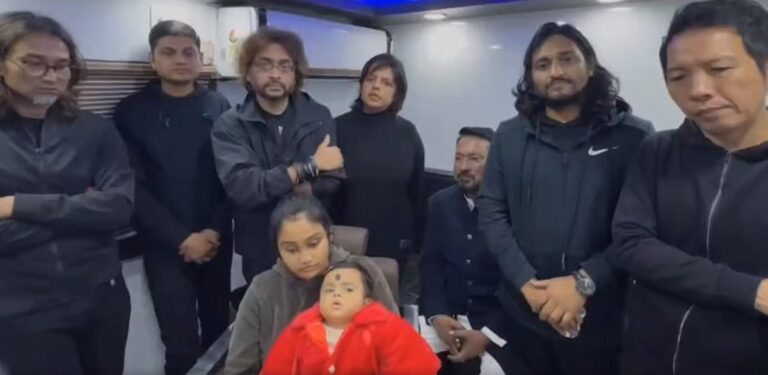
Kolkata: A baby girl of only twelve months old, Asmika, whose name means beauty, has recently gone viral as a crowdfunding movement is underway for her treatment.
Asmika Das was born in the district of Nadia, West Bengal, on January 9, 2024, at Ranaghat’s Swami Vivekananda Sarani. Her parents, Lakshmi and Shuvankar Das, were married in 2022. Asmika’s birth brought immense joy to the family. However, when Asmika was four months old, her parents noticed that she did not move like other children her age. Alarmed, they sought medical advice, traveling from their district to the state capital, Kolkata, and even to Southern India. After undergoing several tests, she was diagnosed with Spinal Muscular Atrophy (SMA) Type-1, a rare and severe genetic disorder.
The High Cost of Hope: Zolgensma and Crowdfunding Challenges
All the excitement turned into despair. Asmika suffers from SMA Type-1, the most severe form of the disease, which manifests in infancy with symptoms such as muscle weakness, poor muscle tone, and difficulty breathing and swallowing. Without early treatment, it often leads to life-threatening respiratory complications. SMA is a rare genetic condition that affects motor neurons—nerve cells that control voluntary muscle movements.
Gene replacement therapy is the only viable treatment to save Asmika. A single dose of Zolgensma, a one-time-only gene therapy for children under two years of age with SMA, costs $2.1 million, making it the world’s most expensive drug. Manufactured by Novartis, Zolgensma is not available in India and must be imported from abroad, taking nearly 20 days to reach India after an order is placed.
For Asmika’s lower-middle-class family, raising such a massive amount is impossible. While some government assistance is available, it is insufficient. Crowdfunding has become their only hope, but it is a time-consuming and arduous process.
Two years ago, on January 7, 2023, another child, Nirvaan, the son of Sarang Menon and Adithi, was diagnosed with SMA Type-2. The family, originally from Kerala but settled in Mumbai, also required a similar amount for treatment. They launched campaigns on crowdfunding platforms Milap and ImpactGuru. Fortunately, an anonymous donor contributed ₹11 crores to their Milap account. However, in Asmika’s case, raising such funds seems far more challenging.
Rare Diseases in India: Policy Gaps and High Stakes
Rare diseases are health conditions with low prevalence, affecting a small portion of the population compared to more common illnesses. Globally, an estimated 6,000 to 8,000 rare diseases exist, with approximately 80% of patients affected by only 350 of these. Rare diseases are lifelong conditions, and around 95% of them have no approved treatments. Where treatments are available, they are often prohibitively expensive.
To address this, the Ministry of Health & Family Welfare (GOI) launched the National Policy for Rare Diseases (NPRD) in March 2021. The policy classifies rare diseases into three groups:
1. Group 1: Treatable through one-time curative treatments.
2. Group 2: Requiring long-term treatment at a relatively lower cost.
3. Group 3: Having definitive treatment options that are prohibitively expensive and require lifelong therapy.
The policy includes 63 rare diseases, such as Lysosomal Storage Disorders, Fanconi Anemia, and Gaucher Disease. Under the NPRD, the government has promised up to ₹50 lakhs per patient for treatment at designated Centers of Excellence (CoEs) for rare diseases. There are 12 such CoEs across India, including AIIMS New Delhi, PGIMER Chandigarh, and IPGMER Kolkata.
Despite these measures, gaps remain. According to a study in the Jindal Journal of Public Policy, authored by Dhruvnil Jakasaniya and Rutu Tekwani, the NPRD falls short in making treatments accessible and affordable. Issues include inadequate data, poor communication frameworks among stakeholders, and insufficient incentives for domestic drug manufacturers to invest in research and development.
Moreover, the government’s promise of digital pooled funds is not yet fully operational. Experts suggest utilizing corporate sector CSR funds and public-private partnerships to enhance funding and strengthen CoEs.
Asmika’s case is a grim reminder of these gaps. If the Zolgensma injection is not administered before she turns 15 months old, her chances of survival will diminish significantly. In May 2023, Delhi High Court Justice Prathiba M. Singh emphasized the need for urgent coordination between the medical community, therapy providers, and government agencies.
A public health expert, speaking anonymously, stated: “The government needs to move from sympathy to empathy for rare disease patients. They must reach out to potential donors, such as PSUs with large CSR funds, and implement a more strategic approach to support these families.”
Unfortunately, many healthcare professionals, activists, and foundations remain reluctant to comment publicly on this issue. Despite its critical importance, rare diseases continue to be a largely neglected area in India’s healthcare system.
In November 2024, India Today reported that one baby boy Din Muhammed managed to get Rs 16 crore through crowdfunding and was successfully administered the life-saving drug.
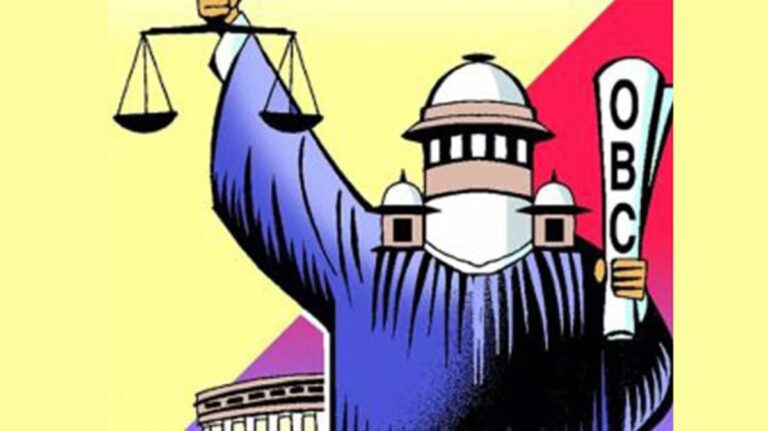
Kolkata: How Muslims were included in West Bengal’s OBC list has been a contentious question troubling many, including the Indian judiciary. With the Supreme Court all set to hear the case on January 28, the bigger question that needs to be asked is: did these communities need the OBC reservation? And if they do need the reservations, then why call it appeasement?
The High Court’s Verdict and Its Fallout
The Calcutta High Court’s order on May 22, during the 2024 General Elections, highlighted the commission’s “undue haste” in recommending the classification of 77 classes to fulfill the then Chief Minister’s public announcement. It also noted that classifying the majority of the 77 groups, who were Muslims, as backward is “an affront to the Muslim community as a whole,” making it appear that the “community has been treated as a commodity for political ends.”
In response to the verdict, the Molla and Mondal communities have filed respective intervention applications seeking permission to make submissions before the court, as the Calcutta High Court had not heard from the denotified groups before canceling their OBC status.
Social activist Md Pasarul Alam, who is also one of the applicants seeking submission, told eNewsroom, “The High Court’s May 23, 2024, judgment on OBC reservation in Bengal has sparked controversy and criticism. As a result, there is a possibility of damage to the backward Muslim society.”
A Decade-Long Struggle for Muslim Representation
According to experts, the OBC certificates for the denotified communities were issued using a procedure prescribed by Buddhadev Bhattacharya’s Left Front regime.
Explaining the woes of the backward Muslims in Bengal, Professor SAH Moinuddin, head of the Department of Sociology at Vidyasagar University, said, “OBC reservations were implemented across India immediately after the Mandal Commission report in 1980, and a survey was conducted by the National Sample Survey Organisation. However, till 2010, the Left Front refused to accept that Bengal had a sizable population belonging to the backward class. After seeing how other states were benefiting from the reservation, the Left Front government implemented its reservation policy for Muslims in Bengal.”
Sabir Ahamed, National Research Coordinator at the Pratichi Institute and founder of the ‘Know Your Neighbour’ initiative at the Sabar Institute, added, “A large section of Muslims in Bengal falls in the backward community, and it has nothing to do with religion but their socio-economic condition.”
A Muslim academic, who didn’t wish to be named, expressed frustration with the OBC reservation controversy, saying, “The 77 communities that have been denotified by the HC verdict are the real sufferers. Post-verdict, students from these communities face difficulties gaining admission to colleges and universities.”
The Present Government’s Role in Muslim OBC Marginalization
The Bengal government not announcing any vacancies under the OBC category has made Bengali Muslim intellectuals fearful. “Whatever progress Bengali Muslims from the remote villages of the state have made in these few years will go down the drain if these 77 communities are brought under the ambit of the general category,” said Saifulla, professor of Bengali at Aliah University.
Annoyed with the present Trinamool government, he said, “What are the benchmarks for getting included in the OBC list? Why weren’t the documents produced by the state before the high court? Why was it left for the Court to state that ‘religion’ was the basis of these reservations?”
Echoing a similar sentiment, Ahamed said, “We won’t deny the fact that there has been an improvement in Muslim representation in colleges, universities, and government jobs. But still, more needs to be done to improve the socio-economic condition of Muslims in Bengal.”
According to some RTI queries filed by Ahamed, the maximum number of recruitments in the years 2019 and 2020 has been for the post of constable in West Bengal Police. In 2019, around 8,419 candidates were selected for the declared vacancies, of which 11.08 percent were from OBC A and 5.6 percent from OBC B categories. SC and ST had a representation of 22.04 percent and 6.39 percent, respectively.
In 2020, for the same category, 8,624 candidates were selected, with OBC A and B representation at 10.74 percent and 7.5 percent, respectively.
Data provided for various job categories created by the Bengal government reveal that despite the rise in Muslim representation, there still lies ample scope to boost their number in various categories of government jobs.
Misconceptions About OBC Reservations and Muslim Inclusion
“Across India, OBCs are granted 27 percent reservation, and in some places, this figure is even higher. However, Bengal still limits OBC reservations to 17 percent, and no one has raised concerns about the community being deprived of 10 percent of government jobs,” said Alam.
Right after the implementation of the Mandal Commission, OBC reservation was introduced across the country, except in Bengal. Incidentally, while 27 percent reservation was introduced nationwide, Bengal offered only 7 percent to OBCs. “This 7 percent reservation was given to OBCs who were Hindu. However, belief in Hinduism was never the criterion for inclusion in the OBC category. OBCs are listed under special communities. Similarly, those who claim Muslims are listed as OBCs due to religion are incorrect. The truth is that all backward communities among Muslims are listed as OBCs,” he explained.
Subsequently, in 2010, Buddhadev’s government introduced 10 percent reservation for Category A and 7 percent for Category B among OBCs. However, this sub-categorisation was propagated as if only Muslims were considered under OBC.
“The Muslims listed in these OBC sub-categories indeed follow Islam, but that doesn’t mean their inclusion is some form of appeasement. Their inclusion is not due to their religious affiliation but because of their social, political, and economic deprivation and under-representation,” said Prof. Moinuddin.
According to the Sachar Committee report, people from minority communities represent just 2 percent of government jobs in West Bengal.
However, many accepted that there might have been procedural errors on the government’s part, which can certainly be rectified.
The Bengali Muslims (OBCs), however, have been left all by themselves. Following the May 2024 judgment, the castes listed as OBCs after 2010 were declared void. Candidates from these castes are no longer being issued fresh OBC certificates.
Admissions for such candidates in central schools, colleges, and universities have also stopped.
Interestingly, Saifulla points out that these OBC certificates without the non-creamy layer certificate issued by the SDO are of no use. He also noted that since the HC judgment, most job vacancies listed by the state government no longer include the OBC category. For instance, a recently announced vacancy for a librarian post listed on the College Service Commission’s website had all categories listed except for OBC. He maintained that if this case doesn’t get a judgment soon, many from the community will be deprived of a chance to uplift themselves socio-economically.
So, does that mean Muslim OBCs are hopeful of the ruling coming in their favor? “We have faith in the apex court,” said Alam. And what about the certification, being labeled as ‘appeasement politics’?
“Well, if they are poor, then why not? I also fail to understand why the inclusion of these 77 communities is seen as appeasement. Hindu OBCs were included long before the government began thinking about Muslim representation in various sectors, particularly following the Sachar Committee Report,” summed up visual artist Subhajit Naskar.
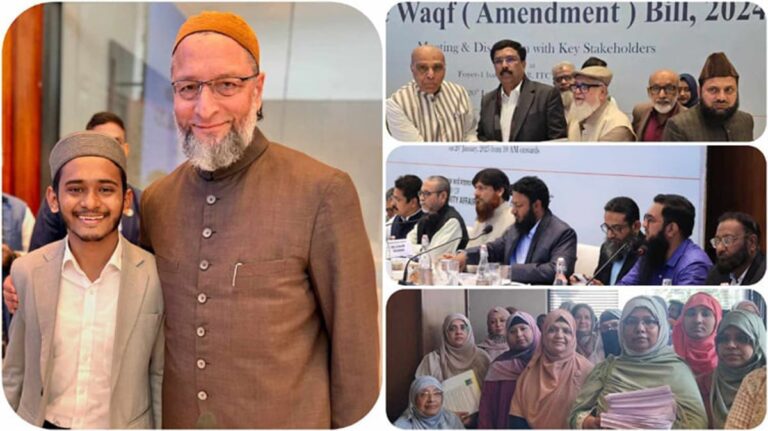
Kolkata: Since the Waqf Amendment Bill 2024 was tabled in Parliament, West Bengal, particularly Kolkata, has witnessed several protests and public meetings. Bengal has the third-largest number of Waqf properties. However, when the Joint Parliamentary Committee (JPC) decided to meet with stakeholders, it allocated only one minute per speaker, leaving participants dissatisfied with the process. Additionally, the meeting saw participation not just from Bengal but also from Jharkhand, where the JPC did not conduct any tours.
The JPC team had only half of its 30 members present. Notable attendees included Chairman Jagdambika Pal, Asaduddin Owaisi, A Raja, Nadimul Haque, Kalyan Banerjee, Imran Masood, Sayed Nasir Hussain, Mohibullah, and Mohammad Jawed. However, several members, including Nishikant Dubey, Gourav Gogoi, Ghulam Nabi Azad, Tejasvi Surya, and Abhijit Gangopadhyay (the judge-turned-politician from Kolkata), were absent, despite the significance of the issue.
The Waqf Act of 1995 has seen several proposed amendments in the Waqf Amendment Bill 2024, making it one of the most extensive changes to any law in recent times.
Two States Covered in Less Than a Day
“In today’s meeting, at least 20 different organizations met the JPC team. Each delegation consisted of 5 to 15 members, but all meetings were wrapped up within 10 to 15 minutes. In most cases, only three people from a group were allowed to speak,” said Mohammed Asif Ali, a chartered accountant and researcher who attended the meeting.
There were around 300 participants from Bengal and Jharkhand, mostly from Bengal. The attendees included social activists, Islamic preachers, and women participants, some of whom had traveled from Jharkhand and Bihar to attend the meeting.
Women were present in significant numbers. “We outrightly rejected the Waqf Amendment Bill 2024,” said Uzma Alam, who led the women’s delegation.
JPC Faced Tough Questions
Although the JPC team prohibited recordings of the speakers’ comments and requested participants not to disclose details to the media, many groups highlighted that the proposed amendments to the bill are unconstitutional and aim to obstruct one of the best humanitarian practices.
The speakers included educationist and Umeed Global School founder Wali Rahmani, Mufti Shamail Nadwi, Dr. Sarfaraz Adil, Sabir Ahamed, Sarfaraz Ahmed Khan, Manzar Jameel, Rafay Siddiqui, Md Asif, Sheikh Khurshid Alam, Uzma Alam and Prosenjit Bose. All of them stated that their groups categorically rejected the bill.
Fahad Wali Rahmani of Rahmani30 was also present, assisting participants from Jharkhand in presenting their concerns to the JPC.
“We voiced our rejection of the bill and questioned why the JPC did not visit Jharkhand. Are the people of Jharkhand not stakeholders in this matter?” asked a speaker from Jharkhand.
The JPC is going to have a clause-by-clause discussion on January 24 and 25. And most probably it will submit its reports during the budget session of the parliament.
Ranchi: In Jharkhand, Bangladeshi infiltrators indulge in love jihad by luring innocent adivasi (tribal) women and marrying them. After that, they engage in land jihad on tribal land. Additionally, these Bangladeshi infiltrators participate in political jihad by making their tribal wives contest Panchayat elections on tribal reserved seats.
Jharkhand BJP spokesperson Pratul Shahdev had emphasized that Jharkhand needs UCC and NRC to stop infiltration before assembly polls.
The BJP’s Allegations: Targeting Tribals and Muslims
He is not alone in making these serious claims. Several national-level BJP leaders, including Prime Minister Modi and Amit Shah, have also made inflammatory statements directly or indirectly targeting Muslims and alleging Bangladeshi infiltration. These remarks were made during recent BJP election rallies organized for the assembly elections in Jharkhand.
But why? On this question, Ashok Verma, an activist knowledgeable about the demography of Jharkhand, explains: “In the tribal-dominated areas, particularly in the ‘Santhal division,’ there is a high degree of similarity between Muslim and tribal societies in terms of social, economic, and cultural aspects. This is the primary reason for the unity between Tribals and Muslims communities.”
Unity Between Tribals and Muslims: A Political Challenge
The unity among the Santhal people significantly impacts the entire region of Jharkhand. As a result, during the May Lok Sabha elections, the BJP was unable to win any of the parliamentary seats reserved for tribals in Jharkhand.
Both the RSS and the BJP are well aware that, until the unity between the tribal communities and Muslims is disrupted, the BJP will struggle to gain a foothold in tribal areas like Santhal.
“The success of the Santhal is the key to ruling in Jharkhand,” Ashok Verma said.
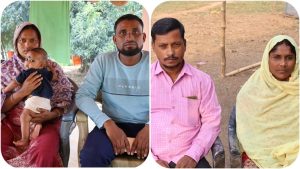
Marangbiti Hansda and Samirul Islam, Panchayat Madhuvapara (Left pciture). Joydur Sheikh married to Bina Marandi, village Kashila, Pakur | Photo credit: Sartaj Alam
While the INDIA bloc led by Jharkhand Mukti Morcha has stopped the BJP’s gains on reserved seats in the state during Lok Sabha polls and defeated the saffron brigade in assembly elections, the seeds of hatred between tribals and Muslims planted in the region—similar to Hindu-Muslim enmity across the country—are not going to die down easily. Alongside its other initiatives, the Hemant Soren government must work on repairing the damage done to the social fabric.
Santhal Division: The Epicenter of Electoral Strategy
Santhal is one of the five divisions of Jharkhand state in India. This division comprises six districts: Godda, Deoghar, Dumka, Jamtara, Sahibganj, and Pakur, which together have a total of 18 assembly seats.
In many of these seats, the combined vote share of Muslims and tribal communities exceeds 45%. This demographic factor has played a crucial role in the success of the Jharkhand Mukti Morcha (JMM) in parliamentary and assembly elections.
As a result, in the 2019 assembly elections, the Bharatiya Janata Party won only four out of the 18 seats in Santhal.
The Soren family, which dominates politics in Jharkhand, has successfully contested elections from seats in Santhal due to Tribal-Muslim unity. Current Chief Minister Hemant Soren was a candidate again from the Barhet assembly constituency in Santhal.
Divisive Narratives to Target Demographics
“BJP aims to create a divide between tribals and Muslims in Jharkhand to gain power,” Ashok Verma claims.
He adds, “As part of a well-planned strategy, the BJP is targeting the Muslims of Santhal, citing demographic changes due to Bangladeshi infiltration in the area.”
Tribal activist Elina Horo says, “The Muslim community in Santhal has two faults: first, they are Muslims, and second, they speak Bengali. Additionally, the Pakur district of Santhal is located near the Bangladesh border. Because of these factors, the local Muslims in Santhal are being accused of being Bangladeshi infiltrators.”
Demographic Shifts: An Analysis
The route from Pakur district to the Bangladesh border spans approximately fifty kilometers. Along this route, the Murshidabad district of West Bengal begins just seven kilometers from Pakur.
Elina Horo argued, “Before Jharkhand was formed in 1991, Santhal Pargana had a tribal population of 31.89% and Muslims at 18.25%. By the 2011 census, these figures changed to 28.11% tribals and 22.73% Muslims.”
Thus, between 1991 and 2011, the tribal population decreased by 3.78%, while the Muslim population increased by 4.48%.
Elina Horo added that the Hindu population in Santhal rose from 43.5% in the 1951 census to 49% in 2011, indicating growth similar to that of the Muslim population.
Regarding Jharkhand, from 1951 to 1991, the tribal population decreased from 35.38% to 27.66%.
Causes of Population Decline Among Tribals
Ashok Verma emphasized that the decline in the tribal population in Jharkhand and the Santhal region from 1951 to 1991 was due to inadequate nutrition, poor healthcare, and economic challenges. Additionally, tribal migration to other states during this period to deal with such a pitiable situation contributed to the population decline.
Verma pointed out that post-independence censuses in India lacked specific religious classifications for tribals, in contrast to Hindus, Muslims, Christians, Buddhists, Sikhs, and Jains. Nature-worshipping tribals don’t fit into the classifications of other religions, while Christian tribals identify only as Christians. This raises the question of whether non-Christian tribals were enumerated under the Hindu religious code. In such a situation, conducting a caste census is necessary to ascertain the exact population of tribals.
Debunking the Infiltration Myth
Has the Muslim population increased due to Bangladeshi infiltration?
Pakur activist Muzaffar Hussain says that laborers from Bihar and West Bengal have always been attracted to stone mining in the Santhal region. Those who come in search of jobs and settle in Santhal areas from time to time include both Hindu and Muslim laborers.
In such a situation, the population of both communities will inevitably increase, he added.
Activist Muzaffar Hussain
Hussain further mentions that local Muslims have been suspected of being Bangladeshi infiltrators. The BJP accused them of causing an unexpected increase in voters at Pakur’s 208 polling booths in July.
In response to the allegations, the Electoral Registration Officer formed a five-member team with two BJP leaders, but the investigation found no evidence of outsiders on the voter list.
The Truth Behind Jamai Tola Allegations
BJP leader Anugrahita Prasad Saha, who was part of the investigation team, said, “You should visit ‘Jamai Tola’ in Kalidaspur Panchayat; there was not a single house ten years ago.
He questioned how an entire village could have settled in that area now if there had been no infiltration.”
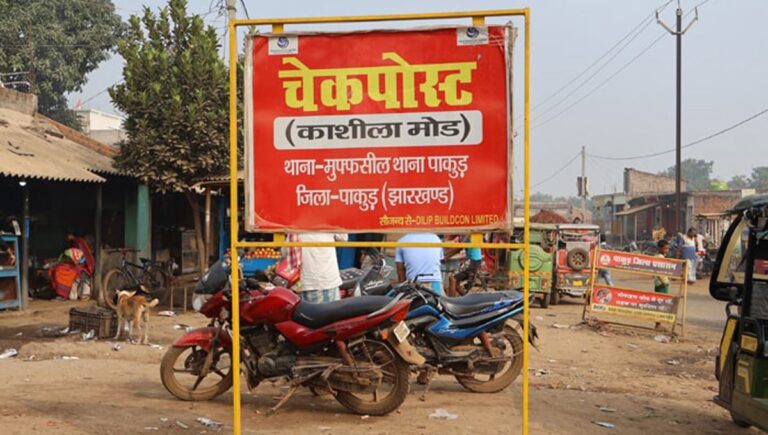
The village Kashila, located seven kilometers away from Pakur railway station, is referred to as ‘Jamai Tola,’ which means “village of sons-in-law.”
The head of this village, Manik Hansda, a tribal, mentioned that out of the 350 families in Kashila, only one household belongs to Joydur Sheikh, who had a love marriage with a tribal girl named Bina Marandi.
Joydur Sheikh works in a private company and earns a monthly income of $150. His wife, meanwhile, with other family members, makes Beedis at home, earning $1 for making 500 Beedis.
Bina Marandi says, “Our constitution permits marriage, so please do not label my successful marriage as love jihad.”
“According to tribal law, a married daughter does not have rights to her father’s land. Therefore, the accusation of land jihad against young men like my husband is unfounded,” Marandi adds.
Jalangi/Raninagar/Charbhadra: The 120-kilometer-long India-Bangladesh border in Murshidabad is a hotspot for smuggling activities and socio-economic struggles. With the Padma River forming a natural boundary in many areas, the absence of consistent barbed wire fencing has left the region vulnerable to trafficking and other illicit activities.
Residents of India’s border villages face daily struggles due to geographical ambiguities, lack of infrastructure, and stringent security measures, leaving their livelihoods and dignity in jeopardy.
Border Residents Face Barriers
Villages like Raninagar, Jalangi, Sagarpara, Lalgola and Bhagwangola in Murshidabad district are at the forefront of these challenges. The Padma River flows alongside the border, creating a geographical ambiguity that blurs the lines between India and Bangladesh. Smuggling activities, especially during the winter months, have escalated under dense fog.
Smuggling and Infiltration Continue to Plague the India-Bangladesh Border. Despite efforts by the Border Security Force (BSF), smuggling and infiltration remain major concerns along the India-Bangladesh border. In recent months, there has been a surge in the smuggling of buffaloes from India to Bangladesh, with smugglers taking advantage of the open border and dense fog to evade detection.
The BSF has reported several incidents of buffalo smuggling. On the night of November 25 last year, a young man died while attempting to cross the Shialmari River with a group of buffaloes. In another incident, on November 29, the BSF seized two buffaloes being smuggled to Bangladesh and arrested a youth attempting to smuggle gold worth Rs 37 lakh.
In addition to smuggling, infiltration remains a significant concern. In the last few months, Indian buffaloes have been smuggled to neighbouring Bengal several times through the open borders of Jalangi, Sagarpara and Raninagar. The Raninagar police recently arrested two Indian brokers and a Bangladeshi national who had entered India without valid documents. It is believed that most Bangladeshi infiltrators enter India with the help of Indian brokers and are destined for South India, where they work as labourers.
While the BSF claims to be active in preventing smuggling and infiltration, questions are being raised about the effectiveness of their efforts. The occasional incidents of infiltration and smuggling suggest that more needs to be done to secure the border and prevent these illegal activities.
Smugglers reportedly use this area to traffic drugs, cattle and even people. Cannabis, heroin, and phensedyl are among the most trafficked items, with drugs entering Murshidabad from states like Assam and Manipur and from across the border in Bangladesh. Despite police claims of year-round vigilance, residents allege that enforcement remains inadequate. Resident Bablu Sheikh shared, “An approximately 75-kilometre stretch between Jalangi and Bhagwangola is not fenced. Surveillance is nearly impossible at night. Until proper fencing is installed, trafficking will continue to thrive.”
Residents of Kharibona Nasipur in Bhagbangola 2 block rely on boats as their only means of transportation to return home | Photo Credit: Khalid Mujtaba
Impact on Local Livelihoods
The BSF has stringent controls in place for civilians entering or leaving certain blocks in Murshidabad, West Bengal. To move in or out of these areas, residents must obtain permission by showing their certificates within a specified time frame.
These restrictions have led to significant social and economic implications for the local population. Many residents from mainland India are hesitant to marry into families from these border areas due to the difficulties posed by the BSF’s controls. A BSF officer explained, “There can be no compromise on border security. These steps have been taken to safeguard the nation’s security, and we must ensure that no illegal activities take place.”
Beyond trafficking, the stringent rules imposed by the BSF have added to the misery of border residents. Villagers in Jalangi’s Char Parashpur and Char Udayanagar alleged restrictions on carrying essentials such as rice, sugar, kerosene and fertilizer for farming. Farmers face obstacles in transporting fertilizers or harvesting crops, often being asked to provide land documents that they do not possess.
A resident, Nizamuddin Sheikh, expressed his frustration, “We are not allowed to bring our harvest from the fields. If we don’t comply, our crops rot. These rules are killing our livelihoods.”
Furthermore, the region’s development has been severely hindered. Roads, water supply, healthcare, and education facilities are all underdeveloped, resulting in a low literacy rate. Residents have long suffered from underdevelopment and border-related issues, with many expressing their desire for change and a better quality of life. “We want to change this. We want to live comfortably,” said one resident, highlighting the need for improved living conditions and greater freedom of movement.
Farmers work along the Padma River in Kaharpara, on the India-Bangladesh border | Photo Credit: Khalid Mujtaba
Farmers & Fisherman Face Unrelenting Challenges
Farmers living in the border areas of India and Bangladesh are plagued by numerous problems that hinder their ability to cultivate and harvest their crops.The lack of barbed wire fencing along the border in Murshidabad has led to an increase in smugglers, causing innocent farmers to suffer the consequences.
One of the major issues faced by these farmers is the destruction of their ripe crops by Bangladeshis. Additionally, they are often harassed by the BSF while cultivating their land. BSF has been accused of beating farmers who refuse to apprehend smugglers, as was the case in Sagarpara, where farmers were asked to capture smugglers but were beaten when they declined.
The central government has been criticized for its inaction in resolving these issues, which have been ongoing for a long time. Farmer Asghar Ali expressed his concern, stating, “Everything depends on this farming. I can do that farming independently. Central forces’ obstruction at the moment. I am in a state of subjugation in my own country. I don’t know when we will get rid of this problem.”
Fishermen, too, are severely impacted. The Padma River, a lifeline for many fishermen in the area, has become a source of uncertainty and struggle. These fishermen rely on catching fish and crabs to support their families, but their livelihoods are being threatened by restrictions on fishing in the river.
Although permission for fishing is occasionally granted, it comes with stringent conditions that make it difficult for fishermen to make a living. As a result, many are struggling to provide for their families. “We start our day at dawn, but often, we are stopped by border security officials even after showing valid documents. How are we supposed to feed our families?” lamented fisherman Uttam Haldar. He said that the Indian government must take immediate action to address the concerns of these farmers and ensure their safety and well-being. This includes providing adequate fencing along the border, increasing security measures, and establishing essential services in the area.
Two residents of Char Rajapur in Raninagar-2 block are returning home after completing their farming work | Photo credit: Kibria Ansary
Social Issues and Alleged Harassment
The restrictions have not only affected the fishermen’s income but also their way of life. With their livelihoods under threat, the future of these fishing communities hangs in the balance. The situation is further complicated by the lack of basic amenities, such as primary schools and medical centres, in the border areas.The absence of these essential services exacerbates the difficulties faced by farmers and their families.
The restrictions have led to numerous incidents of alleged harassment. Residents report cases where guests visiting from nearby villages were denied entry without proper justification. In one shocking incident, a pregnant woman was reportedly forced to dance before BSF personnel under suspicion of smuggling. Local political leader Jabul Mandal stated, “Even daily labourers and farmers are forced to work for border guards without pay. This exploitation must stop.”
Lack of Infrastructure and Education
The lack of basic infrastructure in these areas exacerbates the crisis. Around 700 families in Char Parashpur and Char Udayanagar depend on a handful of government facilities, including a sub-health centre and two schools. However, schools often remain closed due to poor connectivity and recurring floods. “Students walk four kilometres through sandy stretches to reach school, only to find teachers unable to conduct classes. The children eat midday meals and go home,” said Gita Biswas, a teacher at Char Bhadra Colony Secondary School.
Residents of the border area are in dire straits due to this move of the border guards. The villagers of Jalangi Char Parashpur Udayanagar say, ‘Even if we go to fetch the field crop, it takes sacks and bags, if BSF does not allow us to bring it, what will we do in the market? Even though the school is open, the children are not able to walk there. Health workers have to return to the sub-health centre. What are the benefits of health care? The government does not consider us as citizens of our country if we have such doubts!’.
About 700 families live in Char Parashpur and Char Udayanagar blocks of Jalangi. There are only a few ICDS Centers one each for children and secondary education in government service. There is a surviving sub-health centre in the area.
Although the MSK centre is open from primary school, there are no students. Closed mid-day meal. After reaching the school after traversing the sand of four km of char, the teachers go back to sleep with their heads on the table. “schools have to be closed during floods. The communication system is so bad that the students can’t come that way. We are worried about that”, she added.
On the other hand, a tiny village of merely 18-20 houses, Sarandajpur in Raninagar-2 block, paints a dismal picture of neglect and desolation. The residents of this village live in jute houses, some surrounded by bamboo fences with tin sheds, but not a single pucca building in sight. The harsh climate adds to their woes, with dusty summers and muddy monsoons making life a daily struggle.
The village’s isolation is compounded by the absence of basic amenities like electricity, primary schools, and medical centres. Angura Bibi, a resident, lamented that despite 77 years of independence, the village remains in darkness, relying on kerosene lamps for light. The scorching summer heat is alleviated only by the wind from the Padma River and hand fans.
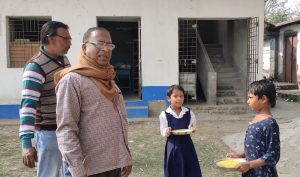
In Udaynagar Khand village, Jalangi block, two teachers engage with young students near the India-Bangladesh international border | Photo credit: Kibria Ansary
Education has taken a hit, with the village lacking a primary school or ICDS centre. The nearest block primary health centre is a staggering 13 kilometres away, making healthcare a daunting challenge. Tufan Shaikh, another resident, pointed out that the village lacks a transport system, and no government projects have been initiated, leaving them feeling disconnected from civilized society.
The villagers’ plight is a stark reminder of the vast disparities in development and access to basic services. As one resident poignantly put it, “The year changes, the rulers change, but the attitude of this village does not change. I don’t know when luck will open.”
Public Representatives’ Promises And Politics
The people of Murshidabad are calling on their newly elected MP, Abu Taher Khan, to highlight the difficulties they face due to the lack of barbed wire fencing along the India-Bangladesh international border. This absence of fencing has led to numerous anti-social activities, including smuggling, and has become a significant concern for the local population.
Sahil Rashid, a teacher at the Sagarpara border, emphasized the need for development in the area, stating that the literacy rate is alarmingly low, and farmers are frequently harassed while working on their land near the border. Rashid urged Khan to raise these issues in parliament and work towards finding solutions.
In response, Abu Taher Khan, the TMC MP from Murshidabad Lok Sabha constituency, acknowledged the problems faced by border dwellers and assured that he would address these concerns in parliament. Khan committed to working towards the development of the border areas, recognizing the need for improved living conditions and security for the local population.
The residents of Murshidabad are hoping that Khan’s efforts will bring about positive change and address the long-standing issues plaguing the region. Residents express frustration with political leaders who make grand promises during election campaigns but disappear after the votes are counted. “We’ve heard the same promises for years, but our situation remains unchanged. Our livelihoods are in danger, and no one seems to care,” said a resident Ketab Ali.
Despite these challenges, the people of Murshidabad’s border villages remain hopeful for a better future. They dream of a day when border security measures will strike a balance between safety and dignity, and their livelihoods will no longer be under constant threat. For now, the border remains a place of blurred lines—both geographically and in the lives of its struggling residents.
Abdul Gani Mondal, secretary of the Domkal branch of the human rights organization APDR, told eNewsroom, “The lives of people in Jalangi and Raninagar border areas are like those of nomads. They are deprived of all government services, including healthcare, education, water, and roads. They have to walk to Jalangi’s main market for any work. The local school lacks teachers, depriving border children of education. Basic healthcare is also unavailable. The border guards’ atrocities against locals are rising. They’re like refugees in their own country. We’ve informed the administration multiple times to resolve the border issue, but they haven’t taken any action.”
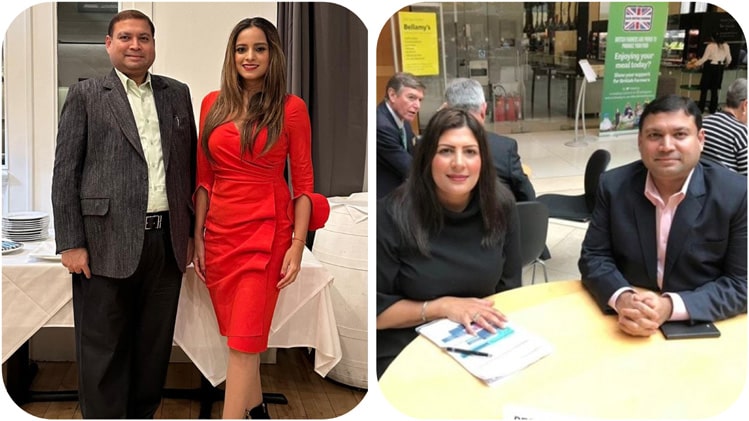
[dropcap]T[/dropcap]hroughout history, the participation of women in politics has been a testament to resilience, vision, and the capacity to lead amidst challenges. During a recent trip to California, I had the privilege of meeting four incredible women whose stories exemplify this spirit. These encounters inspired me to reflect on the broader impact of women of Indian origin in global politics, not just as participants but as changemakers in governance, policy, and community leadership. Their journeys are emblematic of determination, and their impact resonates far beyond the regions they represent, symbolising the transformative potential of representation and inclusivity.
A New Wave of Representation
In a world where women still face systemic barriers to leadership, the contributions of Indian-origin women in politics stand out as beacons of hope. Figures like Kamala Harris, the Vice President of the United States, epitomise this impact. Harris, with her dual South Asian and African American heritage, represents a historic milestone in global politics. Her tenure underscores the importance of diverse voices in shaping equitable policies and inspiring future generations.
Similarly, leaders such as Nikki Haley, former US Ambassador to the United Nations, and Chandrika Tandon, philanthropist and business leader, showcase the breadth of contributions made by Indian-origin women across political and civic domains. These pioneers exemplify a broader trend of increasing diversity and inclusion in leadership roles.
Other remarkable figures include Canada’s Anita Anand, who has served as Minister of National Defence, and Malaysia’s former Deputy Minister, Kasthuri Patto, whose work advocates for human rights and gender equality. These leaders not only represent their communities but also contribute to shaping a global political discourse that is inclusive and transformative. Their stories are critical reminders of how multicultural backgrounds and diverse experiences can enrich governance and bridge gaps in understanding among varied constituencies.
Stories of Young and Grassroots Leaders
Among the women I met, Zeel Ahir stands out as a young leader who epitomises the integration of cultural roots with progressive action. Elected to the Artesia City Council in California, Ahir’s work in mental health awareness, particularly within the South Asian diaspora, highlights her commitment to addressing deeply entrenched social stigmas. Her academic background in counselling psychology and social work equips her to tackle these issues effectively. Ahir has championed programmes to provide culturally sensitive mental health resources, which have had a measurable impact on the well-being of the community. Beyond mental health, Ahir’s advocacy for environmental sustainability has led to initiatives aimed at reducing plastic consumption and banning harmful fertilizers — projects that align with global priorities of ecological preservation. Her leadership as the Commissioner of Beautification & Maintenance demonstrates her dedication to creating inclusive, thriving community spaces. Ahir’s personal story, shaped by her immigrant family’s values of service and education, adds depth to her achievements and highlights the importance of representation at every level of governance.
Similarly, Jenifer Rajkumar’s journey to becoming the first South Asian woman elected to the New York State Assembly is a powerful narrative of breaking barriers. Rajkumar’s parents, who immigrated to the US and faced poverty, instilled in her a strong sense of perseverance. Her career as a lawyer, professor, and legislator typifies her commitment to justice and equity. Rajkumar has championed significant causes, from securing domestic workers’ rights to establishing New York’s first Asian American & Pacific Island (AAPI) Commission. Her successful campaign to make Diwali a recognised school holiday reflects her dedication to cultural representation and inclusivity, creating a sense of belonging for diverse communities. Rajkumar’s work extends beyond legislative victories. She frequently engages with grassroots organisations, fostering connections that amplify the voices of underrepresented groups. Her ability to combine policy expertise with community activism makes her a transformative figure in modern politics.
Bridging Gaps with Global Perspectives
Across the Atlantic, the achievements of women like Pam Gosal and Poonam Gupta further underline the global impact of Indian-origin leaders. Gosal, the first woman of Indian origin elected to the Scottish Parliament, has paved the way for others in public service. Her focus on economic development and education demonstrates her commitment to building a prosperous and equitable Scotland. Gosal’s legislative work has included championing initiatives that support small businesses, particularly those led by women and minorities, fostering economic resilience. During a conversation at Loch Lomond, Gosal introduced me to Gupta, an entrepreneur whose innovative approach to sustainability has earned her recognition as one of the most influential figures in UK-India relations. Gupta’s PG Paper Company Ltd. has transformed the waste management and paper industries, proving that businesses can be both profitable and environmentally conscious. Her ventures across healthcare, property, and environmental innovation reflect a multifaceted approach to leadership, grounded in purpose and impact. Gupta’s philosophy of “sustainability with profitability” serves as a blueprint for businesses aiming to balance economic success with social responsibility. Beyond her entrepreneurial endeavours, Gupta is an advocate for mentorship, regularly engaging with young professionals to share insights and inspire the next generation of leaders.
Preet Kaur Gill’s career as the first female Sikh Member of Parliament in the UK further highlights the intersection of identity and leadership. Representing Birmingham, Edgbaston, Gill has been a steadfast advocate for social justice and equity. Her work spans critical areas such as public health, international development, and religious freedom. In Parliament, Gill’s leadership in All-Party Parliamentary Groups, including those for British Sikhs and Levelling Up Birmingham, showcases her commitment to addressing systemic inequalities. Recognitions like MP of the Year and the Sikh Woman of Substance award underline her influence as a role model for aspiring women leaders. Gill’s efforts to improve educational access for underserved communities and her focus on healthcare equity have set benchmarks for inclusive policymaking.
The contributions of these women highlight broader trends in the global political landscape. As societies become increasingly interconnected, leaders with multicultural backgrounds are uniquely positioned to address complex, cross-border challenges. Women of Indian origin, in particular, bring a blend of cultural heritage and modernity to their roles, enabling them to navigate diverse constituencies and advocate for inclusive policies. Their successes challenge traditional stereotypes and inspire younger generations to envision themselves in leadership positions.
Priti Patel’s legacy as the UK’s first Indian Diaspora Champion and former Secretary of State for the Home Department exemplifies this dynamic. Her tenure was marked by a focus on economic reform and inclusivity in governance. Patel’s contributions to international development and employment policy reflect a pragmatic approach to addressing global challenges. Her career serves as a reminder of the significant role that diverse perspectives play in shaping effective and forward-thinking policies.
In addition to these prominent figures, grassroots efforts by Indian-origin women further emphasize the profound impact of female leadership. For instance, grassroots organisers like Seema Nanda, who served as the CEO of the Democratic National Committee, have contributed to systemic change by bridging gaps between communities and governance. Women like Rashmi Sinha, co-founder of SlideShare, have also left an indelible mark on the intersection of technology, business, and civic engagement, reminding us that leadership comes in many forms.
At the community level, women such as Kalpana Kotagal, a prominent employment and civil rights attorney, have broken barriers in law and activism. Her advocacy for workplace inclusivity and diversity led to her co-authorship of the ‘Inclusion Rider’, a groundbreaking initiative in Hollywood promoting equity in hiring practices. Kotagal’s work exemplifies how leadership in traditionally male-dominated fields can ripple outwards to influence broader societal norms.
The role of education and mentorship cannot be overstated in fostering female leaders. Initiatives like the Cherie Blair Foundation for Women, which empowers female entrepreneurs worldwide, have seen Indian-origin leaders championing efforts to uplift marginalised groups. Such programmes are instrumental in breaking cycles of poverty and underrepresentation, providing women with tools to create meaningful change.
The Transformative Power of Representation
As women rise in politics and public service, their influence extends to reshaping global narratives. Figures like Usha Rao-Monari, the Under-Secretary-General and Associate Administrator of the United Nations Development Programme, have contributed to sustainable development efforts that prioritise marginalised communities. Rao-Monari’s work demonstrates the vital role of Indian-origin women in steering international policies toward equity and resilience.
The underrepresentation of women in leadership remains a persistent challenge, but the stories of these Indian-origin leaders demonstrate that progress is possible. Their journeys underscore the importance of mentorship, education, and opportunities in overcoming systemic barriers. Representation matters not only for the policies enacted but also for the message it sends to future generations. When women see others who share their heritage and values succeeding on the global stage, it fuels aspirations and expands the realm of what is possible.
Leadership is not just about holding office; it is about inspiring change, challenging norms, and building inclusive futures. The women I met during my trip — Ahir, Rajkumar, Gosal, and Gupta — embody these principles, proving that the fusion of cultural identity and global vision can yield powerful results. Their achievements remind us that diversity in leadership is not just a goal but a necessity for addressing the complexities of the modern world.
As I reflect on their stories, I am reminded of the transformative power of representation. Leaders like Kamala Harris, Nikki Haley, Anita Anand, Zeel Ahir, Jenifer Rajkumar, Pam Gosal, Poonam Gupta, Preet Kaur Gill, Priti Patel, and Kasthuri Patto show us that the path to a brighter, more equitable world is paved with courage, conviction and an unwavering commitment to service. Their impact resonates not only within their communities but across the globe, inspiring a future where leadership knows no gender, and every voice has the opportunity to be heard.
[dropcap]I[/dropcap]n November 2024, an Islamophobic signboard at a Jagadhatri Puja pandal in Beldanga, Murshidabad district, West Bengal, sparked significant communal tensions. The signboard’s offensive message outraged the local Muslim community, leading to violent clashes. Stone-pelting was reported from both sides, resulting in vandalism and injuries. Fifteen Muslims sustained injuries, three of whom were reported to be in critical condition. The district administration imposed prohibitory orders and suspended internet services to control the situation.
However, mainstream media coverage primarily focuses on the disruption to public order rather than the Islamophobic provocation that initiated the violence. Furthermore, in cases where an individual from a Muslim background is accused, the media emphasizes the person’s religion. Headlines often highlight the Muslim identity of the accused, even when it is irrelevant to the case. Such narratives reinforce stereotypes portraying Bengali Muslims as ‘inherently criminal’ or ‘anti-social.’ For instance, reports of petty theft or smuggling in border districts like Malda and Murshidabad are framed as ‘organized crime’ by ‘Bangladeshi Muslims,’ even without evidence of cross-border involvement or communal intent.
In cases of communal violence, media narratives focus on the religious identity of Hindu victims while downplaying or ignoring attacks on Muslims. For instance, in cases of retaliatory violence during riots, Muslim victims usually receive less attention in terms of coverage, victim narratives, and follow-up reporting. This trend of framing shifts attention away from the root causes and demonizes the Bengali Muslim community, leading to their marginalization within the mainstream social spectrum. Conceptually, these incidents exemplify a particular mode of narrativity akin to racialized stereotyping, finely unbalanced by maintaining an uneven epistemology. Scholars in the concerned field term this epistemic Islamophobia, which, in the hands of the dominant community, not only alienates the Muslim community but also disrupts the social fabric of Bengal’s pluralistic society.
Understanding Epistemic Islamophobia
Epistemic Islamophobia refers to a form of Islamophobia that perpetuates distorted or erroneous ideas about Islamic beliefs, Muslims, and their cultural identity within society. Ramón Grosfoguel, a scholar of postcolonial studies, coined the term to describe hostility towards Islam that transcends simple prejudice or discrimination. Scholars such as Alia Al-Saji, Tariq Modood, Ziauddin Sardar, Naved Bakali, Sami Zubaida, and Khaled Abou El Fadl have significantly contributed to understanding epistemic Islamophobia by examining biases and misconceptions about Islam and Muslims. Their work, grounded in Western epistemology, postcolonial theory, and anti-discriminatory thought, has contributed to efforts to eradicate Islamophobia.
Epistemic Islamophobia does not merely create negative perceptions of Islam or Muslims through descriptions or expressions. Instead, it emerges from entrenched cultural biases rooted in education, media, literature, history, and the dominant cultural perspectives of society. This form of Islamophobia builds stereotypes over time, portraying Muslims as unjust, uneducated, uncivilized, or dangerous to society. As a result, erroneous or biased ideas about the Muslim religion, culture, and social identity emerge, leading to discrimination, disdain, and even justification for oppression against them.
While this discourse is considered Western, it is equally relevant in societies of the Global South. For example, West Bengal’s foundation lies in colonial history and the religious reform movements of the 19th-century Bengali Renaissance, but its influence persists today. Epistemic Islamophobia manifests in various ways in Bengal’s society. Textbooks in schools and universities often overlook or distort Muslim history, culture, and contributions. The role of Bengali Muslims in Bengal’s history is portrayed with bias and negativity.
Misrepresentation in Education and Popular Culture
Bengal’s media and films often associate Muslims with violence, terrorism, or political instability, thereby perpetuating misconceptions about their social and cultural role. In contemporary contexts, political speeches and rallies mostly depict the Muslim community as traitorous or foreign. Islam is portrayed as synonymous with “internal conflict” or “crime,” fostering hostile attitudes toward Muslims. This type of political discourse diminishes the legitimacy and value of Muslims in society.
Mosques, madrasas, or Islamic institutions are viewed with suspicion and labelled as weak or culturally antagonistic. Islamic education or ideas are dismissed as “antiquated” or “ignorant” by Western standards, and this imported narrative takes institutional form in our society, sidelining the epistemic contributions of Bengali Muslims.
Economic Disparities and Social Alienation
The Muslim community frequently faces economic marginalization, with significant disparities in access to education, healthcare, employment, and other opportunities. These inequities stem from an epistemic framework that undervalues Muslim knowledge and cultural contributions, thereby hindering their inclusion in the mainstream. Furthermore, ignorance or disdain persists toward their religious practices, attire, dietary habits, and lifestyle. For instance, Muslim attire often invites ridicule or dismissive remarks, with little effort made to understand their cultural practices.
Representation of Muslim perspectives is lacking in Bengal’s universities and cultural circles. Muslim thinkers, cultural activists, or intellectuals often fail to assert their influence in the mainstream, sidelining their artistic and intellectual contributions. On social media, blogs, and online platforms, Islamophobia against Muslims is vividly evident. Negative comments, fake news, and hate speech are spread, reinforcing misconceptions and distrust of Muslims.
The history and culture of Bengali Muslims are diverse and multifaceted. They are an integral part of the Indian subcontinent. However, a significant section of society perceives them through distorted and biased lenses. There is little respect or recognition for the heritage, language, and religion of Bengali Muslims. Many Muslim families here still face various social and economic challenges due to their faith. Misconceptions about Islam, disdain for its language, and ignorance of its culture create a form of epistemic Islamophobia.
Such misconceptions lead Bengali Muslims to face constant humiliation, discrimination, and social alienation. Their professional advancement, education, and societal acceptance are hindered by their religious identity. They are neglected in social and cultural domains as well. Muslim women, in particular, face compounded challenges, as they are subject to both criticism and internal oppression.
Combating epistemic Islamophobia requires establishing epistemic pluralism. This perspective considers the knowledge and beliefs of various nations, religions, and cultures. To foster justice and equality, society needs to cultivate a new awareness by addressing internal biases, oppression, and misconceptions.
Building a Discrimination-Free Society
To eliminate epistemic Islamophobia and promote equal dignity and rights for Bengali Muslims, we must first promote a pluralistic perspective in society. The first step is to show respect and support for different religions, cultures, races, and communities. This requires active engagement from educational institutions, media, and cultural organizations. Education should include a positive portrayal of the Muslim community and appropriately represent their heritage, culture, and language. Accurate information about Bengali Muslims’ history, including their contributions to literature, art, and science, should be highlighted.
While fostering mutual respect among religious communities is essential, it is equally important to instil confidence and pride among Muslims in their heritage, culture, and language. To tackle epistemic Islamophobia, society needs an open, inclusive, and pluralistic perspective. Raising awareness about Muslim contributions, incorporating accurate history and identity of Islam and Muslims in education, and discouraging negative attitudes towards Muslims in the media are crucial steps.
To create a humane, discrimination-free society for Bengali Muslims in the state, collective awareness and action against all forms of discrimination and Islamophobia are essential. By striving for mutual respect and understanding, we can build a pluralistic society where people of all religions and communities live with equal rights and dignity.
Kolkata: Despite being unfamiliar, but very similar to the common cold, a Human metapneumovirus (hMPV) has gone viral nowadays! Common people are becoming terrified visualizing how severe it’ll be!
The Chinese Centers for Disease Control and Prevention have reported a sharp increase in acute respiratory viral infections, including human metapneumovirus infections in northern China during recent weeks. As people continue to live with the nightmare of COVID-19; this news has raised public concerns globally about the possibility of a virus outbreak again.
But hMPV is not a novel virus, it has been in the air for decades. As per WHO’s report, in many countries of the Northern Hemisphere, trends in acute respiratory infections increase at this time of year. These increases are typically caused by seasonal epidemics of respiratory pathogens such as seasonal influenza, respiratory syncytial virus (RSV), and other common respiratory viruses, including human metapneumovirus (hMPV), as well as mycoplasma pneumonia. In China, detections of seasonal influenza, rhinovirus, RSV, and hMPV, particularly in northern provinces of China have increased as usual. WHO is in contact with Chinese health officials and has not received any reports of unusual outbreak patterns. The observed increase in respiratory pathogen detections is within the range expected for this time of year during the Northern Hemisphere winter.
Like many other nations, there are very few hMPV-positive cases in India, and it hints at a virus-phobia nationwide. But experts ask not to get panicked. This virus is most active during late winter and spring in the temperate climate of the northern hemisphere, overlapping with RSV and influenza viruses. Dr Tina Mukherjee, HoD, Department of Microbiology, Scottish Church College, Kolkata, said that Human metapneumovirus is not a very new one of its kind. It’s been there for many years and has been making children fall ill for quite a long time. Children, elderly adults and immunocompromised people may be its worst victims. She also said, It’s contagious like any other pneumonia or flu-like viruses, however, the severity linked to morbidity is questionable yet.
hMPV is a negative–sense single-stranded RNA virus, while Coronavirus have positive–sense genomes. Positive–sense viral RNA sequence may be directly translated into viral protein which is needed for viral replication; but this negative–sense RNA can’t be translated into protein directly. Rather it must be transcribed into a positive–sense RNA with the help of a complementary RNA intermediate. Along with hMPV, influenza virus and RSV also have negative–sense RNA. Thus there’s a basic difference between the characteristics of hMPV and coronavirus.
This virus belongs to the kingdom of Orthornavirae, the order of Mononegavirales, a family of Pneumoviridae, and the genus of Metapneumovirus. Under this genus, there are two species, namely Metapneumovirus hominis related to humans and Metapneumovirus avis about birds. Bayesian statistics indicate that hMPV emerged between 1875 and 1889 and diverged from avian Metapneumovirus around 1800. hMPV is closely related to the avian MPV subgroup C. Avian MPV was first reported in 1970, and hMPV was in 2001 in the Netherlands by Dr Bernadette G Van den Hoogen and her colleagues while examining 28 young children’s respiratory secretions. Till now there are at least four lineages of this virus — A1, A2, B1, and B2. None of them are known to cause varying levels of severity.
Researchers have noticed that hMPV is mostly localized and can differ significantly from community to community, allowing for the possibility of the strain in one location one year to be the most similar to the strain in a different location the next year. Kayachikitsa professor of Contai’s Raghunath Ayurveda Mahavidyalaya and Hospital, Dr Tuhin Kanti Biswas also said, the character of hMPV can be compared with “Vata–shlaishmika Jwara” in Ayurveda. He also mentioned that the main causative factors considered behind are change of climate (KALA), geographical pattern (DESH), air (VAYU), and water(JALA).
Clinical features and severity of hMPV are similar to those of RSV and influenza virus. The incubation period of this virus is 3–6 days and the peak age of hospitalization for infants with hMPV is 6–12 months. Children, older people, pregnant women and weak people are more vulnerable to this virus. The common cold, cough, fever, runny nose, sore throat, and shortness of breath are the common symptoms. Sometimes these complications may progress to bronchitis, bronchiolitis, asthma flare-ups, and pneumonia. Since it is contagious, the virus can spread from person to person from surface to person through direct, close contact with the afflicted individual and secretions from coughing and sneezing among others.
WHO has continuous surveillance of this situation worldwide. In India, on behalf of the Ministry of Health and Family Welfare, the health secretary along with states and UTs reviewed the present situation of respiratory illnesses and the status of hMPV cases following media reports. The Union Health Ministry emphasised that there is no cause of concern for the public from hMPV which has been present globally since 2001. Regarding the management of this issue, Dr Nivedita Das, Specialist Grade I Microbiology, Government of India said that they’re following the government-issued directives. Maintaining a safe distance in public places, washing hands, cleaning surfaces, keeping the body clean and clear, and staying home when sick, are the primary precautions to keep us healthy. Though there’s no proper medication, only symptomatic treatment available, management of this situation is crucial, said sister-tutor Dipanwita Patra Biswas of Kalyani JNM Hospital Nursing Training School.