Kolkata gets first food ATM, as Samaritans pledge hunger free society

Kolkata: Did you know that, the amount of food that Indians wastes, if utilized could feed a Egypt like nation for a year? And did you know that 194.6 million Indians go hungry every day. In fact according to Global Hunger Index, 2016, India has been marked as “serious” when it comes to national hunger levels.

A chance discussion on the topic of hunger, food wastage led four friends – Asif Ahmed, Prakash Nahata, Nirmal Bazaz and Rahul Agarwal, to set up food ATM, which aims at dishing out quality leftover food to the poor and the hungry.

“We had just watched a video on YouTube, of how a lady in South India had installed a refrigerator outside her house and was stocking it up for the needy. A discussion which followed made the four us to do something immediately. It’s our 70th year of Independence, and still millions go to bed without food, while on the other hand million tons of food is wasted by us. So, we decided to have a food storage refrigerator installed, which can be stocked up by us and those with surplus food for the hungry,” Ahmed told eNewsroom.

[embedyt] https://www.youtube.com/watch?v=pigIz-HHoJc[/embedyt]

So, how does the atm work? How does a hungry get access to it? How is it refueled? “Well, it’s easy. If anyone has excess leftover, they can come and handover the food, which will be dispensed at the atm. We at this point are requesting donor to at least make packets of the leftovers, while donating. It’s easy to store and share. In the long run, we do aspire to have collectors, who could visit the donor’s place,” informed Rahul Agarwal.

The ATM, currently set up outside, CIT Road’s Sanjha Chulah, a famous Kolkata-based eatery is a proto-type, which is to be soon replicated in four other branches of it. Inaugurated on August 15, the ATM is being well appreciated by many.

“We have heard about a food ATM being installed in our vicinity. It’s a great move, we will also try to donate time to time left over as well as fresh meals to it,” said Shaheen Begum, a local resident.

Organisations like Rotary Renaissance, Round Table India, JITO and JIYO have volunteered to topping up the 300 litres refrigerator installed outside the restaurant for 3 months each. “We will also be motivating our customers and small eateries in the vicinity to contribute towards this cause,” added Ahmed.

Stocked with food, the ATM was launched at the “stroke of midnight” on August 15, with a pledge of making the neighbourhood hunger free and then the city and then the nation. Are you motivated enough to be part of the cause? If yes, feel free to leave decently packed leftovers for those in need. Be the change that you want to see.

Vijay Goyal: The saviour of India’s future

Jaipur: Fourteen-year-old Marsa, 10-year-old Uday Kumar, 15-year-old Saddam, or Rahul, Mantu, Md. Ilyas are children from different walks of life, but they share a similar fate. They all have been trafficked to Jaipur, Rajasthan’s state capital and one of the most popular tourist destinations, as cheap and efficient bonded labours in various factories that churn out some of the most popular Rajasthani handicrafts. Put up in dingy rooms, where they toiled from dawn to dusk, without breaks, they had been leading a life of captivated birds, till their messiah came searching for them. A man fighting against child trafficking and saved thousands of children from Jaipur only.

Meet the 48-year-old Vijay Goyal, who has helped hundreds of bonded child labours trapped in factories across Rajasthan in getting back to their normal life. Goyal, has been working for a decade now, to both rescue and rehabilitate such children under The Bonded Labour system (Abolition) Act, 1976.

The child rights activist is also the nodal officer of the first and only one stop child crisis management centre, from a Jaipur police station. The centre is a brainchild of Goyal and was setup in 2014. This crisis centre works in collaboration with Rajasthan police and Unicef.

Because of the initiative of Goyal, a child help desk has also been started at Jaipur Railway station in July this year.

Speaking about his dedication, Additional Director General of Police (ADG) BL Soni, says, “He is a very dedicated person working towards this cause. He is sensitive and is doing a great job.” Recalling the first time that he had met Goyal, he adds, “We had collaborated for the first time in 2012. Together, we had rescued 300 children from Hashimpura, Jaipur. It was a tough job.”

However, Goyal, began rescuing bonded child labour in 2007. He has so far has been instrumental in saving 5000 children from Jaipur, Sikar, Alwar, Kota and Jhunjhunu. Bonded child labours are mostly employed in some of the traditional handicraftbusiness like bangle (lac) making, embroidery, gem polishing and even for domestic work. Tracing and rescuing bonded child labours is a difficult task and takes up a lot of his time.

And when Goyal, is not rescuing children, you can spot him in courts, as he has over 100 cases pending against him. The activist, who is very active when it comes to rescuing children and rehabilitating them, as he is a party to most of these cases pending in courts.

“I have lodged over 70 First Information Reports (FIR) and am witness to around 30 cases related to child rescue. The moment, I get a tip off related to children being employed somewhere or of trafficked kids, I immediately contact the concerned officials, without wasting any time,” he says.

Goyal, is also the state convener of Rajasthan Child Rights Protection Combine Campaign and the General Secretary of Resource Institute for Human Rights.

The worldly celebration means nothing to him. He is only concerned about saving lives. So when world was busy celebrating Valentines Day, he was busy sending of messages to journalists about 78 children that he has rescued. Same was the case on Republic Day, however, back then he was informing the media about 97 children being sent off to their native place Bihar.

“But, maximum 3500 children have been rescued from bonded labour from Jaipur,” he mentions. He has about five people in his team, who help him keep a vigil on areas that are known for employing bonded labours. A majority of the kids trafficked to Rajasthan are from Bihar and Jharkhand.

Goyal even travels with them, in a bid to rehabilitate them.

“Our work doesn’t end with us rescuing the children. We have to get a relief certificate issued first to declare that they were bonded labours and that they needed to be rescued and rehabilitated,” he informs.

“I even travelled to both Bihar and Jharkhand. But, my visit to Bihar has been more than 10 times. I did not only try to rehabilitate them but also delve more into our case study of 550 children, who had been working as bonded labours. I have visited their home and met their parents,” says Goyal.

Under The Bonded Labour system the (abolition) Act, children rescued from hubs where they had been serving as bonded labours get Rs 20,000 from the state, where he has been rescued from. On the other hand, his native state is bound to insure the the child’s education, health and hygiene is taken care of. And also, help their parents with employment opportunities. The family is marked as below poverty line (BPL) so that they can avail various schemes under the BPL programme.

However, despite doing everything that was needed to be done to help the rescued children, In 2015, Goyal noticed that the states were not acting in accordance with the prescribed guidelines of the Bonded Labour System (abolition) Act, he moved to National Human Rights Commission (NHRC) too.

“I had helped in issuing around 544 relief certificates to those rescued. However, despite these children having the certificates, the concerned authorities have failed in providing relief to them in accordance with the Act. While working on this issue, the NHRC had issued notice not only to the government of Bihar and Rajasthan but also to various district administrations level,” he informs.

Goyal relentlessly works for a cause that he believes in without any awards and recognition, despite having played an instrumental role in rescuing children.

“If you will notice the smile on the faces of these kids when they reunite with their parents your heart wont crave for anything bigger,” the crusader signs off.


Sparkling Pink City celebrates Independence Day

0

Jaipur: Jaipur, the state capital of Rajasthan and Pink City of India was looking more beautiful on the night of August 15, the 70th Independence Day of India.

Pink City celebrates Independence Day

From iconic Albert Hall to picturesque Statue Circle to the Walled City and the SMS Stadium, everything was decorated and lightening. Watch here the pictures and enjoy yourself the beauty. Picture Credit: Chandra Mohan Aloria.

Indian Muslims and Independence Day celebration

0

Muslims, the largest minority in India are neither less Indian nor less patriot, but most of the times, they have to under go a patriotism test. time, the Chief Minister of Uttar Pradesh Yogi Adityanath asked madarsas to hoist Tricolor and record on video and to have it exhibited before education officials. This move was replicated in Madhya Pradesh too.

“Like any other citizen of India, we have been celebrating Independence Day since independence, but did not bother to record or document it. However, this time, we did it. We are Indians and India is our country like any other communities of the country. We love living here,” said Md. Shahid, an Aalim of Islamic studies in Bhopal.

Watch the video to know how beautifully in several places, Muslims celebrated the national festival.

[embedyt] https://www.youtube.com/watch?v=Bcl6Cy_XoBU[/embedyt]

Warm response to ‘Know Your Army’ show

1

Jaipur: To mark India’s 70th Independence Day, the Sapta Shakti Command of Indian Army organise a two-day event– Know Your Army from August 13 to 14 in Jaipur. Several army weapons including tanks, rocket launchers were exhibited, while army men flaunted their skills during the exhibition. The locals responded well to the show. The event had a healthy footfall comprising,  senior citizens, teenagers and kids, who came along with their guardians to meet the soldiers and see their latest equipments. Senior army officials claimed that the event was just to showcase their equipments but also to interact with the civilians. See here the pictures clicked by our photojournalist Chandra Mohan Aloria.

Amitabh Bachchan at Versova to back Beach Man Afroz Shah

0

Mumbai/Kolkata: Afroz Shah, a Mumbai-based lawyer by profession took up a daunting task of cleaning the 2.5 km long Versova beach. Inspired by his work, Bollywood Superstar Amitabh Bachchan too visited Versova and met the beach man.

The two years long journey inspired many and thousands joined the mission. Every week, during weekends, Afroz Shah used to go to Versova Beach and start cleaning it. Gradually, people noticed his work, and then many joined him.

Later, Municipal Corporation also extended its support. Till now his efforts helped remove 5.3 million tonnes garbage from one of the most sought after beaches of India’s financial capital and home of Hindi film industry. Many Bollywood actors also participated in the cause.

Today, on the 97th week of the campaign, Superstar Amitabh Bachchan visited Afroz Shah and took part in the cleaning act. Recognizing his extra-ordinary work, Shah has been awarded Environment Award by the United Nations (UN).

Afroz Shah’s work inspired thousands of Mumbai youth and especially students, who join him on weekends in large numbers. Later celebrities too started joining him. And finally it was millenium star who visited Versova and watched the work of the beach man.

Watch our video to know the beach man’s work.

Toilet: Ek Prem Katha’s inspiration, Anita, gets peanuts for copyrights

0

Bhopal: Do you think it’s fair enough to sign a contract, seeking copyright rights for a real life story for a mere five lakh Indian rupees, while shelling out 18 crores to shoot the film? Well, that’s what exactly happened with Akshay Kumar’s much talked about Toilet: Ek Prem Katha.

The filmmakers, san Akshay, met Anita Narre, the lady on whom the film is based upon just twenty days prior to the film’s release. Director Shree Narayan Singh and actor Bhumi Pednekar went to meet Anita and her husband Shivram Narre, and handed over an agreement paper seeking their permission from the couple to allow the filmmakers to use their story for a commercial film for a nominal fee of Rs 5 lakhs.

Speaking to eNewsroom, Shivram said, “The first thing that we asked them was – why did they come to us so late? Why come to us when the film is ready? To which, they told us that they were not aware of our story. They need to shoot a few clips, which would be shown at the end of the film.” He then added, “I was surprised at their reply, but we are poor people and could not counter them much.”

Interestingly, a soft copy of the agreement papers which they shared with eNewsroom clearly has the copyright clause which means, Anita, the Personality (as mentioned in the contract) had given the filmmakers the rights in lieu of Rs 5,00,000 to publish, republish or narrate her story anywhere in the Universe and she couldn’t object to it.

Two sections of the contract clearly states: “The personality is a well-known personality who brought about a social revolution, by standing up against the issue of defecation in the open and has taken great efforts to create awareness among the people of the country to construct toilets in their houses.”

“The producer was desirous of making a film on this entire incident, related to the personality on the issue of fight against defecation in the open and had approached the personality for narrating the story of the particular incident and certain important, ancillary aspects thereof (“story”) which the producer wanted to develop in a film script (“script”) and subsequently produce a cinametograph film based on the script (“film”).”

Anita, Toilet
The two paragraphs inside red area, clearly point out the important works of Anita and the film made on her character

As evident from the contract details, the film is based on Anita’s life and the filmmaker was seeking her consent. Narre’s family realizing the significance had not readily accepted the amount. They had requested the director and his team for a bigger compensation amount, as the commercial film would be earning in crores by selling their story. “I politely asked them for Rs 30 lakhs, but the fillmakers felt that it was too big an amount. They refused and gave us 48 hours to take or leave the offer. We had even pleaded for more time as the contract was in English.”

He further revealed, “We got a call stating that if we fail to sign, we should return the papers and money. We are poor people, with little earning, so we gave in to this tactic and went to Bhopal and signed the contract on July 20.”

Significantly, in 2012, Sulabh International had rewarded Anita with Rs 5 lakh cash for her revolutionary work.  But five years down the line, the film makers, who will earn billions of rupees, gave the same amount to her.

Seeking an insider’s take on the issue, legendary script writer Salim Khan told eNewsroom, “Copyright rights are not very stringent in India. One can’t do much. However, I would like to add that since the concerned lady has signed the dotted lines, she has no option but to honour the contract.”

Interestingly, Shivram also informed that, their agreement copy has also been taken by the Friday Filmworks lawyers.  The film has been produced by Friday Filmworks (India) Pvt. Ltd. “They said us that they will post the papers from Mumbai,” added Shivram.

‘Toilet Revolution’ bride gets only Rs 500 as brand ambassador

0

Bhopal: The coy Indian bride, who made it to the headlines, way back in 2011, for ushering in a toilet revolution in India, is now leading a life of alienation. While the movie based on her life – Toilet: EK Prem Katha is making it to Page 3 section daily.

Anita Narre, an Arts Graduate from Madhya Pradesh’s Jiturana village in Betul district, was heralded by all for a brave feat and even rewarded for making such a demand for the first time in India, where open defecation is a norm. However, after the initial acknowledgement, today, Anita leads an anonymous life. Interestingly, Anita, the brand ambassador of Swachh Bharat’s Ghar Ghar mein Sauch (Toilets at Every House) for MP, has been least utilized by the government to sensitise people about the ills of defecating in the open.

“Apart from being in news for sometimes and getting rewarded by Sulabh International, we have not been used by the state or union governments to inspire people to build toilets,” rued Anita to eNewsroom, who chose to leave her in-laws home within two days of being married, for the lack of a toilet in their house.

Her husband, Shivram Narre, was left with no option but to have a toilet built in a bid to bring back his bride. It took him 10 days to fulfill his wife’s demand.  Sulabh International rewarded Anita with a cash prize, while MP government announced her as Swachh Bharat’s ambassador in 2012.

“But, even after announcement, for one year, no government official contacted us. Later in 2013, we went to Vidyanchal Bhavan, Bhopal, where we filled a form, which stated that we would be getting a fee of Rs 500 for visiting each panchayat to inspire villagers to build toilet and not to defecate in open,” recalled Shivram.

“However, we could visit only two panchayats—Khadla and Shelgaun. Thereafter, no official assisted us in visiting other places. We have been left to do it of our own. When we demanded travelling allowance, no one cared. As we had no money to do it on our own, the movement could not take any shape further,” he added.

Interestingly, Open Defecation Free (ODF) is a term of Indian government’s Swachch Bharat Abhiyaan, which also made it to the headlines recently, when Pratapgarh Municipal officials allegedly lynched Zafar Khan, for stopping them to click pictures of women defecating in the open. However, it seems MP government is not that keen on meeting its target, when the ‘revolutionary bride’ hails from state itself. Not only government did not use them for the cause but was also not very kind to the couple.

“Leave aside the work of persuading people to make toilets, in 2013 we got only Rs 500 for our work as the MP government’s brand ambassador” revealed Anita.

The couple is jobless at the moment and has already used the five lakhs reward to build a three room pucca house, which is still under construction.

Shivram, a third year student of Bachelor of Science, works as a daily labour to make ends meet. “I often take up odd jobs as a daily labour. I am paid Rs 100 for each day that I work,” said Shivram. Anita, a graduate now, is also in the look out of a job, so that they can provide a stable life to their two daughters.

Interestingly, her village and village panchayat (which comprises of four neighbouring villages) is yet to become ODF, even as Akshay Kumar starrer Toilet: Ek Prem Katha is getting raving reviews for highlighting a burning issue. Wouldn’t, it have been more interesting if the actor, who recently unveiled 24 toilets in 24 hours via Instagram, had asked Kaya, the organization that is constructing toilets, to build a few in Anita’s panchayat too. After all, it all began there, right?

[print-me]

Chandigarh stalking: Making police citizen-friendly! Who is interested?

0

The Chandigarh stalking incident has once again focussed attention on the working of the police which is still governed by a law enacted by the British more than 156 years ago. The daring of the victim and her family background (her father being an IAS officer) have made the incident a talking point all over the country, forcing the police to give up their intention to dismiss it as a minor incident. The policeman brutalities on innocent citizens and policemen’s misbehaviour with women is a common occurrence in the country and is not always reported by the media. The harassment of a young, unmarried girl and her family members by policeman in a tribal district of Madhya Pradesh had made a MP High Court judge describe the police as ‘criminals in uniform’.

In Chandigarh, the 29-year-old woman was going in her car when two persons in a car blocked her way, banged on her windows and even tried to force the door open. Finally, a police patrol team came, responding to her SOS. She duly lodged a complaint of attempt to abduct her with the criminal intentions. One of the accused happened to be Vikas Barala, son of Haryana BJP president’s son.

As the son of a high profile ruling party leader was involved, the police diluted the charges with the result that Barala and his friend were granted bail within hours whereas the attempt to abduct is a more serious crime. The police also said that the CCTV cameras on the route were not functioning. That was till the victim, Varnika Kundu, created a ruckus. Following this, the police promptly ‘retrieved’ the CCTV cameras and even confirmed Varnika’s version of the incident.

Talks of reforming the police and making the force accountable to the society have been going on at various levels for decades but no one has made an honest attempt in this respect. The British rulers had enacted the Police Act of 1861 after the mutiny of 1857 to establish a police force which could be used to consolidate and perpetuate their rule in this country, by terrorising, oppressing and suppressing the natives if necessary. The tragedy was that the British, when they left the country, handed over the power not to the people of this country but to a bunch of politicians who soon saw the advantage of keeping the British-constituted police force intact for their own use. Little wonder that the Police Act of 1861 must be the only one, out of thousands of acts inherited by us from the colonial regime, which has not been amended even once so far.

The Congress was in power at the Centre and in the States most of the time after independence. That may be the reason why the Congress leaders scarcely felt the need for changing the Police Act. Opposition leaders occasionally raised their voice against the continuation of the Act, Ram Manohar Lohia being the most vocal of them. But the voice of the Opposition was much too feeble to make the ruling party to take notice.

In the 1980s, BJP president Lal Krishna Advani scarcely opened his mouth without demanding repeal or amendment of the Police Act of 1861. When he became Deputy Prime Minister and Home Minister in the Atal Behari Vajpayee government, this hypocrite not only did not remember his oft-repeated demand but used the police force like the British had used it. Of all the persons, even Congress Chief Minister of Madhya Pradesh Digvijaya Singh had started harping on the need to change the Police Act of 1861, but only when he had foreseen the rout of Congress at the close of his second term. He had himself used the police arbitrarily against his opponents. Narration of macabre rape of a hapless tribal woman or a grisly murder of a poor farmer never appeared to affect Digvijaya Singh who continued to smile or indulge in frolics, as those attending the Assembly sessions had observed all those years. Criticism of the working of the police-had, however, been a different matter. The former raja of Raghogarh would promptly be on his feet urging the Speaker to expunge the remarks against the police. The chemistry of his complexion would change as he tried to defend the policeman.

The BJP’s Sunderlal Patwa made the same nefarious use of the police as his Congressi successor did later. Four persons were arrested by the Indore police for possessing heroin in 1991. The case against them was registered under the Narcotic Drugs and Psychotropic Substances Act (NDPSA), which makes the offence non-bailable. As it came to be known that one of the arrested persons was Ehsan, younger brother of Patwa’s smuggler-friend Mohd Shafi, the police tore ten pages of the Roznamcha and made fresh entries about the case in order to enable the four criminals to get bail. Patwa, instead of booking the police officers under Section 204 IPC, patted them on the back.

Jharkhand shamed again, as father carries son’s dead body on his back

Ranchi: There is no pain bigger in the world than carrying the dead body of your child, they say. Thanks to the awry state of human health service in Jharkhand, a father from the mineral rich state have to undergo it on Saturday.

Suman Singh, an eight-year-old son of farmer Karan Singh was having very high temperature. Karan, a resident of Gumla’s Basia block, first took him to a hospital in Sisai village, unequipped with proper facility to handle to case, the doctor, asked Suman’s father to take him to the Sadar Hospital.

Suman, a student of standard one, on reaching the hospital was prescribed a few medicines. “The prescribed medicine was unavailable in the hospital. Karan didn’t have enough money to buy the medicines. As he was arranging for the money and buying it outside, Suman breathed his last,” said one of Karan’s relative.

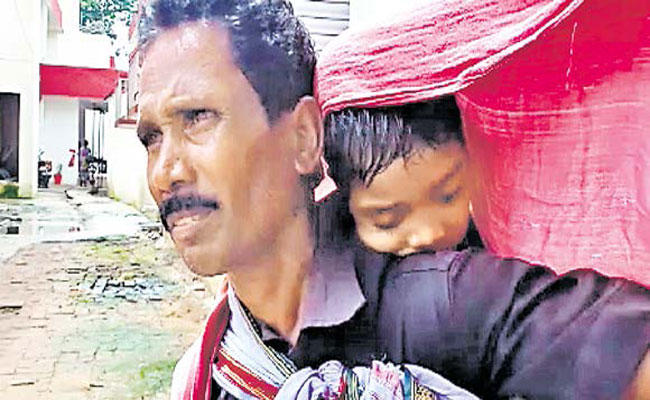
The family’s woe didn’t just end there. The grieving father had to wrap his dead son’s body on a gamcha and tie it on to his back and walk all the way to his home, because the hospital also failed to provide him with an ambulance.

Significantly, Sadar Hospital, Gumla has got model hospital reward by the state government.

However, the civil surgeon JP Singh denied that medicine was not available at the hospital and claimed that Suman was brought dead. He also claimed that Karan Singh did not ask for ambulance and silently took away the body of his son.

Meanwhile, the Chief Minister of Jharkhand Raghubar Das has ordered inquiry into this incident.

However, the counter denial and a probe being initiated, is not being able to pacify the people of Jharkhand. They now want to know, why such incidents taking place in their sate and how many inquiries will the CM initiate? They want to know, when Das will take measures to better the health infrastructure in state.

Last month, a brother was denied ambulance at Chatra district by Sadar hospital authorities, when Rajendra Uraon had died from snake bite and his brother Laxman and wife had to carry Rajendra’s body.

Dead body, ambulance
[/media-credit] File picture of Uraon family carrying the body of Laxman
“It is a known fact that the healthcare system is in shambles in Jharkhand and most cases get referred from one hospital to another or from one city to another. This requires ambulance service and Jharkhand is among the few states of India where there is no 108 ambulance service. Which means, private operators are ruling the roost, and poor often could not afford to pay them,” Krishan Murari Sharma, a social activist told eNewsroom.

“Non- availability of medicine is another common thing in state hospitals, and news reports of how government supplied medicines get sold out into market or are left to expire. But, when it happens in a model hospital, then it worries us more,” Sharma added.