Lack of occupational safety makes six widows under one roof

0

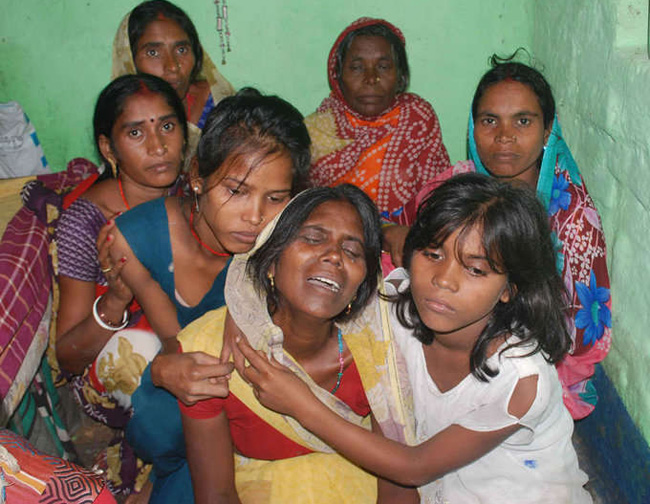
Giridih: What Asha Devi, Gulbi Devi, Shohgi Devi, Kaushalya Devi, Suniyo and Basanti Devi have more in common than just their surnames. The six women are widows, and two among them have not only lost their husbands but sons too.

They hail from a single family, and based in Ranginiya village of Gorhar block, Hazaribagh district.

Sanichar Mahto had five sons — Bada Buddhan, Kanshi, Chota Buddhan, Hira Lal and Teklal Mahto. Asha, Gulbi, Shohgi and Kuashalaya were married to four of the brothers of the Sanichar family.

The brothers were workers who used to install electrical towers and help transmit cables. Despite this being a job with severe occupational hazards, workers of such nature rarely get an opportunity to work near their native place or state.

Among the six deaths, three members of the family died outside Jharkhand and two on foreign shores.

“There is not much opportunity to find work here. So, we couldn’t even force them to stay back or not take up such jobs. We had a dream of a better life, instead we lost our husbands and sons, one after another,” rues Asha.

Kaushalaya and Gulbi are the ones whose tragedies did not stop there, as Kaushalaya’s son Taleshwar and Gulbi’s Prayag also died while working outside and in same work, leaving behind Basanti and Suniyo as other two widows in the family.

The oldest of the men to have died thus was 55 years old, while the younger ones were only 26 and 25 years of age.

Asha was widowed in April 2016, when her husband Teklal died in Saudi Arabia. Just eight days before Teklal’s death, their daughter, Reena Kumari had got married.

While Basanti, now 20, was nursing a three months baby, when her husband Taleshwar had died in Congo in 2014.

Prayag had died in Mumbai, and only two years back he had got married. He had no kids, and his wife Suniyo now lives with her parents.

In 2011-12, the mineral rich Jharkhand state was reported to be having the second highest unemployment rate in India, which tells the story why people migrate outside state to eke-out-a-living.

A report published in the International Journal of Engineering Innovations & Research, volume 5, mentioned that over 1000 electrical workers die each year due to workplace accidents.

There are several laws for workers’ safety in India including the Factory Act. Yet non implementations of the laws are resulting in such deaths on a regular basis and most of them go unreported.There are compensatory acts as well such as the Employees State Insurance Act and the Workmen’s Compensation Act. But to no avail.

The tragedy of this family goes beyond the loss of lives. These women are struggling to live with dignity. Only two of them could manage to get some amount as compensation. One was made possible because the local CPI-ML leaders had stepped in. And the other one got lucky because her husband worked for the Indian Railways who not only give pension but also gave her son a job.

The rest of them are barely able to manage even a single meal a day. “Most of us are not getting widow pension by the government,” complains Shohgi Devi. Fortunately, being physically challenged she has managed to get Rs 300 per month through the disability pension scheme.

“I had no such luck. I neither got any compensation, nor any kind of pension. My parents are supporting me financially. Now my daughter has reached marriageable age. I don’t know what to do,” shares a very worried Asha.

When contacted Barkattha MLA, Janaki Yadav, he told eNewsroom, “We had some knowledge about the deaths in the family, though not in much detail. But, how they are not getting widow pension remains a mystery. These days, the formalities get done in just five days, and recently, five hundred women from Bharkatta block alone have been added to the widow pension list.” He promised to look into all such cases and come up with concrete steps for their wellbeing.

But the question remains, will it be enough?

A Fair To Conquer Fear At Naxal Hot-bed

0

Giridih: From the night of February 11, the officials of Giridih district administration will add a new chapter to their history, by spending night at the Harladih village, in Pirtand block.

The stay will be of great significance, as for more than three decades naxals or CPI-Maoists ruled from the lowland of Parasnath Hills. Leave aside doing over night duty, the officials were reluctant to be posted there.

Pirtand, connecting Giridih, Dhanbad and Bokaro districts, is the place, where Jharkhand’s naxal movement began in the late 70s.

Post 80s, Pirtand graduated to not only being the focal point of the movement but also to serve as a training centre for the naxalites. It also served as a safe red corridor for the leaders of the banned outfit.

Till recent times, Pirtand Police Station had the least number of first information report (FIR) registered. Despite being one of the oldest blocks in Jharkhand, there has been minuscule development in this area.

In order to initiate a fresh beginning for the villagers of this area officials have clubbed their stay with a fair, called the Garib Kalyan Mela Sah Ratri Vishram (Poor Welfare Fair cum Night Stay). This fair is being organised for 21 villages, belonging to six panchayats. Twenty stalls will be set up by different departments like health, education and agriculture, to name a few, during this fair. Along with a night chaupal, a football match will be organised in the following morning.

“We want to send a message to the people living in these areas that, the administration is available for them, just like for others. Also, that we can go to any extent for them,” elaborated Uma Shankar Singh, Deputy Commissioner, Giridih, while briefing media persons about this stay.

Around 300 officials of district administration will be posted there for 24 hours. The duty of these officials begins from 9 am on February 11 and ends next day, around same time in the morning.

“We have been working on this for few months now. Normally, in such a fair, we opt for on the spot applications, and provide its benefits later. However, in this case, we have already identified most of the beneficiaries. We have plans of accommodating around 550 local youths in government and private jobs,” Singh informed.

However, the biggest challenge for the superintendent of police Akhilesh Variar, who has to conduct everything safely, said, “We have come to know that people of these villages feel that we don’t visit these areas because of the Naxalites. Organising such a fair, is our way of sending across a message that we can go anywhere, anytime.”

On being asked how fruitful will be such an exercise be when many officials do not stay there during their term. The deputy commissioner replied, “From now onwards, we are going to make officials mark their address and send it to Chief Secretary, to start off an inspection, with regards, to officials who don’t stay posted there.”

Last December, the administrative officials of Lohardaga had also stayed overnight at the Panchayat Bhavan. Given that, Giridih is a naxal hot bed, and Harladih, a place where only police have been able to do Long Range Patrolling (LRP). Even the government schemes do not reach there. This initiative will thereby, mark the beginning of a new chapter.

Irada Director: Directing Naseeruddin Shah sir, was like a dream

Kolkata: It’s just a week for Aparnaa Singh’s directorial debut Irada to release. Her schedule is chock-a-bloc, but that doesn’t stop her from taking out some time to talk exclusively to eNewsroom, about her directing Naseeruddin Shah and Arshad Warsi for her big Bollywood break. Following are excerpts from a freewheeling chat with her.

eN: Why did you choose a film like Irada to be your Bollywood debut, as a director?

Aparnaa: I have always been part of films that are thought provoking, be it co-scripting for Anuraag Kashyap’s Gulaal or doing the research for Black Friday. So, choosing Irada, as my directorial debut for Hindi mainstream cinema, is just an extension of my choice of doing films that connects with the audience and educates them and yet not preaches. The film belongs to the noir thriller genre, with a strong resonance of environmental terrorism that we experience daily.

We all know what’s happening to Punjab. It was the centre of green movement and look where it is today. It’s now a cancer belt.  The crop it produces are often are labelled as food items than can cause cancer. It’s scary, isn’t it we all have rice grown in Punjab.  There was a need to make a film like this, which would wake us up to certain extent.

However, it’s not a gory dark film. It has a lot more to it. It’s a perfect balance between facts and drama. It has a lot to do with water.

eN: Well, was the Bhopal Gas Tragedy, on your mind when you were scripting the film?

Aparnaa: Well, definitely. Given the fact that I hail from Jabalpur, Madhya Pradesh and have spent considerable amount of time in Bhopal, so somewhere deep down it was on my mind while scripting the film. You, know the Badi Talaab of Bhopal, is a very popular place, where people assemble late in the evening, catching up with friends, indulging in a bit of the delicious roadside food available round the clock. However, if you think deeply, the truth is that there is something poisonous about that water, post Bhopal Gas Tragedy (BGT). No matter what the Union Carbide officials say, some amount of toxicity has definitely seeped down the soil, into the water. The changes that it (BGT) has brought about to the ecosystem of Bhopal will remain irreversible.

eN: How difficult was it for you to co-script this film?

Aparnaa: To dish this story as a palatable one, which could entertain and educate the audience at the same time, was indeed a difficult task. To be honest this was the most difficult story to script.

eN: What was it like directing Naseerudin Shah?

Aparnaa: It was an experience, rather a dream come true for me. No other could have done justice to the character he plays in the film. He has reached such a state, where he gives the perfect shot, even without having to give an extra effort.

eN: Your first shot with him?

Aparnaa: I went to his van to discuss the scene with it, as that’s the norm while shooting. He made the environment so conducive that I forgot that I was talking to “the Naseeruddin Shah”. He listened to me, gave his inputs. Indeed it was a great learning experience for me.

eN: What was it like working with Naseeruddin Shah and Arshad Warsi, together?

Aparnaa: Both are legends in their own right. Their performances are powerful and when they work together, its sheer magic. I mean, they share a great onscreen chemistry. While Naseer saab, gets into his character the moment you say “action”. Arshad sir, is more spontaneous. He is so amazing and also helps in improvising the shots. It was a learning experience for me to have directed them together in a single film.

eN: What genre of films do you enjoy, personally?

Aparnaa: It’s drama, thrillers and really emotional stories that appeal to me. I also like films that have been researched well.

eN: Given that, you have worked with exceptionally good filmmakers, Anurag Kashyap and Tigmanshu Dhulia. Are you influenced by them?

Aparnaa: Well, I have learnt so much from Anuraag and Tigmanshu. They are quite knowledgeable and well-read. They are the finest that we have today. So, yes, they definitely are the torch bearers for me.

A dead body reaches India after 195 days

0

Giridih: The dead body of Nunuchand Mahto, which was lying  in Saudi Arabia for 194 days, reached Bagoder, Giridih, Jharkhand on the intervening night of February 6-7.

eNewsroom, which had done a detailed report after meeting the wife and children of the deceased on February 4. And, had also used social media to highlight the issue in front of the concerning minister.

Nunuchand had gone to work in Saudi, on July 6, 2016 and had died from from cardiac arrest, within 20 days of joining. Thereafter began a long exchange of letters between the concerned departments of the two countries, which in a way delayed the arrival of the dead body back to his native village.

Nunuchand is survived by three children and wife, for whom every passing day was bringing unbearable pain.

Soon after the news of Nunuchand’s death had broken out, Bagoder legislator Nagendra Mahto had written to the External Affairs Minister Sushma Swaraj, who had created a grievance id at the Madad portal.

While, former MLA Vinod Singh had met the grieved family and had also talked to the Arabian Teams Contracting (ATC) Establishment regarding compensation, following which they agreed to pay 10,000 Riyal or 1.7 lakh in Indian rupee.

However, as it happens in most of such cases, because of several formalities get done, it delays the arrival of the dead body from international shores. And when it get delayed for over six months, matter was raised inside the Jharkhand assembly also.

But, when the news was tweeted to Sushma Swaraj, it got attention outside India too, and Manik CD tagging enewsroom mentioned that his uncle’s dead body is also lying at Kuwait embassy for four days. We also tracked that development and today Manik tweeted that his uncle’s body is being dispatched.

While back in Jharkhand, a Whatsapp group specially meant for non-resident Indian (NRI)s created by Sikander Ali kept informing the concerned people for six mont

Digitalisation is a Double-edged Weapon

0

Digitalisation, which Prime Minister Narendra Modi is touting as the panacea for the country’s ills, is a double-edged weapon. If it can help solve problems, it can also make the job of the rogues easier. It was the digitalisation that turned small examination frauds into what has now come to be known as Vyapam scam of Madhya Pradesh, the country’s biggest examination and recruitment racket, having affected careers of thousands of young girls and boys. There is no record of how many of them must have ended their lives in sheer frustration.

Vyavsayik Pareeksha Mandal (Vyapam) or Professional Examinations Board (PEB) was constituted, initially, to conduct tests for admission to medical colleges (PMT). Later on, the tests for admission to engineering colleges (PET) were also entrusted to the Vyapam. In 2007, Chief Minister Shivraj Singh Chouhan entrusted to Vyapam the responsibility of making recruitments for some government departments, public sector undertakings and semi-government bodies also, which was till then handled by the State Public Service Commission. The avenues of earning money and obliging important persons thus widened further with the recruitments being made for various departments such as the police, education, transport, civil supplies and weight and measures.

The modus operandi used in the scam was somewhat like this: the candidates for PMT who had done well will be disqualified and other names (either on the recommendation of some important person or against payment of a heavy amount) will be shown as having qualified, and even put in merit list, for admission to medical colleges. After investigation, the Special Task Force (STF) of Madhya Pradesh police has come across names of doctors working in important government hospitals who had not even appeared in PMT but had been declared qualified against payment of hefty sums. The young boys and girls who had worked hard for their tests were just at a loss to understand what went wrong.

Dr Anand Rai, an Indore-based ophthalmologist who has played an important role in exposing the Vyapam scam, explains the traditional methods of cheating as ‘impersonation’ and ‘engine and bogey system’. In the first the admit card of a candidate is used by replacing the photograph of the candidate with that of the impersonator. In the ‘engine and bogey system’ the person appearing in the test is strategically seated between two candidates by the Board officials and he/she can copy from their sheets. The Board officials, examiners and impersonators are paid hefty amounts.

Then a third method was evolved by Vyapam officials to help the paying candidates; they were asked to leave their answer sheets blank and were given high percentages after the exam. Later on the records were changed or destroyed.

However, this all changed with the digitalisation. There was no need for assembling impersonators or making seating arrangements in the exam hall. Just the name of the candidate who has appeared was replaced with the scam beneficiary with high marks (according to the money paid) in the excel sheets. This turned out to be so simple a method for getting ‘one’s own candidates’ selected that Chief Minister Shivraj Singh Chouhan took the recruitment in several departments out of the jurisdiction of the State Public Service Commission and entrusted it to Vyapam in 2007.

Sunny: A reel to real Slumdog Millionaire

0

 Kolkata: His is a real life rags to riches story or Slumdog Millionaire. He is the Indian small wonder, who is grabbing all the attention, globally. Well, we are talking about our very own Sunny Pawar, the young Saroo, who is winning hearts across the world with his performance in the highly acclaimed Hollywood film, Lion. The movie has received six Oscar nominations. Sunny plays the role of young Dev Patel in Lion. Dev Patel, had played lead role in much acclaimed Slumdog Millionaire Hollywood movie.

Posters of the Oscar nominated film Lion has Sunny stretching his arms to catch butterflies. Just like little Saroo, the character he plays in the film Slumdog Millionaire, Sunny loves chasing the butterflies. So what if he is yet to come to terms with those chasing him for an interview?

This is a big leap for a child who enjoyed watching television with his younger siblings in the slums of Mumbai’s Kalina area and dreaming of being on television someday. With no acting background and no English-speaking skills, Sunny was only five when he was auditioned for the role.

When Sunny, was quizzed about his selection, over the phone, he said, “We received a brochure in our school about the audition happening for the film in Andheri. A lot of my classmates were going for it, so even I tagged along with my father for the audition. However, we were not asked to do anything special for the audition, just play and run. Well, that’s how I got selected for this role.”

After being chosen over thousands of kids for the movie, Sunny, then barely 6 years old had traveled to Kolkata and Australia to shoot for the film, which is based on a real life story.

But, the cute kid does not hesitate to share that he is tired of all the questions being thrown at him and that he would rather play games than answer being posed at him by journalists. However, on being prompted by his father he is quick to add that he is loving all the attention. Studying in standard 3 at a local school in Mumbai Sunny’s story is what Bollywood dreams are made of. His father has already left his job to manage his now famous son’s career.

Sunny
[/media-credit] Sunny Pawar
Sunny had also made headlines for not being granted the US visa to attend the screening of Lion. He finally went on to share the red carpet with his co-stars including Dev Patel, Nicole Kidman and Priyanka Bose at the 8th Annual Governors Awards in California.

And all he says about the red carpet moment was that it was a lot of fun and he got to wear a suit. Clearly, stardom is yet to affect his innocence but stars like Nicole Kidman are already his fan. “Sunny is this little light and he makes the huge story leap very believable, from small Saroo to big Saroo,” shares Kidman.

The child artist bonded with Nicole Kidman and David Wenham, his on-screen parents, by playing cricket with them – scenes which eventually made it into the film was guided by director Garth Davis through improvised sign language to communicate. There used to be extensive rehearsals before the shoot.  But he brushes aside any suggestion of stage fright or being intimidated by the limelight.

A short conversation made it evident that Sunny, who was familiar only with his mother tongue Marathi, is now quite conversant in Hindi. He seems quite relieved that his friends and teachers have not started treating him any differently than before even though they are proud of him.

Talk about shooting at various cities for the film, he says that of the places he had visited while filming he loved Australia the most? And what about Kolkata? He had spent a month in the city, shooting for the film. He reveals that despite having visited all tourist spots in the city, he cant recall much.

The Weinstein Company, which has the distribution rights of Lion, had pitched the child actor for a potential Best Actor Oscar nomination, following strong reviews of his performance at the Toronto and London film festivals . Here’s wishing the rising star all the very best.

192 days, a dead body’s endless wait to return India

0

Giridih: Chinta Devi, spends hours wondering if she will get to see the dead body of her husband, Nunuchand Mahto sometime soon. Part in denial, part in remorse, Chinta, is torn apart in a mental turmoil. “I had no idea such a thing (referring to her husband’s death) would happen. I had talked to him on that fateful night.”

Mahto, a 42-year-old, a electrical fitter, and resident of Tirla village of Bagoder block in Giridih district, Jharkhand, had gone to work in Tamra city of Saudi Arabia on July 6, 2016 itself and had unfortunately passed away only twenty days later. Earlier he had worked in Malaysia for two years.

After his sudden death, his colleague, who is also a resident of Bagoder had called the family. Without revealing the death information, he had said that they will take care of the education of Mahto’s kids. The call had surprised the family.

Soon, the family members started contacting other colleagues of Nunuchand to know what exactly had happened. However, nobody was ready to tell the exact reason as there had been no official confirmation about it.

It was only after a fortnight, that the middle man who had sent Nunuchand to Saudi, sent a hand written letter, informing the family members about his death, on July 31.

“After almost a month, we got a letter from a hospital in Tamara, mentioning that when Nunuchand had arrived at the hospital, he was already dead. He had died from a cardiac arrest. Also, if they would permit for a post-mortem to be conducted. But, in hospital’s letter, the date of his death of mentioned was mentioned as July 26,” said Prakash Mahto, brother-in-law of the deceased.

In reply to the hospital letter, Chinta Devi said that they do not want post-mortem of the body.

Mahto is survived by his wife and three children, Poonam Kumari (16), Mukesh Kumar (10) and Khushi Kumari (6). Poonam, a standard eleven student, reacting the situation, where her father’s body is yet to arrive after 191 days of his death, says, “We are still hopeful of getting his mortal remains back, but you people have to help us also.”

Interestingly, the brother of the deceased, Babulal Mahto, also bagged a job with the same company— Arabian Teams Contracting (ATC) Establishment and went to Saudi on August 28.

“While leaving, he had said that soon after reaching there, he would be sending the dead body of his brother, but there has been no contact with him also,” said Chinta.

Whereas Chinta and her family members are furnishing all details to leaders,  the embassy and district administration, their wait is getting longer.

Prakash also says that as soon as he got the information over phone, he had met Bagoder”s BJP MLA Nagendra Mahto, and later former MLA Vinod Singh.

Singh even had had a word with the company officials.

“I talked to them, to  which they agreed to compensating the family. Later, they transferred Rs 1.7 lakh to his wife’s account. While some immigrated labours have also collected money for the family,” informed the former legislator.

MLA Mahto on the other hand, on August 6, wrote to the Minister of External Affairs, Sushma Swaraj, bringing the case to her notice. Nunuchand’s case was given a grievance identity number — SB2MTR101010216 on Madad, a website, initiated by the ministry of External Affairs, to file consular grievances online.

Last updated is on January 22, his grievance case, says that NOC for transportation of MTR has been issued. But in it’s December 15, 2016, it has also mentioned that they have not been able to establish contact with the family and that the dead body can be buried by the authorities in Saudi Arabia.

Amidst all, on January 23, CPI-ML MLA Rajkumar Yadav raised this issue in Jharkhand Vidhan Sahba, as to why Nunuchand’s body is lying in Saudi and had not been brought back home?

The government in its reply cited the same reason for the delay— demand of no post-mortem by the family.

When contacted, Mahto told eNewsroom, “One week back I had got a call from the Indian Embassy in Saudi Arabia informing me that all formalities had been done, but there has been no further update on the issue. I will check to know why the body has not reached yet.”

With her children, a mother also left city to make them doctor, engineer

0

Jaipur: Meet Razia Begum, a new age mother, who moved on to Kota from Sikar, Rajasthan for her kids. And yes, you heard us right. Razia stayed put for six long years in Kota, so that her two kids could crack the engineering entrance examination and another the medical entrance exam to become engineers and doctor. Razia’s husband Mohammad Hussain, is a Nayab Subedar in the Indian Army. However, instead of choosing to stay posted with him, she chose to take care of children in Kota, so that they could be guided well.

“My brother Shahid Hussain, was a bright student. He wanted to become an engineer, hence he got enrolled in a coaching institute in Kota. But Abbu was posted in Punjab. Ammi didn’t want my brother to live alone in Kota, so she packed her bags and tagged me and my younger sister along with her to Kota. It was here that we did our schooling, while bhai jaan prepared to crack the entrance examination,” said Mohit Alam, the second son of Razia to eNewsroom.

Razia’s stay gets longer

So, by the time, Shahid cracked the exam, Mohit was already preparing for his engineering exams. “Despite my brother having made it to National Institute of Technology (NIT) Kurukshetra, we had to stay back in Kota. As by then we were ready to take those preparatory classes,” he recounts.

Soon after he cleared All India Engineering Entrance Examinations (AIEEE) and got admission in NIT Durgapur, Tabassum Khan, Razia’s youngest child began her medical entrance examinations. This made her stay back in Kota till Tabassum cleared the entrance exam.

Six years itch gets over

“My sister cleared the medical entrance and got admission in Jaipur’s SMS Hospital, in 2014,” he informs. Post which,  Razia returned to Sikar lead her own life. However, soon her husband got posted to Jaipur, where she is now living with him. Her sons too seem to be doing well in life. Both her sons are working in Noida — one with Honda Car and the other in a multi-national company.

Interestingly, Razia, is just a standard 5th pass. Guess, this what pushed her to leave her comfort zone for six years, just to help her kids avail the best education.

Can you move out of your comfort zone or how much you will push your limit, for the better education of your children? Drop in a line in the comment box to let us know.

Bullet Trains: The Secret Of China’s Growth

0

Kolkata: As the train route for India’s first bullet train has been identified, it is believed that India will soon have its bullet trains. Taking this opportunity, I am sharing my first experience with China’s high-speed train.

Before I begin, let me clarify that the bullet train is considered a high-speed train in China.

In May 2015, when I landed in Beijing and was trying my best to get acquainted with the city, a friend of mine, Aakash Salampuriar, came to meet me. He was there on a scholarship. During our meeting, he asked, “Did you check out the high-speed train?” I replied, “You mean the bullet train? No, not yet.” To this, he said, “You should. When you travel by China’s high-speed trains, it will be an unforgettable experience.”

It took me a fortnight to make my first trip on a high-speed train, but it turned out to be a significant one — from Beijing to Shanghai, as I had to visit Wuxi, a city in Jiangsu province. Wuxi is only 117 kilometers away from Shanghai and, due to its rapid growth, is often referred to as “Little Shanghai.” Wuxi and Suzhou, two neighboring cities, host offices of all the Fortune 500 companies.

My company’s human resources representative accompanied me to the Beijing Nan (South) station. Upon arrival, I realized that navigating the enormous and crowded station alone would have been challenging. Entering the station and reaching the platform seemed like a daunting task.

Beijing Nan station, inaugurated in 2011, serves as a hub for trains traveling to every part of China. The cleanliness of the station stood out, especially considering that around a lakh (100,000) commuters use it daily. Reports suggest that approximately 2.2 lakh (220,000) people travel daily between China’s national capital and its financial capital using high-speed trains.

The cleanliness is maintained by two contributing factors: the tireless efforts of the cleaning staff, who work round the clock, and the disciplined behavior of travelers, who ensure their waste is disposed of in the numerous dustbins installed around the station.

High-speed trains reduce travel time to one-third of what regular trains take, and as a result, they primarily feature chair cars to accommodate more passengers and allow for quicker reservations.

Tickets between Beijing and Shanghai are priced at RMB 550, which is quite reasonable considering the reduced travel time. The ticket includes a QR code and the traveler’s name printed on it.

Interestingly, passengers can enter the platform premises only 15 minutes before the train’s departure. Anyone arriving less than five minutes before departure will not be allowed in, even if the train is still at the platform. However, tickets can be exchanged for the next available train without any fare deduction.

Upon entering the train, stewards, dressed as professionally as airline cabin crew, warmly welcome passengers. As expected from the clean platform, the train’s interiors, including the coaches and toilets, were spotless. Staff members were available round the clock to ensure cleanliness throughout the journey.

Now, for the most crucial aspect: speed and travel time. The maximum speed during my journey was 309 kilometers per hour. At such speed, the external view from the window becomes the only indicator of the train’s velocity. The train covered 1,200 kilometers in just 5 hours and 10 minutes to reach Wuxi, while it takes 5 hours and 30 minutes to reach Shanghai. Delays are rare and usually last no more than 5 or 10 minutes.

To put it into perspective, the distance between Delhi and Howrah (1,400 kilometers) could be covered in less than six hours with such trains.

China has a high-speed railway network spanning approximately 20,000 kilometers, connecting all provinces. On January 6 this year, China unveiled the world’s longest high-speed railway line, stretching 2,760 kilometers between Beijing and Kunming, the capital of Yunnan province. This journey now takes only 13 hours to complete.

After leaving the train, I had only one thought: if such a facility were available in India, it would save so much time that could be utilized for more productive activities. Currently, Indian trains not only take significantly longer but are also frequently delayed.

It’s no surprise that most people in China prefer high-speed trains. They eliminate lengthy check-ins and security procedures, allow unlimited luggage, and offer a fast, comfortable journey.

It will be fascinating to see how bullet trains reshape lives in India once they are introduced.

A cup, to conserve water, thanks to ‘water man’ doctor

0

Kolkata: Recently, Aamir Khan, launched the anthem Ala Toofan, for his pet project – The Satyamev Jayate Cup, an initiative by The Paani Foundation, that aims at maximising watershed and water conservation. The second edition of this competition– Water Cup is all set to kickstart on April 8, 2017. The tournament, which started off with a modest 3 districts participating in 2016, will be witnessing 30 districts participating this year.

The nation, has gone gaga over the motivational anthem, but do you know the man who motivated Mr Perfectionist to kick start this unique tournament? Meet, Dr Avinash Pol, a dental surgeon by profession and a water conservationist by passion.

The water man

A 43-year-old dentist hailing from Satara, Maharashtra, is busy travelling to various districts, building up the tempo and even handpicking a few villagers to be trained for the tournament. It took a good five days to get a slot of 15 minutes for this interview. “The tournament is about to take place. It’s getting more hectic with every passing day. Every morning I have to do shramdaan for two hours at Ajinkyatara, then attend my patients in the hospital post which I have to do work related to this tournament. At the moment I am in Sholapur and am busy doing the groundwork,” he says.

What is this Ajinkyatara and shramdaan, he is asked. To which he says, “This is where I began my journey as a conservationist. On January 12, 2013, in response to an appeal made by a local newspaper to clean the fort’s premise, I reached Ajinkyatara, a Maratha fort in Satara district. Two more people turned up in response to this advertisement. Since then, it has become a daily practice for me and them to reach the spot by 6:30 in the morning and toil for two almost two hours to clean up the fort premise. By the way, with time, our team is now a 40-member team.”

Recalling his journey  Dr Pol shares, “When I began practising in Satara, most of my patients complained about none of the government plans being implemented. They also complained of water crisis. So, one day, one of my patient asked me to attend a gram sabha related to public toilet. To my surprise not many turned up. However, that didn’t deter me from helping those villagers set up public toilets.” He laughs, and says, “Believe me I didn’t have to shell out a single paise to help them. All I did was, help them avail benefits from government schemes.”

Every government has policies to resolve water issues

Two decades back, this was how, Dr Pol began his humble journey as a social crusader. However, with time, he noticed that the problem of water scarcity, was increasing.

He reveals that any government, be it the Congress, BJP or any other political party at the centre, all set aside funds for the drought hit areas. “There are many government funds, but mediators to make them reach where needed is rare. So, I took it upon myself to be that missing link. I used to scan newspapers for news related to water conservation. I was also toiling two hours on daily basis, with my group at Ajinkyatara Fort. Our efforts, were already paying rich dividends, my group had grown. It comprised of a healthy group of 40 people, who without any communication or reminder reach the fort at 6:30 pm sharp, for the two hours shramdaan, as we call, for the betterment of the fort,” he adds.

His tale travels

His work was now and the changes he was bringing about in drought prone Satara district, was making people take notice of the silent revolution that he had brought about. One day, an official from his village introduced, him to a person called, Satyajit Bhatkal, who had come to know about his work and plan. A few days later the man was back, but this time with his crew. “Satyajit shot a documentary of the work that we were doing to conserve soil and water at Ajinkyatara. He showed my work to Aamir, who called me over for a lunch. He told me that he wanted to do something for drought prone areas. But I dissuaded him from giving grants or funds to the villages. They didn’t need money. What they needed was direction and guidance on how to conserve,” Dr Pol recalls.

That was when the idea of hosting the Water Cup took place. So, what is this water cup all about? Do people play matches? Well, for the uninitiated, Satyamev Jayate Water Cup, is a competition, held in Maharashtra, under the aegis of Paani Foundation, a non-profit organisation run by Bollywood star Aamir Khan, that aims at addressing drought issues in Maharashtra.

The Water Cup

The Satyamev Jayate Water Cup, Season 2, is a competition with a difference. During this contest, spanning over a time period of 45 days, participating villages work for watershed management and water conservation. The best performing village wins a trophy, and a prize money of Rs 50,00,000.

So, now with so much of a change coming in, does it mean that his work is done? “This is just the beginning. Helping out 70 villages till now is too little. When we will be able to eradicate this issue of water scarcity, from India, then the job will be done. But we will be able to achieve this, only if every single citizen is motivated to bring about a chance. Remember, no policy, no fund can bring about the change, unless, we get involved.”

So, are you ready, to contribute? Let’s just begin by not wasting water. What say?