Adani’s Godda Power Plant is a tale of oppression, forceful land acquisition and violation of human rights

0

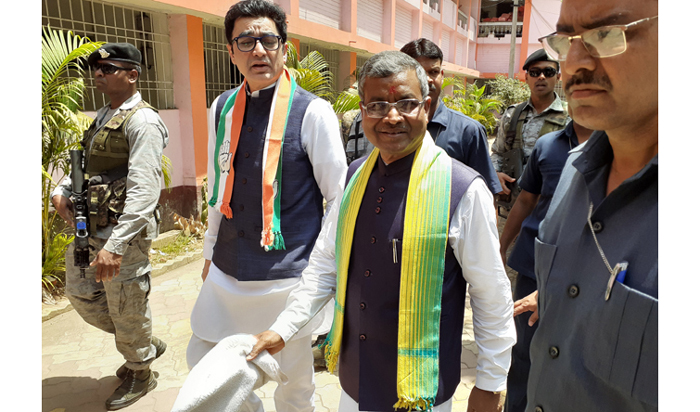
Ranchi: The fact-finding team of Jharkhand Janadhikar Mahasabha, an umbrella network of 30 organisations working for the betterment of the common men, on investigating the truth of Jharkhand government’s much hyped MOU with the Adani group to setup a power plant in its Godda district found that the project tells a saga of forceful acquisition of land and severe violation of processes set by land acquisition act 2013. It has also noted that the project to attain the target has done it all— right from bulldozing standing crops of farmers to lying to people about the potential benefits to intimidating affected people with police brutalities to filing lawsuits and so on.

According to the social impact assessment report of the proposed company, 1364 acres of land spreading across 10 villages belonging to two blocks of Godda district are to be acquired for the setting up of thermal power plant, which is to produce 1600 MW of electricity.

Both the government and company claim that the plant is a public-project with ‘zero’ displacement. They further claim that it will lead to employment and economic development of the area. The company maintains that 25 percent of total power generated would be made available to the state, while the remaining 75 percent would be sourced out to Bangladesh.

However the fact-finding report shared with eNewsroom stated, “The ground realities are far from these claims. According to the acquisition act, consent of at least 80 percent of affected families and permission of the concerned Gram Sabhas are required for acquisition of land for private projects. But most of the adivasi and several non-adivasi landowners are opposed to the project from the beginning.”

The report indicated that between 2016 and 2017, public hearings for social impact assessment (SIA) and environment impact assessment (EIA) had also been organised. However, during those hearings several landowners opposed to the setting of the plant had been barred from attending the event by Adani functionaries and local administration. “The affected villagers also claim that people of non-affected areas were made to sit in the hearings. In one of these meetings, when affected families had protested against not being allowed to express their views, the police had misbehaved with several women and lathi charged at them,” mentioned the report.

The social activists who did the ground study maintained that the social impact assessment report of the company had factual and constitutional errors like the report stating that no person in the village had been affected, zero displacement of villagers and all the residents being marked as Hindu. “The report does not mention the other alternatives for the proposed project site. It is silent on the number of jobs that would be created by this project. Also, neither the video recording of landowners giving their consent for the acquisition nor the signed consent forms are available. It must be mentioned that the act clearly specifies that affected families do not only include the land owners but also the workers and sharecroppers,” pointed out the report.

What the Mahasabha wants:

  • Implementation of the illegal project be immediately stopped, acquisition of land for the plant be stopped and illegally acquired land be given back.
  • Since this project has violated several constitutional provisions and laws, a judicial inquiry of the project be undertaken and  legal action be taken against the Adani company and responsible officials for the exploitation of people
  • All affected families to be compensated for the loss of crops and livelihoods

For the uninitiated, the Jharkhand government has acquired around 500 acres of land in four villages of Godda district, of which 50 acres of land had been forcibly acquired from the 40 families who owned it. “In its attempt to forcefully acquire land, the company with the support of the local police, bulldozed standing crops, several trees, burial ground and pond across 15 acres of land of Manager Hembram and five other adivasi families of Mali village. While forcefully acquiring land of Motiya village’s Ramjeevan Paswan, Adani functionaries threatened him that he would be buried in his land if he refused to give it to the company (“zameen nahi di to zameen mein gaad denge”). The police refused to lodge his complaint against the functionaries,” further alleged the fact-finding report.

The report also accused the Deputy Commissioner of not taking action when the people of Mali complained against the forceful acquisition of their land. The reported further added, “Instead (he) told the people that since their lands had been acquired, they should just take the compensation.” According to report, the inhabitants of the area maintain that about over 1000 families would be displaced if land is acquired from the marked villages, which in turn would have a direct impact on their livelihoods and survival.

It poses a grave threat to the adivasi families, whose cultural and historical identity is at stake with the acquisition of land. Interestingly, Section 20 of the Santhal Paragana Tenancy Act bars the transfer and acquisition of agricultural land in Santhal Pargana for any government or private projects, barring a few exceptions.

The project also has its environmental impact too. The project requires about 14-18 MT of coal for power generation, annually. The plant will further need about 36 MCM water on a yearly basis, which will be sourced from the Chir River. “This will drain up the limited source in the water-deprived district of Godda,” pointed out the report.

Interestingly, a recent newsreport had exposed how Jharkhand government changed its energy policy in 2016 to buy power from the Adani’s company at a higher rate which might cost the exchequer more than Rs. 7000 crores in the next 25 years.

Based on its fact-finding report the Mahasabha, on behalf of all the constituent organisations and activists have demanded for the project to be stalled immediately as it violates several constitutional and legal provisions.

Do election duty honestly at your own risk in Madhya Pradesh

On complaints from the Congress, the Election Commission has removed Bhind and Satna Collectors. A common complaint against them was preparation of fake voters’ lists. Bhind Collector Ashish Kumar was said to have included in the voters’ lists the names of residents of Uttar Pradesh. The allegation against Satna Collector Mukesh Kumar Shukla was that he had allowed inclusion of 73 names in the voter’s lists without their applications.

The Bhind Collector was further accused of allocating mines and allowing illegal sand excavation and transport from the district while the Satna Collector was said to have helped in Chief Minister Shivraj Singh Chouhan’s ‘Jan Ashirvad Yatra’ in violation of the Model Code of Conduct. Some other government employees have also been removed from their positions following complaints against them that they were helping BJP.

The election law is so inadequate that Election Commission’s wrath hardly works as a deterrent, particularly for IAS and IPS officers. They know that if another party replaces the BJP in the November 28 poll, there will not be much dent in their positions. But if the BJP returns to power, they will be rewarded suitably. It has happened in Madhya Pradesh.

When Chouhan became Chief Minister in November 2005, he was not a member of the Assembly but a member of Lok Sabha. He resigned his Lok Sabha seat and contested from Budhni in Sehore district where a by-election was held following resignation of the MLA who was loyal to Chouhan. Sehore Collector and Returning Officer S K Mishra was removed by the Election Commission at the peak of the campaigning – a rare incident of the Returning Officer being removed a few days before polling. Mishra was openly working more like a BJP worker than an IAS officer. As soon as the Election Commission’s Model Code of Conduct was over, Chouhan made Mishra Bhopal Collector. It was a big jump for the promotee IAS officer to be posted to one of the most prestigious and coveted posts whereas Sehore is one of the smallest districts. Thereafter, Mishra was made Secretary to CM and also Secretary, Mines Department where he supervised illegal mining in which relatives of Chouhan were said to be involved. It was only after an IPS officer, N K Singh, was crushed under the wheels of a dumper carrying illegally mined stones in Morena district, reportedly at the instance of mining mafia, that Mines Department was taken away from Mishra. Singh was getting a bit too zealous in trying to curb illegal mining.

If the dishonest officers helping the BJP are duly rewarded by the party if it returns to power, those doing the election duty diligently and honestly are punished also. Election Commission has no power or mechanism to protect them. During the 2008 Madhya Pradesh Assembly elections, Phoolchand Verma had filed his nomination papers as BJP candidate from Sonkutch (SC) constituency in Dewas district and the Congress candidate was Sajjan Singh Verma. Tukojirao Puar, a Minister of State in Chouhan’s Council of Ministers, was the BJP candidate from Dewas. At the time of the scrutiny, Tukojirao Puar and Phoolchand Verma created a ruckus in the office of Dewas Sub-Divisional Magistrate (SDM) Sanjana Jain, who was the Returning Officer for the Sonkutch (SC) constituency. They wanted Sanjana Jain to reject Sajjan Singh Verma’s nomination papers because, they claimed, he did not submit Form-B (letter of authorisation from the party) within the stipulated time. As Sanjana tried to explain the things, Puar lost his temper and he and Phoolchand Verma started threatening her and shouting that she had taken a bribe of Rs one lakh for adjusting Sajjan Singh Verma’s Form-B submitted belatedly. The rowdy behaviour of the BJP leaders lasted for quite some time.

After receiving a report, accompanied by a CD of the proceedings in her office, from Sanjana Jain, the Election Commission pondered over the matter and directed the Chief Electoral Officer of the Madhya Pradesh to get a criminal case registered against Puar under Sections 186,353 and 506 of IPC. As the Sections make it a cognisable offence, Puar was arrested by the police. At the same time, the Election Commission ordered immediate removal of Dewas Collector Navneet Mohan Kothari, who was the District Returning Officer, for not sending Sanjana Jain’s report to the Commission promptly.

Chouhan told an election meeting at Dewas a few days later that he was proud of Tukojirao Puar. As the BJP returned to power, Chouhan promoted Puar to the cabinet rank. Criminal case against Puar had to fizzle out because it was handled by Chouhan’s police and Chouhan’s prosecutor. Election commission had no role in defending its own action against Puar. A little later, Sanjana Jain was removed from field duty on a flimsy ground and given a desk job at the Academy of Administration in Bhopal.

Why should the officers annoy the party in power by working honestly for Election Commission which cannot defend them against injustice?

The Love Song of Maya K and Other Stories offers a Slice of Modern Life in Metros

0

The back cover of The Love Song of Maya K and Other Stories, reads: A rumour that ends in calamity; A girl who is demonised because of her ‘evil’ horoscope; A man who preys upon young girls; A train journey that forces a woman to look at her marriage anew; The gorgeous inner life of a shop girl; A child overwhelmed by the wonder and terror of his world.

Set in Kolkata and Delhi, the stories in this collection deal with love and betrayal, dogma and superstition, sexuality and thwarted desires. The characters belong to the world of urban, aspirational India where snobbery and rat race go hand in hand with class and religious conflicts. Dark or funny, satirical or poignant, these stories are as much a snapshot of modern India as they are an intense crystallization of the unpredictable chaos pervading our lives.

Dedicated to her mother, the author looks through the prism of reality to write about women and their everyday existence, thereby turning the mundane into a story worth telling.

The first thing you notice about The Love Song of Maya K and Other Stories is that it looks at ‘news’ from another perspective. From the very first story it is evident that the author has taken inspiration from the happenings around and turned them in the head. This is not surprising given that she has been a journalist and continues to write on current affairs for various media houses. What surprises though is the way her stories end. Or rather remain open ended, much like poetry. Her English doesn’t make you reach out for the dictionary or google but impresses you with her felicity with words. It is not the common everyday Indianised English. Nor does it use the erudite and complex Tharoorian expressions. It is good old English that add a smattering of European romance to tales set in Kolkata and Delhi.

book shuma raha
Shuma Raha

From the very first story, the author manages to catch your attention and by the time you reach the title story it makes you jump up in surprise. The ending is as unexpected and as subtle as it could get.  With a touch of passion thrown in. The rest of the stories too keep your interest intact as the author delves into the mind of the protagonists. The story of the old decrepit bungalow being sold off brings out the nostalgia of an era gone by, losing its grandeur and giving way to the mundane. While a parallel sub plot tells yet another story, all in that one short story.

The interplay between passion and compassion forms the warp and woof of another telling tale of a modern day married life, seen through the eyes of a little boy. Kudos to Shuma for keeping the innocence intact as a seven-year- old tries to make sense of the world around him while talking about a relationship that in today’s parlance would be termed “it’s complicated”.

It comes as no surprise that most of the stories are woven around women characters. Shuma, the news breaker writes the news stories. But she writes them this time not to grab headlines but to read the minds of the newsmakers. It’s as obvious as daylight. But even if one is unaware of the real life incidents around which the fictional tales are woven, the stories, each one of them, make you stop and ponder or smile, especially if you have been a student of English Literature.

The reference to TS Eliot is quite obvious. Perhaps the author is reminding us of the Wasteland that is creeping up on us. Or perhaps it’s just her testing the waters with fictional writing. A couple of stories do read a bit vague, as if something is missing. But for a first book by a new author, this one is highly recommended reading. As Eliot said, “Only those who will risk going too far can possibly find out how far one can go…” Here’s hoping to read more from her stable.

Has Mahendra Singh Dhoni become selectors’ nightmare?

0

In the recently concluded Asia Cup, Mahendra Singh Dhoni looked a pale shadow of his former self. His diehard fans somehow found him out of his depth. He was finding it difficult to play his natural shots against the likes of Afghanistan and Bangladesh. A batsman known for intimidating and decimating even the best bowling attack from anywhere in the world looked intimidated and clueless. In the ongoing India-West Indies one-day series, Dhoni has failed to get going in the first three one-dayers. In the third one-dayer, when skipper Kohli was waging a lone battle against the spunky and plucky Caribbean side, cricket fans pinned their hopes on the flamboyant Dhoni to steer his team to safety. After all, he is not the one to throw in the towel so easily in the face of adversity. But again our worst fear came true. He was dismissed for 7 runs and another opportunity to impress his coach and selectors went abegging.

End of T-20 career?

The decision of the national selectors to drop Dhoni from the T-20 series against the West Indies and against Australia next month is an indication that they are looking at other options. They feel that persisting with Dhoni in this format of the game can prove counterproductive and sooner they realize it the better off they will be. With young players like Rishab Pant having already cemented their place in the test team and one-dayers, the day is not far off when he would get to play T-20 on a regular basis. Dhoni’s age factor might also be one of the factors for the selectors to drop him from the side notwithstanding the fact that his wicket keeping remains as exemplary as ever. Sometimes, it is never easy making tough decisions in the interest of the team.

Where are his towering sixes and helicopter shots?

It seems that Dhoni’s bat has suddenly fallen silent and bowlers are happy to see a batsman like him taking the path of least resistance and returning to his default settings of passivity and unaggressive approach. For the last decade or so, whenever Dhoni has come out to bat, the spectators have whipped themselves into a frenzy expecting the best out of him, and on majority of occasions, he has delivered. Dhoni’s towering sixes and jaw-dropping helicopter shots, which turned a match on its head, are stuff of cricketing legend now. He could singlehandedly snatch victory from the jaws of defeat by chasing down the target. But, alas, we don’t get to see such improvised shots from Dhoni anymore robbing us of the frisson of excitement that we experienced all these years.

The unforgettable World Cup victory in 2011 against the Sri Lankans is still best remembered for Dhoni’s batting pyrotechnics in the last few overs; how he finished off the match in style by thwacking the bowler for a mighty six and helping India regain the trophy after a hiatus of 28 years.

But in 2018, Dhoni has ceased to infuse terror in the bowlers. Any bowler who scalps his wicket doesn’t whoop with delight anymore the way he does in the case of a Kohli or a Rohit Sharma wicket. The very idea of Dhoni sans a potential nuisance value for the opponent doesn’t bode well for his future in one-day cricket.

Can Mahi make it to the World Cup squad next year?

MS Dhoni with a dipping batting average is not a good sign for Indian cricket. Now that he won’t get to play in the shorter version of the game against the Indies and, later against Australia, he has to play positive cricket against Australia in the one-dayers. As a wicketkeeper in one-dayers, Mahi is irreplaceable in terms of experience and competence. His quick reflexes behind the stumps still remain a clinching factor for him. The major challenge that stares Dhoni in the face now is to prove his indispensability in the team and for that he needs to fire on all cylinders and take the game to the opposition. Having been reduced to a busted flush, Dhoni has to transform himself into a run-machine in the one-dayers in Australia. His performance will matter in every match as he knows that the selectors’ take-no-prisoners approach to the selection criteria can make or break him.

Cricket lovers will still be loath to see their adorable MS Dhoni hanging up his boots and walking off into the sunset before next year’s World Cup.

Mamata makes a point with Durga puja carnival

0

Kolkata: West Bengal’s Puja Carnival or Pujo Carnival in its third year since inception emerged grander and better. On Tuesday, around 75 puja pandals showcased their idols and tableaux on Kolkata’s Red Road. Chief Minister Mamata Banerjee, who conceptualised it was present along with her ministers and Tollywood stars during the extravaganza.

Thousands of people converged on Red Road to have a look at the best of the puja idols which were being sashayed down the streets accompanied with dance and skit performances.

Mamata, who has many a time been accused of Minority appeasement, has been praised by many for her idea of having the best idols being showcased along Red Road.

Significantly, Red Road is also a place where every year Eid prayers get offered and observers believe that by choosing the road for the carnival, Bengal Chief Minister is trying to give a strong message to the opposition parties that every religion is equal for her government.

And in its third year, the carnival seemed to have taken a full shape as several Tollywood actors and consulate generals were present during the Durga Puja idol showcasing event.

Please watch the video:

[embedyt] https://www.youtube.com/watch?v=c-ZHLbMd1Lo[/embedyt]

Stampede at Kolkata railway bridge, Mamata connects with Amritsar rail tragedy

0

Kolkata: The day, Kolkata was in a celebration mood because of the much awaited Pujo Carnival, which showcases the best idols along with their tableaux, the news of a stampede on a railway foot over bridge at the Santragachhi Railway station got marred the festive mood and got all the national media coverage.

During the stampede at least two people were killed and 17 injured on Tuesday evening. Allegedly, the announcement via the public address system about the simultaneous arrival of trains on the platforms connected by the over bridge led to an unexpected rise in the number of the over bridge user. Kala Kant Singh, aged 32, resident of Kolaghat, East Midnapur and Taser Sardar, aged 61, resident of Nasirpur, Murshidabad has been declared dead.

However, this time Bengal’s Chief Minister Mamata Banerjee was not on receiving end. She had earlier earned public flak for the non maintenance of the bridges in the state, when the Majerhat bridge had recently collapsed.

She tweeted after the incident and connected it with recent Amritsar train tragedy where a train had run over 60 Dussehra revellers.

Following the unfortunate incident the railway authorities issued a press note which stated that overcrowding at Santragachhi station as the main reason behind the accident. They also mentioned that an inquiry has been initiated.

As per the initial report, about 6 pm on Tuesday evening, about 17 passengers suffered injury and while many fell ill at the Santragachhi station due to overcrowding of the foot bridge. Initially the injured passengers were taken to the Santragachhi Rail Health Unit. Later, they were shifted to the Howrah General Hospital.

At that time, 12659 Nagercoil-Shalimar Gurudev Express, 68007 Howrah-Belda-Jaleswar MEMU, 18007 Shalimar-Bhanjpur Simlipal Express and 38823 Howrah-Midnapur EMU local had just passed the Santragachhi station.

Moreover 58015 Howrah-Adra Passenger, 22853 Shalimar-Visakhapatnam Express, 22807 Shalimar-Chennai AC Express and 38917 Howrah-Amta local were about to leave the station.

Presence of passengers of eight trains at the same time resulted in a heavy rush at the Santragachhi station’s foot bridge.

Railway Minister Piyush Goyal in a statement announced an ex-gratia of Rs 5 lakh to the kin of the deceased and Rs 1 lakh to the injured during the stampede. Those who have sustained minor injuries would be given Rs 50,000 as compensation, the railway minister announced.

Bengal Chief Minister, who visited the hospital where the injured were being treated, too announced a compensation of Rs 5 lakh each to the families of the deceased and Rs 1 lakh each to those injured. The state government has assured that an investigation would be initiated. She has also assured to extend help to the railway authorities if they approach for it.

Santragachhi incident is a reminder of the tragic incident that occurred at Mumbai’s Prabhadevi station, almost a year back on September 29, 2017, which had killed 23 people. The stampede took place on a footbridge at the suburban Prabhadevi railway station, formerly known as Elphinstone station, which connects two of Mumbai’s major suburban lines. The stampede occurred due to overcrowding and the rains, which had made the bridge slippery.

Sanjay Kumar is a quintessential intellectual and a rebel thinker

0

[dropcap]A[/dropcap]ssistant Professor Sanjay Kumar is a quintessential intellectual, a rebel thinker, a conscientious and rigorous teacher with an open mind. He is also an old-fashioned fighter, unable to endure injustice. He truly represents the synthesis of theory and praxis as part of a historical struggle to create a just, equal, pluralist and secular society.

He might have his views, and there is no reason that all should agree with him. There is ample space for dissent and debate; to re-imagine and rethink positions.

However, his pedagogy in the social sciences, anthropology or in political studies has been non-dogmatic, non-sectarian, as open-ended as the idea of ‘deschooling society, or the ‘pedagogy of the oppressed’. His social media posts would travel through a kaleidoscope of rainbow coalitions of knowledge systems: from the thought process of Professor Avijit Pathak of Center for Study of Social Systems/School of Social Sciences (CSSS/SSS), JNU, who would move with Ivan Illich to Rabindra Nath Tagore to Gandhi and the Frankfurt School with equal ease, to the classical, political economy of legendary Marxist academic and economist Prabhat Patnaik, formerly with the Center for Economic Study and Planning (CESP/SSS) in JNU; to the non-conformist thinking and brilliant footnotes from the revolutionary past of world history posted by genius scholar Jairus Banaji, also a former student of JNU the campus will always be proud of.

Indeed, the pluralist landscape of the mind of JNU was integral to Sanjay Kumar’s theory and praxis as a teacher of Sociology and Social Anthropology at the Mahatma Gandhi Central University in Motihari in Bihar.

Indeed, Sanjay, the faculty, the teachers’ union and the 600-odd students in this quiet and obscure campus were growing new schools of thoughts and new trees of knowledge, combined with the essential idea that no university can flourish without democratic and transparent institutions of equality and transparency, with high intellectual standards, peaceful dissent and struggle, and responsible freedom of speech and expression. In this campus, where ideas flourished outside the gaze of mainline, well-known and prestigious university campuses, violence was never on the agenda. It was rationality and argument, and the quest for knowledge which formed the core aesthetic of this culture of mind and soul, inside and outside the classroom.

Therefore, the murderous lynching of Sanjay Kumar in his home at Motihari on August 17, 2018, by an organised mob of blood-thirsty goons, including students, in the presence of another teacher who was also hit badly, shocked not only the campus, the people in Bihar, his friends, scholars and faculty in JNU and Delhi University, it created a national outrage across India. The media covered the attack widely, even while Sanjay was first transferred to a Patna Hospital, then to the AIIMS in Delhi in highly critical condition.

Sanjay had put up a post on a former prime minister belonging to the BJP after his death. Several similar critical and controversial posts were doing the rounds in the social media. Even for those who thought that it was not really an act of discretion to be critical about a leader during a period of condolence, ideally, it should have been opposed by peaceful condemnation or a worthwhile debate.

Instead, he was stripped and brutally assaulted, relentlessly and continuously. His body was ravaged and brutalized, including his internal organs. He was assaulted on his private parts by the mob which seemed to be trained in the ritual of mob-lynching. While teachers in the campus and his friends, and politicians, academics and activists in Delhi and Patna and elsewhere, rallied in quick support, the video of his lynching, another ritual in these series of murderous attacks all over India, became viral in social media.

The sheer audacity of this brutality was transparent and open for all to see as a grotesque public spectacle, and the sheer physical degradation, humiliation and destruction of the concept of an intellectual and teacher by a mob of young goons, became yet another jarring chord in a nation where one MOB-lynching has followed another. In most cases these seem akin to ‘organized murders’ enacted as a public spectacle often with alleged tacit and overt support by the police, the administration and the state, who choose to turn a blind eye.

In Sanjay’s case, his colleagues in the faculty and the teachers’ union claimed, that the university administration and the vice-chancellor, along with the police and the JD (U) and BJP government in Bihar, seemed in an alleged nexus with the attackers. Even in the hospital, the teachers and his friends claimed, his treatment seemed to be not up to the mark considering his critical condition. The cops, predictably, went soft on the identified goons, according to his faculty colleagues, and the Deputy Chief Minister Sushil Modi of the BJP openly came out with a tactless and crude statement on Sanjay.

The BJP leader said he had tracked the assistant professor’s medical reports right from Sadar Hospital, Motihari, to Patna Medical College and Hospital. “While Sadar Hospital called the injuries superficial, PMCH reports also did not suggest any serious injuries. I doubt that he is admitted at AIIMS, Delhi,” he was quoted in the media.

This was when streams of visitors had earlier visited him in the hospital in Patna, including top politicians and eminent citizens and academics from across the spectrum, but also at the AIIMS in Delhi. That his condition was critical was a medical truth was a priori, while fears about his recovery were etched in the minds of his friends and relatives.

In response to Modi’s statement, Professor Apoorvanand of Delhi University, wrote a moving open letter to the BJP leader. He wrote:

“…Sushil Modi, I am writing this article to inform you that Sanjay Kumar is alive. His skull is intact. He can move his limbs. He can walk on his own. He can even see. Forget the persisting pain in his neck, abdomen, his thighs, the hurt in his eyes and his blurred vision. Forget the fever that keeps returning….

…All this, after all, is superficial. You say he is faking his injuries. You even doubt that the All India Institute of Medical Sciences has admitted him. You accuse him of exaggerating his injuries to “evoke sympathy of the media and the Left-liberals…”

…You also accuse him of dramatising the attack on him. To attract sympathy of the Left and liberals…

…Dear deputy chief minister, it was not Kumar who dramatised the attack on him. He was simply sitting in a room in his third floor house where the goons who are your nationalist friends, descended. They dragged him down the stairs, pushing, punching, hitting him with an iron rod. Then he was dragged on the road and while being dragged, constantly attacked…

…The attack was quite dramatic. But it was not Kumar who dramatised it. It was the gang of your nationalist friends who made it theatrical. One of them even filmed the entire episode. So the drama which could have been ephemeral turned into a document for posterity. One of the attackers was bold enough to boast after his performance that the work was done…Like the old dacoits, the attackers had announced beforehand that Kumar would be punished. They kept their word…” (The Wire)

As the protests in the university continued and intensified, a peaceful protest by the students in support of their teachers and against goondaism was once again attacked. One student was brutally assaulted – he too had to be admitted in a Patna hospital in a critical condition.

Since then there has been a protracted and peaceful strike at the Motihari campus, with total shut-down, even while ‘socialist’ and ‘secular’ Chief Minister Nitish Kumar has chosen abject silence. After weeks, the teachers and students started classes, but continued the non-violent protest. Students have rallied around their teachers and there have been peaceful protests in a general atmosphere of terror and fear psychosis with no one trusting the police, the district administration or the government in Patna and Delhi.

There have been solidarity protests all over India, including in Delhi, and the media has been flooded with news reports and articles. This unknown campus became the epicenter of yet another struggle against what appears to be a complete violation of rule of law and the reign of terror of mobocracy, despite Supreme Court orders.

After the attack on Sanjay, two students were arrested and are out on bail. Others clearly identified by witnesses and in the video, have been allowed to go scot free, allege the teachers. One of the students arrested was recently admitted back into the campus despite his dubious and violent past. A teacher told this reporter that he is openly walking around the campus in a threatening posture, pointing fingers at teachers and students, even while the resilient teachers, with no support from the police, or an accomplice vice-chancellor who is clearly backing these goon elements, move around in collective groups – with the possible fear of yet another lynching.

In a press statement issued on October 15, 2018, by the Mahatma Gandhi Central University Teachers’ Union, they have categorically depicted the dismal state of affairs in the campus. The statement is as follows:

“The corrupt vice-chancellor and his associates accomplished yet another conspiracy by giving admission to one of the accused of the mob-attack on Mr Sanjay Kumar, Assistant Professor of Sociology and Social Anthropology of Mahatma Gandhi Central University, Motihari, Bihar on 17-Aug-2018 (FIR No 582/18, dated 17-08-2018). The accused Diwakar Kumar Singh was granted admission in a post-graduate course, MSW, even after being in waiting list no. 23. The admission to such a criminal is given to silence the voice of the faculty and students who are protesting against the fraudulent employment of the VC through fake qualifications. Granted admission, Mr Singh also posted a threatening message in Facebook against the teachers. A video in social media is also available in which he is seen threatening the teachers protesting against the VC on 17 July, 2018 at the university gate. The VC himself was determined to give admission to him as he was personally present during the admission on Sunday and let him be welcomed by flowers. The VC, Dr Arvind Kumar Agrawal, and the president of the Admission Committee, Dr Pavnesh Kumar, also accused in the same FIR, granted admission despite knowledge of the same. It is noteworthy here that Mr Diwakar needs to produce a character certificate for his admission. Can the accused, who is on anticipatory bail in the attack on a teacher of Mahatma Gandhi Central University, be given admission without submission of the character certificate? The VC is personally seen in many photos along with Mr Singh, viral through social media before and after 17 August. Amidst this criminal conspiracy, we, the teachers of MGCU, are really worried about our safety and appeal to the concerned competent authorities, media and civil society for our protection.”

In the protracted struggle for justice against the relentless and organized attacks on academic autonomy and democracy in several university campuses by the current regime led by a tyranny of mediocrity, the campus in Motihari represents all that is noble, brave, pure and courageous, against all odds. It is a hard struggle and protracted struggle, but it is an incredible pointer to the infinite resilience and resistance of the human will against all that is evil, barbaric, nasty and brutish in this world.

This too is a dialectic which will be close to Sanjay’s heart. The constant movement of opposites, in unity, in struggle, in synthesis, in disunity, in anti-catharsis. The struggle of good against evil, ideas against brute force, truth against untruth.


The writer is a journalist based in Delhi

#MeToo Charges: Brazen-Faced MJ Akbar Files Criminal Defamation Suit Against Journalist

0

Delhi: As the chorus for his resignation grows, Minister of State for External Affairs and former Editor M J Akbar, stung by sexual harassment allegations by at least 14 women journalists as part of the #MeTooIndia on social media, tried to play the victim card by accusing all these women of following a ‘political agenda’ and even filed a criminal defamation case against one of them.

Akbar, who has been accused of sexual misconduct as Editor, on Monday filed a criminal defamation case against Priya Ramani in Delhi’s Patiala House Court. Ramani was the first to call him out after she posted her October 2017 article written in Vogue India magazine in which she had written about his sexual misconduct and harassment at workplace without naming him. After that followed a volley of allegations by various women, including a foreign journalist who is Akbar’s friend’s daughter and was just 18 years old when he allegedly forced himself on her.

Ramani told The Indian Express on Sunday: “Akbar has decided to brazen it out. There is no conspiracy against Akbar, none of us — unlike him — have any political ambitions. We are speaking up at great cost to our personal and professional lives”, adding that “The truth is the best defence in any defamation case. I’m not worried.”

Akbar’s friend’s daughter (who was 18 years old when he allegedly forced a kiss on her), New York-based journalist Majlie de Puy Kamp (30), told Indian Express: “I am not a citizen, I cannot vote. I do not have a political agenda. Plus, I have a paper trail. My father wrote an email to Akbar about the incident to which he responded. I have evidence. I am disappointed but not surprised by his statement. I am, however, very comfortable with my story.”

Incidentally, a criminal defamation case, as opposed to a civil defamation case, entails imprisonment if found guilty.

According to CNN-News18, Akbar filed the suit through his advocates Karanjawala and Co, which is expected to be heard in the post-lunch session on Tuesday, where 97 lawyers are expected to represent the junior Minister.

The complaint was filed under Section 500 of the Indian Penal Code, “for making false and defamatory statements in print/electronic media”. Akbar has accused Ramani of “willfully, deliberately, intentionally and maliciously defaming” him on “wholly and completely false, frivolous, unjustifiable and scandalous grounds”, thereby harming his “goodwill and reputation”, according to Firstpost.

So far, there are conflicting voices emerging from the ruling BJP. While the Prime Minister is still silent on the allegations, two women ministers in the Union Cabinet — Maneka Gandhi and Smriti Irani — have openly voiced their concern over the issue, with the former also calling for an investigation.

Women journalists, meanwhile, held a demonstration in Delhi on Saturday demanding Akbar’s resignation. Over a hundred feminist organisations and individuals, too, have come out in support of the women journalists calling for united struggles to ensure a safe workplace for women.

Coming down heavily on patriarchy and power play, CPI(M) leader Brinda Karat flayed the BJP’s ‘silent’ response on allegations against their Minister.

“What message is the government sending by keeping him (Akbar) on? We need to question the politics of such a government and the cultural impunity that it is strengthening by refusing to take action against him. This is exactly what cultural impunity is all about: political patronage, corporate power, money power and position power,” she said in an interview with Hindu Business Line.

Referring to BJP’s stand on the Unnao and Kathua rape cases, Karat said BJP had “the same response when a brave girl gave such detailed evidence against a Minister. This government supported him; they supported what happened in Unnao and Kathua.”

In a joint statement, the Press Club of India, Indian Women’s Press Corps, South Asian Women in Media and Press Association expressed “deep disappointment” at the statement issued by M J Akbar wherein he has threatened legal action against all those who have alleged they were harassed by him.

“Mr. Akbar is a senior functionary of the government and his response should reflect the responsibility that is thus bestowed on him. There can be no dispute about the need for an impartial probe into all the complaints without fear of threat or intimidation to the complainants – and this acquires particular significance if one of the accused is an influential minister in the government. In the interests of a fair probe, moral and public propriety, it would only be appropriate that the minister step down from his post till such time as the inquiry is completed. We are disappointed that Mr. Akbar did not choose to take this step instead of threatening the complainants with legal action.@ read the statement.

#MeToo: Its Government’s Turn to Act against Sexual Harassment allegations

0

[dropcap]T[/dropcap]he courageous women in the media and film fraternity are pointing to the sexual predators in powerful positions. #MeToo in India, started with Tanushree Dutta talking about an incident with Nana Patekar from 2008, was continued with accounts of several women journalists.

Many female journalists have accused senior journalist and minister MJ Akbar and now most wait to see how the government acts on this issue. The action by the Narendra Modi-led BJP government will also make it clear how serious the centre is on the high-profile sexual harassment cases in India, which came to the fore because of the #MeToo movement.

The accused journalist-turned-politician MJ Abkar was termed as an institution in the media industry. Earlier, his political association was with Congress. He had become an MP on Congress symbol and was the party’s spokesperson too. Later, he joined the BJP and became a minister.

Senior Journalist Bhasha Singh takes stock of all facets of the #MeToo campaign –- from accusations against Alok Nath to the vulnerability of women professionals in vernacular media. NewsClick brings a detailed take on ‘Media Par Khari-Khari’, Episode 21.

Also read, eNewsroom‘s exclusive report on a sexual harassment case with Times of India (TOI)’s Kolkata Times Editor.

One Day He says, I was like his daughter, next day, he wanted me as second wife: Journalist Sayantanee

0

So the days arrived when I started doubting my news sense. All the journalism I learnt in last seven years prior to joining this Big Bong Brand, was slowly becoming worthless for my new Boss, my Editor, let’s say Mr. Tiger. It is difficult to let go off a passion, but I did. I stepped down, I resigned. I, at times, feel Mr. Tiger had some serious problem with his brain. Or he had lost it totally to his arrogance gained from professional success. So on some occasions Tiger used to tell me I was like his daughter and therefore i used to think i should not doubt him. And he used to advise me a good sound sleep.

The very next day he would tell me that had my will prevailed, I would have accepted you as my second wife!

Okay back then I was going through a terrific situation in personal life and he was aware of my helplessness. I agree he was helpful but poor me did not realise that the help was  sowing seeds for his sex-starvation. I was fighting a battle with in me. Every single day of that 1 year I went to that office with a fear in mind and a hatred in heart for this man. I joined here in October, 2016 and resigned in January this year.

Being a crime reporter for years I was suddenly beatless here. For months I had no idea what stories I was doing. And what kind of journalism it was. I went upto him to ask for work, his used to reply, “why are you bothered when you are earning well”. It was a time I needed this financial independence as I going through a tough panch in my personal life.

He insisted me to accompany him to his private bunglow, a few hour drive from Kolkata.

I kept dodging his proposals. I wanted to survive at least for a while. Everyday i used to wake up regretting my decision of returning to Kolkata, and leaving Patna. I was working there as Senior Correspondent with The Times of India and joined there in 2012.

The ordeal became part of my life. I kept on begging for beat. So one day I was tagged along with Didi . The other day he assigned me to be a tour reporter of  Didi. And on third day he again pestered me to go to the bungalow. As i denied again, a month later I was sent to cover civic body instead of the Didi thing. I digested. But I could not digest how cheap a person could be who knowingly wants to take advantage of a lady who was fighting her demons already.

Every other day I was told I was a worthless reporter. They used to wonder how did the English edition of his brand gave me promotion. I repeat I tried to handle the situation as safely as possible. During this confidence-waning episodes as directed by the spineless, Fat belly Editor, I did not give in to his predatory advances.

The day came when I told myself enough is enough. Journalism runs through my veins. I did not learn it from you and therefore you cannot make me unlearn it. I did quit the news house, the pukesome newsroom of Tiger. Leaving a job should not be an option for anyone but not doing justice to your passion, your work but taking home salary is dishonesty. So I stepped down. I might be asked why I never lodged a complaint against him or asked for office intervention. Well I became judgemental. Myself being a crime reporter I knew my grievances will hardly ever see any justice. Someday or other I would be removed and I did not want that to happen. In India complaints of sexual harassment at workplace is not unbiased, my experience says. So I started looking for options. Well meanwhile I must mention here – I always made clear that I am not liking his attitude and someday I clearly told him in a text that how his attitude towards me was not suitable for his image. I shared my experience with my formal colleagues and friends. I shared screenshots of his chat with me. It is not the first time I am writing about it. I wrote almost the same thing in my blog a year back.

Nobody ever taught me how to handle this kind of shit but I shall teach my daughter definitely..

I did not name anyone here because I never made a written complaint against him despite the fact that he used to try to touch. I decided to move on and leave him with people who deserve him.


Sayantanee now freelances for a living.