Bharat Bandh impacts normal life, Bengal most affected, school bus attacked in Kolkata

0

Kolkata: The West Bengal Commission for Protection of Child Rights has taken cognizance in the matter of an attack on a school bus in Barasat with school children on board allegedly by members of the Communist Party of India (Marxist), during the first day of the two days’ Bharat Bandh.

A press communiqué released by the WBCPCR mentioned that commission has issued a show-cause notice to Sujan Chakraborty and other office bearers of the CPI(M).

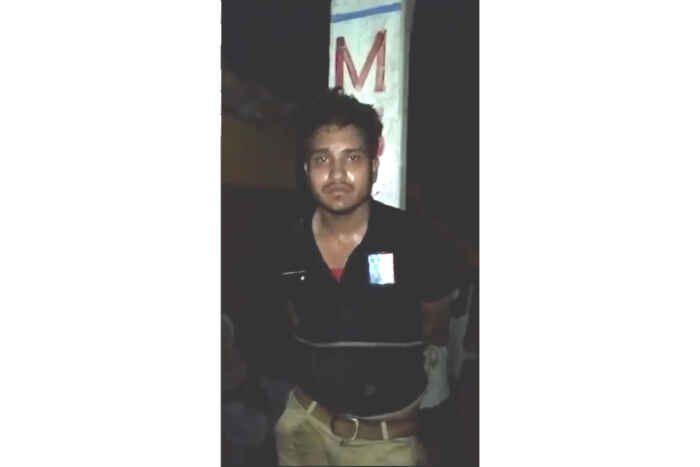
Earlier, few sporadic incidents of vandalism was also reported to have taken place in some parts of Bengal on Tuesday following the 48-hour-long nationwide general strike called by central trade unions protesting against the “anti-people” policies of Narendra Modi led NDA government in the center. Scuffles between police and the strike supporters were witnessed in some areas. At Jadavpur area in south Kolkata, CPI(M) leader and MP of Jadavpur Lok Sabha constituency Sujan Chakraborty along with several other strike supporters were detained by the police.

Stones were pelted at a school bus in Champadali area of Barasat in North 24 Parganas district. A government bus was also ransacked by strike supporters at Champadali. Protestors also vandalised a bus at Jamuria in Paschim Bardhaman district.

Protestors squatted on tracks in some places to stop trains and burnt tyres on the roads. Members of Students’ Federation of India staged agitation at the gates of Presidency University in Kolkata. In Siliguri, protesters organised a big procession. But the trading hub in the city was open, though roads had fewer vehicles compared to a normal working day.

There have been reports of clashes between TMC and CPM workers in Asansol during the first day of the ongoing 48-hour nationwide strike. Train services came to a halt at Madhyamgram, Hasnabad-Bongaon, Krishnagar, Duttapukur and Lakshmikantapur train line. At Sodepur, in North 24 Parganas district, protesters threw banana leaves on overhead wires to disrupt train movement.

The state government had earlier announced that state employees would be barred from availing casual leave or half day leave on Tuesday and Wednesday. No leave will also be allowed on the day preceding the two-day strike or following it, as per the government notification issued on Friday.

A circular for no adverse order was also issued by the Calcutta High Court that prevails over all the lower courts under it.

Joint Entrance Examination

The Joint Entrance examination has begun from Tuesday which coincides with the 48-hours-old strike. But the state government has made special arrangements for examinees. Special examination bus and other vehicles in large numbers were seen plying on the metropolis streets. The security has been tightened too. This year, 9.5 lakh students are appearing for the Joint Entrance main examination. Through this exam, one can take admission in a graduation course in engineering at IIT, NIT, CFTI, SFTI, etc. The exam which started on Tuesday will continue till January 12.

At least 391 people including 34 women were detained across Bengal during the bandh.

In Jharkhand, Madhya Pradesh and Rajasthan too, bandh was effective, however, no major violence was reported.

Watch Madhya Pradesh MLAs entering Assembly on day one

Bhopal: On January 8, when the MLAs entered the Madhya Pradesh Assembly for the first time after the fifteenth Madhya Pradesh Assembly polls, most members were seen bowing at the entrance. Among the MLAs, mostly first timers, eNewsroom spotted ruling Congress’ Education and Sports Minister Jitu Patwari, Public Relations Minister PC Sharma, Revenue and Transport Minister Govind Rajput, MLA Kalawati Bhuria, Omkar Singh Markam bowing at the Assembly entrance along. BJP MLAs, Aakash Vijayvargiya and Kamal Patel were also seen doing the same. Onlookers maintained that had the elected representatives bow before the people who elected them it would have been better for democracy. What matter for MLAs are their attendance, raising public issues and answering the queries of the common man will be a reflection of how much they respect the Assembly.

In other development, Narmada Prasad Prajapati became the Speaker. The four times Congress MLA Prajapati, for the first time in 52 years got elected after voting.

All pictures by: Raj Patidar.


Amartya Sen says, We as humans have failed to fulfill our basic human responsibility to stand with the oppressed

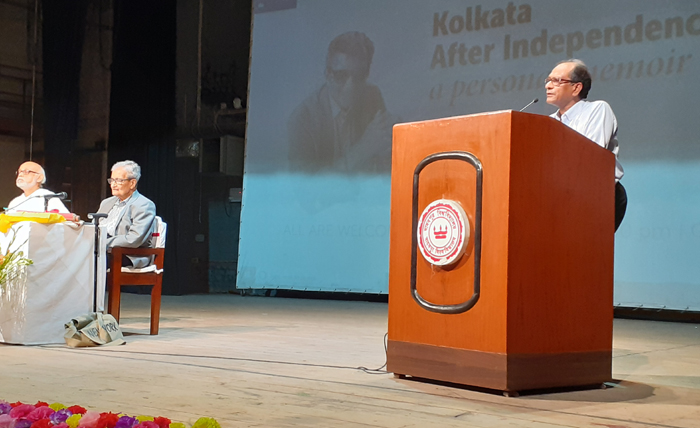
Kolkata: Humanity is connected through our art and literature even though politics and geography divide us. That was the message sent out at a recent event attended by Nobel Laureate and renowned economist Professor Amartya Sen.

Speaking at the occasion Professor Sen came out in full support of actor Naseeruddin Shah, who recently got into a controversy when he expressed concern regarding the rising mob violence in India and had also spoken against the alleged crackdown by the government on NGOs.

Since then the veteran actor is facing the wrath of right wingers and even the ruling Bharatiya Janata Party (BJP)’s leaders. One BJP MLA even went on to say that if he were to be made a minister he will bomb such people who speak about intolerance in India.

In his speech, Professor Amartya Sen stressed on the need for fostering and maintaining humanity, “During the liberation war of Bangladesh in 1971, what we did, does not come under social responsibility but it is in our humanity to stand by the oppressed. What is happening to Bengali Muslims in Assam in the name of NRC or the deportation of Rohingyas to Myanmar can never be justified. We as humans have failed to do our basic human responsibility to stand with the oppressed.”

The nobel laureate also said, “We need to come out in full support of people like Shah and at the same time be vociferous against those who condemn views expressed by the likes of Naseeruddin Shah.”

Earlier intellectuals of Kolkata had expressed support for Naseeruddin Shah and had even called out Bollywood for not coming out in support of the legendary actor.

Professor Sen further added, “The atmosphere of religious intolerance is gaining momentum each passing day. So every rational person should come forward and protest against this kind of environment.”

When asked why a country like India, which is secular, is witnessing such religious intolerance and what are the reasons behind it, Professor Sen smiled and said, “This could well be qualified as a doctoral thesis. But yes, social reasons coupled with political reasons is the cause.”

Regarding the change of RBI governors in quick succession, Professor Sen didn’t elaborate much, but simply stated that they have been removed as the present government didn’t like them.

The 85-year-old renowned economist was in town to attend the golden jubilee celebration of a Bengali magazine Samatat. He addressed a gathering at Purbashree auditorium, EZCC on Sunday evening.

Along with Prof Sen, Indologist Nrisingha Prasad Bhaduri, singers Srikanta Acharya and Sraboni Sen, elocutionist Ratna Mitra, Mayor of Bidhannagar Corporation Sabyasachi Dutta were also present at the occasion.

Professor Bhaduri spoke at length about his association with Samatat and it’s editor Arghyakusum Duttagupta who happens to be economist Prof Amlan Dutta’s younger sibling. “My association dates back to the time when I was still a college student. I once wrote an article for Samatat where I wrote an introduction of my book ‘Sukhosaptati’ which is a collection of stories, our folklores that have a message.”

Elaborating further on this Professor Bhaduri said that our folklore are the same stories that have been found in an Arabic book ‘Tuti Nama’ in Arabia which had probably travelled from India. From Arabia these folklores travelled to Italy and then to England. “The well known book of English literature, Chaucer’s Canterbury Tales, are a collection of such stories that have their origin in India. I was surprised and so happy to see it,” said the Indologist.

On the occasion of the 50th anniversary celebration, Samatat has published a 400 pages book where the best articles that created storm in the literary world were republished along with some new articles.

Kolkata hosts its first Queer Literary Festival

Kolkata: The season to celebrate literature has set in. And Calcutta alone will be hosting not one but three literature festivals in January itself. In fact, between November to January, several literature festivals have already taken place at several Indian cities. But there has been few sessions dedicated to ‘queer’ literature in the popular Lit Fests and the number  of authors specialising in it being invited as speakers is even lesser in number. Thereby, feeling the need of a separate fest for the community, Kolkata hosted its first Queer Literary Festival on January 5.

Celebrating the ‘queer’

On a cold winter afternoon, seeing three of the four panelists occupying the stage, representing a form of literature that not many choose to talk about, in the heart of the city, was appreciated by many. Setting the motion for the session – Every Struggle Is Our Struggle: Queer Voices, Literature of Resistance was Aulic, writer and anthropologist from Dhaka, currently residing in Berlin. She said, “I don’t write to resist but to exist.”

Actor and poet Tista Das, a prominent face of the West Bengal Trans Movement, began by saying, “Being a transgender woman, I am also part of the society. I have never thought myself to be different, so, I never began my poetry or writing as ‘queer poetry’ or ‘queer writing’. I began writing to voice against the injustice that exists in the society till date. To be honest, I never thought myself to be different from the society, but it was this very society that made me feel that I was different and gradually, my writing also got a tag.”

QUEER LGBT Transgender Kolkata
A painting at the entrance of the Queer Literature Festival site

Abhijit Majumdar, a professor and researcher by profession and writer by passion, who has penned a couple of books on ‘queer emotions’ and human rights, among which the most prominent being Noishobdyer Potroguccho said, “I am not a writer by profession but I write, not to exist but to resist, unlike Aulic. I am being very candid, my writings are agenda based, if they are considered as literature, I have no issue.”

Need for another setup

With write-ups, poems and even reports written in support of the ‘queer’ community adorning the walls of the Goethe Institut, the organizers made their need for being talked about or being taken into the fold evident.

[embedyt] https://www.youtube.com/watch?v=9Eb3N5syzIo[/embedyt]


Talking about the need of a literary meet dedicated to the queer authors and literature, was Mallobika, co-founder Sappho for Equality, she said, “Because people don’t have the courage to talk about queer issues let alone queer literature. This festival is an attempt to open up conversations with writers, readers and publishers about our struggles, joys and sorrows. It is also an attempt to listen to other movements of struggles, resistances and movement.”

Adding to that, Avinaba, independent gender, sexuality and policy researcher currently associated with Sappho for Equality, said, “The whole idea of organizing this literary meet was to create a pace for the writers and poets from the community to come and share their work. None of the mainstream festivals has ever invited writers from the community.”

All minorities are ‘one’

Speaking about the need of a platform, which gives space to other representatives of the minority community – be it religious, sexual, class or caste. Avinaba said, “The primary idea was to focus on queer and other marginalized representatives of the society, who for different reasons – gender, sexuality, class, caste, religion, geographic locations, cannot come forward, or rather let’s say are not allowed to put forward their work. We often hear from others, “we do not discriminate”  “we do not see one’s gender and sexuality!” However, the mainstream publishing houses – both regional and national – often complained about not finding enough talent in the queer community, in terms of literature.”

Adding to that, Md Reyaz, Assistant Professor, Department of Journalism and Mass Communication, Aliah University said, “As a religious minority, I empathise with the sexual minorities, for I believe that living in a secular country, if I am taking benefits of being a minority and say that people have no business to know what’s being cooked in my kitchen then we should not peep into other’s bedroom. On the contrary, we have reached a stage, where I would say all minorities should come together on one platform.”

The organisers, also used the event to raise their voice against the Transgender Bill. “We have dedicated a complete session on this issue as the law is draconian in its present form. An individual belonging to the male and female category don’t need to be verified as male or female by specialists. They why are trans men and women being subjected to such humiliation. This bill if enacted will be misused by those being authorised to scan our bodies. As it is we are humiliated by the society, this will subject us to further humiliation,” said Prabhat Majumdar, one of the panelist for the session on Transgender Bill. Another bill which was much talked about in between the session was the Triple Talaq Bill, the demand being – redrafting of the bill, as the bill in its present form, many felt would lead to a witch hunt of Muslim men in particular

Kolkata girl promotes dying Madhubani Art using new-age technology

Kolkata: On a lazy summer afternoon, which was meant to be spent at leisure, Wasma Mirza was left awestruck by the beautiful bed sheets and tablecloth that adorned the rooms of her grandmother’s residence in Darbhanga, Bihar.

Mesmerised by its beauty, she was compelled to trace the history of the artwork that was displayed before her. “My grandmother told me that those artwork had been sourced from a village called Madhubani, which wasn’t very far from our Darbhanga residence. I decided to pay a visit to the village, from where the now-dying art-form Madhubani Art or Mithila Paintings has originated.”

ABC of Madhubani/Mithila Art

Determined to have a closer look and better understanding of what this art was all about and why it was dying, she along with her parents (Shahanshah Mirza, great-great-grandson of Wajid Ali Shah and Fatima Mirza) went to Madhubani.

“On the day we visited Madhubani, I was extremely delighted to witness the haat in progress. I was left fascinated with what I saw – women selling their Madhubani artwork, as some in small batches sat under the tree, giving the final strokes to some of their near finished products,” she said. She further added, “However, my visit to this haat left me a bit disheartened, as I saw that there were not many buyers for this artwork.”


E for Entrepreneur

As locals speak Mithila, in her first visit, Wasma took an interpreter with her to understand both the artwork and communicate with the artist in order to seal the deal. “I am in the second year of college and will soon be graduating. So, career happens to be on the top list of our discussions. When I saw these handicrafts at my grandparent’s house, I got an idea of starting a small business by buying from these women and selling it to my family and friends, back in Kolkata. However, I was appalled by the response that these artists were getting in their own town. There were very few buyers and most of the artists were from the economically backward community. This further encouraged me to promote their work in my own small way,” she told to eNewsroom.

Social Media to boost the sale

Madhubani Art Mithila kolkata
Wasma Mirza

Determined to help the artists, she used her savings to purchase a couple of artworks from the haat. “I used WhatsApp and Facebook to promote the handicrafts, and I got a great response from my family and friends in Kolkata. Overwhelmed with the response, now on a regular basis I am getting a number of these products from Madhubani, straight from these women artists and am selling them in Kolkata, for a very marginal profit. This is my small way of reviving a dying art and paying the artists their due. They are generally left underpaid by middlemen.”

Wasma’s work model may be new and small in size, but experienced artists in Mithila Art, believe that this can be beneficial for them. Speaking to eNewsroom, from Madhubani was Anjali Jha, who ekes out a living by doing Madhubani painting, said, “In our villages, almost every house has an expert in Mithila art. So, there is a surplus product but less number of buyers. The maximum money made by artists like us is Rs 10000 a month. Agents make more profit than us, but if someone could directly contact us like this girl from Kolkata and give us regular work, then at least we can expect a steady flow of income.”

Adding to that Shalini Karn, an emerging Madhubani artist said, “This kind of an initiative will be beneficial for the local artists. Today, it has become essentially important for the artists to have a market beyond the the local haat, to market their product and make a steady income. It’s encouraging to see urban girls taking interest in us.”

The last sunset and sunrise of 2018

0

Jaipur: The year 2018 has came to an end with the promise of a fresh start in 2019. To make moments memorable, Chandra Mohan Aloria captured the last sunset and sunrise of the year gone. Enjoy the pictures as it is, as we are not giving any caption to these pictures captured by the photographer. The first photo captures the last sunset of 2018 and rest are of last sunrise of the last day of 2018. Let us pledge to make the world a better place to live in for everyone. Wishing our readers – A Very Happy New Year 2019!

Modi’s popularity registers sharp decline in 2018

0

The popularity of Prime Minister Narendra Modi registered a sharp decline towards the close of 2018 — merely four and a half years after he had come to power with a bang. During the year he was surrounded by many unsavoury controversies. After the BJP’s drubbing in the Assembly elections in the five States of Rajasthan, Madhya Pradesh, Chhattisgarh, Telangana and Mizoram, he has become more and more incoherent and occasionally irritable in his public speeches. The election results show that he has ceased to be a vote-catcher; rather, Narendra Modi has become a liability for the BJP.

That the people voted decisively against the BJP in all the five States where elections were held in November-December was much too evident. In Rajasthan, Madhya Pradesh and Chhattisgarh the party could not retain its government in spite of spending a scandalous amount of money on the campaign. The BJP had fielded its candidates on almost all the seats in Telangana and Mizoram. BJP general secretary in charge of north-east Ram Madhav had announced much ahead of the polling day in Mizoram: “we are willing to forge an alliance with like-minded non-Congress parties after the elections.” But the BJP could win only one seat out of 39 it contested (Mizoram Assembly has 40 members), and its dream of ruling, directly or indirectly, the entire north-east was shattered. So was the case in Telangana where it was hopeful of an impressive electoral victory to dictate terms to Telangana’s ruling party Telangana Rashtra Samithi (TRS) for an alliance for the 2019 Lok Sabha elections. The BJP could get only one seat in Telangana also.

According to an IndiaSpend analysis of electoral data, the BJP lost more than 70 per cent of the Assembly constituencies where Prime Minister Narendra Modi campaigned in the five States. Uttar Pradesh Chief Minister Yogi Adityanath fared slightly better than Modi, with a winning percentage of 39 as against Modi’s less than 30.

Even though Prime Minister Modi’s two major “achievements” did not figure prominently in the high-pitched campaigns, these two seemed to have considerably influenced the mind of the voters, particularly in the three Hindi heartland States of Rajasthan, Madhya Pradesh and Chhattisgarh. The scars created by the demonetisation on the middle and lower classes have not healed so far. Similarly, the GST continues to be a sore point with the middle rung traders. The party leaders in the three States were apparently aware of this because the party in the three States did not seek the vote in the name of Narendra Modi but in the names of their chief ministers, Vasundhara Raje in Rajasthan, Shivraj Singh Chouhan in Madhya Pradesh and Raman Singh in Chhattisgarh. In the full page newspaper advertisements also, the photos of the chief ministers were displayed prominently while a small photo of Narendra Modi was tucked behind the chief minister of the State.

The people just wanted to oust the BJP in the three States though they did not repose full confidence in the Congress, except in Chhattisgarh where it won 68 seats in a House of 90. The BJP got only 15 seats. Former Congress Chief Minister Ajit Jogi had formed his own party Janta Congress Chhattisgarh (JCC). He had entered into an alliance with Mayawati’s Bahujan Samaj Party (BSP) in the hope of emerging as an alternative to the BJP and the Congress but the alliance could get only 7 seats — JCC 5 and BSP 2.

In both Rajasthan and Madhya Pradesh, the Congress failed to get the clear majority. In Madhya Pradesh, its tally stopped at 114 seats in a House of 230. The BJP won in 109 constituencies. As many as 120 parties were in the fray in Madhya Pradesh. Only two of them could taste victory: Bahujan Samaj Party got two seats and Samajwadi Party was able to win one seat. Four independents also got through. These seven members lent their support to the Congress, raising the strength of the alliance to 121 and, thus, allowing the Congress to form the government. It was ironic that BJP received slightly more votes in Madhya Pradesh than the Congress but the Congress got more seats. The BJP received 41 per cent (1, 56, 42,980 votes) of the total votes cast while the share of the Congress was 40.9 per cent (1, 55, 95,153 votes). Besides, in as many as 22 constituencies, the votes cast for NOTA (none of the above) exceeded the victory margins of the winning candidates. In Rajasthan, too, the Congress reached near-majority point, getting 99 seats in a House of 200. The election for one constituency was countermanded following the death of a BSP candidate.

Kolkata shows spine, backs actor Naseeruddin Shah

0

Kolkata: At a time when the Bollywood fraternity is maintaining a distance from Naseeruddin Shah, intellectuals from Kolkata have expressed their solidarity for the veteran actor. Condemning the way Naseeruddin Shah’s session at the Ajmer Literature Festival, was called off, due to the pressure from the Right-Wing groups, they maintained that the actor had just shown the mirror and was unnecessarily being witch-hunted.

“I don’t see anything wrong that Naseeruddin Shah has said. He has just expressed a valid concern and as a citizen of this country he is justified in raising this question. I completely support his statement. He has highlighted what India has been witnessing in the past four years,” said former Supreme Court Judge, Justice Ashok Kumar Ganguly, during an intellectual meet organised in Kolkata.

During the meeting, a resolution was passed, in which they not only pledged solidarity with the Naseeruddin Shah, but have also decided to organise rallies, to condemn the way the actor is being criticised by the right-wingers.

“What is more disturbing was the fact that he was barred from attending a session at the Ajmer Literature Festival after he had expressed himself. The ring-wing politicians and foot soldiers should be grateful to him, as he has shown a mirror to them. Instead of hounding him they should contemplate into what they have made of India in these four years,” said Md Nesar Khan, former member of West Bengal Human Rights Commission (WBHRC).

Adding to that justice Ganguly, who is also a former chairman of WBHRC, said, “Sadly enough, what ever the actor said is true. Look at the Bulandshahr case. Didn’t the CM ask the cow slaughtering case to be first investigated, instead of the police murder to be first probed.” He then added, “People like Naseeruddin Shah and Dilip Kumar have contributed a lot towards our culture, they shouldn’t be hounded for speaking their mind. Any right-thinking person would have made the same comment as him.”

Khan pointed out, “This is not the first time in the history of India that a person from the minority community or a dalit is being tortured. But sadly, enough today, they are state sponsored. The attitude of the police while investigating cases related to mob lynching etc clearly indicates that they have been told by the government to act in that particular way.”

Also, present at the meet was the actor’s niece Saira Shah Halim. Saira, who is also a social activist said, “I am overwhelmed by the kind of support that he has been getting from across the country. But sadly, the industry that he works in has been maintaining an eerie silence. None has spoken in support of what he has said. It reflects the hypocrisy of the industry. People are there just to earn their living and not take a stand. They are just pretending as if nothing has happened. We had witnessed the same during the Aamir Khan episode. The actor had to pay dearly. Snapdeal had even cancelled their contract with the actor.”

The event, which was organised by Save Democracy Forum, was attended by former mayor of Kolkata and former advocate general of Tripura Bikash Ranjan Bhattacharya, Dr Fuad Halim, visual artist Wasim Kapoor, Poet Madrakanta Sen among others.

Cabinet formation renews infighting in Madhya Pradesh Congress

0

Cabinet formation in Madhya Pradesh has renewed infighting not only in the ruling Congress party but in former chief minister Digvijaya Singh’s family also. With Chhindwara MP Kamal Nath appointed as the PCC president and Guna MP Jyotiraditya Scindia as the chairman of the Campaign Committee, the party had displayed a semblance of unity during the Assembly election campaign after a long time. The selection of candidates was without much hassle, unlike in 2008 and 2013. It appeared that it would sail smoothly if it got majority and formed the government. Voters of the State, though, did not trust the party fully and gave it 114 seats, two short of a clear majority, in a House of 230. The BJP won 109 seats. With the support of four independents, two BSP members and one SP member (total 121), the Congress staked the claim and was invited by Governor Anandiben Patel to form the government.

The unity which was visible during the campaign started dissolving. After an exercise lasting several days and with the intervention of party president Rahul Gandhi, Kamal Nath was declared to be the Leader of Congress Legislature Party (CLP). He was sworn in as Chief Minister. Selection of members of the Council of Ministers proved to be a tortuous task. The week-long efforts by Kamal Nath, Jyotiraditya Scindia and Digvijaya Singh in Bhopal and Delhi failed to produce an agreed list. The intervention of Rahul Gandhi was of not much help. The only point of agreement was that those who had won for the first time would not be inducted into the Council of Ministers.

The problem, it was said, arose because of Digvijaya Singh’s insistence that his son Jaivardhan Singh (who has won from Raghogarh constituency for the second time) should be given the cabinet rank. This prompted Scindia to push some names of his own supporters. Ultimately, the three agreed on 28 names — 22 of them first entrants to the Council of Ministers and only six old hands who had served as ministers in the past. Exasperated by claims and counter-claims of Digvijaya Singh and Jyotiraditya Scindia, Kamal Nath then announced cabinet rank for all the 28 ministers.

This was followed by public protests including chakka jam (road-block) by some senior members of the party who were hopeful of getting berths in the cabinet but were ignored. A former minister said that he was told to get ready for swearing in and he had organised a celebration meal at his residence for his workers but at the last moment his name was dropped causing so much embarrassment to him. One of the four independents was made a minister, leaving the other three sulking. Public dissatisfaction was displayed by the lone SP MLA and two BSP MLAs.

When it came to the allotment of portfolios to the ministers, the Congress was jolly well at its old game of full blown infighting. While Digvijaya Singh and Jyotiraditya Scindia fought for important departments for their supporters, Chief Minister Kamal Nath appeared a helpless spectator. No other Congress leader has as much grip over State’s politics as Digvijaya Singh. This gives him immense power of manipulation. Kamal Nath has to mainly depend on him. The problem with Kamal Nath is that he has never been active in State politics, keeping himself confined to Chhindwara which he has been representing in Lok Sabha since 1980 except for one term. While he gets along well with Scindia also, his relationship with Digvijaya Singh is much deeper as both of them were protégés of the late Arjun Singh. (The decision on portfolios could not be arrived at till the evening of December 28).

Among the senior party leaders left out of the cabinet is Lakshman Singh, younger brother of Digvijaya Singh. Lakshman Singh has been elected to the State Assembly for the third time and was also a member of Lok Sabha for five terms. He was a claimant to a berth in the cabinet but Digvijaya Singh was said to have insisted only on his son’s inclusion. This appeared to have renewed the bitterness in the Raghogarh household which Digvijaya Singh was able to adroitly paper over in the past few months.

The tension in the Raghogarh family had started when Digvijaya Singh married Amrita Rai in 2015, not long after the death of his first wife Asha Singh. His marriage was opposed by his son and daughters, but more bitterly by Lakshman Singh and his wife Rubina Sharma Singh. Rubina is Lakshman Singh’s second wife. The major cause of Rubina’s bitterness was that Digvijaya Singh had opposed tooth and nail Lakshman’s marriage to Rubina on the ground that she was not of their Thakur caste; and now Digvijaya Singh was marrying Amrita Rai who was also not a Thakur. Property, too, was said to be behind the family feud. Digvijaya Singh has not yet been able to visit Raghogarh after his marriage to Amrita Rai.

Master of manipulation as he is, Digvijaya Singh had managed to appease Lakshman Singh and Rubina and a semi-normal relationship was re-established in the family. Digvijaya Singh and Amrita were said to have invited Lakshman Singh and Rubina over lunch in their Delhi residence.

Digvijaya Singh’s “refusal” to get his younger brother included in the cabinet has rekindled the old bitterness. In her comment on a post in Facebook, Rubina Sharma Singh observed: Digvijaya Singh “has a serious insecurity problem. Can’t stand it that Lakshman wins elections. You should have seen what all was done to try and to make him lose. Absolutely pathetic!” She also scotched the rumours that Lakshman Singh would contest for Lok Sabha.

Know about the major scams of Shivraj Singh Chouhan’s regime

0

[dropcap]S[/dropcap]hivraj Singh Chouhan was the chief minister of Madhya Pradesh for 13 years. His regime will be remembered for scams more than anything else. Police and a section of judiciary were Chouhan’s accomplices. Here is a summary of major scams of the Chouhan era:

Vyapam scam

This is the biggest scam of Chouhan’s period. It has destroyed the careers of thousands of young boys and girls. Vyapam or Vyavsayik Pareeksha Mandal (Professional Examination Board – PEB) is entrusted with the task of conducting technical/professional examinations. The names of the meritorious students appearing for pre-medical test were quietly replaced with the names of those who could pay hefty sums to the touts and they were declared successful for admission to medical colleges, leaving the genuine students wondering how they failed in spite of having done the tests so well. The names of Chouhan, his wife Sadhna Singh and his close associates were said to be involved in the scam. As it turned out a money-spinner, recruitment to several other departments was also brought under the control of Vyapam.

Following a public hue and cry, Chouhan constituted a Special Task Force (STF) to investigate the scam. Cover-up by STF was helped by then Madhya Pradesh High Court Chief Justice (now a Supreme Court judge) A M Khanwilkar who monitored the investigation in a secret and dubious manner. Later the Supreme Court handed the investigation to the CBI. In its order, a bench of the apex court comprising Chief Justice H L Dattu, Justices Arun Mishra and Amitava Roy made it clear that with the CBI on the case now, the High Court will not “touch” the Vyapam cases.

Around 50 people connected with the Vyapam scam have died under mysterious circumstances. There is no record of how many meritorious students committed suicide after they found themselves unsuccessful in the tests. Incidentally, the CBI did hardly better than the State police.

Dumper scam

Chouhan became the Chief Minister on November 29, 2005. On December 12, his government issued an order allotting to JP Associates prospecting licence of mining on 470.941 hectares of land in Rewa district. Not only that, the government also allotted to JP Associates 25.842 hectares of private land belonging to farmers of the area though no farmers’ land can be allotted for mining without the consent of the farmers. When the farmers protested, the security personnel of the JP Associates fired on them. In return, the JP Associates gifted to Chouhan’s wife Sadhna Singh four dumpers worth Rs two crore and took these dumpers on rent from Sadhna Singh Chouhan.

The case was referred by a court to Lokayukta for investigation. The post of Lokayukta was held by former Supreme Court judge P P Naolekar, a dishonesty incarnate. His investigation found nothing illegal in the matter. Later Chouhan’s government made an out-of-turn favour to Naolekar’s son Sandeep Naolekar. In reply to an RTI query by a Damoh social worker Santosh Bharti, the Chouhan government replied that it did not know who Sandeep Naolekar’s father was nor did it know the age, profession or correct address of Sandeep Naolekar.

‘Encounter of SIMI activists

Eight SIMI activists, seven of them undertrials and one convict, lodged in the high security Bhopal Central Jail, were reportedly told by the jail authorities on the eve of the Diwali that they were being shifted to Indore jail. They were given new clothes and shoes and taken out in vehicles to a hillock, some 10 km from the Bhopal jail and killed. It was claimed as encounter. Chouhan ordered a judicial inquiry by a retired High Court judge S K Pande who gave a report as the police and jail authorities wanted it without even hearing the others.

Shehla Masood murder

RTI activist Shehla Masood was gunned down in front of her house. Then Director-General of Police S K Raut, Additional Director-General of Police (Intelligence) R K Shukla (who is DGP now) and other senior police officers reached the spot promptly and messed up with the evidence. Masood was said to have made RTI queries about some illegal mining operations in which had the involvement of Chouhan’s close relations was alleged. She was also said to have made queries about the late Anil Dave’s Narmada Samagra. Dave had an unusual hold over Chouhan and was running several rackets with the help of Chouhan. The police, or the CBI which had later taken up the investigation, did not even question top police officers nor did they interrogate retired Medico-Legal Institute Director D K Satpathy who had prepared a made-to-order post mortem examination report. Meddling with murder evidence attracts imprisonment and deprivation of post-retirement benefits. Could these high government officers have taken the risk without an assurance from the Chief Minister?

Sabharwal murder

Prof. H S Sabharwal (of Madhav College of Ujjain) was beaten to death allegedly by Akhil Bharatiya Vidyarthi Parishad (ABVP) activists enraged at the Professor’s decision to postpone the students’ union elections following rowdyism. Six of the top ABVP activists were booked for murder. Chouhan’s police bungled the investigation. Supreme Court, while transferring the hearing of the case from Ujjain court to Nagpur court disapproved of the police conduct and made some harsh remarks. The Nagpur court acquitted all of them saying the police could not produce evidence of their involvement in the murder.

Disappearance of a rape victim

A girl, belonging to a poor family in Indore, was gang-raped. The girl’s parents met chief minister Shivraj Singh Chouhan during the latter’s visit to Indore. A little after the incident and the chief minister promised early arrest of the perpetrators of the heinous crime as well as some financial help to the family. Months passed and nothing happened. The girl, along with her mother, travelled to Bhopal to meet the chief minister and remind him of his promises. They were sitting near gate number six of the Chief Minister’s residence (where the Chief Minister met the petitioners). From there the girl disappeared. Neither the girl nor her mother have been traceable since then.

Hit and run victim

A middle-aged man was going to his shop on a two-wheeler around one in the afternoon. On the wide road in MP Nagar, a car hit him from behind and sped away before anybody could read the number of the car. The victim received head injuries and fell unconscious but he, somehow, survived.

What made the incident different from such other happenings was that the victim in this case was Raman Rusiya, younger brother of Madan Gopal Rusiya, who was the Bhopal Development Authority (BDA) chief executive officer (CEO), and was taken to Delhi by BJP MLA Jitendra Daga (whose land was marked to be acquired by the BDA for development of new colonies) but never returned to Bhopal. His body was recovered from a ditch near the railway track, some 30 kms away from Agra. Madan Gopal’s family members, his hit-and-run victim younger brother included, had been talking of a high level conspiracy to eliminate Madan Gopal and demanding a CBI inquiry. However, the district police chief ruled out a foul play even without it was known whose car it was or who was driving it when it hit Raman Rusiya.

Death by ritual shooting

There were scores of RSS activists assembled at the Saraswati Shishu Mandir at Kotra locality (of Bhopal) on the day of the Dussehra for “Shastra Pooja” (worship of weapons). RSS Pracharak Naresh Motwani, in his late forties, arrived. There was the sound of a gunshot and all those present escaped. Two RSS activists, having come from outside, arrived there half an hour later and found Motwani’s body lying in a pool of blood. They carried him in the auto in which they had come and took him to the hospital where he was declared brought dead.

The district police chief ruled out a foul play even though neither the weapon of offence had been recovered nor had it been known who had fired it. Four days later, following tremendous pressure from the people in general, and Motwani’s relations in particular, a case of causing death by negligence against unknown person(s) was registered. Motwani’s son, Vijay, had all along been saying that his father had been murdered.