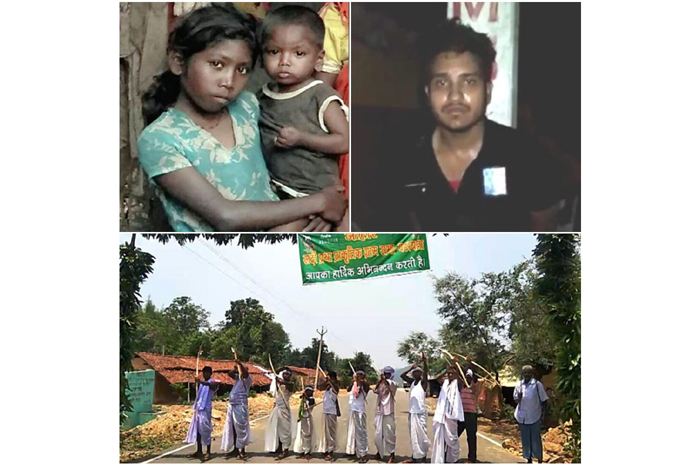
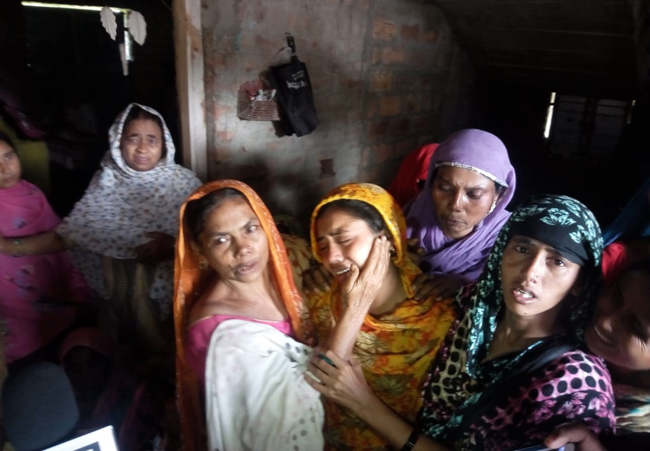
No pension in Jharkhand’s Latehar district for 171 days, where starvation death took place recently

Ranchi:  Jharkhand, where two more persons have died from starvation recently, were pensioners too, but neither they were getting rations, nor pensions. Raghubar Das government had announced to increase pension amount from Rs 600 to Rs 1000 per month, but since January, 2019, when it should get implemented, neither increased amount nor earlier one get paid in Latehar district.

Latehar is also the native of Ramcharan Munda, who succumbed to hunger on June 5.

In the month of May and June, two people, both tribals, died from hunger in Jharkhand, Motka Manjhi of Jama (Dumka district) and Ramcharan Munda of Mahuadanr (Latehar district).

Along with these two, at least 21 alleged hunger deaths took place in Jharkhand in last three years.

Right to Food Campaign’s Jharkahnd chapter, whose members visited both the families issued a press communiqué and claimed, “In both cases, the victims were pensioners but they did not receive any pension payment since January 2019.”

It writes further, “Enquiries from the welfare office in Latehar district reveal that no pensions have been paid in the entire district after January 2019. The reason, we were told, is that the required financial allotments had not been made by the state government.”

“Reports from other districts suggest same situation in many other districts as well, if not in the entire state, the press release adds.

On 28 November 2001, the Supreme Court had directed the central and state governments to ensure that social security pensions are promptly paid by the 7th day of each month every month. Nearly 18 years later, this order is still nowhere near being observed in Jharkhand.

Notably, according to RTF, The discontinuation of pension payments is all the more shocking as Chief Minister Raghubar Das promised to raise pension amounts from Rs 600 per month to Rs 1,000 per month around the beginning of this year. Six months later, the enhanced payments of Rs 1,000 per month are yet to begin. Meanwhile, pension payments have been stopped altogether, in some districts at least.

The campaign made three demands:

  1. Immediate clearance of the backlog of pension payments, at the enhanced rate of Rs 1,000 per month, throughout the state.
  2. Assured pension payments by the 7thday of each month from now on, as per Supreme Court orders.
  3. Compensation of Rs 10 lakh each for the families of Motka Manjhi and Ramachandra Munda.

Is Torture part of police investigation?

0

Stan Swamy, one of the accused in the Bhima Koregaon case, whose house was raided twice by Pune police written a piece, which we are here publishing as it is for our readers:

Torture means any act by which severe pain or suffering, whether physical or mental, is intentionally inflicted on a person for such purposes as obtaining from him information or a confession, punishing him for an act he has committed or is suspected of having committed,“ (https://www.apt.ch/en/what-is-torture/).

Couple of years ago, India’s Attorney General had said at the UN that “Ours (India) is a land of Gandhi and Buddha. We believe in peace, non-violence and upholding human dignity. As such, the concept of torture is completely alien to our culture and it has no place in the governance of the nation.” (Baljeet Kaur in EPW Vol. 53, Issue No. 36, 08 Sep, 2018)

Fine words indeed. However the 2015-2016 NHRC Annual Report states:

Custodial violence and torture continue to be rampant in the country. It represents the worst form of excesses by public servants entrusted with the duty of law enforcement.

Between September 2017 and June 2018  news reports noted 122 incidents of custodial torture resulting in 30 deaths. There has been no consistent documentation of torture-related complaints. The National Crime Records Bureau (NCRB) does not document cases of custodial torture. (Baljeet…)

Let us enumerate some of the tortures taking place in the context of Indian government’s efforts to do away with so-called ‘extremism’ in the country:

  • Several intellectuals, artists, writers, journalists, legal professionals, poets, dalit & adivasi rights activists, human rights activists have now become suspects in the eyes of the ruling class. They are now invariably called ‘Maoists’, ‘naxals’, ‘urban naxals’ etc. Cases, including serious cases such as Unlawful Activities Prevention Act [UAPA], Sedition have been foisted on them. Several of them have already been jailed, others are being harassed with raids on their work places and residences.

Now let us ask ‘who’ and ‘what’ are these individuals. They are perhaps the most precious human beings who have given the most and best of themselves for the cause of truth and justice and have clearly taken the side of the deprived, marginalized sections of society. They have expended their individual charisms, professional expertise, unconditional solidarity with the deprived masses and many of them have achieved phenomenal success in bringing relief to the abandoned lot of human beings about whom the rest of society does not bother. They have deprived themselves of social & economic security which they otherwise would have enjoyed.

When the ruling class instead of commending their commitment is bent upon punishing them in meanest ways, it is deplorable.

Is this not torture?

The condition of the economically and socially deprived sections is even more a cause of concern. The fact is two-thirds [67%] of prisoners in India are under trials. Besides, one in every three under-trial prisoners in India is either SC or ST. Although they constitute only 24% of the population, 34% of them are under-trials. A random sampling study of under trial prisoners in Jharkhand reveals that the family-income of 59% of under trials is below Rs.3000 p/m and 38% of them earn between Rs.3000 and 5000 p/m. That means a total of 97% of under trial prisoners in Jharkhand earn less than Rs.5000 p/m. The inevitable conclusion is that practically all under trial prisoners are very poor people. (Finding taken from ‘A Study of Undertrials in Jharkhand’ by Bagaicha Research Team, 2016, p.54)

A vexing question is how did they come to be arrested as ‘naxals’/‘sympathisers of naxals’?  The above-mentioned study found out that about 57% were arrested while they were at their homes. 30% were arrested while travelling, at railway station or at a town while shopping. Eight percent said they surrendered themselves on being informed that there was a case registered against them, and five percent said that they were summoned by the police to the station ostensibly for some other purpose but on arrival they were arrested. However, most of the charge sheets filed by the police state that these arrests were made from forests. This mismatch is a clear indication that the police habitually fabricate cases against Adivasi villagers. (From above-mentioned study, p.56)

It is important to remember that greater part of them are young people. 22% are in the age-group of 18-28 which is the most creative part of one’s life and 46% are aged 29-40 which is the most productive part of one’s life. (Facts from above study, p.50)

But the repercussions of their imprisonment on themselves and their families are tragic. Many families have mortgaged or sold off the little assets such as their land, cattle. The sole breadwinner of the family is either in jail or implicated in cases. It is heart-rending to see many many families have been reduced to destitution and their small children are growing up without paternal love and care. And knowing full well that if and when they are tried most of them will be acquitted.  Hence their trial is deliberately prolonged no end.

Is this not torture?

  • It is common knowledge that prisoners are systematically tortured in our country. The poorer you are, the more liable you become a victim of physical torture in prison. Even very educated, knowledgeable, professionals are not exempt from physical as well as mental torture. It became evident when one of the accused in Bhima-Koregaon case who is himself a lawyer was repeatedly slapped during police custody in Pune jail to the extent he had to be taken to the hospital. If this can happen to an eminent legal professional, the fate of poor helpless under-trial prisoners is best left to one’s imagination.                                                                                                                                                                                                                                                                           Is this not torture?

 And yet we are told ‘India is the land of Buddha and Gandhi and torture is just not part of our culture’! 

We can only take solace from the endearing song of our revered patriot, philosopher, poet Rabindranath Tagore. . .

Where The Mind Is Without Fear

Where the mind is without fear and the head is held high
Where knowledge is free
Where the world has not been broken up into fragments
By narrow domestic walls
Where words come out from the depth of truth
Where tireless striving stretches its arms towards perfection
Where the clear stream of reason has not lost its way
Into the dreary desert sand of dead habit
Where the mind is led forward by thee
Into ever-widening thought and action
Into that heaven of freedom, my Father, let my country awake.


Opinions expressed in this column are those of the author and not of eNewsroom. This is an open forum and we try
to give space to every school of thought.

End of Dialogue and Atmosphere of Disconnection in the rural life of ‘New India’

0

Bambhola came to me, an android phone in hands, to say that the Indian Prime Minister, Narendra Modi and his Pakistan counterpart, Imran Khan stayed in a room for nine hours at Brishkek.

Quoting a news report from his mobile phone, he expressed surprise that how could the two leaders could not talk to each other even after spending so much time together in the same enclosure. Bambhola is a retired Army soldier who has returned to Daraili Mathia—our village in Siwan district in northern Indian state of Bihar—doing farming. As usual I too had gone to my native place to see my mother and meet my old friends at the village.

After a pause, I told Bambhola, “What is so unusual? You too don’t speak to your octogenarian mother despite you live in the same house”. Bambhola turned uneasy, saying, “You are bringing the family matters whereas I am talking about the national and international issue”.

Bambhola was not wrong. In fact, he wanted to engage me on the hot topic of diplomacy and relationship between the two neighbouring countries.

rural india new india rural life villages narendra Modi imran khan
A photograph of children playing together at a village. Courtesy: Wandertrails

But I found it bizarre in the sense that the villagers no longer talk among themselves. They don’t play and sing together. The youths no longer gather under the shades of mango and jamun trees and eat the seasonal fruits together. The orchards of mango and jamun have vanished. They no longer play guillidanda, chikka and kabaddi—the local games their fathers and forefathers used to play during the month of Jeth (coinciding with June) in the barren fields awaiting rains and sowing of paddy crops. Jeth also marked marriage season. The local folk artists would play the drama replicating the chivalry of old kings Alha and Rudal or love stories of Siri and Farhad on the wedding venues, drawing a huge number of people to entertain themselves. The community of peasants would sit in groups cracking jokes and telling fables. Bambhola’s father, Patru Ahir used to sing ballad based on the love story of Rani Saranga and Sadabrij for whole night getting other villagers to listen and get emotional at the pangs of the struggle in the love life of Saranga and Sadabrij. The people would tell many stories about the cows, crows, sparrows, roosters and peacocks which were in plenty in the village.

In the last 30-40 years, the villager life has changed dramatically. The ponds in which the children used gather, fish, bathe, play with their buffaloes have dried. The singers of Alha-Rudal and Rani-Saranga Sadabrij ballad have died. So have the nest of sparrows and sparrows themselves. The crows too are not visible.

The community life based on co-existence has gone. The youths neither play among themselves nor are interested in talking to their grandfathers or grandmothers and listening to their stories. The akhara (local wrestling grounds) in which the previous generation youths used to gather and wrestle too have vanished.  The modern day youth don’t have friends on the streets. If they are getting them on Facebook and WhatsApps.

Thus, these youths talk about the topics—Narendra Modi, Imran Khan, Gauraksha (cow protection), terrorism, Hindutva etc—that they encounter on their mobile phones. Their forefathers were dependent on the weather predictions on the basis of legendry folklorists, Ghagh-Bhaddri’s couplets. They had no mobile phones and, thus, were largely unaware of the information about the big national and international leaders and film stars. They were seized with their cattle, farms and their dialogue revolved around what they were doing in their day today life. Despite they had no connection with the national and international affairs; they were very much connected to each other and shared their grief and sorrow among themselves. The local bard and folksingers were their heroes and the local faith healers and successors were their benefactors.

Bambhola who turned uneasy when I asked about his relationship with his old mother too was suffering from this syndrome. Working as a Jawan, he earned handsomely and gifted mobile phones to his sons. His sons stay more engrossed in mobile phone. They too don’t talk to Bambhola either. Bambhola doesn’t have their authority over his sons the way his father and mother had on him when he was young.

In fact, there is a loss of dialogue and disconnection all around. My mother sums up, “Ab Jeevan Mein Ras Nahin Hai (There is no flavour in life now)”. She waits for Harishankar Choudhary—an old villager and her contemporary to come to her and talk to her. But the old people are dying and the new generation that is taking over is going to make New India.

I will be able tell the story of New India in next 20-30 years if I remain alive.


Nalin Verma is senior journalist and author of Gopalganj to Raisina– Lalu Prasad’s autobiography

Hate mongering author Tarek Fatah gets educated for his comment on Inzamam

0

Kolkata: Hour before the much-awaited India-Pakistan match, Canada-based author Tarek Fatah, tweets a picture of Pakistan team captain Sarfaraz Ahmed, Mickey Arthur and Inzamam ul Haq inspecting the pitch ahead of the India-Pakistan match. However, in the tweet, he makes a cheap pot shot at Inzamam, who is now the chief selector of Pakistani team, by terming him as a “mulla” who had been summoned to bless the pitch ahead of the India-Pakistan match of World Cup 2019.

Fatah, who is much followed in India and liked by the right-wingers for his acidic comments and critique of both Pakistan and Islam, however, was in for a surprise, as his recent shot on Pakistan backfired, with many Indians ‘educating’ him about Inzamam and how he is a ‘legend’ in South Asian Cricketing World. Many even chose to reprimand the Canadian author for hatemongering.

tarek fatah inzamam cricket world cup
The tweet by Tarek Fatah

“The @CricketWcup2019 witnesses a bizarre spectacle only Pakistanis can offer. Capt. @SarfarazA_54 Ahmed brings out their 13th Man, a Mullah to bless the pitch for tomorrow’s match against India. Thank you @Sachin_anshu06 for sharing this gem. #INDvsPAK #PAKvsIND #WorldCup2019,” tweeted Fatah from his Twitter handle, on June 15.

The tweet, which has got about 1.6k likes and 2.7 retweets, also witnessed a battery of replies, some criticising, some educating and some reprimanding Tatah. Interestingly, it was the Indian followers of his that took on the task of educating him about the legendary batsman.

Roshan Rai, who calls himself a cricketoholic, while replying to Fatah, tweeted, “Funny how we grew up watching Inzimam’s batting and his lazy elegance and considered him as the legend of the game and a hatemonger tells us that his only identity is that he is a ‘mullah’. Bhai aaram kar, not everything is about hatred.”

While Manas G A replied to Fatah in a reprimanding note, “Inzamam-ul-Haq is a South Asian legend. He has every right to inspect the pitch as he is Pakistan’s chief selector. But, of course, what would a Canadian know?”

The hate mongering author also lost several followers for his hate comment.

And many even asked the Canadian author to verify news before tweeting. “Oh God! I can’t follow you anymore Sir. It’s the third time I have seen you sharing something without verifying. FYI, that’s Inzamam Ul Haq. One of cricket’s greats. And another thing. Sports should always be kept away from all this,” tweeted The Whisperer.

tarek fatah inzamam cricket world cupOne Manish Rao even asked him to brush up his cricket knowledge. “Sir, you’re an author, so you read a lot, but it seems your readings on the game of cricket’s limited. So follow the game for a few years, read a lot about it, and then write something about it. You can access profiles of most of the cricketers on Cricbuzz and Cricinfo. All the best,” tweeted Rao.

While many replies were made unavailable, there were many followers who complained of having been blocked by Fatah for either reprimanding him for his uncalled post. “And I am blocked,” tweeted Radhika Misra, after her post in which she reminded him that the man in question was Inzamam. A. Rehman too complained of being block by the author.

Will India continue its winning streak against Pakistan in World Cup Cricket?

0

New Delhi: Back in the Eighties, the much popular, Sharjah Cup, had mostly India playing Pakistan in the finals in the three-nation tournament. Pakistan at that time was considered to be one of the toughest teams to beat. The likes of Mudassar Nazar, Javed Miandad, Salim Malik, Imran Khan and Wasim Akram could turn the tables at any moment of the game during any Indo-Pak encounter. In 1992 cricket World Cup, Imran Khan was plucked out of retirement to lead the team. Paul Woodcock once said, “Imran was brought back to the smell of grass, willow and leather from the inertia of retirement.’’ Under his able and competent captaincy, Pakistan lifted the World Cup, a feat the team is yet to replicate after 27 years.

As India and Pakistan clash at a crucial game today at Manchester, one expects high-voltage action with both sides giving their best to win the match. However, Pakistan have their work cut out. They have to excel in all department of the game to give a tough fight to India which is undoubtedly the best team in this tournament. Kohli, in all probability, would bring in Shami and Vijay Shanker in today’s match. Shami’s deadly yorker and outswingers and inswingers can be a pain in the neck of Pakistani batsmen.

In the absence of Shikhar Dhawan, it will be Rahul and Rohit Sharma who would be opening the batting for India. The presence of Pandya, Dhoni and Rishab Pant would definitely be a major boost for the team. India have never lost a single match to Pakistan in the World Cups so far. And, Indian cricket fans would expect another convincing victory for their team this time round also. While captain Virat Kohli can anchor the Team India’s batting side, the dangerous Hardik Pandya can definitely take the game away from the Pakistan team if he gets going. Then there is MS Dhoni who is a great finisher and he can pose a major threat to Pakistan’s victory once he starts unleashing his sixers and boundaries.

As for Pakistan, they need a solid opening partnership if they have to chase a formidable total. It is true, Pakistan don’t have openers like Saeed Anwar and Amir Sohail, so all that the openers need to do is to play with caution and avoid playing impulsive shots.

For India, one bowler who can be dangerous is none other than Mohammad Amir. In their last game against Australia, Amir’s 5-wicket haul somewhat stopped the former’s run fest. Shaheen Afridi also needs to keep his line and length perfect to trouble the Indian batsmen. Wahab Riaz is a good bowler and batsman. He is a man to watch out for as he is a big hitter of the bowl. Pakistani fans would definitely be expecting a solid knock from the likes of Babar Azam, Imam-Ul-Haq and all-rounder Shoaib Malik at crucial stages of the game. But remember, they would be pitted against a disciplined and highly lethal bowling attack spearheaded by the likes of Bumrah, Bhuvaneshwar Kumar and Shami. Dealing with Chahal would also not be easy as his deceptive flights and spins can bamboozle even an experienced player.

With rain playing spoilsport in this tournament, fans from both the sides are hoping for a 50 over match today. Indian fans were hugely disappointed after the India-New Zealand match had to be abandoned following incessant rains.  Here is hoping the rain gods show some mercy so that cricket fans from the subcontinent can enjoy a nail-biting and heart-stopping India-Pakistan encounter.

As agitating doctors protest intensifies in Bengal, Mamata Banerjee gets stuck in catch-22 situation

Kolkata: With every passing day, the government healthcare system has seen a complete breakdown in West Bengal since a patient party at Neel Ratan Sarkar (NRS) Hospital beaten doctors after the death of a patient on June 10. With Chief Minister Mamata Banerjee visiting another government hospital (SSKM) and asking the doctors to withdraw their protest, without condemning the assault has only aggravated the situation. Now, both the senior and junior white coat persons have not only suspended their work in government hospitals across the state, and around 300 medical practitioners have also resigned.

The Six demands

While the agitation is getting support from across India, the junior medical practitioners have now put forward six unconditional demands.

The first and the most important demand being, Chief Minister Mamata Banerjee, who is also the state health minister, should both condemn the act of patient party assaulting junior doctors at the NRS Hospital and visit the injured doctor at Neurosciences Institute Kolkata.

“Urgent intervention of the Honourable Chief Minister of Bengal into the matter including visiting Dr Paribaha Mukhopadhyay at INK and interacting with the agitated students at NRSCMC&H followed by a detailed press release from her office condemning the events that took place on 10.6.2019 and withdrawal of statement issued by her at the SSKM hospital on 13.6.2019,” stated the press note released by the agitating doctors.

The doctors have also demanded documentary evidence of action taken by the police against those involved in the incidence of violence against the doctors on June 10. They have also demanded the withdrawal of false cases imposed on the doctors and medical students.

Speaking to eNewsroom, Anupam Bhattacharjee, a junior doctor at R G Kar, without mincing words stated, “The way the CM spoke and ridiculed us instead of taking action against those involved in the attack at NRS Hospital. Her statement has further infuriated us.”

Apology first, treatment later

On being reminded about being under oath to treat the sick, he said, “The emergency is open so people can come in and avail treatment.” However, on being reminded that there were no doctors in the emergency, he quickly said, “We will resume work immediately, once she tenders an apology. Also, they have the CCTV footage, which can help them identify the culprits, which can be used as evidence to book the accused.” He further stressed that the doctors could be coerced to work. “A public apology from the CM is the only way to get us back to work,” he said.

How justified is the complete shutdown?

The complete shutdown of government healthcare infrastructure has lead to a medical emergency of a kind in the state, which has put the terminally ill and those in need of immediate medical help at stake.

While the junior doctors are claiming in a video that they have the support of the legal fraternity, eNewsroom spoke to advocate Shabnam Sultana to know what the law has to say about such strikes.

Sultana, who practices in the Calcutta High Court said, “Complete shutdown of hospitals across the state is definitely not justified legally. There are several Supreme Court rulings which don’t support such agitation.”

She further added, “Doctors are life savers and are bound to save life at any cost. Such agitation is putting the lives of so many patients at a risk. There are many ways of putting forward their demands. They can, of course, take the legal recourse to have guilty punished.

“Doctors’ going on strike is unconstitutional”

Meanwhile socio-legal researcher and activist, Biswanath Goswami, pained by the gross violation of ‘right to life’ of patients pleading to the doctors for medical help has filed public interest litigation (PIL) against the total breakdown of the healthcare system in the government hospitals and infringement of Fundamental and Legal Rights of emergency patients, injured and terminally ill patients and gross violation of the Article 21 of the constitution of India and Hon’ble Supreme Court judgments.

In his PIL, Goswami mentions, “Access to medical attention and treatment is a part of right to life and a Fundamental right guaranteed under Article 21 of the Constitution of India and basic human right conferred by the common law where such illegal Suspension of work/Cease-Work by the Doctors in the Govt. hospitals and other hospitals in the state of West Bengal and others is gross violation of the constitution of India.”

He further pointed out, “Medical service is not like any other services. They are missions for serving the society and nation and saving lives as they are under ‘Hippocratic Oath’, any strike, cease-work, work-suspension by doctors and medical professionals for any reason is professional misconduct and illegal. In case of any larger / local interest issues, doctors must be more responsible for registering their protest in a noble manner.”

Meanwhile, Indian Medical Association (IMA) has also announced for nationwide doctors strike on June 17, if the demands of the junior doctors in Bengal is not  fulfilled.

Political violence in West Bengal turning communal

0

The toll of post-poll political violence is rising alarmingly in West Bengal. At least 10 people have lost their lives and dozens have suffered grievous injuries in clashes between the resurgent BJP and ruling Trinamool Congress (TMC). True, the state is no stranger to gory political turf wars since independence. But the latest bout of mob violence is taking an ugliest turn to communal conflagrations.

The result shows that the Hindutva camp has succeeded in engineering communal polarization through approx. 40 sectarian clashes in pre-poll years, particularly in areas bordering Bangladesh and industrial suburbs with mixed population. TMC supremo and chief minister Mamata Banerjee’s opportunist courtship with Muslim orthodoxy has only created space and legitimized saffron upsurge. The post-poll sectarian overtone of political wrangling is fast becoming a new normal for the state, once known as the citadel of Left-liberal ethos and politics.

The saffron camp led by Narendra Modi-Amit Shah duo is smelling blood after wresting as many as 18 parliamentary seats out of total 42, a meteoric rise from two in 2014 in contrast to TMC’s reduced tally of 22 from 34. Gaining 40 per cent of the vote-share against TMC’s 43 per cent, an aggressive saffron brigade is now hellbent to dislodge ‘Didi’ from power, if possible, even before assembly polls in 2021.

On the other hand, the hegemons of Bengal politics for three decades, the CPM-led Left Front (LF) now stands decimated at the hustings as their candidates lost deposits except in one seat while country’s grand old party, Congress has managed to retain two out of four seats. The transfer of lion’s share of Left-Congress votes to BJP has now boiled down to a direct duel between Bengal’s big sis and her friend-turned bete noire.

The BJP game-plan  

Backed by Shah-led union home ministry, BJP’s multi-pronged strategy appears to be focused on further communalization of everyday conflicts of interests along with armed Hindutva mobilizations during religious festivals. The latest example of first kind is the reaction of the party stalwarts to the ongoing cease-work by doctors in hospitals following an attack on some junior doctors by a deceased patient’s family and neighbors who complained medical negligence at NRS Medical college and hospital in Kolkata. Though the patient party-doctors clashes point to deep-rooted maladies in healthcare system, Dilip Ghosh, the state BJP president and Mukul Roy, once Mamata’s number 2 and now BJP linchpin for breaking the ruling party ranks blamed Muslims and their ‘protector’ Mamata, simply on the ground of religious identity of the deceased’s family.

Another means for continued unrest is provocation to street-fights over its victory rallies in hitherto TMC strongholds and combative anti-government demonstrations. The consequent violence is making room for central intervention on the ground of the state’s failure to maintain law and order. Already, the possibility of President’s rule is being discussed as the pivot for political initiative on all-party peace meet has been moved to state governor Kesrinath Tripathi, a veteran RSS man and former UP speaker.

Mamata’s Response 

Ironically, life seems to have come to full circle for Mamata as she is now a victim of her own brand of politics in opposition and ruling avatars. Reneging on her big promise for ‘Paribartan’(change) to the Left legacy, she has neither allowed any electoral space to rivals nor she has tolerated independent civil society voices.

Since she has stepped into the CPM’s shoes by awarding government doles to party faithful and denying it to dissenters, a sizable section of disgruntled rural voters has switched to saffron camp this time, not necessarily out of ideological shift but to teach a lesson to highhanded and corrupt TMC satraps. Many a local toughs and other weathercocks too have changed their colors as their new masters have deeper pockets and more power berths to offer. Although, she has reprimanded her minions for their greed and factional feuds, no sincere self- introspection has come from her on her own policies and practices. Instead, she expressed her anguish over voter’s ingratitude to her despite availing the benefits of welfare schemes for tribals, poor and women as well as rural development projects.

Her impulsive outbursts and police action against BJP’s provocations like raising the battle-cry, ‘Jai Sri Ram’ in front of her and other TMC biggies were not expected from an astute politician. On the other hand, she publicly thanked Muslims for supporting her. Her comment – ‘it is better to suffer the kicks of the cows which give us milk’— a Freudian slip over betraying her attitude to the minorities would only help her challengers.

The boiling communal cauldron

Muslims comprise around 30 per cent of the state population and have sizable presence in approximately 100 assembly constituencies out of total 294. The community votes were divided between Congress and Lefts In earlier decades. After being a member of Vajpayee government in her initial post-Congress years, Mamata left the BJP bandwagon and joined hand with her parent party to unseat the LF.

Before and after assuming office, Mamata courted Muslim clergy and other conservatives to maximize her minority votes rather than nurturing the emerging educated Muslim middle class while endeavoring for jobs and education for the community youth. Her populist but opportunist personal identification with the community’s religious affairs have only helped the Sangh Parivar to foment the Hindu backlash. Sensing trouble, she tried to outsmart the Sangh by promoting Ganapati and Vajrangvali worships in addition to more extravaganza during annual Durga Puja festival at state expenses. But the election result has outwitted her.

The Parivar has been spreading its wings in Bengal since the Ram Janambhoomi movement but found political legitimacy after Mamata joined NDA in late nineties. Cross-border situation has also helped it greatly. Not only the victims of Partition riots and Pakistan era, waves of persecuted Bengali Hindus have taken shelter in west Bengal even from post-liberation Bangladesh. Aimed at tapping the latent anti-Muslim anger and hatred of Hindu refugees of different generations, the saffron camp raised a specter of ‘silent but steady’ demographic deluge by Islamists from Bangladesh while accusing rivals of vote-bank politics. The BJP has also harvested the dividend of Modi-Shah’s promise to make distinction between Hindu refugees and Muslim infiltrators and proposed changes in citizenship laws to welcome non-Muslims from neighboring countries.

Hindutva forces have succeeded in making huge dents in one of Mamata’s support base among one of Bengal’s Dalit communities, the Matuas. This influential sect which had begun as an anti-Brahminical socio-religious movement in undivided Bengal is popular among Nomo Shudras, largest scheduled caste group in south Bengal. Mamata courted the sect’s ruling clan and garnered support till BJP succeeded in dividing it and making hay with citizenship promises. Undivided Bengal had proponents of Dalit-Muslim unity against Brahminism and biggest of them, Jogendranath Mondol joined Jinnah government only to leave Pakistan during riots in 50s. Mamata’s Muslim-Matua joint base too has been fractured by Hindutva onslaught.

To be historically honest, the communal narrative is not at all alien to Bengal given the contest for power between peasants-dominated Muslim majority and Hindu Bhadroloks in undivided Bengal. Both Muslim League and Hindu Mahasabha flourished here before the Partition. It was also home to Shyama Prasad Mukherjee, Hindu Mahasabha and Jana Sangh leader and Nehru’s minister whose death in Kashmir made him the first martyr-hero of Hindutva pantheon after 1947. However, the post-independence mainstream politics here had remained largely secular for decades after suffering the Partition horrors including the Great Calcutta Killings. But the increasing communal tension is resurrecting the memories of Partition years to many a member of civil society and other saner minds.


Opinions expressed in this column are those of the author and not of eNewsroom. This is an open forum and we try
to give space to every school of thought.


Kolkata’s First NRC Victim to Walk Out ‘Stateless’ of Detention Camp in 2020

0

Kolkata/Guwahati: Fifty-year-old Asgar Ali, a carpenter by profession, will be reuniting with his family in 2020 after completing his three-year-detention in Goalpara detention centre, Assam. But this time when he will meet his family, he will be “stateless”.

Asgar, a Kolkata-born carpenter who was eking out a living in Assam, got listed in the D-Voters category when National Register of Citizens (NRC) was being implemented in the state. However, as luck would have it an anomaly in the name of his father, put his Indian Citizenship at stake.

All in the name

Speaking to eNewsroom, Arshad Ali, one of Asgar’s brother said, “Our father had a very peculiar name – Sk Morol. We were often ridiculed by our neighbours and friends for this. Hence, my father changed his name to Md Jarif. However, we failed to update the name in some of our father’s document. And that made it easier for my brother to be stripped off his nationality.”

Arshad claimed that he and his family have been residing at 9, Chamru Khansama Lane in Ghaasbagan area of Kolkata, for decades and that he and his family are nothing but Indian. He said, “We are not that educated and have little understanding for correct documentation and that has worked against us. We are from Kolkata and have no other place of origin. We definitely are not Bangladeshi.”

Documents termed invalid

Arshad and his younger brother work as tailors, while Asgar had travelled to Assam in hope of better work opportunity. It has been 30 years now since he had settled in Assam’s Islampur district with his family. Zeeshan Ali, his Assam-based nephew said, “We presented almost all the documents that we could before the court, but the judges didn’t find them valid. Following which he was arrested and sent to the Goalpara detention camp. We had even petitioned before the Supreme Court, but our petition had been dismissed.”

No clear roadmap for NRC detainees

Speaking to eNewsroom, lawyer Aman Wadud, who along with advocate Anas Tanwir had represented Asgar, before the Gauhati High Court and the Apex Court, respectively, said, “Asgar is about to finish his second year in the detention centre this year. On completion of his 3-year-term, he will be released. But following his release, he will be declared ‘stateless’ as in his case, his place of origin couldn’t be traced to Bangladesh, so he will not be deported. But given the fact that the court didn’t honour any of the documents submitted by him, he is no longer an Indian.”

On being asked, what would be his fate then, he replied, “He like the 200 other detainees, will be released, but no road map has been decided by the government to take care of such individuals, who have been stripped off their citizenship but haven’t been identified as Bangladeshis. So they will continue to work in India as a stateless person.”

Why documents were declared invalid?

Explaining the reasons for Asgar’s documents being termed invalid by the court, he said, “His family from Kolkata couldn’t provide sufficient documents and the ones they shared were termed invalid by the court.” He even shared the legal documents with eNewsroom to understand the case.

The copy of the judgment, states, “There is nothing on record to show that Md. Jarif and Sk Moral is one and the same person. That apart and as rightly pointed out by the Tribunal, certified copy of this exhibit i.e. extract of electoral roll of 1966 was issued by one Subodh Ch. Das, Assistant Director, Director of State Archives, Higher Education Department, Government of West Bengal. Director of State Archives cannot be the custodian of electoral roll of assembly constituencies in the State of West Bengal. It is the Electoral Registration Officer of the concerned assembly constituency who would be the custodian of the electoral rolls of the said constituency.

Therefore, the certified copy issued by the Assistant Director, Director of State Archives, Higher Education Department, Government of West Bengal cannot be said to be a legitimate certified copy of the electoral roll of 1966 of Ballygunge Assembly Constituency. This coupled with the surrounding material contradictions which are apparent from the other documents on record, makes this document wholly unreliable, besides putting a question mark over its genuineness.”

Adding to that, “In such circumstances, we do not find any good ground to interfere with the impugned order passed by the Tribunal. Consequently, writ petition is dismissed. Interim order passed earlier stands vacated.”

Following which his appeal was dismissed by the SC and Asgar was sent back to the Goalpara detention centre, where he will be completing his detention tenure of three years, to walk out free, stateless and stripped off his citizenship.

Jharkhand activist raided again in connection with Bhima-Koregaon incident, civil society furious

Ranchi: The residence of 83-year-old Stan Swamy, a well-known activist from Jharkhand, was once again raided by the Maharashtra police today morning in Ranchi.

The eight-member police team searched Stan Swamy’s belongings for about three-and-half hours. They took Stan’s hard disk and internet modem and forced him to share the passwords for his email and Facebook accounts. Thereafter, they changed the passwords and seized the accounts. Maharashtra police had raided the Jharkhand activist’s residence last year on August 28, 2018.

Stan works for the rights of Adivasis and other underprivileged groups in the state. Among other issues, he also works on displacement, corporate loot of resources, the condition of undertrials and PESA. Stan has been a vocal critic of the government’s attempts to amend land laws and the land acquisition act in Jharkhand. He is also a strong advocate for the Forest Rights Act, PESA and other related laws. He also happens to be an exceptionally gentle, honest and public-spirited person.

Stan on January 26, the Republic Day this year had written an open letter to the common man of India, seeking their support to question the authority about the declining Human Right situation in India.

Following the raids by the Maharashtra police, Jharkhand Janadhikar Mahasabha (JJM), an umbrella body of progressive activists has strongly condemned the police action.

The Mahasabha, which claims of having the highest regard for Stan and his works, is shocked by the intimidation and arrests of activists and public intellectuals who are critical of the government and the ruling party at the Centre.

It, in a press communiqué, stated that last year, Surendra Gadling, Sudhir Dhawale, Mahesh Raut, Shoma Sen, and Rona Wilson were arrested on 6 June 2018, and they continue to be held imprisoned in the Yerwada Central Jail.

In 2018, the police arrested five more activists – Sudha Bharadwaj, Arun Ferreira, Vernon Gonsalves, Varavara Rao and Gautam Navlakha. They too are yet to be released.

“These imprisonments are nothing but an attempt by the government to strike terror among those who are fighting for the rights of the marginalized,” states the press note.

It further added that the central government and media houses close to the BJP claim that the human rights activists were part of a Maoist conspiracy related to the Bhima-Koregaon incident. This concocted story seems to be part of a larger propaganda, based on terms like “urban naxals”, aimed at stifling any criticism of the government.

The raids and arrests are part of the government’s growing attempts to stifle dissent and intimidate those who are fighting for justice.

“JJM demands an immediate end to the raids, dropping of all false charges against human rights activists across the country and release of those who are arrested. These harassments are politically motivated and wholly unjustified,” read the press note.

Public Protest Against Mob Lynching and Inaction of Jharkhand Police

Ranchi: Large number of tribals, activists and concerned citizen from several districts in Jharkhand protested against the lynching of a tribal over alleged cow slaughter by a mob at Dumri in Gumla district.

On April 10, 2019, one Prakash Lakda, a 50-year-old Adivasi of Jurmu village in Dumri block, was lynched to death by a mob from the neighbouring Jairagi village. Three other victims – Peter Kerketta, Belarius Minj and Janerius Minj – sustained severe injuries due to the assault by mob.

Along with Lakda, 11 other persons have been lynched so far in Jharkhand, of whom nine were Muslims and the remaining two were Adivasis.

On Friday, May 31, Kendriya Jan Sangharsh Samiti (KJSS) organised a protest against the violence, killing, and police inaction in Dumri block. The protest was attended by thousands of people from Gumla, Latehar and Ranchi districts. Several human rights activists of the state also participated in it.

KJSS’s Saroj Hembrom shared that a fact finding team of human rights found that the four victims, along with other men and children of their village, were skinning a dead ox on the bank of a river that flows near their village. Some people from Jurmu were told by the owner of the dead ox to carve it for its meat and its hide. While the Adivasis were doing so, they were attacked by a mob of about 35-40 persons from Jairagi village.

After being beaten for around three hours, the victims were dumped by the perpetrators in front of Dumri police station at midnight.

But instead of immediately rushing the victims to a hospital, the police made them wait outside in the cold for around four hours. By the time they were taken to the local health centre, Lakda had already succumbed to his injuries.

While the victims kept saying that they were carving an ox that had died, the police filed an FIR against them and 20-25 unnamed persons of their village on charges of cow slaughter.

Jerome Kujur of KJSS informed the gathering about police inaction in Prakash Lakda’s death. And a member of the fact finding team, James Herenj said that he was very saddened to learn about the false reporting on this matter by the local media. He read in the newspaper that the Adivasis began to fight among themselves while distributing cow meat, which led to Lakda’s death.

Jean Dreze, the renowned development economist and social activist who had met the SP on this matter, said on the occasion that the incident in Jurmu is a plain and simple case of murder which received the blessings of the local police and the state government.

Dreze added that in the past few years, at least 40 persons have died across the country in similar acts of violence.

KJSS unequivocally condemned Prakash Lakda’s death. The Samiti said that they want peace in the entire region. But the incident has created an atmosphere of fear.

At the end of the protest, the representatives met the local administration and submitted a memorandum addressed to the Governor of Jharkhand with the following demands:

  1. Withdrawal of false cases of cow slaughter filed against the Adivasis of Jurmu
  2. Arrest all the perpetrators involved in the mob violence and file charges against them under The Scheduled Castes and Scheduled Tribes (Prevention of Atrocities) Act
  3. Take action against the local police for its long delay in arranging medical treatment for the victims and filing of false case of cow slaughter
  4. Provide interim compensation of Rs 15 lakh to the deceased’s family and Rs. 10 lakhs each to the injured victims
  5. Compliance with the recent Supreme Court judgement on lynching