



Kolkata: Who doesn’t know Assam’s Jadav Payeng – the forest man of India? But do you know that Kolkata has its own forest man? Do you know that this city-based naturalist, has created a lush green forest patch in a 1-kilometre corridor between Majerhat and Durgapur bridge?
Meet 43-year old Mantu Hait, a lawyer on weekdays and a naturalist on weekends. Hait, a resident of Chetla, practices law at the Alipore Court, is credited for having created a green corridor which is now home to 250 varieties of trees and shrubs and home to over 10 mammals including the golden jackal and mongoose.
Speaking to eNewsroom, Hait said, “My association with this area between Majerhat Bridge and the Durgapur Bridge can be traced back to my teenage days. I used to spend a lot of time in this area and admire the greenery. But in the late Nineties and the dawn of the new millennium, I was disappointed with the disappearing greenery of this area. I wanted to bring about a change but couldn’t as I didn’t have enough money to execute my plans.”
So, the moment Hait completed his degree in law and began practicing, he started coming back to his favourite spot. But this time he came loaded with seeds of fruit trees, which he planted in the area using guerrilla technique, which involves the sowing of one type of seed so that a huge number of trees grows in a small area.
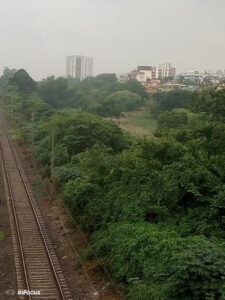
Soon within a few years, the change began to be felt by the people living in and around the area. “When I decided to go ahead with my guerrilla plantation, I first wrote to the Kolkata Port Trust (KoPT), seeking their permission, as this particular stretch of land belongs to them. I waited for their response, but when I didn’t get any, I began with my plan of restoring the green lungs of our area. Here I would like to add that when I began planting trees, KoPT didn’t raise any objection but it also never gave me any permission.”
However, his first stint was a major disappointment as most of the seed that he planted failed to bloom into saplings. Determined to resurrect the greenery, he researched the subject. “I realized that summer would be the best time to plant trees. So, in my second stint I hired some labours to help me meet my target and post-monsoon, I witnessed most of my planted seeds growing into beautiful saplings.”
In these 10 years, since he started realizing his vision, Hait has grown at least 2500 trees. However, there is a stark difference between the trees that he sows and the ones planted by the municipal corporation. “Most of those trees are either Asoka or Eucalyptus trees. Such trees only can give oxygen but are useless for birds and other animals. Hence, I make sure to plant fruit trees, this, in turn, has helped make the area congenial for various birds, animals and butterflies,” said Hait.
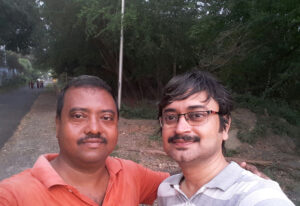
On an average, he shells out at least INR 10000 or more on an annual basis to purchase seeds or fruits which he distributes among the people of his locality, with the only catch to have the seeds returned to him so that they can be planted in the urban forest of Kolkata.
Taking a step forward, he has even set up two cottages in Sunderban area, with the sole intention of growing fruit trees. On being asked he will be getting some monetary gain from such plantations, he said, “Definitely not, these trees are a gift from me to the future generation and it’s the least that we can individually do to conserve the biodiversity.”
However, Hait was a little sad, with the recent act of KoPT mowing down around 200 trees in the urban forest that he has been taking care of for the past decade. “They just came and destroyed 200 trees. They can’t do this. With rapid urbanization, this stretch is like the lungs of our area. I even wrote to them but as usual no response. I am disappointed but now down. On July 14 we will be having a massive tree plantation programme in this stretch. We have requested people to join us in this campaign,” he said.
Given the goodwill that Hait has created in the past 10 years, a huge number of people are donating not just seeds but are also vouching to be part of the green Kolkata mission.

