Giridih: Nobody has the exact idea about the firecrackers’ worth that go boom in Delhi, and National Capital Region (NCR) during Diwali. It is also, here that the Supreme Court has banned the sale of firecrackers, to control pollution.
But, 1300 kilometers away from Delhi, in Giridih, a small town in Jharkhand, which doesn’t even have one-fourth of the national capital’s population, firecrackers being recovered by the district administration over the past 72 hours. The raid is still on.
However, being small town, here the major concern for the administration was not pollution but huge quantity of illegal crackers, which is being stocked in residential area.
“We have seized 787 big boxes of firecrackers from four different locations. Our search is still on. We are conducting these raids, as our major concern is the huge quantity of firecrackers being stocked in residential area,” Sub-divisional Magistrate Vijaya Jadhav told eNewsroom.
Firecrackers worth four crores has been shifted in through 15 tractors to different locations. Most of the firecrackers are either made in China, from Indian city Sivakasi or from Bengal state.
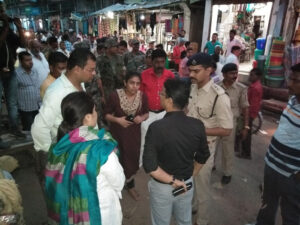
On Friday, when the search and seizure had begun on a tip off, which SDM Jadhav had got from her source, power had cut off for more than seven hours in the area surrounding the place where the firecrackers had been stocked up. And entire district administration including District Commissioner Uma Shankar Singh, Superintendent of Police Akhilesh Variar were seen supervising the raid, along with the SDM.
“We are really concerned. Such a huge stock in residential area can be lethal, so those trader stocking up firecrackers in their houses will be treated as accused. Two people have been arrested, but prime accuse Intikhab Alam, alias Putul is absconding,” informed Jadhav.
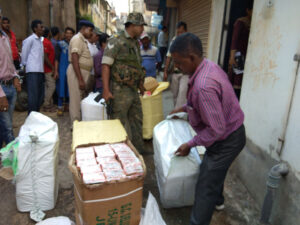
Administration has dispatched the recovered crackers to far away locations and issued fresh guidance for the firecracker sellers in the district.
On October 9, Supreme Court had banned the sale of firecrackers in Delhi-NCR. The order was given, on the basis of a petition filed by three toddlers, who had approached the court through their parents, claiming that firecrackers burst during Diwali, makes air poisonous the already polluted air of Delhi.
While in India, firecrackers are burst through out the year, on marriages, after cricket matches results, but its burst in massive quantity during Diwali festival. Cashing the occasion, large number of sellers do business without license and even stock in residential area, thereby, posing a threat to common man’s life.