



Kolkata: “Saturday and Sunday have become very dangerous days for civil rights activists in India,” stated Professor Apoorvanand, a well-known advocate of civil rights, at an event in Kolkata.
He emphasized that the role of the police is to protect the civil rights of every citizen of India, whether they are prisoners, tribals, or Maoists.
“We don’t need to agree with what Maoists do, but they too have civil rights. The meaning of the rule of law is that everyone is equal and their rights should be protected. When we say this, we are told that we are demoralizing the police,” said Apoorvanand through a video message.
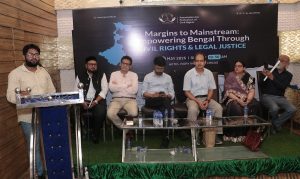
A Delhi University professor, Apoorvanand’s academic freedom was curtailed in April when he was barred from speaking in the United States by the Indian government. Speaking at the event titled- Margins to Mainstream: Empowering Bengal Through Civil Rights & Legal Justice., he said,
“If the civil rights of any section of society are violated, we should stand against it—even if it does not directly affect us.”
The conference was organized by the Bengal chapter of APCR (Association for Protection of Civil Rights).
He cited two examples: police actions under the guise of Naxal eradication in Bastar and the arrest of Ashoka University professor Ali Khan Mahmudabad.
Referring to the latter case, Apoorvanand began:
“There was nothing wrong with Ali Khan’s social media post. Considering what is happening with Muslims in ‘Hindu Nation’ India (as the professor pointed out, neither the RSS nor BJP hides its Hindu Rashtra intentions), people were surprised to see Colonel Sophia Qureshi along with Foreign Secretary Misri and Wing Commander Vyomika Singh. BJP and RSS do not want to see Muslims in public life in positions of equality. So, while many were surprised, some were even happy. But the Haryana Women’s Commission Chairperson, Ms. Bhatia, did not like the post. And just because it was written by a Muslim and disliked by a Hindu, it was enough to lodge a case—despite the fact that no law was violated.”
He continued,
“In our country, even a rape victim struggles to get her complaint converted into an FIR so quickly. Yet, in this case, an FIR was registered with unusual speed, and Ali Khan was arrested at 6 a.m.”
“It’s a case of ‘process as punishment’, a practice used by the government. Though the court granted relief, it is a form of freedom that comes with a leash—his passport and laptop have been seized,” added Apoorvanand.
Nadeem Khan, All India Convener of APCR, highlighted the organization’s efforts to protect civil rights and the challenges it faces in Bengal.
Well-known city-based social activist Chotan Das, and advocates Muslima Begum Molla and Tarique Quasimuddin also addressed the gathering.
Social activists Manzar Jameel, Azhar Salim, Sheikh Khurshid Alam, and Rafay Siddiqui served as the conveners of the event.

