



Kolkata: In a stirring lecture that linked Cold War-era organizing to present-day struggles against authoritarianism, Professor Elisabeth Armstrong of Smith College delivered a powerful message: to counter the growing crises of inequality and fear-driven politics, solidarity and grassroots resistance are more essential than ever.
Speaking at Jadavpur University, Armstrong opened with a potent critique of contemporary America under Donald Trump, drawing a direct line from the radical political struggles of the 1970s to the polarized climate of today.
At the heart of her talk was a compelling historical analysis of the Communist Party USA’s grassroots organizing from 1974 to 1982. Rallying under the slogan “People Before Profits,” these movements challenged systemic racism, unchecked corporate power, and the imperialist ambitions of the U.S. military-industrial complex. Armstrong highlighted how Cold War-era repression and virulent anti-communism served to isolate and demonize leftist movements—paralleling modern tactics of political suppression and spectacle-driven governance.
Crucially, Armstrong spotlighted the role of Roy Cohn, the infamous political fixer and mentor to Trump, whose legacy of fear, aggression, and denial has become a blueprint for today’s authoritarian playbook. She argued that this ethos—rooted in a culture of division and deregulation—has left working-class Americans grappling with rising costs, wage stagnation, and an eroding public sphere. “Basic necessities like eggs have surged in price by up to 400% since 2019,” she noted, “a symptom of a deeper crisis of economic precarity.”
Yet Armstrong’s lecture was far from a tale of despair. She urged a reawakening of collective political consciousness, asking, “What is it to change the political climate?” Drawing inspiration from the anti-Vietnam War protests and today’s pro-Palestine solidarity movements, she celebrated the resurgence of street-level activism—from labor union revivals to grassroots racial justice campaigns. “The streets,” she said, “are once again our democratic forums.”
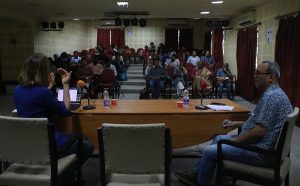
The lecture, titled “Lessons from Revolutionary Organizing in the Cold War US to Trump 2.0,” was hosted by Perspectives: A Researchers’ Network in collaboration with the Centre for Marxian Studies at Jadavpur University. It drew a vibrant audience of students, academics, and activists eager to connect past struggles to present-day resistance.
Armstrong closed with a call to action: building solidarity across fragmented movements is challenging, but it is the only path forward. In an age of fear and fragmentation, she reminded the audience, unity remains the most radical and necessary act.

