



When the deadly gas was spreading havoc in Bhopal on a cold winter night in December 1984, Arjun Singh was hundreds of miles away — praying.
Hours after the leaking methyl isocyanate gas had left a trail of death in the Madhya Pradesh capital, the state’s then chief minister had taken a flight to Allahabad [now Prayagraj], where he visited the chapel of his childhood school to pray for “moral courage”.
The startling revelation was made by Arjun Singh himself in his memoirs, “A Grain of Sand in the Hourglass of Time: An Autobiography, published posthumously by Hay House.
At the chapel, Arjun wrote, he prayed for victims of the gas tragedy and “gain moral courage to act personally in the face of monumental catastrophe”.
In his autobiography, the late Congress leader said he wanted to set the record straight on allegations of his “disappearance” in the wake of the enormous tragedy that unfolded on the intervening night of December 2 and 3, 1984.
“Late in the morning of December 3, 1984, I quietly took off from Bhopal in a plane and landed in Allahabad, about 550km away. I went to my old school, St. Mary Convent, where with the permission of the principal, I sat in the chapel to pray for the welfare of my people and gain moral courage,” Arjun wrote on page 175 in chapter 21 titled “The Bhopal Gas Tragedy.”
That night, angry protesters had raised the slogan in Bhopal, “Gas Nikli Adhi Raat, Arjun Bhaga Ratoon Raat”. Translated, it would read “gas leaked at midnight, Arjun ran away under the cover of darkness”.
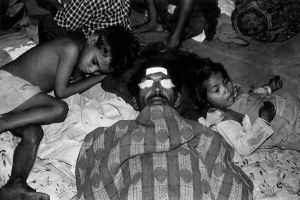
The chief minister was reportedly advised by the local administration to stay away from Bhopal after the lethal gas had leaked from the Union Carbide factory in one of the world’s worst industrial disasters.
In official records, it is said that over 3000 persons were killed on the intervening night of December 2-3, 1984 when over 40 tons of poisonous methyl isocyanate (MIC) leaked from the storage tanks of the Bhopal-based Union Carbide India Ltd (UCIL). But rights campaigners like late Abdul Jabbar used to insist that the killer gas killed more than 25,000 people leaving 5,50,000 others injured and disabled.
Arjun’s disappearance was raised before Rajiv Gandhi, too, when the then Prime Minister visited Bhopal on December 4. Rajiv had asked Arjun to clarify but the chief minister had suggested setting up a commission of inquiry to address all issues, including the allegation of his disappearance. A commission, under Justice N.K. Singh, was appointed but it was folded up within nine months even before it had made any progress.
Jabbar also questioned Arjun’s move to name the then Union home minister, P.V. Narasimha Rao, as responsible for Union Carbide CEO Warren Anderson being allowed to leave India after visiting Bhopal on December 7, days after the tragedy.
In his memoirs, Arjun claimed that when he broached the subject of Anderson’s arrest with Rajiv, the Prime Minister had kept mum.
However, on page 174 of his memoirs, Arjun has given a detailed account of his meeting with Rajiv on December 6, 1984, adding an element of mystery. “At one of the hospitals (in Bhopal) that we visited, Rajiv took me aside to brief me. It was something rather confidential, which, naturally, I could not have shared with anyone. Everyone later wanted to know what did he say? What was it all about? What were his instructions or his brief? Well even today I cannot reveal what he told me. It is a state secret that I shall carry to my grave.”
Arjun Singh died in March 2011.

