



Kolkata: It is no longer a secret that Gujarat—the land of Mahatma Gandhi, who gave the world the message of non-violence—has drifted far from the ideals of its own son of the soil. Today, the state is increasingly associated with blatant Islamophobia. This disturbing reality did not spare even the Independence Day celebrations inside a school. At Bhavnagar’s Kumbharwada School, during a play, hijab-wearing girls were portrayed as terrorists.
The act has drawn criticism from netizens for deepening prejudice against India’s largest minority community, who often find themselves at the receiving end of discrimination and hate. Yet, tellingly, there has been no news of any legal action against the school authorities so far.
Two Indias on Display: Demonisation in Gujarat, Innovation in Bengal
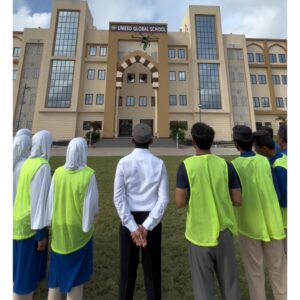
In stark contrast, while Bhavnagar’s school was maligning Muslim women on August 15, the hijab-wearing girls of Bengal’s Umeed Global School were writing a very different story of patriotism and innovation. On India’s 79th Independence Day, these students hoisted the Tricolour using a powerful hexacopter drone—an achievement that symbolized not just freedom, but also the spirit of possibility.
This was no ordinary drone. As the school’s statement highlighted, it was a 15-kg UAV (Unmanned Aerial Vehicle), the kind often used for operations such as agriculture and mapping, among others. The students themselves assembled the drone, programmed it, configured its flight system, and even built the payload along with the flag-hoisting and petal-shower mechanisms. The project involved a month of rigorous training under the guidance of a drone pilot and instructor.
When Classrooms Nurture Hope, Not Hate
“It was not a normal drone, but the kind used in industries for agriculture and mapping. It also took a month of training for the students to operate it,” said Wali Rahmani, the founder of Umeed Global School, speaking to eNewsroom.
The abaya-clad girls of Umeed Global School stand in stark contrast to the caricature painted in Gujarat’s classrooms. Their example reflects countless hijab-wearing women across India and the world who have reached the pinnacle of excellence in diverse fields.
The Forgotten Heroes and the Manufactured Villains
And if the Bhavnagar school wanted to depict a Muslim woman in its Independence Day play, it could have looked no further than Colonel Sofiya Qureshi of Vadodara, Gujarat itself. A decorated Army officer, Colonel Sofiya became a household name during the India-Pakistan war and later commanded India’s Operation Sindoor. Her patriotism and service to the nation embody the spirit of sacrifice and courage that Independence Day is meant to celebrate.
Yet, in a state where Islamophobia runs deep, a Muslim Colonel who led a historic Indian Army operation was not considered worthy of portrayal. Instead, imaginary Muslim women terrorists were staged.
This contrast—between prejudice in Gujarat and promise in Bengal—reveals the choices India faces today: whether to nurture hate-filled stereotypes or to celebrate the real, inspiring stories of its people.

