

Raipur: When Naina was a teenager, she became confused about whether to stand in the boys’ or the girls’ queue in school.
“When I tried to join the boys’ queue, they pushed me towards the girls’ queue. By then, the girls made a chain firmly holding each other’s waist, leaving no space for me to join,” Naina , 25, a trans woman explains.
Upset with continuous victimisation and seemingly permanently sandwiched between the two queues, Naina reached Raipur – capital of India’s central eastern state Chhattisgarh – in a pair of slippers.
“More than discrimination, abuse and all form of harassment, I believed I had nothing and wanted to go in search for something. I didn’t know what I was looking for but I knew I should reach somewhere where there is not one to judge me in my new circle,” she says.
No-one would have guessed she would be part of the first trans recruits to the state police.
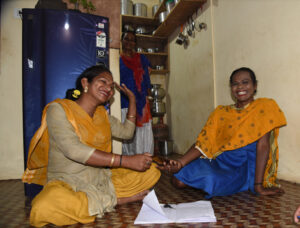
Still at this point presenting as male, she joined a large, closely-knit trans family headed by Nisha Yadav, in a two room flat within a slum house in the Bhatagaon locality. Here, in contrast to the regular discrimination and mocking of family members, friends and neighbours, they nurse each other through illness and provide mutual support through the difficult times.

Naina began begging at signal lights, trains, bus stands and parks. But she was troubled by fundamental questions. “Why did I leave? What is my identity? And, most basic of all, what is my individuality?”
In 2017, when the Chhattisgarh Government invited trans people to apply for the state police constable recruitment examination, Naina was one of the 97 trans women who applied.
She was supported by her adopted family who prepared her a special breakfast of soaked black chickpeas to send her off strongly, a contrast from begging for food. She set off, leaving her glittering saris and makeup for another day.
The obstacles before the trans community in India are daunting. According to the Indian Journal of Psychological Medicine, trans people experience bullying and rejection at even higher rates than their LGBQ counterparts.
“I have no doubt in my mind that my family loves me but there was a point in time when they didn’t want me to exist. The time when they disliked some part[s] of my body”, Dipsha, 29, one of the thirteen trans people selected, says.
“To avoid embarrassment and due to societal pressure, parents, brothers and sisters build pressure to remain indoors and avoid playgrounds. Games and [the] playground are the first things that gets snatched if you are a TG [transgender],” Krishi explains.
“So, when we were told to attend a physical session, we found our body unfit. Our muscles, nerves and bones were not responding the way it [they] should be,” she adds.
Behind the often sad stories – of exploitation, the sex trade and risky castrations – there are those who support their peers. One such advocate is Vidya Rajput, who is transgender, a social activist and a member of the Chhattisgarh Transgender Welfare Board, and wanted to be present at the police parade ground that morning.
“I made it a point to reach the ground before them. I wanted to send a message what may come in, we have to accept the competition, face the challenge and excel,” Rajput says.
But on the training ground, nothing about how Naina, Krishi and Dipsha had been raised mattered at all.
“The moment I saw them waiting for me, I decided those standing on the ground are going to win and my duty is to organise them,” says Sarita Yadav, head constable, Chhattisgarh Police [CG] and trainer.

Helping them to build the strength to clear the five physical levels – a 100 metre and an 800 metre run, long and high jumps and shot put throws – of the exam, Lokesh Kumar Verma, CG police constable and drill instructor, found them to be tough candidates. “I am touched with their sportsman spirit. They are sharp listeners, honest and obey orders. I think it’s the discipline that worked a lot in favour of them,” Verma says.
Alongside the fitness preparation, the social welfare department offered accommodation for the applicants and preparation for the written exam.
“We made special arrangements for them. All transgender candidates were brought under one roof. Here, we provided them with a career counsellor and others to make them progress in the written test. They are remarkable. The success rate is much higher than what we expected,” says P Dayanand , Director of the Social Welfare Department.
Nearby is Nukkad – The Teafe, a café-restaurant run by Priyank Patel, with several “specially-abled” staff. Patel explains that he has actively recruited people among the team who happen to be deaf, speech-impaired and trans as he rates their work highly. “In less time they learn more. They easily mix-up with other co-workers, basically the specially-abled persons, I found them to be the most suitable employees, fit for the hospitality industry,” Patel says.
There’s a conventional narrative that trans people could be part of the mainstream and take up the challenge for a new and happier beginning. In many cases, experts say, the situation is significantly more complicated.
“It’s not [as] simple as being found and restarting [their] own life for the transgender. There are several hidden hurdles. It takes a lot of time and patience and understanding,” Vidya says.
For Naina, gaining a place on the scheme is transforming her life.
“Seeing the queue no longer frightens me. In fact, soon I will be standing in a queue and that too with an official position”.
This story was produced by eNewsroom India. It was written as part of a media skills development programme run by the Thomson Reuters Foundation supported by the Swedish Postcode Foundation. The content is the sole responsibility of the author and the publisher.