



Delhi/Kolkata: The second wave of Covid-19 is now in India, and it is again forcing lockdowns in many parts of the country. Again migrants are out to return to their native places. When it had forced lockdown in the entire country in 2020, it had changed the lives of many people, from the suffering migrants to those who worked closely with them.
While the world hailed Bollywood actor Sonu Sood’s work during lockdown, many government officers and common people worked silently during the lockdown crisis last year.
Who worked on ground zero is Preeti Agrawal, a 2013 batch Indian Postal Service (IPoS) officer. Presently, Preeti is Under Secretary, Ministry of Communications, Government of India. Preeti is also Member Drafting Committee, IT Modernisation Project 2.0.
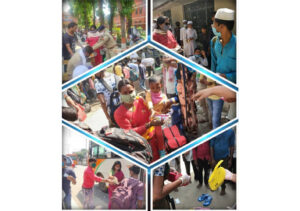
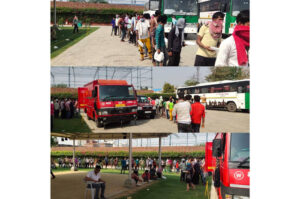
Preeti, not only worked for Bihar and Jharkhand migrants when they were going from Delhi during the lockdown, she also made and arranged food for them and distributed lakhs of masks among frontline workers. The situation of daily wagers in India had shocked her to the core.
The IPoS officer, who spent her entire savings, broke her fixed deposit (FD), further shares, “My team with the help of Gurudwara Saheb and vehicles of postal department distributed langars and provided food to thousands of migrants.”
During the lockdown providing masks to frontline workers was a bigger challenge. But coming from a merchant family, it helped Preeti. “Over the next 3 months (April-May-June 2020) my team produced and distributed 75,000 masks for free to frontline workers.”
“I realized that if daily wagers do not get a day’s wage, they would not have food to feed their kids. It was really troubling me. What we are doing as officers is just writing on files, but nothing much is reaching these needy people.”
Preeti who has closely worked among tribal women recalled, “I had a similar experience during my school days, when I was working among tribal people. And when I was working in Kolkata. If a thief steals their money, if it rains, they have nothing to eat and they sleep hungry at night.”
These experiences augmented Preeti’s zeal to understand the situation better so that workable solutions and policies can be implemented.
Preeti has a good academic background. She did MPhil in Sociology from Delhi School of Economics. “I want to study further and upgrade my skills in policymaking,” she said.
The public servant rued, “There is no policy which works for the informal section. So that became the background of my proposals.”
Wanting to do more for such daily wagers, especially for women, Preeti submitted her proposals for further studies in public policy programmes to the world’s top five universities including Harvard Kennedy School, University of Oxford and London School of Economics.
“I have received an admission offer letter from Harvard Kennedy School, USA for Mid Career MPA program/Mason Fellow along with a scholarship worth $73,641 which is the John F. Kennedy Fellowship & John K Galbraith Scholarship.”
She excitedly shared, “I am the only Indian civil servant to receive the scholarship this year.”
“I have also received offers from London School of Economics; University of Oxford; University of York from UK and Lee Kuantan Yew School of Public Policy, National University of Singapore, for Masters in Public Policy for the year 2021.”
Preeti has also appeared for the Interview of Chevening Scholarship this year, the results of which are expected in June 2021.
Preeti hails from Madhya Pradesh, her sister Garima Agrawal is an IAS officer.
Preeti had used her connections across civil services, school friends, Indian diaspora abroad, NGOs, connection in media and Bollywood to raise funds to the tune of 1.6 million rupees to support people during the pandemic.
The IPoS officer did not forget to mention that it was not her sole efforts, “I will always be grateful to the Secretary CPLO (Central Postal Ladies Organisation) and colleagues, seniors as well family members for extending full support for all activities during the lockdown and helped me to sail through the grilling process of getting admission into these colleges.”
“I want to return to India and work in the government sector, but I wish to work at a higher level, at policy making level, maybe at Niti Ayog,” she signs off.

