



Kolkata: On Saturday, Mursalim Sheikh had called up his wife and daughter from Kashmir, promising that he would be home soon, with all the promised fineries for Suhana, his daughter in her teens. Four days later his widow Saira Bibi, Suhana and his 5-year-old toddler are finding it difficult to believe that soon the dead body of Sheikh would be coming in from Kashmir to their Sagardigih residence in West Bengal’s Murshidabad district.
Sheikh, along with five other migrant labours, were dragged out of their accommodation and gunned down by militants in Katrasoo village of Kulgam district, Kashmir. All the six killed in this attack were migrant daily labours who used to work in the apple orchards and paddy fields. All those slain hailed from the same village – Bahalnagar, a remote village in Sagardigih, Murshidabad.
Hossain paused and said, “This time when he got the call from his employer in Kashmir, we were apprehensive. But we were constantly being told that things are normal in Kashmir. The employer too guaranteed security. But see what has happened? We have lost our sole bread earner for the family.” Hossain is in his mid-seventies.
Talking to eNewsroom, Anwar Hossain, father of Mursalim Sheikh said, “Every year my son used to go to Kashmir around this time to help the orchard owners and paddy field owners to harvest their apples and other crops. We have around 10 cottah of land, but that is barren. We are left with no option but to send our sons away to other states in search of a better livelihood.”
He paused and said, “This time when he got the call from his employer in Kashmir, we were apprehensive. But we were constantly being told that things are normal in Kashmir. The employer too guaranteed security. But see what has happened? We have lost our sole bread earner for the family.” Hossain is in his mid-seventies.
The story of the other five families, who have lost their beloved, is the same. “All those who have been killed in Kashmir are poor people, who often migrate to other states in search of work. Some go to Kerela, some to Rajasthan and some to Kashmir, simply based on the money and treatment they received while working in a particular place. Every year, around this time of the year, over 130 individuals go to Kashmir to work as helpers on fields and orchards. This time, however, only 10-12 went to Kashmir,” said Nur Salam Mondal, a resident of the same village.
eNewsroom contacted one such family, whose sole earning member Bakar Sheikh is stuck in Kashmir. “My father-in-law had contacted us yesterday. He was scared and wanted to be home soon. His tickets were booked for today. But following the attack, the tickets have been cancelled. We are scared about his security and are only hopeful that the West Bengal government will help the trapped migrant workers to come back to their state,” said Najibur Sheikh.
Mondal added, “The family of those killed in this terror attack is in a state of shock, as they all were supposed to board their train to Kolkata today. Almost half of the number of men who went for work is dead.” He further informed that since the attack took place, many had contacted him, seeking his help to return to their home.
eNewsroom contacted one such family, whose sole earning member Bakar Sheikh is stuck in Kashmir. “My father-in-law had contacted us yesterday. He was scared and wanted to be home soon. His tickets were booked for today. But following the attack, the tickets have been cancelled. We are scared about his security and are only hopeful that the West Bengal government will help the trapped migrant workers to come back to their state,” said Najibur Sheikh.
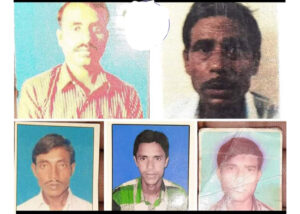
Meanwhile, the West Bengal government Chief Minister Mamata Banerjee has announced a compensation package for the families who have lost their loved ones in this dastardly attack and deputing Mayor Firhad Hakim to bring back the dead bodies to West Bengal as soon as possible.
“While the CM has announced a compensation of Rs 5 lakh for the families of those killed in this attack and a government job for the widows, if they are a graduate, I as the MP of Murshidabad, have also pledged by support to these families. I have visited their residences and am in constant touch with them. We will do our best for the aggrieved families. They are residents of my constituency and I will do my best to help them out,” said Trinamool Congress, MP Khalilur Rahman. Adding to it, Abu Taher Khan, MP from Murshidabad’s Naoda, said, “We are in touch with those migrant workers from Bengal stranded in Kashmir and are doing our best to safely bring them back.”
However, Samirul Islam, a social activist and president of Bangla Sanskriti Mancha, who has been actively involved in migrant worker issues said, “It is fine that compensation has been announced. But we believe that the amount should have been at least of INR 10 lakhs. Also, the government should make sure that at least one of the family members is given a job. The educational benchmark should be relaxed as the casualties are from rural Bengal where people are educationally backward.”
Kulgam terrorist attack on migrant workers from Bengal exposes how migrants are being targeted by terror outfits since Article 370 has been abrogated.
The six who have been gunned down by militants in Kashmir are– Naimuddin Sk, Murshakim Sk, Sadekul Sk, Rafikul Sk and Kamaruddin Sk. Johiruddin Sarkar, who was injured also succumbed to his injuries.

