Kolkata: Three days after India entered its first nationwide lockdown, on March 28, 2020, seven people gathered in Topsia, one of Kolkata’s densely populated Muslim-majority neighbourhoods. The city had fallen silent, livelihoods had vanished overnight, and hunger loomed large over thousands of families. That modest meeting had a simple but urgent aim: to support local residents with food and rations. By the end of their first sitting, they had collected Rs 7,500—an amount small in numbers, but immense in intent. Within days, rations were distributed among the poorest families.
Five years later, that first act of solidarity has evolved into the SR Foundation, a Kolkata-based non-governmental organisation whose journey reflects how grassroots compassion can grow into a sustained movement for social reform.
Kolkata Lockdown Relief Grows into SR Foundation’s Statewide Humanitarian Mission
When COVID-19 unleashed a humanitarian crisis through repeated lockdowns, the suffering extended far beyond illness. Hunger, joblessness and uncertainty hit marginalised communities the hardest. It was in this moment of collective despair that the group began its work under the name Food For Hunger.
“It was just the beginning. And within a few days, we realised our work was not enough. So we decided to scale up immediately. Thereafter, during three lockdowns, we collected funds and distributed rations, food and other essential items worth Rs 38 lakhs. Two people—Haji Neyaz and Haji Imtiyaz sahab—helped us immensely. At that time, we named our organisation Food For Hunger,” Athar Firdausi, a founding member, told eNewsroom.
As the lockdowns dragged on, the group’s responsibilities expanded.
Hunger relief alone could not address the deeper social wounds exposed by the pandemic. Recognising this, the members transformed Food For Hunger into SR (Socio-economic Reform) Foundation, formally registering it under the Trust Act. The organisation continues to operate from Topsia—remaining rooted in the community it first served.
Ghettos to Serving the State—and Beyond Borders
The emotional intensity of SR Foundation’s early work left a lasting impact on its members. “On at least three occasions, our team has experienced extreme situations in society,” one member recalled during the Foundation’s annual meet held on December 14 in Topsia.
“First, it was during lockdowns, when needy people started crying after receiving our rations and support, which led to the tears of our members as well. Then, during the devastating cyclones Amphan and Yash, people became desperate for food and plastic sheets, as they were living in extremely difficult conditions.”
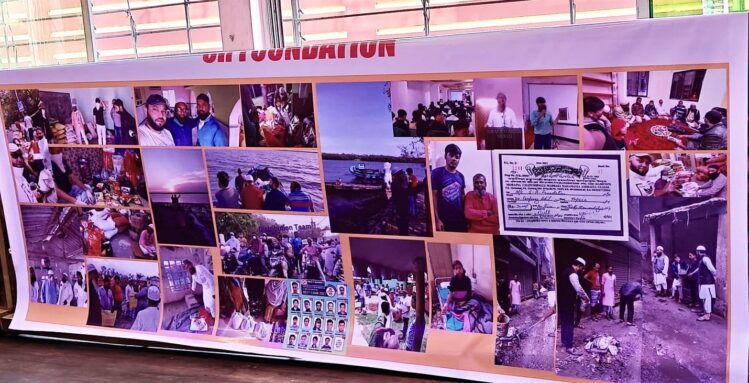
COVID Lockdown, Cyclones and SR Foundation’s Disaster Response
Natural disasters further tested the organisation’s resolve. During cyclones Amphan and Yash, SR Foundation volunteers worked in devastated neighbourhoods, distributing food, essentials and shelter materials. Over time, their work expanded well beyond Kolkata.
Speaking at the annual meet, Dr Sarfaraz Adil, another founding member, detailed the Foundation’s growing footprint. “Now, SR Foundation works in several parts of Kolkata and across Bengal as well. The Foundation has reached the Sundarban region multiple times—conducting medical camps, providing cyclone relief, and assisting in the repair of mosques damaged by storms and floods,” he said.
SR Foundation’s humanitarian work has also crossed state boundaries. During the devastating floods in Punjab, the organisation collected Rs 5.30 lakhs for flood victims. Seven members of the Foundation personally travelled to Punjab to hand over the entire amount to the affected Sikh community.
Importantly, all travel and logistical expenses were borne by the members themselves, ensuring that the entire donation reached flood survivors without any deductions. Not a single rupee of public donation was spent on travel or accommodation. The initiative was widely appreciated as an example of ethical, transparent and inter-community solidarity.
Beyond Relief: Legal Aid, Livelihoods and Community Work
Beyond disaster response, SR Foundation has steadily addressed long-standing structural inequalities. Through its legal aid initiatives, the organisation has helped innocent and poor prisoners secure release from jail. “At least 20 prisoners were helped secure release from jail. This also includes the acquittal of a 16-year-old from a juvenile court,” informed advocate Babul.
The Foundation has also provided financial assistance to underprivileged individuals to establish small shops and livelihood ventures. Medical support through health camps, inter-religious dialogues to promote communal harmony, and spiritual workshops aimed at strengthening community resilience have become integral to its work.
The Foundation today functions around ten core visions: creating a hunger-free society; providing quality education; ensuring health for all; supporting youth employment; offering financial assistance; delivering legal aid; conducting social awareness programmes; organising spiritual workshops; resettling vulnerable populations; and promoting inter-religious dialogue.
Mohammad Shahnawaz, founding member and treasurer, presented a detailed overview of the organisation’s work during 2024 and 2025. “In 2024, we conducted one or another programme almost every month. However, in 2025, because of our work on major issues—such as creating awareness about the boycott of Zionist products, which has continued for two years, as well as the UCC and the Waqf Amendment Act—we could not undertake many smaller programmes. Even so, we made important and necessary interventions in society and among community members,” he said.
SR Foundation’s Future Plans in Health, Housing and Youth Work
From its modest beginnings in a ghetto to its expanding vision for society at large, SR Foundation now looks to the future with clarity and ambition. “We will reach out to young boys and girls to clear misconceptions about community-related issues,” Dr Adil said. “We also aim to help arrange marriages of eligible boys and girls, making them simple, affordable and dowry-free.”
On healthcare, the Foundation also plans to work with Janata Charitable Hospital in Topsia to strengthen access to affordable medical services for local residents. Alongside this, the organisation is exploring plans to develop a residential complex on the outskirts of Kolkata to provide dignified and affordable living conditions.
For thousands affected by hunger, disaster and neglect, SR Foundation became proof that help could arrive without conditions.
From a modest collection of less than Rs 10,000 during a moment of fear to multi-state humanitarian interventions rooted in ethical practice, SR Foundation’s journey stands as a reminder that meaningful change often begins in the most marginalised spaces—and, when guided by conscience, can aspire to serve not just a neighbourhood or a state, but humanity itself.